
Module 1 Analytic Hierarchy Process Prepared by Lee

Module 1 Analytic Hierarchy Process Prepared by Lee Revere and John Large To accompany Quantitative Analysis for Management, 9 e by Render/Stair/Hanna M 1 -1 1
Learning Objectives Students will be able to: 1. Use the multifactor evaluation process in making decisions that involve a number of factors, where importance weights can be assigned. 2. Understand the use of the analytic hierarchy process in decision making. 3. Contrast multifactor evaluation with the analytic hierarchy process. To accompany Quantitative Analysis for Management, 9 e by Render/Stair/Hanna M 1 -2 2

Module Outline M 1. 1 Introduction M 1. 2 Multifactor Evaluation Process M 1. 3 Analytic Hierarchy Process M 1. 4 Comparison of MFEP and AHP To accompany Quantitative Analysis for Management, 9 e by Render/Stair/Hanna M 1 -3 3
Introduction § Multifactor decision making involves individuals subjectively and intuitively considering various factors prior to making a decision. § Multifactor evaluation process (MFEP) is a quantitative approach that gives weights to each alternative. § Analytic hierarchy process (AHP) is an approach designed to quantify the preferences for various factors and alternatives. To accompany Quantitative Analysis for Management, 9 e by Render/Stair/Hanna M 1 -4 4

Multifactor Evaluation Process Steve Markel is considering employment with three companies. He has determined three factors that are important to him and assigned each factor a weight. Factor Importance (weight) AA EDS, Co. LTD. PW, Inc. Salary 0. 3 0. 7 0. 8 0. 9 Career Advancement Location 0. 6 0. 9 0. 7 0. 6 0. 1 0. 6 0. 8 0. 9 Weights should sum to 1 To accompany Quantitative Analysis for Management, 9 e by Render/Stair/Hanna M 1 -5 5
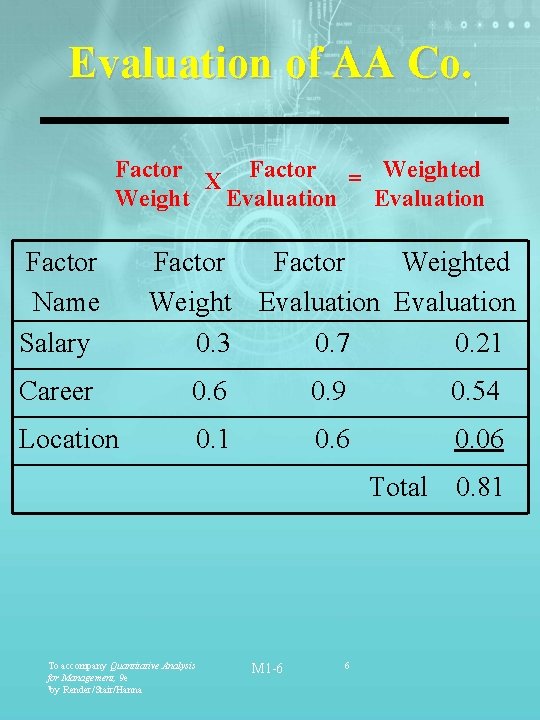
Evaluation of AA Co. Factor X Factor = Weighted Weight Evaluation Factor Name Salary Factor Weight 0. 3 Factor Weighted Evaluation 0. 7 0. 21 Career 0. 6 0. 9 0. 54 Location 0. 1 0. 6 0. 06 Total 0. 81 To accompany Quantitative Analysis for Management, 9 e by Render/Stair/Hanna M 1 -6 6
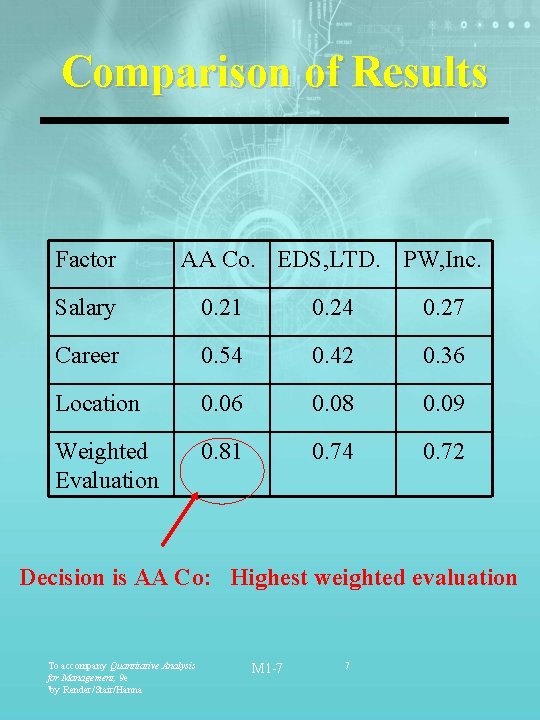
Comparison of Results Factor AA Co. EDS, LTD. PW, Inc. Salary 0. 21 0. 24 0. 27 Career 0. 54 0. 42 0. 36 Location 0. 06 0. 08 0. 09 Weighted Evaluation 0. 81 0. 74 0. 72 Decision is AA Co: Highest weighted evaluation To accompany Quantitative Analysis for Management, 9 e by Render/Stair/Hanna M 1 -7 7
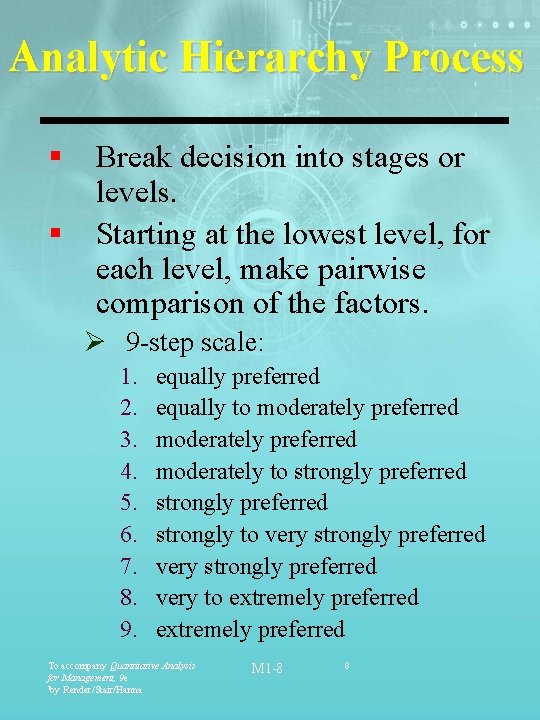
Analytic Hierarchy Process § § Break decision into stages or levels. Starting at the lowest level, for each level, make pairwise comparison of the factors. Ø 9 -step scale: 1. 2. 3. 4. 5. 6. 7. 8. 9. equally preferred equally to moderately preferred moderately to strongly preferred strongly to very strongly preferred very to extremely preferred To accompany Quantitative Analysis for Management, 9 e by Render/Stair/Hanna M 1 -8 8
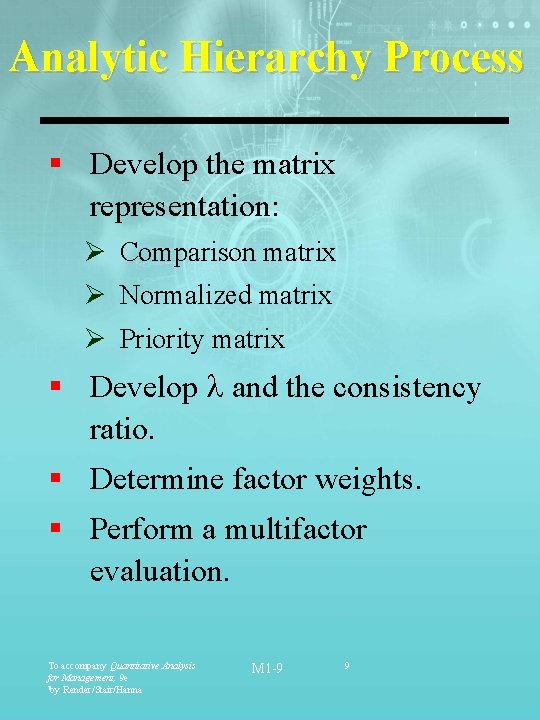
Analytic Hierarchy Process § Develop the matrix representation: Ø Comparison matrix Ø Normalized matrix Ø Priority matrix § Develop and the consistency ratio. § Determine factor weights. § Perform a multifactor evaluation. To accompany Quantitative Analysis for Management, 9 e by Render/Stair/Hanna M 1 -9 9
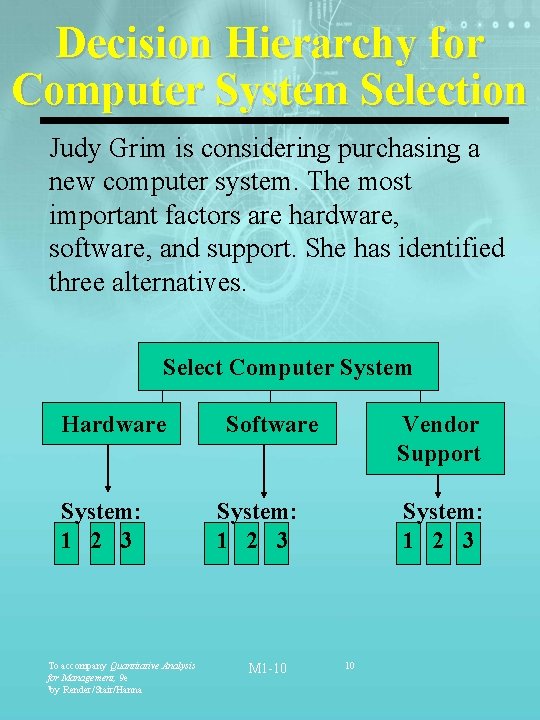
Decision Hierarchy for Computer System Selection Judy Grim is considering purchasing a new computer system. The most important factors are hardware, software, and support. She has identified three alternatives. Select Computer System Hardware System: 1 2 3 To accompany Quantitative Analysis for Management, 9 e by Render/Stair/Hanna Software Vendor Support System: 1 2 3 M 1 -10 System: 1 2 3 10
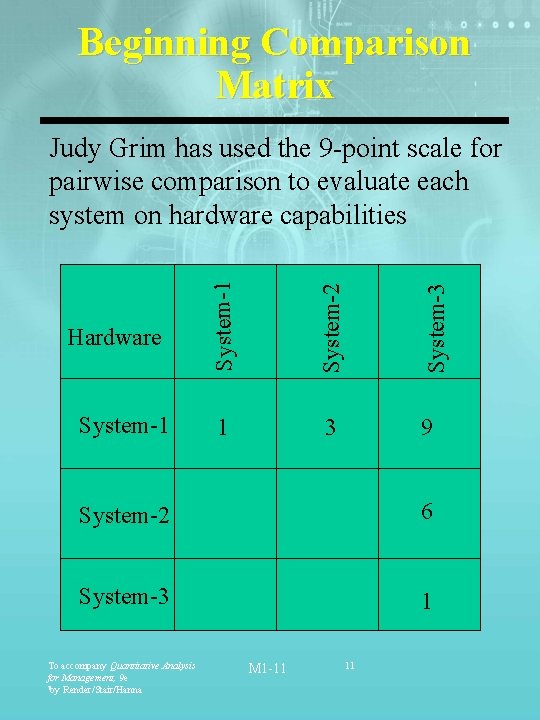
Beginning Comparison Matrix System-1 1 3 System-2 Hardware System-1 Judy Grim has used the 9 -point scale for pairwise comparison to evaluate each system on hardware capabilities 9 System-2 6 System-3 1 To accompany Quantitative Analysis for Management, 9 e by Render/Stair/Hanna M 1 -11 11
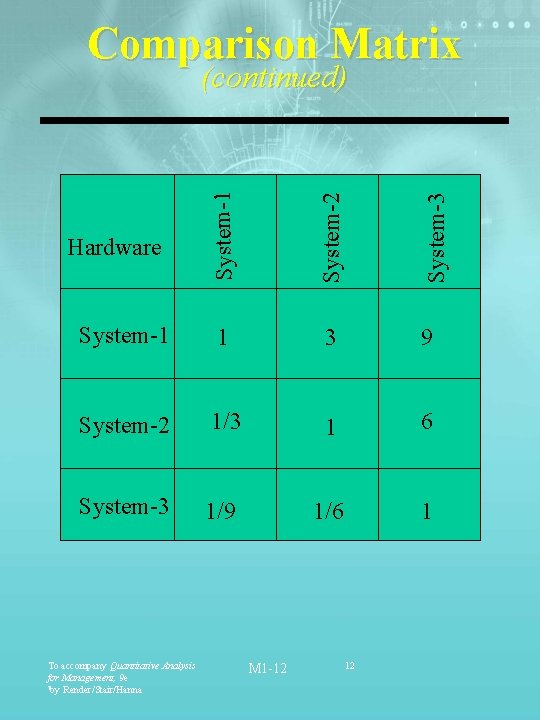
Comparison Matrix System-2 System-1 1 3 9 System-2 1/3 1 6 System-3 1/9 1/6 1 Hardware To accompany Quantitative Analysis for Management, 9 e by Render/Stair/Hanna M 1 -12 System-3 System-1 (continued) 12
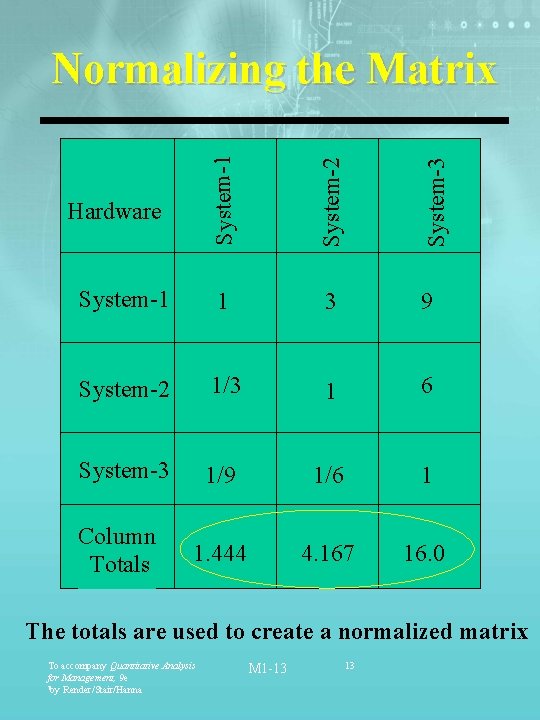
System-2 System-1 1 3 9 System-2 1/3 1 6 System-3 1/9 1/6 1 1. 444 4. 167 16. 0 Hardware Column Totals System-3 System-1 Normalizing the Matrix The totals are used to create a normalized matrix To accompany Quantitative Analysis for Management, 9 e by Render/Stair/Hanna M 1 -13 13
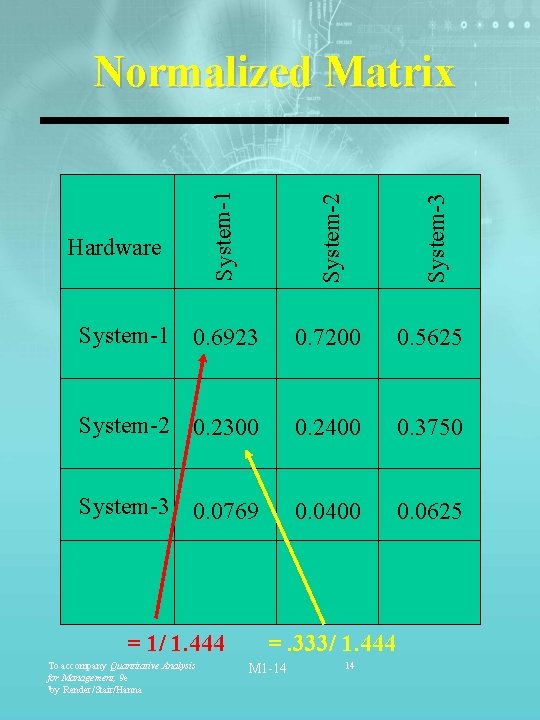
System-2 System-3 System-1 Normalized Matrix System-1 0. 6923 0. 7200 0. 5625 System-2 0. 2300 0. 2400 0. 3750 System-3 0. 0769 0. 0400 0. 0625 = 1/ 1. 444 =. 333/ 1. 444 Hardware To accompany Quantitative Analysis for Management, 9 e by Render/Stair/Hanna M 1 -14 14
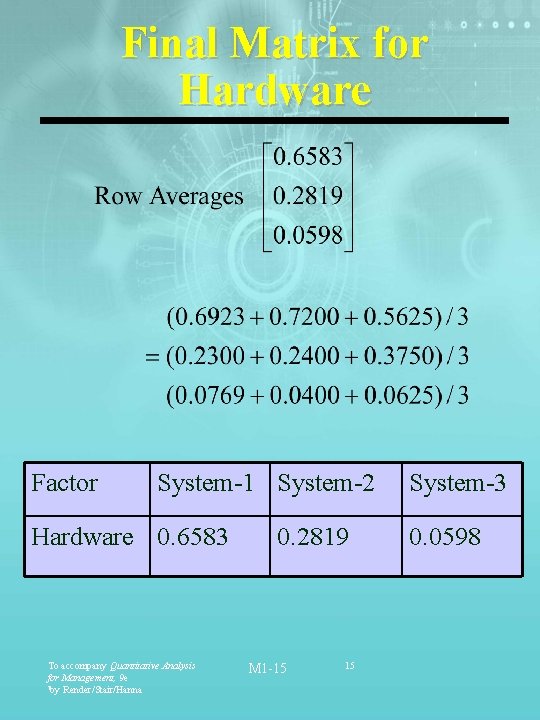
Final Matrix for Hardware Factor System-1 System-2 Hardware 0. 6583 To accompany Quantitative Analysis for Management, 9 e by Render/Stair/Hanna 0. 2819 M 1 -15 15 System-3 0. 0598
![The Weighted Sum Vector F = [ 0. 6583 0. 2819 0. 0598] 1](http://slidetodoc.com/presentation_image_h2/9fe112242591ca13d6a40ed50600df61/image-16.jpg "The Weighted Sum Vector F = [ 0. 6583 0. 2819 0. 0598] 1")
The Weighted Sum Vector F = [ 0. 6583 0. 2819 0. 0598] 1 0. 33 0. 11 3 9 1 6 0. 167 1 (0. 6583)(1) + (0. 2819)(3) +(0. 0598)(9) = 2. 0423 0. 6583)(0. 33) + (0. 2819)(1) + (0. 0598)(6) = 0. 8602 (0. 6583)(0. 167) + (0. 2819)(0. 167) + (0. 0598)(1) = 0. 1799 To accompany Quantitative Analysis for Management, 9 e by Render/Stair/Hanna M 1 -16 16
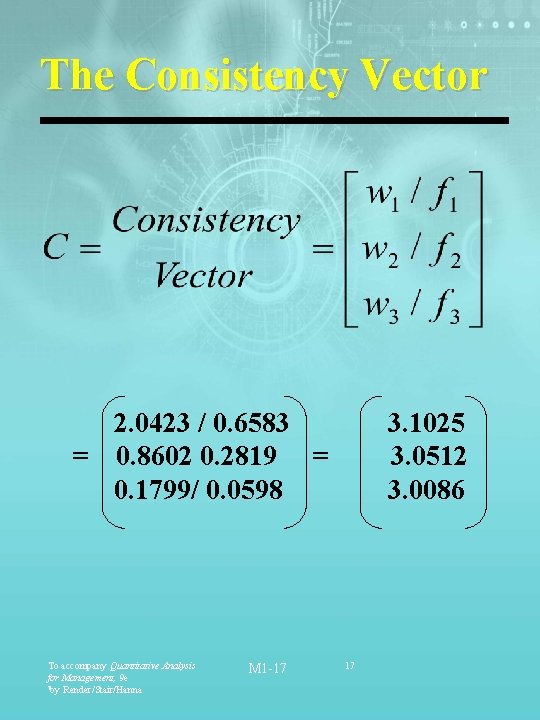
The Consistency Vector 2. 0423 / 0. 6583 = 0. 8602 0. 2819 = 0. 1799/ 0. 0598 To accompany Quantitative Analysis for Management, 9 e by Render/Stair/Hanna M 1 -17 3. 1025 3. 0512 3. 0086 17
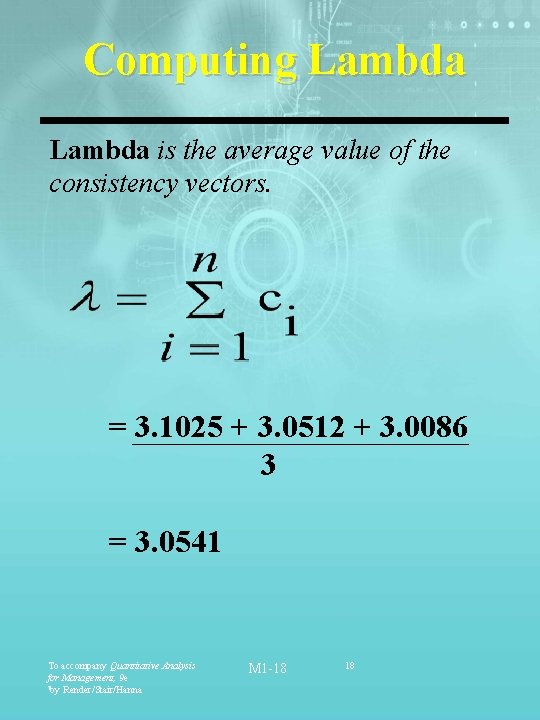
Computing Lambda is the average value of the consistency vectors. = 3. 1025 + 3. 0512 + 3. 0086 3 = 3. 0541 To accompany Quantitative Analysis for Management, 9 e by Render/Stair/Hanna M 1 -18 18
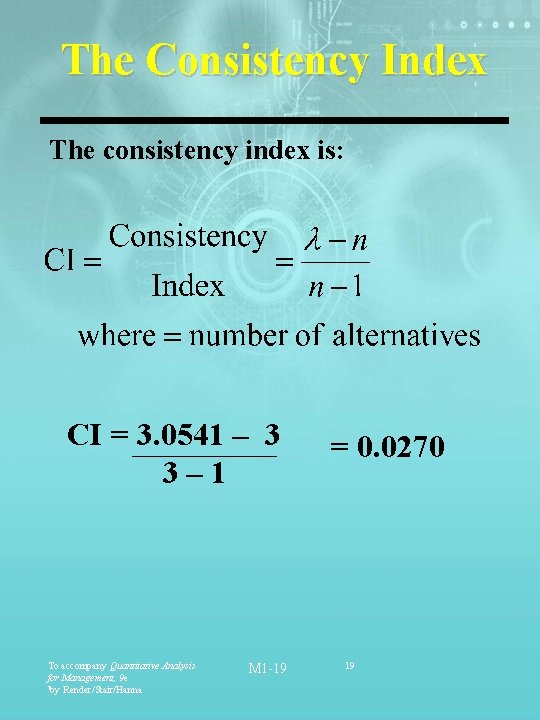
The Consistency Index The consistency index is: CI = 3. 0541 – 3 3– 1 To accompany Quantitative Analysis for Management, 9 e by Render/Stair/Hanna M 1 -19 = 0. 0270 19
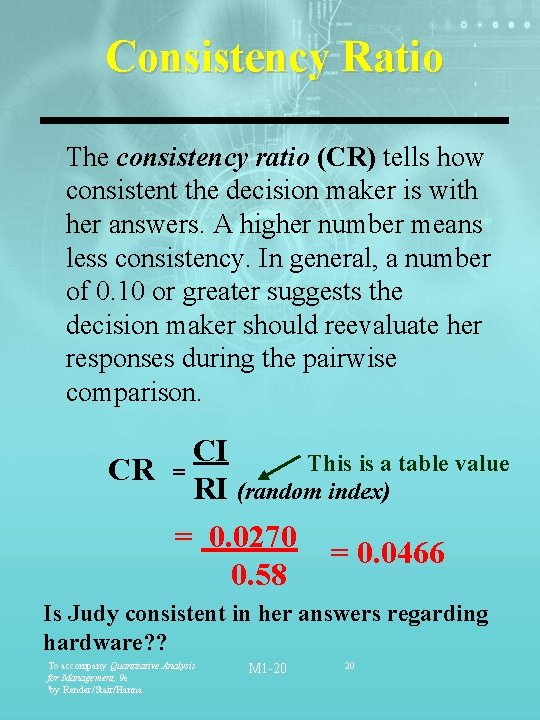
Consistency Ratio The consistency ratio (CR) tells how consistent the decision maker is with her answers. A higher number means less consistency. In general, a number of 0. 10 or greater suggests the decision maker should reevaluate her responses during the pairwise comparison. CI This is a table value CR = RI (random index) = 0. 0270 = 0. 0466 0. 58 Is Judy consistent in her answers regarding hardware? ? To accompany Quantitative Analysis for Management, 9 e by Render/Stair/Hanna M 1 -20 20
Achieving a Final Ranking § We must now perform a second pairwise comparison regarding the relative importance of each of the remaining two factors. § For simplicity, computation of the software and vendor support factor evaluations are left to you. To accompany Quantitative Analysis for Management, 9 e by Render/Stair/Hanna M 1 -21 21
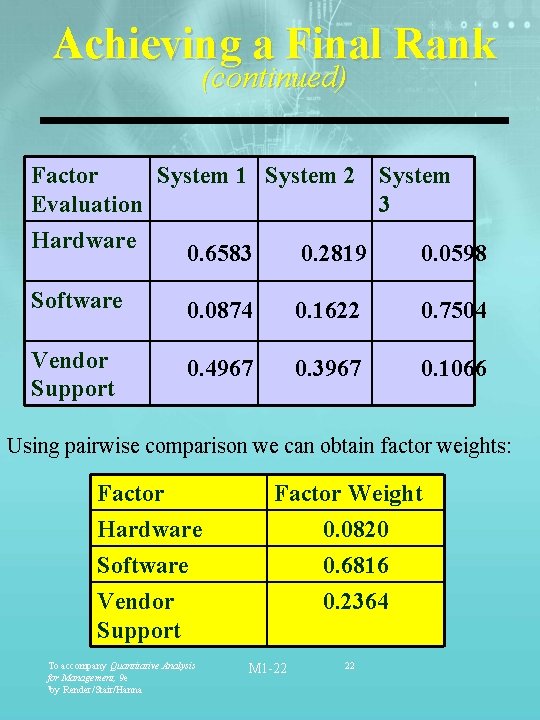
Achieving a Final Rank (continued) Factor System 1 System 2 System Evaluation 3 Hardware 0. 6583 0. 2819 0. 0598 Software 0. 0874 0. 1622 0. 7504 Vendor Support 0. 4967 0. 3967 0. 1066 Using pairwise comparison we can obtain factor weights: Factor Hardware Software Vendor Support To accompany Quantitative Analysis for Management, 9 e by Render/Stair/Hanna Factor Weight 0. 0820 0. 6816 0. 2364 M 1 -22 22
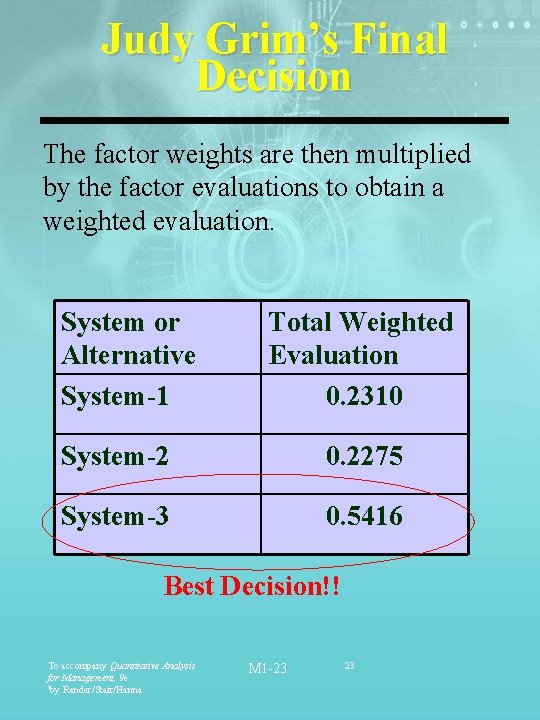
Judy Grim’s Final Decision The factor weights are then multiplied by the factor evaluations to obtain a weighted evaluation. System or Alternative System-1 Total Weighted Evaluation 0. 2310 System-2 0. 2275 System-3 0. 5416 Best Decision!! To accompany Quantitative Analysis for Management, 9 e by Render/Stair/Hanna M 1 -23 23
- Slides: 23