
MODULE 1 2 3 4 5 6 7
- Slides: 44
MODULE 1 2 3 4 5 6 7 8 9 10 11 12 13 14 15 16 Management of Common Medical Conditions Observed During Middle and Late Stages of Dementia MODULE 7 U. S. Department of Health and Human Services Health Resources and Services Administration November 2018 The U. S. Department of Health and Human Services, Health Resources and Services Administration developed this module under a contract. Some of the views expressed in this presentation module are solely the opinions of the author(s) and do not necessarily reflect the official policies of the U. S. Department of Health and Human Services or the Health Resources and Services Administration, nor does mention of the department or agency names imply endorsement by the U. S. Government.
MODULE 1 2 3 4 5 6 7 8 9 10 11 12 13 14 15 16 Copyright Language • We purchased the images for Modules 1 -12 from i. Stock by Getty. • We accessed the images for Modules 13 -16 using Google Find Free-to-Use Images. 2
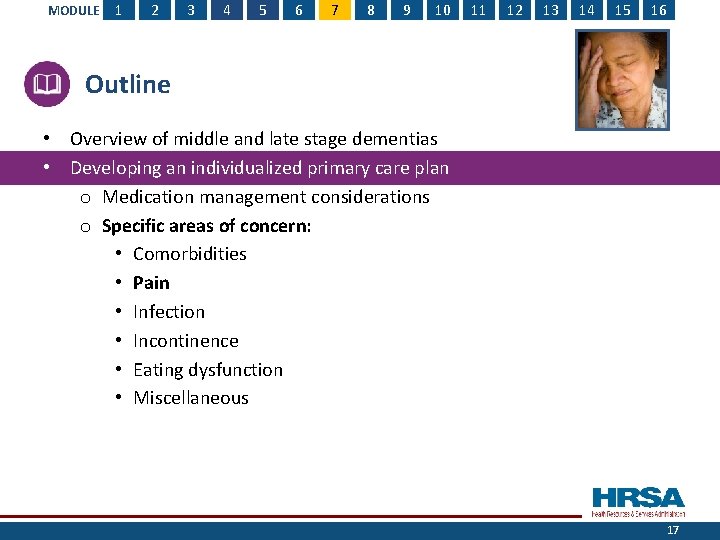
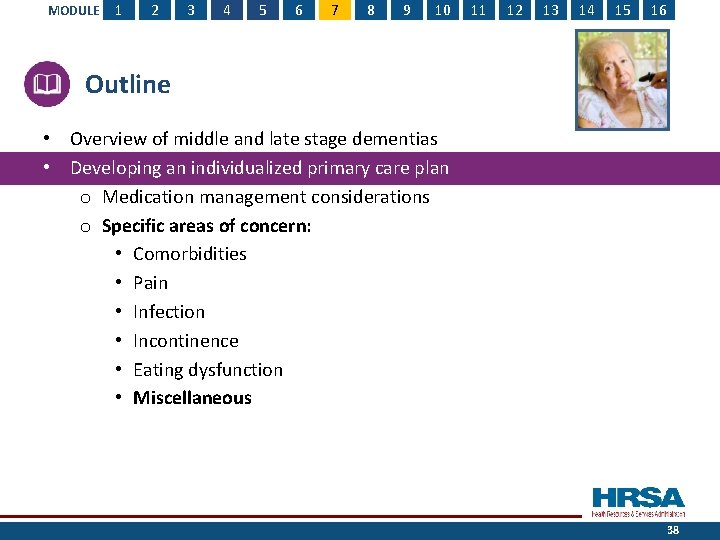
MODULE 1 2 3 4 5 6 7 8 9 10 11 12 13 14 15 16 Outline • Overview of middle and late stage dementias • Developing an individualized primary care plan o Medication management considerations o Specific areas of concern: • Comorbidities • Pain • Infection • Incontinence • Eating dysfunction • Miscellaneous 3
MODULE 1 2 3 4 5 6 7 8 9 10 11 12 13 14 15 16 Learning Objectives After reviewing this module, the learner will be able to: • Identify common components of an individualized primary care plan for persons with middle stage dementia. • Identify 3 common components of an individualized primary care plan for persons with late stage dementia. • List 3 common medical issues related to middle stage dementia. • List 3 common medical issues related to late stage dementia. • Discuss evaluation and management of incontinence in persons living with middle stage dementia. • Discuss evaluation and management of incontinence in persons living with late stage dementia. • Identify manifestations of pain in persons living with middle stage dementia. • Identify manifestations of pain in persons living with late stage dementia. 4
MODULE 1 2 3 4 5 6 7 8 9 10 11 12 13 14 15 16 Key Take-Home Messages • The more advanced the stage of dementia, the greater the number of comorbid conditions likely to be present. • Worsening of comorbid diseases and conditions such as pain, infection, incontinence, and eating dysfunctions can occur with dementia. • Incontinence is often a primary cause of moving PLw. D to institutional care. 5
MODULE 1 2 3 4 5 6 7 8 9 10 11 12 13 14 15 16 Outline 2 • Overview of middle and late stage dementias • Developing an individualized primary care plan o Medication management considerations o Specific areas of concern: • Comorbidities • Pain • Infection • Incontinence • Eating dysfunction • Miscellaneous 6
MODULE 1 2 3 4 5 6 7 8 9 10 11 12 13 14 15 16 Overview of Middle Stage Dementias • The rate of progression varies with the individual and type of dementia (NINDS, 2013). o There is no clear means of determining when a person transitions out of early-stage. • Cognitive and activities of daily living (ADL) abilities often gradually deteriorate (NINDS, 2013). • The identifications of manifestations suggest the need for referral to specialists (Darrow, 2015). 7
MODULE 1 2 3 4 5 6 7 8 9 10 11 12 13 14 15 16 Overview of Late Stage Dementias • Progressive deterioration necessitates full-time, around-the-clock assistance with daily personal care (Mitchell, 2015). • Manifestations include: o Profound cognitive impairments o Significant changes in physical abilities o Minimal verbal abilities o Escalating behavioral changes o Medical complications (Arcand, 2015 a, 2015 b) 8
MODULE 1 2 3 4 5 6 7 8 9 10 11 12 13 14 15 16 Outline 3 • Overview of middle and late stage dementias • Developing an individualized primary care plan o Medication management considerations o Specific areas of concern: • Comorbidities • Pain • Infection • Incontinence • Eating dysfunction • Miscellaneous 9
MODULE 1 2 3 4 5 6 7 8 9 10 11 12 13 14 15 16 Developing an Individualized Primary Care Plan • • • Need for continual assessment of patient status and medical needs Address all co-morbidities Medication management Specific medical considerations Assessment of care partner health and status 10
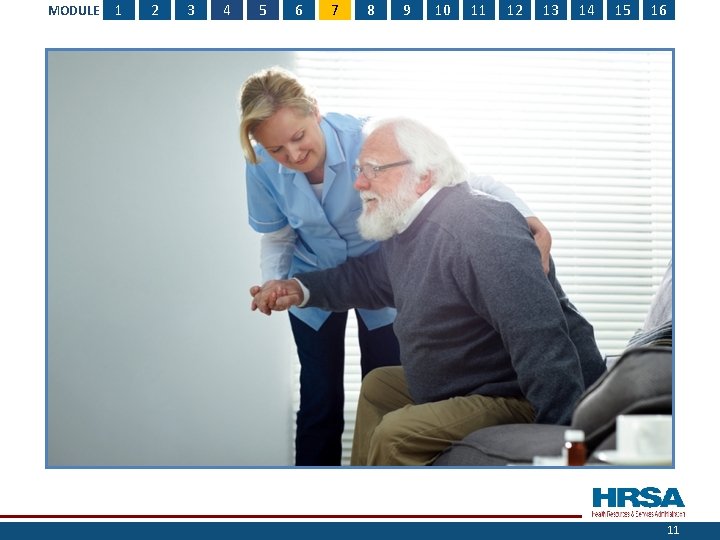
MODULE 1 2 3 4 5 6 7 8 9 10 11 12 13 14 15 16 Photo - Nurse helping senior man 11
MODULE 1 2 3 4 5 6 7 8 9 10 11 12 13 14 15 16 Outline 4 • Overview of middle and late stage dementias • Developing an individualized primary care plan o Medication management considerations o Specific areas of concern: • Comorbidities • Pain • Infection • Incontinence • Eating dysfunction • Miscellaneous 12
MODULE 1 2 3 4 5 6 7 8 9 10 11 12 13 14 15 16 Medication Management • Primary care providers (PCPs) need to consistently evaluate the benefits and risks of all medications being taken by PLw. D (Smith et al. , 2014; Beer’s criteria, 2012): o Are medications providing benefit? o Are medications being taken correctly? o Are there any adverse effects? o Are there recommendations regarding medications? • All clinicians should reference the 2015 updated Beer’s Criteria for potentially inappropriate medications for older persons. 13
MODULE 1 2 3 4 5 6 7 8 9 10 11 12 13 14 15 16 Outline 5 • Overview of middle and late stage dementias • Developing an individualized primary care plan o Medication management considerations o Specific areas of concern: • Comorbidities • Pain • Infection • Incontinence • Eating dysfunction • Miscellaneous 14
MODULE 1 2 3 4 5 6 7 8 9 10 11 12 13 14 15 16 Comorbidities: Overview and Prevalence • There is a high rate of multiple comorbidities in PLw. D (Vassilaki et al. , 2015). • There is need for comprehensive assessment of comorbid conditions (Fox et al. , 2014). • Multiple comorbidities compromise health status (Martin-Garcia et al. , 2013). • There is evidence of fewer comorbidities in early-onset versus late-onset dementia (Gerritsen et al. , 2016). • Multiple comorbidities increase risk of dementia (Vassilaki et al. , 2015). • Multiple comorbidities increase the consequences of dementia (Bunn et al. , 2014; Fox et al. , 2014; Slaughter et al. , 2012). • Persons living with dementia and intellectual disability generally may have both comorbidities that emanated in early live and appeared in association with progressive dementia (Mc. Carron et al. , 2018). 15
MODULE 1 2 3 4 5 6 7 8 9 10 11 12 13 14 15 16 Most Common Comorbidities Identified in Dementia Among the most common comorbidities identified in PLw. D are (Bauer, et al. , 2014; Duthie, et al. , 2011; Gurgu et al. , 2014; Kurrle, et al. , 2012; Poblador. Plou et al. , 2014; Smith et al. , 2014): • Cardiovascular disease • Diabetes • Hypertension • Parkinson’s disease • Other neurologic disorders 16
MODULE 1 2 3 4 5 6 7 8 9 10 11 12 13 14 15 16 Outline 6 • Overview of middle and late stage dementias • Developing an individualized primary care plan o Medication management considerations o Specific areas of concern: • Comorbidities • Pain • Infection • Incontinence • Eating dysfunction • Miscellaneous 17
MODULE 1 2 3 4 5 6 7 8 9 10 11 12 13 14 15 16 Pain in Dementia: Prevalence • Pain is prevalent in aging persons and in persons living with dementia (Achterberg et al. , 2013). • Nearly two-thirds of PLw. D have bothersome pain, and more than 40% have activity-limiting pain (Hunt et al. , 2015). • There is a lower rate of analgesic use in PLw. D (Hunt et al. , 2015). 18
MODULE 1 2 3 4 5 6 7 8 9 10 11 12 13 14 15 16 Pathophysiology of Pain in Dementia • There are many common causes of pain that may or may not be related to dementia (Corbett et al. , 2012; Lobbezoo et al. , 2011; Siniscalchi et al. , 2012). • Dementia alters processing of pain (Beach et al. , 2015; Husebo et al. , 2008; Kunz et al. , 2015). 19
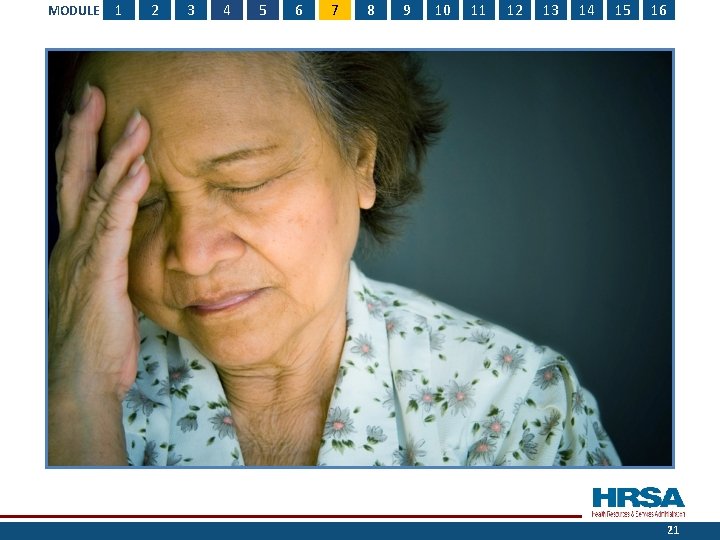
MODULE 1 2 3 4 5 6 7 8 9 10 11 12 13 14 15 16 Manifestations of Pain in Persons Living With Dementia • Pain is a primary cause of BPSD in PLw. D (Achterberg et al. , 2013; Flo et al. , 2014). • Evaluate for pain if sudden change in behavior (Inelmen et al. , 2012) • American Geriatrics Society (AGS) identifies these 6 common manifestations of pain: o Facial expressions o Verbalizations/vocalizations o Body movements o Changes in interpersonal interactions o Changes in patterns or routines o Mental status changes (AGS, 2002) 20
MODULE 1 2 3 4 5 6 7 8 9 10 11 12 13 14 15 16 21
MODULE 1 2 3 4 5 6 7 8 9 10 11 12 13 14 15 16 Challenges in Assessing Pain in Persons Living With Dementia • Difficult to assess pain in persons with moderate to severe dementia (Flo et al. , 2014; Lichtner et al. , 2014; Malara et al. , 2016) o PLw. D may not be aware of or capable of communicating presence, location, severity of pain. o Pain is often underdetected and undertreated. • Pain assessment strategies (Gregory, 2015; Lichtner et al. , 2014; Lichtner et al. , 2015; Malara et al, 2016; Neville & Ostini, 2014) o Self-report, proxy reports, clinical observations • Benefits, disadvantages with each approach o Pain assessment scales/tools: underused, may lack reliability and sensitivity in PLw. D (Achterberg et al. , 2013; Lichtner et al. , 2014; Malara et al. , 2015; Neville & Ostini, 2014) o Available guidelines: older and possibly not applicable for this population (Cruccu et al. , 2010) 22
MODULE 1 2 3 4 5 6 7 8 9 10 11 12 13 14 15 16 Pain Management in Persons Living with Dementia: Nonpharmacologic Options • There are substantial consequences to untreated pain in PLw. D (Malara et al. , 2016). • Clinicians should routinely monitor PLw. D for potential causes of pain. • Clinicians should routinely assess for pain. • Nonpharmacologic management is preferred; it may also reduce behavioral manifestations (Achterberg et al. , 2013). • PLw. D have greater sensitivity to pain (Beach et al. , 2015; Kunz et al. , 2014) but less access to pain relief (Regan et al. , 2015). • When medications are necessary they should not be given pro re nata (PRN) (Achterberg et al. , 2013), but rather, should be taken as prescribed. 23
MODULE 1 2 3 4 5 6 7 8 9 10 11 12 13 14 15 16 Outline 7 • Overview of middle and late stage dementias • Developing an individualized primary care plan o Medication management considerations o Specific areas of concern: • Comorbidities • Pain • Infection • Incontinence • Eating dysfunction • Miscellaneous 24
MODULE 1 2 3 4 5 6 7 8 9 10 11 12 13 14 15 16 Infections • PLw. D have increasing vulnerability to infections—especially respiratory and urinary tract, particularly in late stage dementia (Dufour et al. , 2015; Foley et al. , 2015). • PLw. D are most likely to die of pneumonia, although type of dementia influences mortality (Foley et al. , 2015; Higashijima, 2014; Manabe et al. , 2015). • There are questions regarding value of treating infections in advanced dementia with antimicrobials (Dufour et al. , 2013; van der Steen et al. , 2012)—potential to increase risk of multi-drug resistant organisms in persons living in care facilities (Mitchell et al. , 2014). • There are questions regarding benefit of vaccinating against respiratory infections (Ridda et al. , 2014). 25
MODULE 1 2 3 4 5 6 7 8 9 10 11 12 13 14 15 16 Outline 8 • Overview of middle and late stage dementias • Developing an individualized primary care plan o Medication management considerations o Specific areas of concern: • Comorbidities • Pain • Infection • Incontinence • Eating dysfunction • Miscellaneous 26
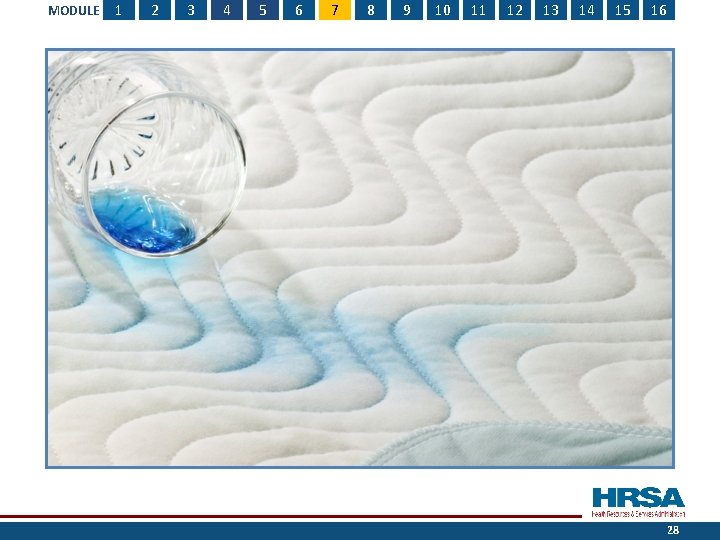
MODULE 1 2 3 4 5 6 7 8 9 10 11 12 13 14 15 16 Urinary Incontinence: Prevalence • Urinary incontinence (UI) is a common concern in older PLw. D (Payne, 2015). • UI adds to the care partner burden, is often very distressing, and influences the decision to consider early institutionalization (Drennan et al. , 2011; Grant, et al. , 2013). • UI can begin during the early stages of dementia, although it is more common in middle to late stage dementia. • It is substantially more common in PLw. D compared with age-matched cohorts without dementia (Drennan et al. , 2013; Drennan, 2014). • Incontinence is a significant predictor for institutionalized care 27
MODULE 1 2 3 4 5 6 7 8 9 10 11 12 13 14 15 16 28
MODULE 1 2 3 4 5 6 7 8 9 10 11 12 13 14 15 16 Urinary Incontinence: Diagnostic Considerations • Need to determine underlying etiology of UI (Idiaquez & Roman, 2011) • Initial assessment: problem of mobility, communication or medical complaint (Orme et al. , 2015) • Clinical assessment: rule out DIAPPERS (Resnick et al. , 1985) o Delirium, Infection, Atrophic vaginitis, Pharmacologic, Psychological (depression), Excessive urine production (from medical conditions), Restricted mobility, Stool impaction o Possible adverse effect of current medication (Kalisch Ellett, et al. , 2014; Kröger et al. , 2011) o Lower urinary tract symptoms (LUTS) (Averbeck et al. , 2015) 29
MODULE 1 2 3 4 5 6 7 8 9 10 11 12 13 14 15 16 Managing Urinary Incontinence in Persons Living with Dementia • Clinical management is challenging; conservative interventions are the first-line treatments (Drennan et al. , 2012; Gormley et al. , 2012). • Strategies are often directed toward care partner versus PLw. D in later stages (Drennan, 2014). o Lifestyle interventions, weight loss, and education (Auwad et al. , 2008; Burgio, 2002; Drennan, 2014; Hersh & Salzman, 2013; Smith et al. , 2012) o Care partner reluctance to discuss UI with providers (Grant et al. , 2013) • Medications and catheters are offered earlier to PLw. D than in healthy same-age counterparts; but they are associated with many potential adverse effects (Chancellor & Boone, 2012; Drennan, 2014; Grant, 2013; Orme et al. , 2015). • Anticholinergic medications worsen cognition. 30
MODULE 1 2 3 4 5 6 7 8 9 10 11 12 13 14 15 16 Incontinence: Dermatologic (and other) Consequences • Skin loses integrity with natural aging (Holroyd & Graham, 2014; Kottner, et al. , 2013). • Incontinence-associated dermatitis (IAD) is common (Beeckman et al. , 2014; Holroyd et al. , 2014). • There are many causes of incontinence in healthy persons; neurological deterioration causes additional impairment (Beeckman et al. , 2014; Salcido, 2011). • Prevention is preferred through appropriate treatment of perianal area (Beeckman et al. , 2014; Doughty et al. , 2012; Gray et al. , 2012; Holroyd et al. , 2014). • Incontinence consequences are associated with increased mortality (Mitchell et al. , 2010). 31
MODULE 1 2 3 4 5 6 7 8 9 10 11 12 13 14 15 16 Fecal Incontinence • Fecal/bowel incontinence more common in persons with versus without dementia, but it is under-recognized (Drennan, 2014; Grant et al. , 2013; Shah et al. , 2012) • Prevalence is approximately 10% to 30% of PLw. D, increasing with age (Drennan, 2014; Drennan et al. , 2013; Grant et al. , 2013; Saga et al. , 2013; Shah et al. , 2012) • Fecal incontinence may result from anatomical changes with aging or dementia or from cognitive or sensory impairments of dementia. (Shah et al. , 2012). • There is a need to prevent/manage dermatologic consequences (Rohwer et al. , 2013). 32
MODULE 1 2 3 4 5 6 7 8 9 10 11 12 13 14 15 16 Outline 9 • Overview of middle and late stage dementias • Developing an individualized primary care plan o Medication management considerations o Specific areas of concern: • Comorbidities • Pain • Infection • Incontinence • Eating dysfunction • Miscellaneous 33
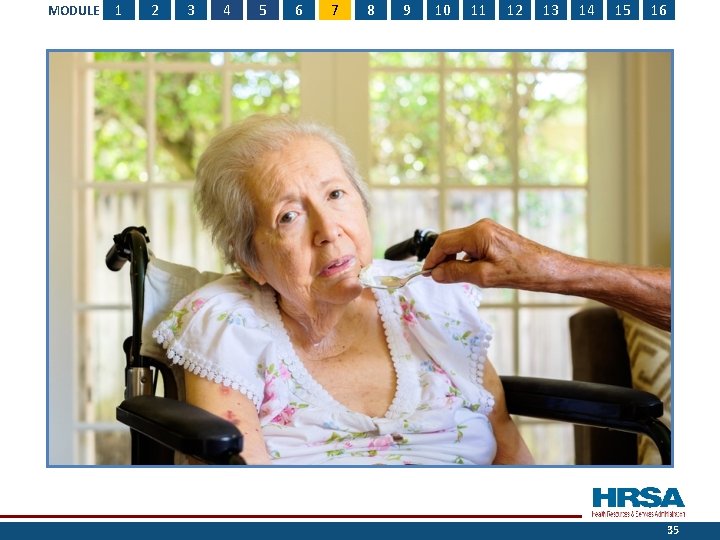
MODULE 1 2 3 4 5 6 7 8 9 10 11 12 13 14 15 16 Eating Difficulties in PLw. D: Overview • Eating and drinking difficulties are common in PLw. D (Abdelhamid et al. , 2016; Hsaio et al. , 2013). • There are many possible etiologies: neurologic damage, cognitive and visuosensory impairments, vascular changes, oral complications, psychological/psychiatric comorbidities, and adverse effects of medications (Chang & Roberts, 2011). • Consequences of eating difficulties in PLw. D can be potentially severe: increased morbidity from malnutrition, weight loss, dehydration, and increased risk of mortality from aspiration pneumonia (Alagiakrishnan et al. , 2013; Altman et al. , 2013; Cereda et al. , 2014). 34
MODULE 1 2 3 4 5 6 7 8 9 10 11 12 13 14 15 16 35
MODULE 1 2 3 4 5 6 7 8 9 10 11 12 13 14 15 16 Eating Difficulties in Persons Living with Specific Dementias • Eating difficulties are common in PLw. D (13% to 57%) (Alagiakrishnan et al. , 2013). • Type and stage of dementia influence emergence of eating difficulties (Ahmed et al. , 2014; Alagiakrishnan et al. , 2013; Altman et al. , 2013; Cereda et al. , 2014). 36
MODULE 1 2 3 4 5 6 7 8 9 10 11 12 13 14 15 16 Management of Eating Difficulties in PLw. D • Must exclude treatable causes (can use Meals On Wheels Common Causes of Malnutrition in Older Persons ) • Limited evidence to support any of the current specific eating interventions (Abdelhamid et al. , 2015; Alagiakrishnan et al. , 2013; Altman et al. , 2013) • Persons living with dementia can take up to 45 minutes to finish a meal when receiving assistance with eating. 37
MODULE 1 2 3 4 5 6 7 8 9 10 11 12 13 14 15 16 Outline 10 • Overview of middle and late stage dementias • Developing an individualized primary care plan o Medication management considerations o Specific areas of concern: • Comorbidities • Pain • Infection • Incontinence • Eating dysfunction • Miscellaneous 38
MODULE 1 2 3 4 5 6 7 8 9 10 11 12 13 14 15 16 Miscellaneous Medical Concerns • Assess for needed corrections associated with sensory impairments o Vision o Hearing o Oral hygiene o Other assistive devices • Referrals to specialists 39
MODULE 1 2 3 4 5 6 7 8 9 10 11 12 13 14 15 16 Psychosis in Parkinson’s Disease Dementia (PDD) • Psychosis is common in PDD, especially visual hallucinations: o Visual hallucinations occur in up to 50% of older adults with PDD. o Paranoid delusions are less common (~5% older adults with PDD) (Connolly & Fox, 2014). • Psychotic symptoms are disruptive and often lead to early institutionalization (Goldman & Holden, 2014). • Risk factors include age, medications, and disease duration. • Impulsive and compulsive behaviors may be related to use of dopamine agonist medications (Weintraub et al. , 2015). 40
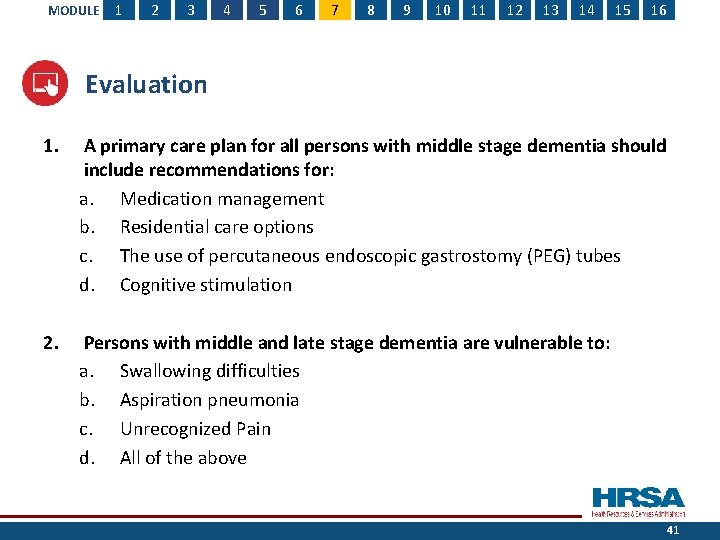
MODULE 1 2 3 4 5 6 7 8 9 10 11 12 13 14 15 16 Evaluation 1. A primary care plan for all persons with middle stage dementia should include recommendations for: a. Medication management b. Residential care options c. The use of percutaneous endoscopic gastrostomy (PEG) tubes d. Cognitive stimulation 2. Persons with middle and late stage dementia are vulnerable to: a. Swallowing difficulties b. Aspiration pneumonia c. Unrecognized Pain d. All of the above 41
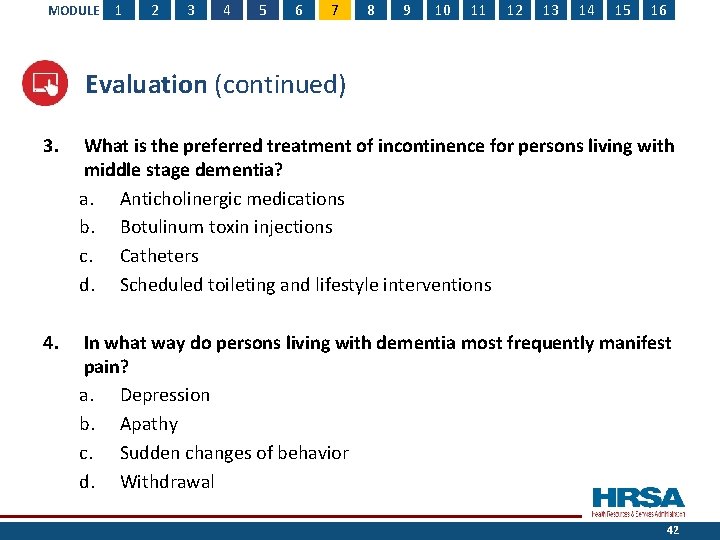
MODULE 1 2 3 4 5 6 7 8 9 10 11 12 13 14 15 16 Evaluation (continued) 3. What is the preferred treatment of incontinence for persons living with middle stage dementia? a. Anticholinergic medications b. Botulinum toxin injections c. Catheters d. Scheduled toileting and lifestyle interventions 4. In what way do persons living with dementia most frequently manifest pain? a. Depression b. Apathy c. Sudden changes of behavior d. Withdrawal 42
MODULE 1 2 3 4 5 6 7 8 9 10 11 12 13 14 15 16 Acknowledgements This module was prepared for the U. S. Department of Health and Human Services (HHS), Health Resources and Services Administration (HRSA), by The Bizzell Group, LLC, under contract number HHSH 25034002 T/HHSH 250201400075 I. The dementia and education experts who served on the Dementia Expert Workgroup to guide the development of the modules included: Alice Bonner, Ph. D, RN, FAAN, Secretary Elder Affairs, Massachusetts Executive Office of Elder Affairs, Boston MA; Laurel Coleman, MD, FACP, Kauai Medical Clinic -Hawaii Pacific Health, Lihue, HI; Cyndy B. Cordell, MBA, Director, Healthcare Professional Services, Alzheimer's Association, Chicago, IL; Dolores Gallagher Thompson, Ph. D, ABPP, Professor of Research, Department of Psychiatry and Behavioral Sciences, Stanford University School of Medicine, Stanford, CA; James Galvin, MD, MPH, Professor of Clinical Biomedical Science and Associate Dean for Clinical Research, Florida Atlantic University, Boca Raton, FL; Mary Guerriero Austrom, Ph. D, Wesley P Martin Professor of Alzheimer's Disease Education, Department of Psychiatry, Associate Dean for Diversity Affairs, Indiana University. Purdue University Indianapolis, IN; Robert Kane, MD, Professor and Minnesota Chair in Long-term Care & Aging, Health Policy & Management, School of Public Health, University of Minnesota; Jason Karlawish, MD, Professor of Medicine, Perelman School of Medicine, University of Pennsylvania; Helen M. Matheny, MS, APR, Director of the Alzheimer's Disease Outreach Program, Blanchette Rockefeller Neuroscience Institute, Morgantown, WV; Darby Morhardt, Ph. D, LCSW, Associate Professor, Cognitive Neurology and Alzheimer's Disease Center and Department of Preventive Medicine, Northwestern University Feinberg School of Medicine, Northwestern University, Chicago, IL; Cecilia Rokusek, Ed. D, MSc, RDN, Assistant Dean of Research and Innovation, Professor of Family Medicine, Public Health, Nutrition, and Disaster and Emergency Preparedness, College of Osteopathic Medicine, Nova Southeastern University, Fort Lauderdale, FL. Additional expertise in the development of the modules was provided by Meg Kabat, LCSW-C, CCM; Eleanor S. Mc. Connell, Ph. D, MSN, RN, GCNS, BC; Linda O. Nichols, Ph. D, MA, BA; Todd Semla, MS, Pharm. D, BCPS, FCCP, AGSF; Kenneth Shay, DDS, MS, from the U. S. Department of Veterans Affairs and Seth Keller, MD and Matthew P. Janicki, Ph. D, National Task Group on Intellectual Disabilities and Dementia Practices. 43
MODULE 1 2 3 4 5 6 7 8 9 10 11 12 13 14 15 16 Brought to you by the U. S. Department of Health and Human Services, Health Resources and Services Administration 44