
Module 07 DIAGNOSTICS AND SUPPLY INVENTORY MANAGEMENT 1162022


- Slides: 15
Module 07 DIAGNOSTICS AND SUPPLY INVENTORY MANAGEMENT 1/16/2022 1
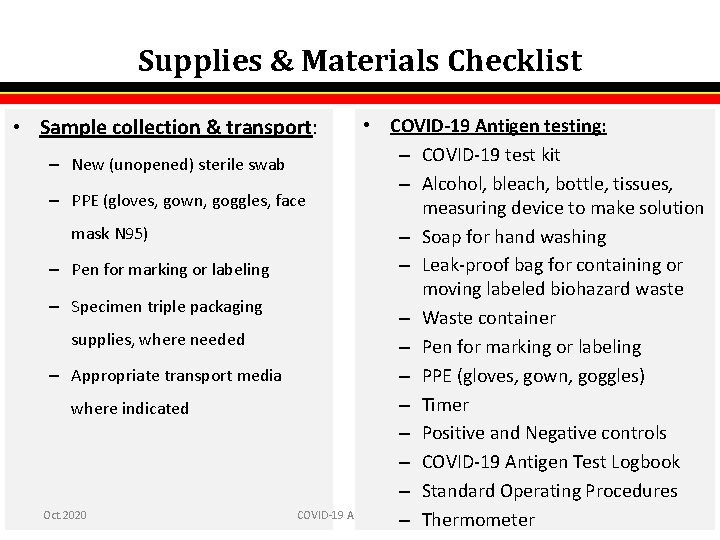
Supplies & Materials Checklist • Sample collection & transport: • COVID-19 Antigen testing: – COVID-19 test kit – New (unopened) sterile swab – Alcohol, bleach, bottle, tissues, – PPE (gloves, gown, goggles, face measuring device to make solution mask N 95) – Soap for hand washing – Leak-proof bag for containing or – Pen for marking or labeling moving labeled biohazard waste – Specimen triple packaging – Waste container supplies, where needed – Pen for marking or labeling – Appropriate transport media – PPE (gloves, gown, goggles) – Timer where indicated – Positive and Negative controls – COVID-19 Antigen Test Logbook – Standard Operating Procedures Oct. 2020 COVID-19 Antigen Testing 2 – Thermometer
COVID-19 ANTIGEN TEST KITS • Typical COVID-19 Antigen test kits consists of: RDT-visual read Test (individually wrapped in foil pouch with desiccant) Extraction buffer tube Nozzle cap Sterile swab Paper stand Device-Based Test strip (individually wrapped in foil pouch with desiccant) Extraction Vial Dropper Lid Instructions for use COVID-19 Antigen Testing Oct. 2020 3
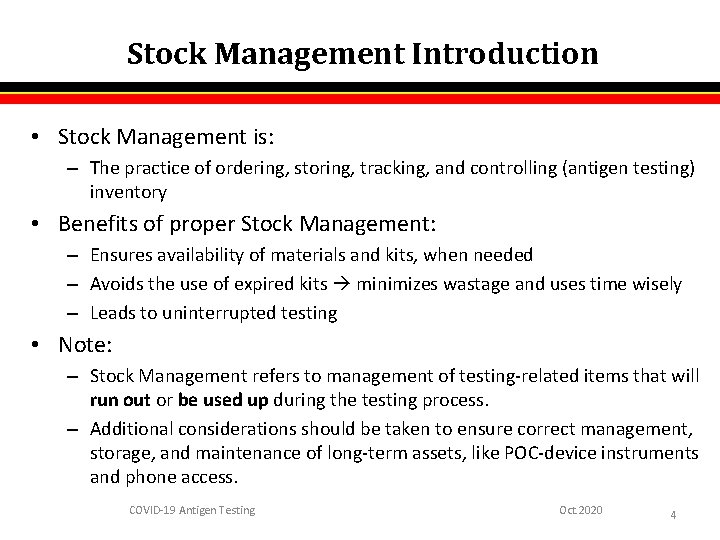
Stock Management Introduction • Stock Management is: – The practice of ordering, storing, tracking, and controlling (antigen testing) inventory • Benefits of proper Stock Management: – Ensures availability of materials and kits, when needed – Avoids the use of expired kits minimizes wastage and uses time wisely – Leads to uninterrupted testing • Note: – Stock Management refers to management of testing-related items that will run out or be used up during the testing process. – Additional considerations should be taken to ensure correct management, storage, and maintenance of long-term assets, like POC-device instruments and phone access. COVID-19 Antigen Testing Oct. 2020 4
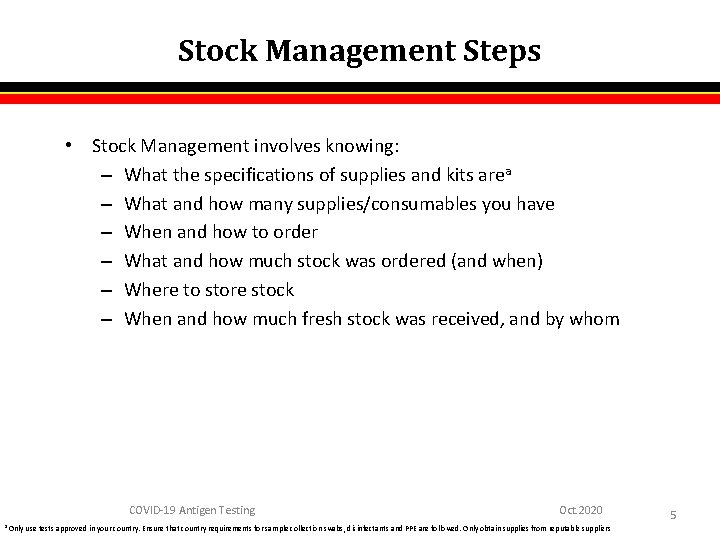
Stock Management Steps • Stock Management involves knowing: – What the specifications of supplies and kits area – What and how many supplies/consumables you have – When and how to order – What and how much stock was ordered (and when) – Where to store stock – When and how much fresh stock was received, and by whom COVID-19 Antigen Testing a Only Oct. 2020 use tests approved in your country. Ensure that country requirements for sample collection swabs, disinfectants and PPE are followed. Only obtain supplies from reputable suppliers 5
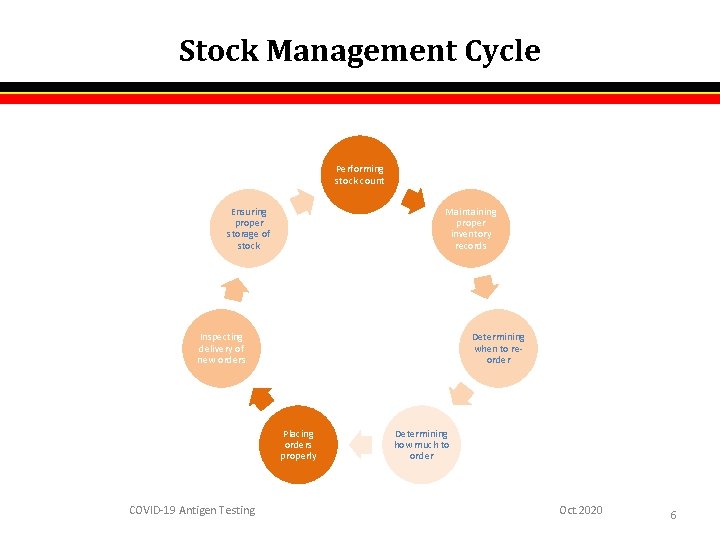
Stock Management Cycle Performing stock count Ensuring proper storage of stock Maintaining proper inventory records Inspecting delivery of new orders Determining when to reorder Placing orders properly COVID-19 Antigen Testing Determining how much to order Oct. 2020 6
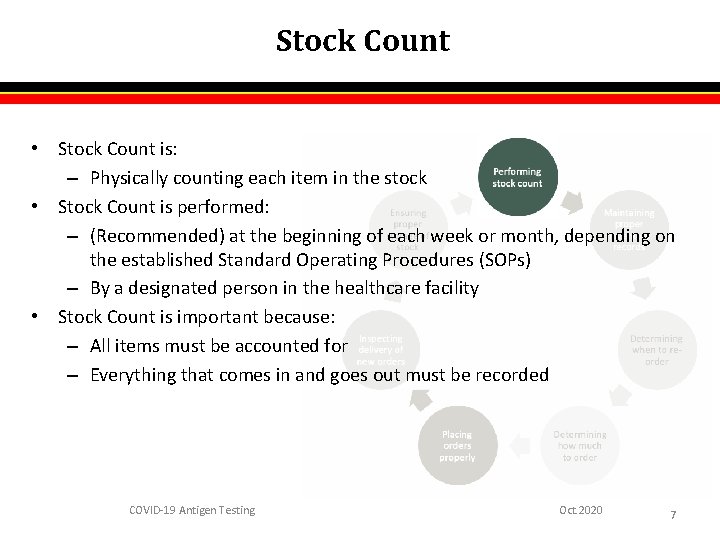
Stock Count • Stock Count is: – Physically counting each item in the stock • Stock Count is performed: – (Recommended) at the beginning of each week or month, depending on the established Standard Operating Procedures (SOPs) – By a designated person in the healthcare facility • Stock Count is important because: – All items must be accounted for – Everything that comes in and goes out must be recorded COVID-19 Antigen Testing Oct. 2020 7
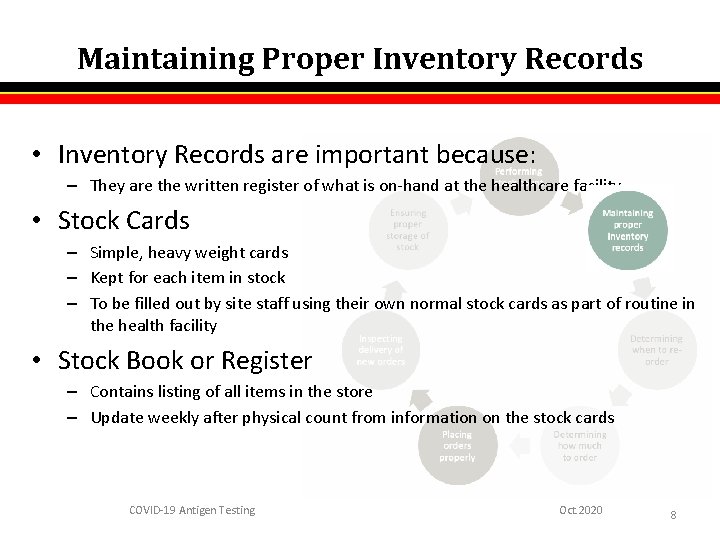
Maintaining Proper Inventory Records • Inventory Records are important because: – They are the written register of what is on-hand at the healthcare facility • Stock Cards – Simple, heavy weight cards – Kept for each item in stock – To be filled out by site staff using their own normal stock cards as part of routine in the health facility • Stock Book or Register – Contains listing of all items in the store – Update weekly after physical count from information on the stock cards COVID-19 Antigen Testing Oct. 2020 8
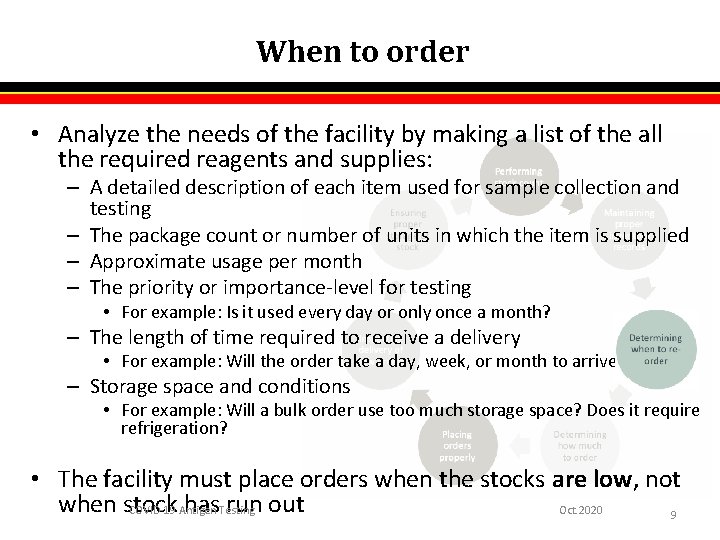
When to order • Analyze the needs of the facility by making a list of the all the required reagents and supplies: – A detailed description of each item used for sample collection and testing – The package count or number of units in which the item is supplied – Approximate usage per month – The priority or importance-level for testing • For example: Is it used every day or only once a month? – The length of time required to receive a delivery • For example: Will the order take a day, week, or month to arrive? – Storage space and conditions • For example: Will a bulk order use too much storage space? Does it require refrigeration? • The facility must place orders when the stocks are low, not when stock has. Testing run out COVID-19 Antigen Oct. 2020 9
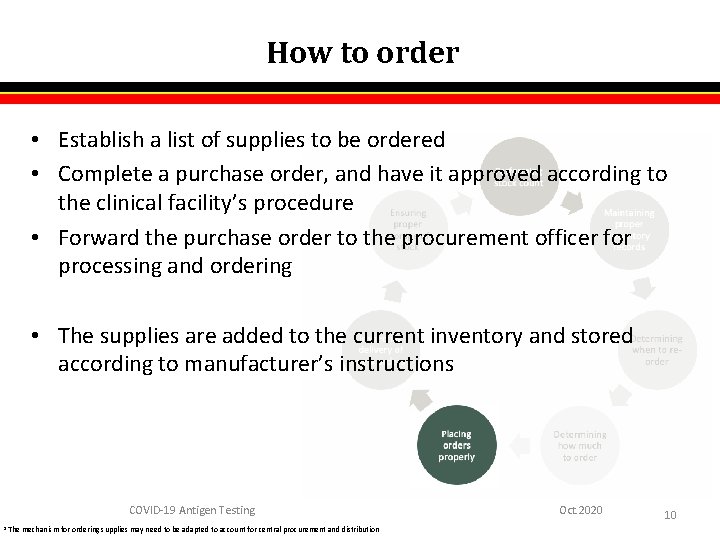
How to order • Establish a list of supplies to be ordered • Complete a purchase order, and have it approved according to the clinical facility’s procedure • Forward the purchase order to the procurement officer for processing and ordering • The supplies are added to the current inventory and stored according to manufacturer’s instructions COVID-19 Antigen Testing a The mechanism for ordering supplies may need to be adapted to account for central procurement and distribution Oct. 2020 10
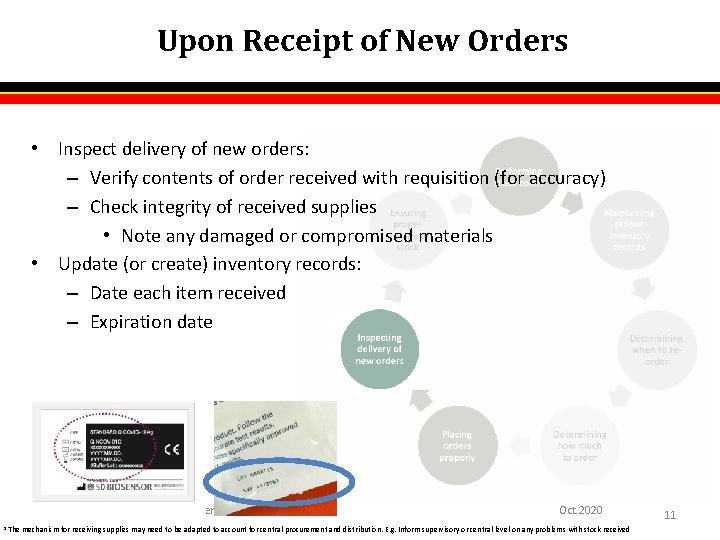
Upon Receipt of New Orders • Inspect delivery of new orders: – Verify contents of order received with requisition (for accuracy) – Check integrity of received supplies • Note any damaged or compromised materials • Update (or create) inventory records: – Date each item received – Expiration date COVID-19 Antigen Testing a The Oct. 2020 mechanism for receiving supplies may need to be adapted to account for central procurement and distribution. E. g. Inform supervisory or central level on any problems with stock received 11
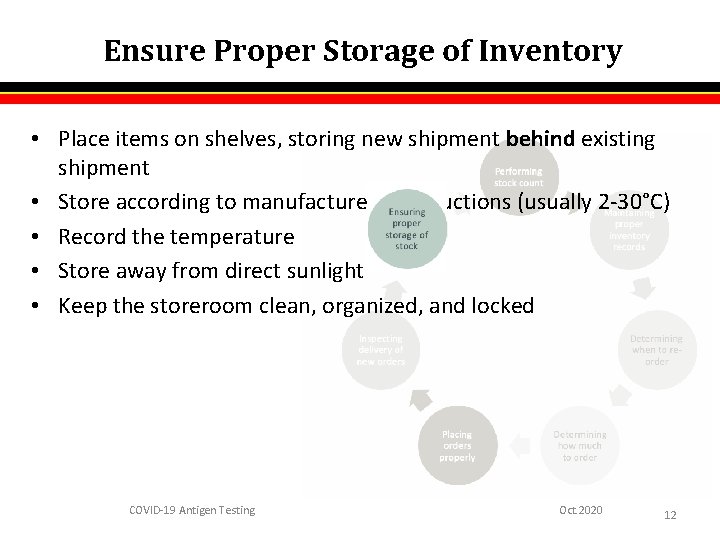
Ensure Proper Storage of Inventory • Place items on shelves, storing new shipment behind existing shipment • Store according to manufacturer’s instructions (usually 2 -30°C) • Record the temperature • Store away from direct sunlight • Keep the storeroom clean, organized, and locked COVID-19 Antigen Testing Oct. 2020 12
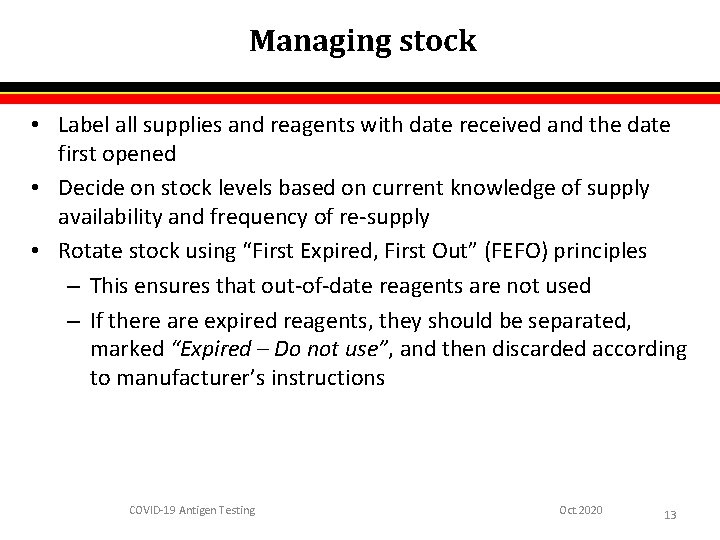
Managing stock • Label all supplies and reagents with date received and the date first opened • Decide on stock levels based on current knowledge of supply availability and frequency of re-supply • Rotate stock using “First Expired, First Out” (FEFO) principles – This ensures that out-of-date reagents are not used – If there are expired reagents, they should be separated, marked “Expired – Do not use”, and then discarded according to manufacturer’s instructions COVID-19 Antigen Testing Oct. 2020 13
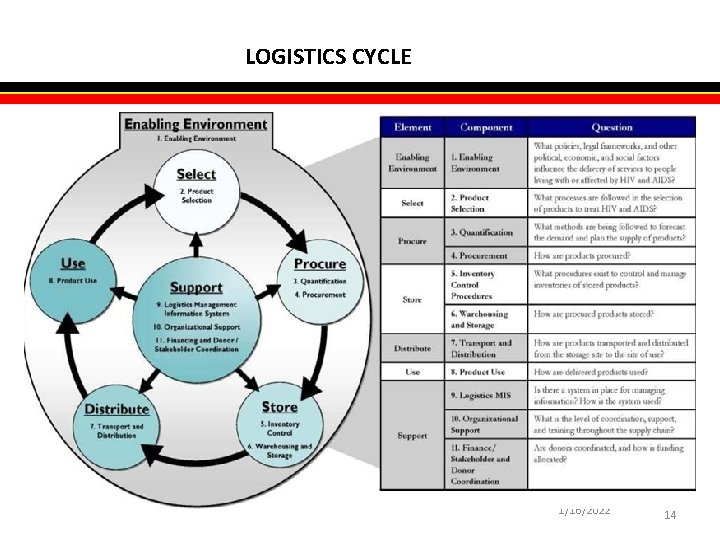
LOGISTICS CYCLE 1/16/2022 14
QUESTIONS