
Module 06 Lecture Explaining the Salem Witch Hunt






- Slides: 62
Module #06 Lecture “Explaining the Salem Witch Hunt”
Part One: Historical Background: What Happens Back in England Affects America
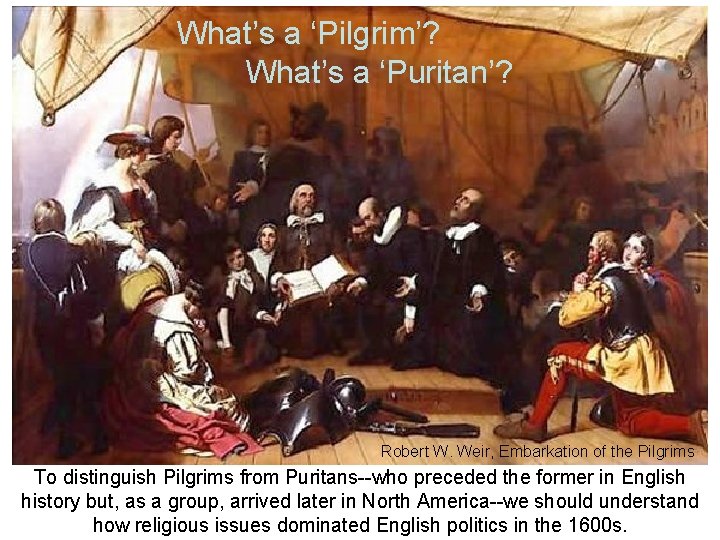
What’s a ‘Pilgrim’? What’s a ‘Puritan’? Robert W. Weir, Embarkation of the Pilgrims To distinguish Pilgrims from Puritans--who preceded the former in English history but, as a group, arrived later in North America--we should understand how religious issues dominated English politics in the 1600 s.
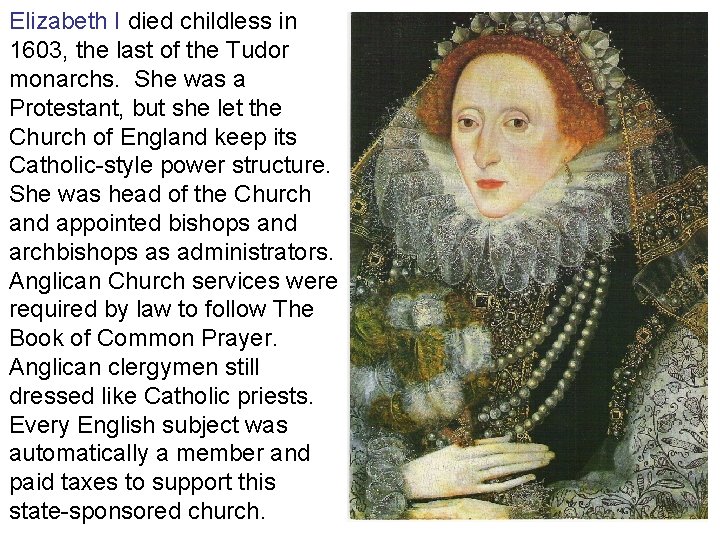
Elizabeth I died childless in 1603, the last of the Tudor monarchs. She was a Protestant, but she let the Church of England keep its Catholic-style power structure. She was head of the Church and appointed bishops and archbishops as administrators. Anglican Church services were required by law to follow The Book of Common Prayer. Anglican clergymen still dressed like Catholic priests. Every English subject was automatically a member and paid taxes to support this state-sponsored church.
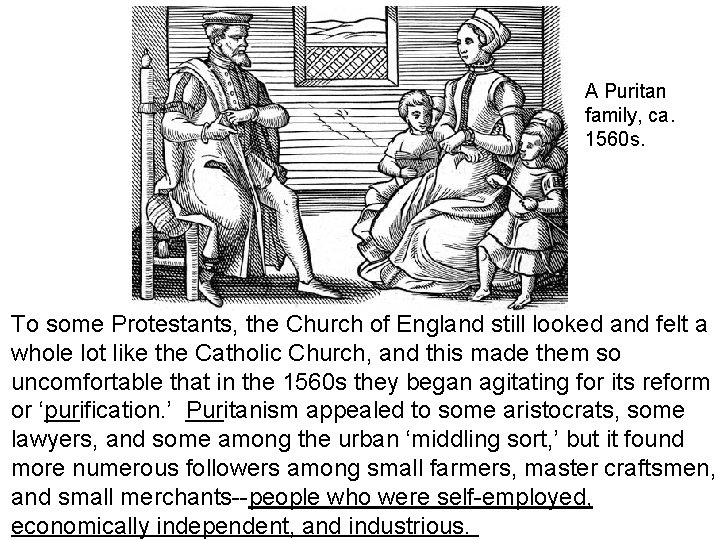
A Puritan family, ca. 1560 s. To some Protestants, the Church of England still looked and felt a whole lot like the Catholic Church, and this made them so uncomfortable that in the 1560 s they began agitating for its reform or ‘purification. ’ Puritanism appealed to some aristocrats, some lawyers, and some among the urban ‘middling sort, ’ but it found more numerous followers among small farmers, master craftsmen, and small merchants--people who were self-employed, economically independent, and industrious.
Three Branches of Dissent • Presbyterians did not object to a state church but wanted it ruled by local groups of elders (presbyters), not bishops; they practiced infant baptism. • Separatists, or Pilgrims believed the Church of England was too corrupt to be redeemed, and they must withdraw into independent congregations; pro-King, anti-Church; early Baptists, they did NOT practice infant baptism. • Puritans believed themselves to be true C. of England, which could still be reformed from within in a model Christian society; anti-King, pro-Church; they practiced infant baptism.
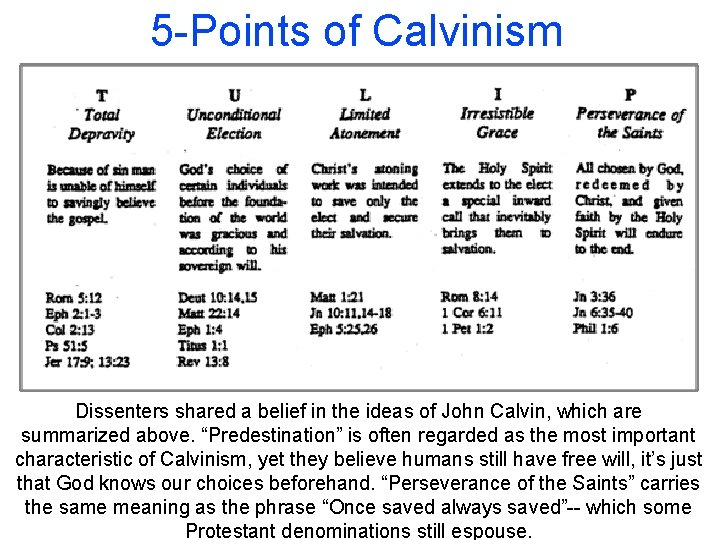
5 -Points of Calvinism Dissenters shared a belief in the ideas of John Calvin, which are summarized above. “Predestination” is often regarded as the most important characteristic of Calvinism, yet they believe humans still have free will, it’s just that God knows our choices beforehand. “Perseverance of the Saints” carries the same meaning as the phrase “Once saved always saved”-- which some Protestant denominations still espouse.
James I, first Stuart King of England James I reigned from 1603 -1625. Queen Elizabeth & her successors, the Stuarts, persecuted Puritans & all other such dissenting sects. Allowing subjects to follow different religious teachings than their rulers sounded like a recipe for disorder & revolution in the 1600 s. King James I (of “Jamestown” & KJV Bible-fame) would not be as harsh with dissenters as his son, Charles I, but Puritans disapproved of James anyway due to his preference for same-sex partners.
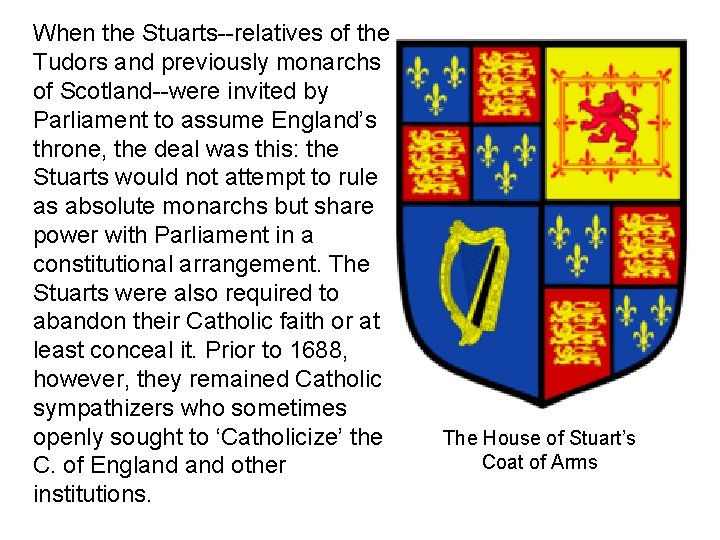
When the Stuarts--relatives of the Tudors and previously monarchs of Scotland--were invited by Parliament to assume England’s throne, the deal was this: the Stuarts would not attempt to rule as absolute monarchs but share power with Parliament in a constitutional arrangement. The Stuarts were also required to abandon their Catholic faith or at least conceal it. Prior to 1688, however, they remained Catholic sympathizers who sometimes openly sought to ‘Catholicize’ the C. of England other institutions. The House of Stuart’s Coat of Arms
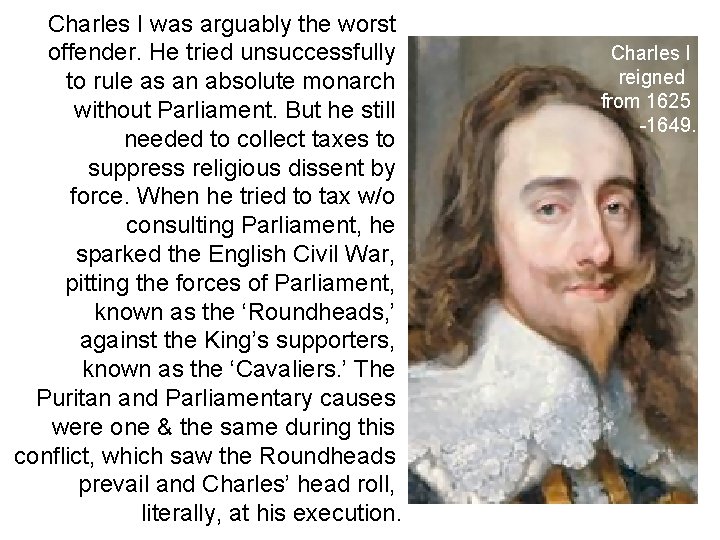
Charles I was arguably the worst offender. He tried unsuccessfully to rule as an absolute monarch without Parliament. But he still needed to collect taxes to suppress religious dissent by force. When he tried to tax w/o consulting Parliament, he sparked the English Civil War, pitting the forces of Parliament, known as the ‘Roundheads, ’ against the King’s supporters, known as the ‘Cavaliers. ’ The Puritan and Parliamentary causes were one & the same during this conflict, which saw the Roundheads prevail and Charles’ head roll, literally, at his execution. Charles I reigned from 1625 -1649.
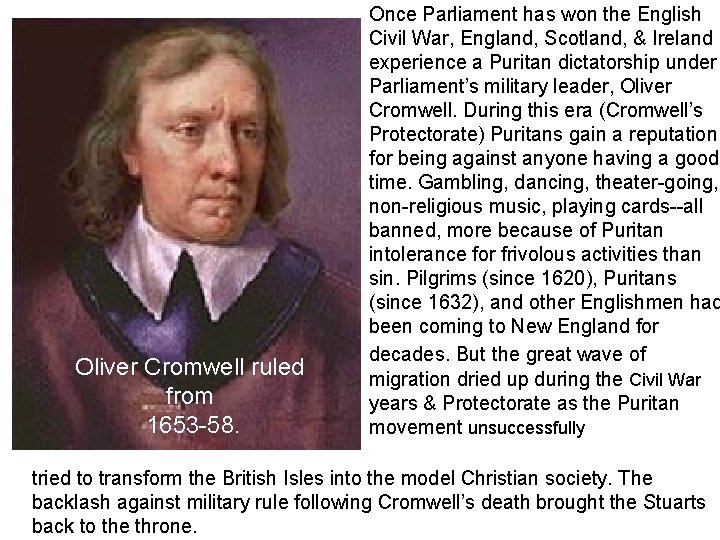
Oliver Cromwell ruled from 1653 -58. Once Parliament has won the English Civil War, England, Scotland, & Ireland experience a Puritan dictatorship under Parliament’s military leader, Oliver Cromwell. During this era (Cromwell’s Protectorate) Puritans gain a reputation for being against anyone having a good time. Gambling, dancing, theater-going, non-religious music, playing cards--all banned, more because of Puritan intolerance for frivolous activities than sin. Pilgrims (since 1620), Puritans (since 1632), and other Englishmen had been coming to New England for decades. But the great wave of migration dried up during the Civil War years & Protectorate as the Puritan movement unsuccessfully tried to transform the British Isles into the model Christian society. The backlash against military rule following Cromwell’s death brought the Stuarts back to the throne.
The Stuart Restoration After Cromwell’s death, Charles II—who had been exiled in France following his father’s execution—was invited by a new Parliament to take back the throne, with the understanding that he would conceal his Catholic sympathies & not try to be an absolutist king like his father. He did not always live up to the agreement, but at least he was cautious about pursuing his true ambitions & expressing his beliefs. Charles II reigned from 1660 -1685
Effects of Stuart Rule on M. B. C. In 1684, Charles II dissolved the original charter of the Massachusetts Bay Colony, which had allowed the Puritan leaders to govern as they saw fit. “The Dominion of New England” was now being run by an arrogant Englishman named Sir Edmond Andros was questioning whether longestablished farmers really owned their land. Worse, he was insisting that any Christian could come into the community. That meant Quakers had to be tolerated! Gov. Andros
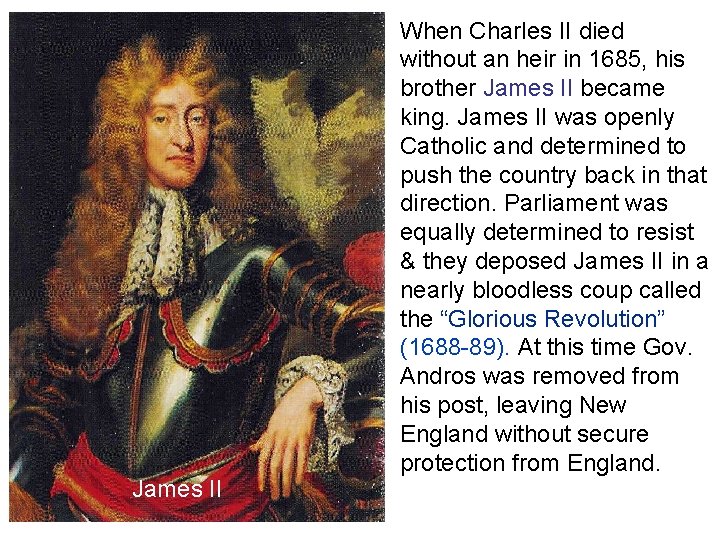
James II When Charles II died without an heir in 1685, his brother James II became king. James II was openly Catholic and determined to push the country back in that direction. Parliament was equally determined to resist & they deposed James II in a nearly bloodless coup called the “Glorious Revolution” (1688 -89). At this time Gov. Andros was removed from his post, leaving New England without secure protection from England.
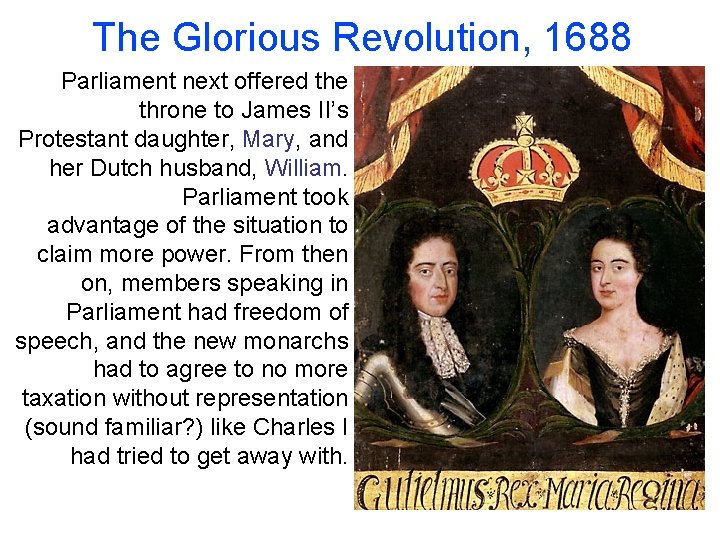
The Glorious Revolution, 1688 Parliament next offered the throne to James II’s Protestant daughter, Mary, and her Dutch husband, William. Parliament took advantage of the situation to claim more power. From then on, members speaking in Parliament had freedom of speech, and the new monarchs had to agree to no more taxation without representation (sound familiar? ) like Charles I had tried to get away with.
Timeline of English & Puritan History • Stuarts became English monarchs in 1603. • Reign of James I (1603 -1625); Charles I (1625 -1649). • 1630 -- Puritans formed Massachusetts Bay Co. and left England; by 1640 Mass. Bay Colony had 20, 000 settlers. • English Civil War (1642 -1651); immigration to New England dropped off; Puritans/Parliament won war. • Cromwell’s Protectorate (1653 -1658); Puritans were in charge in England! • Restoration of Charles II (1660) • Charles II dies, 1685; James II (1685 -88); • 1688 – William and Mary; “Glorious Revolution” • 1689 -- Revolt against Gov. Andros • 1691 – Reorganization of Plymouth and Massachusetts Bay into one colony. • 1691 -92 – Salem Witch Hunt
The point is that what happened back in England had a big impact on English settlers in America. For example, political fallout in the aftermath of the Glorious Revolution created a power vacuum/shake-up locally in Massachusetts that made possible the devastating Indian attacks of 1688 as well as the 1692 witch trials. Now that you have some idea about the historical background, it’s time to look at Pilgrims, Puritans, ‘Strangers, ’ & Native Americans in the New World.
Part Two: Cooperation & Conflict-- Relations Between Native-Americans & English Settlers in the Northeast
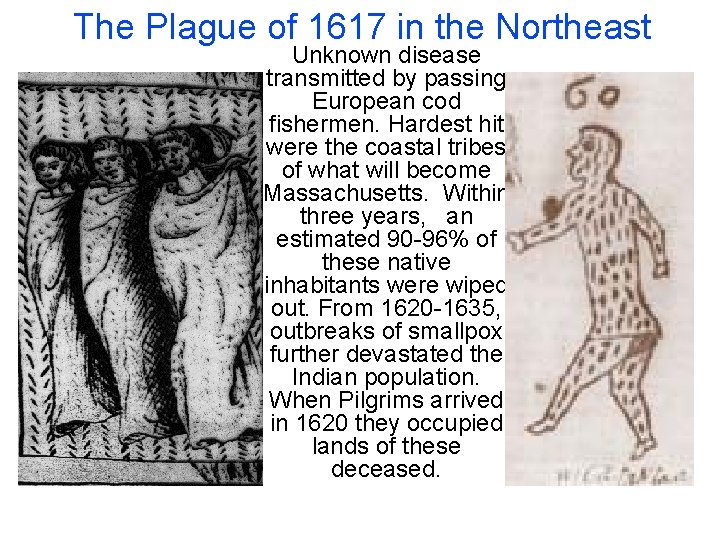
The Plague of 1617 in the Northeast Unknown disease transmitted by passing European cod fishermen. Hardest hit were the coastal tribes of what will become Massachusetts. Within three years, an estimated 90 -96% of these native inhabitants were wiped out. From 1620 -1635, outbreaks of smallpox further devastated the Indian population. When Pilgrims arrived in 1620 they occupied lands of these deceased.
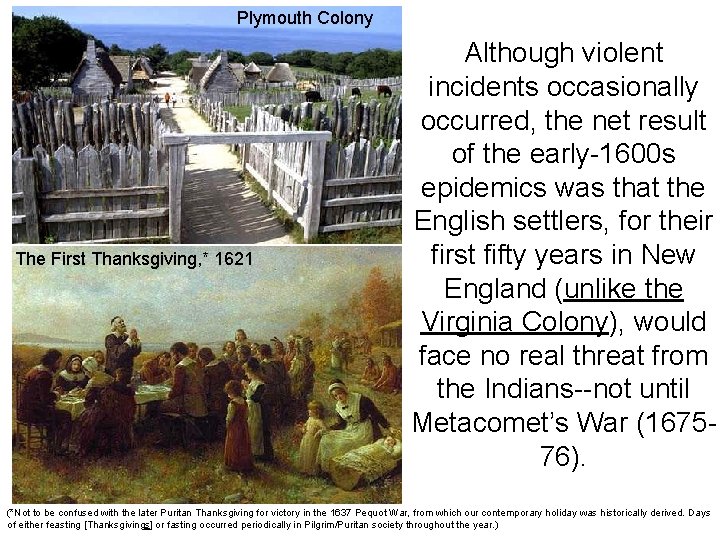
Plymouth Colony The First Thanksgiving, * 1621 Although violent incidents occasionally occurred, the net result of the early-1600 s epidemics was that the English settlers, for their first fifty years in New England (unlike the Virginia Colony), would face no real threat from the Indians--not until Metacomet’s War (167576). (*Not to be confused with the later Puritan Thanksgiving for victory in the 1637 Pequot War, from which our contemporary holiday was historically derived. Days of either feasting [Thanksgivings] or fasting occurred periodically in Pilgrim/Puritan society throughout the year. )
Pilgrims & ‘Strangers’ Arrived, 11/11/1620 • Founded Plymouth Colony in what is now Massachusetts. • Pilgrims, or Separatists, made up 35 of 102 aboard the Mayflower; the others they considered “Strangers” to their religious fellowship. • They set out for Virginia, so how did they end up in Massachusetts? • Hijacking theory: Perhaps there was a conspiracy among the Pilgrim fanatics to land somewhere the Anglican Church was not established, but straying off course could also have happened for other reasons (bad weather; human error). • Mayflower Compact – agreement granting political rights to all male colonists who would abide by the colony’s laws. The Pilgrims were in the minority & had to make the compact to unify all aboard behind the colonizing effort.
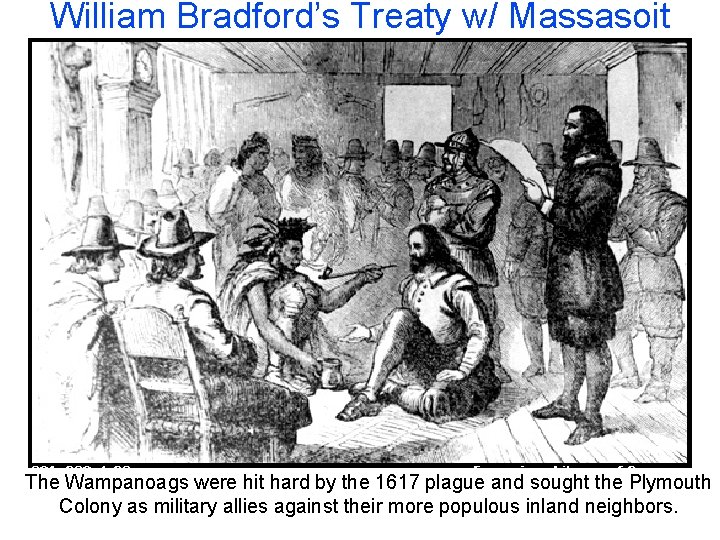
William Bradford’s Treaty w/ Massasoit The Wampanoags were hit hard by the 1617 plague and sought the Plymouth Colony as military allies against their more populous inland neighbors.
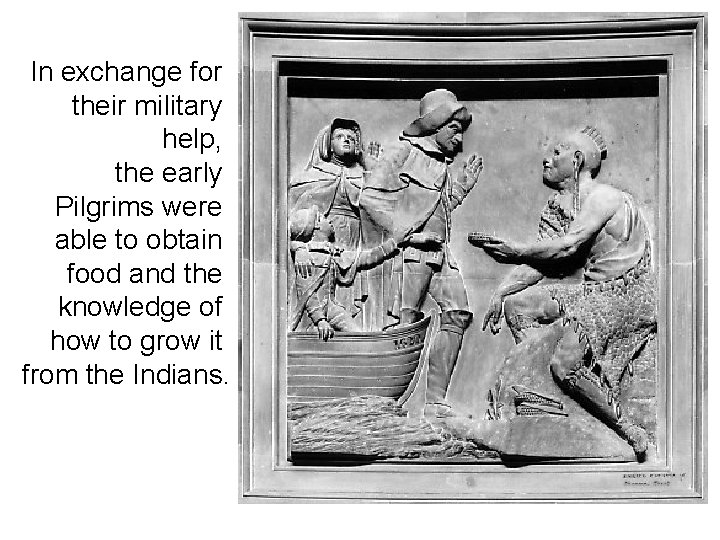
In exchange for their military help, the early Pilgrims were able to obtain food and the knowledge of how to grow it from the Indians.
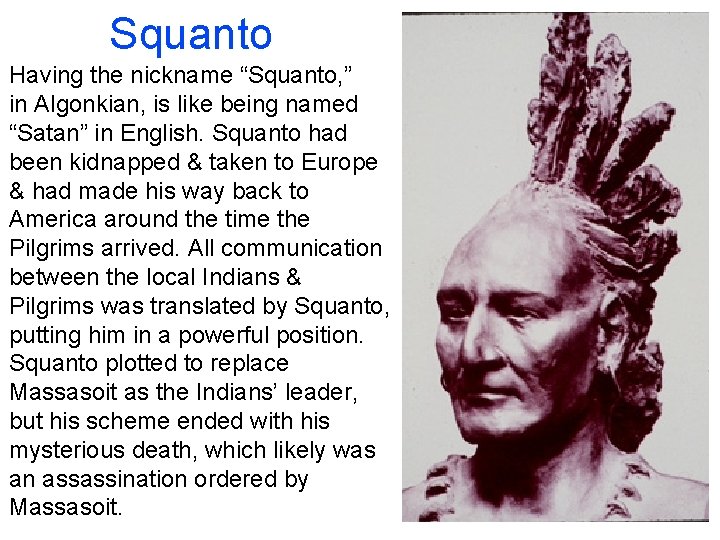
Squanto Having the nickname “Squanto, ” in Algonkian, is like being named “Satan” in English. Squanto had been kidnapped & taken to Europe & had made his way back to America around the time the Pilgrims arrived. All communication between the local Indians & Pilgrims was translated by Squanto, putting him in a powerful position. Squanto plotted to replace Massasoit as the Indians’ leader, but his scheme ended with his mysterious death, which likely was an assassination ordered by Massasoit.
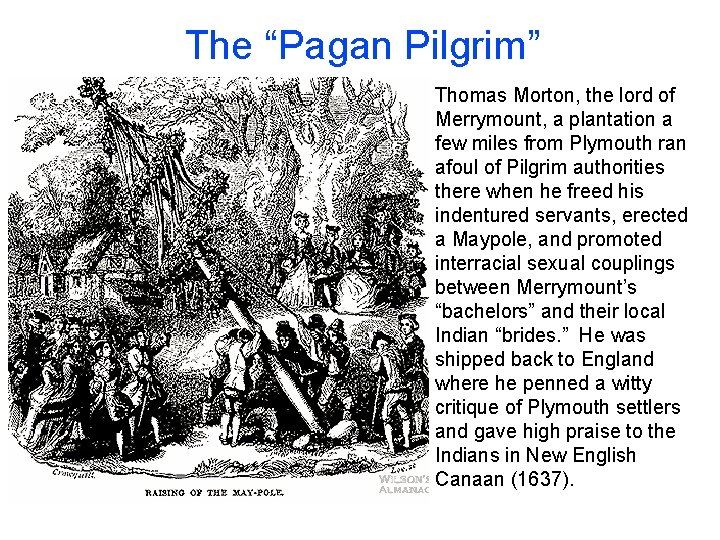
The “Pagan Pilgrim” Thomas Morton, the lord of Merrymount, a plantation a few miles from Plymouth ran afoul of Pilgrim authorities there when he freed his indentured servants, erected a Maypole, and promoted interracial sexual couplings between Merrymount’s “bachelors” and their local Indian “brides. ” He was shipped back to England where he penned a witty critique of Plymouth settlers and gave high praise to the Indians in New English Canaan (1637).
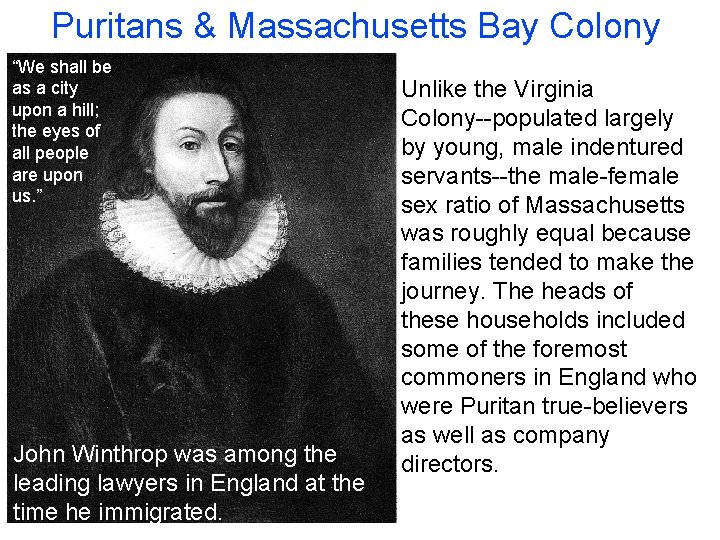
Puritans & Massachusetts Bay Colony “We shall be as a city upon a hill; the eyes of all people are upon us. ” John Winthrop was among the leading lawyers in England at the time he immigrated. Unlike the Virginia Colony--populated largely by young, male indentured servants--the male-female sex ratio of Massachusetts was roughly equal because families tended to make the journey. The heads of these households included some of the foremost commoners in England who were Puritan true-believers as well as company directors.
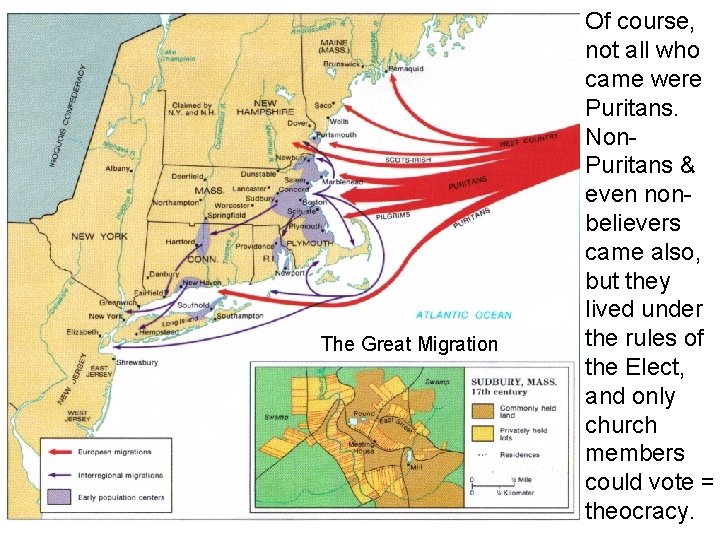
The Great Migration Of course, not all who came were Puritans. Non. Puritans & even nonbelievers came also, but they lived under the rules of the Elect, and only church members could vote = theocracy.
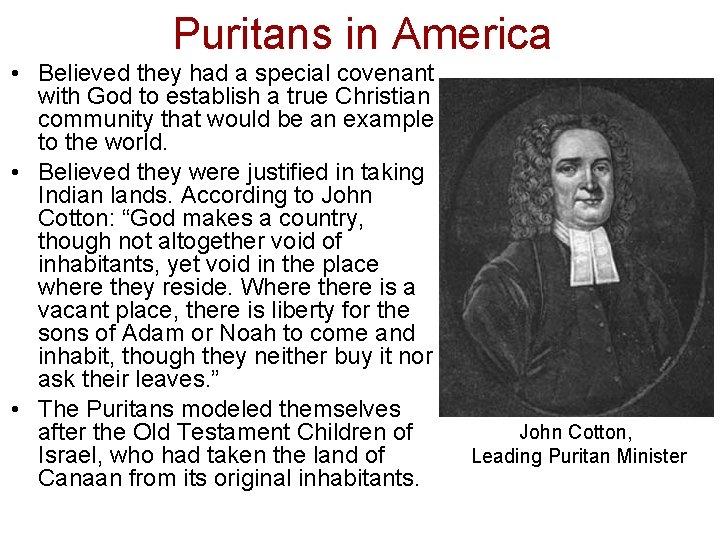
Puritans in America • Believed they had a special covenant with God to establish a true Christian community that would be an example to the world. • Believed they were justified in taking Indian lands. According to John Cotton: “God makes a country, though not altogether void of inhabitants, yet void in the place where they reside. Where there is a vacant place, there is liberty for the sons of Adam or Noah to come and inhabit, though they neither buy it nor ask their leaves. ” • The Puritans modeled themselves after the Old Testament Children of Israel, who had taken the land of Canaan from its original inhabitants. John Cotton, Leading Puritan Minister
Puritans & Indians • All white men in MB colony required to use firearms; no guns for Indians; no missionary activity for first 13 yrs; Indians held accountable to white law. • Believed Christians had a right to take the land of non-Christians. • Believed “civilized” people had a right to “settle” lands that others simply “roamed. ” • Puritans said: “God directs Puritan policy and God wants the Puritans to have the land. ”
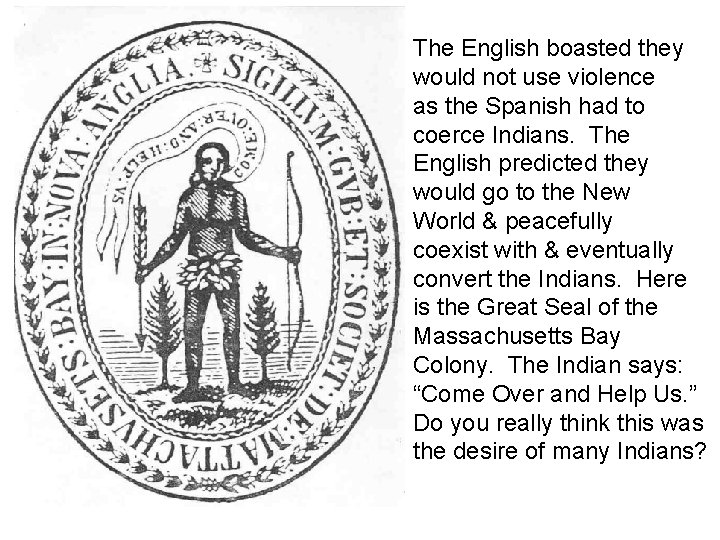
The English boasted they would not use violence as the Spanish had to coerce Indians. The English predicted they would go to the New World & peacefully coexist with & eventually convert the Indians. Here is the Great Seal of the Massachusetts Bay Colony. The Indian says: “Come Over and Help Us. ” Do you really think this was the desire of many Indians?
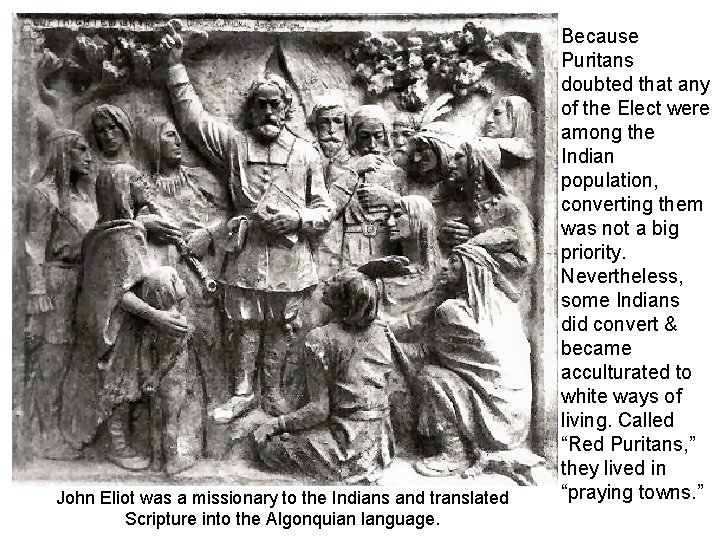
John Eliot was a Puritan missionary who translated John Eliot was a missionary to the Indians and translated Scripture into the Algonquian language. Because Puritans doubted that any of the Elect were among the Indian population, converting them was not a big priority. Nevertheless, some Indians did convert & became acculturated to white ways of living. Called “Red Puritans, ” they lived in “praying towns. ”
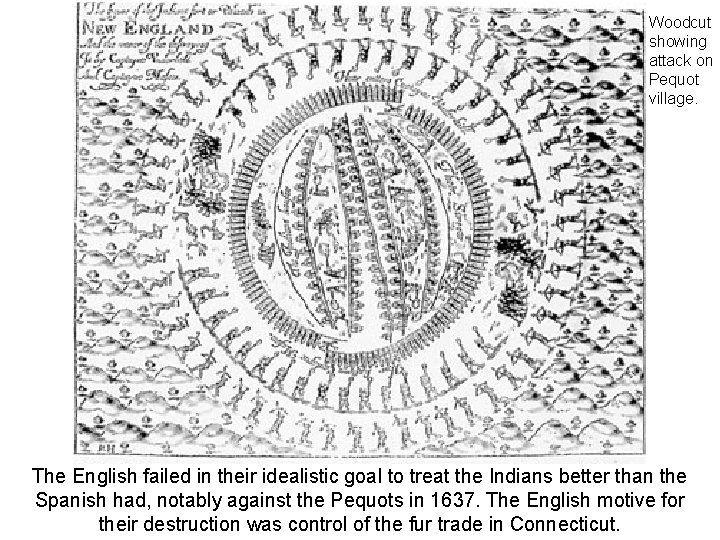
Woodcut showing attack on Pequot village. The English failed in their idealistic goal to treat the Indians better than the Spanish had, notably against the Pequots in 1637. The English motive for their destruction was control of the fur trade in Connecticut.
The Pequot War, 1637 • Pequots and Narragansetts were two strongest tribes in area. • Pequots made plea for unity to Narragansetts but were rebuffed. • Puritan aims were to drive Dutch traders from southern New England obtain Pequot lands. • Puritans & their Narragansett allies exterminated most of Pequot tribe and enslaved any survivors. • English could be just as brutal as Spanish. • Our national Thanksgiving holiday has its roots as a New England regional holiday commemorating the Puritans’ victory over the Pequots.
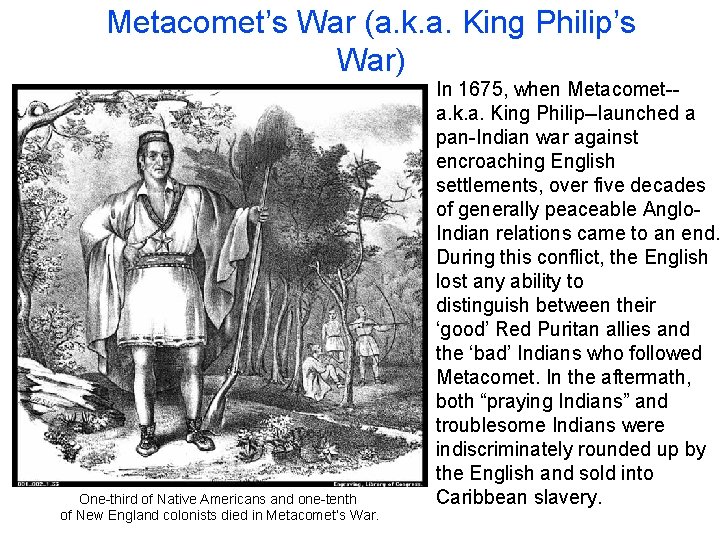
Metacomet’s War (a. k. a. King Philip’s War) One-third of Native Americans and one-tenth of New England colonists died in Metacomet’s War. In 1675, when Metacomet-a. k. a. King Philip--launched a pan-Indian war against encroaching English settlements, over five decades of generally peaceable Anglo. Indian relations came to an end. During this conflict, the English lost any ability to distinguish between their ‘good’ Red Puritan allies and the ‘bad’ Indians who followed Metacomet. In the aftermath, both “praying Indians” and troublesome Indians were indiscriminately rounded up by the English and sold into Caribbean slavery.
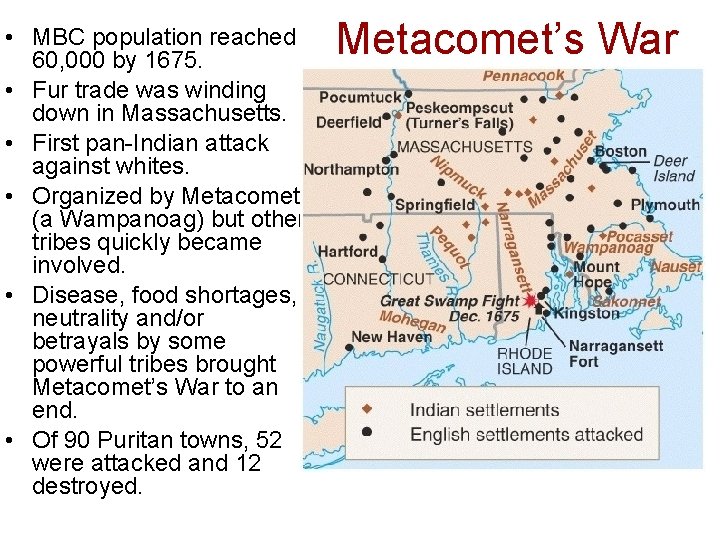
• MBC population reached 60, 000 by 1675. • Fur trade was winding down in Massachusetts. • First pan-Indian attack against whites. • Organized by Metacomet (a Wampanoag) but other tribes quickly became involved. • Disease, food shortages, neutrality and/or betrayals by some powerful tribes brought Metacomet’s War to an end. • Of 90 Puritan towns, 52 were attacked and 12 destroyed. Metacomet’s War
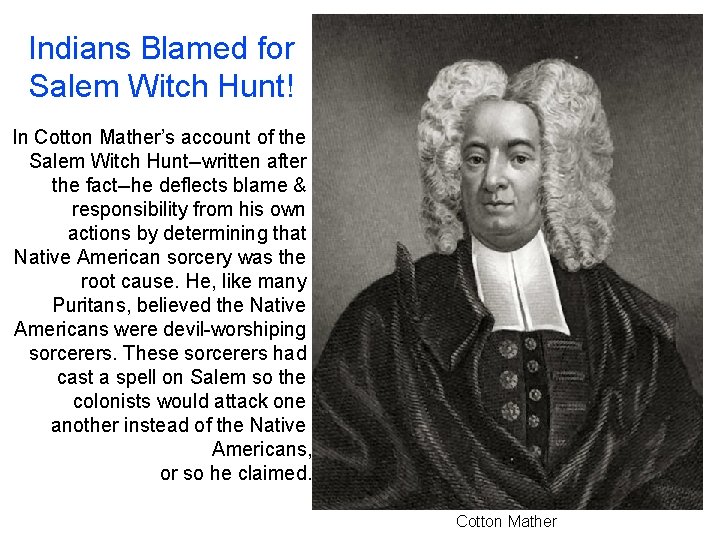
Indians Blamed for Salem Witch Hunt! In Cotton Mather’s account of the Salem Witch Hunt--written after the fact--he deflects blame & responsibility from his own actions by determining that Native American sorcery was the root cause. He, like many Puritans, believed the Native Americans were devil-worshiping sorcerers. These sorcerers had cast a spell on Salem so the colonists would attack one another instead of the Native Americans, or so he claimed. Cotton Mather
Part Three: Massachusetts Bay Colony, Life in a Puritan-Controlled Theocracy
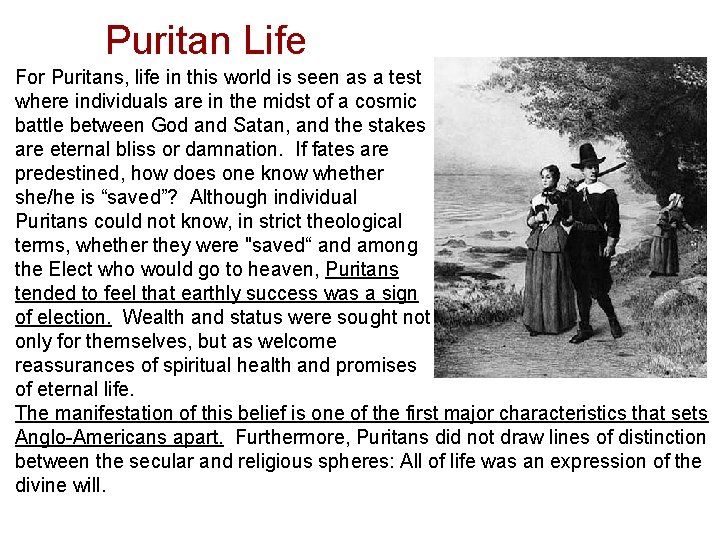
Puritan Life For Puritans, life in this world is seen as a test where individuals are in the midst of a cosmic battle between God and Satan, and the stakes are eternal bliss or damnation. If fates are predestined, how does one know whether she/he is “saved”? Although individual Puritans could not know, in strict theological terms, whether they were "saved“ and among the Elect who would go to heaven, Puritans tended to feel that earthly success was a sign of election. Wealth and status were sought not only for themselves, but as welcome reassurances of spiritual health and promises of eternal life. The manifestation of this belief is one of the first major characteristics that sets Anglo-Americans apart. Furthermore, Puritans did not draw lines of distinction between the secular and religious spheres: All of life was an expression of the divine will.
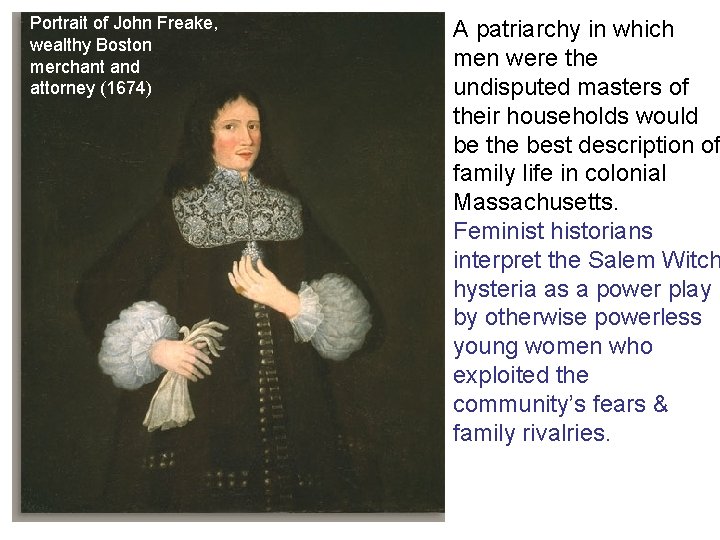
Portrait of John Freake, wealthy Boston merchant and attorney (1674) A patriarchy in which men were the undisputed masters of their households would be the best description of family life in colonial Massachusetts. Feminist historians interpret the Salem Witch hysteria as a power play by otherwise powerless young women who exploited the community’s fears & family rivalries.
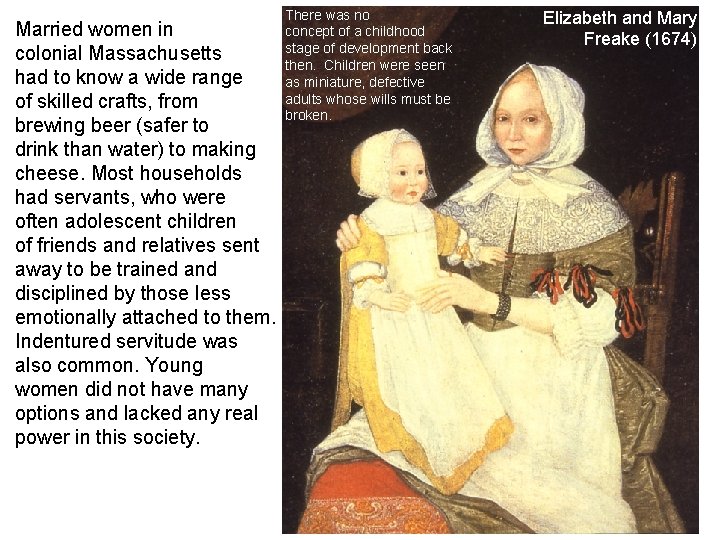
Married women in colonial Massachusetts had to know a wide range of skilled crafts, from brewing beer (safer to drink than water) to making cheese. Most households had servants, who were often adolescent children of friends and relatives sent away to be trained and disciplined by those less emotionally attached to them. Indentured servitude was also common. Young women did not have many options and lacked any real power in this society. There was no concept of a childhood stage of development back then. Children were seen as miniature, defective adults whose wills must be broken. Elizabeth and Mary Freake (1674)
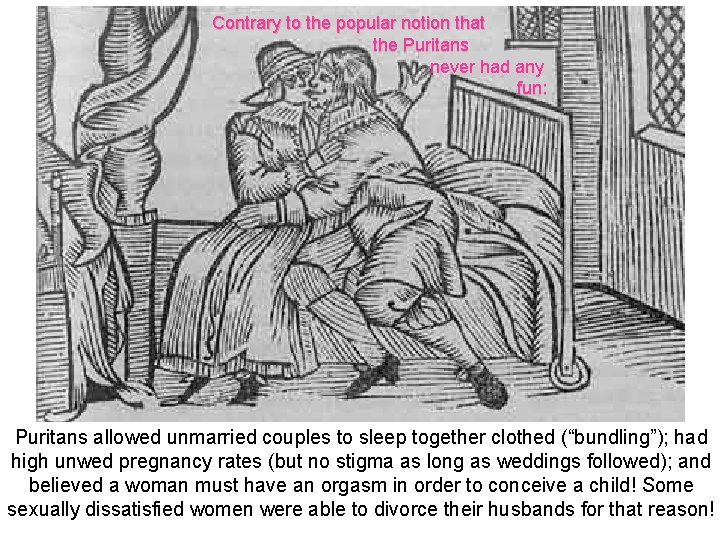
Contrary to the popular notion that the Puritans never had any fun: Puritans allowed unmarried couples to sleep together clothed (“bundling”); had high unwed pregnancy rates (but no stigma as long as weddings followed); and believed a woman must have an orgasm in order to conceive a child! Some sexually dissatisfied women were able to divorce their husbands for that reason!
Puritan Intolerance Back in England, Puritans had been persecuted for their religious beliefs. In the Massachusetts Bay theocracy (where religious leaders were also political leaders) Puritans became the persecutors of others (especially Quakers, some of whom were hanged) as well as those among their own number who disagreed with the colony’s leadership.
Puritans & Quakers • All good Puritans knew that Quakers trembled & shook in their meetings & claimed to be in touch with an ‘inner light. ’ • To Puritans, this sounded suspiciously like possession. • From the time of Gov. Andros’ administration onward, Puritans felt they were being told to allow people who might be directly in touch with the Devil into their towns & villages!
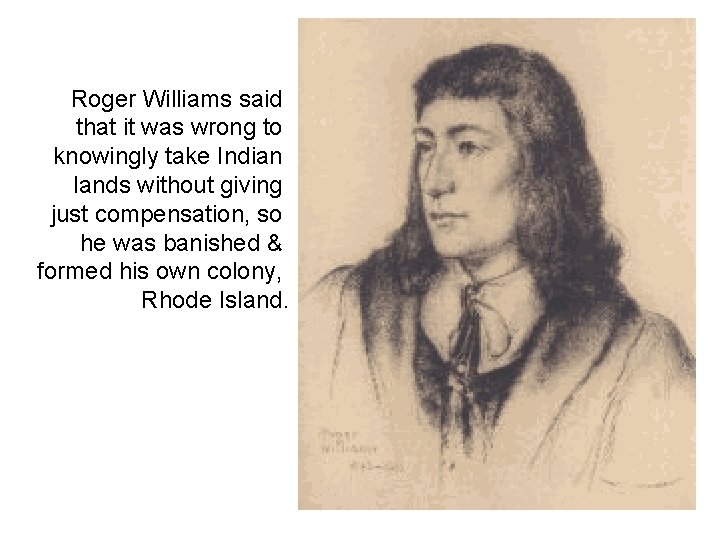
Roger Williams said that it was wrong to knowingly take Indian lands without giving just compensation, so he was banished & formed his own colony, Rhode Island.
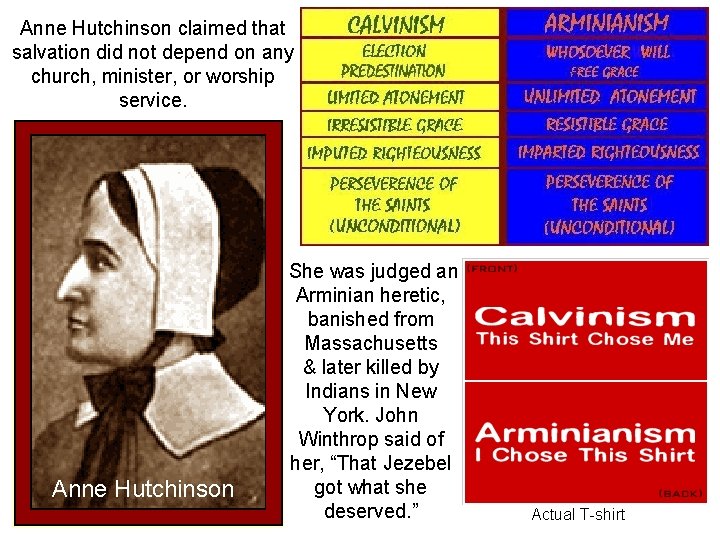
Anne Hutchinson claimed that salvation did not depend on any church, minister, or worship service. Anne Hutchinson She was judged an Arminian heretic, banished from Massachusetts & later killed by Indians in New York. John Winthrop said of her, “That Jezebel got what she deserved. ” Actual T-shirt
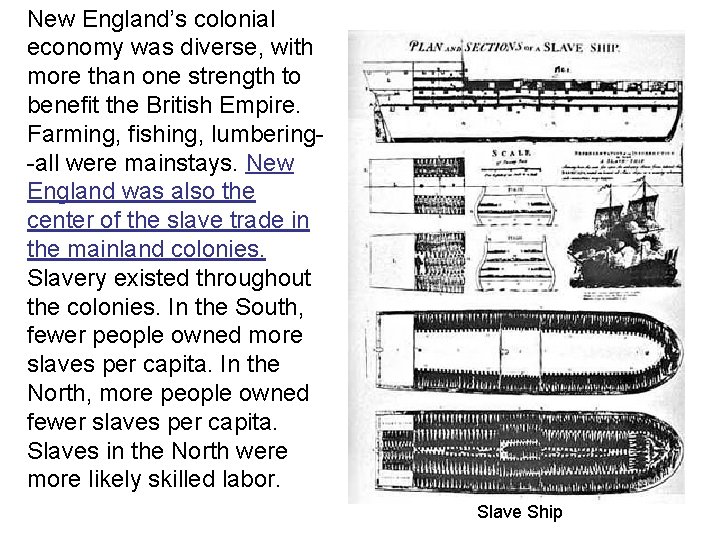
New England’s colonial economy was diverse, with more than one strength to benefit the British Empire. Farming, fishing, lumbering-all were mainstays. New England was also the center of the slave trade in the mainland colonies. Slavery existed throughout the colonies. In the South, fewer people owned more slaves per capita. In the North, more people owned fewer slaves per capita. Slaves in the North were more likely skilled labor. Slave Ship
The Puritan Decline Within little more than a generation of their coming to America, Puritan clergymen had already begun lamenting the fact that the children of the Elect--to their surprise--had not all turned out godly; the importance of religion in daily life had declined; people were too interested in money, trade, commerce; and patterns of settlement had become dispersed and de-centralized. Hard-line Calvinism was on the wane. But, at the time of the American Revolution, most all non-Anglican Christians here still believed in some form of predestination--and, moreover, that the apocalyptic event triggering both the destruction of the world and the start of Christ’s 1000 -year reign (the Millennium) was not far off.
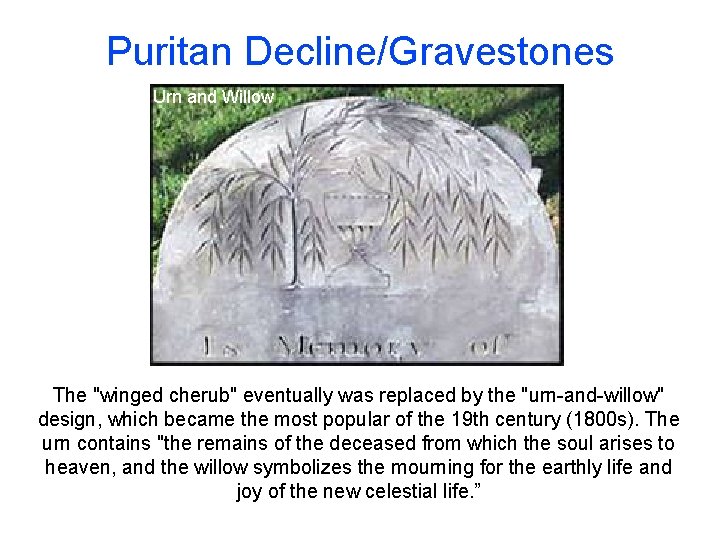
Tracing the Puritan Decline in New England’s Gravestones New England gravestones dating from the Colonial Era through the mid 1800 s exhibit three dominant funerary motifs that changed over time, each one giving way to the next. The first was the "death's head, " which (along with the epitaph "Here lies the body of. . ") was commonly used on graves from the early 1600 s to around 1700. The "death's head" represents the fragile mortality of humans and the awesome The second was the "winged cherub" or power of death. "soul effigy, " which (along with the epitaph "In memory of. . ") was dominant in the 1700 s but fell out of favor in the early 1800 s. The "winged cherub" suggests immortality and the hope of heaven, where the soul will spend eternity. Death’s Head Soul Effigy
Puritan Decline/Gravestones Urn and Willow The "winged cherub" eventually was replaced by the "urn-and-willow" design, which became the most popular of the 19 th century (1800 s). The urn contains "the remains of the deceased from which the soul arises to heaven, and the willow symbolizes the mourning for the earthly life and joy of the new celestial life. ”
Part Four: Explaining the Salem Witch Hunt
Witchcraft in Salem? Among social scientists, actual demonic possession brought on by witchcraft has never been a satisfactory explanation for what happened in Salem in 1692.
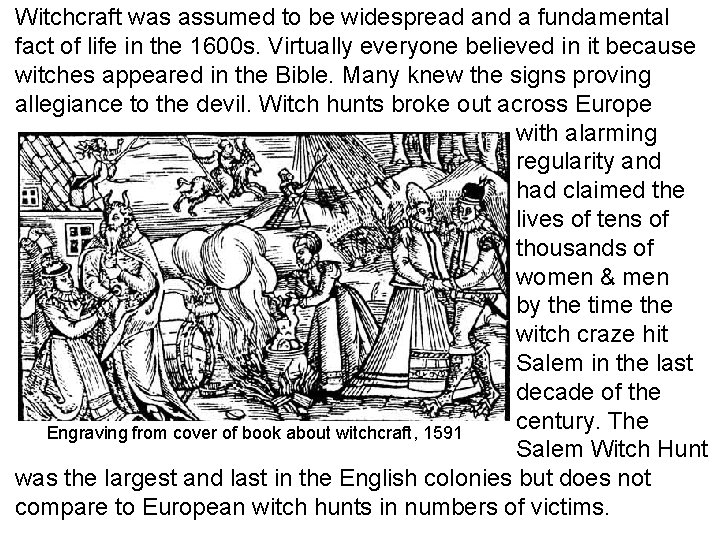
Witchcraft was assumed to be widespread and a fundamental fact of life in the 1600 s. Virtually everyone believed in it because witches appeared in the Bible. Many knew the signs proving allegiance to the devil. Witch hunts broke out across Europe with alarming regularity and had claimed the lives of tens of thousands of women & men by the time the witch craze hit Salem in the last decade of the century. The Engraving from cover of book about witchcraft, 1591 Salem Witch Hunt was the largest and last in the English colonies but does not compare to European witch hunts in numbers of victims.
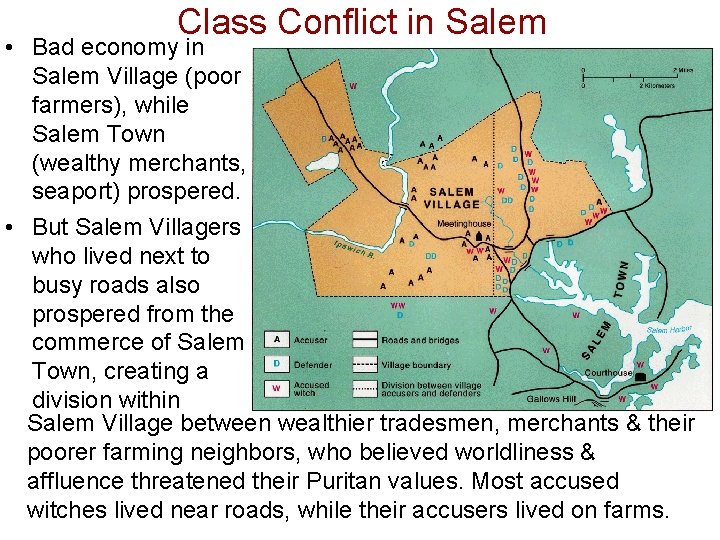
Class Conflict in Salem • Bad economy in Salem Village (poor farmers), while Salem Town (wealthy merchants, seaport) prospered. • But Salem Villagers who lived next to busy roads also prospered from the commerce of Salem Town, creating a division within Salem Village between wealthier tradesmen, merchants & their poorer farming neighbors, who believed worldliness & affluence threatened their Puritan values. Most accused witches lived near roads, while their accusers lived on farms.
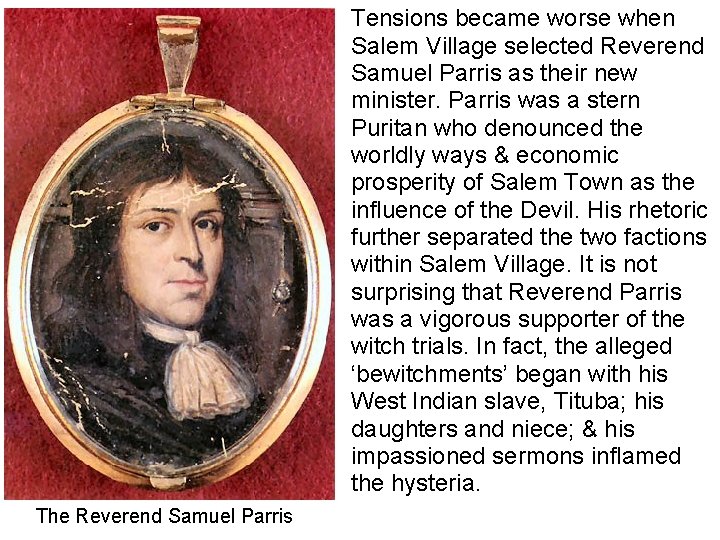
Tensions became worse when Salem Village selected Reverend Samuel Parris as their new minister. Parris was a stern Puritan who denounced the worldly ways & economic prosperity of Salem Town as the influence of the Devil. His rhetoric further separated the two factions within Salem Village. It is not surprising that Reverend Parris was a vigorous supporter of the witch trials. In fact, the alleged ‘bewitchments’ began with his West Indian slave, Tituba; his daughters and niece; & his impassioned sermons inflamed the hysteria. The Reverend Samuel Parris
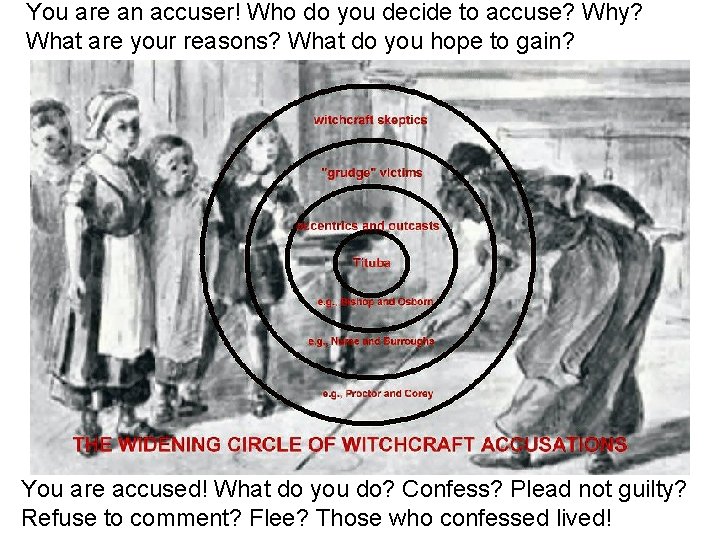
You are an accuser! Who do you decide to accuse? Why? What are your reasons? What do you hope to gain? You are accused! What do you do? Confess? Plead not guilty? Refuse to comment? Flee? Those who confessed lived!
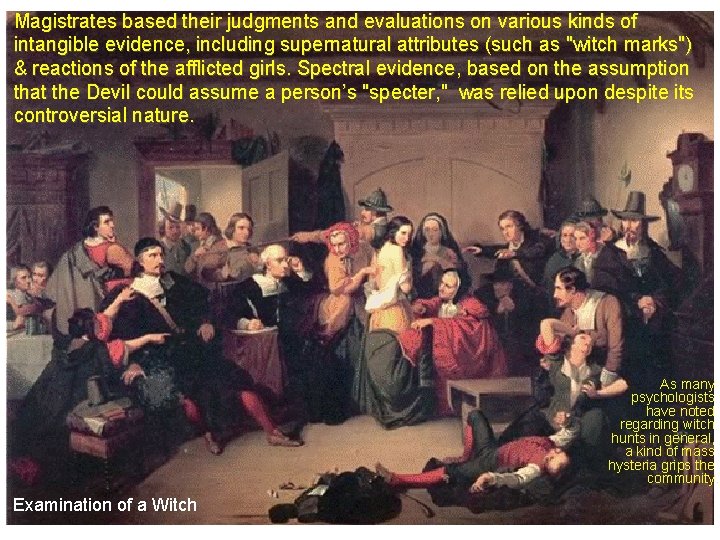
Magistrates based their judgments and evaluations on various kinds of intangible evidence, including supernatural attributes (such as "witch marks") & reactions of the afflicted girls. Spectral evidence, based on the assumption that the Devil could assume a person’s "specter, " was relied upon despite its controversial nature. As many psychologists have noted regarding witch hunts in general, a kind of mass hysteria grips the community. Examination of a Witch
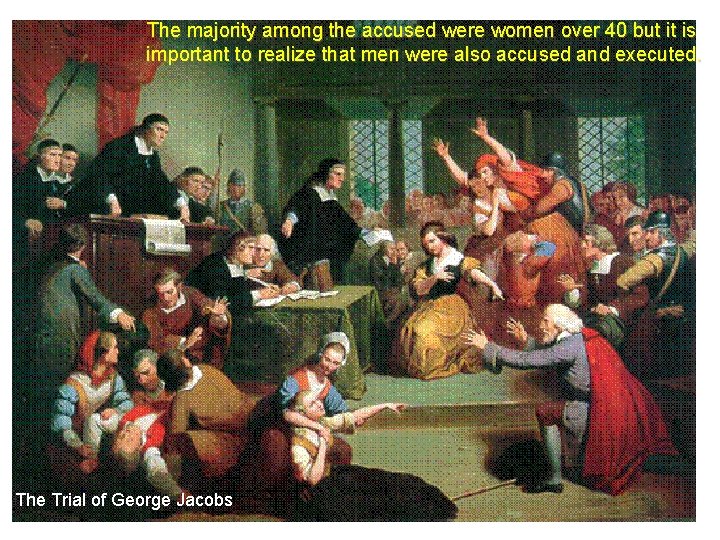
The majority among the accused were women over 40 but it is important to realize that men were also accused and executed. The Trial of George Jacobs
Ergot as Explanation? • In 1670 a French physician, Dr. Thuillier put forth the concept that the condition known as “St. Anthony’s Fire”--which had symptoms in common with alleged bewitchments--was not an infectious disease, but one that was due to the consumption of rye infected with ergot. • In 1976 psychologist Linda Caporael proposed that those who displayed symptoms of bewitchment in Salem (and surrounding areas) in 1692 were actually suffering from ergotism, but we cannot say for certain.
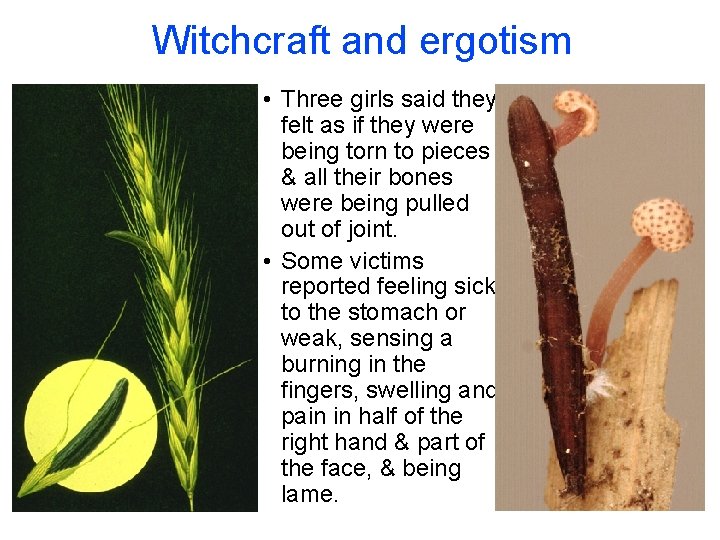
Ergot and Ergotism – A disease of cereals, especially rye and occasionally other grasses caused by the fungus Claviceps purpurea. • When ingested by humans or animals in sufficient quantity, ergot (nature’s LSD) produces a disease called “ergotism” which has in serious cases two variants: – 1. convulsive--characterized by nervous dysfunction, such as writhing, tremors, and hallucinations, which in the past were frequently reported as “convulsions” or “fits. ” – 2. gangrenous--victims of gangrenous ergotism may lose fingers, toes, and limbs to dry gangrene, caused by an alkaloid chemical produced by the ergot fungus.
Witchcraft and ergotism – Symptoms of bewitchment in Massachusetts • The victims did not have true convulsions because they did not lose consciousness (victims of convulsive ergotism writhe and have spasms but do not lose consciousness. ) • 24/30 victims of bewitchment in 1692 suffered from “fits” and the sensations of being pinched, pricked or bitten, all of which are common symptoms of ergotism. • Temporary blindness, deafness, and speechlessness, burning sensations, visions, and the sensation flying through the air (out of body).
Witchcraft and ergotism • Three girls said they felt as if they were being torn to pieces & all their bones were being pulled out of joint. • Some victims reported feeling sick to the stomach or weak, sensing a burning in the fingers, swelling and pain in half of the right hand & part of the face, & being lame.
Witchcraft Trials End • The trials lasted a relatively short time in 1692 • 19 people executed; 1 tortured to death. • Dramatic impact on nation’s development & dramatic legacy even today • Modern witch hunts? ? – Mc. Carthyism, 2 nd Red Scare (1950 s) – Alleged Child Abuse by ‘Satanic’ Cults in 1980 s – Arrest of and Anger Toward Arab-Americans after 9/11 • Why did the hunt for witches end? – After 20 people had been executed in the Salem witch hunt, Thomas Brattle wrote a letter criticizing the witchcraft trials. This letter had great impact on Governor Phips, whose wife was accused. Phips ordered that reliance on spectral and intangible evidence no longer be allowed in trials & dissolved the Court investigating witchcraft accusations.