
Module 05 Sample Collection Referral 1172022 1 Learning
- Slides: 22
Module 05 Sample Collection & Referral 1/17/2022 1
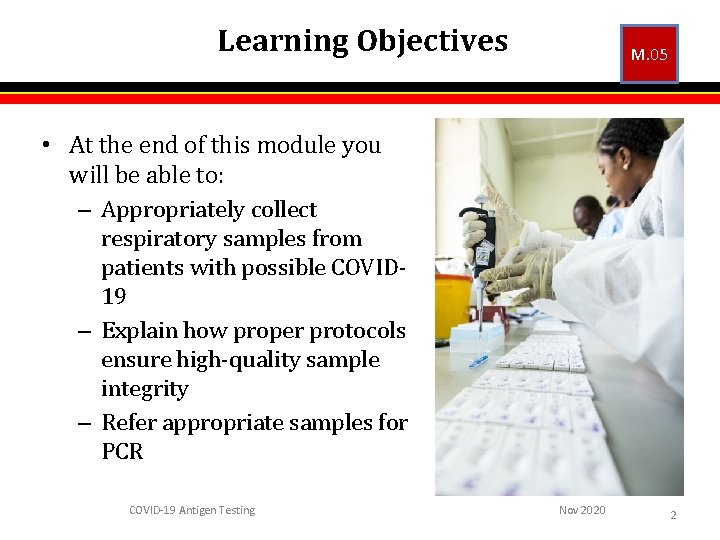
Learning Objectives M. 05 • At the end of this module you will be able to: – Appropriately collect respiratory samples from patients with possible COVID 19 – Explain how proper protocols ensure high-quality sample integrity – Refer appropriate samples for PCR COVID-19 Antigen Testing Nov 2020 2
Introduction to Sample Collection • Collecting good samples is first step in determining diagnosis and treatment. – Critical for rapid-diagnosis of COVID-19 • Collecting high-quality samples using proper protocols: – Is critical in the testing and diagnosis of COVID-19 – Includes: proper collection and proper sample handling – Increases the likelihood of a usable result (for any diagnostic test) – Reduces likelihood of generating false-negative test results (in turn, protecting communities from potential transmission) • Responsible cadre: trained clinician or nurses, lab techs, and other frontline healthcare workers properly trained to safely collect, handle, and transport patient samples COVID-19 Antigen Testing Nov. 2020 3
General Guidelines • Read, understand, and adhere strictly to all applicable biosafety measures for collecting, handling, and managing samples for COVID-19 testing – Using established sample collection procedures helps yield high quality samples • Timing: – Collect the sample as soon as possible, regardless symptom onset timing – Test the sample as soon as possible after collection • Correct sample collection technique is critical; otherwise, a HCW might cause injury to patient COVID-19 Antigen Testing HCW should always practice standard and transmission-based precautions Nov. 2020 4
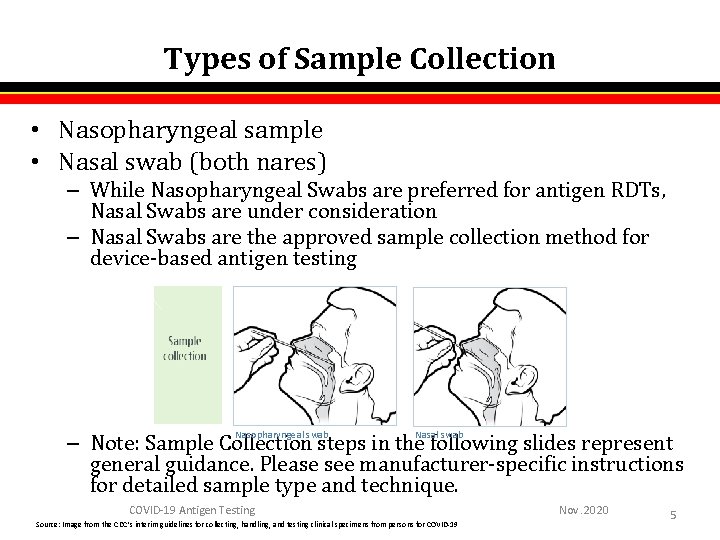
Types of Sample Collection • Nasopharyngeal sample • Nasal swab (both nares) – While Nasopharyngeal Swabs are preferred for antigen RDTs, Nasal Swabs are under consideration – Nasal Swabs are the approved sample collection method for device-based antigen testing Nasopharyngeal swab Nasal swab – Note: Sample Collection steps in the following slides represent general guidance. Please see manufacturer-specific instructions for detailed sample type and technique. COVID-19 Antigen Testing Source: Image from the CDC’s interim guidelines for collecting, handling, and testing clinical specimens from persons for COVID-19 Nov. 2020 5
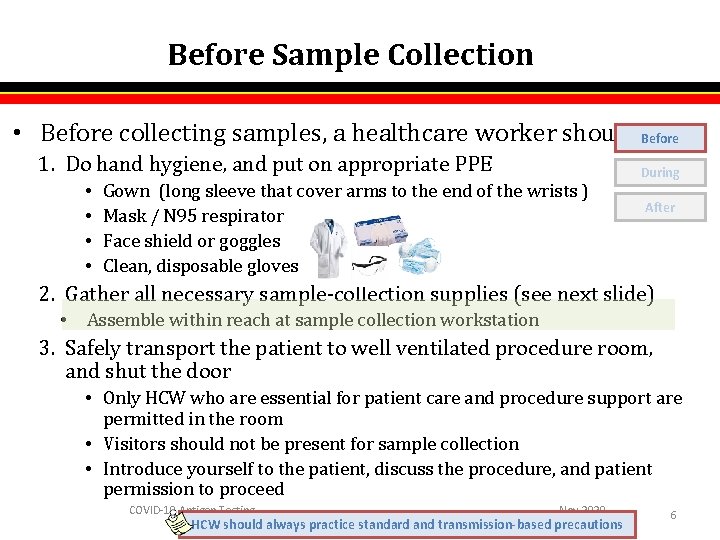
Before Sample Collection • Before collecting samples, a healthcare worker should: Before 1. Do hand hygiene, and put on appropriate PPE • • Gown (long sleeve that cover arms to the end of the wrists ) Mask / N 95 respirator Face shield or goggles Clean, disposable gloves During After 2. Gather all necessary sample-collection supplies (see next slide) • Assemble within reach at sample collection workstation 3. Safely transport the patient to well ventilated procedure room, and shut the door • Only HCW who are essential for patient care and procedure support are permitted in the room • Visitors should not be present for sample collection • Introduce yourself to the patient, discuss the procedure, and patient permission to proceed COVID-19 Antigen Testing Nov. 2020 HCW should always practice standard and transmission-based precautions 6
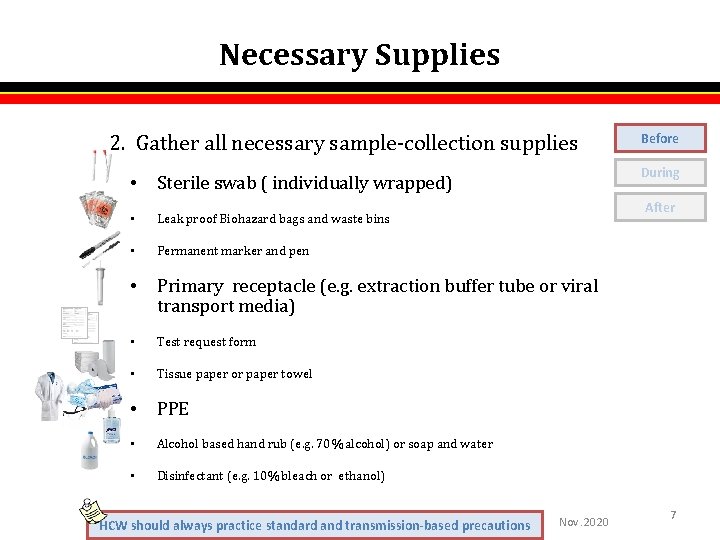
Necessary Supplies 2. Gather all necessary sample-collection supplies During • Sterile swab ( individually wrapped) • Leak proof Biohazard bags and waste bins • Permanent marker and pen • Primary receptacle (e. g. extraction buffer tube or viral transport media) • Test request form • Tissue paper or paper towel • PPE • Alcohol based hand rub (e. g. 70% alcohol) or soap and water • Disinfectant (e. g. 10% bleach or ethanol) Antigenpractice Testing standard and transmission-based precautions HCW COVID-19 should always Before After Nov. 2020 7
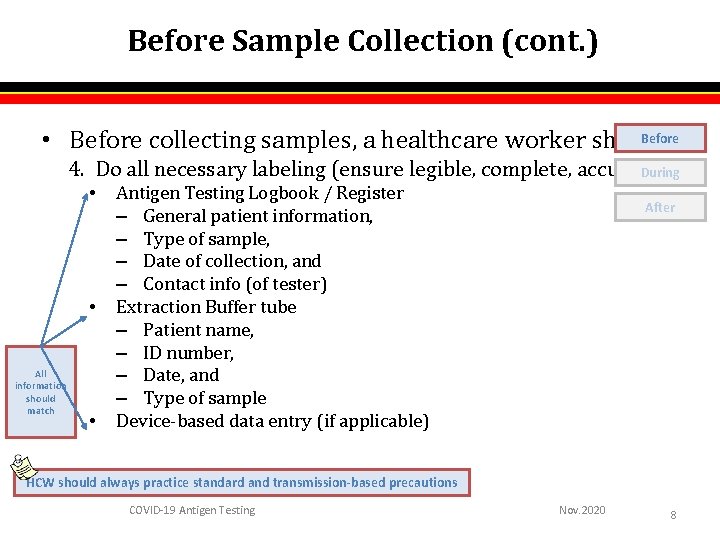
Before Sample Collection (cont. ) Before • Before collecting samples, a healthcare worker should: 4. Do all necessary labeling (ensure legible, complete, accurate) During • • All information should match • Antigen Testing Logbook / Register – General patient information, – Type of sample, – Date of collection, and – Contact info (of tester) Extraction Buffer tube – Patient name, – ID number, – Date, and – Type of sample Device-based data entry (if applicable) After HCW should always practice standard and transmission-based precautions COVID-19 Antigen Testing Nov. 2020 8
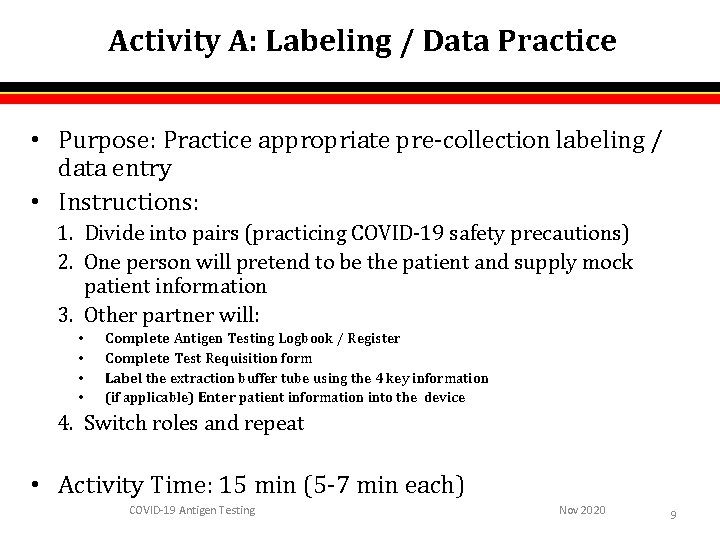
Activity A: Labeling / Data Practice • Purpose: Practice appropriate pre-collection labeling / data entry • Instructions: 1. Divide into pairs (practicing COVID-19 safety precautions) 2. One person will pretend to be the patient and supply mock patient information 3. Other partner will: • • Complete Antigen Testing Logbook / Register Complete Test Requisition form Label the extraction buffer tube using the 4 key information (if applicable) Enter patient information into the device 4. Switch roles and repeat • Activity Time: 15 min (5 -7 min each) COVID-19 Antigen Testing Nov 2020 9
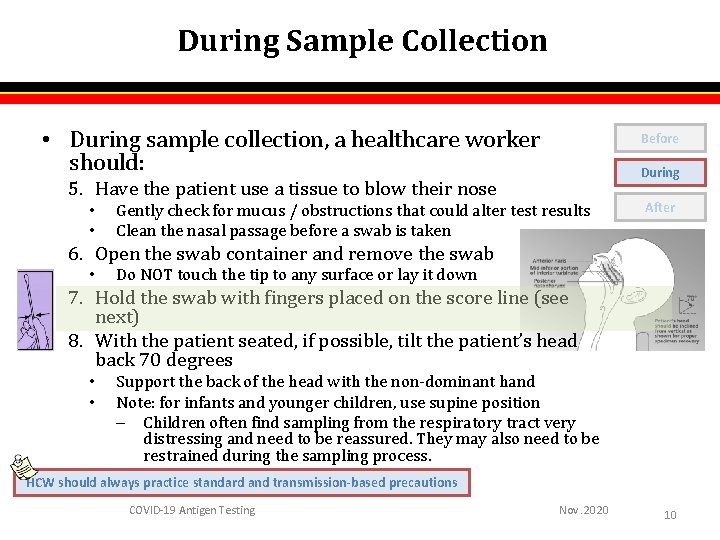
During Sample Collection • During sample collection, a healthcare worker should: Before During 5. Have the patient use a tissue to blow their nose • • Gently check for mucus / obstructions that could alter test results Clean the nasal passage before a swab is taken After 6. Open the swab container and remove the swab • Do NOT touch the tip to any surface or lay it down 7. Hold the swab with fingers placed on the score line (see next) 8. With the patient seated, if possible, tilt the patient’s head back 70 degrees • • Support the back of the head with the non-dominant hand Note: for infants and younger children, use supine position – Children often find sampling from the respiratory tract very distressing and need to be reassured. They may also need to be restrained during the sampling process. HCW should always practice standard and transmission-based precautions COVID-19 Antigen Testing Nov. 2020 10
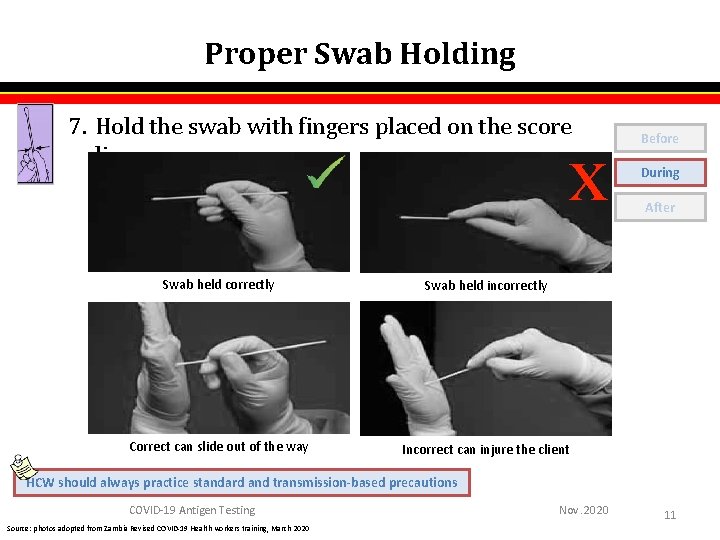
Proper Swab Holding 7. Hold the swab with fingers placed on the score line x Swab held correctly Swab held incorrectly Correct can slide out of the way Incorrect can injure the client Before During After HCW should always practice standard and transmission-based precautions COVID-19 Antigen Testing Source: photos adopted from Zambia Revised COVID-19 Health workers training, March 2020 Nov. 2020 11
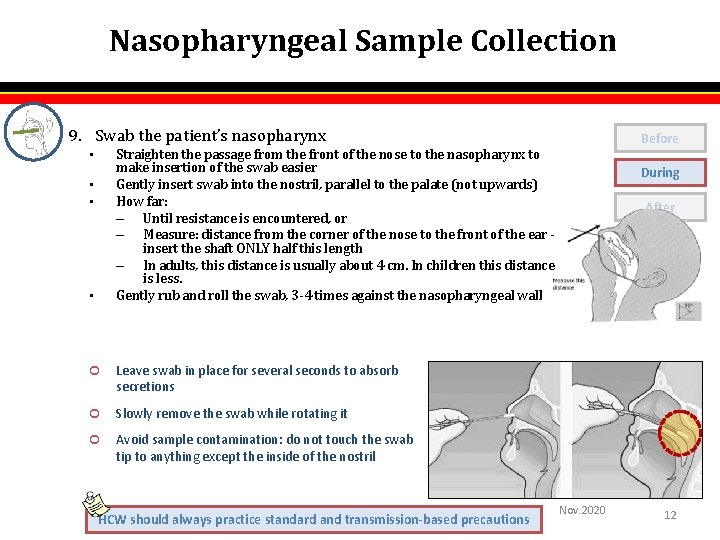
Nasopharyngeal Sample Collection 9. Swab the patient’s nasopharynx Before Straighten the passage from the front of the nose to the nasopharynx to make insertion of the swab easier Gently insert swab into the nostril, parallel to the palate (not upwards) How far: – Until resistance is encountered, or – Measure: distance from the corner of the nose to the front of the ear insert the shaft ONLY half this length – In adults, this distance is usually about 4 cm. In children this distance is less. Gently rub and roll the swab, 3 -4 times against the nasopharyngeal wall • • Leave swab in place for several seconds to absorb secretions Slowly remove the swab while rotating it Avoid sample contamination: do not touch the swab tip to anything except the inside of the nostril COVID-19 Antigen Testing HCW should always practice standard and transmission-based precautions During After Nov. 2020 12
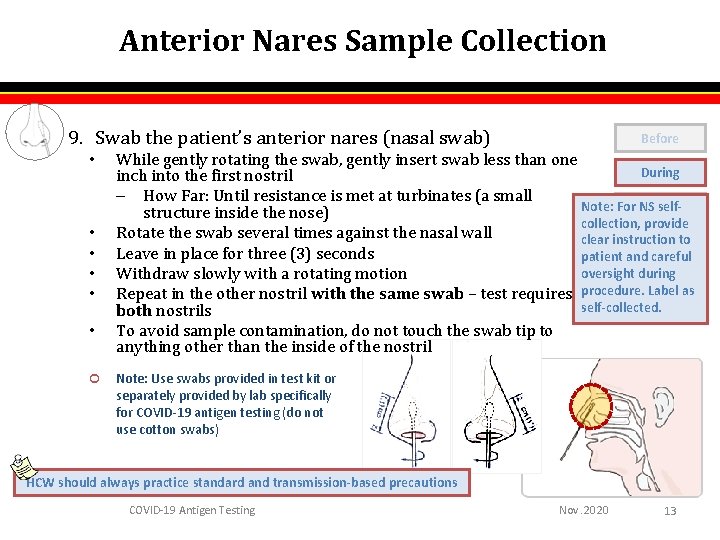
Anterior Nares Sample Collection 9. Swab the patient’s anterior nares (nasal swab) • • • Before While gently rotating the swab, gently insert swab less than one During inch into the first nostril – How Far: Until resistance is met at turbinates (a small Note: For NS self. After structure inside the nose) collection, provide Rotate the swab several times against the nasal wall clear instruction to Leave in place for three (3) seconds patient and careful oversight during Withdraw slowly with a rotating motion Repeat in the other nostril with the same swab – test requires procedure. Label as self-collected. both nostrils To avoid sample contamination, do not touch the swab tip to anything other than the inside of the nostril Note: Use swabs provided in test kit or separately provided by lab specifically for COVID-19 antigen testing (do not use cotton swabs) HCW should always practice standard and transmission-based precautions COVID-19 Antigen Testing Nov. 2020 13
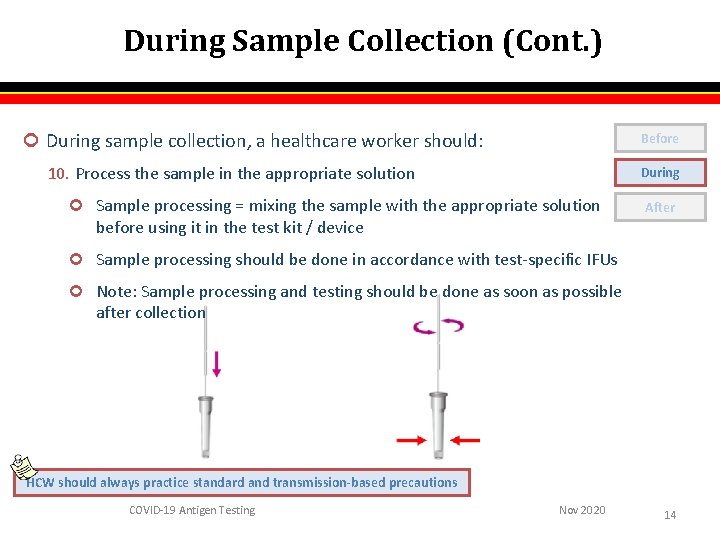
During Sample Collection (Cont. ) During sample collection, a healthcare worker should: Before 10. Process the sample in the appropriate solution During Sample processing = mixing the sample with the appropriate solution After before using it in the test kit / device Sample processing should be done in accordance with test-specific IFUs Note: Sample processing and testing should be done as soon as possible after collection HCW should always practice standard and transmission-based precautions COVID-19 Antigen Testing Nov 2020 14
Activity B: Sample Collection Practice • Purpose: Practice appropriate sample collection procedures • Instructions: 1. Divide into pairs (practicing COVID-19 safety precautions) 2. One person will pretend to be the patient and consent to being tested 3. Other partner will: • • Put on PPE and observe transmission-based precaution With supervision, perform sample collection 4. Switch roles and repeat • Activity Time: 20 min (10 min each) COVID-19 Antigen Testing Nov. 2020 15
After Sample Collection (1) • After collecting samples, a healthcare worker should: 11. Test the sample as soon as possible after collection – If not possible to test the sample immediately, follow test specific IFU recommendations for storage • • Before During After Nasopharyngeal samples may be stored and tested at room temperature for 1 -2 hours The extracted nasal swab sample must be used within 5 hours when stored at room temperature – Extracted nasal samples may be frozen at -80°C and tested up to 5 days after freezing – Note: Samples and extraction buffer must be at room temperature before testing – According to your country algorithm, if a second sample is to be collected for NAAT molecular testing, ensure appropriate materials and reagents (e. g. viral transport medium) are available at the workstation COVID-19 Antigen Testing HCW should always practice standard and transmission-based precautions Nov. 2020 16
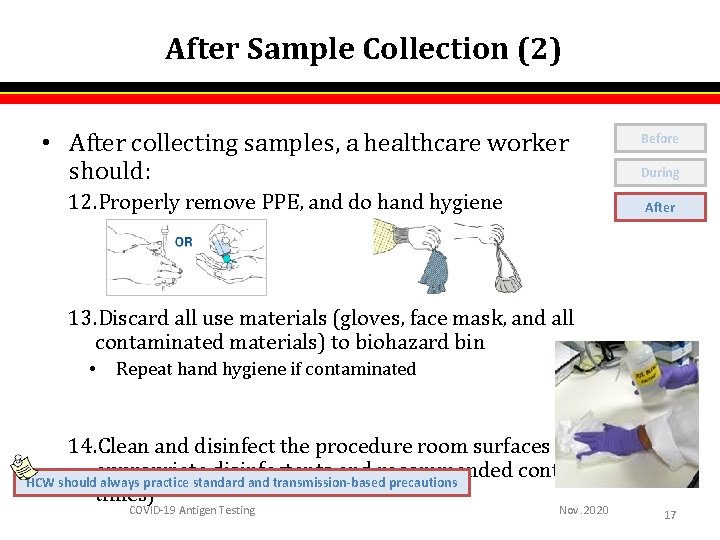
After Sample Collection (2) • After collecting samples, a healthcare worker should: 12. Properly remove PPE, and do hand hygiene Before During After 13. Discard all use materials (gloves, face mask, and all contaminated materials) to biohazard bin • Repeat hand hygiene if contaminated 14. Clean and disinfect the procedure room surfaces (using appropriate disinfectants and recommended contact HCW should always practice standard and transmission-based precautions times) COVID-19 Antigen Testing Nov. 2020 17
OFF-Site Contingency • If lab-testing is not available on-site, a healthcare worker should: – Pack for transport immediately after collection • • • Package samples individually in a plastic zipper bag following the: – Triple Packaging System (see next slide) Place samples inside the cooler-box – In the upright position – On tube rack – Well secured Keep the cooler-box lid closed – Transport at room temperature immediately after packing • • Transport within the time recommended by manufacturer Alert the designated testing site before sending the sample(s) HCW should always practice standard and transmission-based precautions COVID-19 Antigen Testing Nov. 2020 18
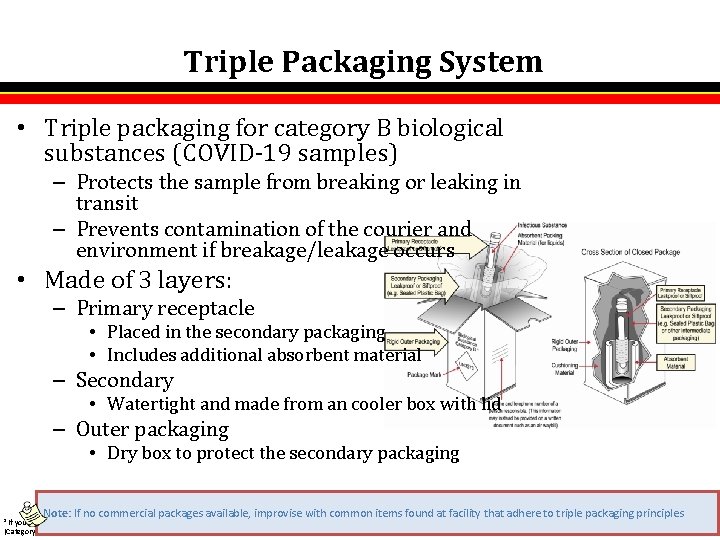
Triple Packaging System • Triple packaging for category B biological substances (COVID-19 samples) – Protects the sample from breaking or leaking in transit – Prevents contamination of the courier and environment if breakage/leakage occurs • Made of 3 layers: – Primary receptacle • Placed in the secondary packaging • Includes additional absorbent material – Secondary • Watertight and made from an cooler box with lid – Outer packaging • Dry box to protect the secondary packaging COVID-19 Antigen Testingimprovise with common items found at facility that adhere to triple Nov. 2020 Note: If no commercial packages available, packaging principles 19 If you ship samples to WHO reference laboratories or collaborating centres outside the country or ship samples by air, you must ensure compliance with all international standards (IATA) for Biological Substances (Category B) a
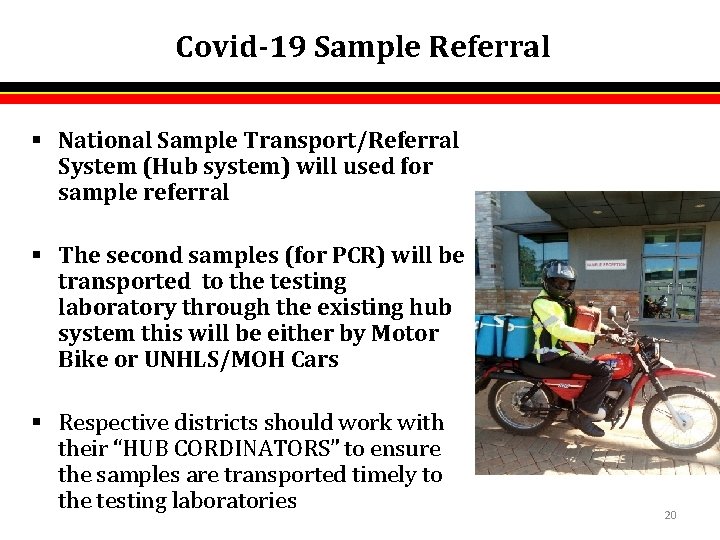
Covid-19 Sample Referral § National Sample Transport/Referral System (Hub system) will used for sample referral § The second samples (for PCR) will be transported to the testing laboratory through the existing hub system this will be either by Motor Bike or UNHLS/MOH Cars § Respective districts should work with their “HUB CORDINATORS” to ensure the samples are transported timely to the testing laboratories 20
Summary § Two samples should be collected 1. Sample for Ag testing 2. For PCR testing (in transport media) § Proper documentation must be maintained at the facility – Results of the RDT must be recorded in on the CIF accompaning the sample for RDT – Record of RDT results and PCR in the daily Covid-19 register – Chain of custody forms be completed for sample tracking 21
QUESTIONS