
Modulational instability and wave growth in finite water
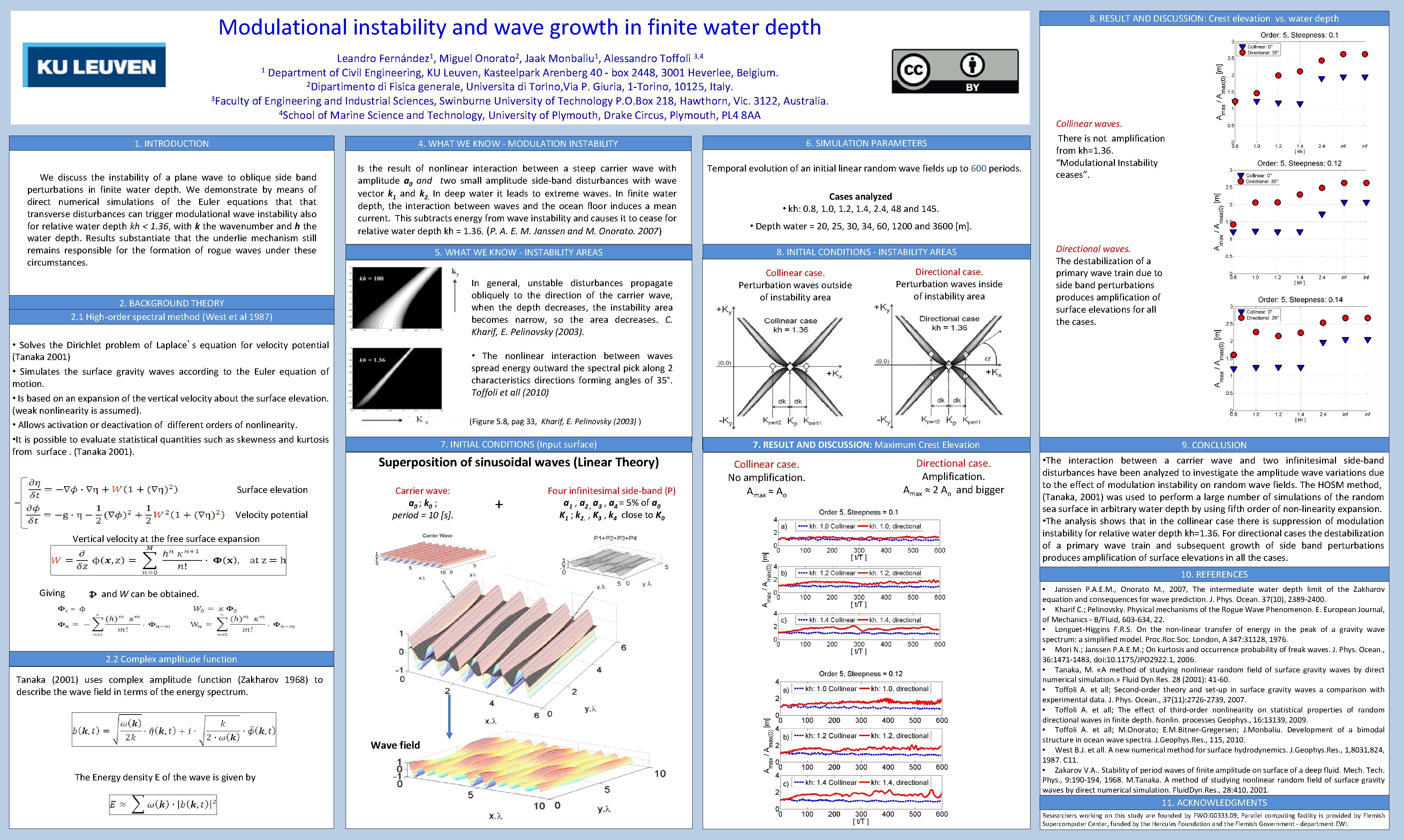
Modulational instability and wave growth in finite water depth 8. RESULT AND DISCUSSION: Crest elevation vs. water depth Leandro Fernández 1, Miguel Onorato 2, Jaak Monbaliu 1, Alessandro Toffoli 3, 4 1 Department of Civil Engineering, KU Leuven, Kasteelpark Arenberg 40 - box 2448, 3001 Heverlee, Belgium. 2 Dipartimento di Fisica generale, Universita di Torino, Via P. Giuria, 1 -Torino, 10125, Italy. 3 Faculty of Engineering and Industrial Sciences, Swinburne University of Technology P. O. Box 218, Hawthorn, Vic. 3122, Australia. 4 School of Marine Science and Technology, University of Plymouth, Drake Circus, Plymouth, PL 4 8 AA 1. INTRODUCTION We discuss the instability of a plane wave to oblique side band perturbations in finite water depth. We demonstrate by means of direct numerical simulations of the Euler equations that transverse disturbances can trigger modulational wave instability also for relative water depth kh < 1. 36, with k the wavenumber and h the water depth. Results substantiate that the underlie mechanism still remains responsible for the formation of rogue waves under these circumstances. 4. WHAT WE KNOW - MODULATION INSTABILITY 6. SIMULATION PARAMETERS Is the result of nonlinear interaction between a steep carrier wave with amplitude a 0 and two small amplitude side-band disturbances with wave vector k 1 and k 2. In deep water it leads to extreme waves. In finite water depth, the interaction between waves and the ocean floor induces a mean current. This subtracts energy from wave instability and causes it to cease for relative water depth kh = 1. 36. (P. A. E. M. Janssen and M. Onorato. 2007) Temporal evolution of an initial linear random wave fields up to 600 periods. 5. WHAT WE KNOW - INSTABILITY AREAS 8. INITIAL CONDITIONS - INSTABILITY AREAS In general, unstable disturbances propagate obliquely to the direction of the carrier wave, when the depth decreases, the instability area becomes narrow, so the area decreases. C. Kharif, E. Pelinovsky (2003). 2. BACKGROUND THEORY 2. 1 High-order spectral method (West et al 1987) • Solves the Dirichlet problem of Laplace’s equation for velocity potential (Tanaka 2001) • Simulates the surface gravity waves according to the Euler equation of motion. • Is based on an expansion of the vertical velocity about the surface elevation. (weak nonlinearity is assumed). • Allows activation or deactivation of different orders of nonlinearity. • It is possible to evaluate statistical quantities such as skewness and kurtosis from surface. (Tanaka 2001). Surface elevation Velocity potential • Depth water = 20, 25, 30, 34, 60, 1200 and 3600 [m]. Collinear case. Perturbation waves outside of instability area Directional case. Perturbation waves inside of instability area Directional waves. The destabilization of a primary wave train due to side band perturbations produces amplification of surface elevations for all the cases. (Figure 5. 8, pag 33, Kharif, E. Pelinovsky (2003) ) 7. INITIAL CONDITIONS (Input surface) Superposition of sinusoidal waves (Linear Theory) Carrier wave: a 0 ; k 0 ; period = 10 [s]. + + and W can be obtained. 2. 2 Complex amplitude function Tanaka (2001) uses complex amplitude function (Zakharov 1968) to describe the wave field in terms of the energy spectrum. Wave field The Energy density E of the wave is given by Cases analyzed • kh: 0. 8, 1. 0, 1. 2, 1. 4, 2. 4, 48 and 145. • The nonlinear interaction between waves spread energy outward the spectral pick along 2 characteristics directions forming angles of 35°. Toffoli et all (2010) Vertical velocity at the free surface expansion Giving Collinear waves. There is not amplification from kh=1. 36. “Modulational Instability ceases”. Four infinitesimal side-band (P) a 1 , a 2 , a 3 , a 4 = 5% of a 0 K 1 ; k 2. , K 3 , k 4 close to K 0 7. RESULT AND DISCUSSION: Maximum Crest Elevation Collinear case. No amplification. Amax ≈ Ao Directional case. Amplification. Amax ≈ 2 Ao and bigger 9. CONCLUSION • The interaction between a carrier wave and two infinitesimal side-band disturbances have been analyzed to investigate the amplitude wave variations due to the effect of modulation instability on random wave fields. The HOSM method, (Tanaka, 2001) was used to perform a large number of simulations of the random sea surface in arbitrary water depth by using fifth order of non-linearity expansion. • The analysis shows that in the collinear case there is suppression of modulation instability for relative water depth kh=1. 36. For directional cases the destabilization of a primary wave train and subsequent growth of side band perturbations produces amplification of surface elevations in all the cases. 10. REFERENCES • Janssen P. A. E. M. , Onorato M. , 2007, The intermediate water depth limit of the Zakharov equation and consequences for wave prediction. J. Phys. Ocean. 37(10), 2389 -2400. • Kharif C. ; Pelinovsky. Physical mechanisms of the Rogue Wave Phenomenon. E. European Journal, of Mechanics - B/Fluid, 603 -634, 22. • Longuet-Higgins F. R. S. On the non-linear transfer of energy in the peak of a gravity wave spectrum: a simplified model. Proc. Roc. Soc. London, A 347: 31128, 1976. • Mori N. ; Janssen P. A. E. M. ; On kurtosis and occurrence probability of freak waves. J. Phys. Ocean. , 36: 1471 -1483, doi: 10. 1175/JPO 2922. 1, 2006. • Tanaka, M. «A method of studying nonlinear random field of surface gravity waves by direct numerical simulation. » Fluid Dyn. Res. 28 (2001): 41 -60. • Toffoli A. et all; Second-order theory and set-up in surface gravity waves a comparison with experimental data. J. Phys. Ocean. , 37(11): 2726 -2739, 2007. • Toffoli A. et all; The effect of third-order nonlinearity on statistical properties of random directional waves in finite depth. Nonlin. processes Geophys. , 16: 13139, 2009. • Toffoli A. et all; M. Onorato; E. M. Bitner-Gregersen; J. Monbaliu. Development of a bimodal structure in ocean wave spectra. J. Geophys. Res. , 115, 2010. • West B. J. et all. A new numerical method for surface hydrodynemics. J. Geophys. Res. , 1, 8031, 824, 1987. C 11. • Zakarov V. A. . Stability of period waves of finite amplitude on surface of a deep fluid. Mech. Tech. Phys. , 9: 190 -194, 1968. M. Tanaka. A method of studying nonlinear random field of surface gravity waves by direct numerical simulation. Fluid. Dyn. Res. , 28: 410, 2001. 11. ACKNOWLEDGMENTS Researchers working on this study are founded by FWO. G 0333. 09; Parallel computing facility is provided by Flemish Supercomputer Center, funded by the Hercules Foundation and the Flemish Government - department EWI.
- Slides: 1