
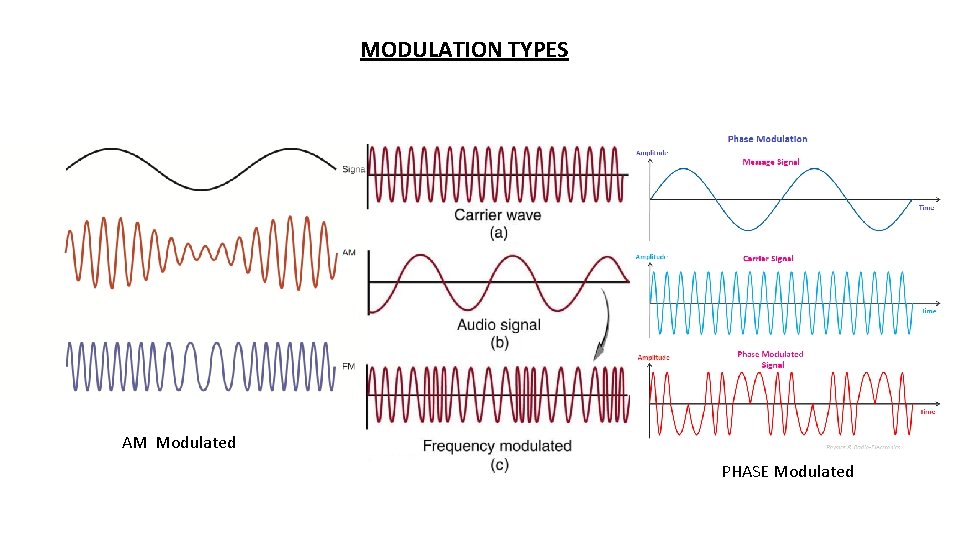
MODULATION TYPES AM Modulated PHASE Modulated AM MODULATION

- Slides: 7
MODULATION TYPES AM Modulated PHASE Modulated
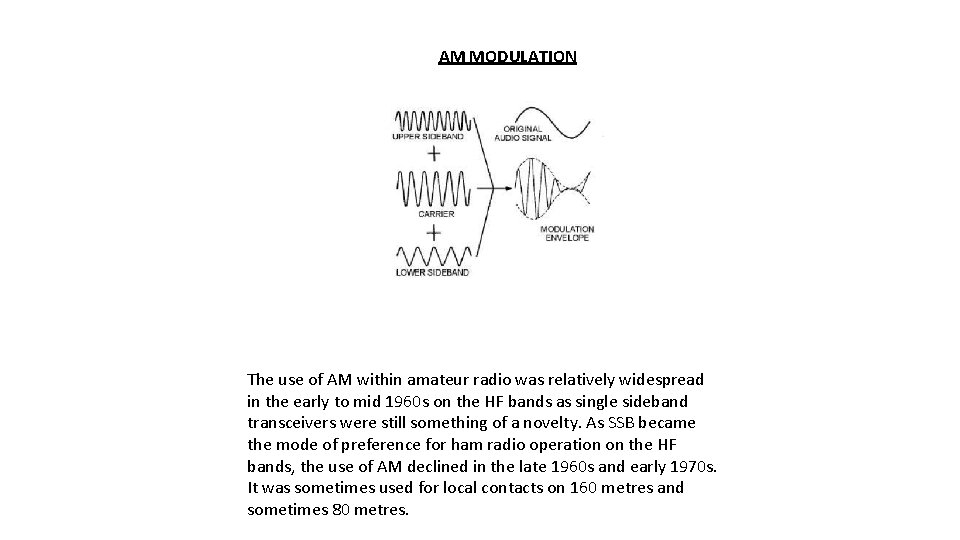
AM MODULATION The use of AM within amateur radio was relatively widespread in the early to mid 1960 s on the HF bands as single sideband transceivers were still something of a novelty. As SSB became the mode of preference for ham radio operation on the HF bands, the use of AM declined in the late 1960 s and early 1970 s. It was sometimes used for local contacts on 160 metres and sometimes 80 metres.
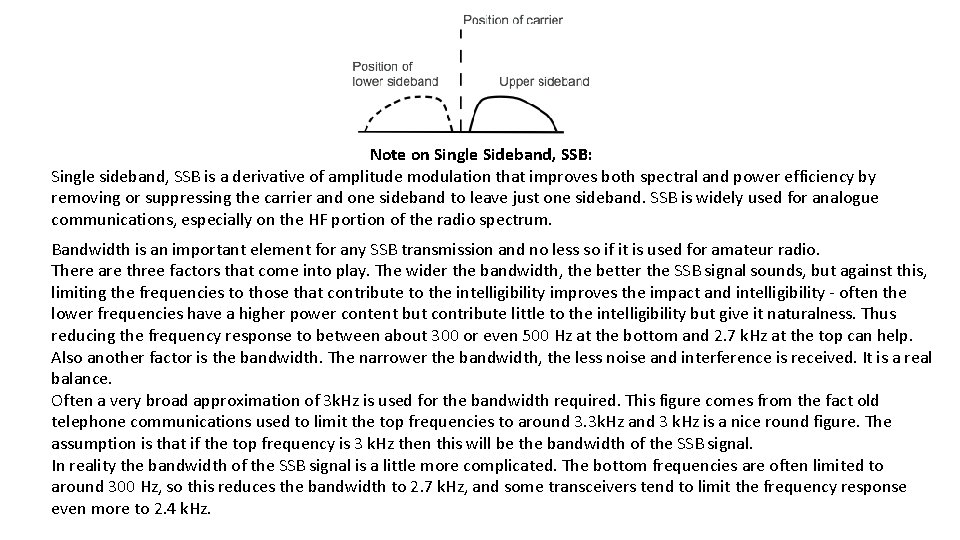
Note on Single Sideband, SSB: Single sideband, SSB is a derivative of amplitude modulation that improves both spectral and power efficiency by removing or suppressing the carrier and one sideband to leave just one sideband. SSB is widely used for analogue communications, especially on the HF portion of the radio spectrum. Bandwidth is an important element for any SSB transmission and no less so if it is used for amateur radio. There are three factors that come into play. The wider the bandwidth, the better the SSB signal sounds, but against this, limiting the frequencies to those that contribute to the intelligibility improves the impact and intelligibility - often the lower frequencies have a higher power content but contribute little to the intelligibility but give it naturalness. Thus reducing the frequency response to between about 300 or even 500 Hz at the bottom and 2. 7 k. Hz at the top can help. Also another factor is the bandwidth. The narrower the bandwidth, the less noise and interference is received. It is a real balance. Often a very broad approximation of 3 k. Hz is used for the bandwidth required. This figure comes from the fact old telephone communications used to limit the top frequencies to around 3. 3 k. Hz and 3 k. Hz is a nice round figure. The assumption is that if the top frequency is 3 k. Hz then this will be the bandwidth of the SSB signal. In reality the bandwidth of the SSB signal is a little more complicated. The bottom frequencies are often limited to around 300 Hz, so this reduces the bandwidth to 2. 7 k. Hz, and some transceivers tend to limit the frequency response even more to 2. 4 k. Hz.
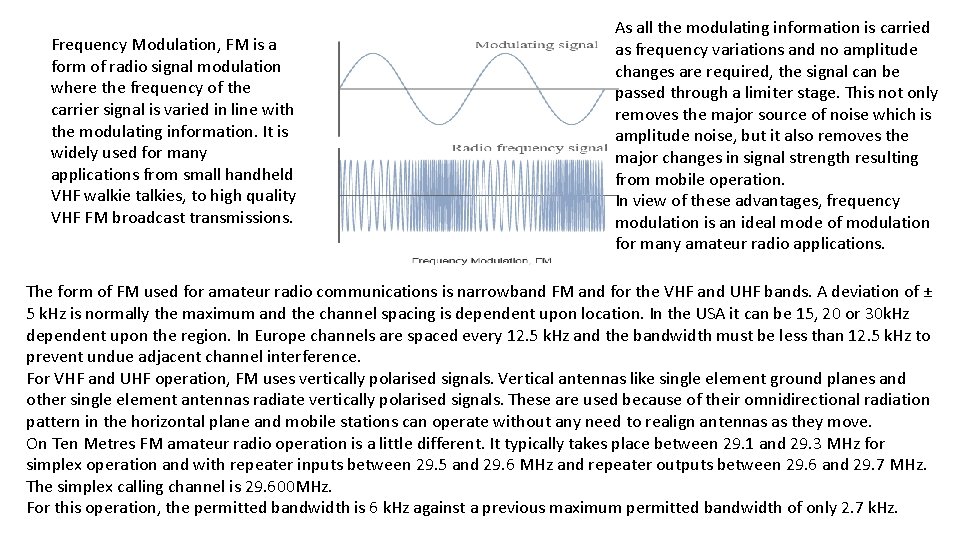
Frequency Modulation, FM is a form of radio signal modulation where the frequency of the carrier signal is varied in line with the modulating information. It is widely used for many applications from small handheld VHF walkie talkies, to high quality VHF FM broadcast transmissions. As all the modulating information is carried as frequency variations and no amplitude changes are required, the signal can be passed through a limiter stage. This not only removes the major source of noise which is amplitude noise, but it also removes the major changes in signal strength resulting from mobile operation. In view of these advantages, frequency modulation is an ideal mode of modulation for many amateur radio applications. The form of FM used for amateur radio communications is narrowband FM and for the VHF and UHF bands. A deviation of ± 5 k. Hz is normally the maximum and the channel spacing is dependent upon location. In the USA it can be 15, 20 or 30 k. Hz dependent upon the region. In Europe channels are spaced every 12. 5 k. Hz and the bandwidth must be less than 12. 5 k. Hz to prevent undue adjacent channel interference. For VHF and UHF operation, FM uses vertically polarised signals. Vertical antennas like single element ground planes and other single element antennas radiate vertically polarised signals. These are used because of their omnidirectional radiation pattern in the horizontal plane and mobile stations can operate without any need to realign antennas as they move. On Ten Metres FM amateur radio operation is a little different. It typically takes place between 29. 1 and 29. 3 MHz for simplex operation and with repeater inputs between 29. 5 and 29. 6 MHz and repeater outputs between 29. 6 and 29. 7 MHz. The simplex calling channel is 29. 600 MHz. For this operation, the permitted bandwidth is 6 k. Hz against a previous maximum permitted bandwidth of only 2. 7 k. Hz.
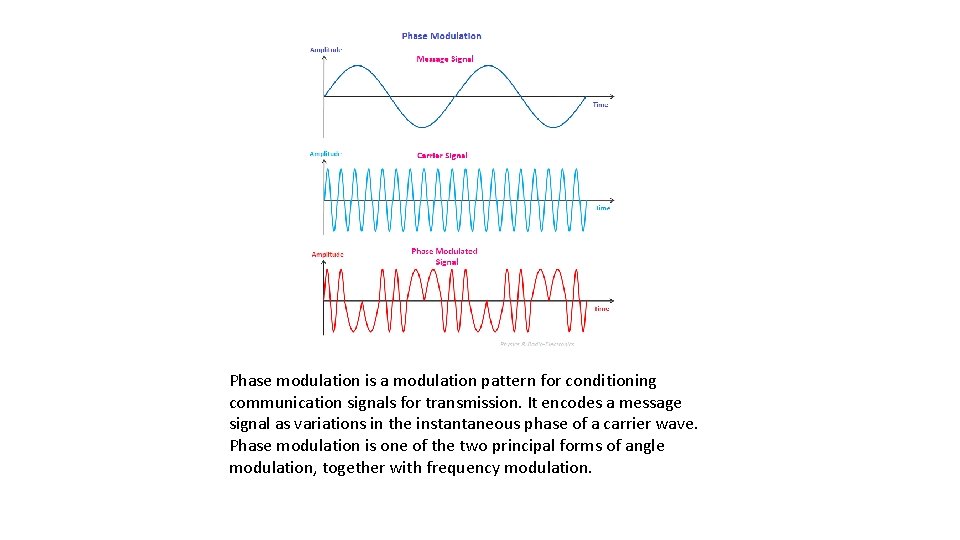
Phase modulation is a modulation pattern for conditioning communication signals for transmission. It encodes a message signal as variations in the instantaneous phase of a carrier wave. Phase modulation is one of the two principal forms of angle modulation, together with frequency modulation.
The FCC limits bandwidth without regard to modulation type. The actual bandwidth is defined at the point where the signal level is 26 d. B down And would actually contained 99% of the signal power. Most radios have filters of defined bandwidth and are designed to meet this requirement. Bandwidths can be variable and tuned in some radios to help eliminate or lower and interfereing signal Nearby you’re frequency.