
Modulation Techniques for Mobile Radio CS 515 Mobile
Modulation Techniques for Mobile Radio CS 515 Mobile and Wireless Networking Ibrahim Korpeoglu Computer Engineering Department Bilkent University CS 515 © Ibrahim Korpeoglu 1
What is modulation n n Modulation is the process of encoding information from a message source in a manner suitable for transmission It involves translating a baseband message signal to a bandpass signal at frequencies that are very high compared to the baseband frequency. Baseband signal is called modulating signal Bandpass signal is called modulated signal CS 515 © Ibrahim Korpeoglu 2
Modulation Techniques n Modulation can be done by varying the Amplitude q Phase, or q Frequency of a high frequency carrier in accordance with the amplitude of the message signal. q n Demodulation is the inverse operation: extracting the baseband message from the carrier so that it may be processed at the receiver. CS 515 © Ibrahim Korpeoglu 3
Analog/Digital Modulation n Analog Modulation q q n The input is continues signal Used in first generation mobile radio systems such as AMPS in USA. Digital Modulation q q CS 515 The input is time sequence of symbols or pulses. Are used in current and future mobile radio systems © Ibrahim Korpeoglu 4
Goal of Modulation Techniques n Modulation is difficult task given the hostile mobile radio channels n n Small-scale fading and multipath conditions. The goal of a modulation scheme is: q q CS 515 Transport the message signal through the radio channel with best possible quality Occupy least amount of radio (RF) spectrum. © Ibrahim Korpeoglu 5
Frequency versus Amplitude Modulation n Frequency Modulation (FM) q q q Most popular analog modulation technique Amplitude of the carrier signal is kept constant (constant envelope signal), the frequency of carrier is changed according to the amplitude of the modulating message signal; Hence info is carried in the phase or frequency of the carrier. Has better noise immunity: q q Performs better in multipath environment q q Increasing the bandwith occupied increases the SNR ratio. The relationship between received power and quality is non-linear. q q CS 515 Small-scale fading cause amplitude fluctuations as we have seen earlier. Can trade bandwidth occupancy for improved noise performance. q q atmospheric or impulse noise cause rapid fluctuations in the amplitude of the received signal Rapid increase in quality for an increase in received power. Resistant to co-channel interference (capture effect). © Ibrahim Korpeoglu 6
Amplitude Modulation (AM) n q q q CS 515 Changes the amplitude of the carrier signal according to the amplitude of the message signal All info is carried in the amplitude of the carrier There is a linear relationship between the received signal quality and received signal power. AM systems usually occupy less bandwidth then FM systems. AM carrier signal has time-varying envelope. © Ibrahim Korpeoglu 7
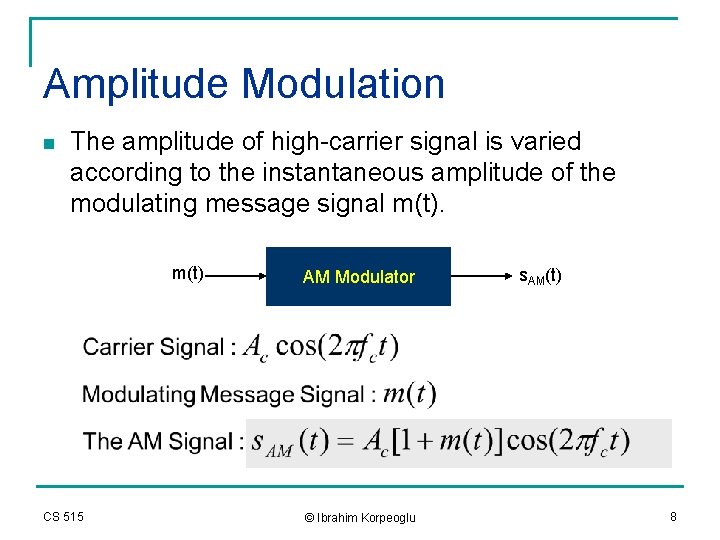
Amplitude Modulation n The amplitude of high-carrier signal is varied according to the instantaneous amplitude of the modulating message signal m(t) CS 515 AM Modulator © Ibrahim Korpeoglu s. AM(t) 8
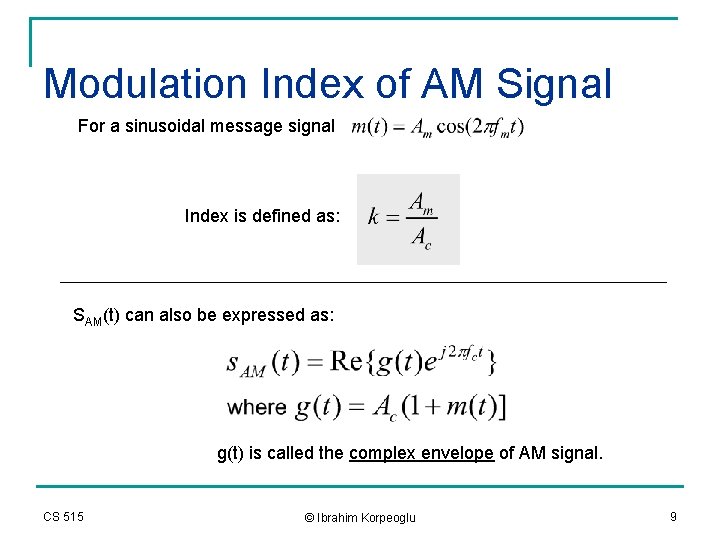
Modulation Index of AM Signal For a sinusoidal message signal Index is defined as: SAM(t) can also be expressed as: g(t) is called the complex envelope of AM signal. CS 515 © Ibrahim Korpeoglu 9
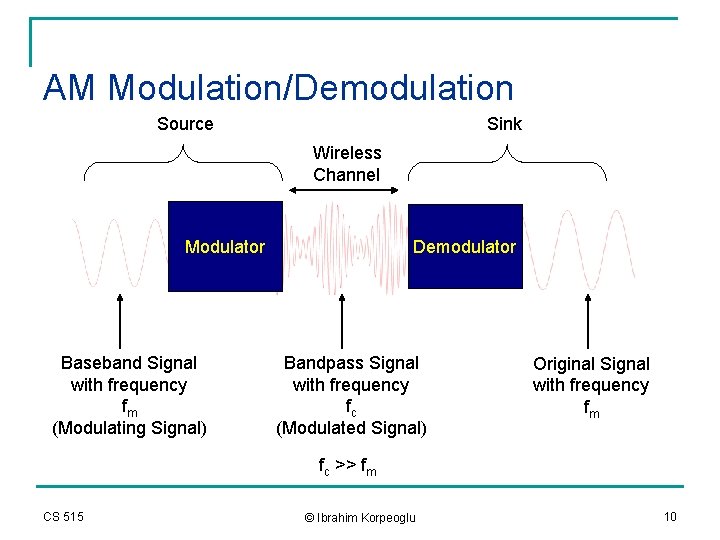
AM Modulation/Demodulation Source Sink Wireless Channel Demodulator Modulator Baseband Signal with frequency fm (Modulating Signal) Bandpass Signal with frequency fc (Modulated Signal) Original Signal with frequency fm fc >> fm CS 515 © Ibrahim Korpeoglu 10
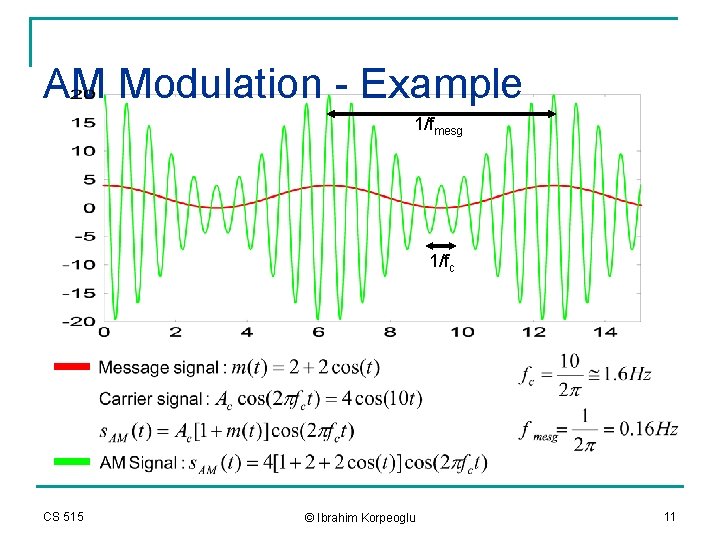
AM Modulation - Example 1/fmesg 1/fc CS 515 © Ibrahim Korpeoglu 11
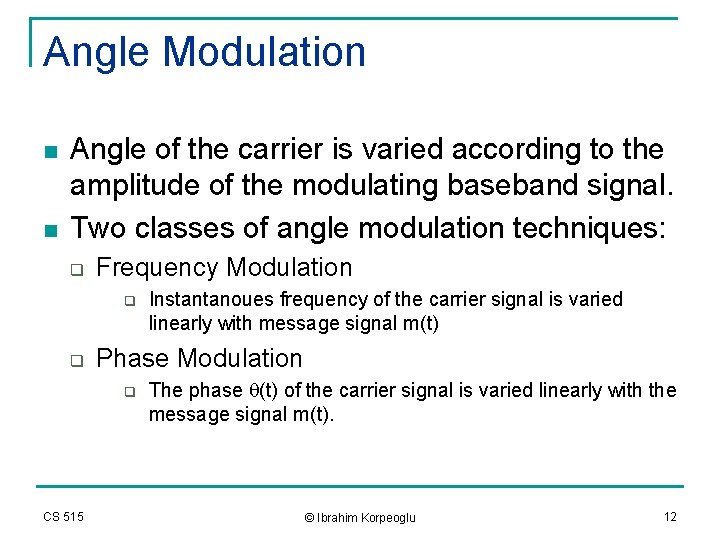
Angle Modulation n n Angle of the carrier is varied according to the amplitude of the modulating baseband signal. Two classes of angle modulation techniques: q Frequency Modulation q q Phase Modulation q CS 515 Instantanoues frequency of the carrier signal is varied linearly with message signal m(t) The phase q(t) of the carrier signal is varied linearly with the message signal m(t). © Ibrahim Korpeoglu 12
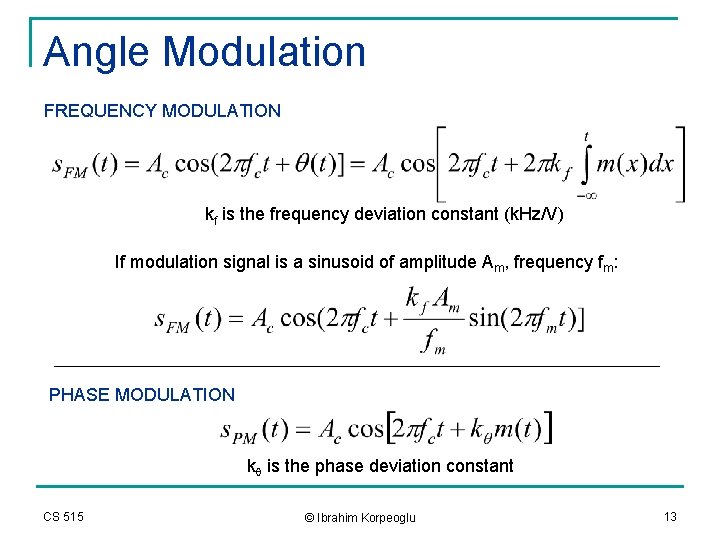
Angle Modulation FREQUENCY MODULATION kf is the frequency deviation constant (k. Hz/V) If modulation signal is a sinusoid of amplitude Am, frequency fm: PHASE MODULATION kq is the phase deviation constant CS 515 © Ibrahim Korpeoglu 13
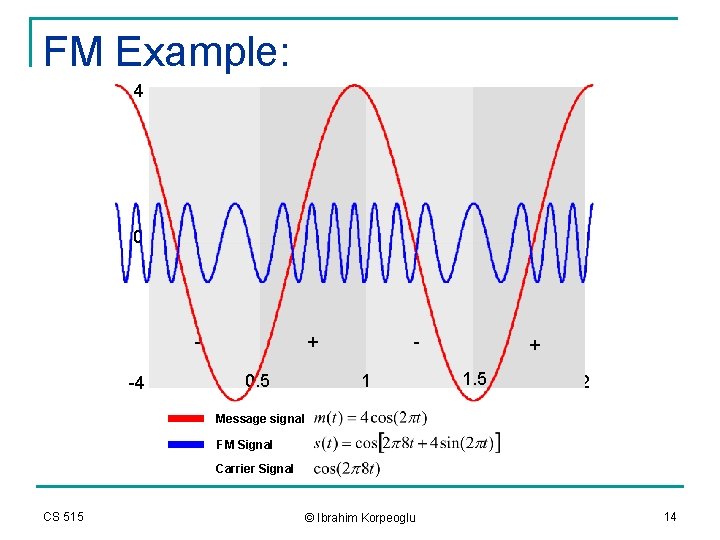
FM Example: 4 0 -4 + 0. 5 1 -+ 1. 5 2 Message signal FM Signal Carrier Signal CS 515 © Ibrahim Korpeoglu 14
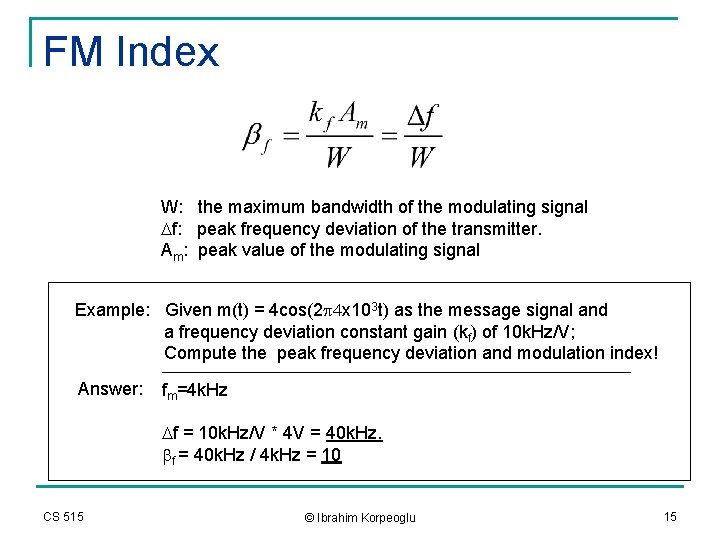
FM Index W: the maximum bandwidth of the modulating signal Df: peak frequency deviation of the transmitter. Am: peak value of the modulating signal Example: Given m(t) = 4 cos(2 p 4 x 10³ t) as the message signal and a frequency deviation constant gain (kf) of 10 k. Hz/V; Compute the peak frequency deviation and modulation index! Answer: fm=4 k. Hz Df = 10 k. Hz/V * 4 V = 40 k. Hz. bf = 40 k. Hz / 4 k. Hz = 10 CS 515 © Ibrahim Korpeoglu 15
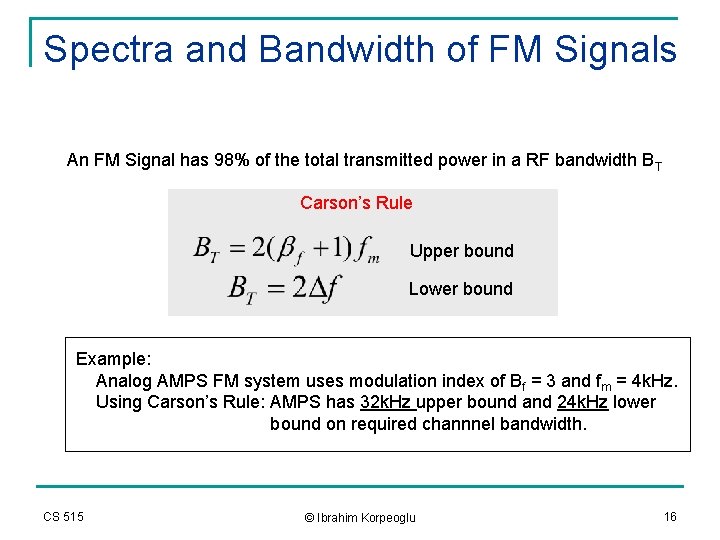
Spectra and Bandwidth of FM Signals An FM Signal has 98% of the total transmitted power in a RF bandwidth BT Carson’s Rule Upper bound Lower bound Example: Analog AMPS FM system uses modulation index of Bf = 3 and fm = 4 k. Hz. Using Carson’s Rule: AMPS has 32 k. Hz upper bound and 24 k. Hz lower bound on required channnel bandwidth. CS 515 © Ibrahim Korpeoglu 16
FM Demodulator n n Convert from the frequency of the carrier signal to the amplitude of the message signal FM Detection Techniques n n CS 515 Slope Detection Zero-crossing detection Phase-locked discrimination Quadrature detection © Ibrahim Korpeoglu 17
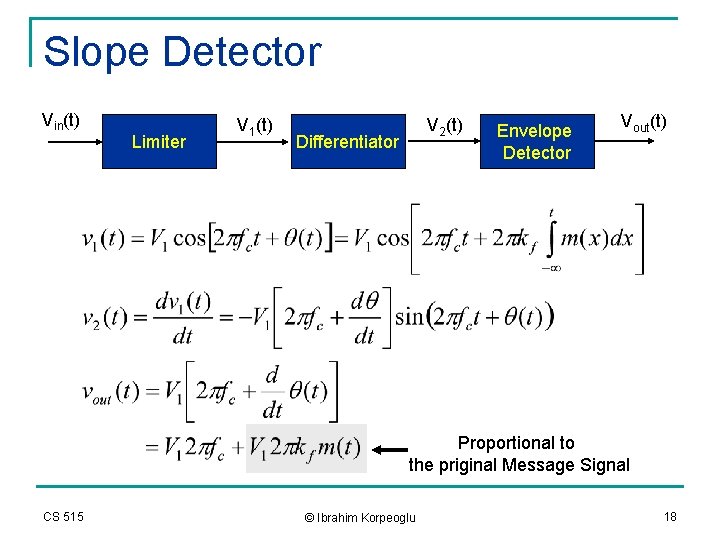
Slope Detector Vin(t) Limiter V 1(t) V 2(t) Differentiator Envelope Detector Vout(t) Proportional to the priginal Message Signal CS 515 © Ibrahim Korpeoglu 18
Digital Modulation n The input is discrete signals n n Time sequence of pulses or symbols Offers many advantages n n Robustness to channel impairments Easier multiplexing of variuous sources of information: voice, data, video. Can accommodate digital error-control codes Enables encryption of the transferred signals § CS 515 More secure link © Ibrahim Korpeoglu 19
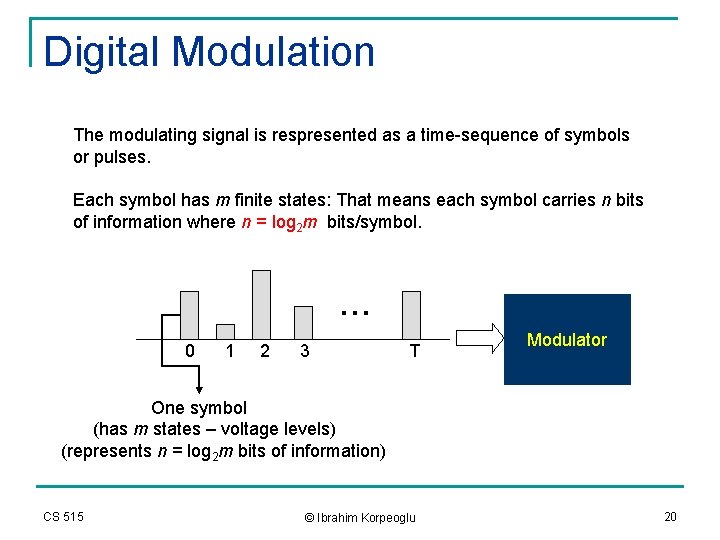
Digital Modulation The modulating signal is respresented as a time-sequence of symbols or pulses. Each symbol has m finite states: That means each symbol carries n bits of information where n = log 2 m bits/symbol. . 0 1 2 3 T Modulator One symbol (has m states – voltage levels) (represents n = log 2 m bits of information) CS 515 © Ibrahim Korpeoglu 20
Factors that Influence Choice of Digital Modulation Techniques n A desired modulation scheme n Provides low bit-error rates at low SNRs q n n Performs well in multipath and fading conditions Occupies minimum RF channel bandwidth q n n Power efficiecny Bandwidth efficieny Is easy and cost-effective to implement Depending on the demands of a particular system or application, tradeoffs are made when selecting a digital modulation scheme. CS 515 © Ibrahim Korpeoglu 21
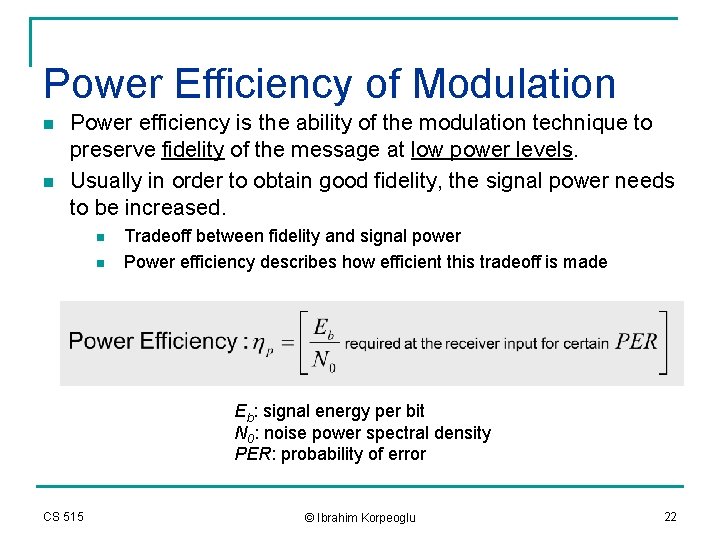
Power Efficiency of Modulation n n Power efficiency is the ability of the modulation technique to preserve fidelity of the message at low power levels. Usually in order to obtain good fidelity, the signal power needs to be increased. n n Tradeoff between fidelity and signal power Power efficiency describes how efficient this tradeoff is made Eb: signal energy per bit N 0: noise power spectral density PER: probability of error CS 515 © Ibrahim Korpeoglu 22
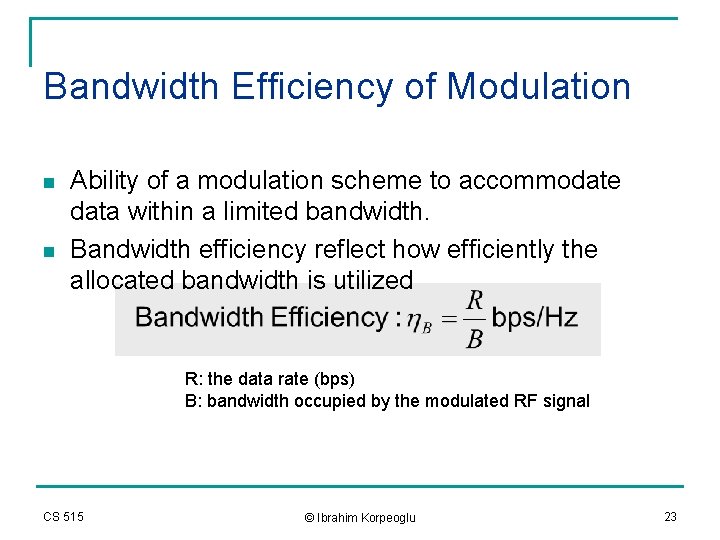
Bandwidth Efficiency of Modulation n n Ability of a modulation scheme to accommodate data within a limited bandwidth. Bandwidth efficiency reflect how efficiently the allocated bandwidth is utilized R: the data rate (bps) B: bandwidth occupied by the modulated RF signal CS 515 © Ibrahim Korpeoglu 23
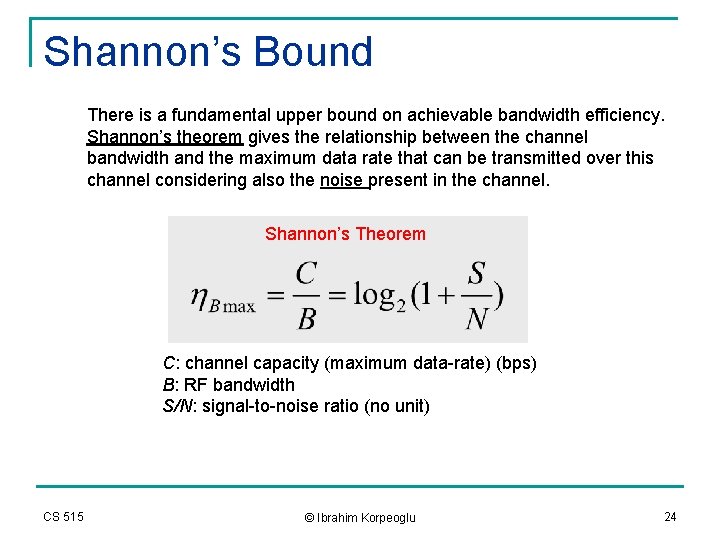
Shannon’s Bound There is a fundamental upper bound on achievable bandwidth efficiency. Shannon’s theorem gives the relationship between the channel bandwidth and the maximum data rate that can be transmitted over this channel considering also the noise present in the channel. Shannon’s Theorem C: channel capacity (maximum data-rate) (bps) B: RF bandwidth S/N: signal-to-noise ratio (no unit) CS 515 © Ibrahim Korpeoglu 24
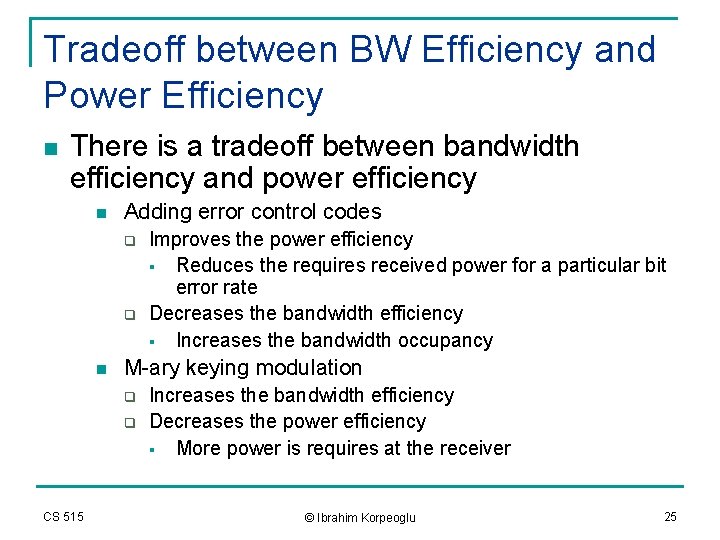
Tradeoff between BW Efficiency and Power Efficiency n There is a tradeoff between bandwidth efficiency and power efficiency n Adding error control codes q q n M-ary keying modulation q q CS 515 Improves the power efficiency § Reduces the requires received power for a particular bit error rate Decreases the bandwidth efficiency § Increases the bandwidth occupancy Increases the bandwidth efficiency Decreases the power efficiency § More power is requires at the receiver © Ibrahim Korpeoglu 25
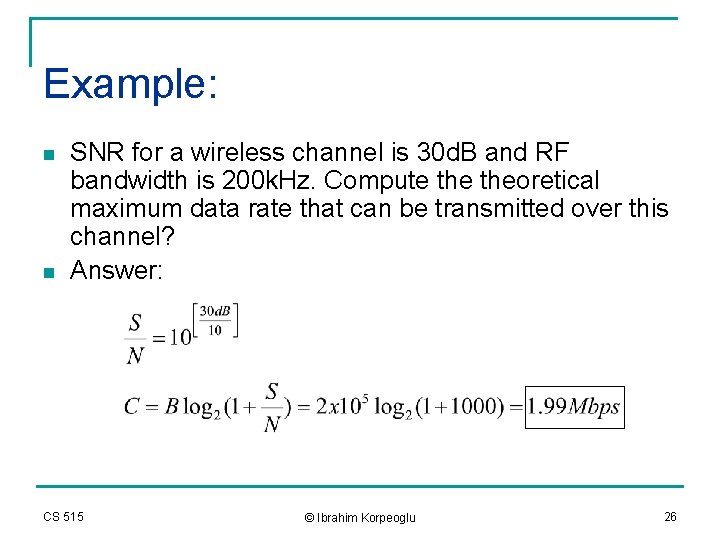
Example: n n SNR for a wireless channel is 30 d. B and RF bandwidth is 200 k. Hz. Compute theoretical maximum data rate that can be transmitted over this channel? Answer: CS 515 © Ibrahim Korpeoglu 26
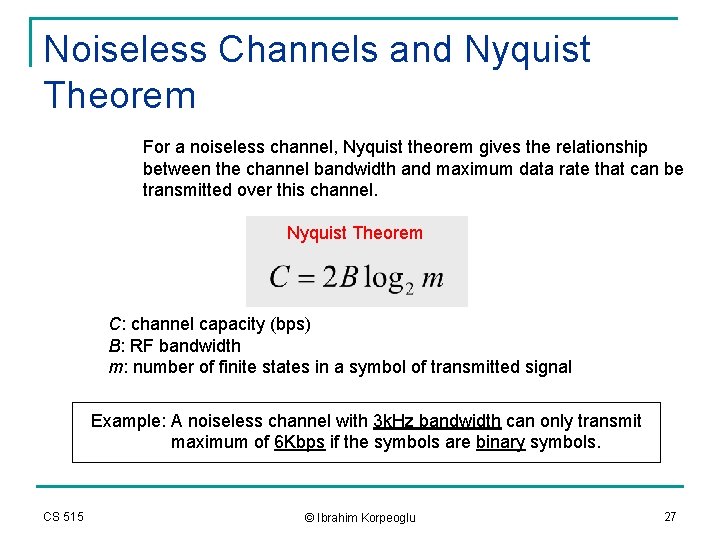
Noiseless Channels and Nyquist Theorem For a noiseless channel, Nyquist theorem gives the relationship between the channel bandwidth and maximum data rate that can be transmitted over this channel. Nyquist Theorem C: channel capacity (bps) B: RF bandwidth m: number of finite states in a symbol of transmitted signal Example: A noiseless channel with 3 k. Hz bandwidth can only transmit maximum of 6 Kbps if the symbols are binary symbols. CS 515 © Ibrahim Korpeoglu 27
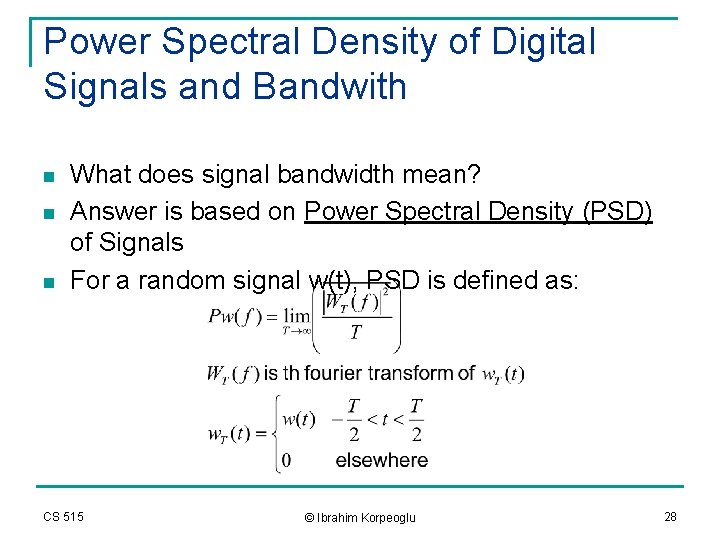
Power Spectral Density of Digital Signals and Bandwith n n n What does signal bandwidth mean? Answer is based on Power Spectral Density (PSD) of Signals For a random signal w(t), PSD is defined as: CS 515 © Ibrahim Korpeoglu 28
PSD CS 515 © Ibrahim Korpeoglu 29
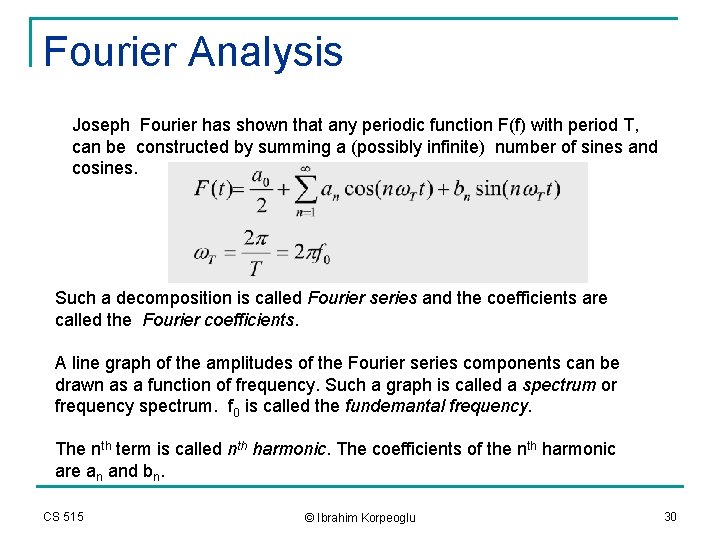
Fourier Analysis Joseph Fourier has shown that any periodic function F(f) with period T, can be constructed by summing a (possibly infinite) number of sines and cosines. Such a decomposition is called Fourier series and the coefficients are called the Fourier coefficients. A line graph of the amplitudes of the Fourier series components can be drawn as a function of frequency. Such a graph is called a spectrum or frequency spectrum. f 0 is called the fundemantal frequency. The nth term is called nth harmonic. The coefficients of the nth harmonic are an and bn. CS 515 © Ibrahim Korpeoglu 30
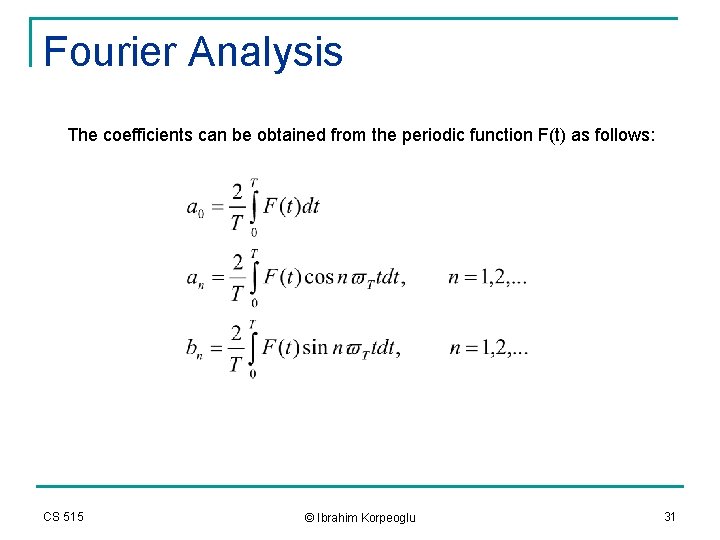
Fourier Analysis The coefficients can be obtained from the periodic function F(t) as follows: CS 515 © Ibrahim Korpeoglu 31
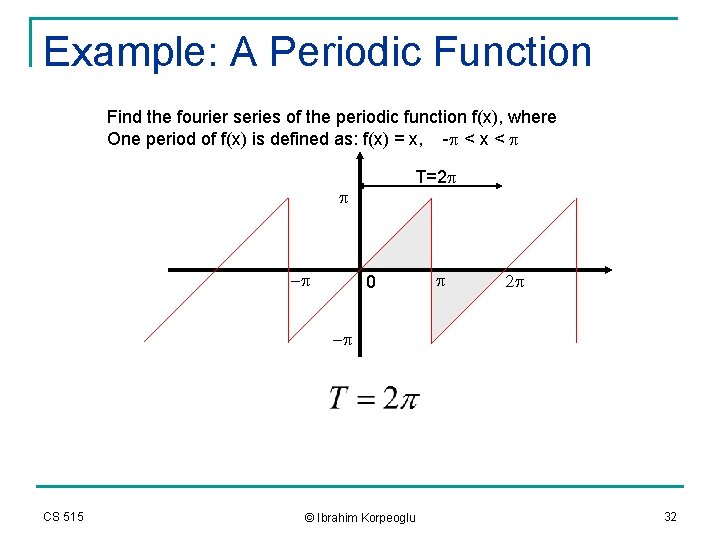
Example: A Periodic Function Find the fourier series of the periodic function f(x), where One period of f(x) is defined as: f(x) = x, -p < x < p T=2 p p -p 0 p 2 p -p CS 515 © Ibrahim Korpeoglu 32
![Example: Its Fourier Approximation Domain: [-p, p] CS 515 1 harmonic 2 harmonics 3](http://slidetodoc.com/presentation_image/2d714189f6cca678373759b70385682f/image-33.jpg "Example: Its Fourier Approximation Domain: [-p, p] CS 515 1 harmonic 2 harmonics 3")
Example: Its Fourier Approximation Domain: [-p, p] CS 515 1 harmonic 2 harmonics 3 harmonics 4 harmonics © Ibrahim Korpeoglu 33
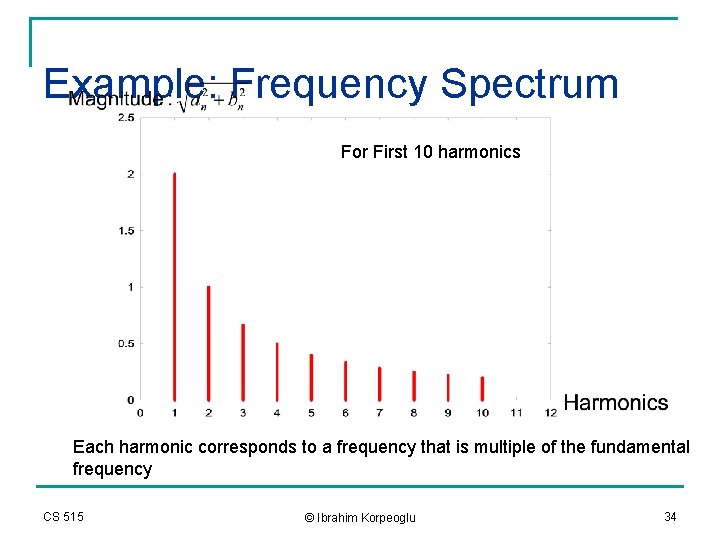
Example: Frequency Spectrum For First 10 harmonics Each harmonic corresponds to a frequency that is multiple of the fundamental frequency CS 515 © Ibrahim Korpeoglu 34
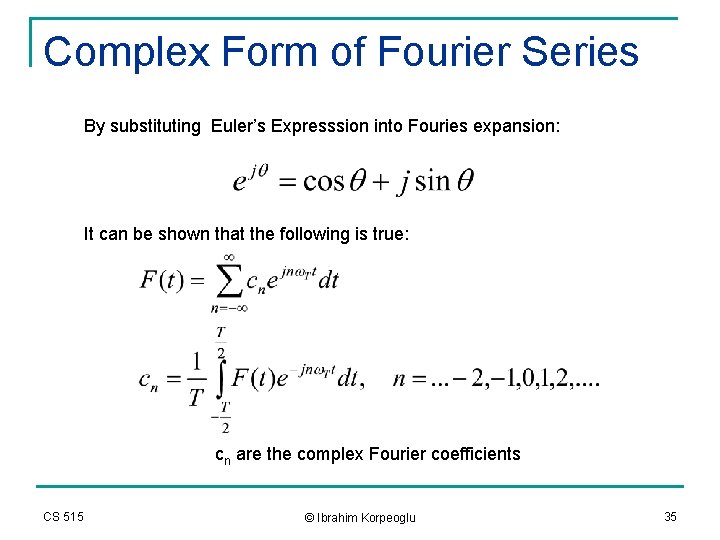
Complex Form of Fourier Series By substituting Euler’s Expresssion into Fouries expansion: It can be shown that the following is true: cn are the complex Fourier coefficients CS 515 © Ibrahim Korpeoglu 35
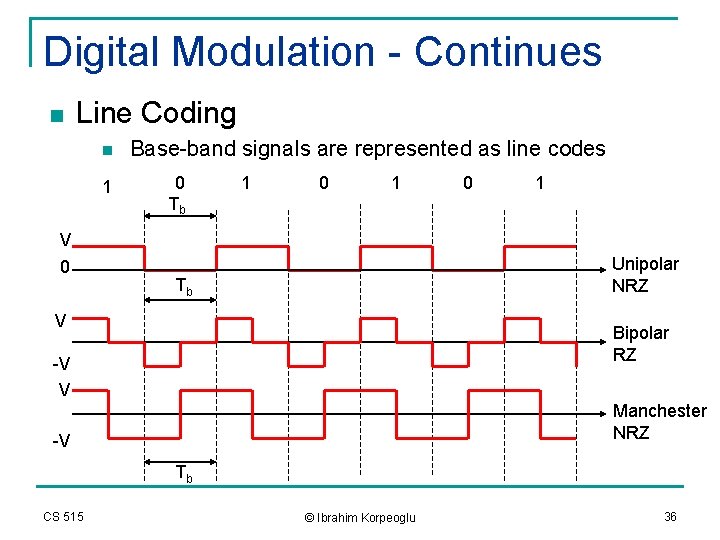
Digital Modulation - Continues n Line Coding n 1 Base-band signals are represented as line codes 0 Tb 1 0 1 V 0 Unipolar NRZ Tb V Bipolar RZ -V V Manchester NRZ -V Tb CS 515 © Ibrahim Korpeoglu 36
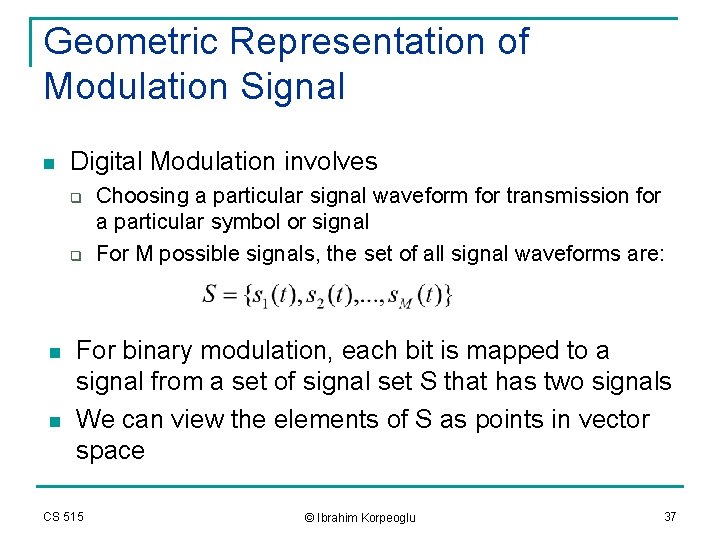
Geometric Representation of Modulation Signal n Digital Modulation involves q q n n Choosing a particular signal waveform for transmission for a particular symbol or signal For M possible signals, the set of all signal waveforms are: For binary modulation, each bit is mapped to a signal from a set of signal set S that has two signals We can view the elements of S as points in vector space CS 515 © Ibrahim Korpeoglu 37
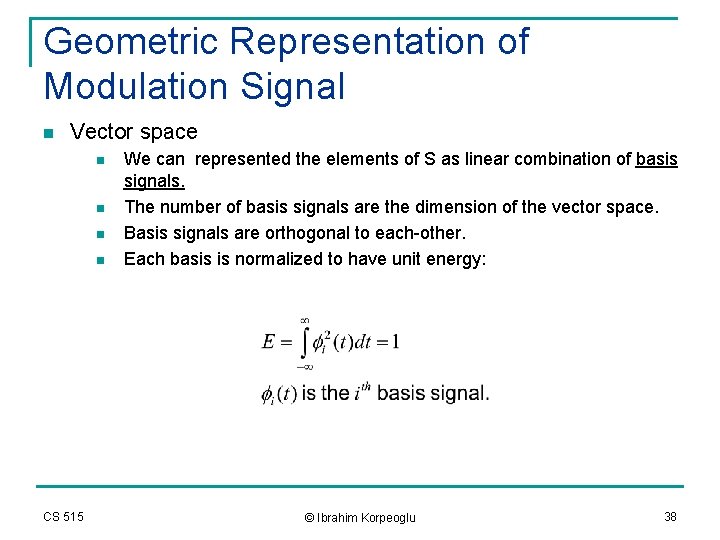
Geometric Representation of Modulation Signal n Vector space n n CS 515 We can represented the elements of S as linear combination of basis signals. The number of basis signals are the dimension of the vector space. Basis signals are orthogonal to each-other. Each basis is normalized to have unit energy: © Ibrahim Korpeoglu 38
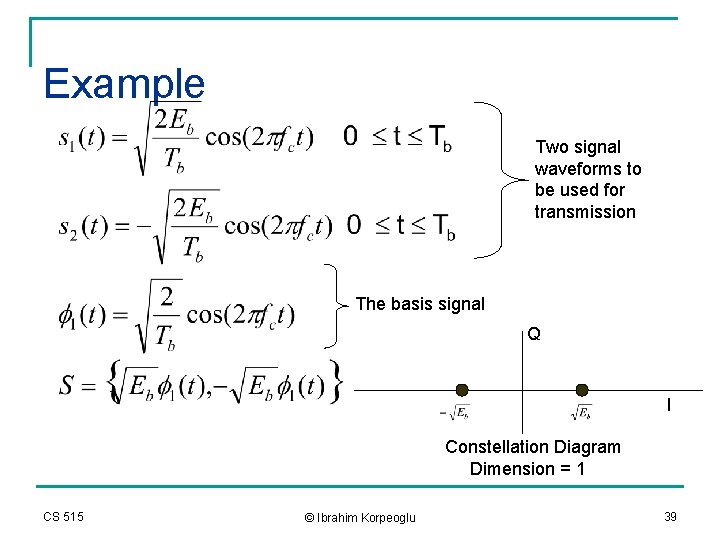
Example Two signal waveforms to be used for transmission The basis signal Q I Constellation Diagram Dimension = 1 CS 515 © Ibrahim Korpeoglu 39
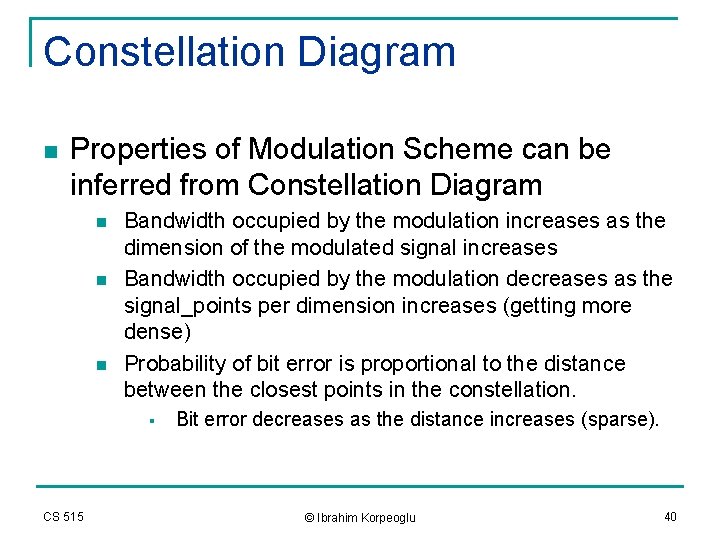
Constellation Diagram n Properties of Modulation Scheme can be inferred from Constellation Diagram n n n Bandwidth occupied by the modulation increases as the dimension of the modulated signal increases Bandwidth occupied by the modulation decreases as the signal_points per dimension increases (getting more dense) Probability of bit error is proportional to the distance between the closest points in the constellation. § CS 515 Bit error decreases as the distance increases (sparse). © Ibrahim Korpeoglu 40
Linear Modulation Techniques n Classify digital modulation techniques as: n Linear q q q n CS 515 The amplitude of the transmitted signal varies linearly with the modulating digital signal, m(t). They usually do not have constant envelope. More spectral efficient. Poor power efficiency Example: QPSK. Non-linear © Ibrahim Korpeoglu 41
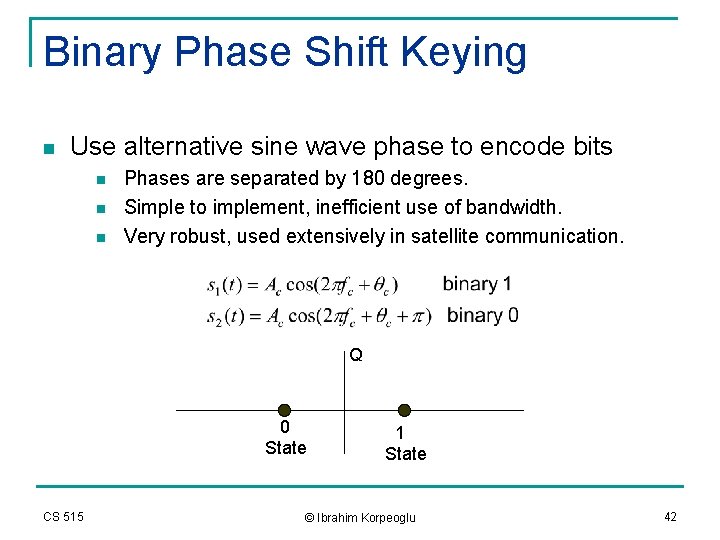
Binary Phase Shift Keying n Use alternative sine wave phase to encode bits n n n Phases are separated by 180 degrees. Simple to implement, inefficient use of bandwidth. Very robust, used extensively in satellite communication. Q 0 State CS 515 1 State © Ibrahim Korpeoglu 42
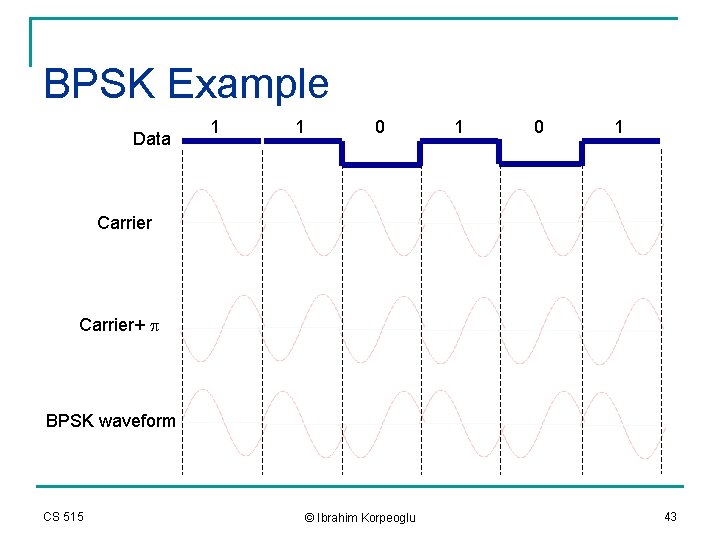
BPSK Example Data 1 1 0 1 Carrier+ p BPSK waveform CS 515 © Ibrahim Korpeoglu 43
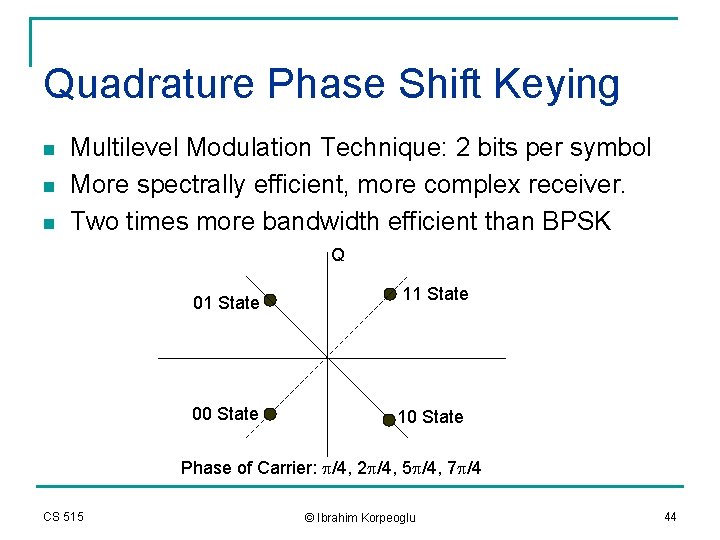
Quadrature Phase Shift Keying n n n Multilevel Modulation Technique: 2 bits per symbol More spectrally efficient, more complex receiver. Two times more bandwidth efficient than BPSK Q 01 State 00 State 11 State 10 State Phase of Carrier: p/4, 2 p/4, 5 p/4, 7 p/4 CS 515 © Ibrahim Korpeoglu 44
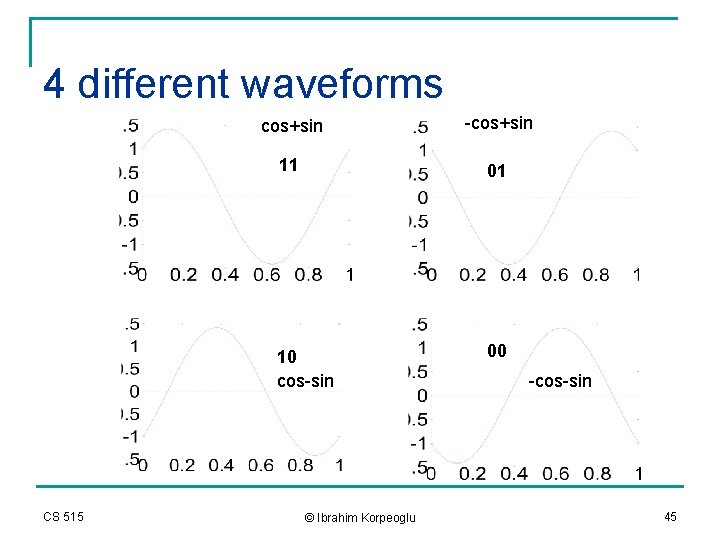
4 different waveforms CS 515 cos+sin -cos+sin 11 01 10 cos-sin 00 © Ibrahim Korpeoglu -cos-sin 45
Constant Envelope Modulation n Amplitude of the carrier is constant, regardless of the variation in the modulating signal q q q n Better immunity to fluctuations due to fading. Better random noise immunity Power efficient They occupy larger bandwidth CS 515 © Ibrahim Korpeoglu 46
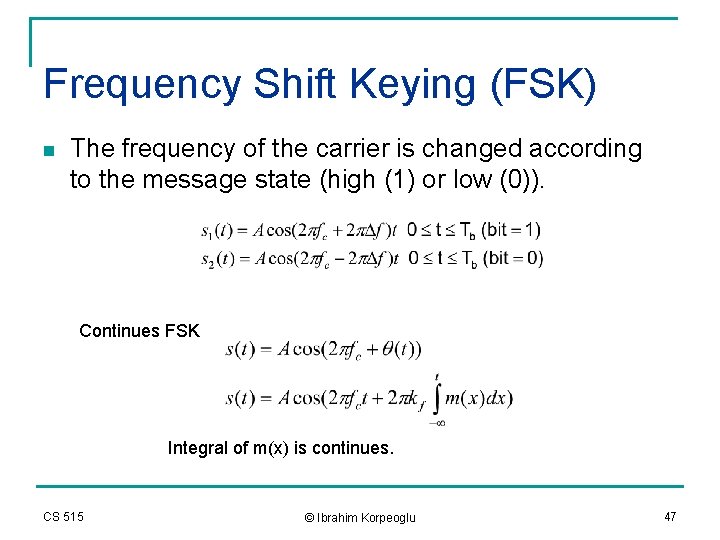
Frequency Shift Keying (FSK) n The frequency of the carrier is changed according to the message state (high (1) or low (0)). Continues FSK Integral of m(x) is continues. CS 515 © Ibrahim Korpeoglu 47
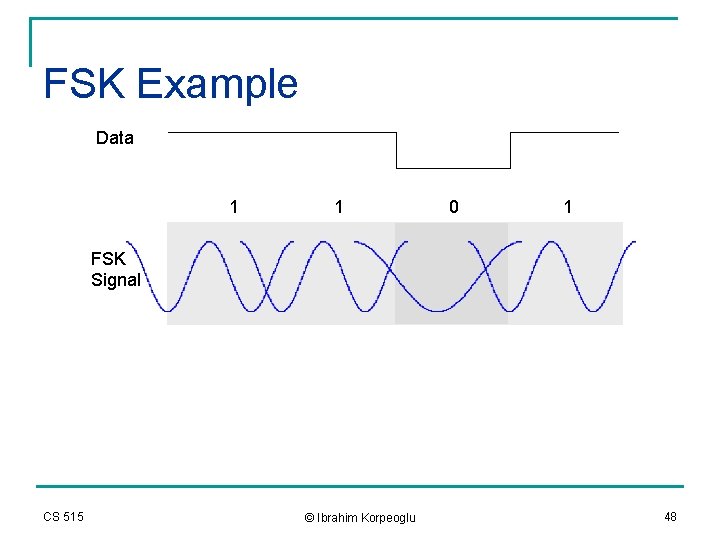
FSK Example Data 1 1 0 1 FSK Signal CS 515 © Ibrahim Korpeoglu 48
- Slides: 48