
Modulation formats for digital fiber transmission Eric Tell
Modulation formats for digital fiber transmission Eric Tell 050329
Outline • • • Fiber performance limitations WDM Optical vs. radio communication Optical modulators Modulation formats – Amplitude shift keying – Duo-binary signalling – Optical single sideband signalling • Simulation/experimental results • Summary
Fiber performance limitations • Fiber Loss • Chromatic dispersion – different refractive index for different wavelengths • Fiber non-linearities
Chromatic dispersion • Distance limit ~1/(bit rate)² – Example: Single mode fiber @1550 nm • chromatic dispersion: 17 ps/km-nm • dispersion limited distance: ~100 km @10 Gbit/s • comparable to loss limit • EDFA => increased loss-limited distance – Chromatic dispersion becomes the limiting factor in single mode long-haul fibers! • We want to decrease the bandwidth for a given datarate!
Wave Division Multiplexing • • Decreased channel spacing leads to interchannel interference and makes it difficult to compensate for fiber nonlinearities Narrower subchannels would be nice. . .
WDM (cont'd) • In a high capacity link the whole EDFA spectrum is filled with subchannels • The bandwidth of each subchannel is proportional to its bit rate • Total fiber capacity is given by the spectral efficency: (bitrate per channel)/(channel spacing)
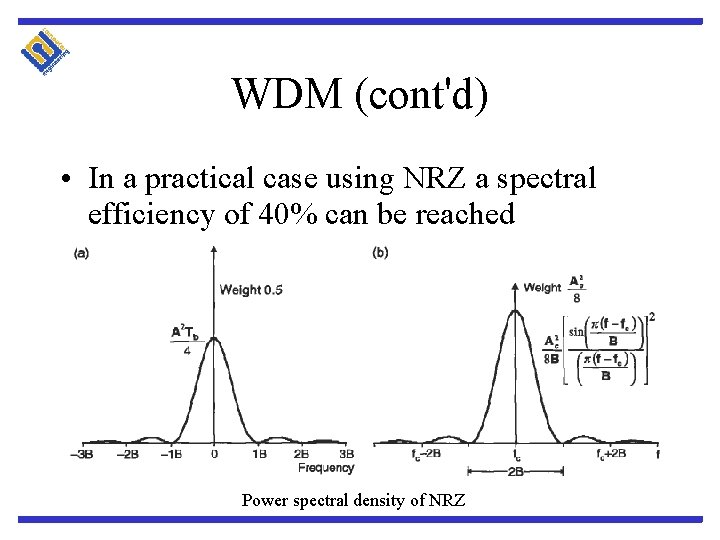
WDM (cont'd) • In a practical case using NRZ a spectral efficiency of 40% can be reached Power spectral density of NRZ
WDM (cont'd • More GB/s per channel does not increase total bandwith, however – It results in fewer channels to manage – Increased channel spacing decreases some non-linear distortions • BUT to reach higher spectral efficiency a format with narrower spectrum for a given bandwidth is needed (while at the same time not increasing other impairments)
How can this be achieved? • M-ary Amplitude Shift Keying (ASK) • Duo-binary signaling • Optical Single Sideband (OSSB)
Comparison to radio systems • Much of the same theory can be applied, except – Carrier frequency is different • 1550 nm => 194 Thz – The available components are different • no coherent detection (no PLLs) – The channel is different
Component imperfections • Modulators are nonlinear – difficult to achieve pure AM • PIN photo detectors responds to optical power rather than electrical field amplitude (“square envelope”) • Dispersion introduces a frequency dependent phase shift • “intensity-modulated” approaches are used

Optical Modulators • Direct modulation – directly modulate the drive current of a semiconductor laser • Absorbtion modulation – Modulate the absorption spectrum of reverse-biased diod placed in front of the laser – Faster and more linear than direct modulation (60 GHz) • The Mach-Zender (MZ) modulator – modulation my adding phase shifted signals

Optical modulators (cont'd) • Direct modulators and absorption modulators directly modulates the optical power, but will also generate phase modulation • The MZ modulator is more flexible and can generate different kinds if modulation other than NRZ/RZ/ASK
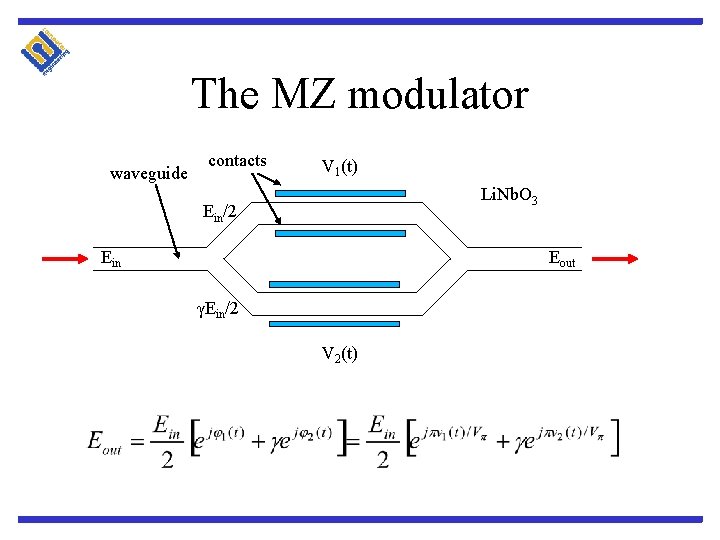
The MZ modulator waveguide contacts V 1(t) Li. Nb. O 3 Ein/2 Ein Eout γEin/2 V 2(t)
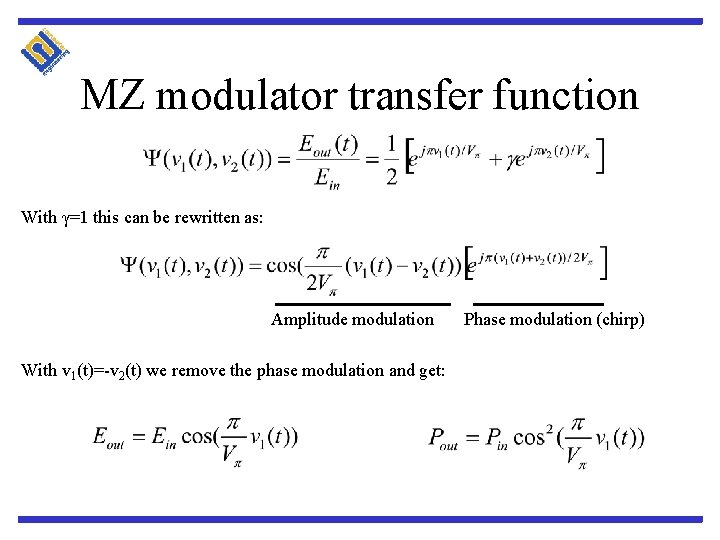
MZ modulator transfer function With γ=1 this can be rewritten as: Amplitude modulation With v 1(t)=-v 2(t) we remove the phase modulation and get: Phase modulation (chirp)
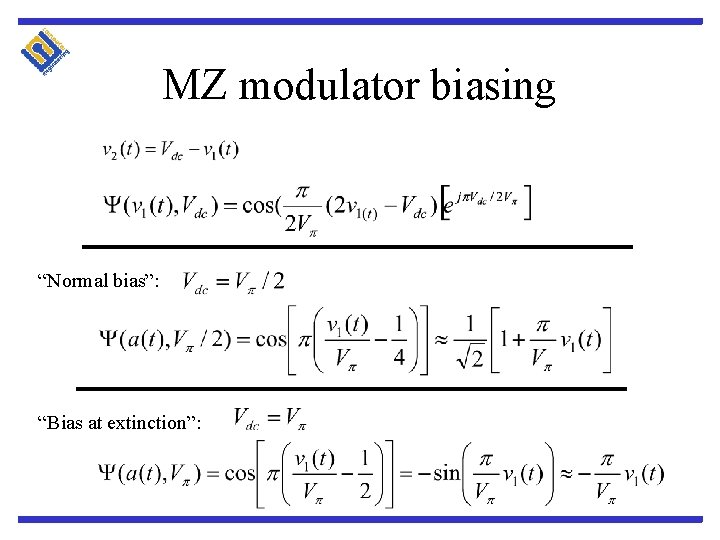
MZ modulator biasing “Normal bias”: “Bias at extinction”:
MZ modulators - observations • These modulators are only linear in a small region – A problem for other than RZ/NRZ signaling • There must normally be an unmodulated carrier in order to use non-coherent detection
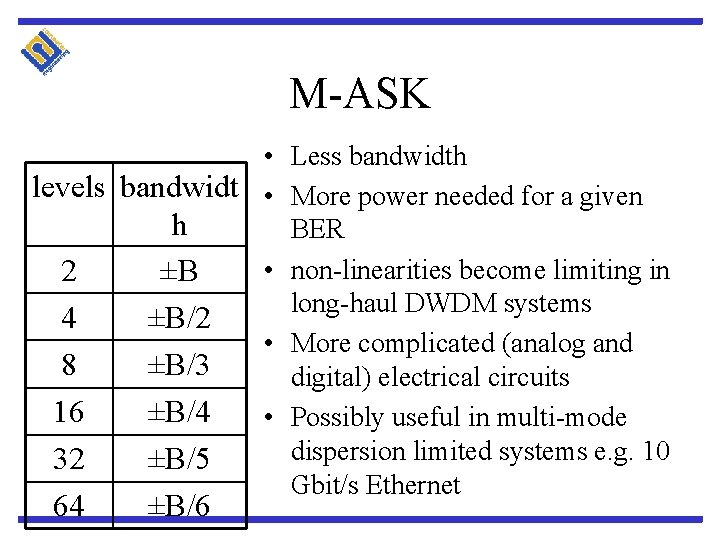
M-ASK • Less bandwidth levels bandwidt • More power needed for a given h BER • non-linearities become limiting in 2 ±B long-haul DWDM systems 4 ±B/2 • More complicated (analog and 8 ±B/3 digital) electrical circuits 16 ±B/4 • Possibly useful in multi-mode dispersion limited systems e. g. 10 32 ±B/5 Gbit/s Ethernet 64 ±B/6
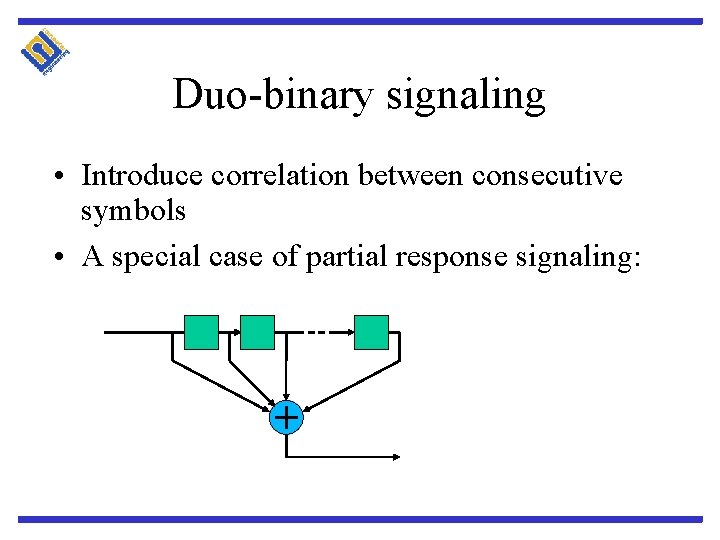
Duo-binary signaling • Introduce correlation between consecutive symbols • A special case of partial response signaling:
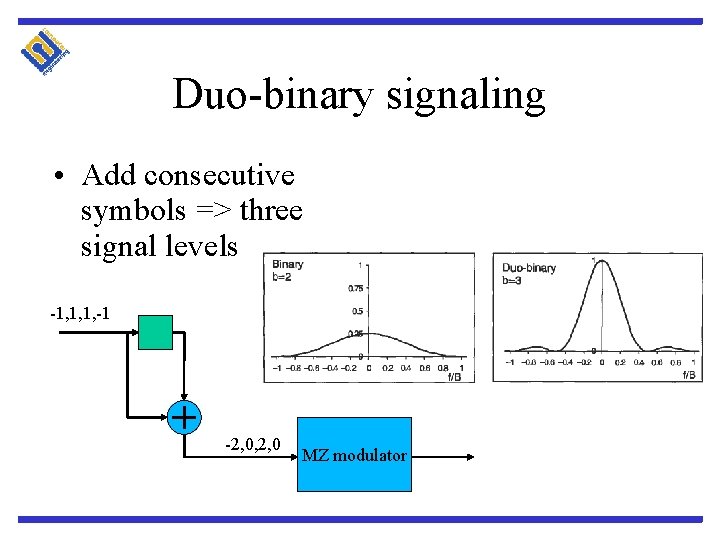
Duo-binary signaling • Add consecutive symbols => three signal levels -1, 1, 1, -1 -2, 0, 2, 0 MZ modulator
AM-PSK Duo-binary • Problem: Normally impractical to handle three levels • Solution: Use 0, E, -E – The detector will detect two levels 0 and E² – By precoding these two levels will correspond to 0 and 1 – a. k. a Amplitude Modulated Phase Shift Keying (AM-PSK) duo-binary signaling
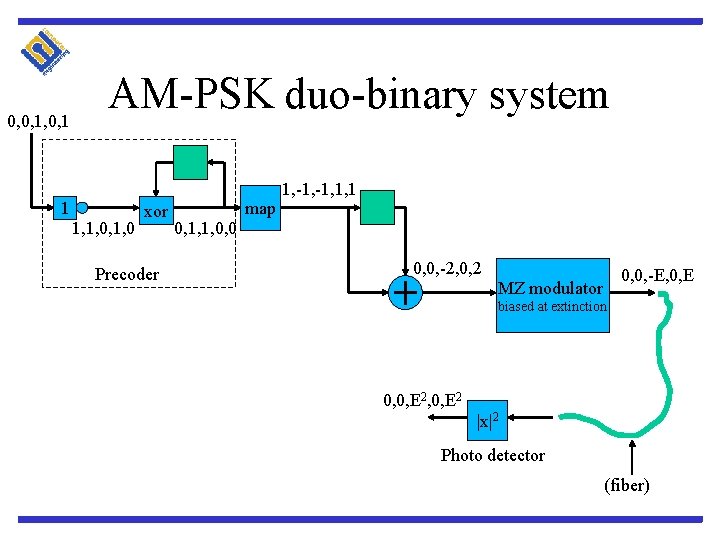
0, 0, 1 AM-PSK duo-binary system 1 1, 1, 0 xor Precoder map 1, -1, 1, 1 0, 1, 1, 0, 0, -2, 0, 2 0, 0, -E, 0, E MZ modulator biased at extinction 0, 0, E 2 |x|2 Photo detector (fiber)
Optical Single Sideband (OSSB) • Observation: The frequency spectrum is symmetrical • Implication: Half of it can be filtered out to save bandwidth => Single Sideband Transmission! • Used e. g. in TV
Subcarrier OSSB • In conventional subcarrier modulation the subcarrier appears on both sides of the optical carrier • Dispersion causes a phase shift between the two signals, which depends on the distance • At certain points the entire signal is canceled out!
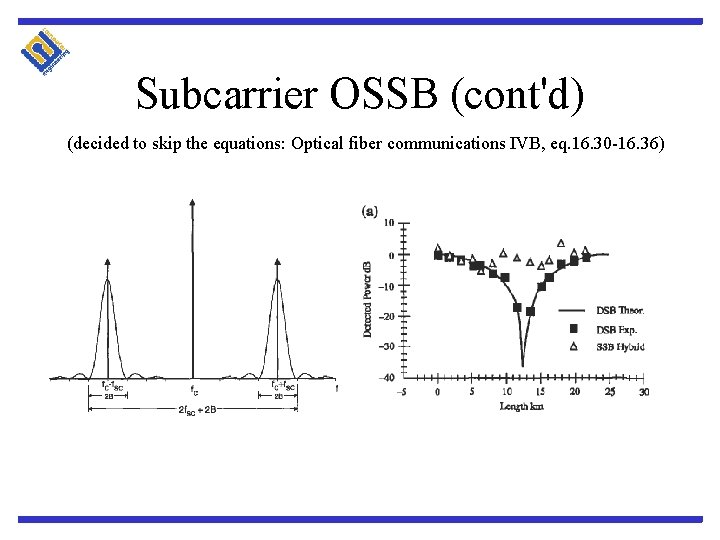
Subcarrier OSSB (cont'd) (decided to skip the equations: Optical fiber communications IVB, eq. 16. 30 -16. 36)
Creating an SSB signal • Two ways – Use a filter (half the energy is lost) – Use the Hilbert transform • known as a Hartley modulator
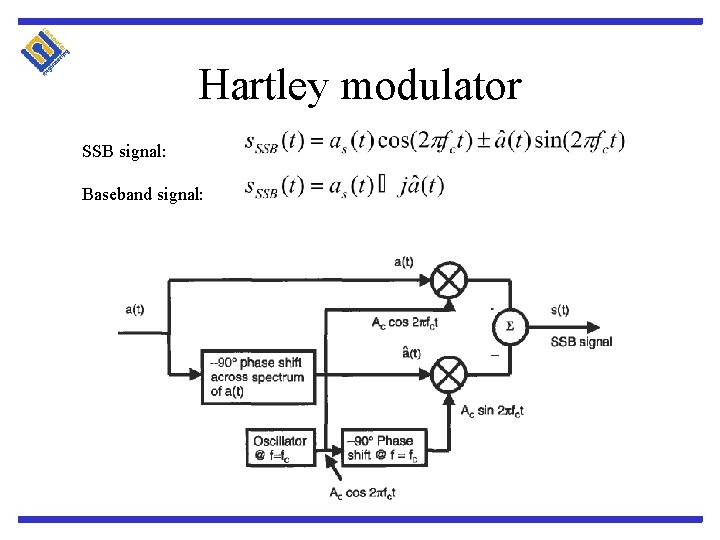
Hartley modulator SSB signal: Baseband signal:
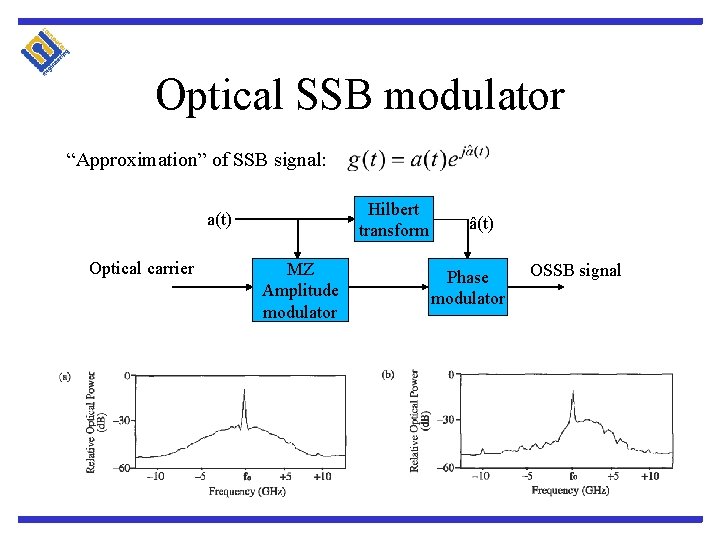
Optical SSB modulator “Approximation” of SSB signal: Hilbert transform a(t) Optical carrier MZ Amplitude modulator â(t) Phase modulator OSSB signal
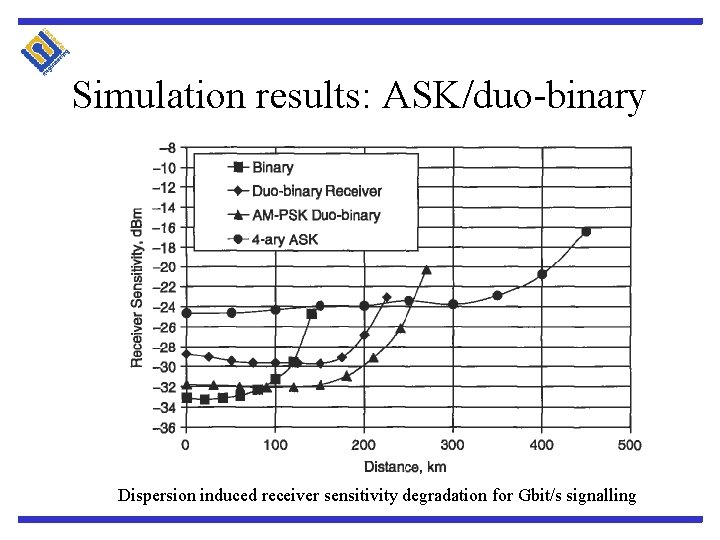
Simulation results: ASK/duo-binary Dispersion induced receiver sensitivity degradation for Gbit/s signalling
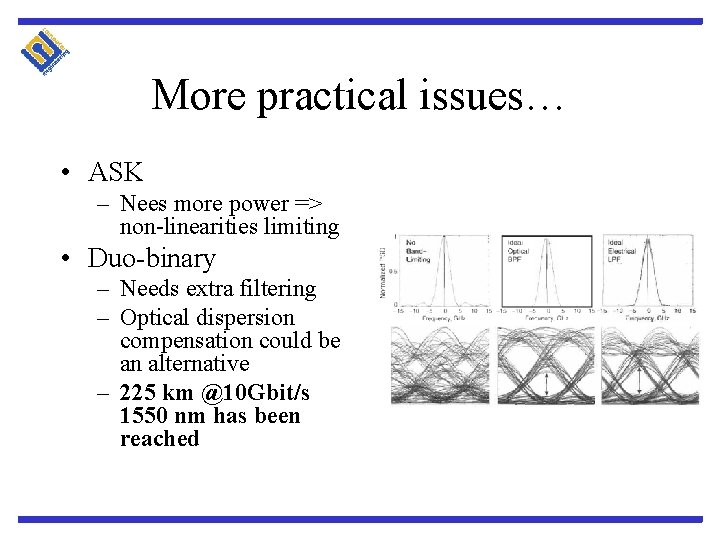
More practical issues… • ASK – Nees more power => non-linearities limiting • Duo-binary – Needs extra filtering – Optical dispersion compensation could be an alternative – 225 km @10 Gbit/s 1550 nm has been reached
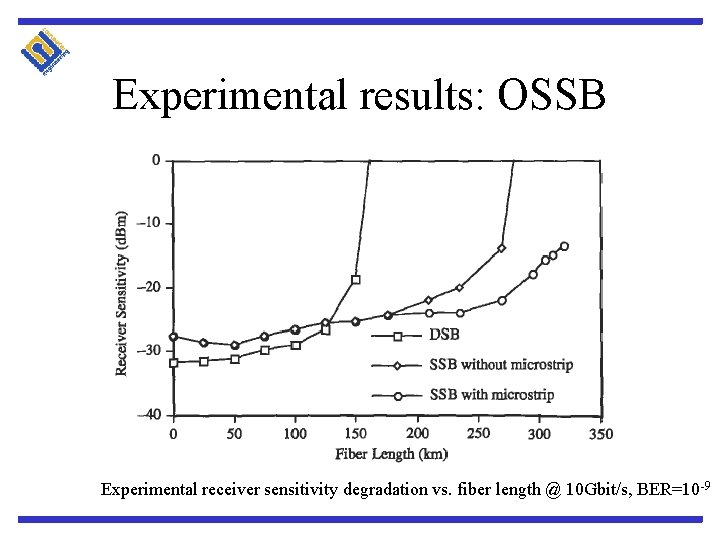
Experimental results: OSSB Experimental receiver sensitivity degradation vs. fiber length @ 10 Gbit/s, BER=10 -9
DWDM • “Normal” NRZ – 40% spectral efficiency over 150 km • Duo-binary AM-PSK – 100% over 100 km • OSSB – 66% over 300 km
Summary • Distance between repeaters is limited by either of – Fiber loss – Chromatic dispersion – Fiber non-linearities • With the advent of EDFA chromatic dispersion has become the limiting factor in long-haul systems
Summary (cont’d) • We want to limit the bandwidth in order too – Reduce the effects of chromatic dispersion – Reach higher spectral efficiency in DWDM systems • Two potential methods: – Duo-binary signaling – Optical single sideband • Both methods could potentially halve the bandwidth • None of the methods are currently used in commercial systems, but there are some promising experimental results
- Slides: 34