
Modulation Definition One signal carrier varies according to
- Slides: 30
Modulation
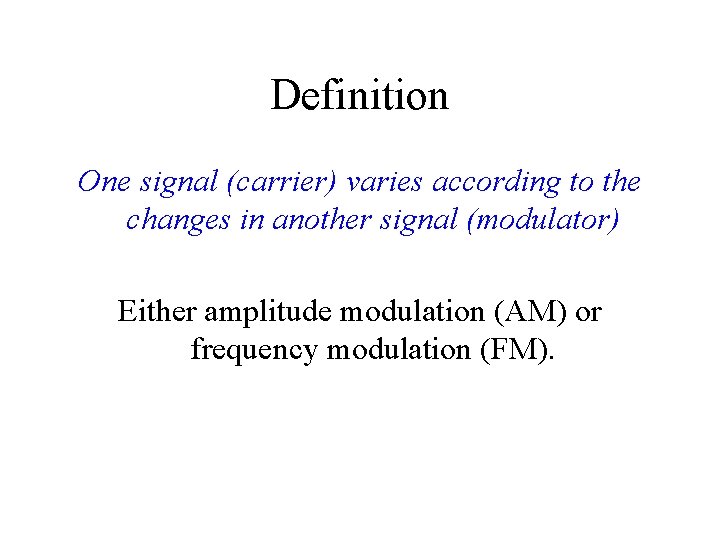
Definition One signal (carrier) varies according to the changes in another signal (modulator) Either amplitude modulation (AM) or frequency modulation (FM).
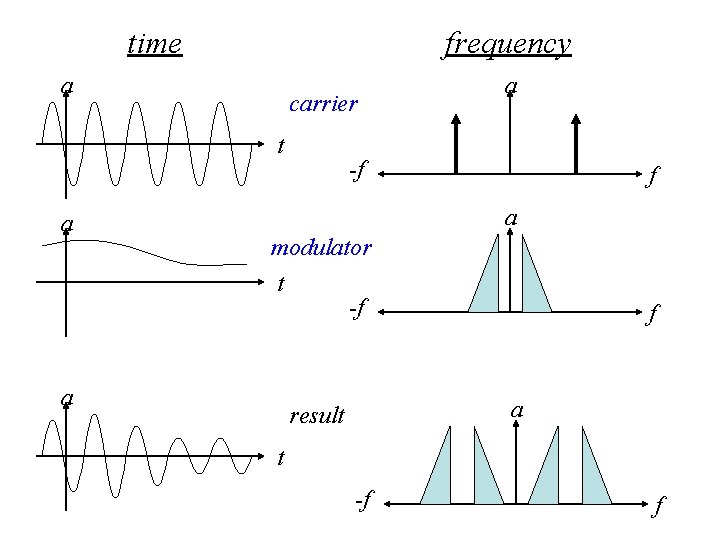
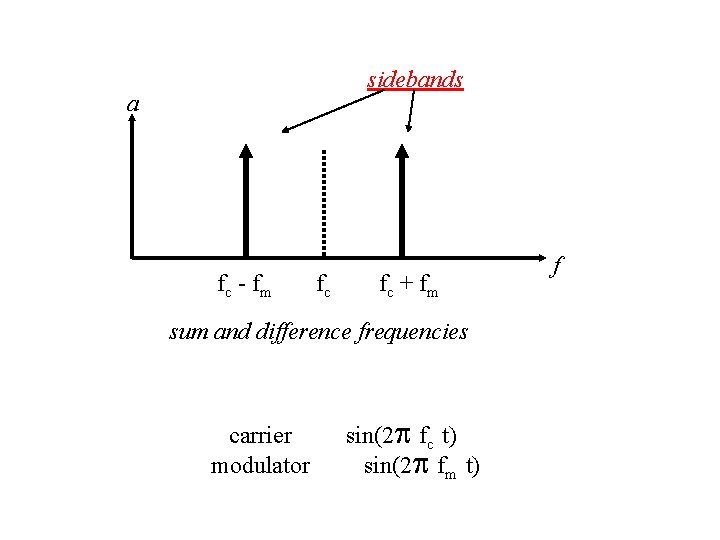
Amplitude Modulation Type #1 balanced/ring/double-sideband suppressed carrier amplitude modulation f 1(t) * f 2(t)
time frequency a carrier t a a -f f a modulator t -f a result t -f f
sidebands a fc - f m fc fc + f m sum and difference frequencies carrier modulator sin(2 p fc t) sin(2 p fm t) f
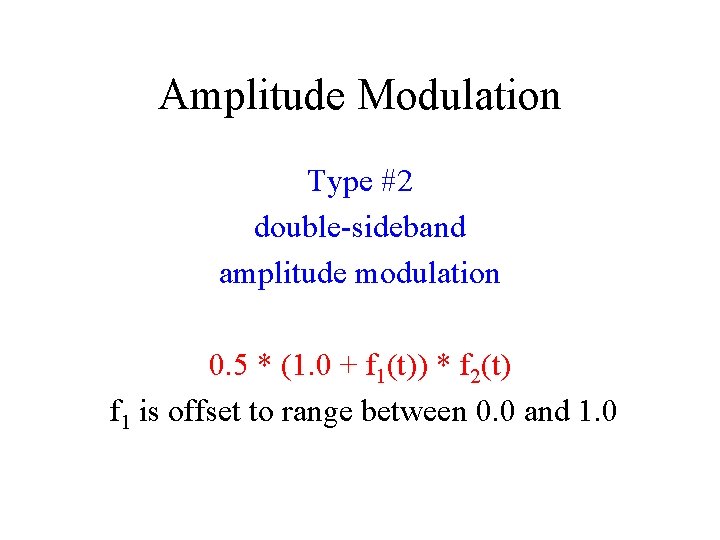
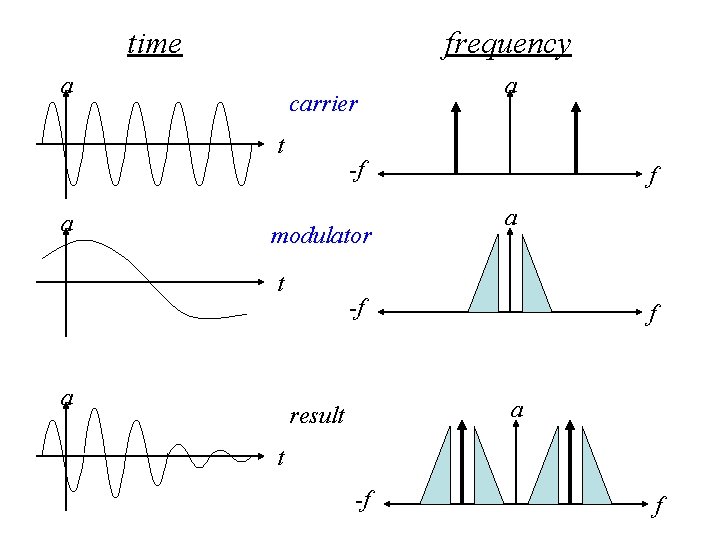
Amplitude Modulation Type #2 double-sideband amplitude modulation 0. 5 * (1. 0 + f 1(t)) * f 2(t) f 1 is offset to range between 0. 0 and 1. 0
time frequency a carrier t a -f modulator t a a f a -f f a result t -f f
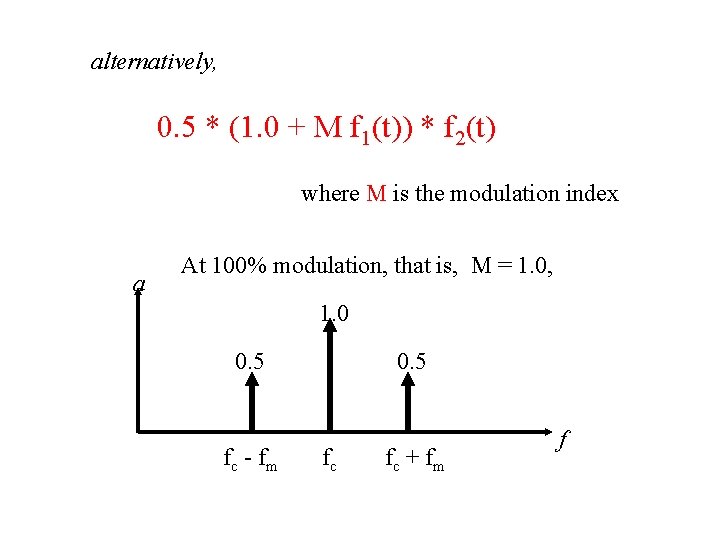
alternatively, 0. 5 * (1. 0 + M f 1(t)) * f 2(t) where M is the modulation index a At 100% modulation, that is, M = 1. 0, 1. 0 0. 5 fc - f m 0. 5 fc fc + f m f
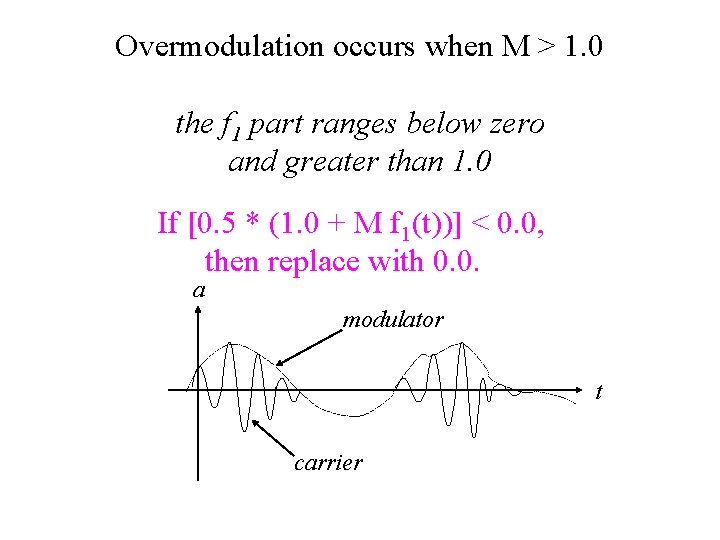
Overmodulation occurs when M > 1. 0 the f 1 part ranges below zero and greater than 1. 0 If [0. 5 * (1. 0 + M f 1(t))] < 0. 0, then replace with 0. 0. a modulator t carrier
Amplitude Modulation Type #3 single-sideband, suppressed carrier amplitude modulation Pretty hard to do digitally!
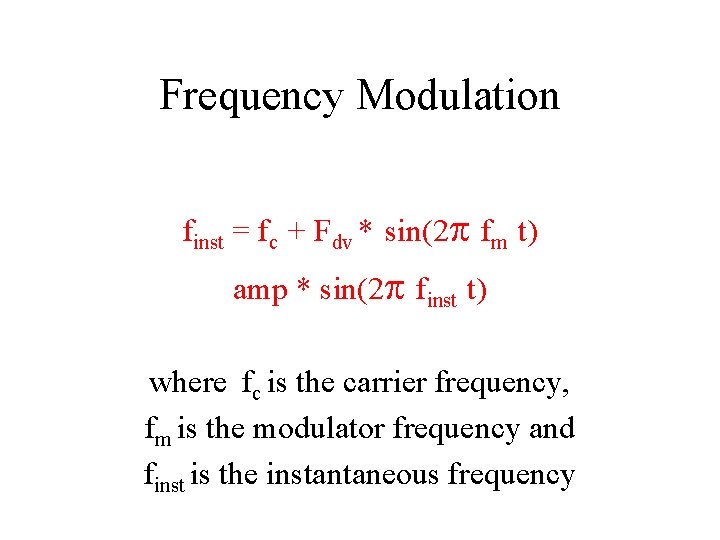
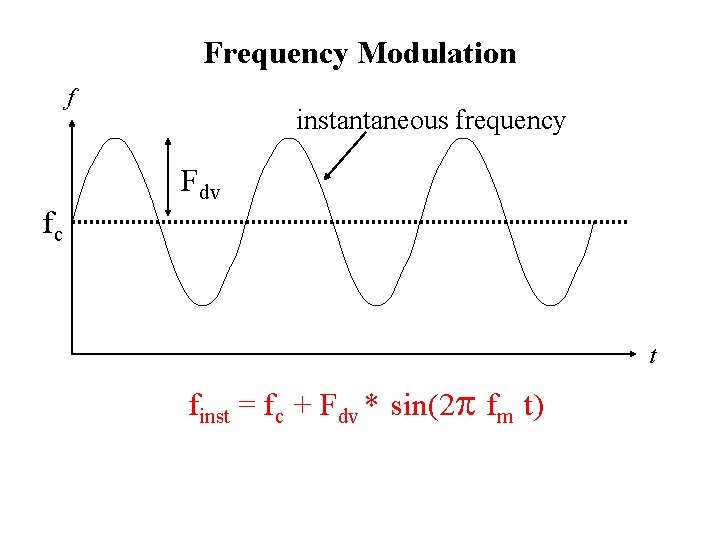
Frequency Modulation finst = fc + Fdv * sin(2 p fm t) amp * sin(2 p finst t) where fc is the carrier frequency, fm is the modulator frequency and finst is the instantaneous frequency
Frequency Modulation f instantaneous frequency Fdv fc t finst = fc + Fdv * sin(2 p fm t)
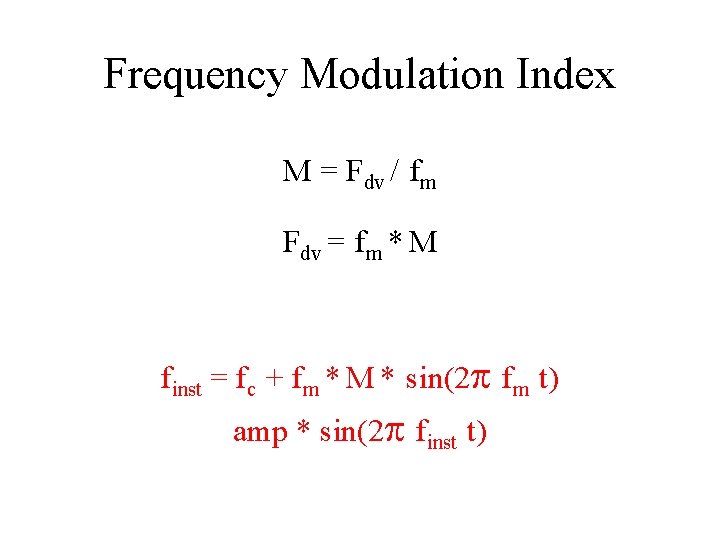
Frequency Modulation Index M = Fdv / fm Fdv = fm * M finst = fc + fm * M * sin(2 p fm t) amp * sin(2 p finst t)
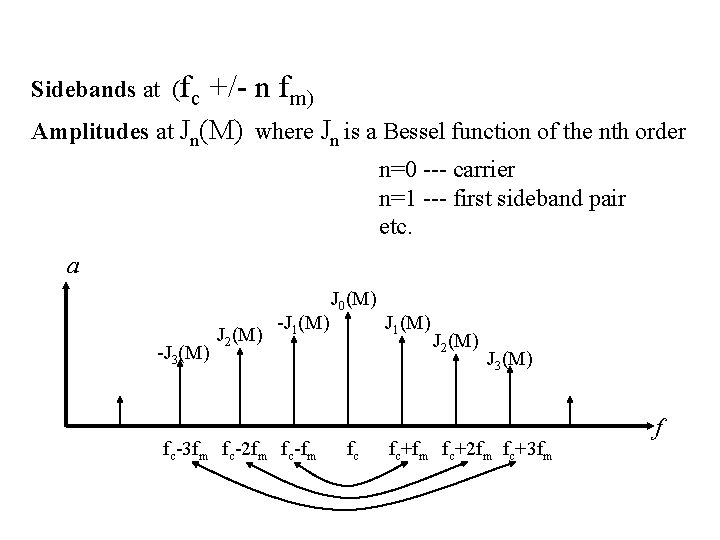
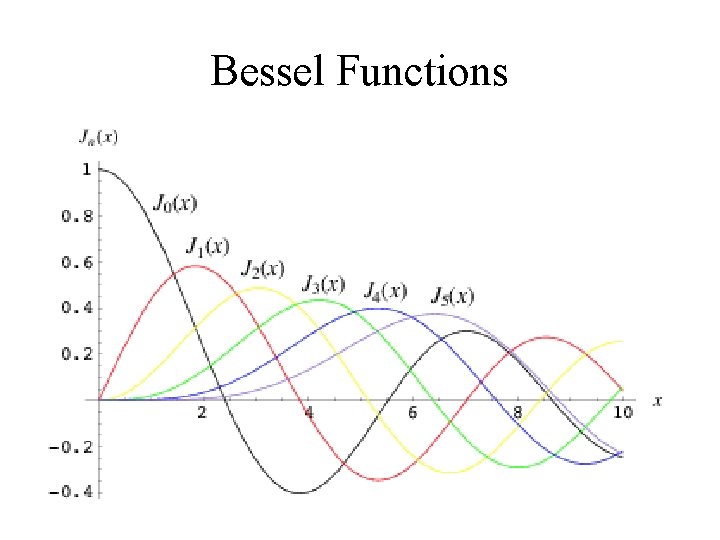
Sidebands at (fc +/- n fm) Amplitudes at Jn(M) where Jn is a Bessel function of the nth order n=0 --- carrier n=1 --- first sideband pair etc. a -J 3(M) J 2(M) -J 1(M) fc-3 fm fc-2 fm fc-fm J 0(M) fc J 1(M) J 2(M) J 3(M) fc+fm fc+2 fm fc+3 fm f
Bessel Functions
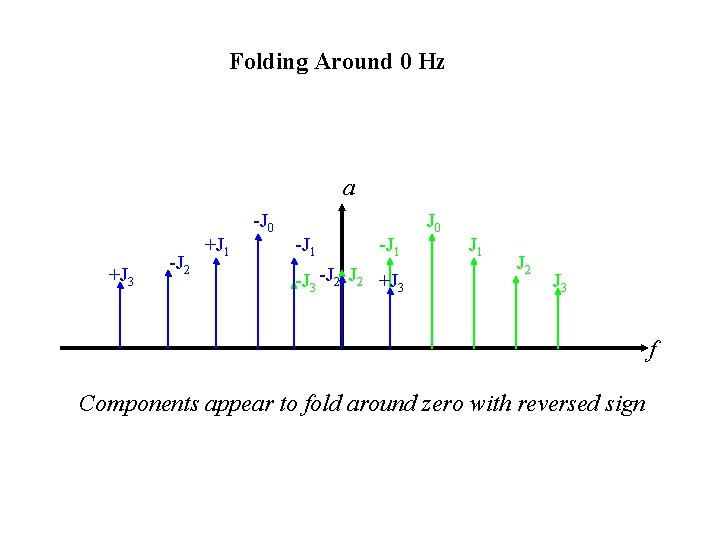
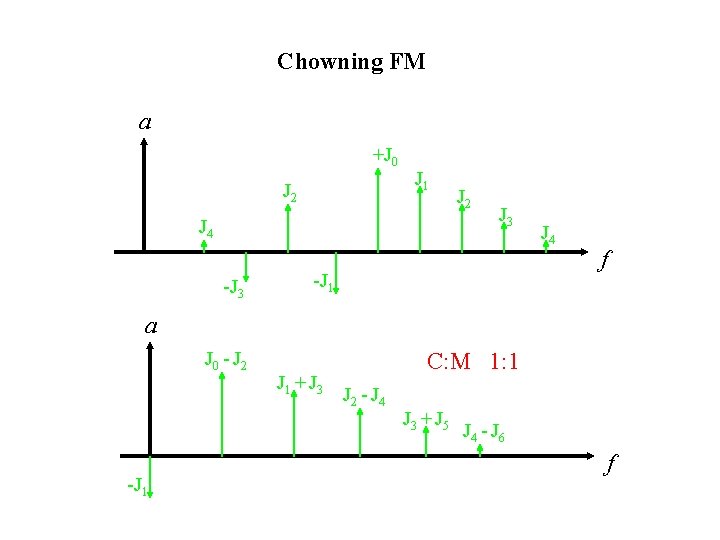
Folding Around 0 Hz a +J 3 -J 2 +J 1 -J 0 -J 1 -J 3 -J 2 +J 3 J 0 J 1 J 2 J 3 f Components appear to fold around zero with reversed sign
Chowning FM a +J 0 J 2 J 1 J 4 -J 3 J 2 J 3 -J 1 J 4 f a J 0 - J 2 -J 1 + J 3 C: M 1: 1 J 2 - J 4 J 3 + J 5 J 4 - J 6 f
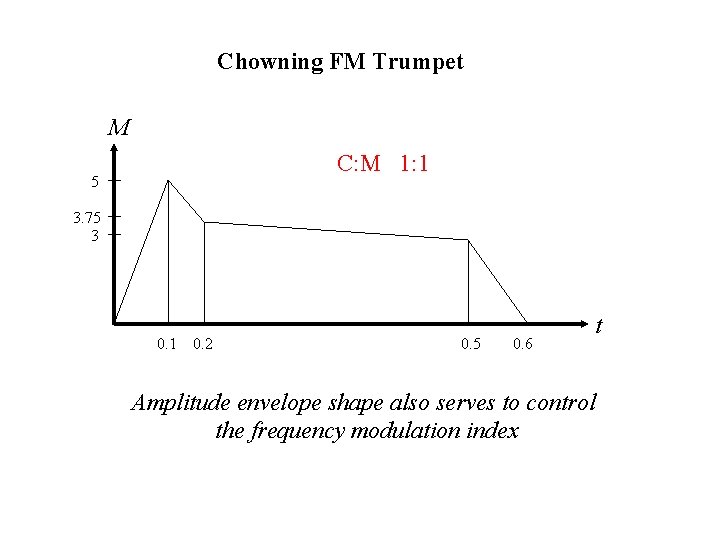
Chowning FM Trumpet M C: M 1: 1 5 3. 75 3 0. 1 0. 2 0. 5 0. 6 t Amplitude envelope shape also serves to control the frequency modulation index
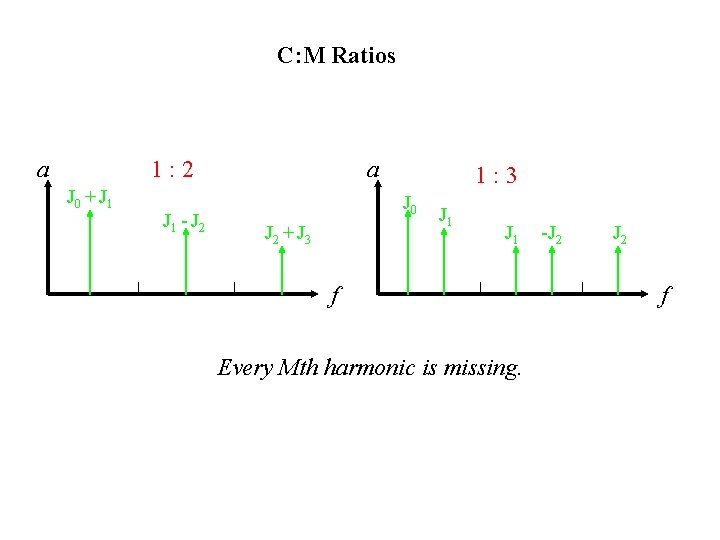
C: M Ratios a 1: 2 J 0 + J 1 - J 2 a 1: 3 J 0 J 2 + J 3 J 1 f Every Mth harmonic is missing. -J 2 f
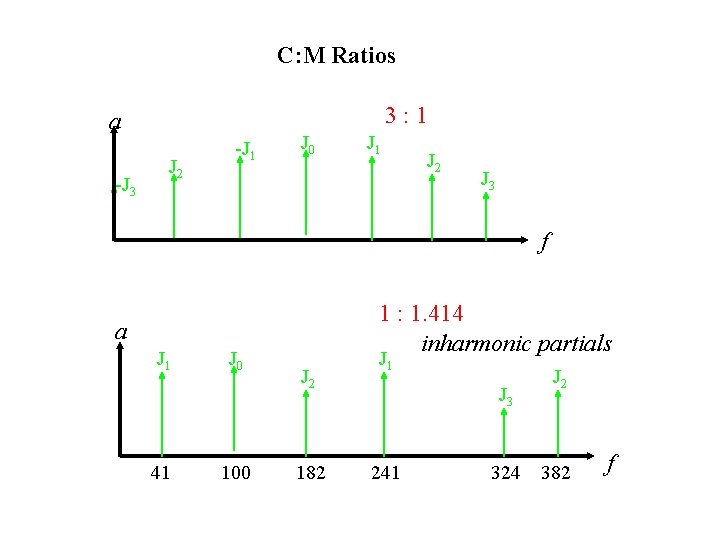
C: M Ratios 3: 1 a -J 3 J 2 -J 1 J 0 J 1 J 2 J 3 f 1 : 1. 414 inharmonic partials a J 1 41 J 0 100 J 2 182 J 1 J 3 241 324 J 2 382 f
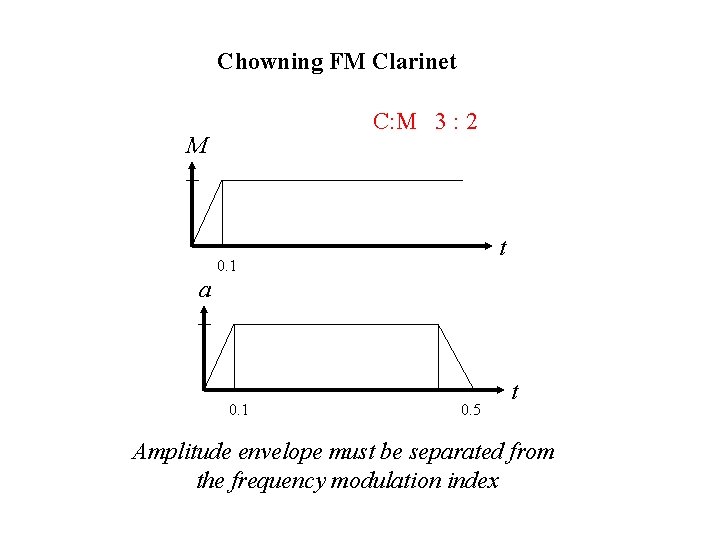
Chowning FM Clarinet C: M 3 : 2 M t 0. 1 a 0. 1 0. 5 t Amplitude envelope must be separated from the frequency modulation index
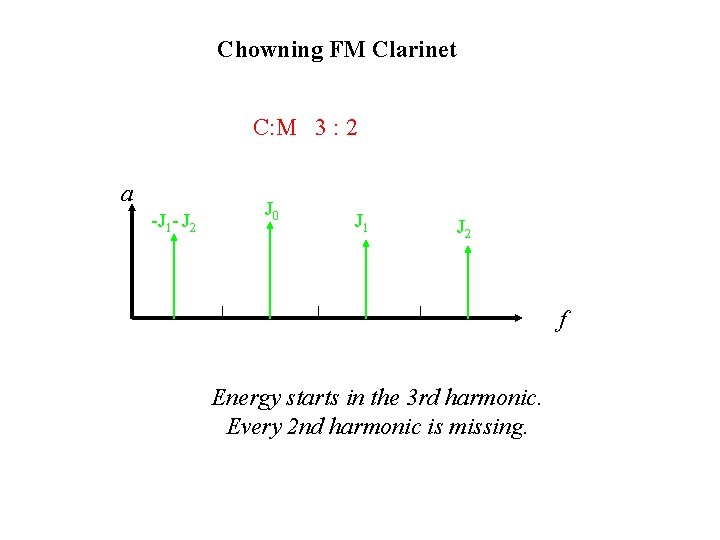
Chowning FM Clarinet C: M 3 : 2 a -J 1 - J 2 J 0 J 1 J 2 f Energy starts in the 3 rd harmonic. Every 2 nd harmonic is missing.
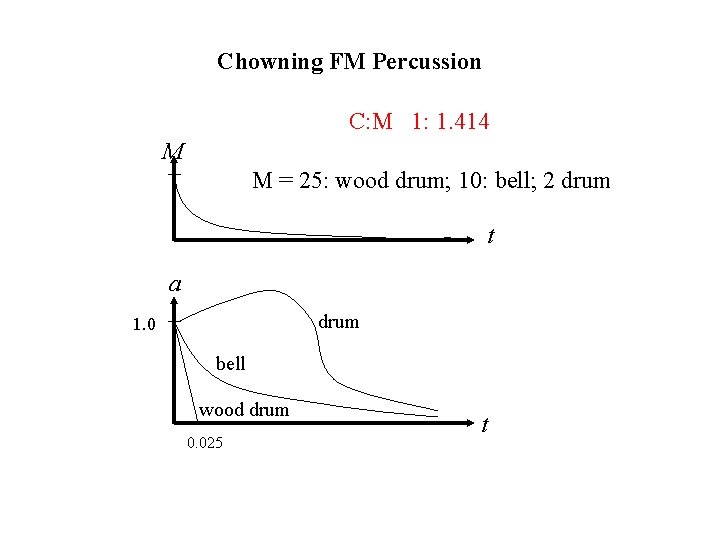
Chowning FM Percussion C: M 1: 1. 414 M M = 25: wood drum; 10: bell; 2 drum t a drum 1. 0 bell wood drum 0. 025 t
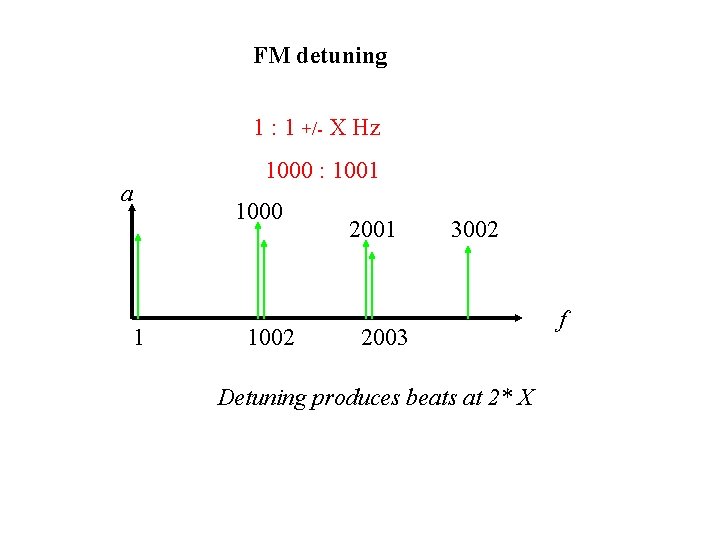
FM detuning 1 : 1 +/- X Hz 1000 : 1001 a 1000 1 1002 2001 3002 2003 Detuning produces beats at 2* X f
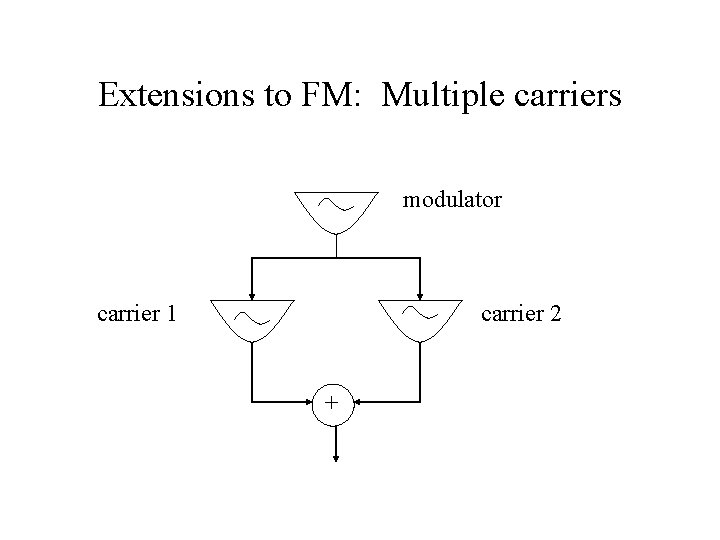
Extensions to FM: Multiple carriers modulator carrier 1 carrier 2 +
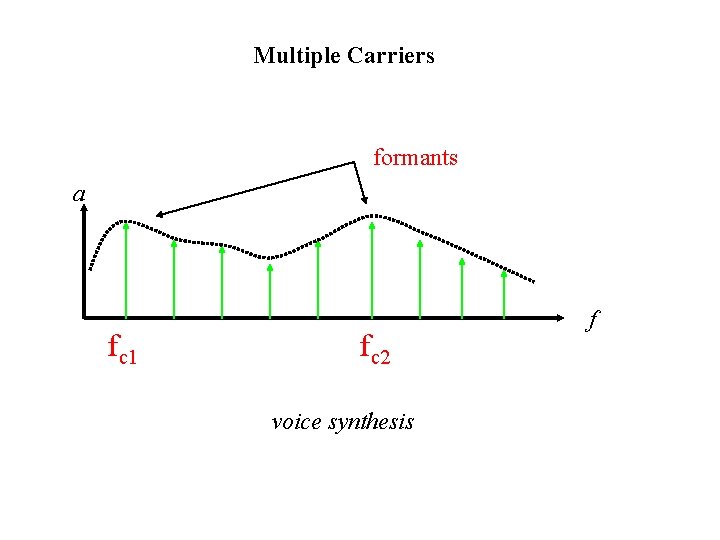
Multiple Carriers formants a fc 1 fc 2 voice synthesis f
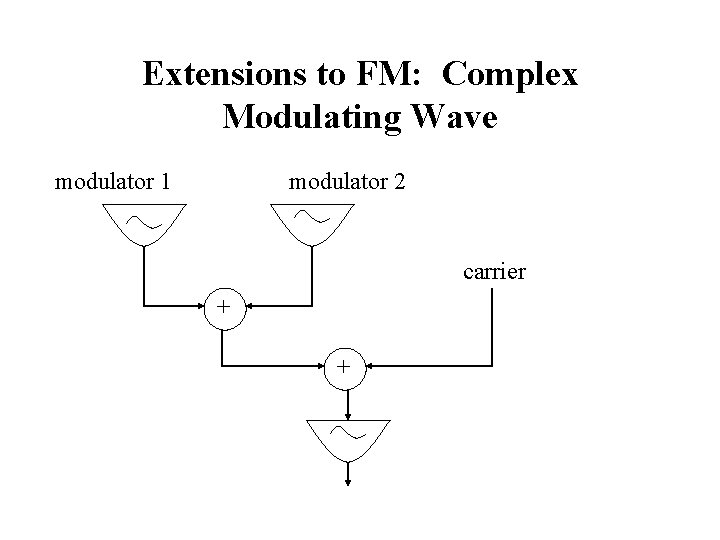
Extensions to FM: Complex Modulating Wave modulator 1 modulator 2 carrier + +
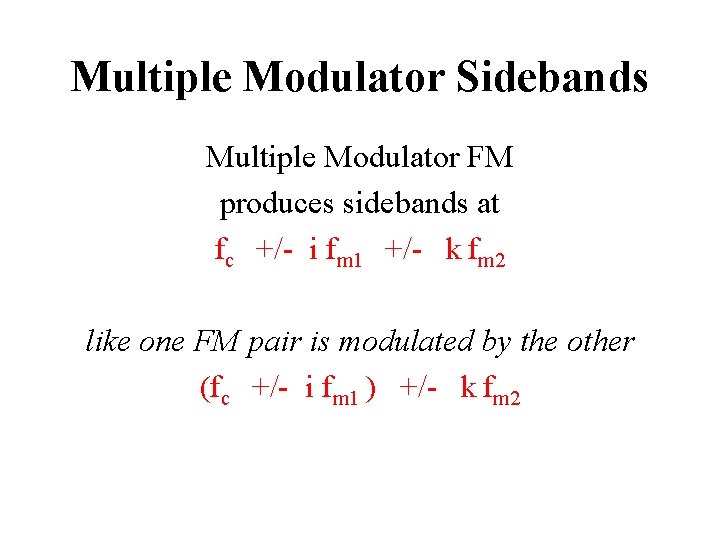
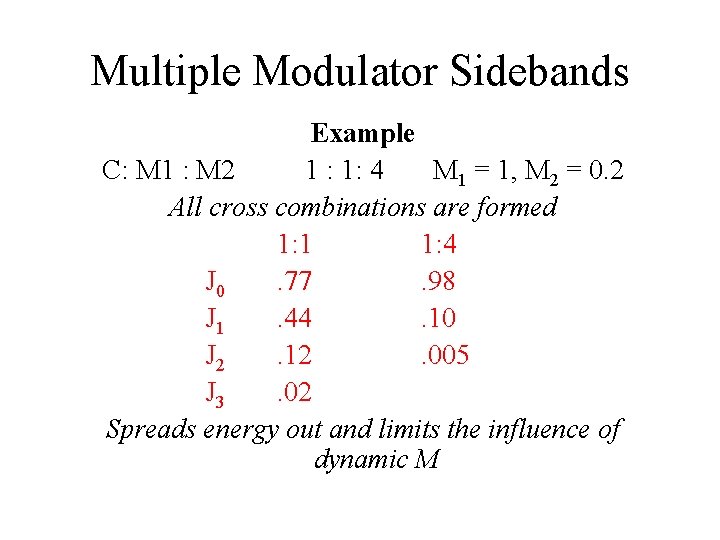
Multiple Modulator Sidebands Multiple Modulator FM produces sidebands at fc +/- i fm 1 +/- k fm 2 like one FM pair is modulated by the other (fc +/- i fm 1 ) +/- k fm 2
Multiple Modulator Sidebands Example C: M 1 : M 2 1 : 1: 4 M 1 = 1, M 2 = 0. 2 All cross combinations are formed 1: 1 1: 4 J 0. 77. 98 J 1. 44. 10 J 2. 12. 005 J 3. 02 Spreads energy out and limits the influence of dynamic M
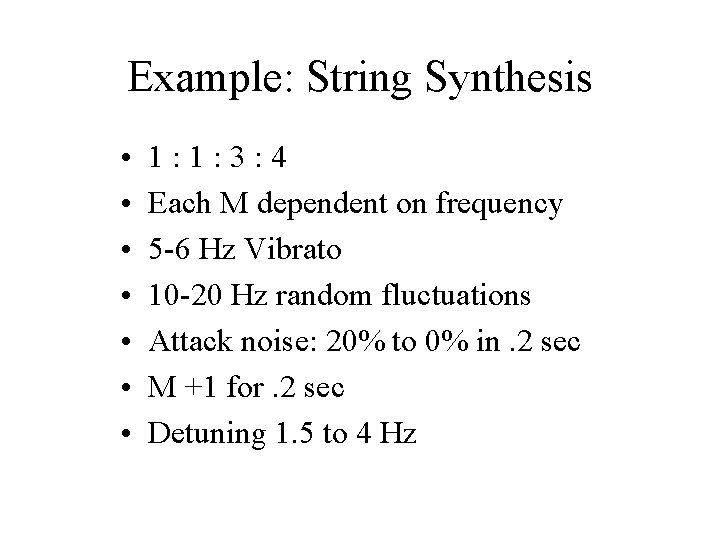
Example: String Synthesis • • 1: 1: 3: 4 Each M dependent on frequency 5 -6 Hz Vibrato 10 -20 Hz random fluctuations Attack noise: 20% to 0% in. 2 sec M +1 for. 2 sec Detuning 1. 5 to 4 Hz