
Modulation and currentvoltage control of the grid converter
- Slides: 49
Modulation and current/voltage control of the grid converter Marco Liserre liserre@ieee. org
Modulation and current/voltage control of the grid converter Introduction ü Modulation and ac current control are the core of grid-connected converters ü They are responsible of the safe operation of the converter and of the compliance with standards and grid codes ü Ac voltage control is a standard solution in WT-system however can be adopted also in PV-system for reinforcing stability or offering ancillary services A glance at the lecture content ü ü ü Introduction Model of the grid converter Overview of modulation techniques Current control Voltage control Marco Liserre liserre@ieee. org
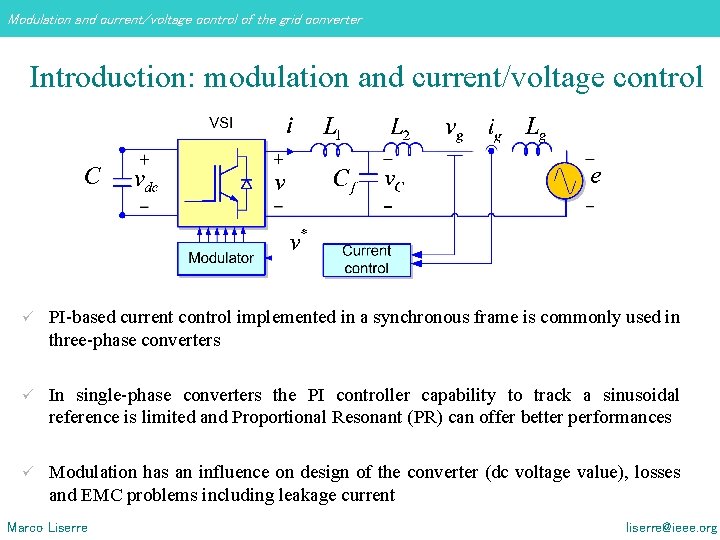
Modulation and current/voltage control of the grid converter Introduction: modulation and current/voltage control ü PI-based current control implemented in a synchronous frame is commonly used in three-phase converters ü In single-phase converters the PI controller capability to track a sinusoidal reference is limited and Proportional Resonant (PR) can offer better performances ü Modulation has an influence on design of the converter (dc voltage value), losses and EMC problems including leakage current Marco Liserre liserre@ieee. org
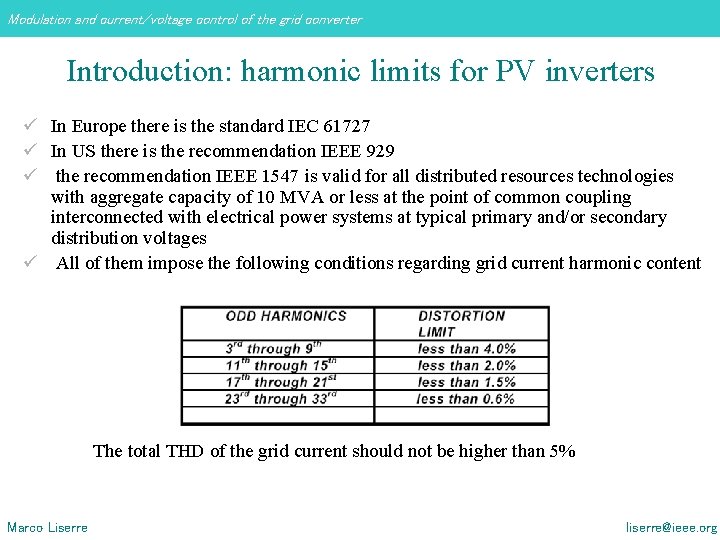
Modulation and current/voltage control of the grid converter Introduction: harmonic limits for PV inverters ü In Europe there is the standard IEC 61727 ü In US there is the recommendation IEEE 929 ü the recommendation IEEE 1547 is valid for all distributed resources technologies with aggregate capacity of 10 MVA or less at the point of common coupling interconnected with electrical power systems at typical primary and/or secondary distribution voltages ü All of them impose the following conditions regarding grid current harmonic content The total THD of the grid current should not be higher than 5% Marco Liserre liserre@ieee. org
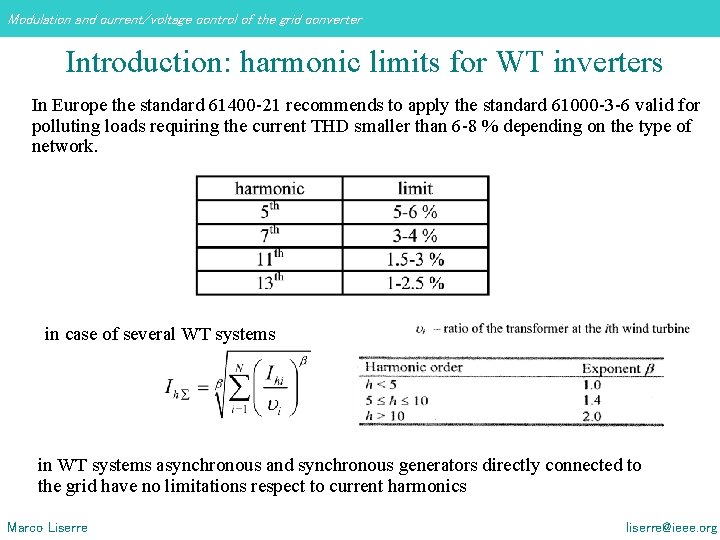
Modulation and current/voltage control of the grid converter Introduction: harmonic limits for WT inverters In Europe the standard 61400 -21 recommends to apply the standard 61000 -3 -6 valid for polluting loads requiring the current THD smaller than 6 -8 % depending on the type of network. in case of several WT systems in WT systems asynchronous and synchronous generators directly connected to the grid have no limitations respect to current harmonics Marco Liserre liserre@ieee. org
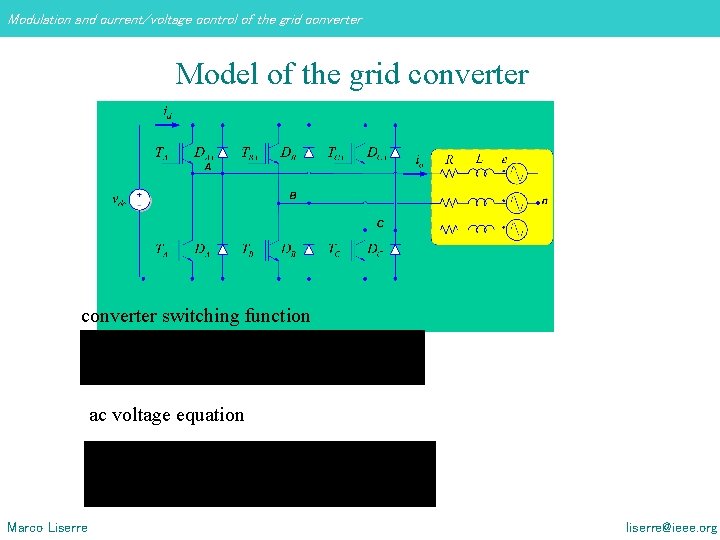
Modulation and current/voltage control of the grid converter Model of the grid converter switching function ac voltage equation Marco Liserre liserre@ieee. org
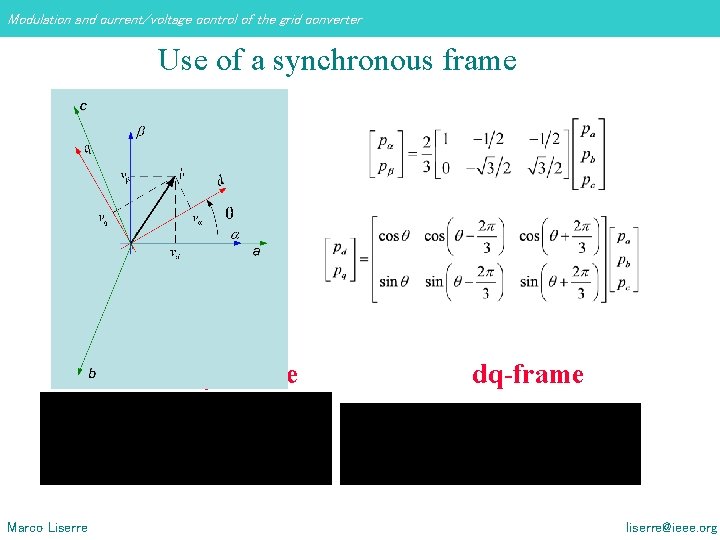
Modulation and current/voltage control of the grid converter Use of a synchronous frame ab-frame Marco Liserre dq-frame liserre@ieee. org
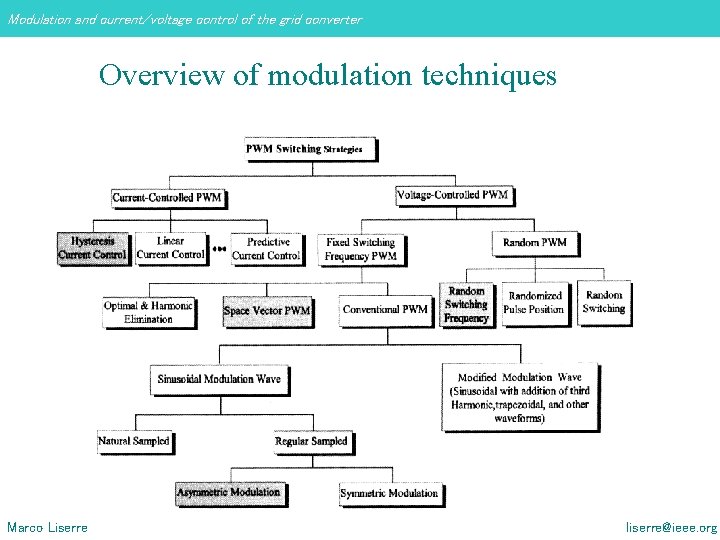
Modulation and current/voltage control of the grid converter Overview of modulation techniques Marco Liserre liserre@ieee. org
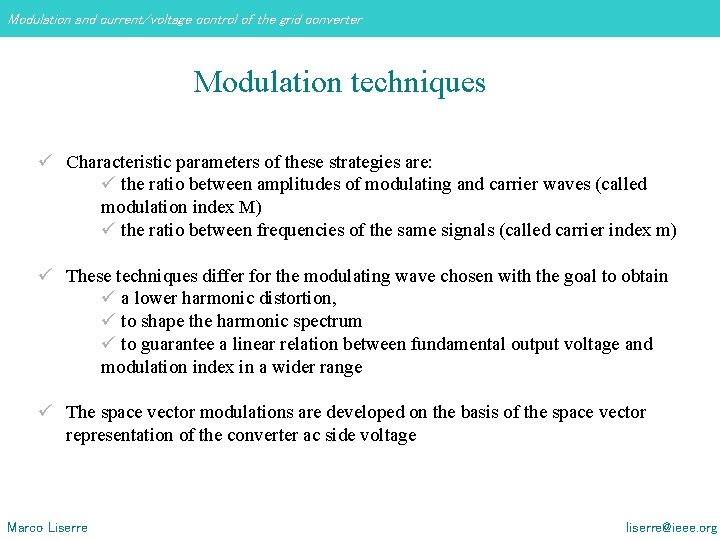
Modulation and current/voltage control of the grid converter Modulation techniques ü Characteristic parameters of these strategies are: ü the ratio between amplitudes of modulating and carrier waves (called modulation index M) ü the ratio between frequencies of the same signals (called carrier index m) ü These techniques differ for the modulating wave chosen with the goal to obtain ü a lower harmonic distortion, ü to shape the harmonic spectrum ü to guarantee a linear relation between fundamental output voltage and modulation index in a wider range ü The space vector modulations are developed on the basis of the space vector representation of the converter ac side voltage Marco Liserre liserre@ieee. org
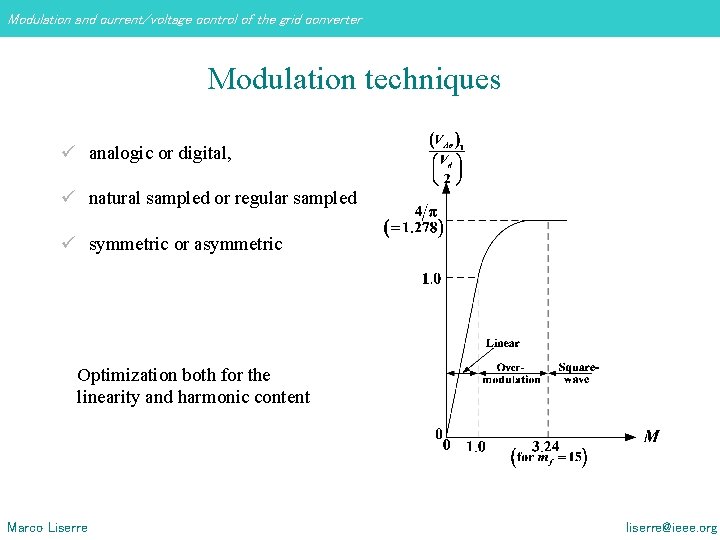
Modulation and current/voltage control of the grid converter Modulation techniques ü analogic or digital, ü natural sampled or regular sampled ü symmetric or asymmetric Optimization both for the linearity and harmonic content Marco Liserre liserre@ieee. org
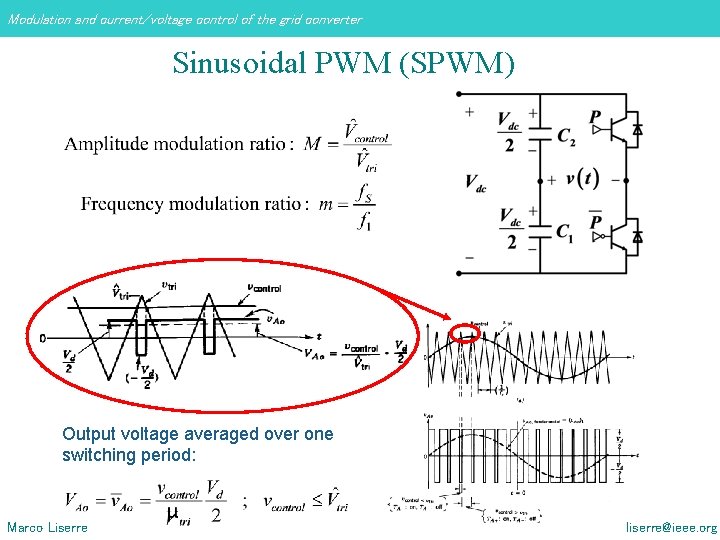
Modulation and current/voltage control of the grid converter Sinusoidal PWM (SPWM) Output voltage averaged over one switching period: Marco Liserre liserre@ieee. org
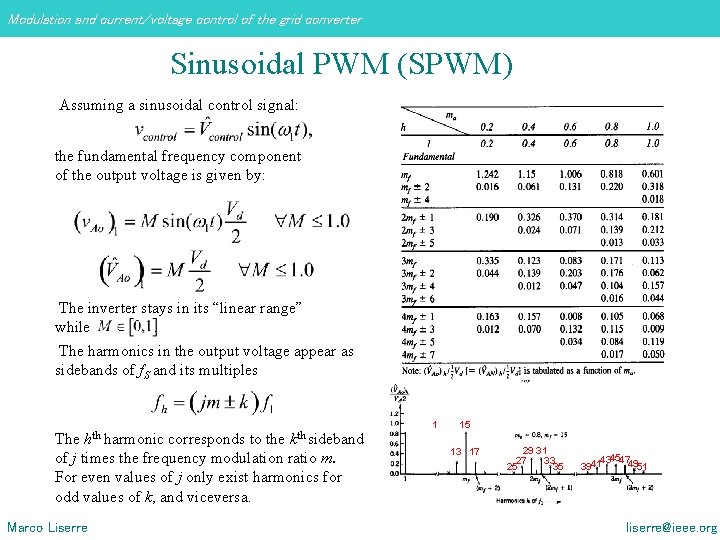
Modulation and current/voltage control of the grid converter Sinusoidal PWM (SPWM) Assuming a sinusoidal control signal: the fundamental frequency component of the output voltage is given by: The inverter stays in its “linear range” while. The harmonics in the output voltage appear as sidebands of f. S and its multiples hth The harmonic corresponds to the of j times the frequency modulation ratio m. For even values of j only exist harmonics for odd values of k, and viceversa. Marco Liserre kth sideband 1 15 13 17 29 31 27 33 25 35 43454749 3941 51 liserre@ieee. org
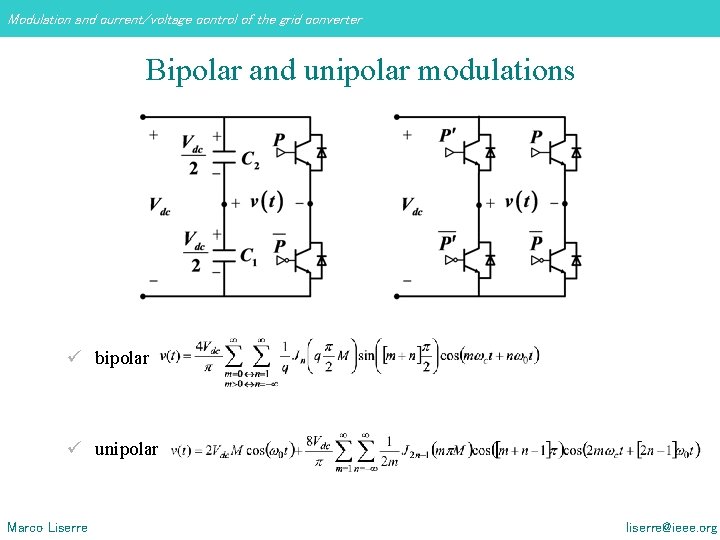
Modulation and current/voltage control of the grid converter Bipolar and unipolar modulations ü bipolar ü unipolar Marco Liserre liserre@ieee. org
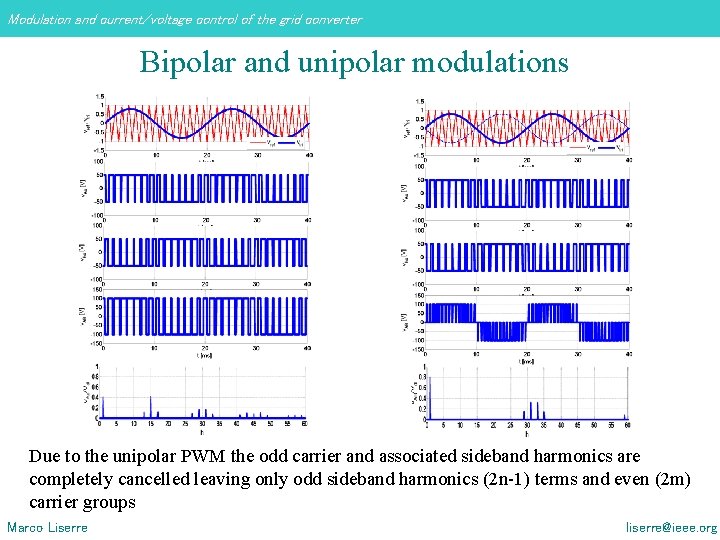
Modulation and current/voltage control of the grid converter Bipolar and unipolar modulations Due to the unipolar PWM the odd carrier and associated sideband harmonics are completely cancelled leaving only odd sideband harmonics (2 n-1) terms and even (2 m) carrier groups Marco Liserre liserre@ieee. org
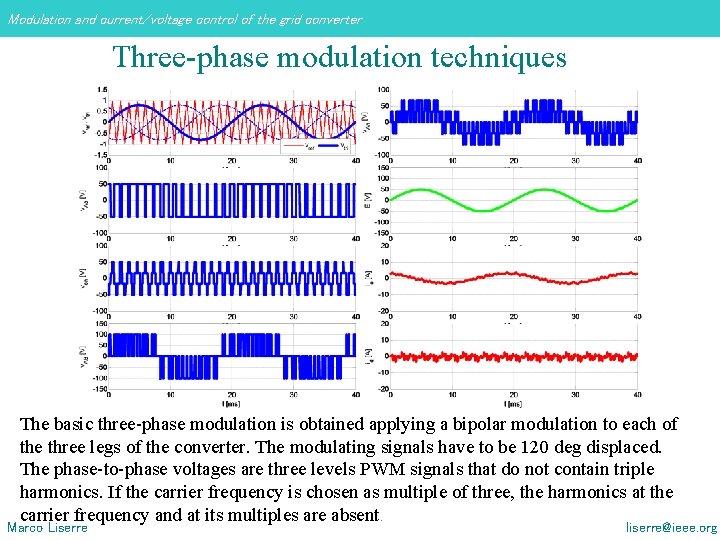
Modulation and current/voltage control of the grid converter Three-phase modulation techniques The basic three-phase modulation is obtained applying a bipolar modulation to each of the three legs of the converter. The modulating signals have to be 120 deg displaced. The phase-to-phase voltages are three levels PWM signals that do not contain triple harmonics. If the carrier frequency is chosen as multiple of three, the harmonics at the carrier frequency and at its multiples are absent. Marco Liserre liserre@ieee. org
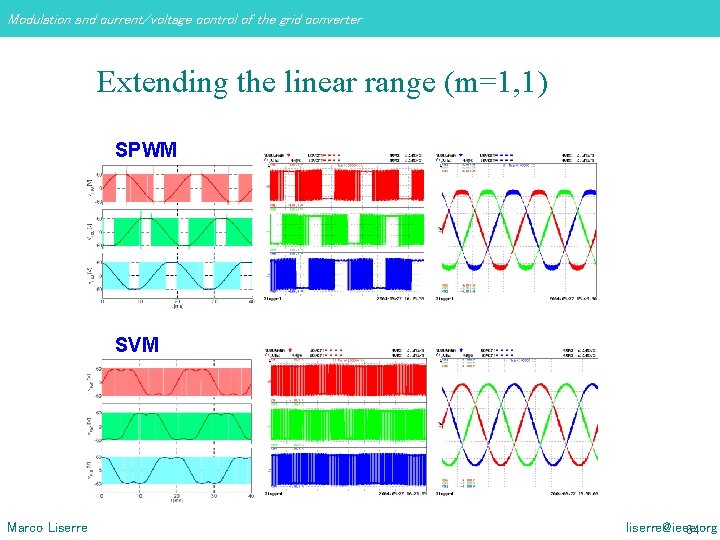
Modulation and current/voltage control of the grid converter Extending the linear range (m=1, 1) SPWM SVM Marco Liserre liserre@ieee. org 64
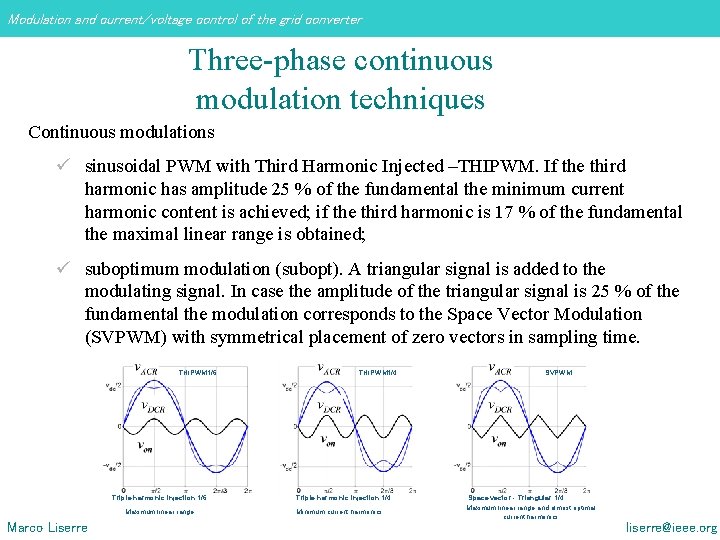
Modulation and current/voltage control of the grid converter Three-phase continuous modulation techniques Continuous modulations ü sinusoidal PWM with Third Harmonic Injected –THIPWM. If the third harmonic has amplitude 25 % of the fundamental the minimum current harmonic content is achieved; if the third harmonic is 17 % of the fundamental the maximal linear range is obtained; ü suboptimum modulation (subopt). A triangular signal is added to the modulating signal. In case the amplitude of the triangular signal is 25 % of the fundamental the modulation corresponds to the Space Vector Modulation (SVPWM) with symmetrical placement of zero vectors in sampling time. THIPWM 1/6 Triple harmonic injection 1/6 Maximum linear range Marco Liserre THIPWM 1/4 Triple harmonic injection 1/4 Minimum current harmonics SVPWM Space vector - Triangular 1/4 Maximum linear range and almost optimal current harmonics liserre@ieee. org
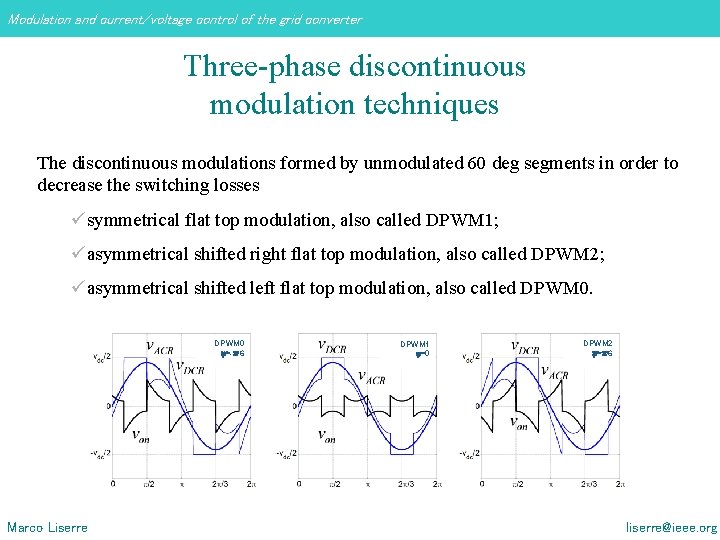
Modulation and current/voltage control of the grid converter Three-phase discontinuous modulation techniques The discontinuous modulations formed by unmodulated 60 deg segments in order to decrease the switching losses üsymmetrical flat top modulation, also called DPWM 1; üasymmetrical shifted right flat top modulation, also called DPWM 2; üasymmetrical shifted left flat top modulation, also called DPWM 0 =- /6 Marco Liserre DPWM 1 =0 DPWM 2 = /6 liserre@ieee. org
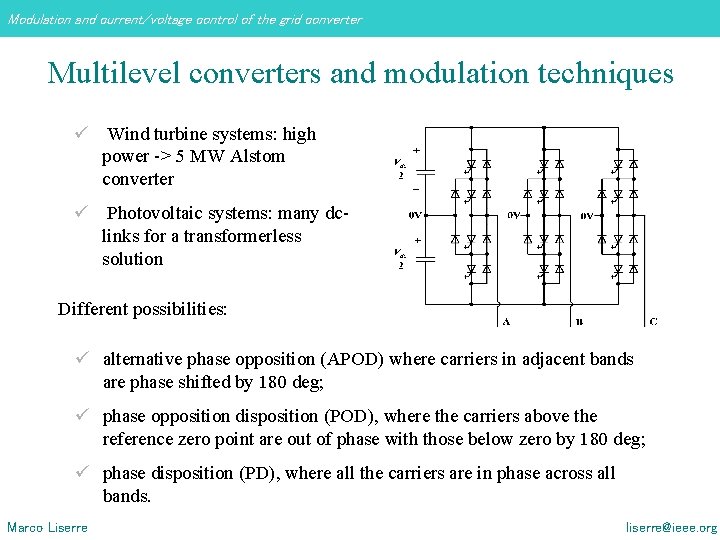
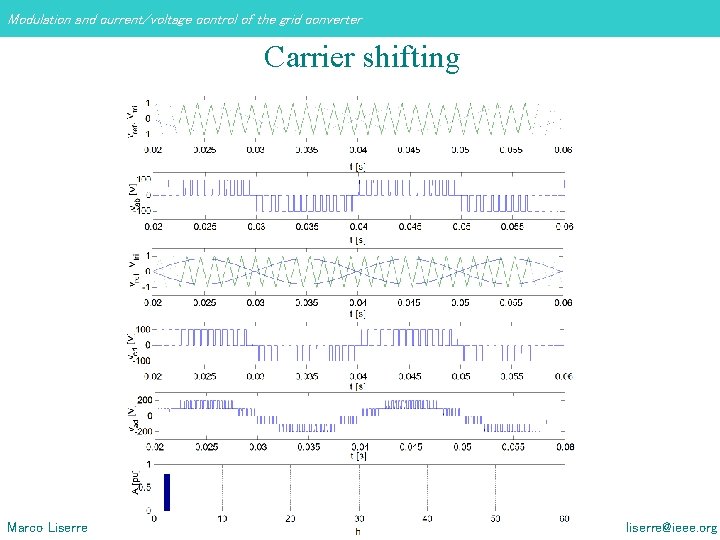
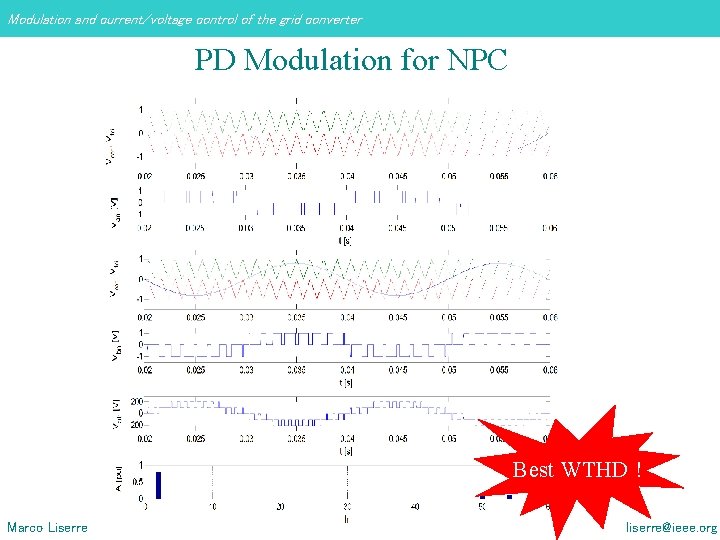
Modulation and current/voltage control of the grid converter Multilevel converters and modulation techniques ü Wind turbine systems: high power -> 5 MW Alstom converter ü Photovoltaic systems: many dclinks for a transformerless solution Different possibilities: ü alternative phase opposition (APOD) where carriers in adjacent bands are phase shifted by 180 deg; ü phase opposition disposition (POD), where the carriers above the reference zero point are out of phase with those below zero by 180 deg; ü phase disposition (PD), where all the carriers are in phase across all bands. Marco Liserre liserre@ieee. org
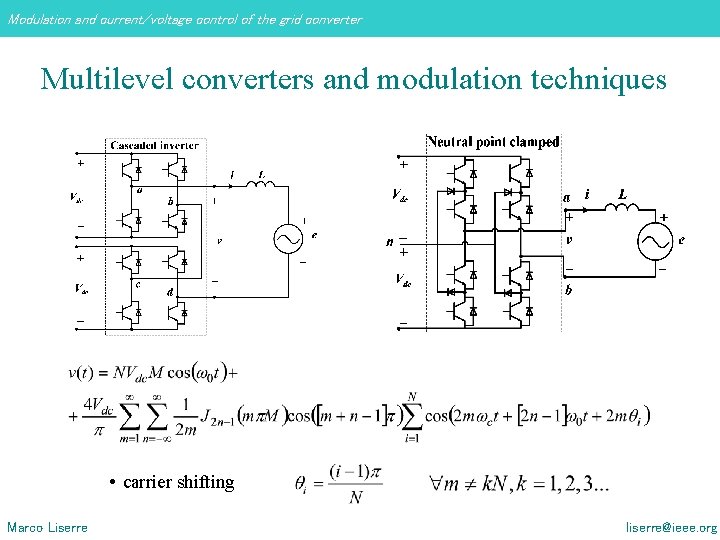
Modulation and current/voltage control of the grid converter Multilevel converters and modulation techniques • carrier shifting Marco Liserre liserre@ieee. org
Modulation and current/voltage control of the grid converter Carrier shifting Marco Liserre liserre@ieee. org
Modulation and current/voltage control of the grid converter PD Modulation for NPC Best WTHD ! Marco Liserre liserre@ieee. org
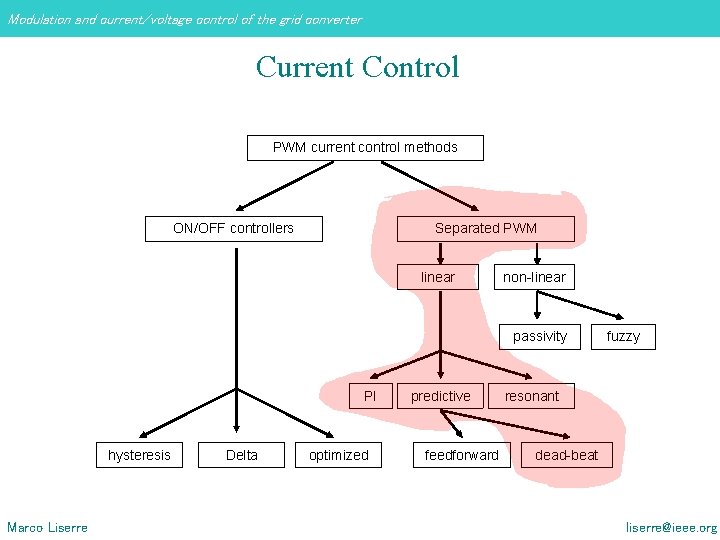
Modulation and current/voltage control of the grid converter Current Control PWM current control methods ON/OFF controllers Separated PWM linear non-linear passivity PI hysteresis Marco Liserre Delta optimized predictive feedforward fuzzy resonant dead-beat liserre@ieee. org
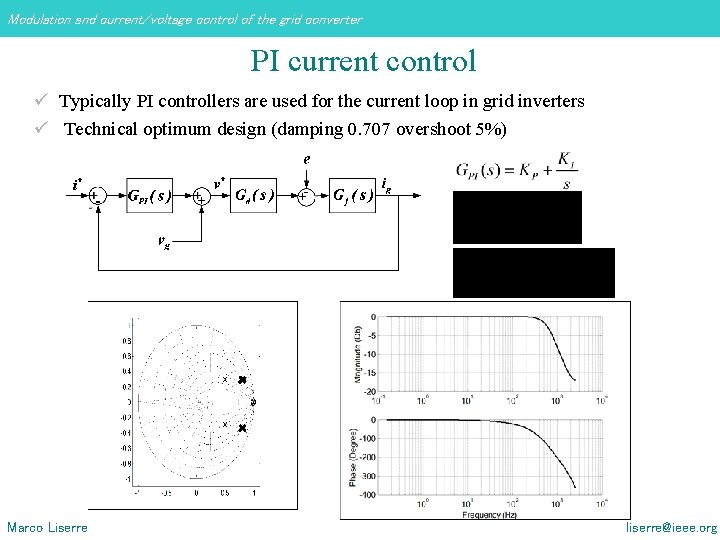
Modulation and current/voltage control of the grid converter PI current control ü Typically PI controllers are used for the current loop in grid inverters ü Technical optimum design (damping 0. 707 overshoot 5%) Marco Liserre liserre@ieee. org
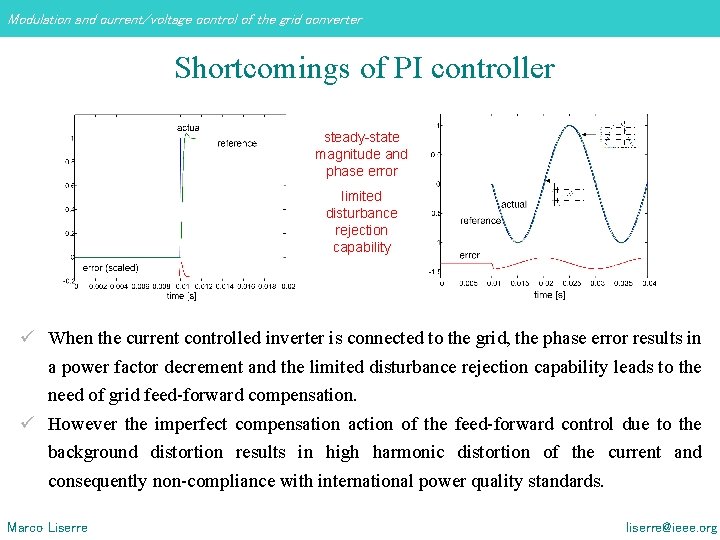
Modulation and current/voltage control of the grid converter Shortcomings of PI controller steady-state magnitude and phase error limited disturbance rejection capability ü When the current controlled inverter is connected to the grid, the phase error results in a power factor decrement and the limited disturbance rejection capability leads to the need of grid feed-forward compensation. ü However the imperfect compensation action of the feed-forward control due to the background distortion results in high harmonic distortion of the current and consequently non-compliance with international power quality standards. Marco Liserre liserre@ieee. org
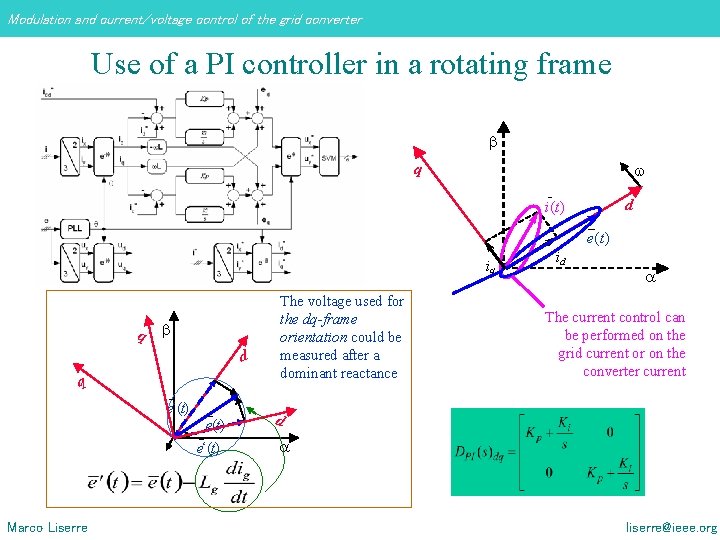
Modulation and current/voltage control of the grid converter Use of a PI controller in a rotating frame b w q d i(t ) e(t ) iq q b d q e‘(t) Marco Liserre e(t) e‘(t) The voltage used for the dq-frame orientation could be measured after a dominant reactance id a The current control can be performed on the grid current or on the converter current d a liserre@ieee. org
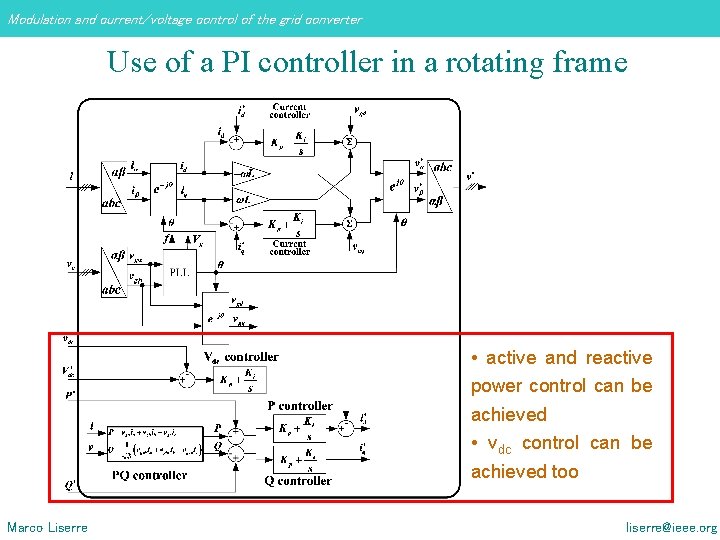
Modulation and current/voltage control of the grid converter Use of a PI controller in a rotating frame • active and reactive power control can be achieved • vdc control can be achieved too Marco Liserre liserre@ieee. org
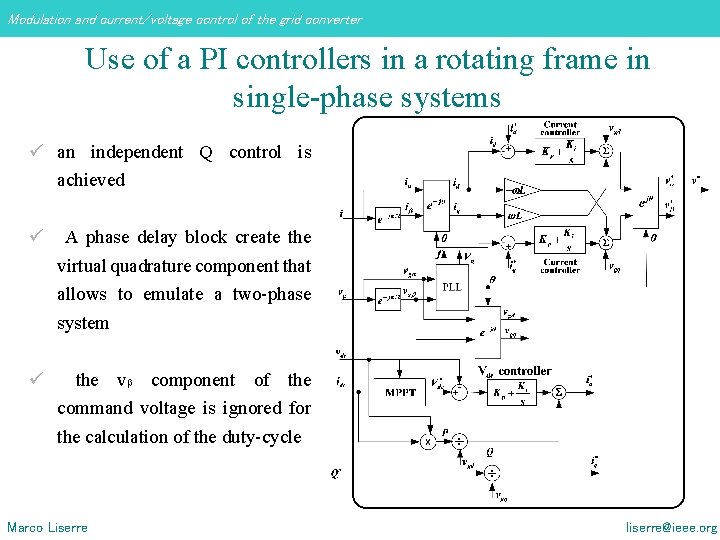
Modulation and current/voltage control of the grid converter Use of a PI controllers in a rotating frame in single-phase systems ü an independent Q control is achieved ü A phase delay block create the virtual quadrature component that allows to emulate a two-phase system ü the vb component of the command voltage is ignored for the calculation of the duty-cycle Marco Liserre liserre@ieee. org
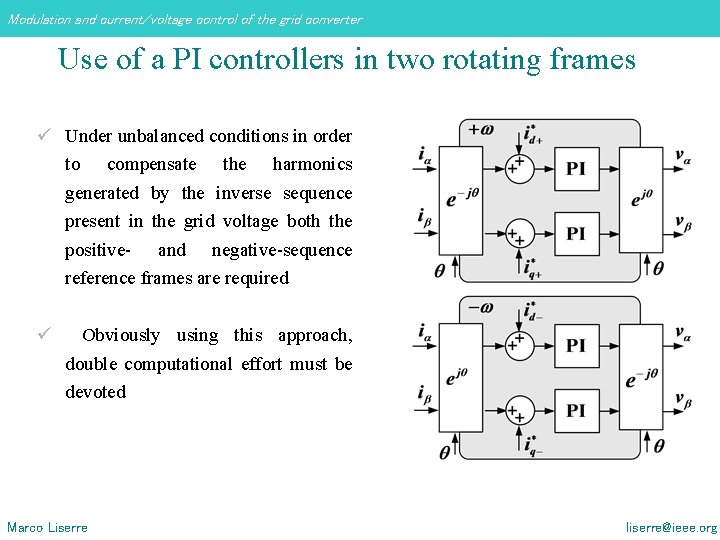
Modulation and current/voltage control of the grid converter Use of a PI controllers in two rotating frames ü Under unbalanced conditions in order to compensate the harmonics generated by the inverse sequence present in the grid voltage both the positive- and negative-sequence reference frames are required ü Obviously using this approach, double computational effort must be devoted Marco Liserre liserre@ieee. org
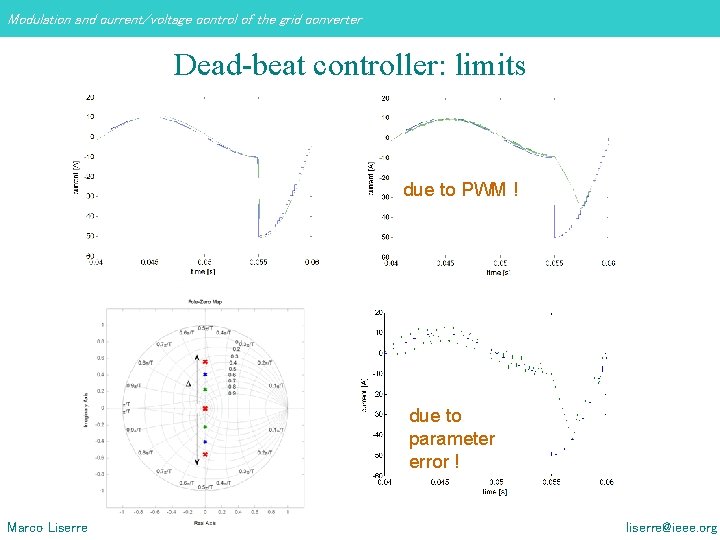
Modulation and current/voltage control of the grid converter Dead-beat controller ü The dead-beat controller belongs to the family of the predictive controllers ü They are based on a common principle: to foresee the evolution of the controlled quantity (the current) and on the basis of this prediction: ü to choose the state of the converter (ON-OFF predictive) or ü the average voltage produced by the converter (predictive with pulse width modulator) ü The starting point is to calculate its derivative to predict the effect of the control action ü The controller is developed on the basis of the model of the filter and of the grid, which is used to predict the system dynamic behavior: the controller is inherently sensitive to model and parameter mismatches Marco Liserre liserre@ieee. org
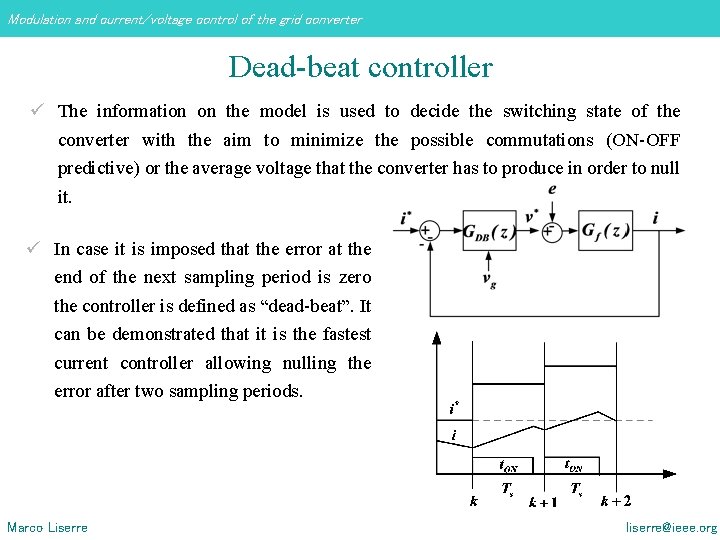
Modulation and current/voltage control of the grid converter Dead-beat controller ü The information on the model is used to decide the switching state of the converter with the aim to minimize the possible commutations (ON-OFF predictive) or the average voltage that the converter has to produce in order to null it. ü In case it is imposed that the error at the end of the next sampling period is zero the controller is defined as “dead-beat”. It can be demonstrated that it is the fastest current controller allowing nulling the error after two sampling periods. Marco Liserre liserre@ieee. org
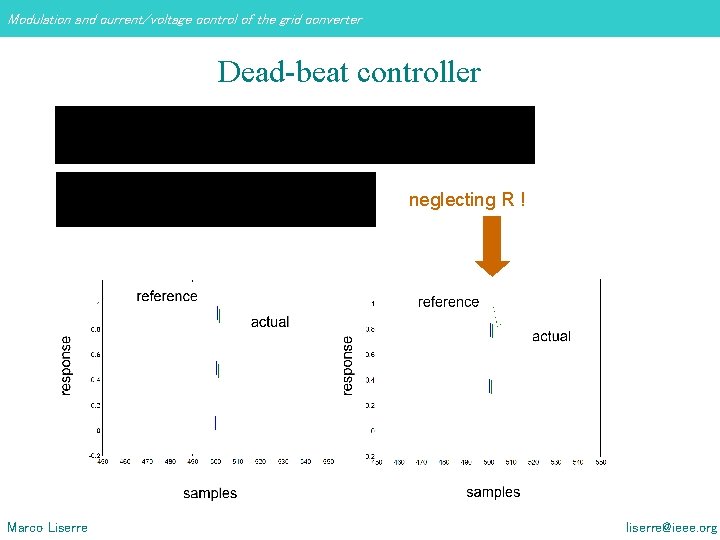
Modulation and current/voltage control of the grid converter Dead-beat controller neglecting R ! Marco Liserre liserre@ieee. org
Modulation and current/voltage control of the grid converter Dead-beat controller: limits due to PWM ! due to parameter error ! Marco Liserre liserre@ieee. org
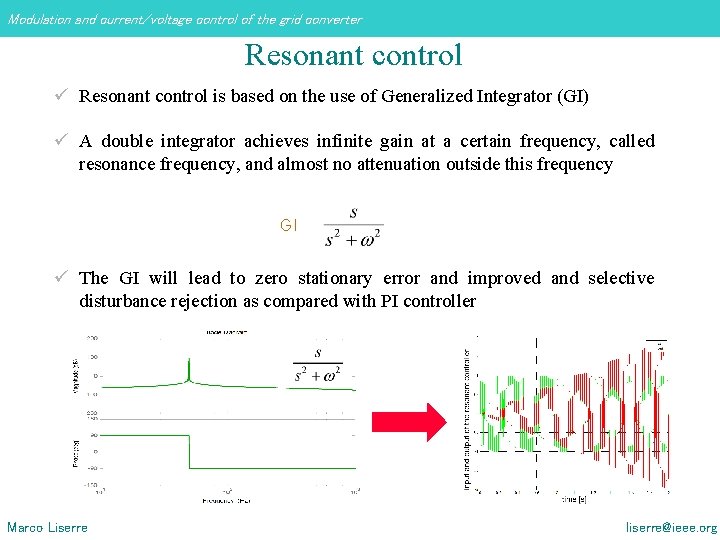
Modulation and current/voltage control of the grid converter Resonant control ü Resonant control is based on the use of Generalized Integrator (GI) ü A double integrator achieves infinite gain at a certain frequency, called resonance frequency, and almost no attenuation outside this frequency GI ü The GI will lead to zero stationary error and improved and selective disturbance rejection as compared with PI controller Marco Liserre liserre@ieee. org
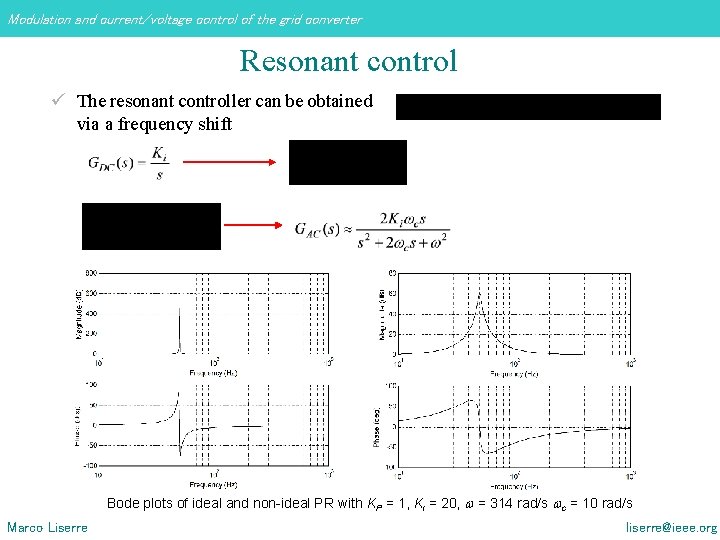
Modulation and current/voltage control of the grid converter Resonant control ü The resonant controller can be obtained via a frequency shift Bode plots of ideal and non-ideal PR with KP = 1, Ki = 20, = 314 rad/s c = 10 rad/s Marco Liserre liserre@ieee. org
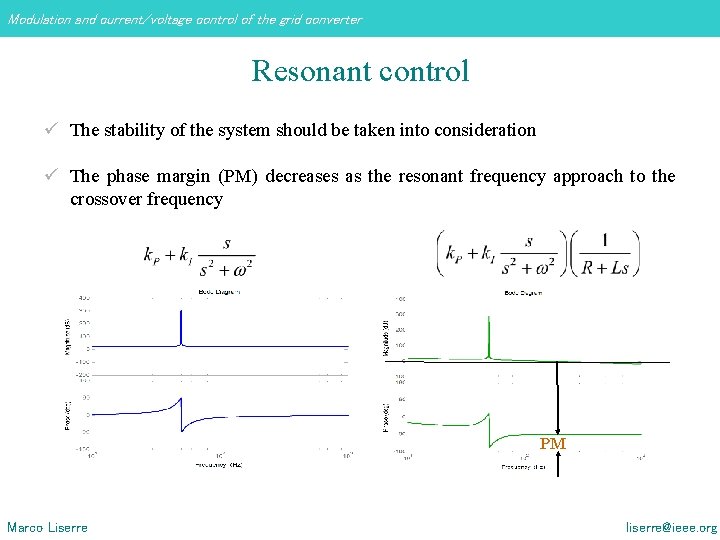
Modulation and current/voltage control of the grid converter Resonant control ü The stability of the system should be taken into consideration ü The phase margin (PM) decreases as the resonant frequency approach to the crossover frequency PM Marco Liserre liserre@ieee. org
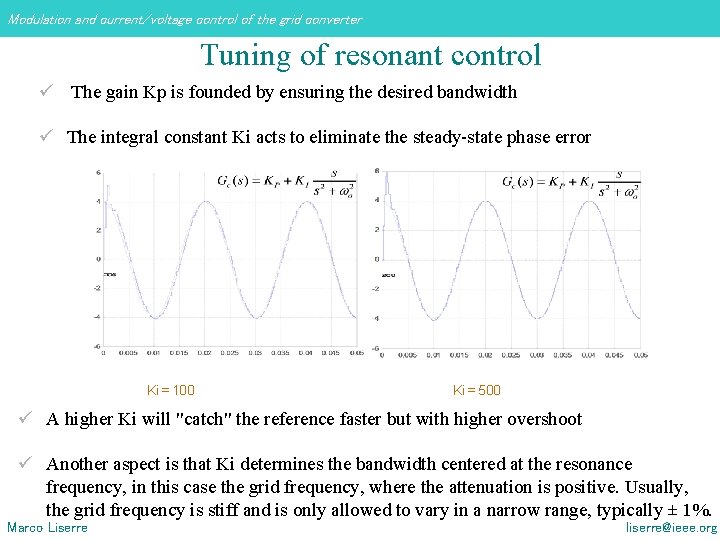
Modulation and current/voltage control of the grid converter Tuning of resonant control ü The gain Kp is founded by ensuring the desired bandwidth ü The integral constant Ki acts to eliminate the steady-state phase error Ki = 100 Ki = 500 ü A higher Ki will "catch" the reference faster but with higher overshoot ü Another aspect is that Ki determines the bandwidth centered at the resonance frequency, in this case the grid frequency, where the attenuation is positive. Usually, the grid frequency is stiff and is only allowed to vary in a narrow range, typically ± 1%. Marco Liserre liserre@ieee. org
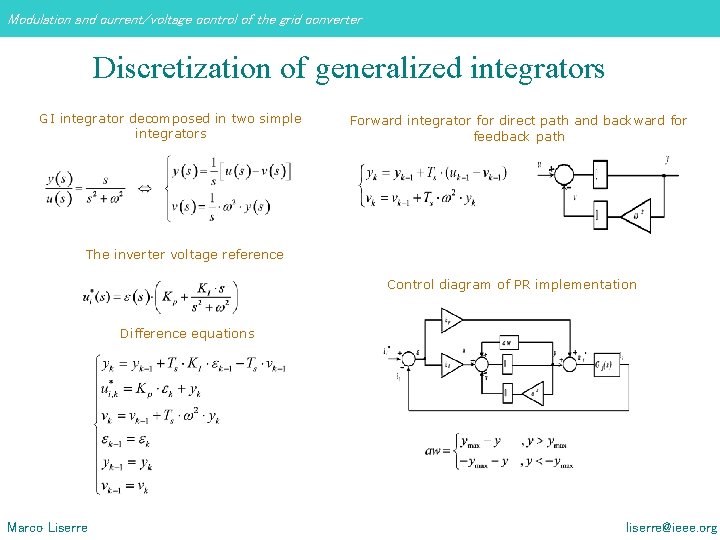
Modulation and current/voltage control of the grid converter Discretization of generalized integrators GI integrator decomposed in two simple integrators Forward integrator for direct path and backward for feedback path The inverter voltage reference Control diagram of PR implementation Difference equations Marco Liserre liserre@ieee. org
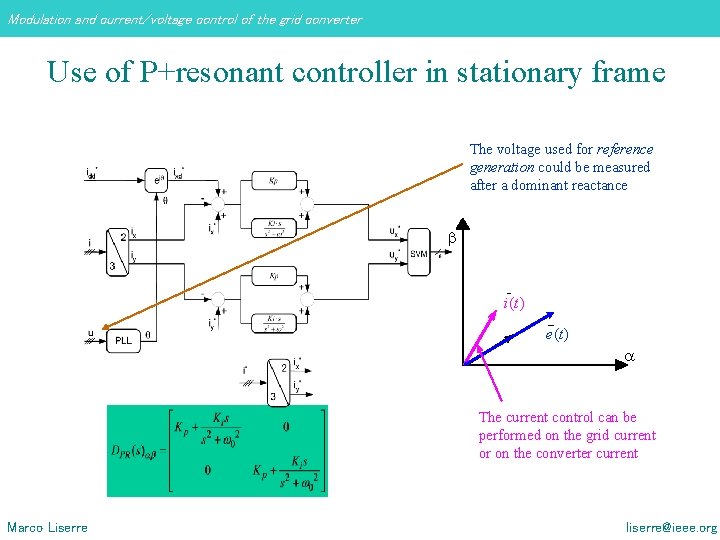
Modulation and current/voltage control of the grid converter Use of P+resonant controller in stationary frame The voltage used for reference generation could be measured after a dominant reactance b i(t ) e(t ) a The current control can be performed on the grid current or on the converter current Marco Liserre liserre@ieee. org
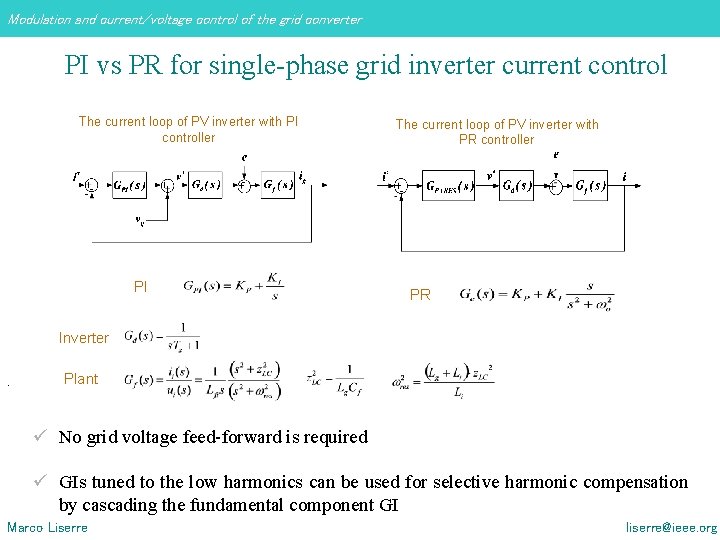
Modulation and current/voltage control of the grid converter PI vs PR for single-phase grid inverter current control The current loop of PV inverter with PI controller PI The current loop of PV inverter with PR controller PR Inverter. Plant ü No grid voltage feed-forward is required ü GIs tuned to the low harmonics can be used for selective harmonic compensation by cascading the fundamental component GI Marco Liserre liserre@ieee. org
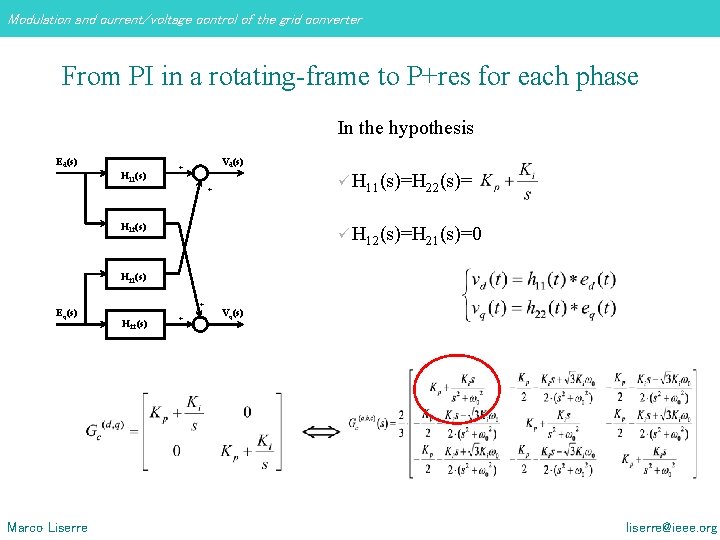
Modulation and current/voltage control of the grid converter From PI in a rotating-frame to P+res for each phase In the hypothesis Ed(s) H 11(s) Vd(s) + ü H 11(s)=H 22(s)= + H 12(s) ü H 12(s)=H 21(s)=0 H 21(s) Eq(s) Marco Liserre + H 22(s) + Vq(s) liserre@ieee. org
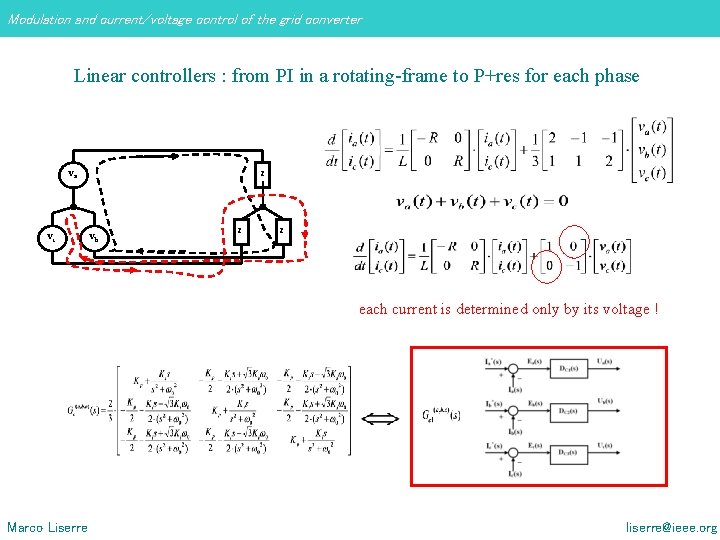
Modulation and current/voltage control of the grid converter Linear controllers : from PI in a rotating-frame to P+res for each phase va vc z vb z z each current is determined only by its voltage ! Marco Liserre liserre@ieee. org
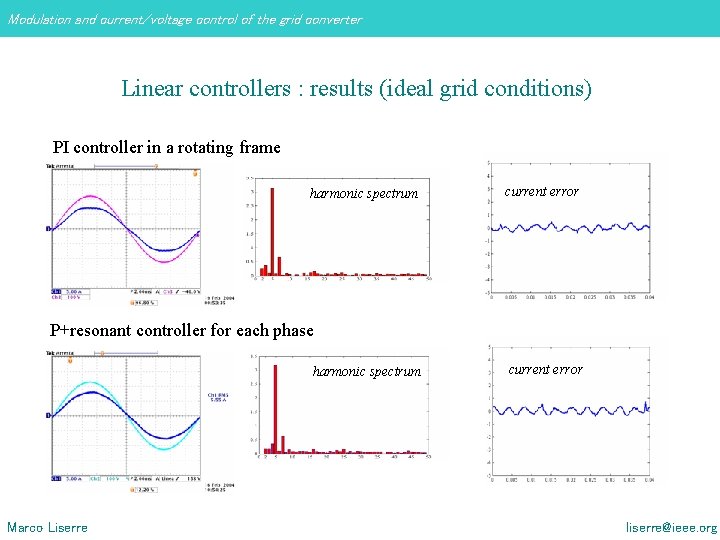
Modulation and current/voltage control of the grid converter Linear controllers : results (ideal grid conditions) PI controller in a rotating frame harmonic spectrum current error P+resonant controller for each phase harmonic spectrum Marco Liserre current error liserre@ieee. org
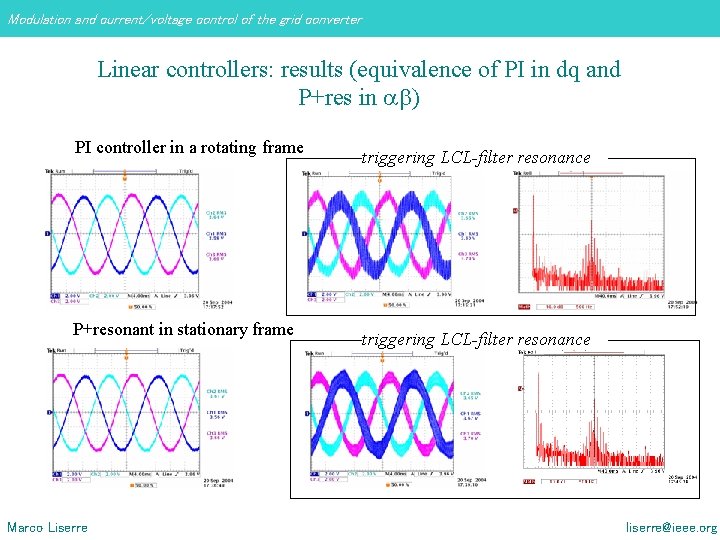
Modulation and current/voltage control of the grid converter Linear controllers: results (equivalence of PI in dq and P+res in ab) PI controller in a rotating frame P+resonant in stationary frame Marco Liserre triggering LCL-filter resonance liserre@ieee. org
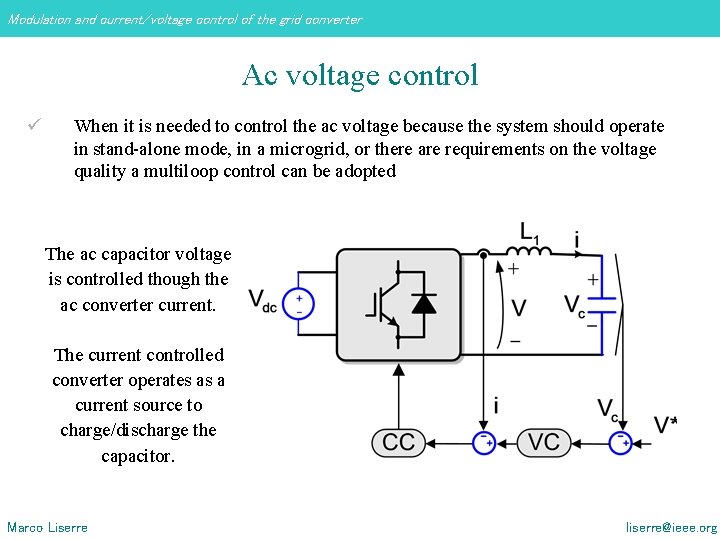
Modulation and current/voltage control of the grid converter Ac voltage control ü When it is needed to control the ac voltage because the system should operate in stand-alone mode, in a microgrid, or there are requirements on the voltage quality a multiloop control can be adopted The ac capacitor voltage is controlled though the ac converter current. The current controlled converter operates as a current source to charge/discharge the capacitor. Marco Liserre liserre@ieee. org
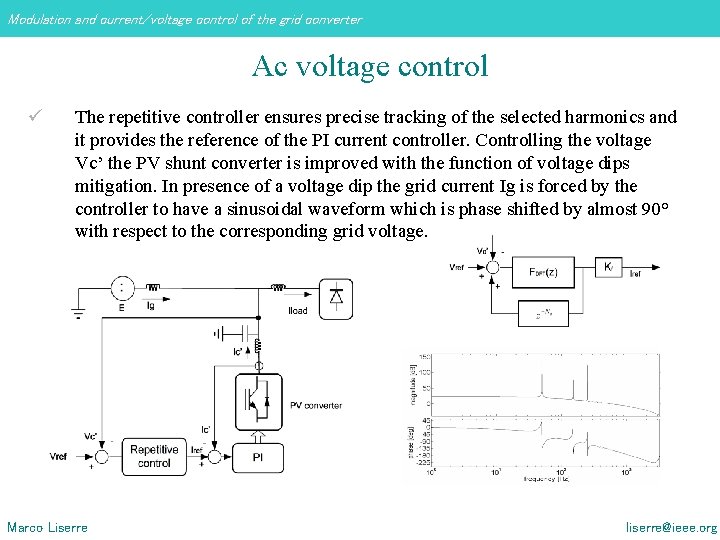
Modulation and current/voltage control of the grid converter Ac voltage control ü The repetitive controller ensures precise tracking of the selected harmonics and it provides the reference of the PI current controller. Controlling the voltage Vc’ the PV shunt converter is improved with the function of voltage dips mitigation. In presence of a voltage dip the grid current Ig is forced by the controller to have a sinusoidal waveform which is phase shifted by almost 90° with respect to the corresponding grid voltage. Marco Liserre liserre@ieee. org
Modulation and current/voltage control of the grid converter Conclusions ü The PR uses Generalized Integrators (GI) that are double integrators achieving very high gain in a narrow frequency band centered on the resonant frequency and almost null outside. ü This makes the PR controller to act as a notch filter at the resonance frequency and thus it can track a sinusoidal reference without having to increase the switching frequency or adopting a high gain, as it is the case for the classical PI controller. ü PI adopted in a rotating frame achieves similar results, it is equivalent to the use of three PR’s one for each phase ü Also single phase use of PI in a dq frame is feasible ü Dead-beat controller can compensate current error in two samples but it is affected by PWM limits and parameters mismatches Marco Liserre liserre@ieee. org
Modulation and current/voltage control of the grid converter Bibliography 1. D. G. Holmes and T. Lipo, Pulse Width Modulation for Power Converters, Principles and Practice. New York: IEEE Press, 2003. 2. M. Kazmierkowski, R. Krishnan, and F. Blaabjerg, Control in Power Electronics – Selected Problems. Academic Press, 2002. 3. X. Yuan, W. Merk, H. Stemmler, and J. Allmeling, “Stationary-frame generalized integrators for current control of active power filters with zero steady-state error for current harmonics of concern under unbalanced and distorted operating conditions, ” IEEE Trans. on Industry Applications, vol. 38, no. 2, pp. 523– 532, 2002. 4. D. Zmood and D. G. Holmes, “Stationary frame current regulation of PWM inverters with zero steady-state error, ” IEEE Trans. on Power Electronics, vol. 18, no. 3, pp. 814– 822, 2003. 5. M. Bojrup, P. Karlsson, M. Alaküla, L. Gertmar, ”A Multiple Rotating Integrator Controller for Active Filters”, Proc. of EPE 1999, CD-ROM. 6. R. Teodorescu, F. Blaabjerg, M. Liserre and A. Poh Chiang Loh, “Proportional-Resonant Controllers and Filters for Grid. Connected Voltage-Source Converters” IEE Proceedings on Electric Power Applications. 7. A. Timbus, M. Liserre, R. Teodorescu, P. Rodriguez, F. Blaabjerg, Evaluation of Current Controllers for Distributed Power Generation Systems, IEEE Transactions on Power Electronics, March 2009, vol. 24, no. 3, pp. 654 -664. 8. R. A. Mastromauro, M. Liserre, A. Dell'Aquila, “Study of the Effects of Inductor Nonlinear Behavior on the Performance of Current Controllers for Single-Phase PV Grid Converters”, IEEE Transactions on Industrial Electronics, May 2008, vol. 55, no 5, pp. 2043 – 2052. 9. IEEE Std 1547 -2003 "IEEE Standard for Interconnecting Distributed Resources with Electric Power Systems", 2003. 10. IEEE Std 1547. 1 -2005 "IEEE Standard Conformance Test Procedures for Equipment Interconnecting Distribut ed Resources with Electric Power Systems", 2005. 11. IEC Standard 61727, “Characteristic of the utility interface for photovoltaic (PV) systems, ”, 2002. 12. IEC Standard 61400 -21 “Wind turbine generator systems Part 21: measurements and assessment of power quality characteristics of grid connected wind turbines”, 2002. 13. IEC Standard 61000 -4 -7, “Electromagnetic Compatibility, General Guide on Harmonics and Interharmonics Measurements and Instrumentation”, 1997. 14. IEC Standard 61000 -3 -6, “Electromagnetic Compatibility, Assessment of Emission Limits for Distorting Loads in MV and HV Power Systems”, 1996. Marco Liserre liserre@ieee. org
Modulation and current/voltage control of the grid converter Acknowledgment Part of the material is or was included in the present and/or past editions of the “Industrial/Ph. D. Course in Power Electronics for Renewable Energy Systems – in theory and practice” Speakers: R. Teodorescu, P. Rodriguez, M. Liserre, J. M. Guerrero, Place: Aalborg University, Denmark The course is held twice (May and November) every year Marco Liserre liserre@ieee. org