
Modulation and Coding set design for IEEE 802
- Slides: 10
Modulation and Coding set design for IEEE 802. 16 m system Document Number: IEEE C 802. 16 m-09/0216 Date Submitted: 2009 -01 -07 Source: Hua Zhou, Shengbao Liang, Yuanrong Lan, Jie Zhang, Yuantao Zhang, Jinyin Xue, Jian Wang, Jun Tian Voice: +86 -10 -59691519 Fujitsu R&D Center. E-mail: zhouhua@cn. fujitsu. com Venue: IEEE 802. 16 m-08/052 -Call for Comments and Contributions on Project 802. 16 m System Description Document (SDD), on the topic of TGm SDD Channel coding Base Contribution: C 802. 16 m-08_1425 Purpose: To be discussed and adopted into the 802. 16 m SDD by TGm. Notice: This document does not represent the agreed views of the IEEE 802. 16 Working Group or any of its subgroups. It represents only the views of the participants listed in the “Source(s)” field above. It is offered as a basis for discussion. It is not binding on the contributor(s), who reserve(s) the right to add, amend or withdraw material contained herein. Release: The contributor grants a free, irrevocable license to the IEEE to incorporate material contained in this contribution, and any modifications thereof, in the creation of an IEEE Standards publication; to copyright in the IEEE’s name any IEEE Standards publication even though it may include portions of this contribution; and at the IEEE’s sole discretion to permit others to reproduce in whole or in part the resulting IEEE Standards publication. The contributor also acknowledges and accepts that this contribution may be made public by IEEE 802. 16. Patent Policy: The contributor is familiar with the IEEE-SA Patent Policy and Procedures: <http: //standards. ieee. org/guides/bylaws/sect 6 -7. html#6> and <http: //standards. ieee. org/guides/opman/sect 6. html#6. 3>. Further information is located at <http: //standards. ieee. org/board/pat-material. html> and <http: //standards. ieee. org/board/pat >. 1
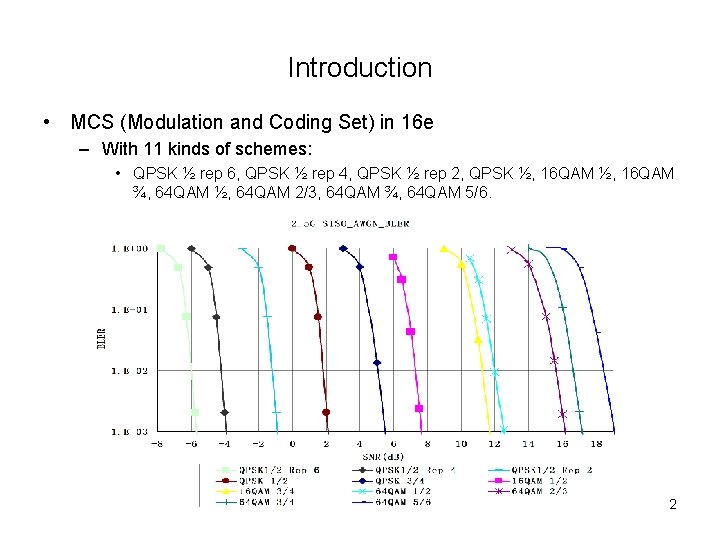
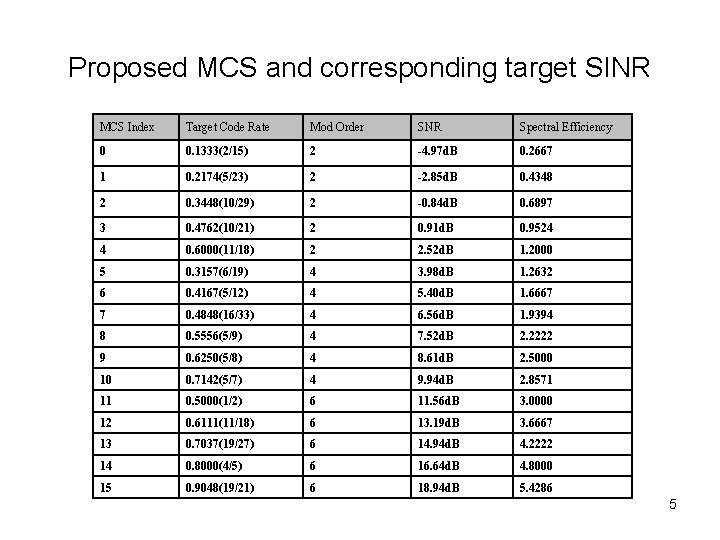
Introduction • MCS (Modulation and Coding Set) in 16 e – With 11 kinds of schemes: • QPSK ½ rep 6, QPSK ½ rep 4, QPSK ½ rep 2, QPSK ½, 16 QAM ¾, 64 QAM ½, 64 QAM 2/3, 64 QAM ¾, 64 QAM 5/6. 2
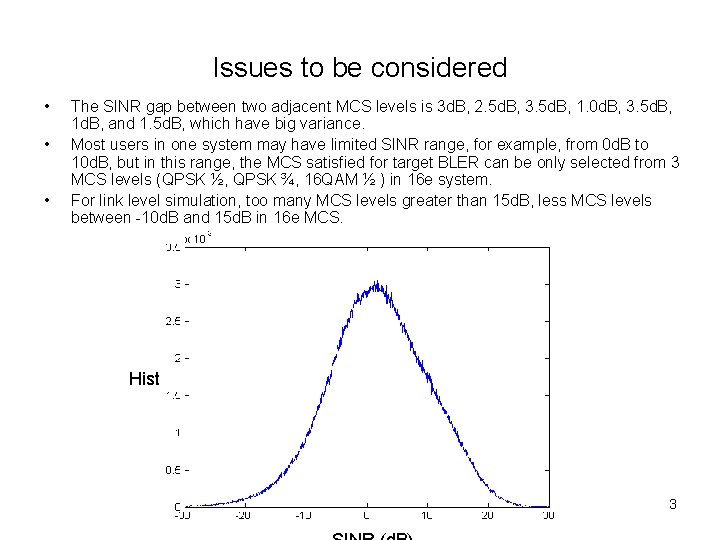
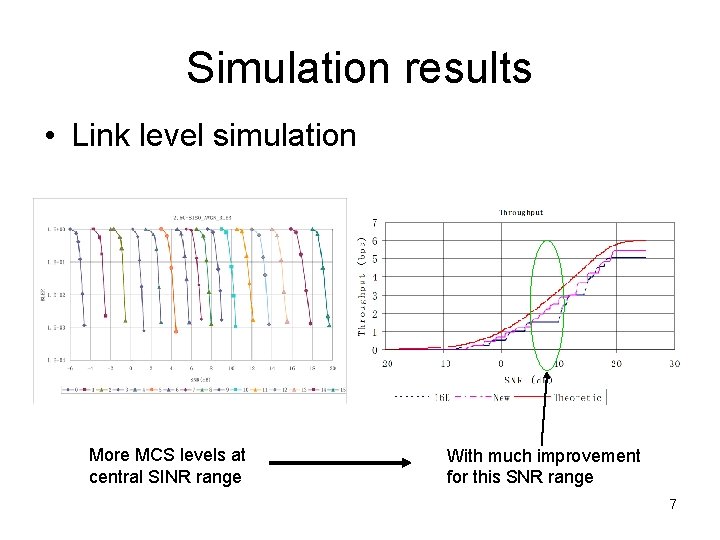
Issues to be considered • • • The SINR gap between two adjacent MCS levels is 3 d. B, 2. 5 d. B, 3. 5 d. B, 1. 0 d. B, 3. 5 d. B, 1 d. B, and 1. 5 d. B, which have big variance. Most users in one system may have limited SINR range, for example, from 0 d. B to 10 d. B, but in this range, the MCS satisfied for target BLER can be only selected from 3 MCS levels (QPSK ½, QPSK ¾, 16 QAM ½ ) in 16 e system. For link level simulation, too many MCS levels greater than 15 d. B, less MCS levels between -10 d. B and 15 d. B in 16 e MCS. Hist 3
Proposed solution • Assign more MCS levels in certain SINR area, i. e. , we design more MCS level for SNR with high probability, and less MCS level for SNR with less probability. 4
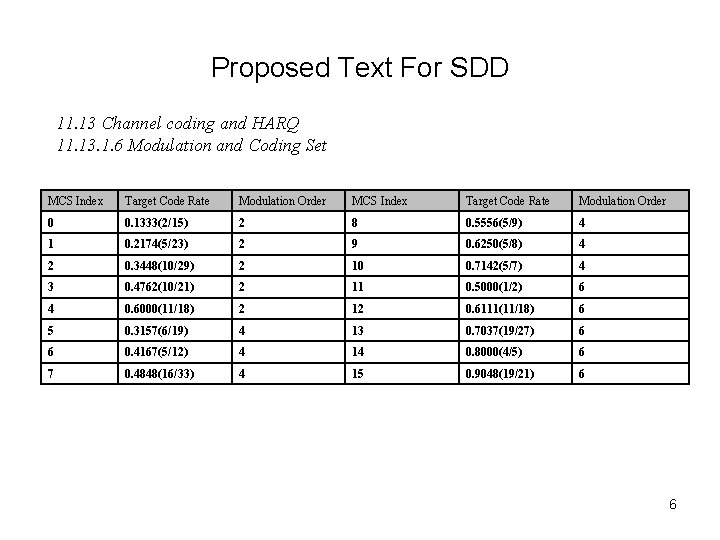
Proposed MCS and corresponding target SINR MCS Index Target Code Rate Mod Order SNR Spectral Efficiency 0 0. 1333(2/15) 2 -4. 97 d. B 0. 2667 1 0. 2174(5/23) 2 -2. 85 d. B 0. 4348 2 0. 3448(10/29) 2 -0. 84 d. B 0. 6897 3 0. 4762(10/21) 2 0. 91 d. B 0. 9524 4 0. 6000(11/18) 2 2. 52 d. B 1. 2000 5 0. 3157(6/19) 4 3. 98 d. B 1. 2632 6 0. 4167(5/12) 4 5. 40 d. B 1. 6667 7 0. 4848(16/33) 4 6. 56 d. B 1. 9394 8 0. 5556(5/9) 4 7. 52 d. B 2. 2222 9 0. 6250(5/8) 4 8. 61 d. B 2. 5000 10 0. 7142(5/7) 4 9. 94 d. B 2. 8571 11 0. 5000(1/2) 6 11. 56 d. B 3. 0000 12 0. 6111(11/18) 6 13. 19 d. B 3. 6667 13 0. 7037(19/27) 6 14. 94 d. B 4. 2222 14 0. 8000(4/5) 6 16. 64 d. B 4. 8000 15 0. 9048(19/21) 6 18. 94 d. B 5. 4286 5
Proposed Text For SDD 11. 13 Channel coding and HARQ 11. 13. 1. 6 Modulation and Coding Set MCS Index Target Code Rate Modulation Order 0 0. 1333(2/15) 2 8 0. 5556(5/9) 4 1 0. 2174(5/23) 2 9 0. 6250(5/8) 4 2 0. 3448(10/29) 2 10 0. 7142(5/7) 4 3 0. 4762(10/21) 2 11 0. 5000(1/2) 6 4 0. 6000(11/18) 2 12 0. 6111(11/18) 6 5 0. 3157(6/19) 4 13 0. 7037(19/27) 6 6 0. 4167(5/12) 4 14 0. 8000(4/5) 6 7 0. 4848(16/33) 4 15 0. 9048(19/21) 6 6
Simulation results • Link level simulation More MCS levels at central SINR range With much improvement for this SNR range 7
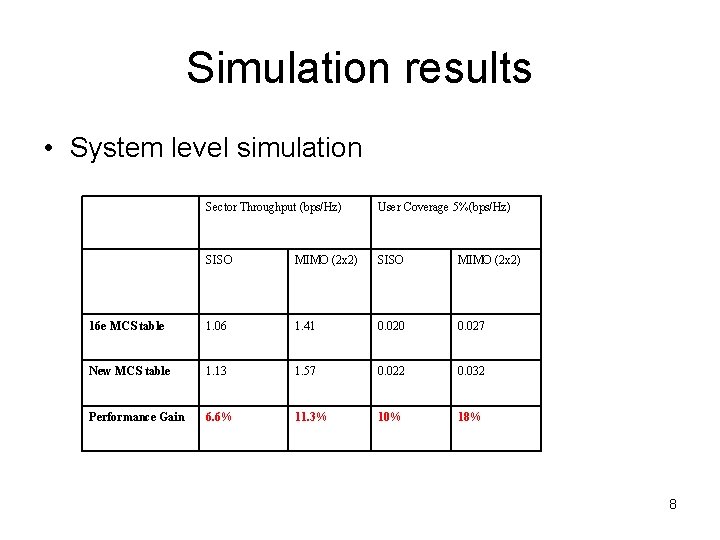
Simulation results • System level simulation Sector Throughput (bps/Hz) User Coverage 5%(bps/Hz) SISO MIMO (2 x 2) 16 e MCS table 1. 06 1. 41 0. 020 0. 027 New MCS table 1. 13 1. 57 0. 022 0. 032 Performance Gain 6. 6% 11. 3% 10% 18% 8
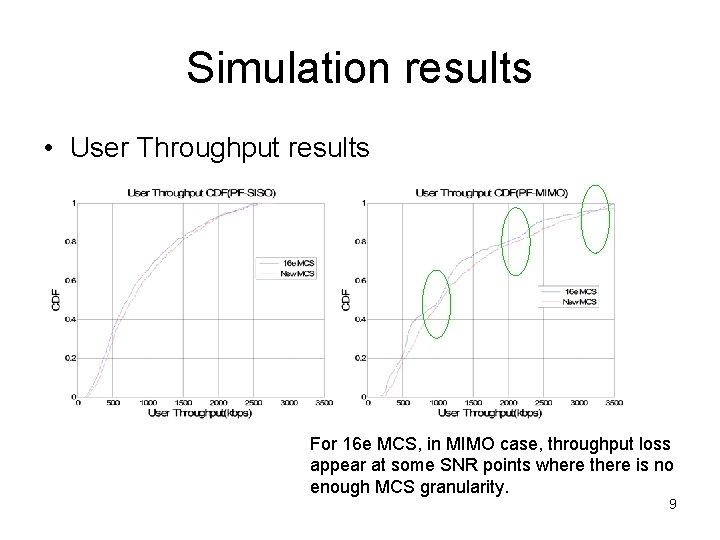
Simulation results • User Throughput results For 16 e MCS, in MIMO case, throughput loss appear at some SNR points where there is no enough MCS granularity. 9
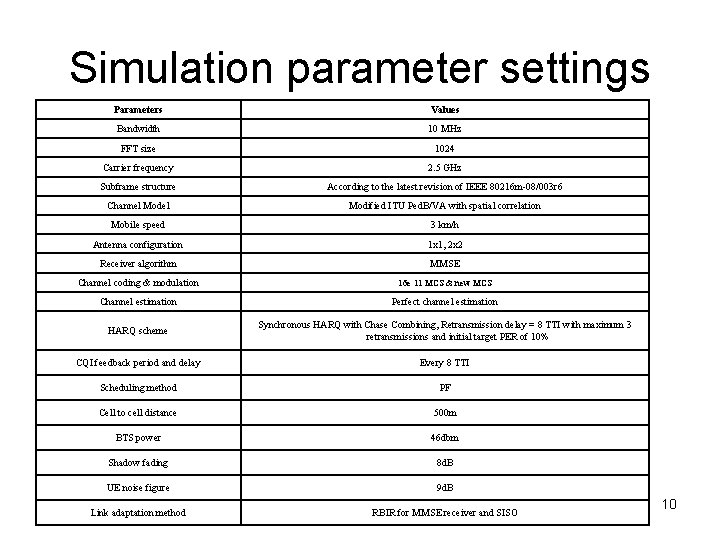
Simulation parameter settings Parameters Values Bandwidth 10 MHz FFT size 1024 Carrier frequency 2. 5 GHz Subframe structure According to the latest revision of IEEE 80216 m-08/003 r 6 Channel Modified ITU Ped. B/VA with spatial correlation Mobile speed 3 km/h Antenna configuration 1 x 1, 2 x 2 Receiver algorithm MMSE Channel coding & modulation 16 e 11 MCS & new MCS Channel estimation Perfect channel estimation HARQ scheme Synchronous HARQ with Chase Combining, Retransmission delay = 8 TTI with maximum 3 retransmissions and initial target PER of 10% CQI feedback period and delay Every 8 TTI Scheduling method PF Cell to cell distance 500 m BTS power 46 dbm Shadow fading 8 d. B UE noise figure 9 d. B Link adaptation method RBIR for MMSE receiver and SISO 10