
Modularizing and Reusing of code through Functions Calculation
- Slides: 8
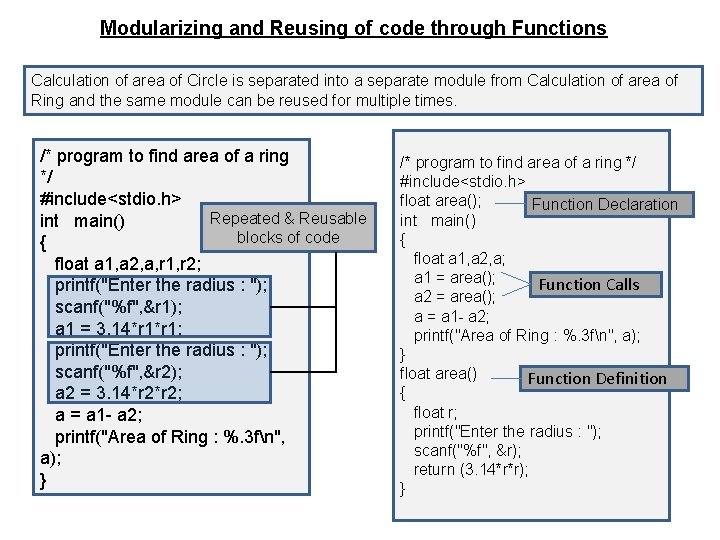
Modularizing and Reusing of code through Functions Calculation of area of Circle is separated into a separate module from Calculation of area of Ring and the same module can be reused for multiple times. /* program to find area of a ring */ #include<stdio. h> Repeated & Reusable int main() blocks of code { float a 1, a 2, a, r 1, r 2; printf("Enter the radius : "); scanf("%f", &r 1); a 1 = 3. 14*r 1; printf("Enter the radius : "); scanf("%f", &r 2); a 2 = 3. 14*r 2; a = a 1 - a 2; printf("Area of Ring : %. 3 fn", a); } /* program to find area of a ring */ #include<stdio. h> float area(); Function Declaration int main() { float a 1, a 2, a; a 1 = area(); Function Calls a 2 = area(); a = a 1 - a 2; printf("Area of Ring : %. 3 fn", a); } float area() Function Definition { float r; printf("Enter the radius : "); scanf("%f", &r); return (3. 14*r*r); }
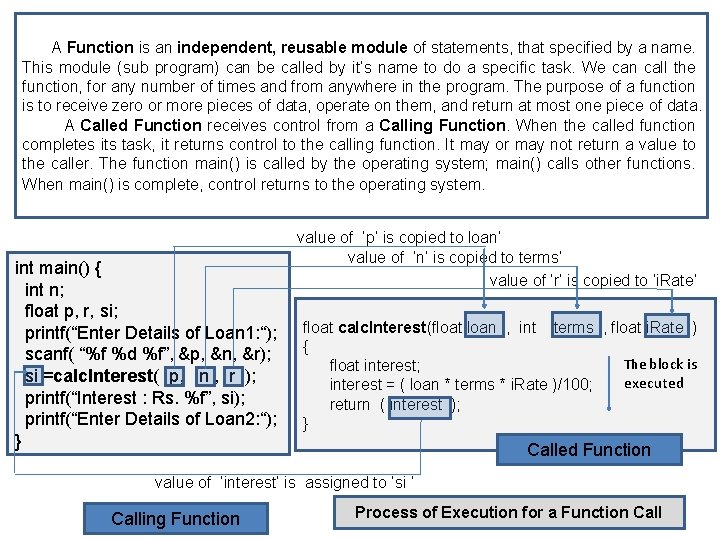
A Function is an independent, reusable module of statements, that specified by a name. This module (sub program) can be called by it’s name to do a specific task. We can call the function, for any number of times and from anywhere in the program. The purpose of a function is to receive zero or more pieces of data, operate on them, and return at most one piece of data. A Called Function receives control from a Calling Function. When the called function completes its task, it returns control to the calling function. It may or may not return a value to the caller. The function main() is called by the operating system; main() calls other functions. When main() is complete, control returns to the operating system. int main() { int n; float p, r, si; printf(“Enter Details of Loan 1: “); scanf( “%f %d %f”, &p, &n, &r); si =calc. Interest( p, n , r ); printf(“Interest : Rs. %f”, si); printf(“Enter Details of Loan 2: “); } value of ‘p’ is copied to loan’ value of ‘n’ is copied to terms’ value of ‘r’ is copied to ‘i. Rate’ float calc. Interest(float loan , int terms , float i. Rate ) { The block is float interest; executed interest = ( loan * terms * i. Rate )/100; return ( interest ); } Called Function value of ‘interest’ is assigned to ‘si ’ Calling Function Process of Execution for a Function Call
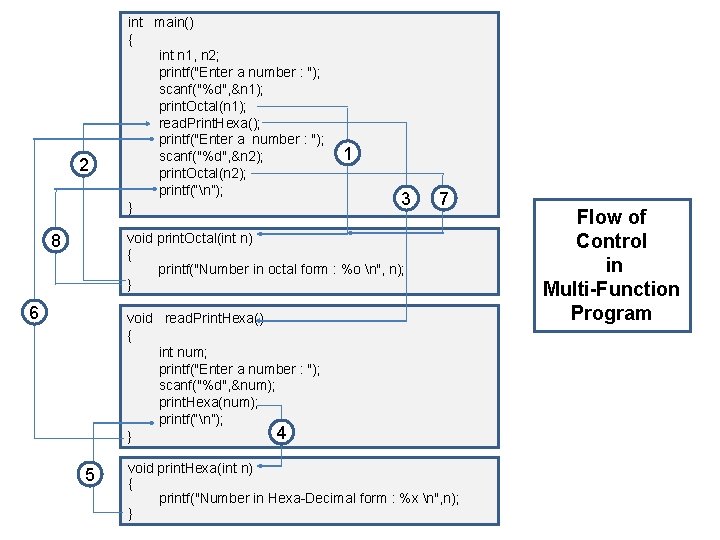
2 8 int main() { int n 1, n 2; printf("Enter a number : "); scanf("%d", &n 1); print. Octal(n 1); read. Print. Hexa(); printf("Enter a number : "); scanf("%d", &n 2); print. Octal(n 2); printf(“n”); } 1 3 7 void print. Octal(int n) { printf("Number in octal form : %o n", n); } 6 void read. Print. Hexa() { int num; printf("Enter a number : "); scanf("%d", &num); print. Hexa(num); printf(“n”); 4 } 5 void print. Hexa(int n) { printf("Number in Hexa-Decimal form : %x n", n); } Flow of Control in Multi-Function Program
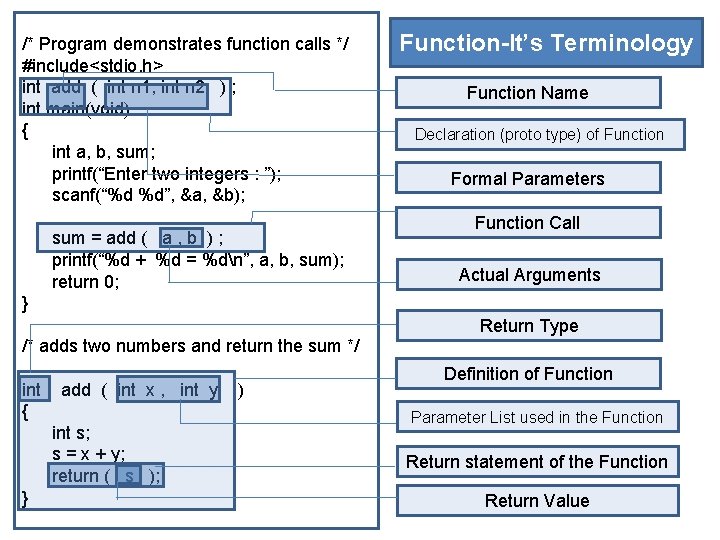
/* Program demonstrates function calls */ #include<stdio. h> int add ( int n 1, int n 2 ) ; int main(void) { int a, b, sum; printf(“Enter two integers : ”); scanf(“%d %d”, &a, &b); sum = add ( a , b ) ; printf(“%d + %d = %dn”, a, b, sum); return 0; Function-It’s Terminology Function Name Declaration (proto type) of Function Formal Parameters Function Call Actual Arguments } Return Type /* adds two numbers and return the sum */ int { add ( int x , int y int s; s = x + y; return ( s ); } ) Definition of Function Parameter List used in the Function Return statement of the Function Return Value
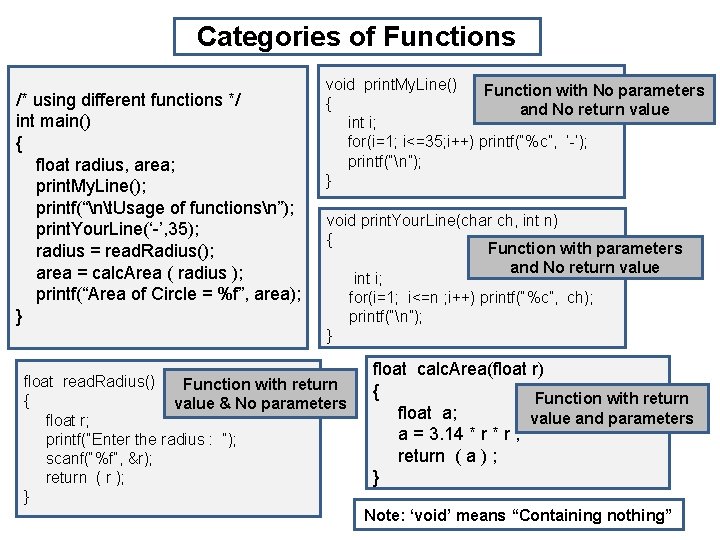
Categories of Functions /* using different functions */ int main() { float radius, area; print. My. Line(); printf(“nt. Usage of functionsn”); print. Your. Line(‘-’, 35); radius = read. Radius(); area = calc. Area ( radius ); printf(“Area of Circle = %f”, area); } void print. My. Line() Function with No parameters { and No return value int i; for(i=1; i<=35; i++) printf(“%c”, ‘-’); printf(“n”); } void print. Your. Line(char ch, int n) { Function with parameters and No return value int i; for(i=1; i<=n ; i++) printf(“%c”, ch); printf(“n”); } float read. Radius() Function with return { value & No parameters float r; printf(“Enter the radius : “); scanf(“%f”, &r); return ( r ); } float calc. Area(float r) { Function with return float a; value and parameters a = 3. 14 * r ; return ( a ) ; } Note: ‘void’ means “Containing nothing”
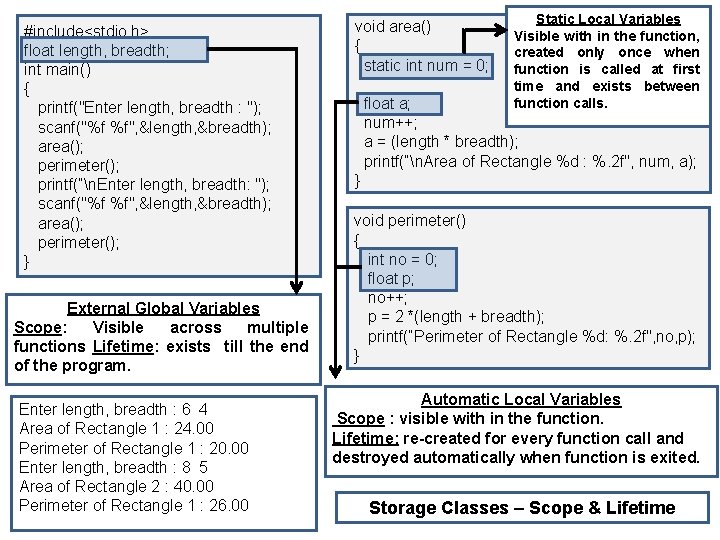
#include<stdio. h> float length, breadth; int main() { printf("Enter length, breadth : "); scanf("%f %f", &length, &breadth); area(); perimeter(); printf(“n. Enter length, breadth: "); scanf("%f %f", &length, &breadth); area(); perimeter(); } External Global Variables Scope: Visible across multiple functions Lifetime: exists till the end of the program. Enter length, breadth : 6 4 Area of Rectangle 1 : 24. 00 Perimeter of Rectangle 1 : 20. 00 Enter length, breadth : 8 5 Area of Rectangle 2 : 40. 00 Perimeter of Rectangle 1 : 26. 00 void area() { static int num = 0; Static Local Variables Visible with in the function, created only once when function is called at first time and exists between function calls. float a; num++; a = (length * breadth); printf(“n. Area of Rectangle %d : %. 2 f", num, a); } void perimeter() { int no = 0; float p; no++; p = 2 *(length + breadth); printf(“Perimeter of Rectangle %d: %. 2 f", no, p); } Automatic Local Variables Scope : visible with in the function. Lifetime: re-created for every function call and destroyed automatically when function is exited. Storage Classes – Scope & Lifetime
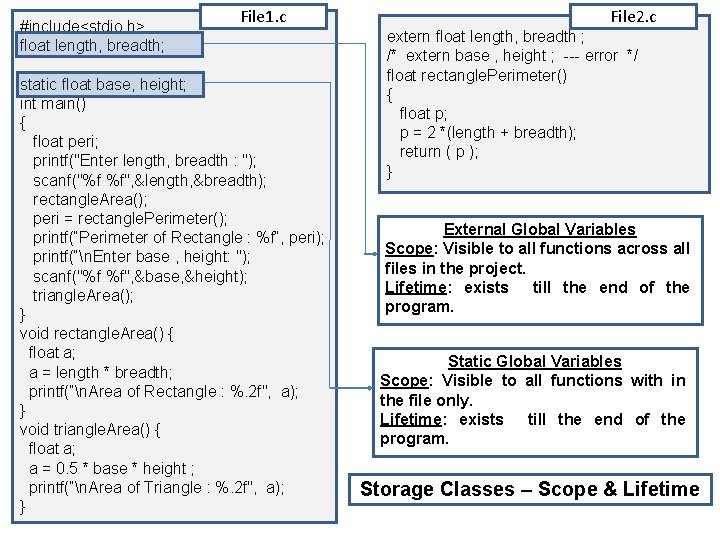
#include<stdio. h> float length, breadth; File 1. c static float base, height; int main() { float peri; printf("Enter length, breadth : "); scanf("%f %f", &length, &breadth); rectangle. Area(); peri = rectangle. Perimeter(); printf(“Perimeter of Rectangle : %f“, peri); printf(“n. Enter base , height: "); scanf("%f %f", &base, &height); triangle. Area(); } void rectangle. Area() { float a; a = length * breadth; printf(“n. Area of Rectangle : %. 2 f", a); } void triangle. Area() { float a; a = 0. 5 * base * height ; printf(“n. Area of Triangle : %. 2 f", a); } File 2. c extern float length, breadth ; /* extern base , height ; --- error */ float rectangle. Perimeter() { float p; p = 2 *(length + breadth); return ( p ); } External Global Variables Scope: Visible to all functions across all files in the project. Lifetime: exists till the end of the program. Static Global Variables Scope: Visible to all functions with in the file only. Lifetime: exists till the end of the program. Storage Classes – Scope & Lifetime
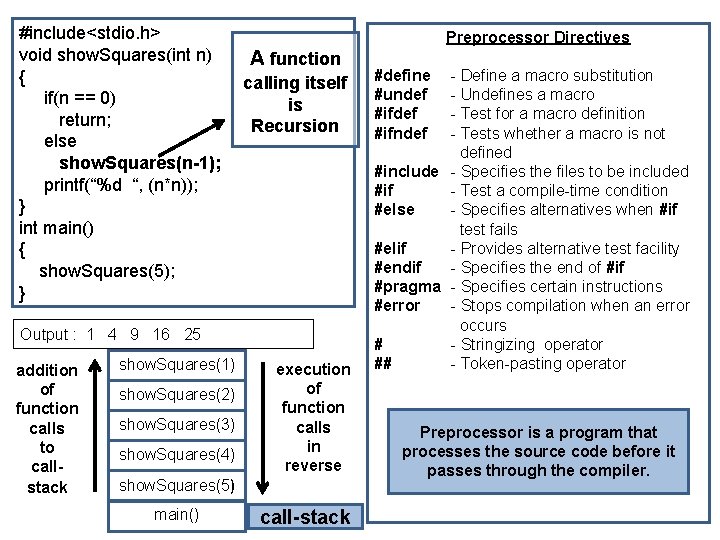
#include<stdio. h> void show. Squares(int n) { if(n == 0) return; else show. Squares(n-1); printf(“%d “, (n*n)); } int main() { show. Squares(5); } A function calling itself is Recursion Output : 1 4 9 16 25 addition of function calls to callstack show. Squares(1) show. Squares(2) show. Squares(3) show. Squares(4) show. Squares(5) main() execution of function calls in reverse call-stack Preprocessor Directives #define #undef #ifndef - Define a macro substitution - Undefines a macro - Test for a macro definition - Tests whether a macro is not defined #include - Specifies the files to be included #if - Test a compile-time condition #else - Specifies alternatives when #if test fails #elif - Provides alternative test facility #endif - Specifies the end of #if #pragma - Specifies certain instructions #error - Stops compilation when an error occurs # - Stringizing operator ## - Token-pasting operator Preprocessor is a program that processes the source code before it passes through the compiler.