
Modularity and Data Abstraction Manolis Koubarakis Data Structures
Modularity and Data Abstraction Manolis Koubarakis Data Structures and Programming Techniques 1
Procedural Abstraction • When programs get large, certain disciplines of structuring need to be followed rigorously. Otherwise, the programs become complex, confusing and hard to debug. • In your first programming course you learned the benefits of procedural abstraction (διαδικαστική αφαίρεση). When we organize a sequence of instructions into a function F(x 1, …, xn), we have a named unit of action. • When we later on use this function F, we only need to know what the function does, not how it does it. Data Structures and Programming Techniques 2
Procedural Abstraction (cont’d) • Separating the what from the how is an act of abstraction (αφαίρεση). It provides two benefits: – Ease of use – Ease of modification Data Structures and Programming Techniques 3
Information Hiding • In your first programming course, you have also learned the benefits of having locally defined variables. • This is an instance of information hiding (απόκρυψη πληροφορίας). • It has the advantage that local variables do not interfere with identically named variables outside the function. • Abstraction and information hiding in a programming language are greatly enhanced with the concept of module (ενότητα). Data Structures and Programming Techniques 4
Modules and Abstract Datatypes • A module is a unit of organization of a software system that packages together a collection of entities (such as data and operations) and that carefully controls what external users of the module can see and use. • Modules have ways of hiding things inside their boundaries to prevent external users from accessing them. This is called information hiding. • Abstract data types (αφαιρετικοί τύποι δεδομένων, ADTs) are collections of objects and operations that present well defined interfaces (διεπαφές) to their users, meanwhile hiding the way they are represented in terms of lower-level representations. • Modules can be used to implement abstract data types. Data Structures and Programming Techniques 5
Modules (cont’d) • Many modern programming languages offer modules that have the following important features: – They provide a way of grouping together related data and operations. – They provide clean, well-defined interfaces to users of their services. – They hide internal details of operation to prevent interference. – They can be separately compiled. Data Structures and Programming Techniques 6
Modules (cont’d) • Modules are an important tool for “dividing and conquering” a large software task by combining separate components that interact cleanly. • They ease software maintenance (συντήρηση λογισμικού) by allowing changes to be made locally. Data Structures and Programming Techniques 7

Encapsulation • When we have features like modules in programming languages, we use the term encapsulation (ενθυλάκωση, the hidden local entities are encapsulated and a module is a capsule). Data Structures and Programming Techniques 8
Modules in C • By means of careful use of header files, we can arrange for separately compiled C program files to have the above four properties of modules. • In this way C modules are similar to packages or modules in other languages such as Modula -2 and Ada. Data Structures and Programming Techniques 9
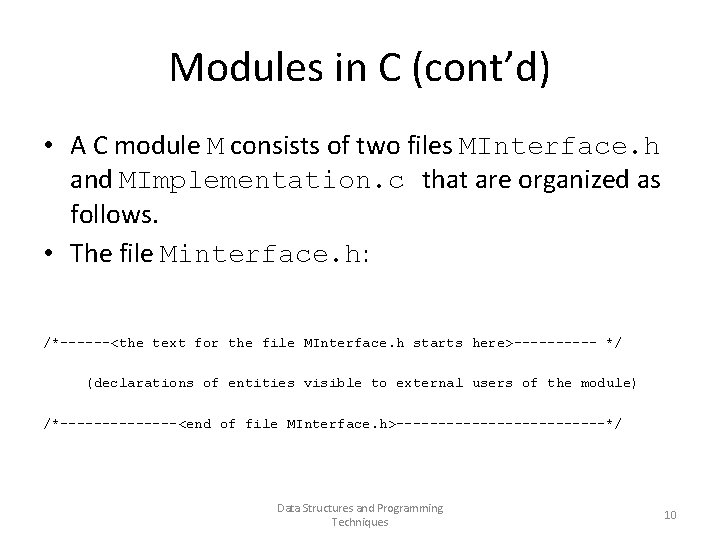
Modules in C (cont’d) • A C module M consists of two files MInterface. h and MImplementation. c that are organized as follows. • The file Minterface. h: /*------<the text for the file MInterface. h starts here>----- */ (declarations of entities visible to external users of the module) /*-------<end of file MInterface. h>-------------*/ Data Structures and Programming Techniques 10
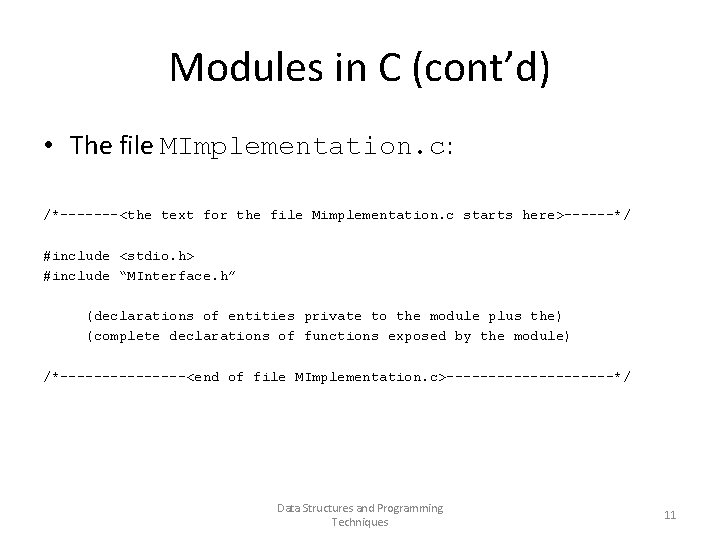
Modules in C (cont’d) • The file MImplementation. c: /*-------<the text for the file Mimplementation. c starts here>------*/ #include <stdio. h> #include “MInterface. h” (declarations of entities private to the module plus the) (complete declarations of functions exposed by the module) /*--------<end of file MImplementation. c>----------*/ Data Structures and Programming Techniques 11
The Interface file • MInterface. h is the interface file. • It declares all the entities in the module that are visible to (and therefore usable by) the external users of the module. • Such visible entities include constants, typedefs, variables and functions. Only the prototype of each visible function is given (and only the argument types, not the argument names). • The book by Standish recommends that declarations of functions in the interface file are “extern” declarations. This is not necessary so we will not follow it. Data Structures and Programming Techniques 12
The Implementation File • MImplementation. c is the implementation file. • It contains all the private entities in the module, that are not visible to the outside. • It contains the full declarations and implementations of functions whose prototypes have been given in the interface file. • It includes (via #include) the user interface file. Data Structures and Programming Techniques 13
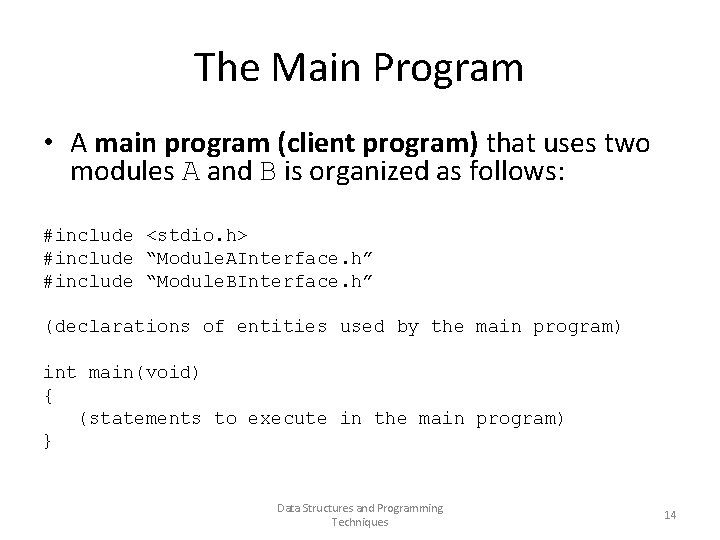
The Main Program • A main program (client program) that uses two modules A and B is organized as follows: #include <stdio. h> #include “Module. AInterface. h” #include “Module. BInterface. h” (declarations of entities used by the main program) int main(void) { (statements to execute in the main program) } Data Structures and Programming Techniques 14
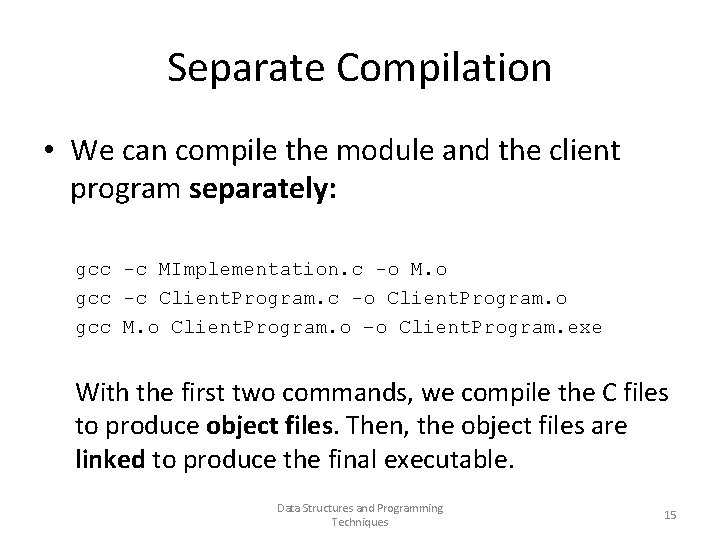
Separate Compilation • We can compile the module and the client program separately: gcc -c MImplementation. c -o M. o gcc -c Client. Program. c -o Client. Program. o gcc M. o Client. Program. o –o Client. Program. exe With the first two commands, we compile the C files to produce object files. Then, the object files are linked to produce the final executable. Data Structures and Programming Techniques 15
Priority Queues – An Abstract Data Type • A priority queue is a container that holds some prioritized items. For example, a list of jobs with a deadline for processing each one of them. • When we remove an item from a priority queue, we always get the item with highest priority. Data Structures and Programming Techniques 16
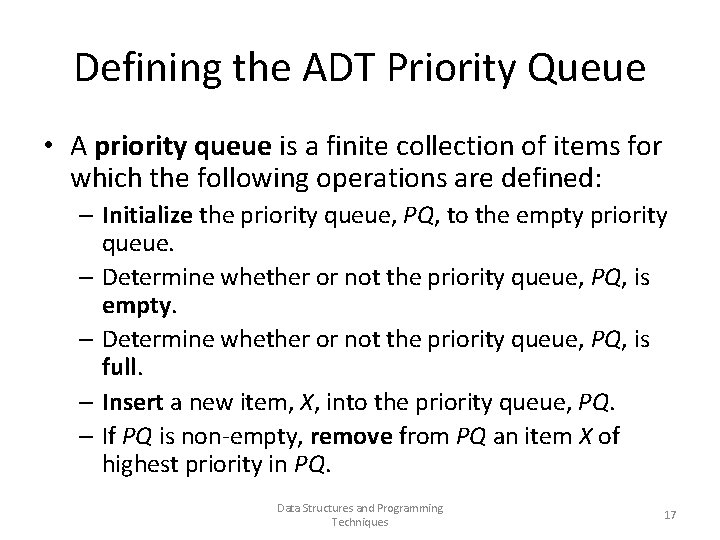
Defining the ADT Priority Queue • A priority queue is a finite collection of items for which the following operations are defined: – Initialize the priority queue, PQ, to the empty priority queue. – Determine whether or not the priority queue, PQ, is empty. – Determine whether or not the priority queue, PQ, is full. – Insert a new item, X, into the priority queue, PQ. – If PQ is non-empty, remove from PQ an item X of highest priority in PQ. Data Structures and Programming Techniques 17
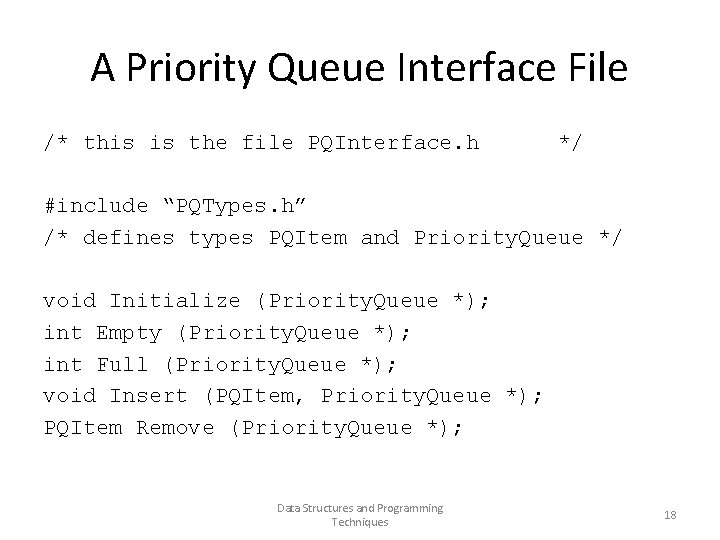
A Priority Queue Interface File /* this is the file PQInterface. h */ #include “PQTypes. h” /* defines types PQItem and Priority. Queue */ void Initialize (Priority. Queue *); int Empty (Priority. Queue *); int Full (Priority. Queue *); void Insert (PQItem, Priority. Queue *); PQItem Remove (Priority. Queue *); Data Structures and Programming Techniques 18
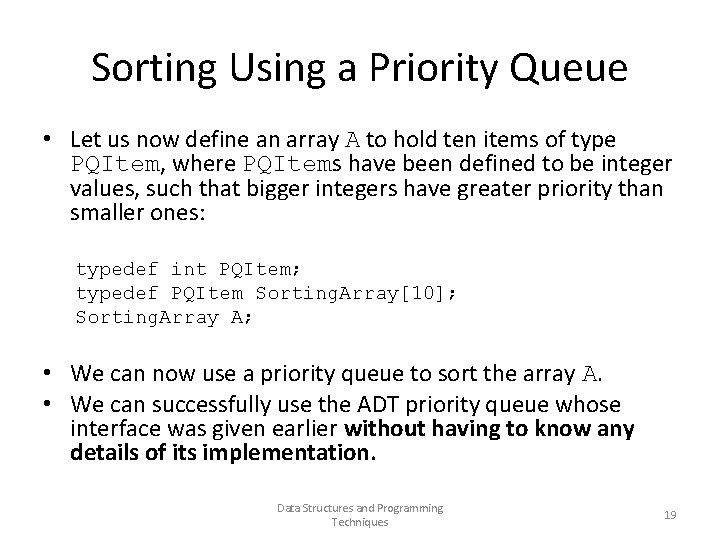
Sorting Using a Priority Queue • Let us now define an array A to hold ten items of type PQItem, where PQItems have been defined to be integer values, such that bigger integers have greater priority than smaller ones: typedef int PQItem; typedef PQItem Sorting. Array[10]; Sorting. Array A; • We can now use a priority queue to sort the array A. • We can successfully use the ADT priority queue whose interface was given earlier without having to know any details of its implementation. Data Structures and Programming Techniques 19
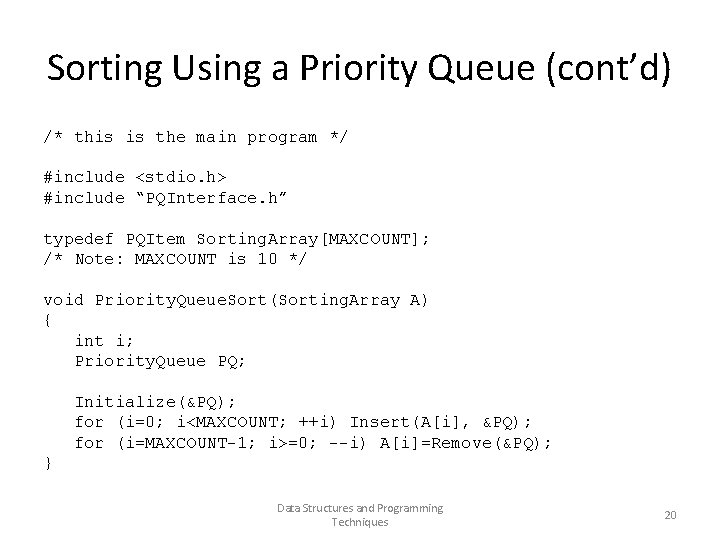
Sorting Using a Priority Queue (cont’d) /* this is the main program */ #include <stdio. h> #include “PQInterface. h” typedef PQItem Sorting. Array[MAXCOUNT]; /* Note: MAXCOUNT is 10 */ void Priority. Queue. Sort(Sorting. Array A) { int i; Priority. Queue PQ; Initialize(&PQ); for (i=0; i<MAXCOUNT; ++i) Insert(A[i], &PQ); for (i=MAXCOUNT-1; i>=0; --i) A[i]=Remove(&PQ); } Data Structures and Programming Techniques 20
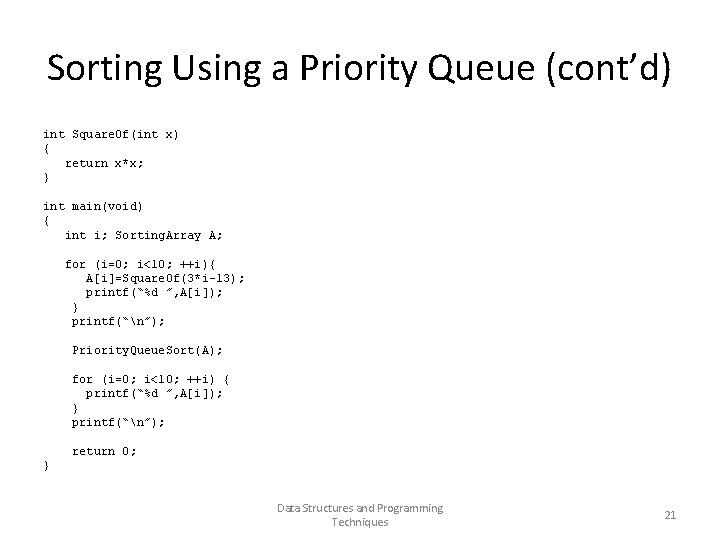
Sorting Using a Priority Queue (cont’d) int Square. Of(int x) { return x*x; } int main(void) { int i; Sorting. Array A; for (i=0; i<10; ++i){ A[i]=Square. Of(3*i-13); printf(“%d ”, A[i]); } printf(“n”); Priority. Queue. Sort(A); for (i=0; i<10; ++i) { printf(“%d ”, A[i]); } printf(“n”); return 0; } Data Structures and Programming Techniques 21
Implementations of Priority Queues • We will present two implementations of a priority queue: – Using sorted linked lists – Using unsorted arrays Data Structures and Programming Techniques 22
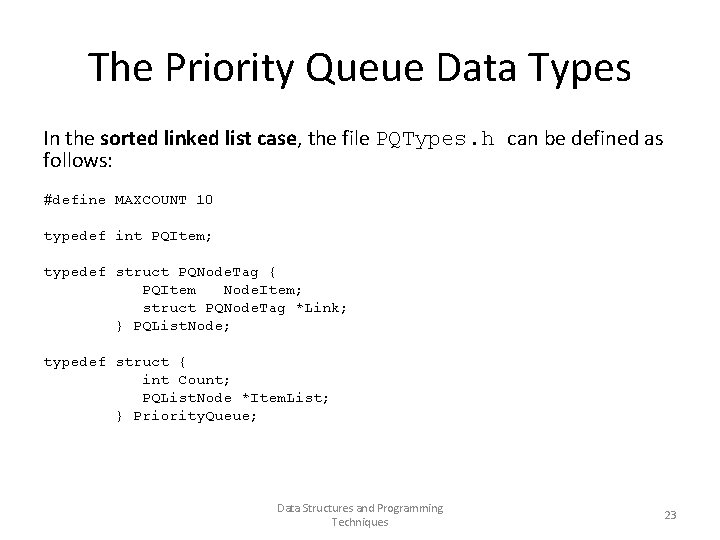
The Priority Queue Data Types In the sorted linked list case, the file PQTypes. h can be defined as follows: #define MAXCOUNT 10 typedef int PQItem; typedef struct PQNode. Tag { PQItem Node. Item; struct PQNode. Tag *Link; } PQList. Node; typedef struct { int Count; PQList. Node *Item. List; } Priority. Queue; Data Structures and Programming Techniques 23
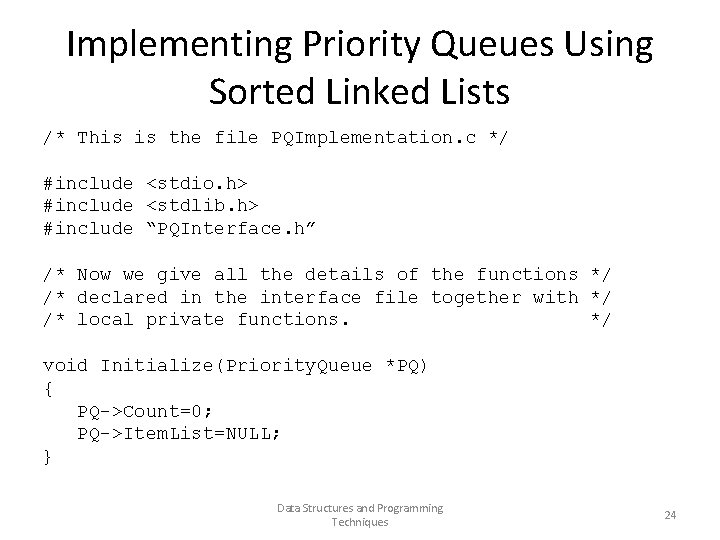
Implementing Priority Queues Using Sorted Linked Lists /* This is the file PQImplementation. c */ #include <stdio. h> #include <stdlib. h> #include “PQInterface. h” /* Now we give all the details of the functions */ /* declared in the interface file together with */ /* local private functions. */ void Initialize(Priority. Queue *PQ) { PQ->Count=0; PQ->Item. List=NULL; } Data Structures and Programming Techniques 24
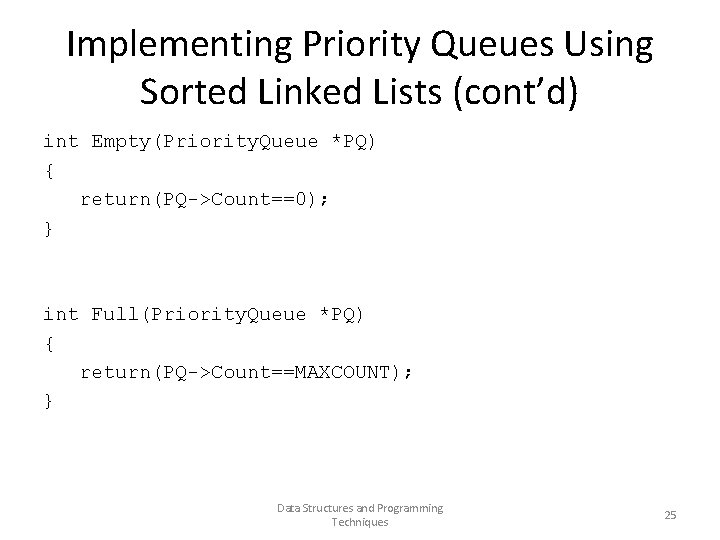
Implementing Priority Queues Using Sorted Linked Lists (cont’d) int Empty(Priority. Queue *PQ) { return(PQ->Count==0); } int Full(Priority. Queue *PQ) { return(PQ->Count==MAXCOUNT); } Data Structures and Programming Techniques 25
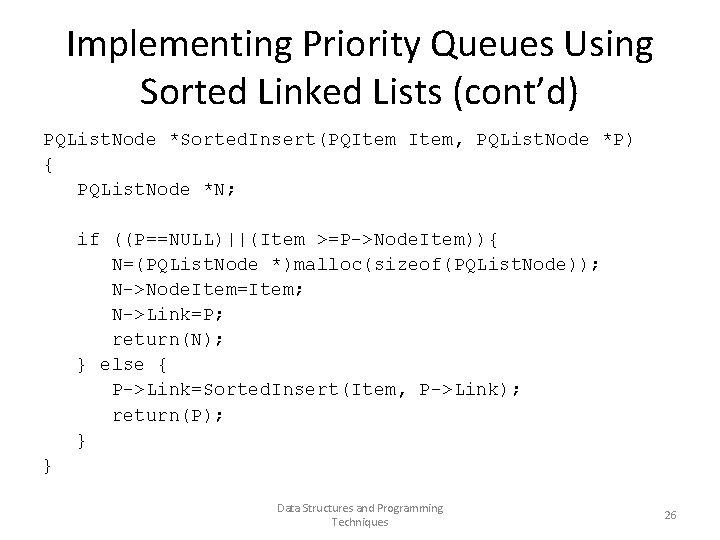
Implementing Priority Queues Using Sorted Linked Lists (cont’d) PQList. Node *Sorted. Insert(PQItem, PQList. Node *P) { PQList. Node *N; if ((P==NULL)||(Item >=P->Node. Item)){ N=(PQList. Node *)malloc(sizeof(PQList. Node)); N->Node. Item=Item; N->Link=P; return(N); } else { P->Link=Sorted. Insert(Item, P->Link); return(P); } } Data Structures and Programming Techniques 26
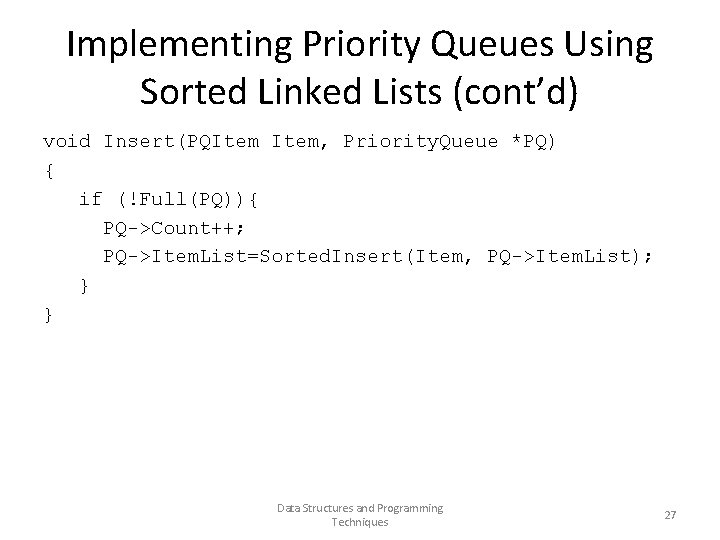
Implementing Priority Queues Using Sorted Linked Lists (cont’d) void Insert(PQItem, Priority. Queue *PQ) { if (!Full(PQ)){ PQ->Count++; PQ->Item. List=Sorted. Insert(Item, PQ->Item. List); } } Data Structures and Programming Techniques 27
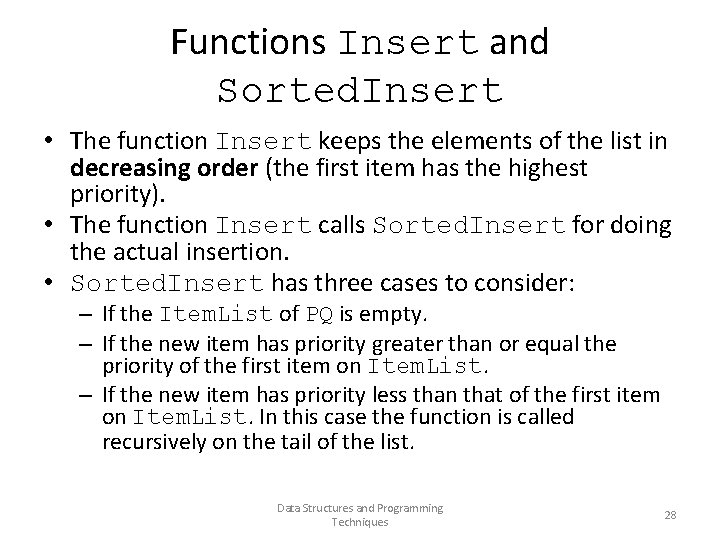
Functions Insert and Sorted. Insert • The function Insert keeps the elements of the list in decreasing order (the first item has the highest priority). • The function Insert calls Sorted. Insert for doing the actual insertion. • Sorted. Insert has three cases to consider: – If the Item. List of PQ is empty. – If the new item has priority greater than or equal the priority of the first item on Item. List. – If the new item has priority less than that of the first item on Item. List. In this case the function is called recursively on the tail of the list. Data Structures and Programming Techniques 28
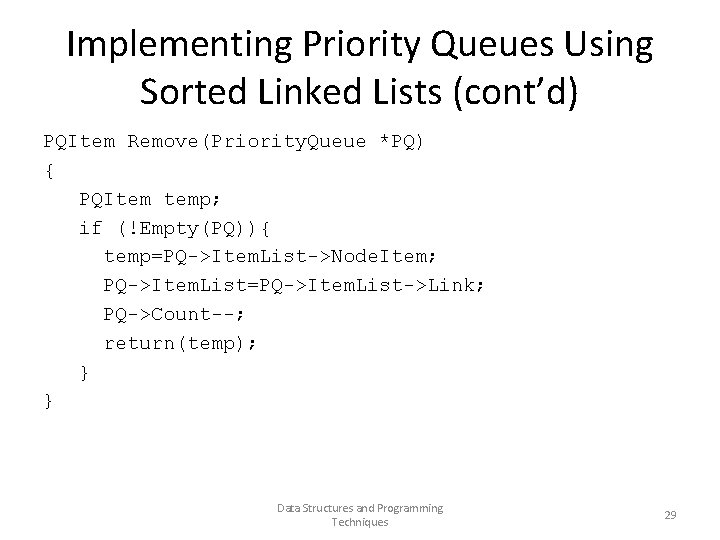
Implementing Priority Queues Using Sorted Linked Lists (cont’d) PQItem Remove(Priority. Queue *PQ) { PQItem temp; if (!Empty(PQ)){ temp=PQ->Item. List->Node. Item; PQ->Item. List=PQ->Item. List->Link; PQ->Count--; return(temp); } } Data Structures and Programming Techniques 29
Function Remove • The function Remove simply deletes the item in the first node of the linked list representing PQ (this is the item with highest priority) and returns the value of its field Node. Item. Data Structures and Programming Techniques 30
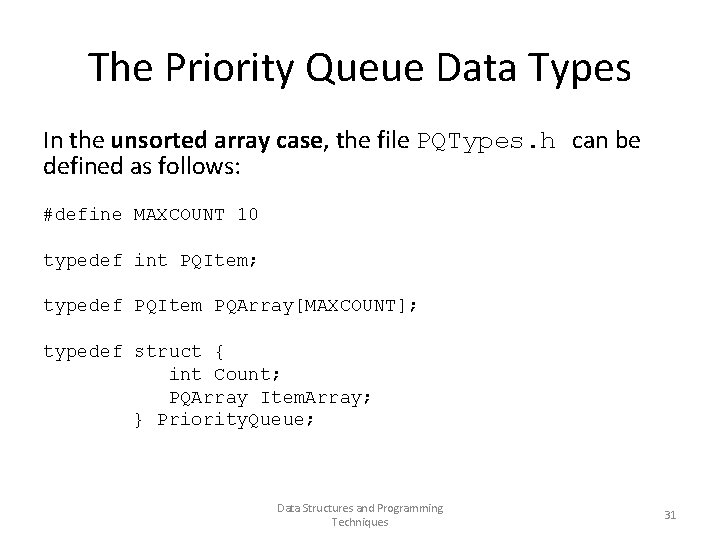
The Priority Queue Data Types In the unsorted array case, the file PQTypes. h can be defined as follows: #define MAXCOUNT 10 typedef int PQItem; typedef PQItem PQArray[MAXCOUNT]; typedef struct { int Count; PQArray Item. Array; } Priority. Queue; Data Structures and Programming Techniques 31
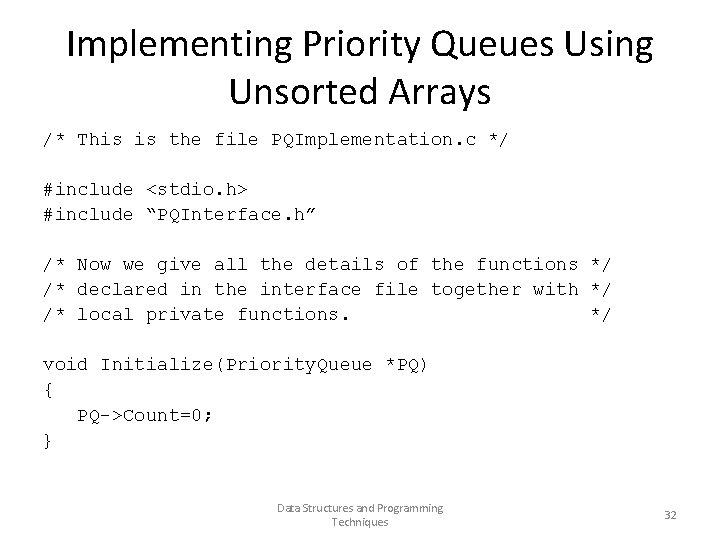
Implementing Priority Queues Using Unsorted Arrays /* This is the file PQImplementation. c */ #include <stdio. h> #include “PQInterface. h” /* Now we give all the details of the functions */ /* declared in the interface file together with */ /* local private functions. */ void Initialize(Priority. Queue *PQ) { PQ->Count=0; } Data Structures and Programming Techniques 32
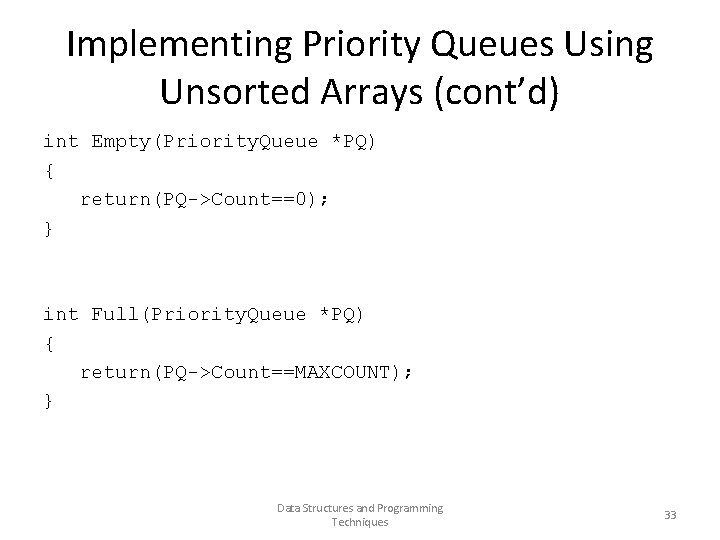
Implementing Priority Queues Using Unsorted Arrays (cont’d) int Empty(Priority. Queue *PQ) { return(PQ->Count==0); } int Full(Priority. Queue *PQ) { return(PQ->Count==MAXCOUNT); } Data Structures and Programming Techniques 33
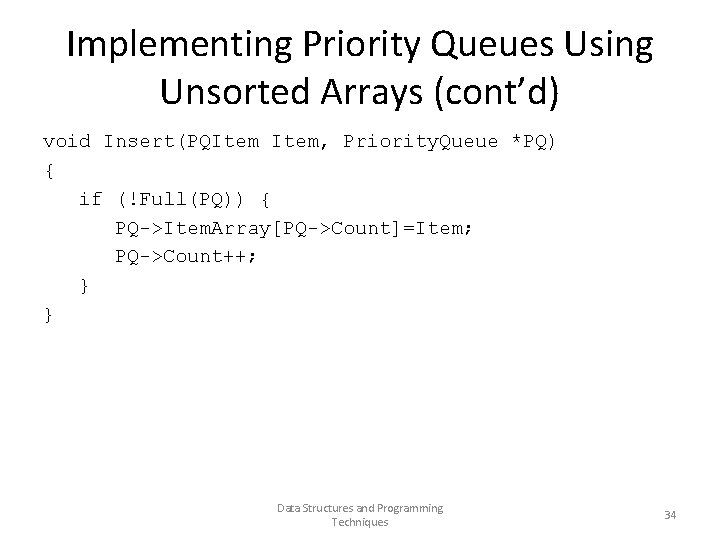
Implementing Priority Queues Using Unsorted Arrays (cont’d) void Insert(PQItem, Priority. Queue *PQ) { if (!Full(PQ)) { PQ->Item. Array[PQ->Count]=Item; PQ->Count++; } } Data Structures and Programming Techniques 34
Function Insert • The function Insert simply appends the new item to the end of array Item. Array of PQ. Data Structures and Programming Techniques 35
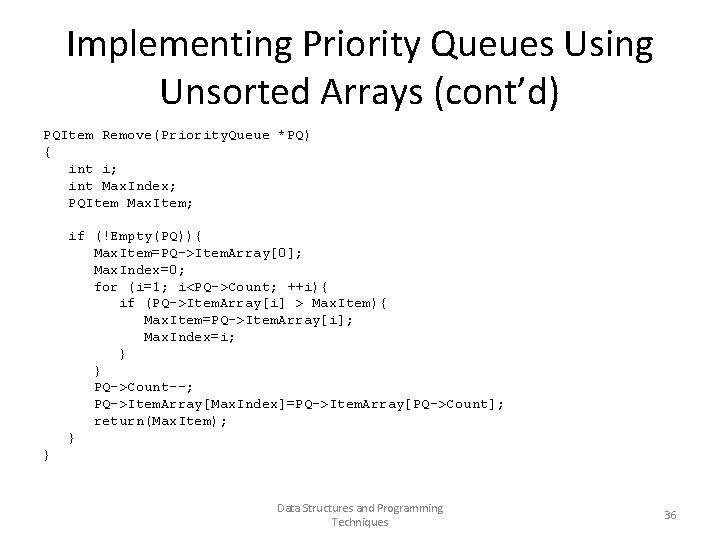
Implementing Priority Queues Using Unsorted Arrays (cont’d) PQItem Remove(Priority. Queue *PQ) { int i; int Max. Index; PQItem Max. Item; if (!Empty(PQ)){ Max. Item=PQ->Item. Array[0]; Max. Index=0; for (i=1; i<PQ->Count; ++i){ if (PQ->Item. Array[i] > Max. Item){ Max. Item=PQ->Item. Array[i]; Max. Index=i; } } PQ->Count--; PQ->Item. Array[Max. Index]=PQ->Item. Array[PQ->Count]; return(Max. Item); } } Data Structures and Programming Techniques 36
Function Remove • In the function Remove, we first find the item with highest priority. Then, we save it in a temporary variable (Max. Item), we delete it from the array Item. Array and move the last item of the array to its position. Then, we return the item of the highest priority. Data Structures and Programming Techniques 37
Interface Header Files • Note that the module interface header file PQInterface. h is included in two important but distinct places: – At the beginning of the implementation files that define the hidden representation of the externally accessed module services. – At the beginning of programs that need to gain access to the external module services defined in the interface file. Data Structures and Programming Techniques 38
Separate Compilation • We can compile the module and the client program separately: gcc -c PQImplementation. c -o PQ. o gcc -c sorting. c -o sorting. o gcc PQ. o sorting. o –o program. exe With the first two commands, we compile the C files to produce object files. Then, the object files are linked to produce the final executable. Data Structures and Programming Techniques 39
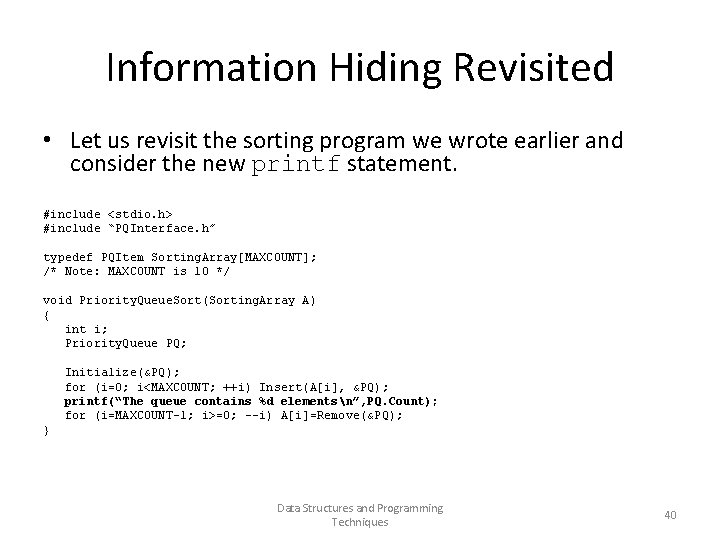
Information Hiding Revisited • Let us revisit the sorting program we wrote earlier and consider the new printf statement. #include <stdio. h> #include “PQInterface. h” typedef PQItem Sorting. Array[MAXCOUNT]; /* Note: MAXCOUNT is 10 */ void Priority. Queue. Sort(Sorting. Array A) { int i; Priority. Queue PQ; Initialize(&PQ); for (i=0; i<MAXCOUNT; ++i) Insert(A[i], &PQ); printf(“The queue contains %d elementsn”, PQ. Count); for (i=MAXCOUNT-1; i>=0; --i) A[i]=Remove(&PQ); } Data Structures and Programming Techniques 40
Information Hiding Revisited (cont’d) • This printf statement accesses the Count field of the priority queue PQ. Therefore, the previous module organization has not achieved information hiding as nicely as we would want it. • We can live with that deficiency or try to address it. How? Data Structures and Programming Techniques 41
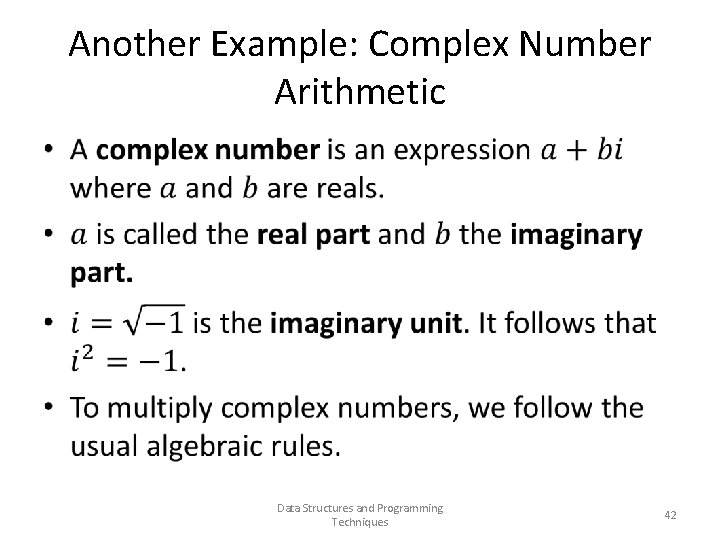
Another Example: Complex Number Arithmetic • Data Structures and Programming Techniques 42
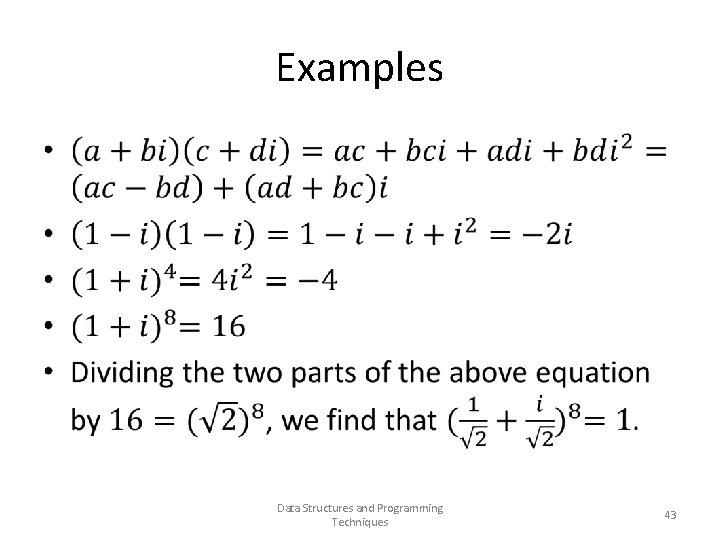
Examples • Data Structures and Programming Techniques 43
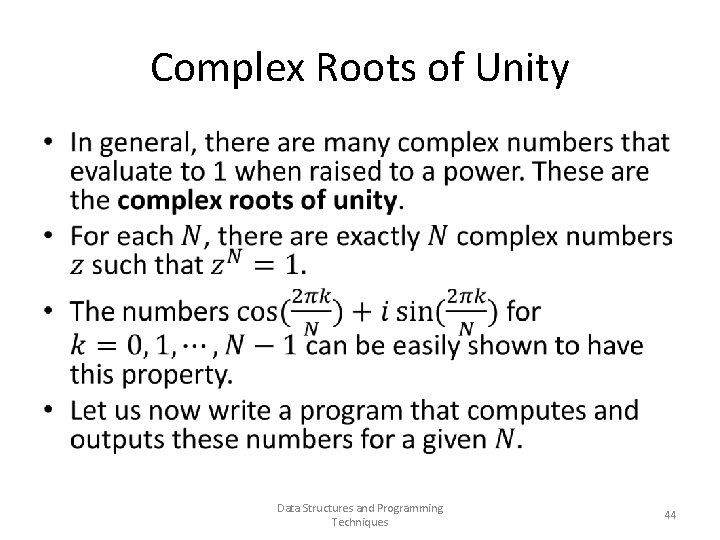
Complex Roots of Unity • Data Structures and Programming Techniques 44
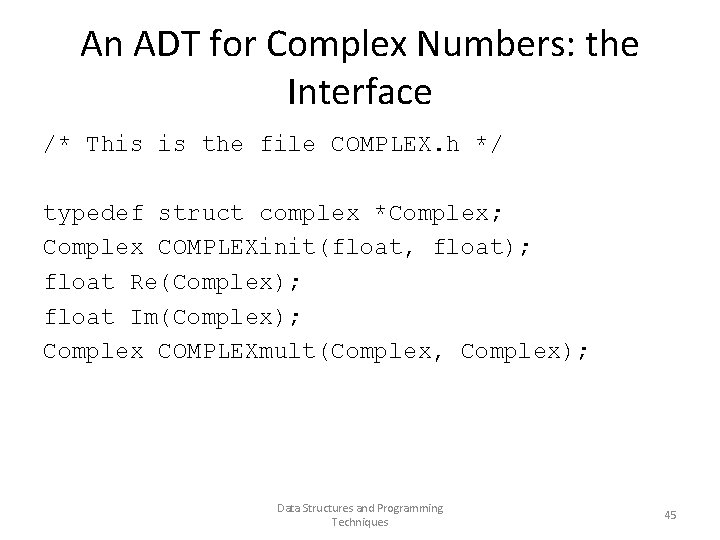
An ADT for Complex Numbers: the Interface /* This is the file COMPLEX. h */ typedef struct complex *Complex; Complex COMPLEXinit(float, float); float Re(Complex); float Im(Complex); Complex COMPLEXmult(Complex, Complex); Data Structures and Programming Techniques 45
Notes • The interface on the previous slide provides clients with handles to complex number objects but does not give any information about the representation. • The representation is a struct that is not specified except for its tag name. Data Structures and Programming Techniques 46
Handles • We use the term handle to describe a reference to an abstract object. • Our goal is to give client programs handles to abstract objects that can be used in assignment statements and as arguments and return values of functions in the same way as built-in data types, while hiding the representation of objects from the client program. Data Structures and Programming Techniques 47
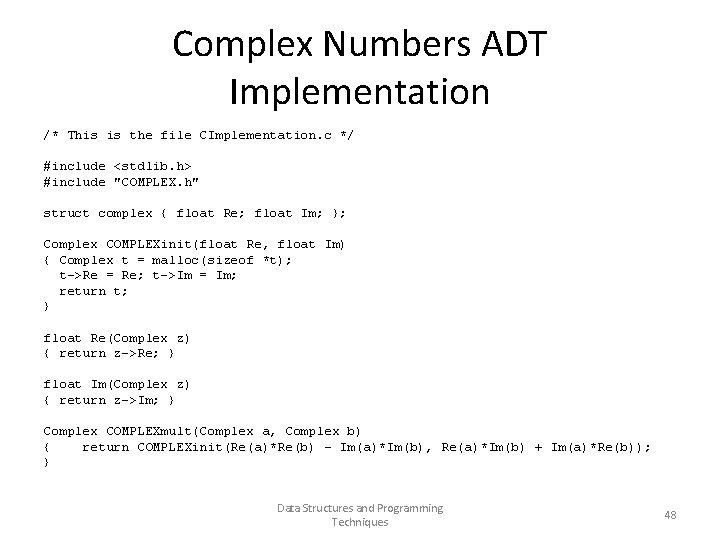
Complex Numbers ADT Implementation /* This is the file CImplementation. c */ #include <stdlib. h> #include "COMPLEX. h" struct complex { float Re; float Im; }; Complex COMPLEXinit(float Re, float Im) { Complex t = malloc(sizeof *t); t->Re = Re; t->Im = Im; return t; } float Re(Complex z) { return z->Re; } float Im(Complex z) { return z->Im; } Complex COMPLEXmult(Complex a, Complex b) { return COMPLEXinit(Re(a)*Re(b) - Im(a)*Im(b), Re(a)*Im(b) + Im(a)*Re(b)); } Data Structures and Programming Techniques 48
Notes • The implementation of the interface in the previous program includes the definition of structure complex (which is hidden from the clients) as well as the implementation of the functions provided by the interface. • Objects are pointers to structures, so we dereference the pointer to refer to the fields. Data Structures and Programming Techniques 49
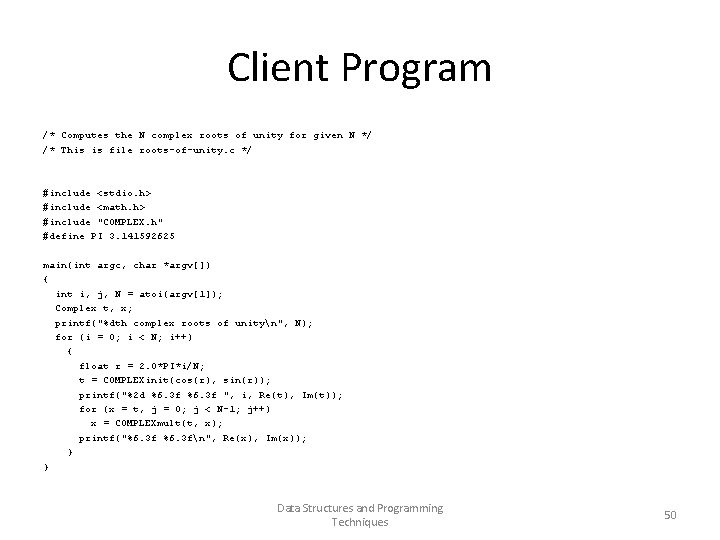
Client Program /* Computes the N complex roots of unity for given N */ /* This is file roots-of-unity. c */ #include <stdio. h> #include <math. h> #include "COMPLEX. h" #define PI 3. 141592625 main(int argc, char *argv[]) { int i, j, N = atoi(argv[1]); Complex t, x; printf("%dth complex roots of unityn", N); for (i = 0; i < N; i++) { float r = 2. 0*PI*i/N; t = COMPLEXinit(cos(r), sin(r)); printf("%2 d %6. 3 f ", i, Re(t), Im(t)); for (x = t, j = 0; j < N-1; j++) x = COMPLEXmult(t, x); printf("%6. 3 fn", Re(x), Im(x)); } } Data Structures and Programming Techniques 50
Notes • The client program outputs the powers of unity one by one, together with a verification that they are indeed such powers. To verify this, raising to a power is implemented by multiplication. Data Structures and Programming Techniques 51
Notes • In this case, we can see that the exact representation of a complex number is hidden from the client program. • The client program can refer to the real and the imaginary part of a number only by using the functions Re and Im provided by the interface. Data Structures and Programming Techniques 52
Command Line Arguments • argc (argument count) is the number of command line arguments. • argv (argument vector) is pointer to an array of character strings that contain the arguments, one per string. • By convention, argv[0] is the name by which the program was invoked so argc is at least 1. • In the previous program argv[1] contains the value of N. Data Structures and Programming Techniques 53
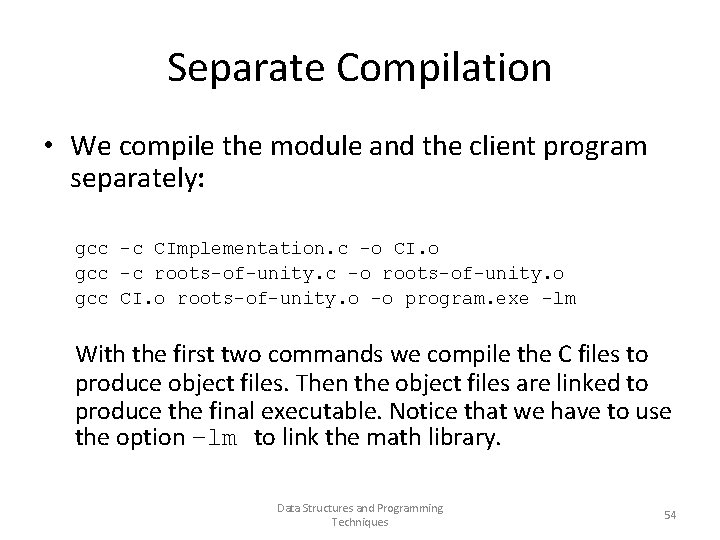
Separate Compilation • We compile the module and the client program separately: gcc -c CImplementation. c -o CI. o gcc -c roots-of-unity. c -o roots-of-unity. o gcc CI. o roots-of-unity. o –o program. exe -lm With the first two commands we compile the C files to produce object files. Then the object files are linked to produce the final executable. Notice that we have to use the option –lm to link the math library. Data Structures and Programming Techniques 54
Exercise • Revisit the ADT priority queue and define a better interface and its implementation so that we have information hiding. Data Structures and Programming Techniques 55
Readings • T. A. Standish. Data Structures, Algorithms and Software Principles in C. Chapter 4. • Robert Sedgewick. Αλγόριθμοι σε C. Κεφ. 4 Data Structures and Programming Techniques 56
- Slides: 56