
ModularContainer Data Centers Selection Guide Optimizing for Energy

- Slides: 9
Modular/Container Data Centers Selection Guide: Optimizing for Energy Efficiency and Quick Deployment • White paper sponsored by Federal GSA and prepared by LBNL. • Authors: Bramfitt/Coles • Published February 2011 • Available at LBNL website: http: //hightech. lbl. gov/documents/data_centers/modular-dc-procurement-guide. pdf Slide 1
Executive Summary • Modular data centers, often in standard shipping container form factors, are being deployed by “utility scale” data center operators, and are marketed as an energy efficient and rapidly-deployable solution to enterprise customers, including federal government agencies. • For users, specifying “second generation” modular data centers featuring air-side economizers will ensure not only significant energy and operational cost savings, but also lower deployment costs due to a reduced need for support infrastructure. • This paper describes the key features of modular data centers, and guides potential users in selecting a feature set that best meets their operational needs. Slide 2
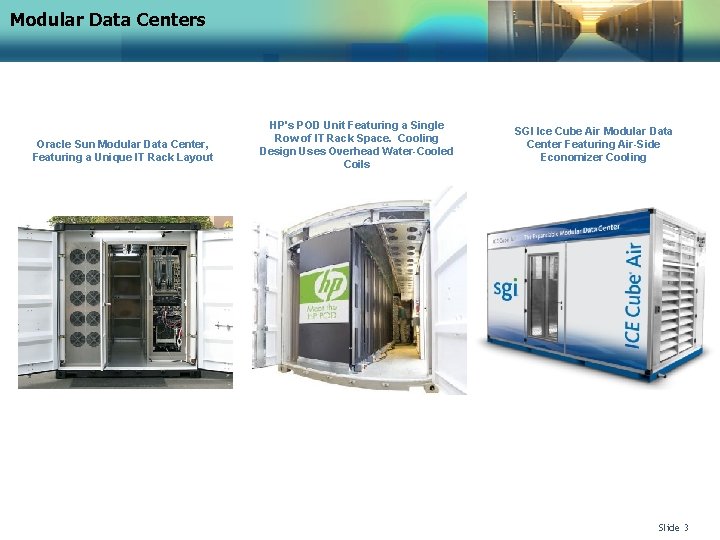
Modular Data Centers Oracle Sun Modular Data Center, Featuring a Unique IT Rack Layout HP's POD Unit Featuring a Single Row of IT Rack Space. Cooling Design Uses Overhead Water-Cooled Coils SGI Ice Cube Air Modular Data Center Featuring Air-Side Economizer Cooling Slide 3
Energy Efficiency Attributes • All solutions offer the advantages of full airflow containment and close-coupled cooling • First Generation units require chilled water supply, or use on-board DX • Second Generation units feature air-side economizer, supplemented as needed by evaporative or other cooling system Slide 4
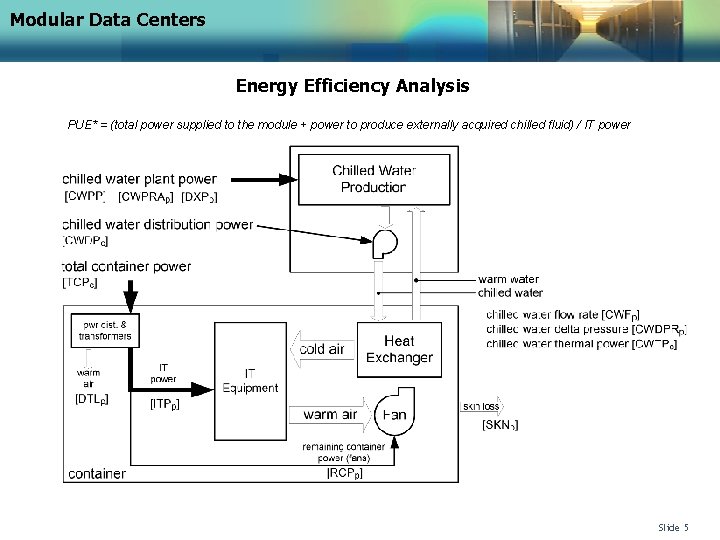
Modular Data Centers Energy Efficiency Analysis PUE* = (total power supplied to the module + power to produce externally acquired chilled fluid) / IT power Slide 5
Modular Data Centers Slide 6
Modular Data Centers Modular Data Center Thermal Analysis Results Slide 7
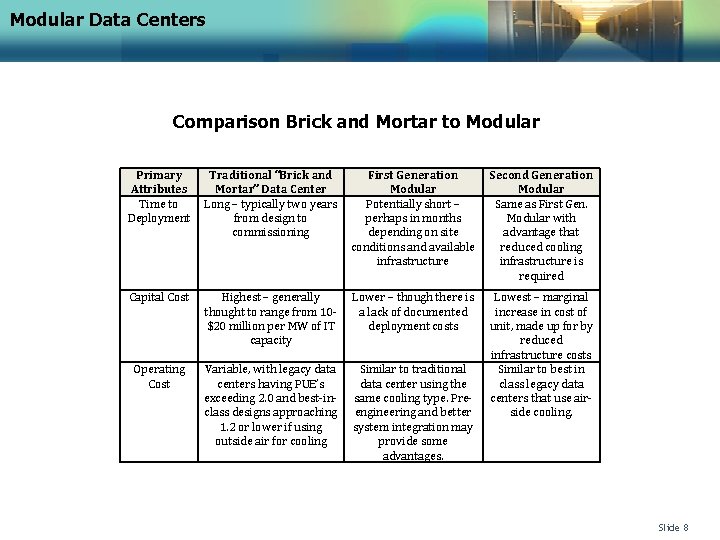
Modular Data Centers Comparison Brick and Mortar to Modular Primary Attributes Time to Deployment Traditional “Brick and Mortar” Data Center Long – typically two years from design to commissioning First Generation Modular Potentially short – perhaps in months depending on site conditions and available infrastructure Second Generation Modular Same as First Gen. Modular with advantage that reduced cooling infrastructure is required Capital Cost Highest – generally thought to range from 10$20 million per MW of IT capacity Lower – though there is a lack of documented deployment costs Operating Cost Variable, with legacy data centers having PUE’s exceeding 2. 0 and best-inclass designs approaching 1. 2 or lower if using outside air for cooling Similar to traditional data center using the same cooling type. Preengineering and better system integration may provide some advantages. Lowest – marginal increase in cost of unit, made up for by reduced infrastructure costs Similar to best in class legacy data centers that use airside cooling. Slide 8
Presentation posted at www. markbramfitt. com Slide 9