
MODIS Solar Diffuser SD Earth Shine Analysis MODIS

- Slides: 29
MODIS Solar Diffuser (SD) Earth Shine Analysis MODIS & Sea. Wi. FS Calibration Meeting Feb. 11, 2004 (revised) Robert Wolfe NASA GSFC Code 922, Raytheon ITSS R. Wolfe, Feb. 11, 2004
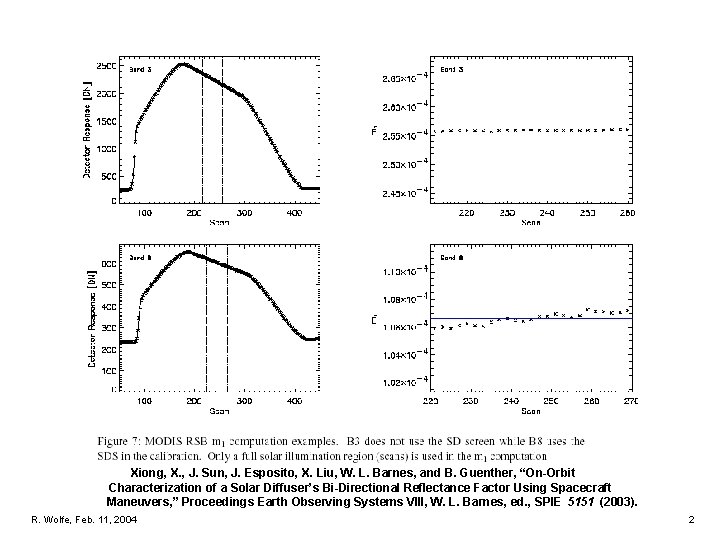
Xiong, X. , J. Sun, J. Esposito, X. Liu, W. L. Barnes, and B. Guenther, “On-Orbit Characterization of a Solar Diffuser’s Bi-Directional Reflectance Factor Using Spacecraft Maneuvers, ” Proceedings Earth Observing Systems VIII, W. L. Barnes, ed. , SPIE 5151 (2003). R. Wolfe, Feb. 11, 2004 2
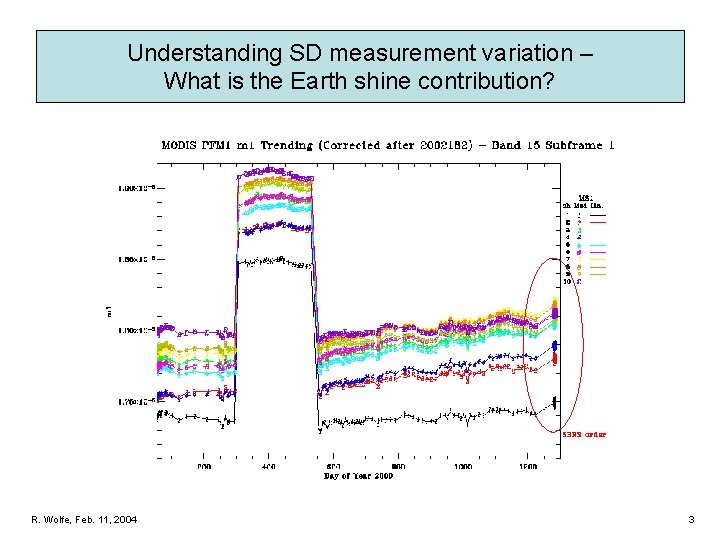
Understanding SD measurement variation – What is the Earth shine contribution? R. Wolfe, Feb. 11, 2004 3
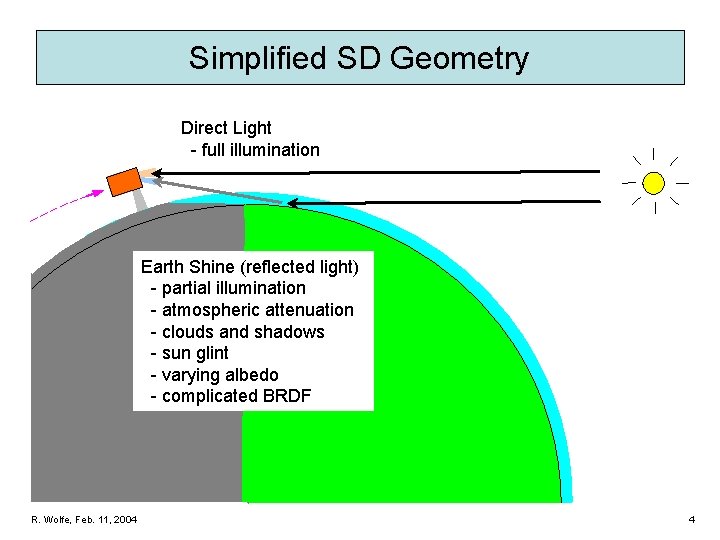
Simplified SD Geometry Direct Light - full illumination Earth Shine (reflected light) - partial illumination - atmospheric attenuation - clouds and shadows - sun glint - varying albedo - complicated BRDF R. Wolfe, Feb. 11, 2004 4
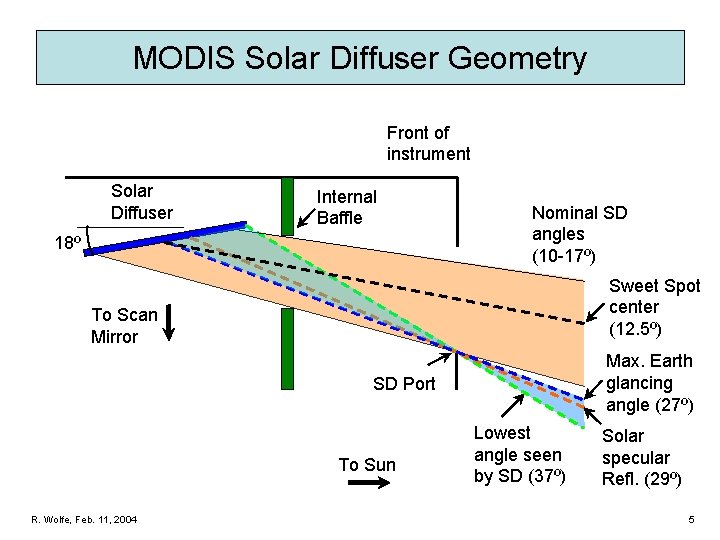
MODIS Solar Diffuser Geometry Front of instrument Solar Diffuser Internal Baffle 18º Nominal SD angles (10 -17º) Sweet Spot center (12. 5º) To Scan Mirror Max. Earth glancing angle (27º) SD Port To Sun R. Wolfe, Feb. 11, 2004 Lowest angle seen by SD (37º) Solar specular Refl. (29º) 5
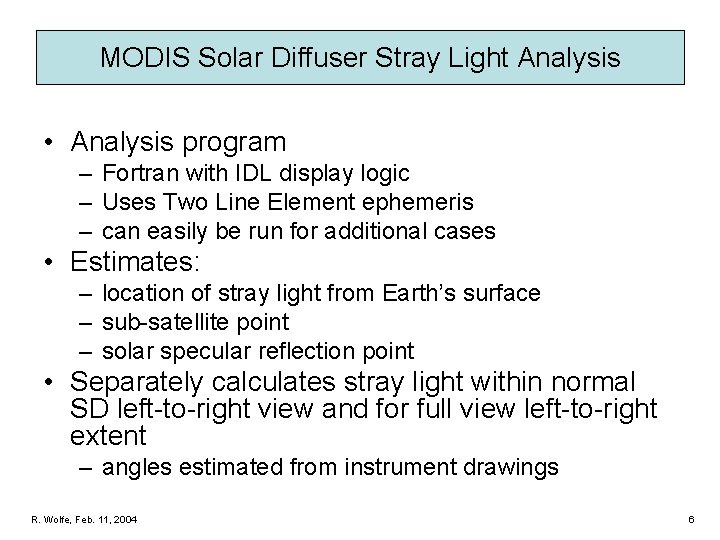
MODIS Solar Diffuser Stray Light Analysis • Analysis program – Fortran with IDL display logic – Uses Two Line Element ephemeris – can easily be run for additional cases • Estimates: – location of stray light from Earth’s surface – sub-satellite point – solar specular reflection point • Separately calculates stray light within normal SD left-to-right view and for full view left-to-right extent – angles estimated from instrument drawings R. Wolfe, Feb. 11, 2004 6
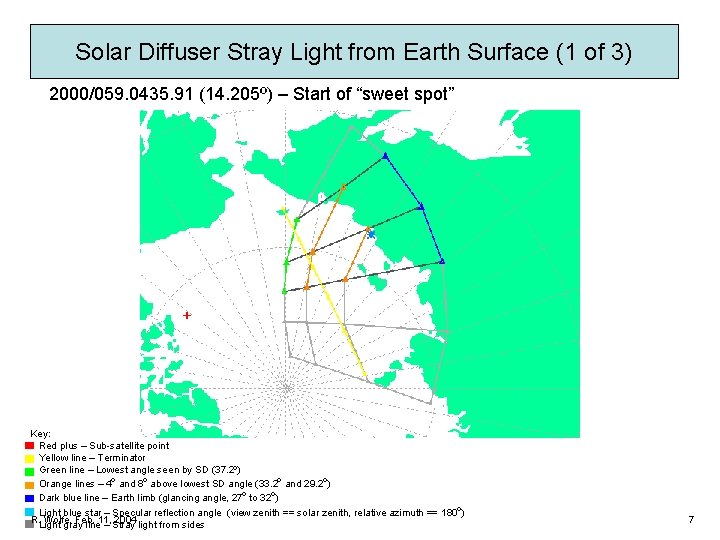
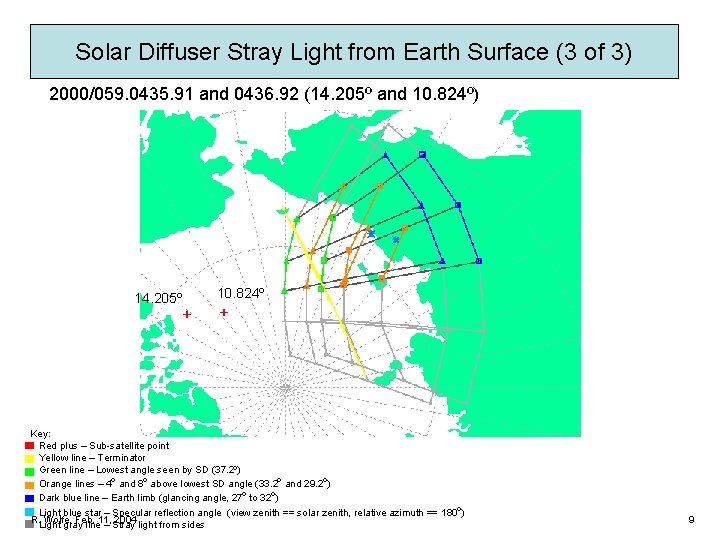
Solar Diffuser Stray Light from Earth Surface (1 of 3) 2000/059. 0435. 91 (14. 205º) – Start of “sweet spot” Key: Red plus – Sub-satellite point Yellow line – Terminator Green line – Lowest angle seen by SD (37. 2º) Orange lines – 4º and 8º above lowest SD angle (33. 2º and 29. 2º) Dark blue line – Earth limb (glancing angle, 27º to 32º) Light blue star – Specular reflection angle (view zenith == solar zenith, relative azimuth == 180º) R. Light Wolfe, Feb. 2004 light from sides gray line 11, – Stray 7
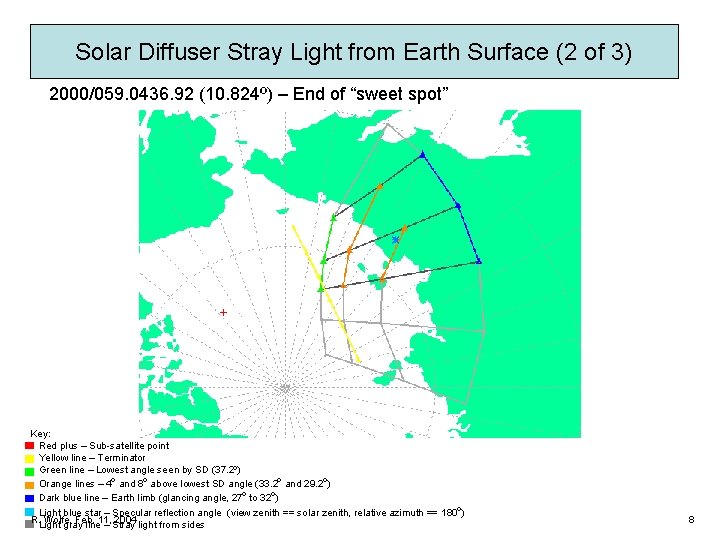
Solar Diffuser Stray Light from Earth Surface (2 of 3) 2000/059. 0436. 92 (10. 824º) – End of “sweet spot” Key: Red plus – Sub-satellite point Yellow line – Terminator Green line – Lowest angle seen by SD (37. 2º) Orange lines – 4º and 8º above lowest SD angle (33. 2º and 29. 2º) Dark blue line – Earth limb (glancing angle, 27º to 32º) Light blue star – Specular reflection angle (view zenith == solar zenith, relative azimuth == 180º) R. Light Wolfe, Feb. 2004 light from sides gray line 11, – Stray 8
Solar Diffuser Stray Light from Earth Surface (3 of 3) 2000/059. 0435. 91 and 0436. 92 (14. 205º and 10. 824º) 14. 205º 10. 824º Key: Red plus – Sub-satellite point Yellow line – Terminator Green line – Lowest angle seen by SD (37. 2º) Orange lines – 4º and 8º above lowest SD angle (33. 2º and 29. 2º) Dark blue line – Earth limb (glancing angle, 27º to 32º) Light blue star – Specular reflection angle (view zenith == solar zenith, relative azimuth == 180º) R. Light Wolfe, Feb. 2004 light from sides gray line 11, – Stray 9
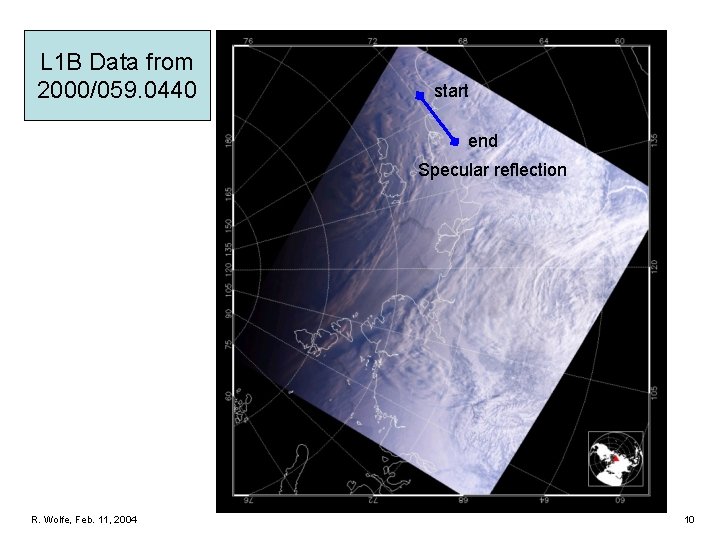
L 1 B Data from 2000/059. 0440 start end Specular reflection R. Wolfe, Feb. 11, 2004 10
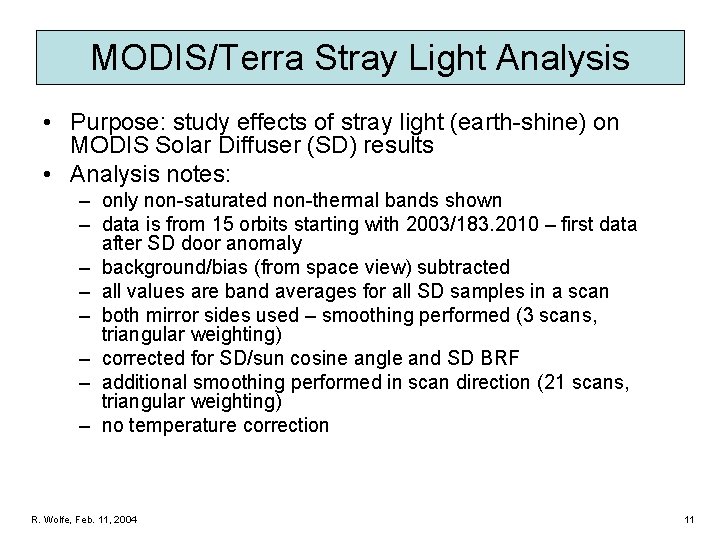
MODIS/Terra Stray Light Analysis • Purpose: study effects of stray light (earth-shine) on MODIS Solar Diffuser (SD) results • Analysis notes: – only non-saturated non-thermal bands shown – data is from 15 orbits starting with 2003/183. 2010 – first data after SD door anomaly – background/bias (from space view) subtracted – all values are band averages for all SD samples in a scan – both mirror sides used – smoothing performed (3 scans, triangular weighting) – corrected for SD/sun cosine angle and SD BRF – additional smoothing performed in scan direction (21 scans, triangular weighting) – no temperature correction R. Wolfe, Feb. 11, 2004 11
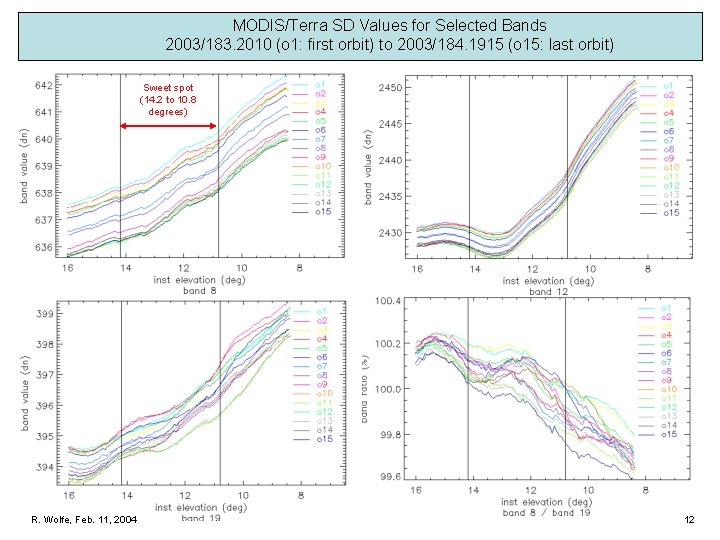
MODIS/Terra SD Values for Selected Bands 2003/183. 2010 (o 1: first orbit) to 2003/184. 1915 (o 15: last orbit) Sweet spot (14. 2 to 10. 8 degrees) R. Wolfe, Feb. 11, 2004 12
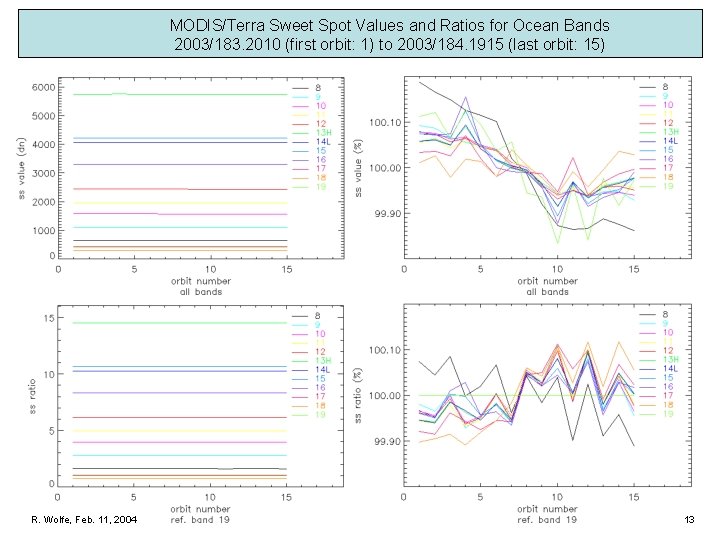
MODIS/Terra Sweet Spot Values and Ratios for Ocean Bands 2003/183. 2010 (first orbit: 1) to 2003/184. 1915 (last orbit: 15) R. Wolfe, Feb. 11, 2004 R. Wolfe, Dec. 10, 2003 13
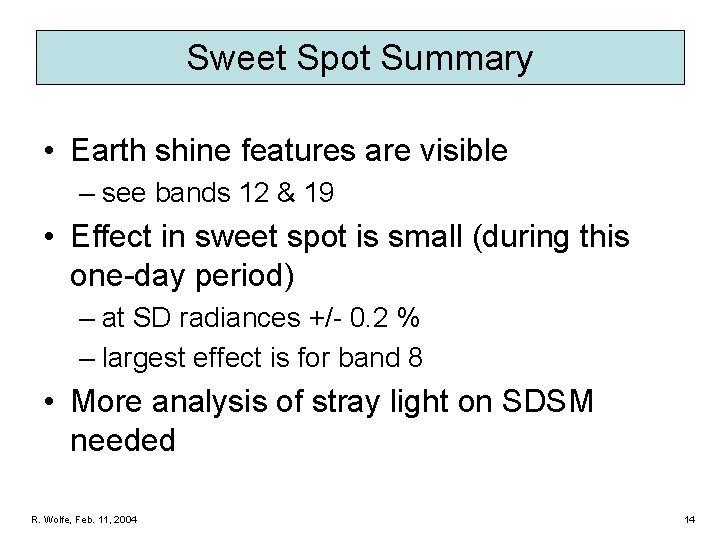
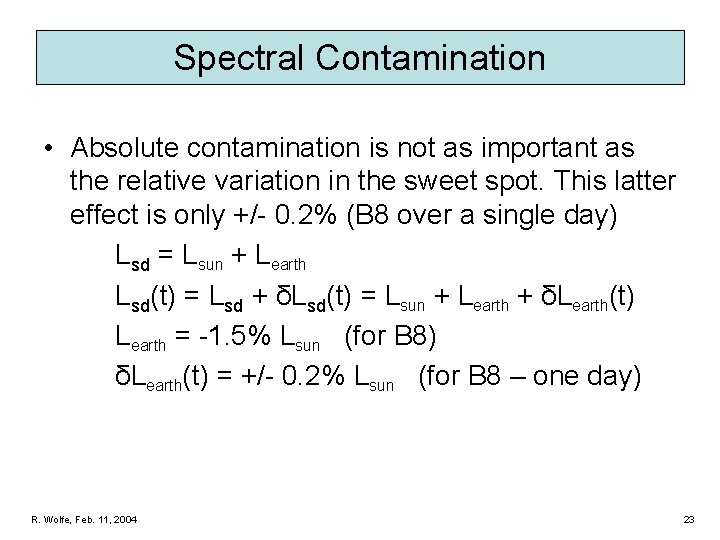
Sweet Spot Summary • Earth shine features are visible – see bands 12 & 19 • Effect in sweet spot is small (during this one-day period) – at SD radiances +/- 0. 2 % – largest effect is for band 8 • More analysis of stray light on SDSM needed R. Wolfe, Feb. 11, 2004 14
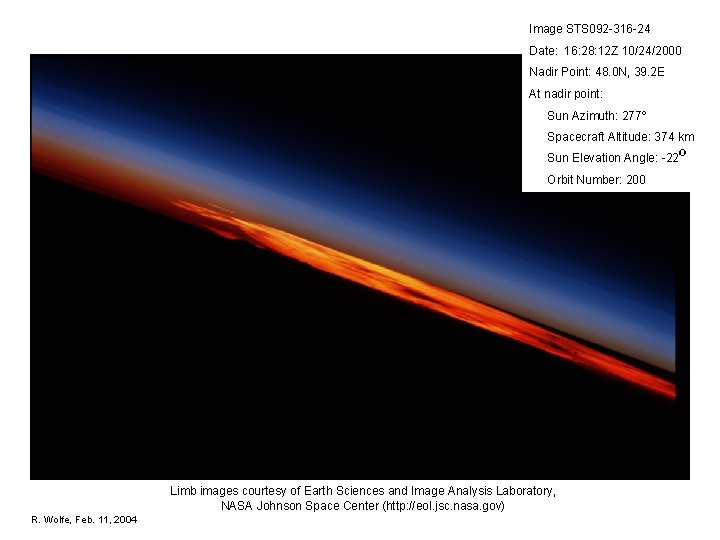
Image STS 092 -316 -24 Date: 16: 28: 12 Z 10/24/2000 Nadir Point: 48. 0 N, 39. 2 E At nadir point: Sun Azimuth: 277º Spacecraft Altitude: 374 km Sun Elevation Angle: -22º Orbit Number: 200 Limb images courtesy of Earth Sciences and Image Analysis Laboratory, NASA Johnson Space Center (http: //eol. jsc. nasa. gov) R. Wolfe, Feb. 11, 2004
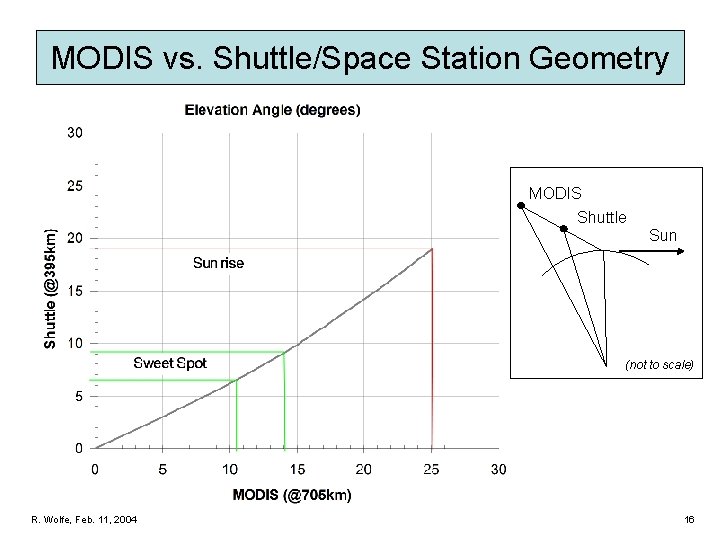
MODIS vs. Shuttle/Space Station Geometry MODIS Shuttle Sun (not to scale) R. Wolfe, Feb. 11, 2004 16
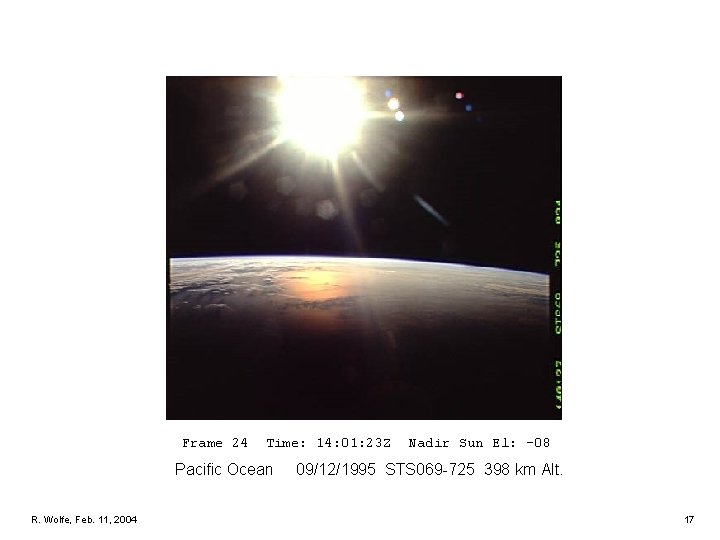
Frame 24 Time: 14: 01: 23 Z Pacific Ocean R. Wolfe, Feb. 11, 2004 Nadir Sun El: -08 09/12/1995 STS 069 -725 398 km Alt. 17
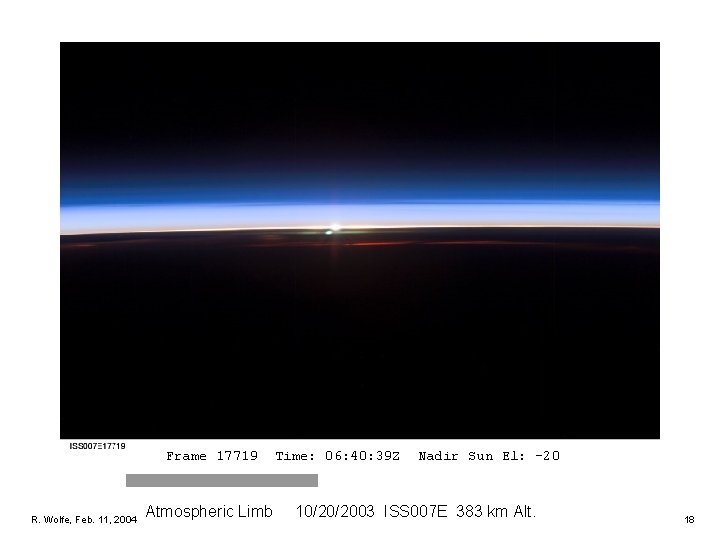
Frame 17714 17712 17713 17715 17716 17717 17718 17719 R. Wolfe, Feb. 11, 2004 Atmospheric Limb Time: 06: 35: 27 Z 06: 34: 35 Z 06: 34: 55 Z 06: 37: 01 Z 06: 37: 17 Z 06: 40: 15 Z 06: 40: 30 Z 06: 40: 39 Z Nadir Sun El: -26 -27 -25 -24 -21 -20 10/20/2003 ISS 007 E 383 km Alt. 18
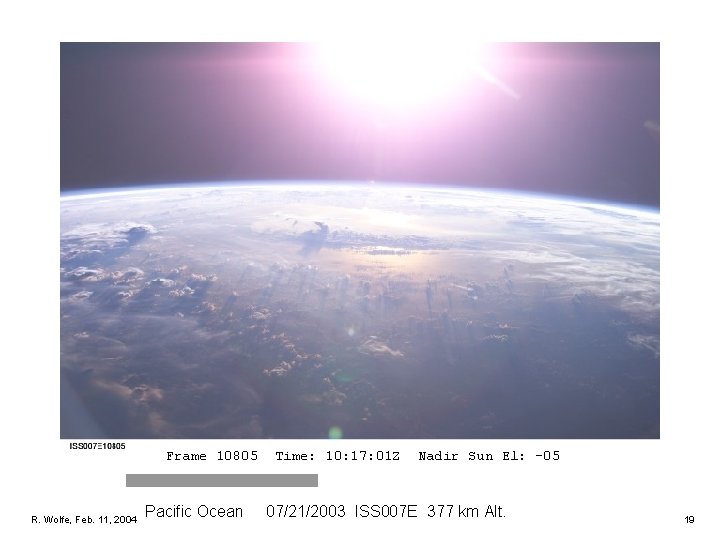
Frame 10805 10812 10811 10810 10809 10808 10807 10806 R. Wolfe, Feb. 11, 2004 Pacific Ocean Time: 10: 17: 01 Z 10: 19: 59 Z 10: 19: 25 Z 10: 17: 46 Z 10: 17: 43 Z 10: 17: 20 Z 10: 17 Z Nadir Sun El: -05 -09 -08 -06 07/21/2003 ISS 007 E 377 km Alt. 19
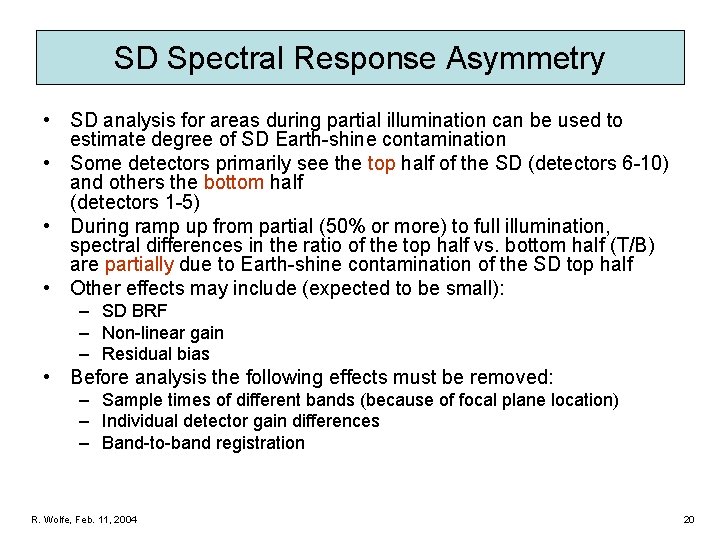
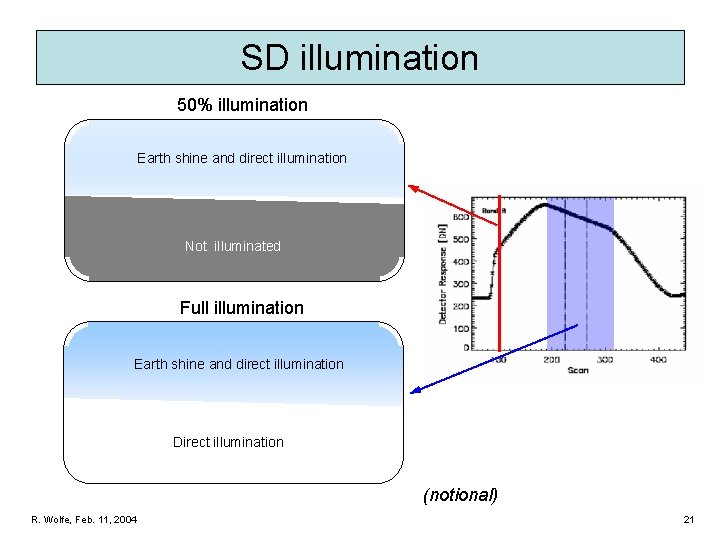
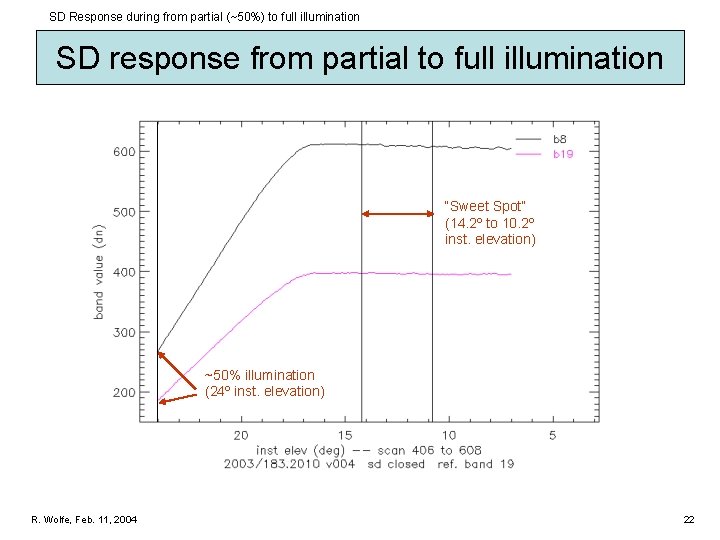
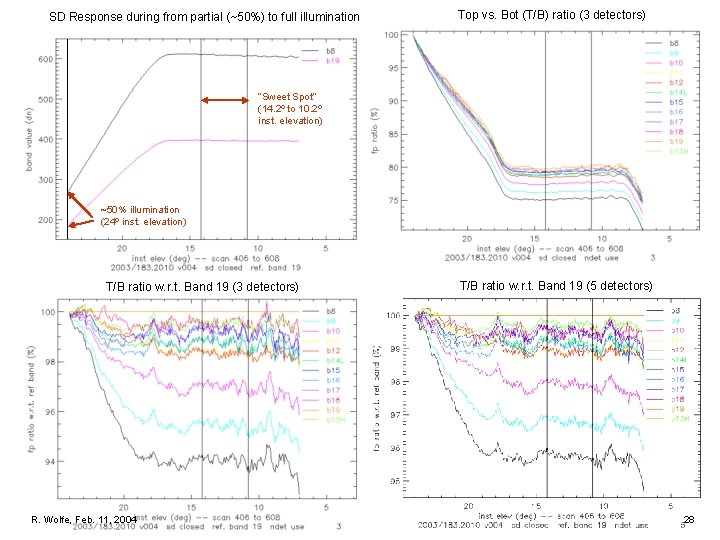
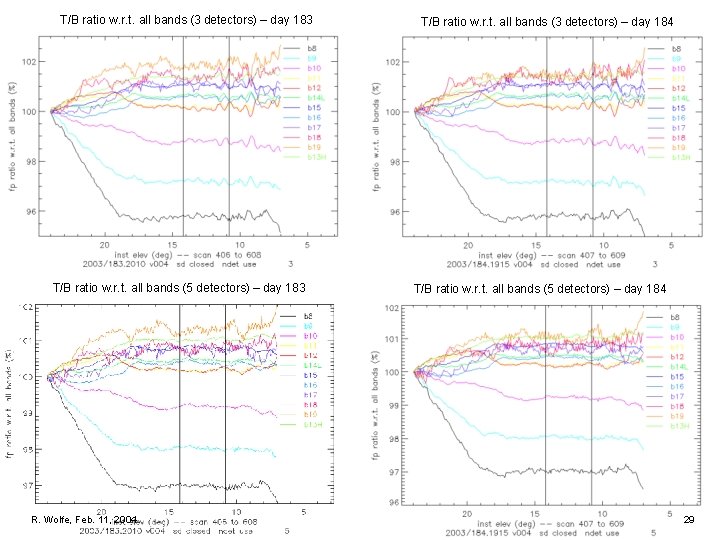
SD Spectral Response Asymmetry • SD analysis for areas during partial illumination can be used to estimate degree of SD Earth-shine contamination • Some detectors primarily see the top half of the SD (detectors 6 -10) and others the bottom half (detectors 1 -5) • During ramp up from partial (50% or more) to full illumination, spectral differences in the ratio of the top half vs. bottom half (T/B) are partially due to Earth-shine contamination of the SD top half • Other effects may include (expected to be small): – SD BRF – Non-linear gain – Residual bias • Before analysis the following effects must be removed: – Sample times of different bands (because of focal plane location) – Individual detector gain differences – Band-to-band registration R. Wolfe, Feb. 11, 2004 20
SD illumination 50% illumination Earth shine and direct illumination Not illuminated Full illumination Earth shine and direct illumination Direct illumination (notional) R. Wolfe, Feb. 11, 2004 21
SD Response during from partial (~50%) to full illumination SD response from partial to full illumination “Sweet Spot” (14. 2º to 10. 2º inst. elevation) ~50% illumination (24º inst. elevation) R. Wolfe, Feb. 11, 2004 22
Spectral Contamination • Absolute contamination is not as important as the relative variation in the sweet spot. This latter effect is only +/- 0. 2% (B 8 over a single day) Lsd = Lsun + Learth Lsd(t) = Lsd + δLsd(t) = Lsun + Learth + δLearth(t) Learth = -1. 5% Lsun (for B 8) δLearth(t) = +/- 0. 2% Lsun (for B 8 – one day) R. Wolfe, Feb. 11, 2004 23
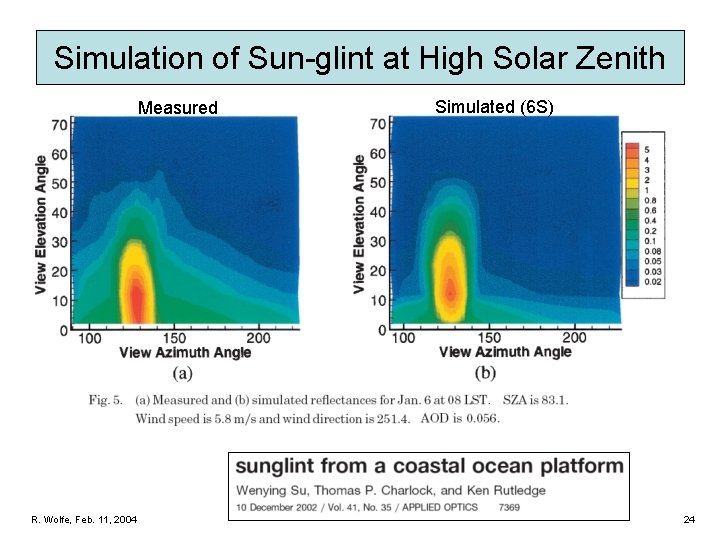
Simulation of Sun-glint at High Solar Zenith Measured R. Wolfe, Feb. 11, 2004 Simulated (6 S) 24
Next Steps • Better understand spectral dependence by simulation of various surface components (snow, vegetation, water) and atmospheric components (aerosols, clouds, water vapor) • Better understand individual detector’s view of SD • Better understand Earth-shine contribution to SDSM measurements – what is the Earth-shine contribution (if any)? – what is the SDSM response to non-uniform SD – which part of the SD does the SDSM see? • Better understand the variability of the SD measurements since SD door fixed open • Understand impact on NPP/VIIRS – very similar solar diffuser geometry R. Wolfe, Feb. 11, 2004 25
Backup Slides R. Wolfe, Feb. 11, 2004
SD Spectral Response Asymmetry – Preliminary Analysis • Caveats – data not corrected for: – Individual detector gains – Band-to-band offsets – Sampling time • These results do not agree with individual detector m 1’s (computed in the sweet spot) R. Wolfe, Feb. 11, 2004 27
SD Response during from partial (~50%) to full illumination Top vs. Bot (T/B) ratio (3 detectors) “Sweet Spot” (14. 2º to 10. 2º inst. elevation) ~50% illumination (24º inst. elevation) T/B ratio w. r. t. Band 19 (3 detectors) R. Wolfe, Feb. 11, 2004 T/B ratio w. r. t. Band 19 (5 detectors) 28
T/B ratio w. r. t. all bands (3 detectors) – day 183 T/B ratio w. r. t. all bands (5 detectors) – day 183 R. Wolfe, Feb. 11, 2004 T/B ratio w. r. t. all bands (3 detectors) – day 184 T/B ratio w. r. t. all bands (5 detectors) – day 184 29