
MODIS Instrument Operations Status MODIS Characterization Support Team




- Slides: 20
MODIS Instrument Operations Status MODIS Characterization Support Team, NASA GSFC (presented by Daniel Link) MODIS/VIIRS Calibration Workshop (February 25, 2021)
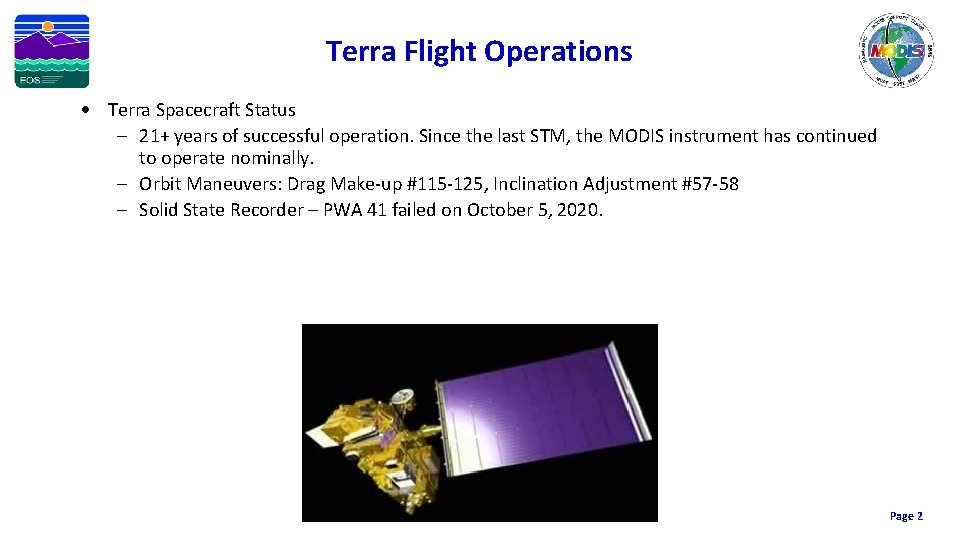
Terra Flight Operations Terra Spacecraft Status 21+ years of successful operation. Since the last STM, the MODIS instrument has continued to operate nominally. Orbit Maneuvers: Drag Make-up #115 -125, Inclination Adjustment #57 -58 Solid State Recorder – PWA 41 failed on October 5, 2020. Page 2
MODIS Instrument Operations (Terra) § Terra MODIS is healthy and operating nominally § Operational Configuration • A-side: launch to Oct. 30, 2000 • B-side: Oct. 30, 2000 to June 15, 2001 • A-side: July 02, 2001 to Sept. 17, 2002 • A-side electronics and B-side formatter: Sept. 17, 2002 to present • Cold FPA (SMIR and LWIR) controlled at 83 K • SD door fixed to “open” position since July 2003 • BB temperatures set at 285 K since April 25, 2020 § Events • Terra PWA failure October 5, 2020 § Largest Concern • Reduced SSR allocation – any additional PWA failures would result in further reduction in data collection § Special Operations • Lunar observations through Earth-View (EV) port • Preparations for Constellation Exit Page 3
Terra PWA Status • Terra launched with 58 Printed Wire Assemblies (PWA) (Memory Boards) for storing instrument data. • MODIS was been allocated 16 PWAs, made up of 32 supersets of storage since the MODIS PWA failure Oct. 14, 2014. • On August 30, 2019 (2019/242) at 06: 20: 00 z, Terra FOT noted a single-event upset which caused the failure of PWA-55, made up of supersets 108 and 109. (reported during last Science Team Meeting) On October 05, 2020 (2020/279) at 15: 21: 12 GMT, Terra noted a single-event upset which caused a failure on PWA-41, made up of supersets 80 and 81. With only 14 PWAs, the onboard data storage was no longer sufficient to record the standard MODIS data rate without significant risk of data loss. The reduced data storage has required an adjustment to the MODIS formatter day/night schedule. This affects the reflective solar bands (RSB) as they are only collected during orbit day. Page 4
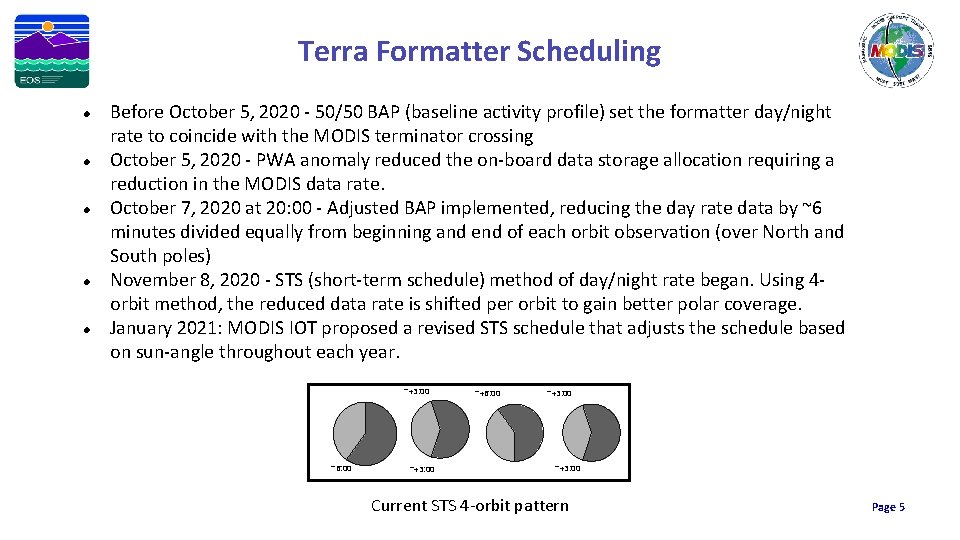
Terra Formatter Scheduling Before October 5, 2020 - 50/50 BAP (baseline activity profile) set the formatter day/night rate to coincide with the MODIS terminator crossing October 5, 2020 - PWA anomaly reduced the on-board data storage allocation requiring a reduction in the MODIS data rate. October 7, 2020 at 20: 00 - Adjusted BAP implemented, reducing the day rate data by ~6 minutes divided equally from beginning and end of each orbit observation (over North and South poles) November 8, 2020 - STS (short-term schedule) method of day/night rate began. Using 4 orbit method, the reduced data rate is shifted per orbit to gain better polar coverage. January 2021: MODIS IOT proposed a revised STS schedule that adjusts the schedule based on sun-angle throughout each year. ~+3: 00 ~6: 00 ~+3: 00 Current STS 4 -orbit pattern Page 5
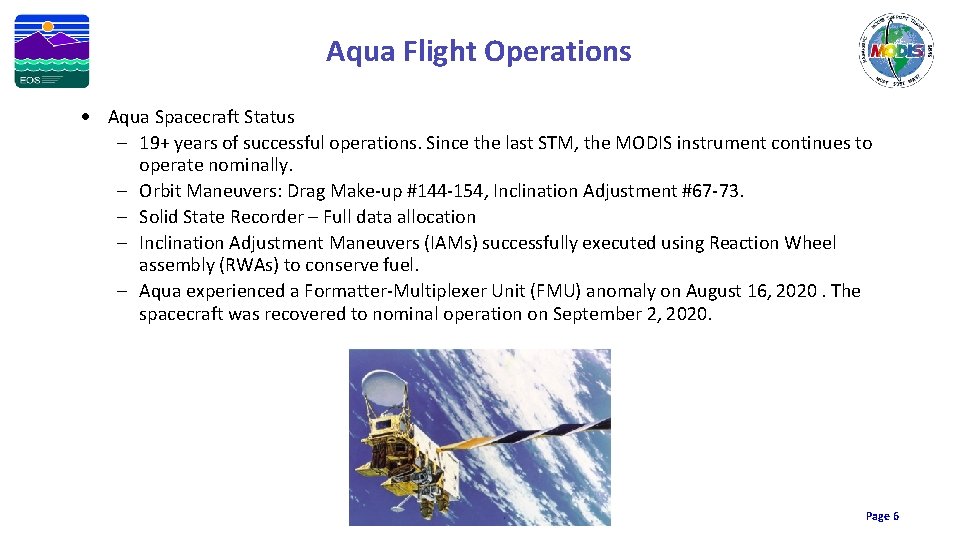
Aqua Flight Operations Aqua Spacecraft Status 19+ years of successful operations. Since the last STM, the MODIS instrument continues to operate nominally. Orbit Maneuvers: Drag Make-up #144 -154, Inclination Adjustment #67 -73. Solid State Recorder – Full data allocation Inclination Adjustment Maneuvers (IAMs) successfully executed using Reaction Wheel assembly (RWAs) to conserve fuel. Aqua experienced a Formatter-Multiplexer Unit (FMU) anomaly on August 16, 2020. The spacecraft was recovered to nominal operation on September 2, 2020. Page 6
MODIS Instrument Operations (Aqua) § Aqua MODIS is healthy and operating nominally § Operational Configuration (No change since last STM) • Same B-side configuration since launch • BB temperatures set at 285 K • Cold FPA (SMIR and LWIR) controlled at 83 K § Events § FMU Anomaly Recovery – No impact on MODIS health. Data from direct broadcast sites were collected and evaluated to shore up data losses over this period. Approximately 27% of lost MODIS data has been recovered using direct broadcast data. § Largest Concern • Passed projected lifetime limit on SD door movements (July 2012) § Special Operations • Lunar observations through Earth-View (EV) port • Preparations for Constellation Exit Page 7
Aqua Deep Space Lunar Calibration • Aqua FOT is preparing for spacecraft pitch maneuvers to allow for deep space calibrations. • The AIRS instrument team requested a deep space calibration be performed before constellation exit. MODIS requested a calibration that includes a view of the Moon at a near-nadir angle. • MCST evaluated the potential opportunities and notified Aqua FOT of our choice of September 23, 2021. • Impact on Science: Due to the non-nominal spacecraft orientation, the TEB focal plane temperature will not be controlled for 25 hours after start of maneuver. • There may be a later pitch maneuver to facilitate a deep space calibration without a lunar observation at the request of the AIRS instrument team. Still TBD Page 8
Preparation for Constellation Exit Maneuvers • In preparation for the expected constellation exit maneuvers, MODIS IOT has determined the ideal MODIS configuration during the maneuvers and associated commanding. These plans have been made and shared in coordination with each spacecraft Flight Operations Team (FOT). • Terra MODIS CEM Plan sent to FOT: 2019/11/04 • Aqua MODIS CEM Plan sent to FOT: 2020/07/24 • Throughout the maneuvers, MODIS will have blackbody and SMIR/LWIR focal plane heaters turned off with both nadir and space view (SV) doors closed. Page 9
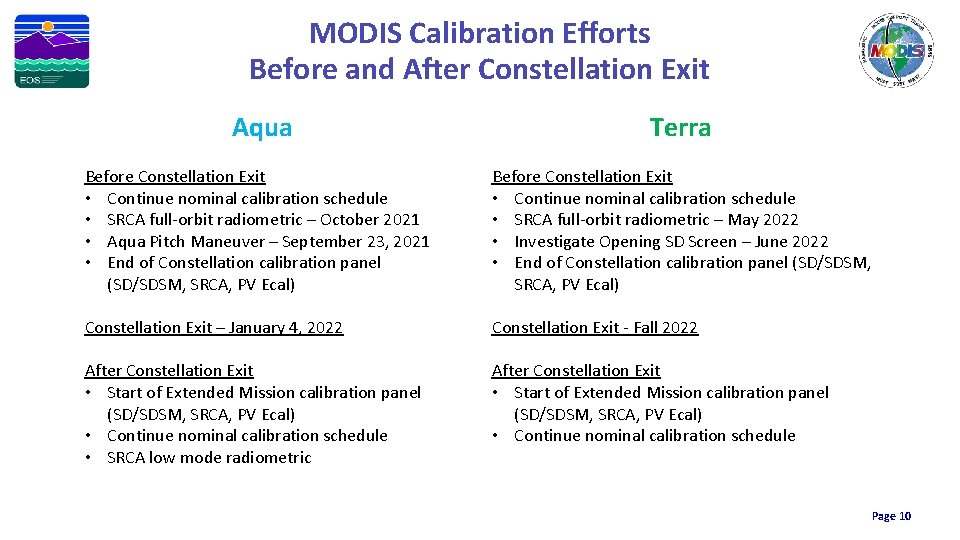
MODIS Calibration Efforts Before and After Constellation Exit Aqua Terra Before Constellation Exit • Continue nominal calibration schedule • SRCA full-orbit radiometric – October 2021 • Aqua Pitch Maneuver – September 23, 2021 • End of Constellation calibration panel (SD/SDSM, SRCA, PV Ecal) Before Constellation Exit • Continue nominal calibration schedule • SRCA full-orbit radiometric – May 2022 • Investigate Opening SD Screen – June 2022 • End of Constellation calibration panel (SD/SDSM, SRCA, PV Ecal) Constellation Exit – January 4, 2022 Constellation Exit - Fall 2022 After Constellation Exit • Start of Extended Mission calibration panel (SD/SDSM, SRCA, PV Ecal) • Continue nominal calibration schedule • SRCA low mode radiometric After Constellation Exit • Start of Extended Mission calibration panel (SD/SDSM, SRCA, PV Ecal) • Continue nominal calibration schedule Page 10
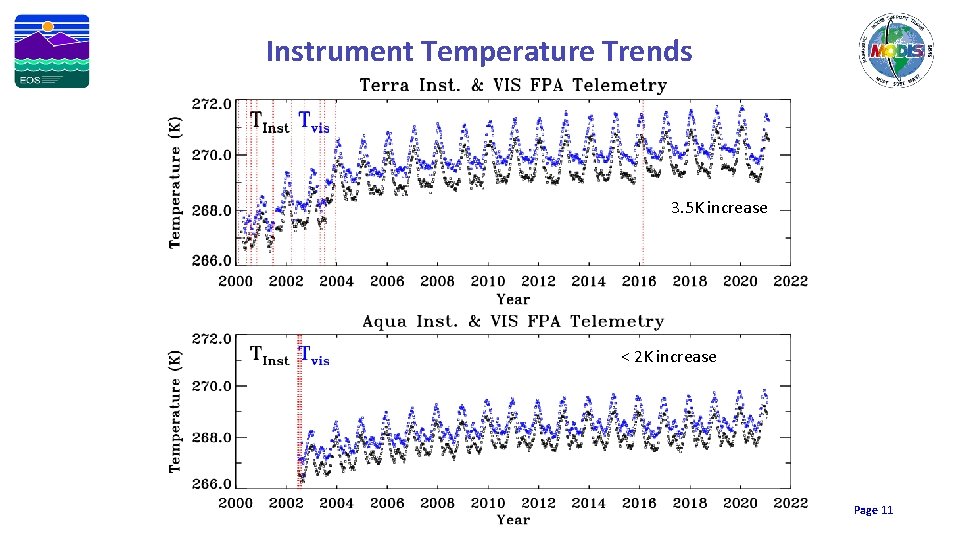
Instrument Temperature Trends 3. 5 K increase < 2 K increase Page 11
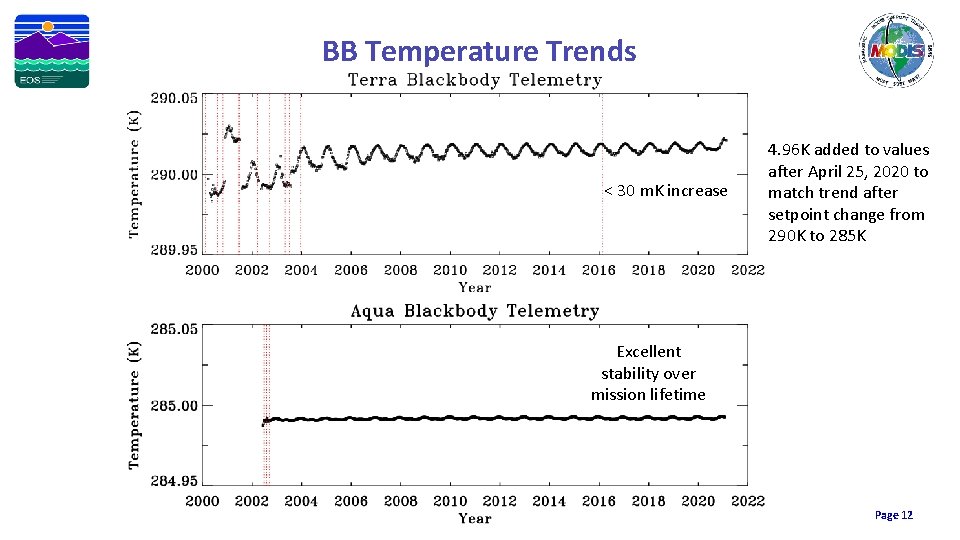
BB Temperature Trends < 30 m. K increase 4. 96 K added to values after April 25, 2020 to match trend after setpoint change from 290 K to 285 K Excellent stability over mission lifetime Page 12
CFPA Temperature Trends Very stable over lifetime Improved performance in recent years Page 13
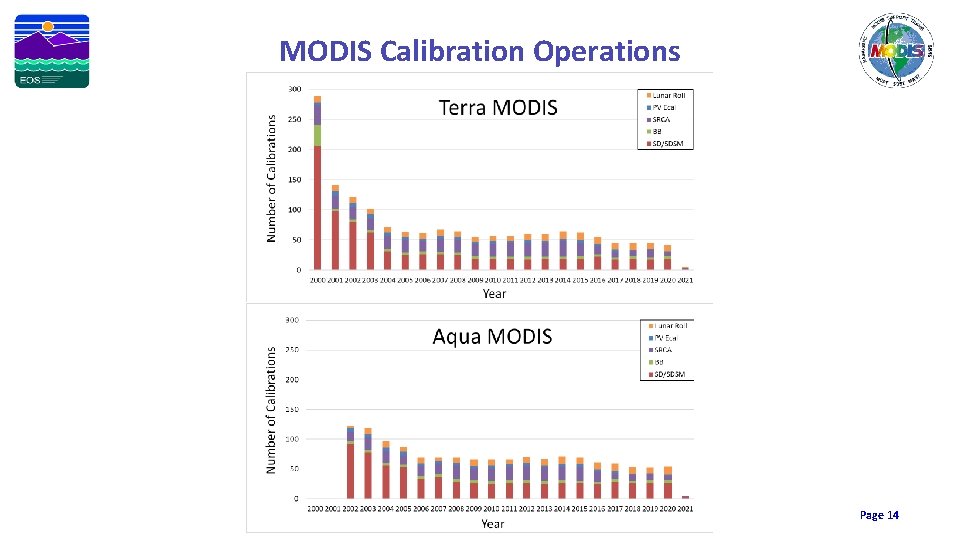
MODIS Calibration Operations Page 14
IOT Backup Slides Page 15
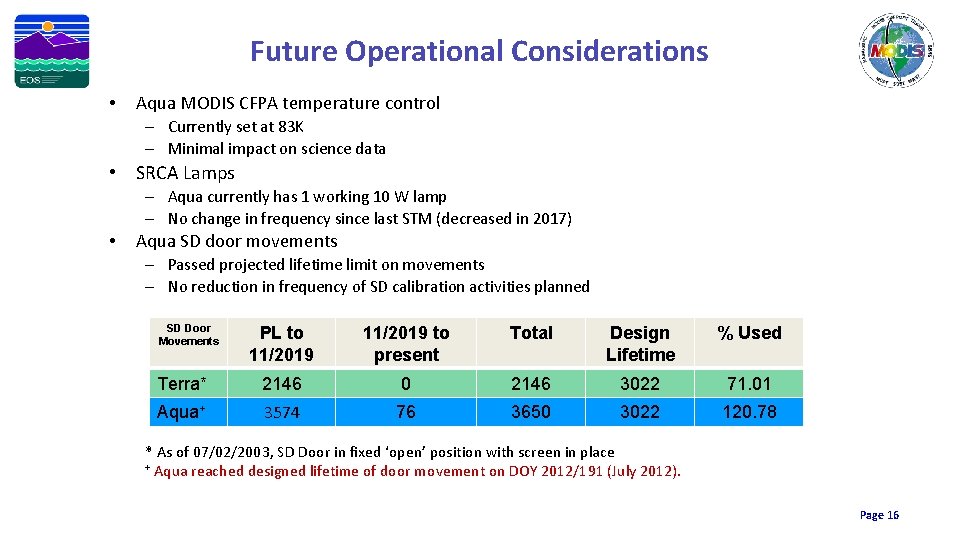
Future Operational Considerations • Aqua MODIS CFPA temperature control – Currently set at 83 K – Minimal impact on science data • SRCA Lamps – Aqua currently has 1 working 10 W lamp – No change in frequency since last STM (decreased in 2017) • Aqua SD door movements – Passed projected lifetime limit on movements – No reduction in frequency of SD calibration activities planned SD Door Movements PL to 11/2019 to present Total Design Lifetime % Used Terra* 2146 0 2146 3022 71. 01 Aqua+ 3574 76 3650 3022 120. 78 * As of 07/02/2003, SD Door in fixed ‘open’ position with screen in place + Aqua reached designed lifetime of door movement on DOY 2012/191 (July 2012). Page 16
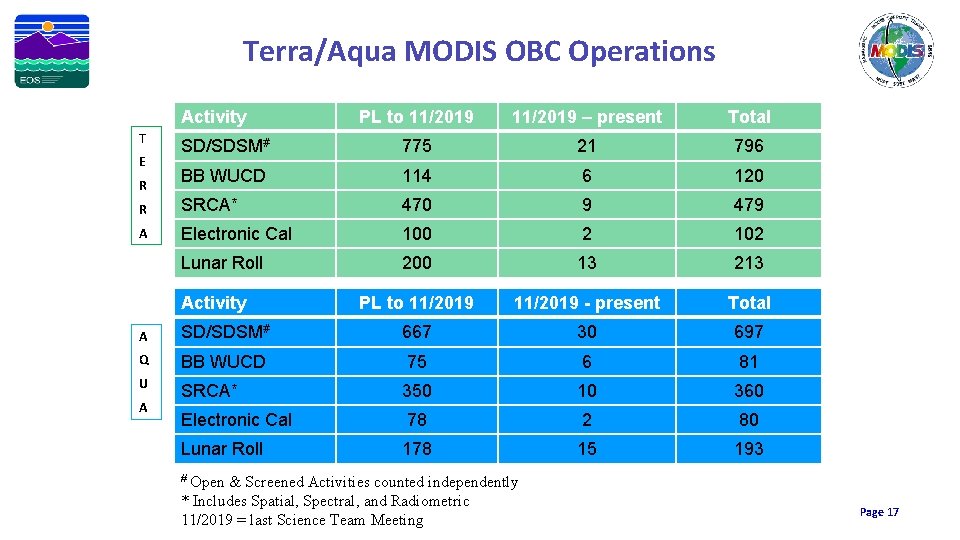
Terra/Aqua MODIS OBC Operations Activity PL to 11/2019 – present Total SD/SDSM# 775 21 796 BB WUCD 114 6 120 R SRCA* 470 9 479 A Electronic Cal 100 2 102 Lunar Roll 200 13 213 PL to 11/2019 - present Total T E R Activity A SD/SDSM# 667 30 697 Q BB WUCD 75 6 81 U SRCA* 350 10 360 Electronic Cal 78 2 80 Lunar Roll 178 15 193 A Open & Screened Activities counted independently * Includes Spatial, Spectral, and Radiometric 11/2019 = last Science Team Meeting # Page 17
SRCA Calibrations • • Terra – 477 SRCA Calibrations Aqua – 359 SRCA Calibrations Lamps well within lifetime usage margins Aqua Lamp #4 Failure - 2016 Lamp Power Lamp # Terra Aqua 10 W 1 W 1 2 3 4 1 2 Usage (hr) 386. 8 172. 1 190. 3 143. 7 591. 7 320. 5 Life (hr) 500 500 4000 percent 77. 4% Failed on 11 -20 -2004 Failed on 2 -18 -2006 28. 7% 14. 8% 8. 0% Usage (hr) 379. 2 188. 1 205. 7 135. 0 532. 3 310. 4 Life (hr) 500 500 5000 percent 75. 8% Failed on 4 -14 -2003 Failed on 6 -28 -2005 Failed on 6 -30 -2016 10. 6% 6. 2% Page 18
Lunar Calibrations Through Earth View Port • • • To aid in scan mirror characterization and response versus scan angle (RVS) determination, MCST proposed measuring the Moon using a slightly adjusted sector rotation in January 2020. This allowed the Moon to be measured through the earth view (EV) port during a lunar roll. During nominal lunar observations, through the space view (SV) port, we rotate the sectors so that the EV sector measures the OBCs, to give additional data beyond the thin amount recorded during nominal science operations. Using the adjusted rotation, the EV sector no longer measures only the OBCs, but rather the edge of the EV port along with the SV and blackbody(BB) sectors to allow for lunar observations at a new angle of incidence on the MODIS scan mirror. Nominal sectors (0° rotation) Nominal Lunar Observation (-135° rotation) New Lunar Observation (-78° rotation) Page 19
Lunar Calibrations Through Earth View Port • Terra MODIS • The updated lunar calibration required a new command procedure • New command procedure used for lunar observations from 2020/03/13 - 2021/02/03 • Lunar observations through EV port: • 2020/10/09 • 2020/11/07 • 2021/01/05 • 2021/02/03 • Aqua MODIS • The updated lunar calibration required a change to the spacecraft SCS (stored command sequence) • Revised SCS used for lunar observations from 2020/02/25 - 2021/02/11 • Lunar observations through EV port: • 2020/04/02 • 2020/06/28 • 2020/11/23 • 2020/12/22 • All lunar observations after 2021/02/11 will use the nominal (old/original) commanding Page 20