
Modifying Games Remember the ultimate goal of physical
Modifying Games Remember the ultimate goal of physical education and your mission statement. Block, M. (2007) A Teacher’s Guide to Including Students with Disabilities in General Physical Education, Paul H. Brookes Publishing Co. , Inc. Baltimore, Maryland, Chapter 8.
Group games and team sports can… Positively: 1. Facilitate skill development 2. Promote an understanding of rules, strategies, and concepts. 3. Be designed to promote sportsmanship, cooperation, and teamwork.
Group games and team sports can… Negatively: 4. Promote competition and adherence to the rules designed for very skilled athletes which for novices or the unskilled creates limited success and exclusion. e. g. basketball 10 foot hoops What happens when kids get frustrated? - unhappy, loss of motivation What is your job as a physical educator?
Why Modify Games? So all students can successfully participate 1. simple changes to individual/group activities or 2. more complex changes to individual/group or 3. modified options within the same class
Basic Principles for Modifying Games and Sports 1. Games are not sacred, kids are. - games have to be appropriate for every student - if not, modify and accommodate - what is the intended purpose for the game? If all students are not succeeding then the game may need to be modified.
2. Not all games are for everyone, at least not in their traditional configurations. - is the game appropriate for your students in the “professional form”? - how can you modify to include everyone regardless of ability level, experience, and motivation?
3. You can modify any game to include anyone. a) to do this modify different components of the game - what do all games have in common? - players, movements, objects, organization, limits - time, space, players, materials - what are your objectives? 4. If you need their buy-in, include the students in the decision-making of modifications.
5. On occasion, play multiple games simultaneously with some games following regulation rules and others having modifications.
Games Design Model Morris and Stiehl (1999) developed an approach for analyzing and changing group games based on: 1. Games are not sacred, kids are. 2. Not all games are for everyone, at least not in their traditional configurations. 3. You can modify any game to include anyone. 3 Areas to Consider: 1. Understand Basic Structure of Games 2. Modify the Basic Structure of a Game 3. Manage Degree of Difficulty of a Game
What Do All Games Have in Common? Basic Structure: There are 6 major aspects of games: 1. 2. 3. 4. 5. 6. Purpose Players Movements Objects Organization Limits
Purpose 1. Do not have to have the same purpose for all students 2. Depends on goals and objectives - of game - of lesson - for certain students
Players Can vary: 1. How they are grouped? - homogenously by gender, size, skill level, heterogeneously so there are skilled and unskilled or random 2. Number of students involved: - on the whole or within groups - level of fair competition
Movement 1. Type of movement - locomotor, nonlocomotor, manipulative, and body awareness skills - skilled and unskilled may work on different movements e. g. skilled use different movements in different games 2. How movements are used - locations (personal space, general space, following directions, levels, or pathways) - quantity of movements (number of reps) - sequences or no sequences
Objects - equipment used during game or practice (amount, type) - how the student moves in relation to the object (over, under, kicking, throwing) - how the object moves the student (scooters, bikes) - how an object is used to send other objects - how an object is used to gather objects * allow students to use modified objects to allow them to participate successfully.
Organization and Limits Organization - patterns, structure and location of players Limits - general rules for players - physical aspects of the environment- boundaries, size/type of equipment, number of players - activity conditions- time of game, time of individual participation, scoring, rules
Modify A Game’s Basic Structure Main areas of focus when modifying specific games : 1. The purpose of the game - modify an existing game or create a new game 2. How many players will be involved - maximize successful participation 3. Game’s movements and objects - amount of practice time and “touches”, strategies, concepts etc. Can use limits to modify the basic structure.
Manage a Game’s Degree of Difficulty 1. Identify factors that are limiting performance - list the aspects that can be manipulated - equipment size, target size, speed of objects - not the students’ abilities - alter the task complexity
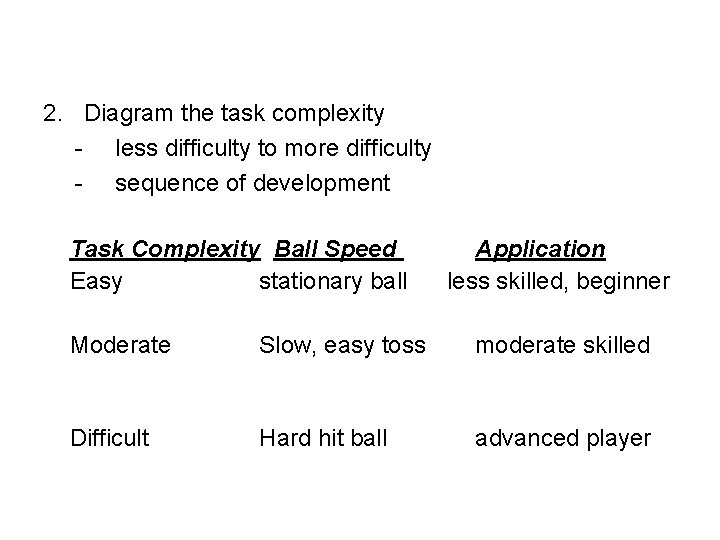
2. Diagram the task complexity - less difficulty to more difficulty - sequence of development Task Complexity Ball Speed Easy stationary ball Application less skilled, beginner Moderate Slow, easy toss moderate skilled Difficult Hard hit ball advanced player
Sequence of Progressions • • • On-air- self Alone Partners Small groups Larger groups • Can play games that focus on certain progressions or include each progression within the same game
3. Create tasks that vary in difficulty - can also modify game categories (limits, players) to reduce or increase difficulty e. g. smaller teams, fieldsize , more goals
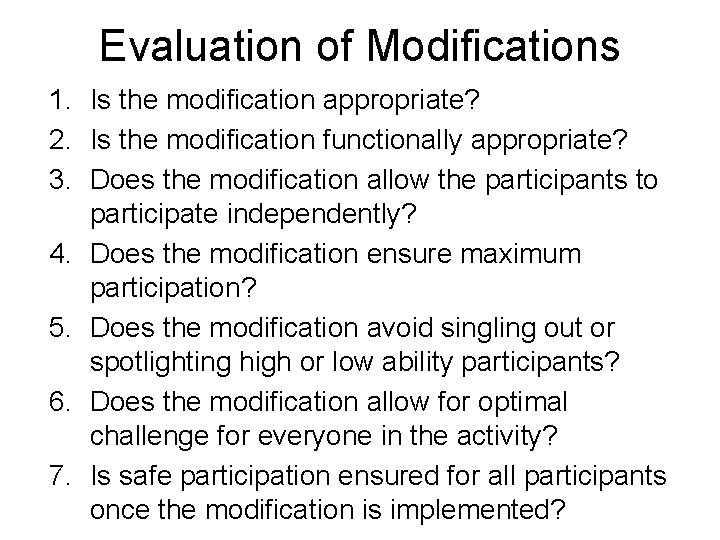
Evaluation of Modifications 1. Is the modification appropriate? 2. Is the modification functionally appropriate? 3. Does the modification allow the participants to participate independently? 4. Does the modification ensure maximum participation? 5. Does the modification avoid singling out or spotlighting high or low ability participants? 6. Does the modification allow for optimal challenge for everyone in the activity? 7. Is safe participation ensured for all participants once the modification is implemented?
- Slides: 21