
MODIFIED RELEASE DOSAGE FORM by A S Adebayo
MODIFIED RELEASE DOSAGE FORM by A. S. Adebayo, Ph. D Thursday, December 23, 2021 1
Introduction n Modified release dosage forms are drug delivery systems (DDS) which, by virtue of formulation and product design, provide drug release in a modified form distinct from that of the conventional dosage forms. Drug release can either be delayed or extended in nature. Thursday, December 23, 2021 2
Delayed-release products n Usually enteric coated tablets or capsules designed to pass through the stomach unaltered to release their medication within the intestinal tract. Thursday, December 23, 2021 3
Extended-release products n Designed to release their medication in controlled manner, at pre-determined rate, duration and location in the body to achieve and maintain optimum therapeutic blood levels of drug. Thursday, December 23, 2021 4
Rationale for extended release pharmaceuticals n Drugs that are not inherently long lasting require multiple daily dosing to achieve the desired therapeutic effects. n Multiple daily dosing is often inconvenient and can result in missed doses, made-up doses and patient non-compliant with therapeutic regimen. n Blood levels of drugs from conventional immediaterelease dosage forms taken more than once daily following definite schedule usually demonstrate sequential peaks and troughs (valleys) associated with each dose. Thursday, December 23, 2021 5
Rationale for extended release pharmaceuticals n Extended release tablets or capsules are commonly taken only once or twice daily compared with the conventional dosing of 2 to 4 times daily ¡ n Products are designed to provide an immediate release of drug which promptly produces the desired therapy, followed by gradual and continual release of additional amounts of drug to maintain this effect over a predetermined period of time. The need for night dosing of drugs may be eliminated Thursday, December 23, 2021 6
Advantages of Extended-release Dosage Forms over Conventional Forms n Reduction in drug blood level fluctuations n Reduction in frequency of dosing n Enhanced patient compliance n Reduction in incidence of adverse side effects n Reduction in overall healthcare costs. Thursday, December 23, 2021 7
Terminology n The following terms have been applied to “extended” or “sustained” drug delivery systems: ¡ ¡ ¡ ¡ Controlled-release Extended release (ER) Sustained-release (SR) Timed-release (TR) Long-acting (LA) Prolonged-action (PA), and Sustained-action (SA) Thursday, December 23, 2021 8
Extended-release dosage forms The US FDA defines ER dosage form as: one that allows a reduction in dosing frequency to that presented by a conventional dosage form such as a solution or an immediate release dosage forms. n Thursday, December 23, 2021 9
Delayed-release n These are dosage forms designed to release the drug at a time other than promptly after administration. n The delay may be time-based or based on the influence of environmental conditions such as g. i. p. H, enzyme, pressure, etc Thursday, December 23, 2021 10
Repeat action n These are dosage forms usually containing 2 single doses of medication, one for immediate and the second for delayed release e. g. bilayered tablets. Thursday, December 23, 2021 11
Targeted release n Drug release that is directed towards isolating or concentrating a drug in a body region, tissue, or site for absorption or drug action Thursday, December 23, 2021 12
Extended-release Oral Dosage Forms The general properties of drugs best suited for ER product design are: n They exhibit neither very slow nor very fast rates of absorption and excretion n They are uniformly absorbed from the g. i. t. n They are administered in relatively small doses. n They possess a good margin of safety i. e. Therapeutic Index (TI) Thursday, December 23, 2021 13
Technology of ER Dosage Forms ER Coated Beads, Granules or Microspheres – ¡ Granules of drug may be coated with lipid materials such as beeswax, carnuba wax, glyceryl monostearate, cetyl alcohol, etc. ¡ Careful blending of coated and un-coated granules and with coatings of different thicknesses will provide drug release of desired characteristics. Thursday, December 23, 2021 14
COMMERCIAL EXAMPLES ¡ Toprol-XL® (metoprolol succinate) tabs. (Astra); ¡ Indocin SR ® (indomethacin capsules (Merck); ¡ Compazine ® (prochloperazine) Spansule Capsules (Smith. Kline Beecham) Thursday, December 23, 2021 15
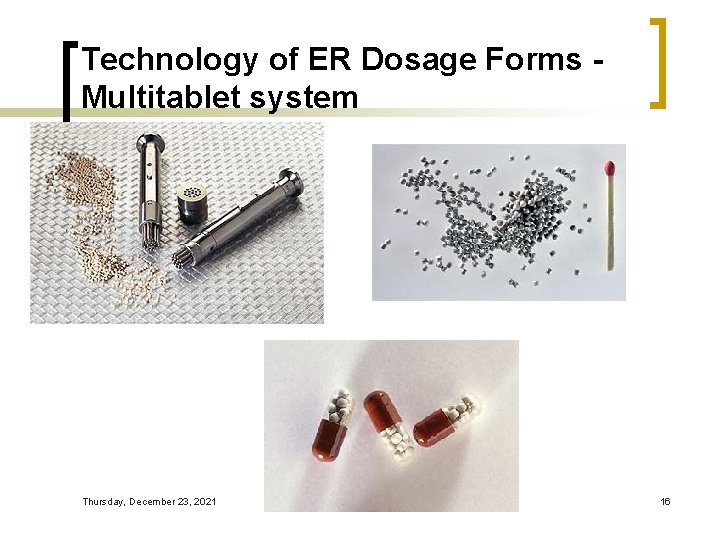
Technology of ER Dosage Forms Multitablet system Thursday, December 23, 2021 16
Technology of ER Dosage Forms n Embedding drug in slowly eroding or hydrophilic matrix system – The design comprises of the drug substance plus excipient material that slowly erodes in body fluids thereby progressively releasing the drug for absorption ¡ E. g. Quinidex® Quinine SO 4 tablets (Robins); Oramorph ® SR Morphine SO 4 tabs. Roxane ® Thursday, December 23, 2021 17
Technology of ER Dosage Forms: ER Microencapsulated Drug ¡ –Microencapsulation is a process by which solids, liquid and semi-solid substances may be encapsulated into microscopic size particles through the formation of thin coating of “wall” material around the substance. n n Different rate of drug release can be obtained by changing the core to wall ratio, the type of polymer coat and the method of microencapsulation. E. g. K-Dur ®Microburst Release System (KCl) tabs. (Key) Thursday, December 23, 2021 18
Technology of ER Dosage Forms: Osmotic pump device n This consists of a core tablet surrounded by a semi-permeable membrane coating with a 0. 4 mm diameter hole produced by laser beam. n The core tablet has 2 layers, one containing the drug (the “active” layer) and the other containing the polymeric osmotic agent (the “push” layer). ¡ ¡ E. g. Glucotrol ® XL (glipizide) tablets (Pfizer) Covera – HS ® (verapamil HCl) tabs. (Searle) Thursday, December 23, 2021 19
Other methods n Embedding drug in an inert plastic matrix – e. g. Desoxyn® (methamphetamine HCl) tabs (Abbott); Procanbid ® (procainamide HCl tabs. (Parke-Davis) n Complex formation n Ion exchange resins Thursday, December 23, 2021 20
Kinetics of Drug release n Drug release from conventional dosage forms, like the other processes of ADME, are governed by the first-order kinetics model. n In First-order model, drug release is dependent on the amount of drug available for release and therefore the rate of release declines exponentially with time. Thursday, December 23, 2021 21
Kinetics of Drug release… n Extended release dosage forms are governed by zero-order kinetics in which the rate of release is independent of amount of drug remaining in the dosage form. n Therefore a constant amount of drug will be released over time from extended release dosage forms Thursday, December 23, 2021 22
Assignments (Due Feb. 4, 2010) n Identify 3 controlled release formulation excipients, giving chemical and commercial names n What is the kinetic mechanism of drug release followed by Osmotic controlled delivery devices? n Using a suitable graph, illustrate the profile that would be observed in the following scenarios: ¡ ¡ ¡ Burst release at peal plasma level Design failure leading to “Dose dumping” Design failure leading to drug being withheld Thursday, December 23, 2021 23
MODIFIED RELEASE DOSAGE FORM THANK YOU FOR YOUR ATTENTION Thursday, December 23, 2021 24
- Slides: 24