
Modifications to Mendelian Inheritance I Allelic Genic and
- Slides: 22
Modifications to Mendelian Inheritance I. Allelic, Genic, and Environmental Interactions
I. Allelic, Genic, and Environmental Interactions A. Overview: B. Intralocular Interactions A a
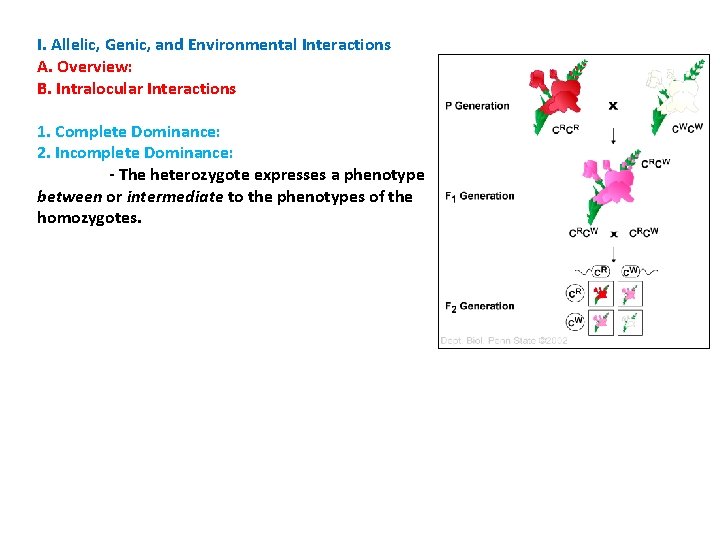
I. Allelic, Genic, and Environmental Interactions A. Overview: B. Intralocular Interactions 1. Complete Dominance: 2. Incomplete Dominance: - The heterozygote expresses a phenotype between or intermediate to the phenotypes of the homozygotes.
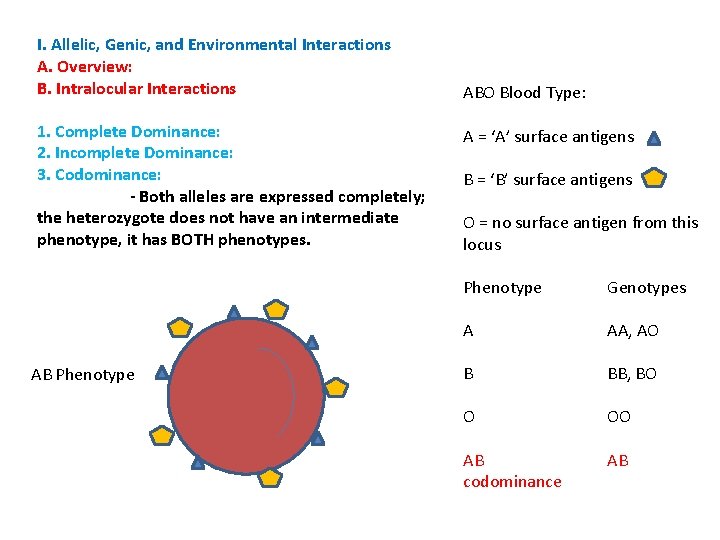
I. Allelic, Genic, and Environmental Interactions A. Overview: B. Intralocular Interactions 1. Complete Dominance: 2. Incomplete Dominance: 3. Codominance: - Both alleles are expressed completely; the heterozygote does not have an intermediate phenotype, it has BOTH phenotypes. AB Phenotype ABO Blood Type: A = ‘A’ surface antigens B = ‘B’ surface antigens O = no surface antigen from this locus Phenotype Genotypes A AA, AO B BB, BO O OO AB codominance AB
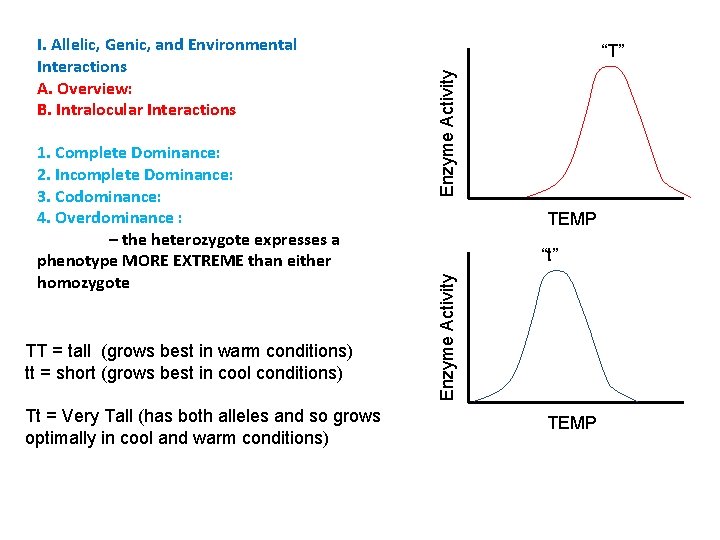
TT = tall (grows best in warm conditions) tt = short (grows best in cool conditions) Tt = Very Tall (has both alleles and so grows optimally in cool and warm conditions) Enzyme Activity 1. Complete Dominance: 2. Incomplete Dominance: 3. Codominance: 4. Overdominance : – the heterozygote expresses a phenotype MORE EXTREME than either homozygote “T” TEMP “t” Enzyme Activity I. Allelic, Genic, and Environmental Interactions A. Overview: B. Intralocular Interactions TEMP
I. Allelic, Genic, and Environmental Interactions A. Overview: B. Intralocular Interactions - Summary and Implications: populations can harbor extraordinary genetic variation at each locus, and these alleles can interact in myriad ways to produce complex and variable phenotypes. -Consider this cross: Aa. Bb. Cc. Dd x AABb. Cc. DD Assume: The genes assort independently A and a are codominant B is incompletely dominant to b C is incompletely dominant to c D is completely dominant to d How many phenotypes are possible in the offspring?
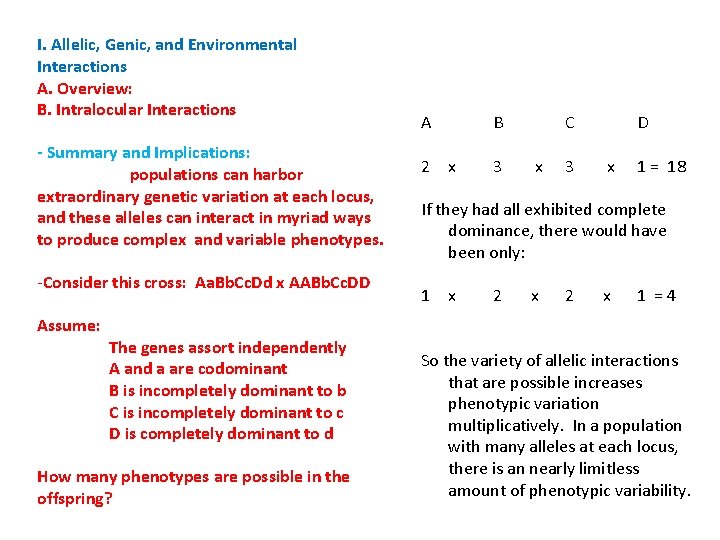
I. Allelic, Genic, and Environmental Interactions A. Overview: B. Intralocular Interactions - Summary and Implications: populations can harbor extraordinary genetic variation at each locus, and these alleles can interact in myriad ways to produce complex and variable phenotypes. -Consider this cross: Aa. Bb. Cc. Dd x AABb. Cc. DD Assume: The genes assort independently A and a are codominant B is incompletely dominant to b C is incompletely dominant to c D is completely dominant to d How many phenotypes are possible in the offspring? A B 2 x 3 C x 3 D x 1 = 18 If they had all exhibited complete dominance, there would have been only: 1 x 2 x 1 =4 So the variety of allelic interactions that are possible increases phenotypic variation multiplicatively. In a population with many alleles at each locus, there is an nearly limitless amount of phenotypic variability.
I. Allelic, Genic, and Environmental Interactions A. Overview: B. Intralocular Interactions C. Interlocular Interactions The phenotype can be affected by more than one gene.
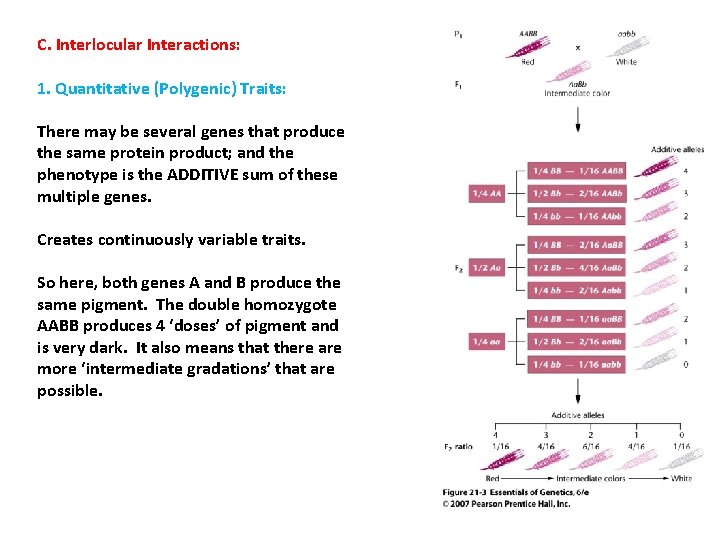
C. Interlocular Interactions: 1. Quantitative (Polygenic) Traits: There may be several genes that produce the same protein product; and the phenotype is the ADDITIVE sum of these multiple genes. Creates continuously variable traits. So here, both genes A and B produce the same pigment. The double homozygote AABB produces 4 ‘doses’ of pigment and is very dark. It also means that there are more ‘intermediate gradations’ that are possible.
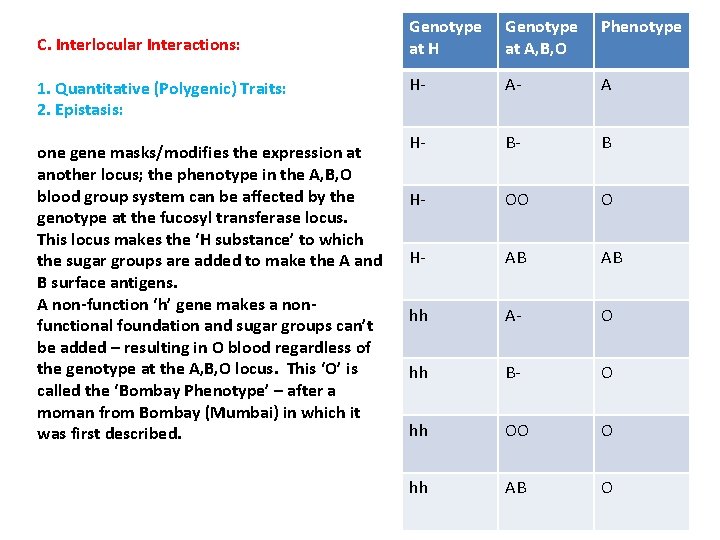
C. Interlocular Interactions: 1. Quantitative (Polygenic) Traits: 2. Epistasis: one gene masks/modifies the expression at another locus; the phenotype in the A, B, O blood group system can be affected by the genotype at the fucosyl transferase locus. This locus makes the ‘H substance’ to which the sugar groups are added to make the A and B surface antigens. A non-function ‘h’ gene makes a nonfunctional foundation and sugar groups can’t be added – resulting in O blood regardless of the genotype at the A, B, O locus. This ‘O’ is called the ‘Bombay Phenotype’ – after a moman from Bombay (Mumbai) in which it was first described. Genotype at H Genotype at A, B, O Phenotype H- A- A H- B- B H- OO O H- AB AB hh A- O hh B- O hh OO O hh AB O
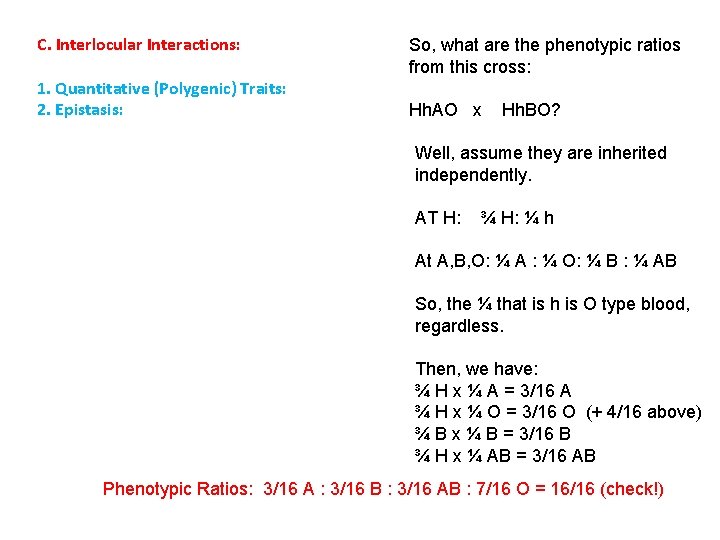
C. Interlocular Interactions: 1. Quantitative (Polygenic) Traits: 2. Epistasis: So, what are the phenotypic ratios from this cross: Hh. AO x Hh. BO?
C. Interlocular Interactions: 1. Quantitative (Polygenic) Traits: 2. Epistasis: So, what are the phenotypic ratios from this cross: Hh. AO x Hh. BO? Well, assume they are inherited independently. AT H: ¾ H: ¼ h At A, B, O: ¼ A : ¼ O: ¼ B : ¼ AB So, the ¼ that is h is O type blood, regardless. Then, we have: ¾ H x ¼ A = 3/16 A ¾ H x ¼ O = 3/16 O (+ 4/16 above) ¾ B x ¼ B = 3/16 B ¾ H x ¼ AB = 3/16 AB Phenotypic Ratios: 3/16 A : 3/16 B : 3/16 AB : 7/16 O = 16/16 (check!)
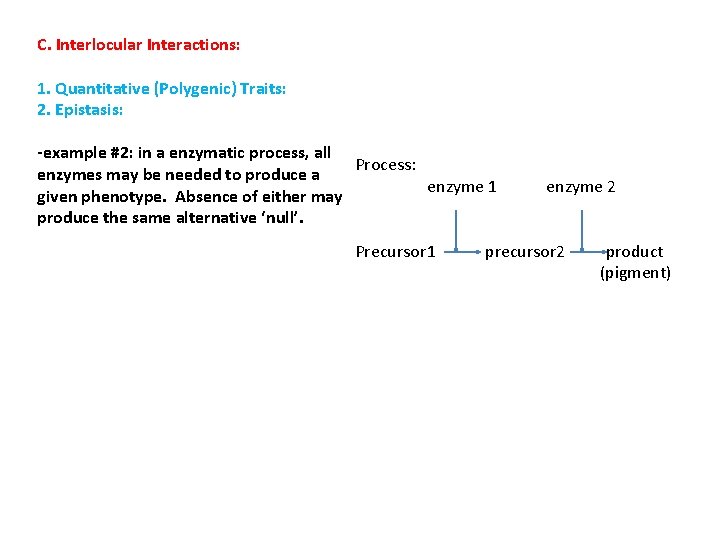
C. Interlocular Interactions: 1. Quantitative (Polygenic) Traits: 2. Epistasis: -example #2: in a enzymatic process, all Process: enzymes may be needed to produce a enzyme 1 given phenotype. Absence of either may produce the same alternative ‘null’. Precursor 1 enzyme 2 precursor 2 product (pigment)
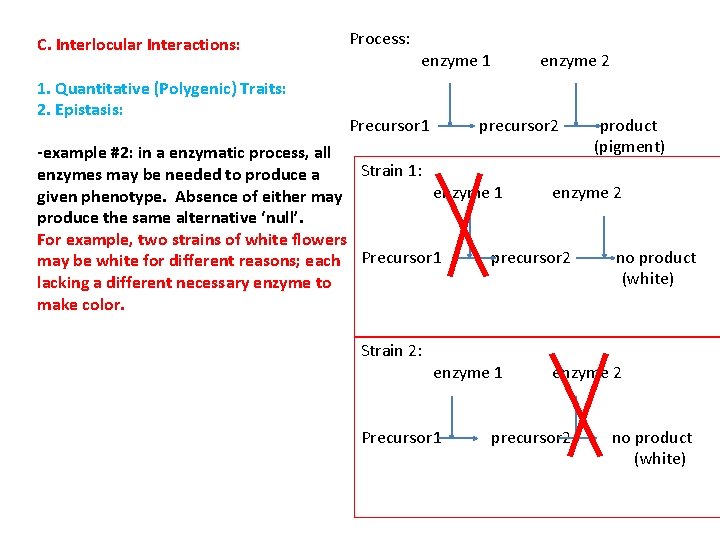
C. Interlocular Interactions: 1. Quantitative (Polygenic) Traits: 2. Epistasis: Process: enzyme 1 Precursor 1 enzyme 2 precursor 2 product (pigment) -example #2: in a enzymatic process, all Strain 1: enzymes may be needed to produce a enzyme 1 enzyme 2 given phenotype. Absence of either may produce the same alternative ‘null’. For example, two strains of white flowers precursor 2 no product may be white for different reasons; each Precursor 1 (white) lacking a different necessary enzyme to make color. Strain 2: enzyme 1 Precursor 1 enzyme 2 precursor 2 no product (white)
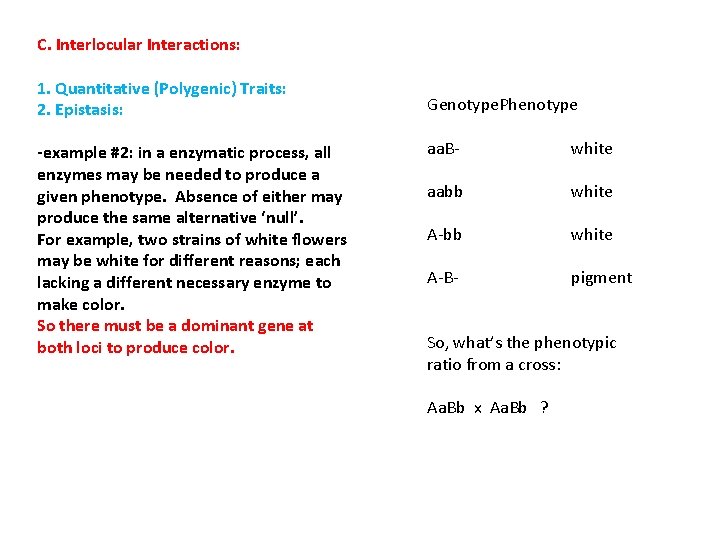
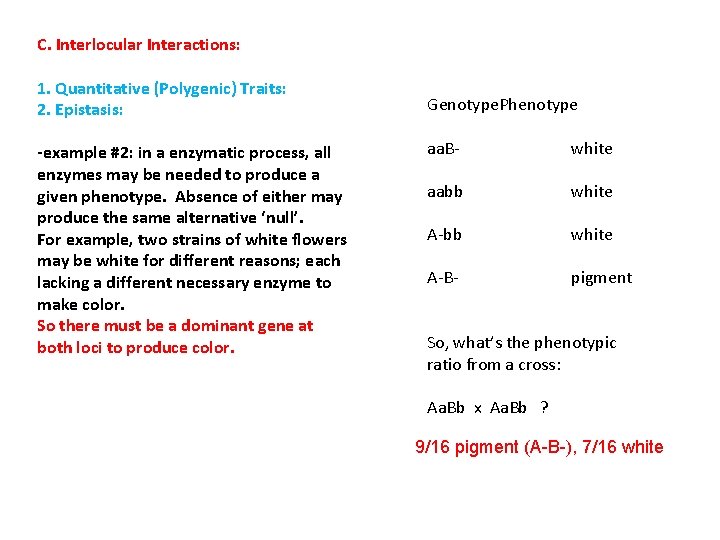
C. Interlocular Interactions: 1. Quantitative (Polygenic) Traits: 2. Epistasis: -example #2: in a enzymatic process, all enzymes may be needed to produce a given phenotype. Absence of either may produce the same alternative ‘null’. For example, two strains of white flowers may be white for different reasons; each lacking a different necessary enzyme to make color. So there must be a dominant gene at both loci to produce color. Genotype. Phenotype aa. B- white aabb white A-B- pigment So, what’s the phenotypic ratio from a cross: Aa. Bb x Aa. Bb ?
C. Interlocular Interactions: 1. Quantitative (Polygenic) Traits: 2. Epistasis: -example #2: in a enzymatic process, all enzymes may be needed to produce a given phenotype. Absence of either may produce the same alternative ‘null’. For example, two strains of white flowers may be white for different reasons; each lacking a different necessary enzyme to make color. So there must be a dominant gene at both loci to produce color. Genotype. Phenotype aa. B- white aabb white A-B- pigment So, what’s the phenotypic ratio from a cross: Aa. Bb x Aa. Bb ? 9/16 pigment (A-B-), 7/16 white
C. Interlocular Interactions: 1. Quantitative (Polygenic) Traits: 2. Epistasis: 3. Position Effects - next to heterochromatin - separated from a promoter - next to enhancer or silencer regions
I. Allelic, Genic, and Environmental Interactions A. Overview: B. Intralocular Interactions C. Interlocular Interactions D. Environmental Effects: The environment can influence whether and how an allele is expressed , and the effect it has.
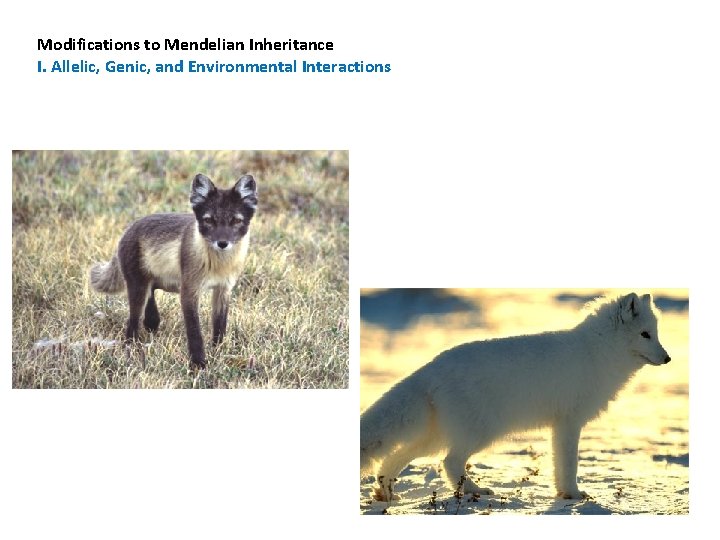
D. Environmental Effects: 1. TEMPERATURE - Siamese cats and Himalayan rabbits – dark feet and ears, where temps are slightly cooler. Their pigment enzymes function at cool temps. - Arctic fox, hares – their pigment genes function at high temps and are responsible for a change in coat color in spring and fall, and a change back to white in fall and winter.
D. Environmental Effects: 1. TEMPERATURE 2. TOXINS - people have genetically different sensitivities to different toxins. PKU = phenylketonuria… genetic inability to convert phenylalanine to tyrosine. Phenylalanine can build up and is toxic to nerve cells. Single gene recessive disorder. But if a homozygote recessive eats a diet low in phenylalanine, no negative consequences develop. So, the genetic predisposition to express the disorder is influenced by the environment. “Conditional lethal”
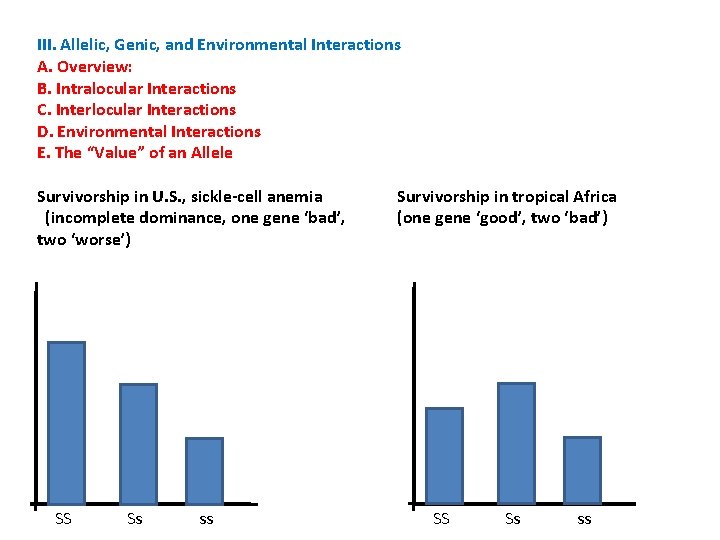
III. Allelic, Genic, and Environmental Interactions A. Overview: B. Intralocular Interactions C. Interlocular Interactions D. Environmental Interactions E. The “Value” of an Allele Survivorship in U. S. , sickle-cell anemia (incomplete dominance, one gene ‘bad’, two ‘worse’) SS Ss ss Survivorship in tropical Africa (one gene ‘good’, two ‘bad’) SS Ss ss
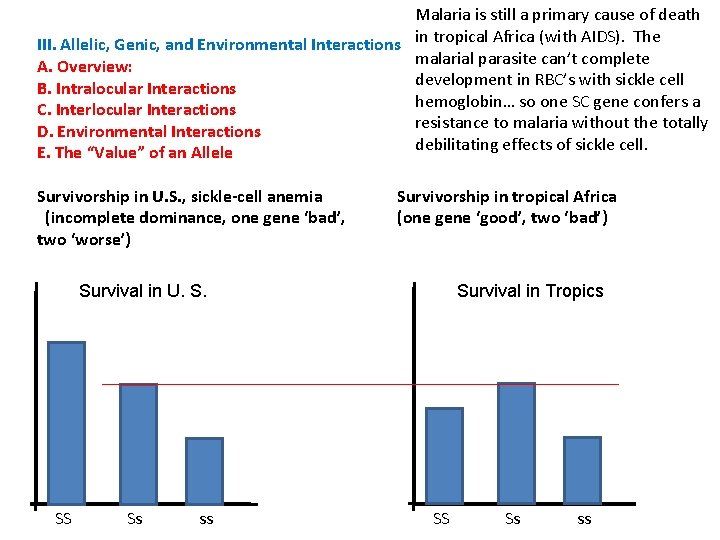
Malaria is still a primary cause of death III. Allelic, Genic, and Environmental Interactions in tropical Africa (with AIDS). The malarial parasite can’t complete A. Overview: development in RBC’s with sickle cell B. Intralocular Interactions hemoglobin… so one SC gene confers a C. Interlocular Interactions resistance to malaria without the totally D. Environmental Interactions debilitating effects of sickle cell. E. The “Value” of an Allele Survivorship in U. S. , sickle-cell anemia (incomplete dominance, one gene ‘bad’, two ‘worse’) Survivorship in tropical Africa (one gene ‘good’, two ‘bad’) Survival in U. S. SS Ss ss Survival in Tropics SS Ss ss