
Modification of Sounds in Connected Speech Plan 1

- Slides: 10
Modification of Sounds in Connected Speech
Plan: 1. The law of speech economy; 2. Types of sound modification; 3. Assimilation; 4. Progressive assimilation ; 5. Regressive assimilation; 6. Accommodation; 7. Linking, vowel reduction, elision.
In the speech continuum, the articulation of each sound is modified so as to make the transition to the following sound more economic and convenient for speech organs. This is the manifestation of the law of speech economy.
There are three main types of sound modification: positional (e. g. reduction, elision), combinatory, and spontaneous.
There are two combinatory sound modifications: assimilation and accommodation.
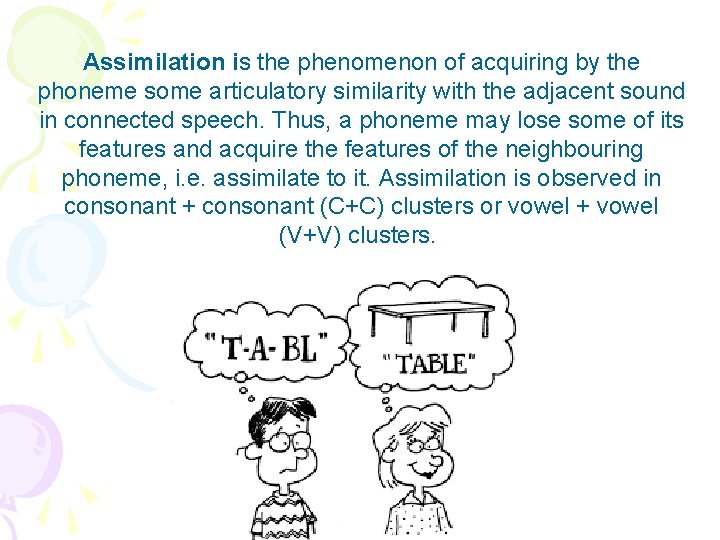
Assimilation is the phenomenon of acquiring by the phoneme some articulatory similarity with the adjacent sound in connected speech. Thus, a phoneme may lose some of its features and acquire the features of the neighbouring phoneme, i. e. assimilate to it. Assimilation is observed in consonant + consonant (C+C) clusters or vowel + vowel (V+V) clusters.
Progressive assimilation when the final consonant exerts influence forward on the next consonant. The weak form of IS/HAS, as well as the plural or possessive morpheme S has a twofold pronunciation according to the final consonant of the preceding word, e. g. the cat has, the cat is, the cat's > are all pronounced as [kæts).
If the consonant exerts influence backward, it's called regressive assimilation. E. g. isolate final [z] of these', 'was', 'chose' may be replaced by [s] in 'these socks', 'he was sent', 'we chose six'; [v] of 'of', 'we've' by [f] in ‘of course' (partial assimilation), 'we've found' (complete assimilation).
Accommodation occurs in V+C, C+V, or C+V+C clusters. It is determined by the articulation basis in the languages and phonetic laws. Thus a short stressed vowel is regarded as Checked 'anti thereford I needs an immediate supplement by the following consonant to form a syllable.
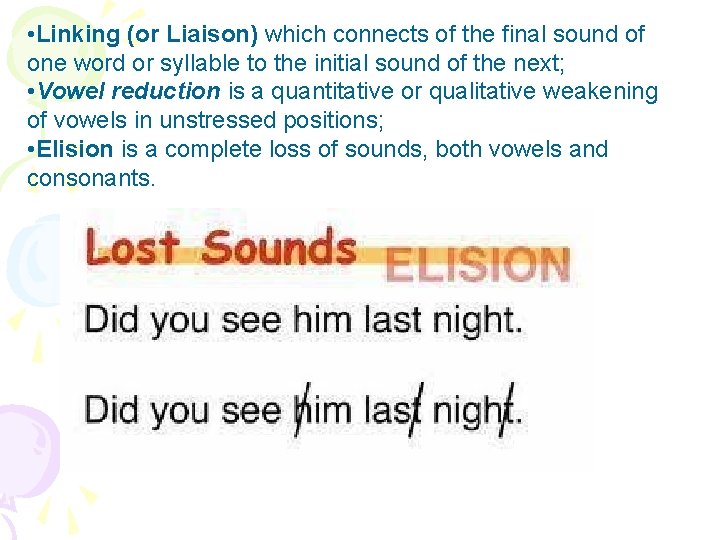
• Linking (or Liaison) which connects of the final sound of one word or syllable to the initial sound of the next; • Vowel reduction is a quantitative or qualitative weakening of vowels in unstressed positions; • Elision is a complete loss of sounds, both vowels and consonants.