
MODIFICATION OF MOLTEN STEELMAKING SLAG FOR CEMENT APPLICATION

- Slides: 34
MODIFICATION OF MOLTEN STEELMAKING SLAG FOR CEMENT APPLICATION Joao B. FERREIRA NETO 1, Joao O. G. FARIA 1, Catia FREDERICCI 1, Fabiano F. CHOTOLI 2, Andre N. L. SILVA 1, Bruno B. FERRARO 1, Tiago R. RIBEIRO 1, Antonio MALYNOWSKYJ 1, Valdecir A. QUARCIONI 2, Andre A. LOTTO 1 Laboratory of Metallurgical Processes, Institute for Technological Research (IPT), Sao Paulo – SP, Brazil 1 Laboratory of Civil Construction Materials, Institute for Technological Research (IPT), Sao Paulo – SP, Brazil 2 4 th International Slag Valorisation Symposium | Leuven | 15 -17/04/2015
OUTLINE - Availability of BF slag in Brazil and use of SS slag as alternative for cement industry in Brazil - Effect of cooling rate and chemical composition on slags crystallization - Conclusions dis 4 th International Slag Valorisation Symposium | Leuven | 15 -17/04/2015
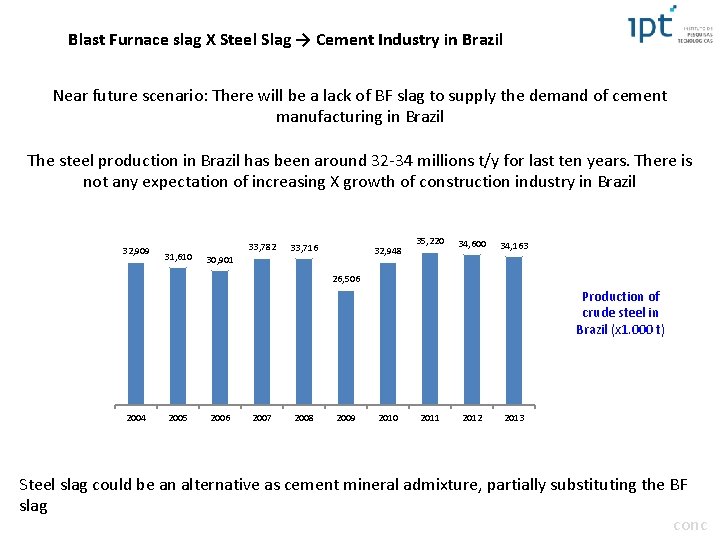
Blast Furnace slag X Steel Slag → Cement Industry in Brazil Near future scenario: There will be a lack of BF slag to supply the demand of cement manufacturing in Brazil The steel production in Brazil has been around 32 -34 millions t/y for last ten years. There is not any expectation of increasing X growth of construction industry in Brazil 32, 909 31, 610 33, 782 33, 716 32, 948 30, 901 35, 220 34, 600 34, 163 26, 506 Production of crude steel in Brazil (x 1. 000 t) 2004 2005 2006 2007 2008 2009 2010 2011 2012 2013 Steel slag could be an alternative as cement mineral admixture, partially substituting the BF slag conc
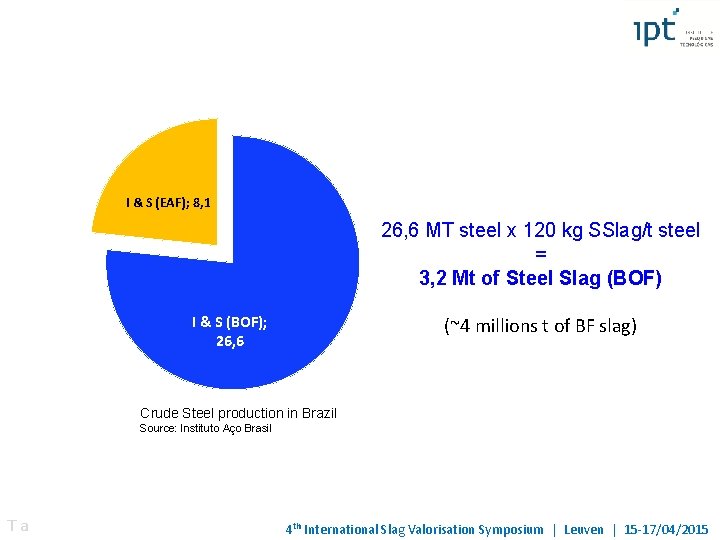
I & S (EAF); 8, 1 26, 6 MT steel x 120 kg SSlag/t steel = 3, 2 Mt of Steel Slag (BOF) I & S (BOF); 26, 6 (~4 millions t of BF slag) Crude Steel production in Brazil Source: Instituto Aço Brasil Ta 4 th International Slag Valorisation Symposium | Leuven | 15 -17/04/2015
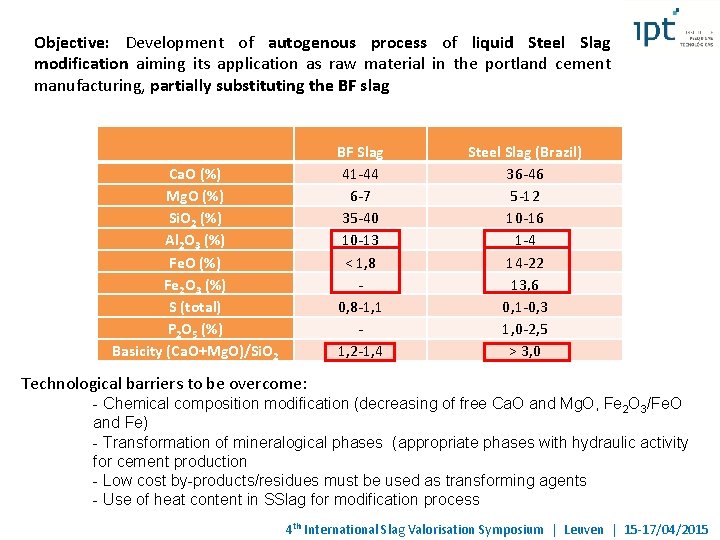
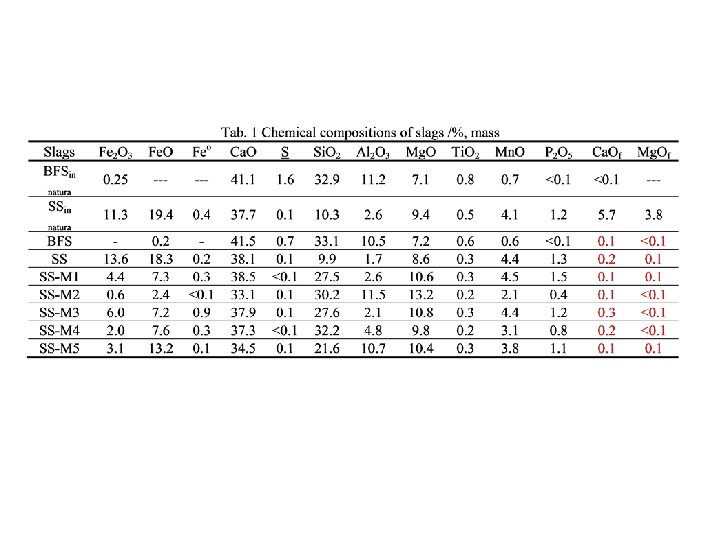
Objective: Development of autogenous process of liquid Steel Slag modification aiming its application as raw material in the portland cement manufacturing, partially substituting the BF slag BF Slag 41 -44 6 -7 35 -40 10 -13 < 1, 8 0, 8 -1, 1 1, 2 -1, 4 Ca. O (%) Mg. O (%) Si. O 2 (%) Al 2 O 3 (%) Fe. O (%) Fe 2 O 3 (%) S (total) P 2 O 5 (%) Basicity (Ca. O+Mg. O)/Si. O 2 Steel Slag (Brazil) 36 -46 5 -12 10 -16 1 -4 14 -22 13, 6 0, 1 -0, 3 1, 0 -2, 5 > 3, 0 Technological barriers to be overcome: - Chemical composition modification (decreasing of free Ca. O and Mg. O, Fe 2 O 3/Fe. O and Fe) - Transformation of mineralogical phases (appropriate phases with hydraulic activity for cement production - Low cost by-products/residues must be used as transforming agents - Use of heat content in SSlag for modification process 4 th International Slag Valorisation Symposium | Leuven | 15 -17/04/2015
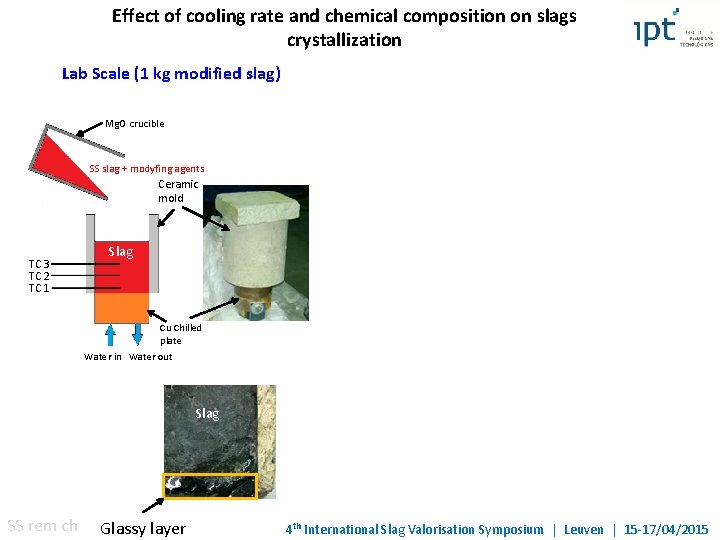
Effect of cooling rate and chemical composition on slags crystallization Lab Scale (1 kg modified slag) Mg. O crucible SS slag + modyfing agents Ceramic mold TC 3 TC 2 TC 1 Slag Cu Chilled plate Water in Water out Slag SS rem ch Glassy layer 4 th International Slag Valorisation Symposium | Leuven | 15 -17/04/2015
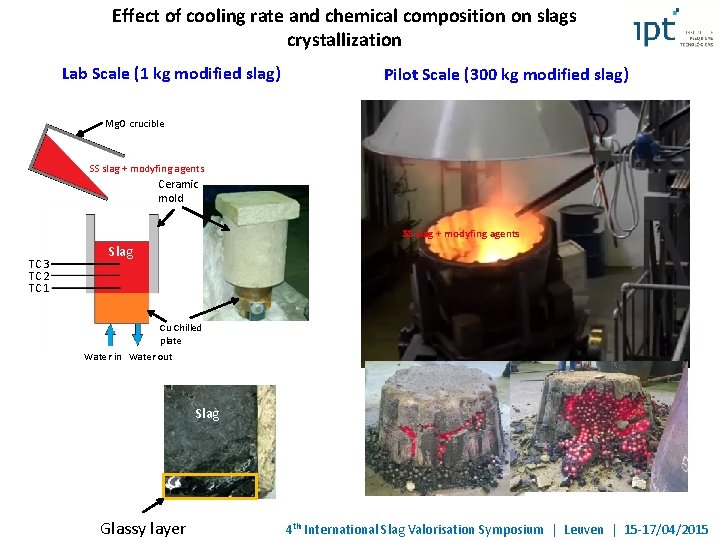
Effect of cooling rate and chemical composition on slags crystallization Lab Scale (1 kg modified slag) Pilot Scale (300 kg modified slag) Mg. O crucible SS slag + modyfing agents Ceramic mold SS slag + modyfing agents TC 3 TC 2 TC 1 Slag Cu Chilled plate Water in Water out Slag Glassy layer 4 th International Slag Valorisation Symposium | Leuven | 15 -17/04/2015
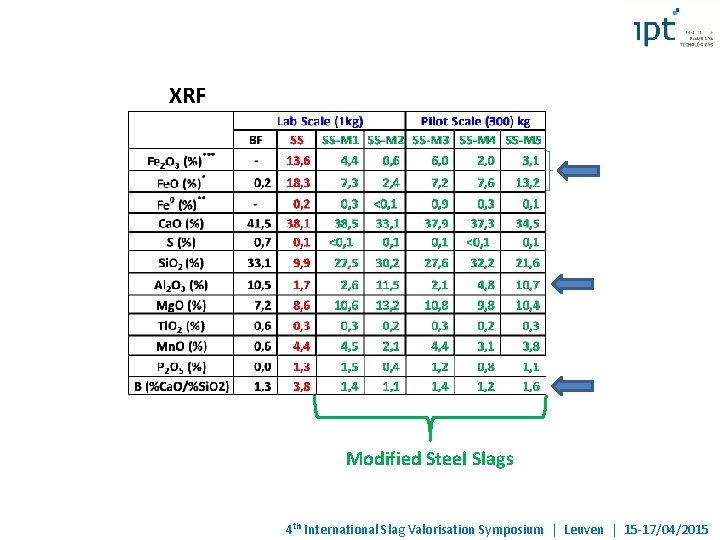
XRF Modified Steel Slags 4 th International Slag Valorisation Symposium | Leuven | 15 -17/04/2015
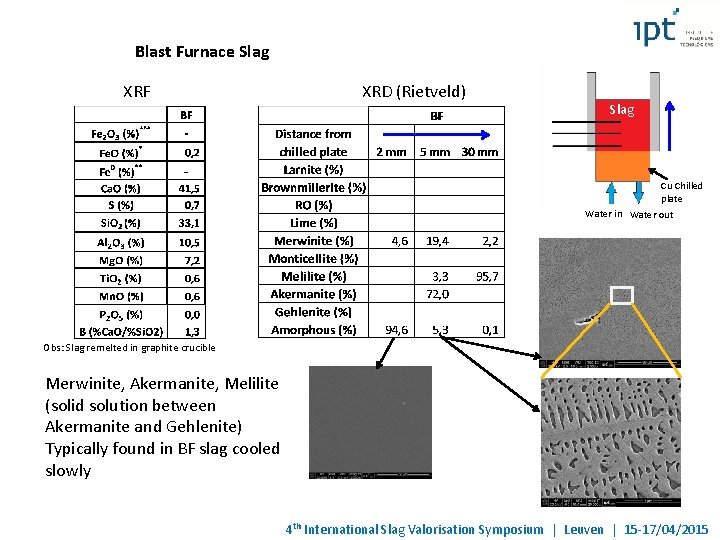
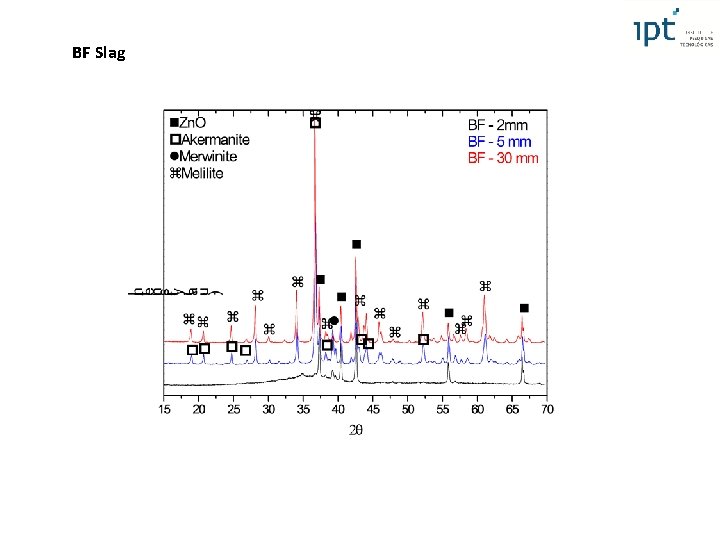
Blast Furnace Slag XRF XRD (Rietveld) Slag Cu Chilled plate Water in Water out Obs: Slag remelted in graphite crucible Merwinite, Akermanite, Melilite (solid solution between Akermanite and Gehlenite) Typically found in BF slag cooled slowly 4 th International Slag Valorisation Symposium | Leuven | 15 -17/04/2015
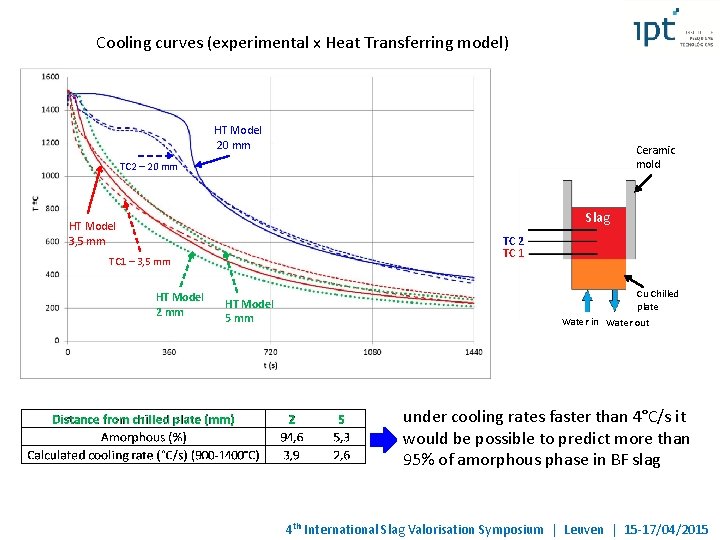
Cooling curves (experimental x Heat Transferring model) HT Model 20 mm Ceramic mold TC 2 – 20 mm Slag HT Model 3, 5 mm TC 2 TC 1 – 3, 5 mm HT Model 2 mm HT Model 5 mm Cu Chilled plate Water in Water out under cooling rates faster than 4°C/s it would be possible to predict more than 95% of amorphous phase in BF slag 4 th International Slag Valorisation Symposium | Leuven | 15 -17/04/2015
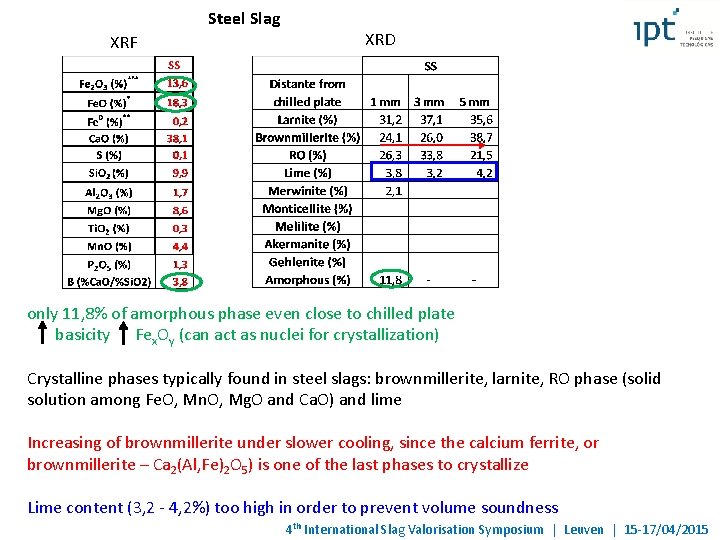
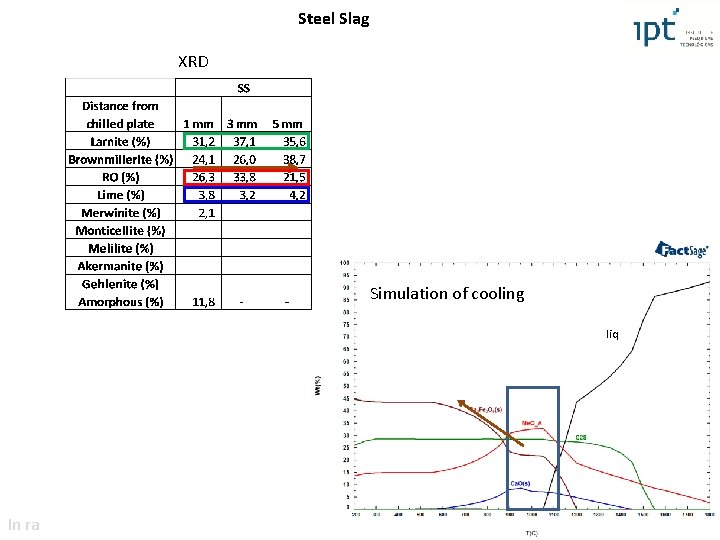
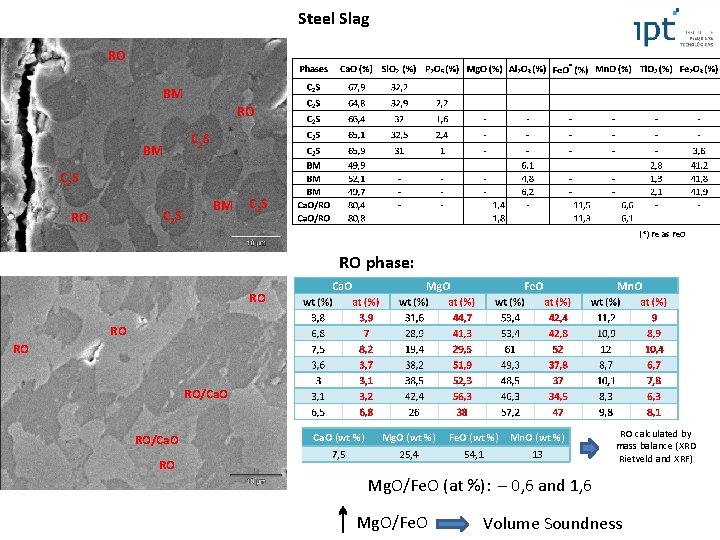
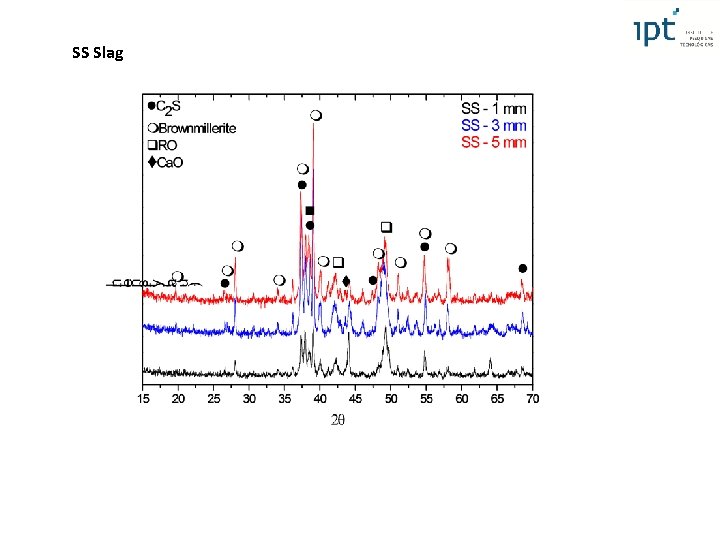
Steel Slag XRF XRD only 11, 8% of amorphous phase even close to chilled plate basicity Fex. Oy (can act as nuclei for crystallization) Crystalline phases typically found in steel slags: brownmillerite, larnite, RO phase (solid solution among Fe. O, Mn. O, Mg. O and Ca. O) and lime Increasing of brownmillerite under slower cooling, since the calcium ferrite, or brownmillerite – Ca 2(Al, Fe)2 O 5) is one of the last phases to crystallize Lime content (3, 2 - 4, 2%) too high in order to prevent volume soundness 4 th International Slag Valorisation Symposium | Leuven | 15 -17/04/2015
Steel Slag XRD Simulation of cooling liqliq In ra
Steel Slag RO BM RO C 2 S BM C 2 S RO BM C 2 S (*) Fe as Fe. O RO phase: RO RO/Ca. O RO Ca. O (wt %) Mg. O (wt %) Fe. O (wt %) Mn. O (wt %) 7, 5 25, 4 54, 1 13 RO calculated by mass balance (XRD Rietveld and XRF) Mg. O/Fe. O (at %): – 0, 6 and 1, 6 Mg. O/Fe. O Volume Soundness
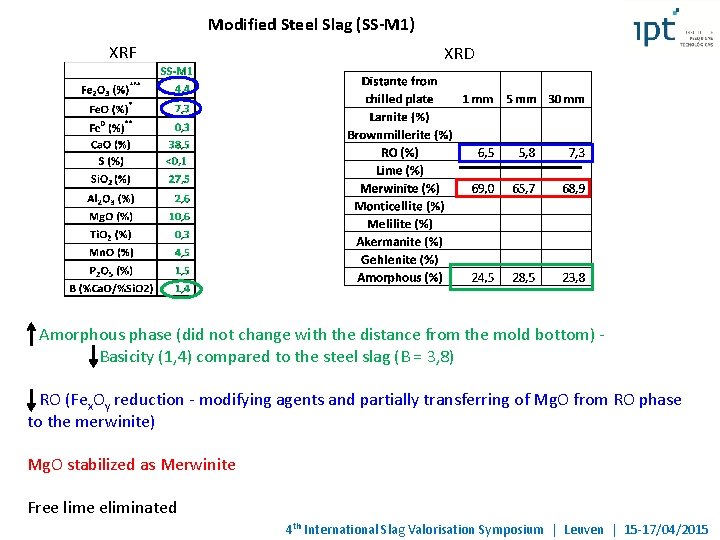
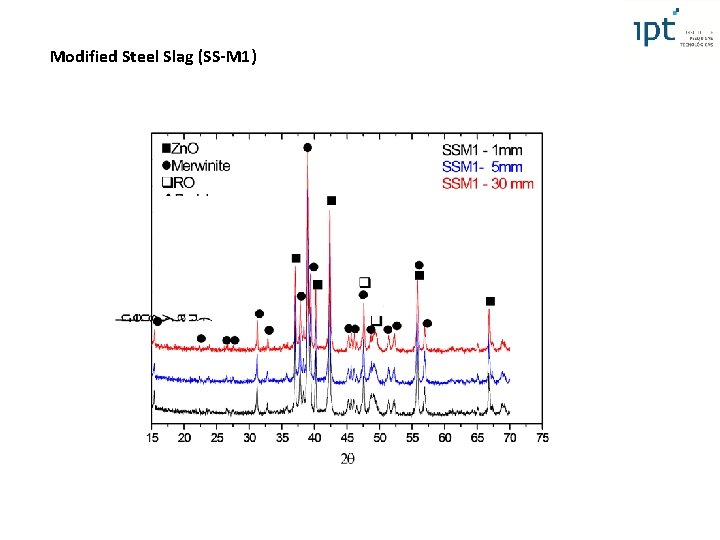
Modified Steel Slag (SS-M 1) XRF XRD Amorphous phase (did not change with the distance from the mold bottom) Basicity (1, 4) compared to the steel slag (B = 3, 8) RO (Fex. Oy reduction - modifying agents and partially transferring of Mg. O from RO phase to the merwinite) Mg. O stabilized as Merwinite Free lime eliminated 4 th International Slag Valorisation Symposium | Leuven | 15 -17/04/2015
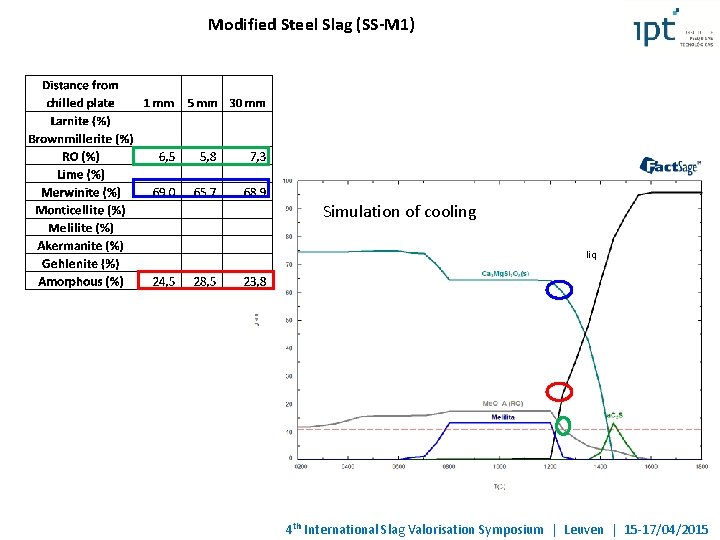
Modified Steel Slag (SS-M 1) Simulation of cooling liq 4 th International Slag Valorisation Symposium | Leuven | 15 -17/04/2015
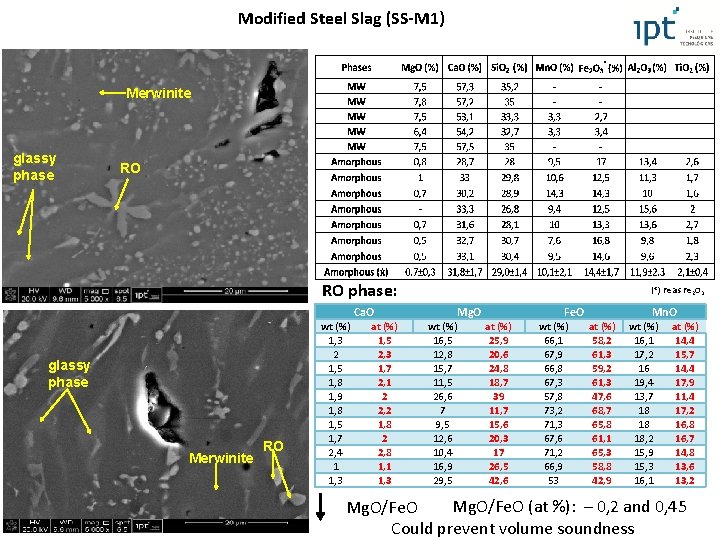
Modified Steel Slag (SS-M 1) Merwinite glassy phase RO RO phase: Ca. O glassy phase Merwinite RO wt (%) 1, 3 2 1, 5 1, 8 1, 9 1, 8 1, 5 1, 7 2, 4 1 1, 3 at (%) 1, 5 2, 3 1, 7 2, 1 2 2, 2 1, 8 2 2, 8 1, 1 1, 3 (*) Fe as Fe 2 O 3 Mg. O wt (%) 16, 5 12, 8 15, 7 11, 5 26, 6 7 9, 5 12, 6 10, 4 16, 9 29, 5 Fe. O at (%) 25, 9 20, 6 24, 8 18, 7 39 11, 7 15, 6 20, 3 17 26, 5 42, 6 wt (%) 66, 1 67, 9 66, 8 67, 3 57, 8 73, 2 71, 3 67, 6 71, 2 66, 9 53 Mn. O at (%) 58, 2 61, 3 59, 2 61, 3 47, 6 68, 7 65, 8 61, 1 65, 3 58, 8 42, 9 wt (%) 16, 1 17, 2 16 19, 4 13, 7 18 18 18, 2 15, 9 15, 3 16, 1 at (%) 14, 4 15, 7 14, 4 17, 9 11, 4 17, 2 16, 8 16, 7 14, 8 13, 6 13, 2 Mg. O/Fe. O (at %): – 0, 2 and 0, 45 Mg. O/Fe. O Could prevent volume soundness
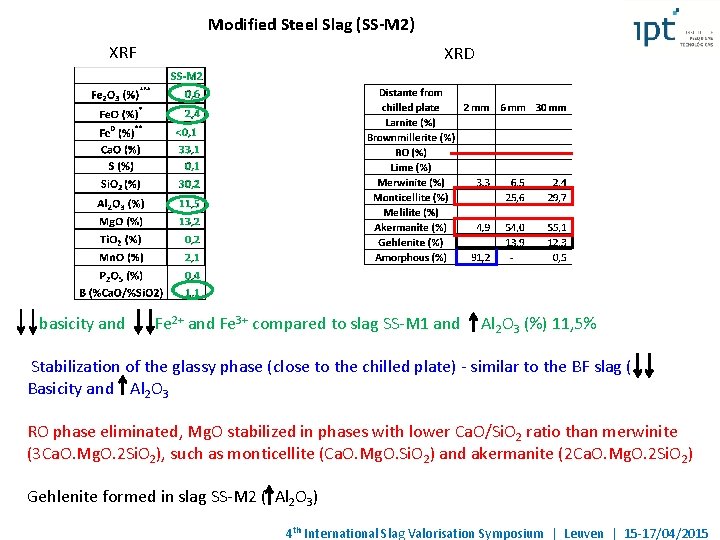
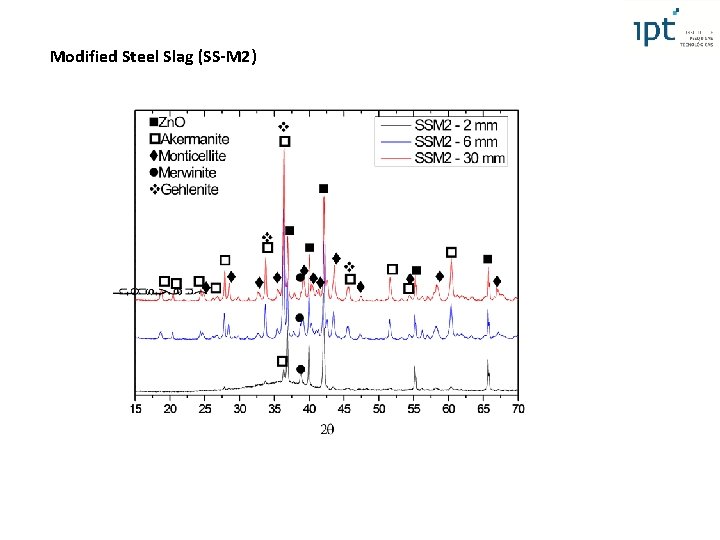
Modified Steel Slag (SS-M 2) XRF basicity and XRD Fe 2+ and Fe 3+ compared to slag SS-M 1 and Al 2 O 3 (%) 11, 5% Stabilization of the glassy phase (close to the chilled plate) - similar to the BF slag ( Basicity and Al 2 O 3 RO phase eliminated, Mg. O stabilized in phases with lower Ca. O/Si. O 2 ratio than merwinite (3 Ca. O. Mg. O. 2 Si. O 2), such as monticellite (Ca. O. Mg. O. Si. O 2) and akermanite (2 Ca. O. Mg. O. 2 Si. O 2) Gehlenite formed in slag SS-M 2 ( Al 2 O 3) 4 th International Slag Valorisation Symposium | Leuven | 15 -17/04/2015
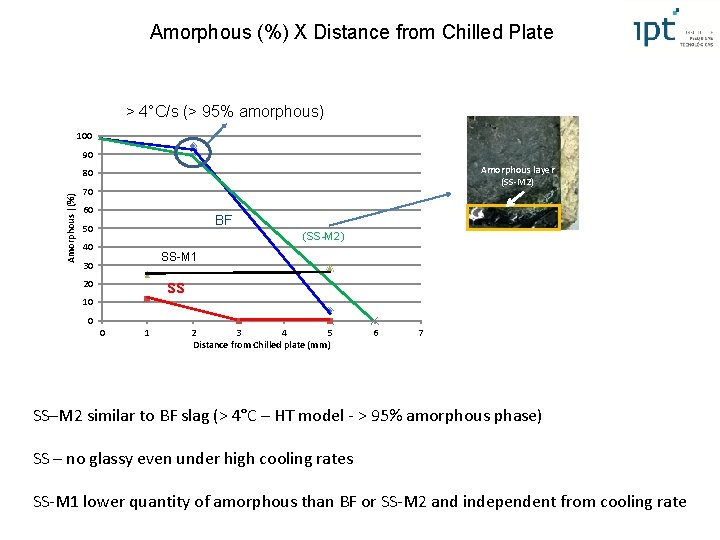
Amorphous (%) X Distance from Chilled Plate > 4°C/s (> 95% amorphous) 100 90 Amorphous layer (SS-M 2) Amorphous |(%) 80 70 60 BF 50 (SS-M 2) 40 SS-M 1 30 ss 20 10 0 0 1 2 3 4 5 Distance from Chilled plate (mm) 6 7 SS–M 2 similar to BF slag (> 4°C – HT model - > 95% amorphous phase) SS – no glassy even under high cooling rates SS-M 1 lower quantity of amorphous than BF or SS-M 2 and independent from cooling rate
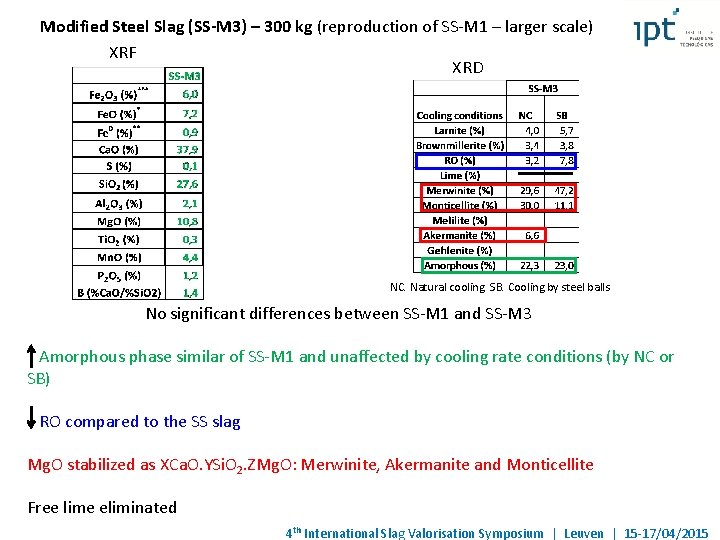
Modified Steel Slag (SS-M 3) – 300 kg (reproduction of SS-M 1 – larger scale) XRF XRD NC. Natural cooling. SB. Cooling by steel balls No significant differences between SS-M 1 and SS-M 3 Amorphous phase similar of SS-M 1 and unaffected by cooling rate conditions (by NC or SB) RO compared to the SS slag Mg. O stabilized as XCa. O. YSi. O 2. ZMg. O: Merwinite, Akermanite and Monticellite Free lime eliminated 4 th International Slag Valorisation Symposium | Leuven | 15 -17/04/2015
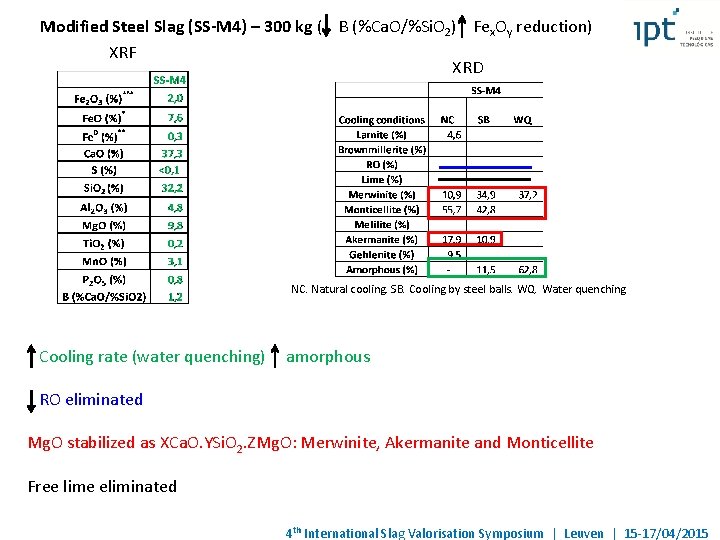
Modified Steel Slag (SS-M 4) – 300 kg ( B (%Ca. O/%Si. O 2) Fex. Oy reduction) XRF XRD NC. Natural cooling. SB. Cooling by steel balls. WQ. Water quenching Cooling rate (water quenching) amorphous RO eliminated Mg. O stabilized as XCa. O. YSi. O 2. ZMg. O: Merwinite, Akermanite and Monticellite Free lime eliminated 4 th International Slag Valorisation Symposium | Leuven | 15 -17/04/2015
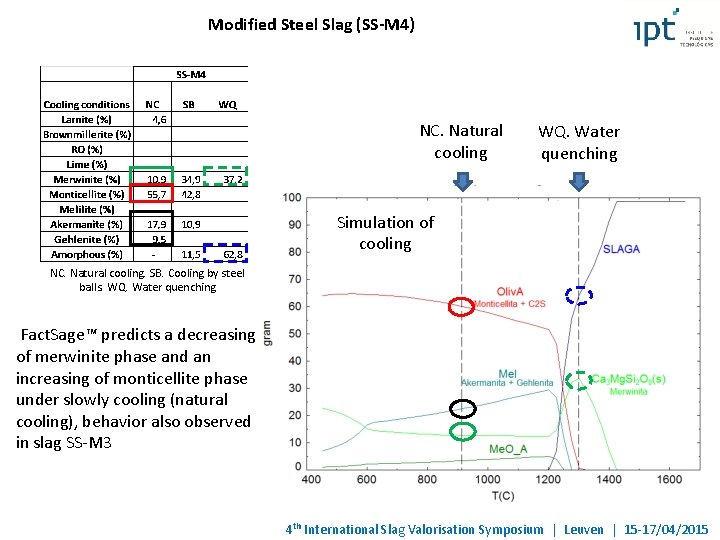
Modified Steel Slag (SS-M 4) NC. Natural cooling WQ. Water quenching Simulation of cooling NC. Natural cooling. SB. Cooling by steel balls. WQ. Water quenching Fact. Sage™ predicts a decreasing of merwinite phase and an increasing of monticellite phase under slowly cooling (natural cooling), behavior also observed in slag SS-M 3 4 th International Slag Valorisation Symposium | Leuven | 15 -17/04/2015
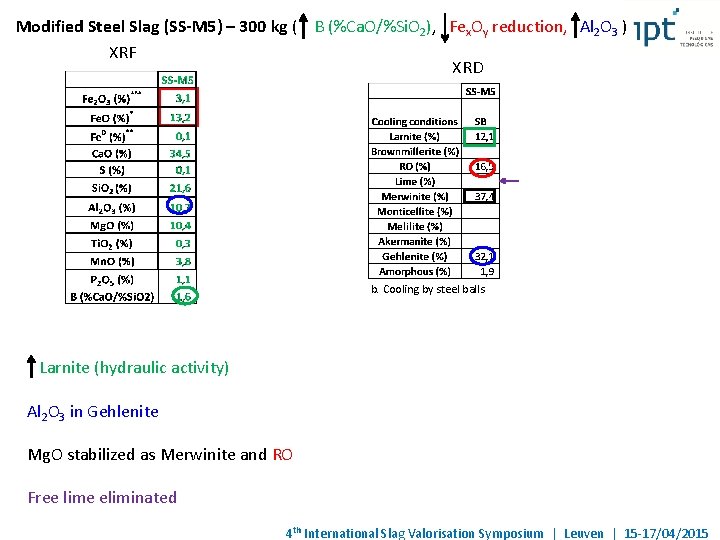
Modified Steel Slag (SS-M 5) – 300 kg ( B (%Ca. O/%Si. O 2), Fex. Oy reduction, Al 2 O 3 ) XRF XRD b. Cooling by steel balls Larnite (hydraulic activity) Al 2 O 3 in Gehlenite Mg. O stabilized as Merwinite and RO Free lime eliminated 4 th International Slag Valorisation Symposium | Leuven | 15 -17/04/2015
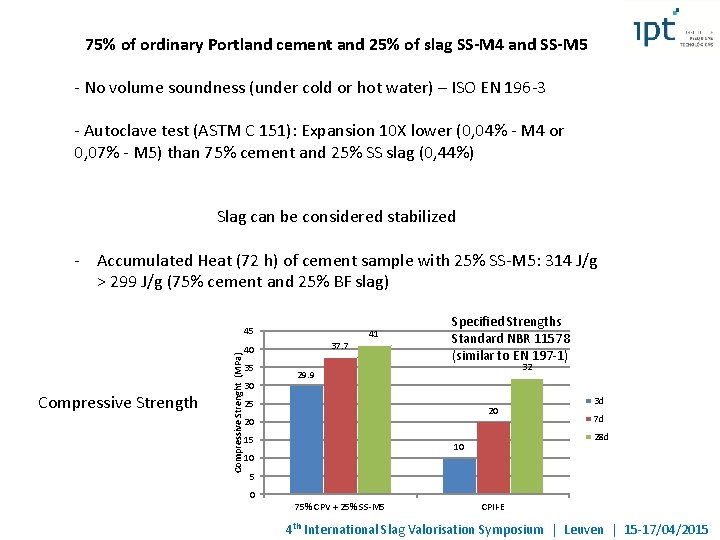
75% of ordinary Portland cement and 25% of slag SS-M 4 and SS-M 5 - No volume soundness (under cold or hot water) – ISO EN 196 -3 - Autoclave test (ASTM C 151): Expansion 10 X lower (0, 04% - M 4 or 0, 07% - M 5) than 75% cement and 25% SS slag (0, 44%) Slag can be considered stabilized - Accumulated Heat (72 h) of cement sample with 25% SS-M 5: 314 J/g > 299 J/g (75% cement and 25% BF slag) Compressive Strength Compressive Strenght (MPa) 45 37. 7 40 35 30 41 Specified Strengths Standard NBR 11578 (similar to EN 197 -1) 32 29. 9 25 20 20 15 7 d 28 d 10 10 3 d 5 0 75% CPV + 25% SS-M 5 CPII-E 4 th International Slag Valorisation Symposium | Leuven | 15 -17/04/2015
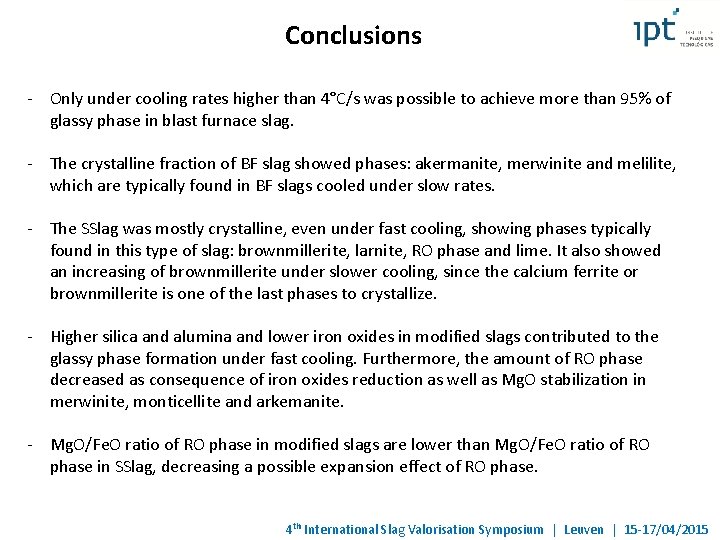
Conclusions - Only under cooling rates higher than 4°C/s was possible to achieve more than 95% of glassy phase in blast furnace slag. - The crystalline fraction of BF slag showed phases: akermanite, merwinite and melilite, which are typically found in BF slags cooled under slow rates. - The SSlag was mostly crystalline, even under fast cooling, showing phases typically found in this type of slag: brownmillerite, larnite, RO phase and lime. It also showed an increasing of brownmillerite under slower cooling, since the calcium ferrite or brownmillerite is one of the last phases to crystallize. - Higher silica and alumina and lower iron oxides in modified slags contributed to the glassy phase formation under fast cooling. Furthermore, the amount of RO phase decreased as consequence of iron oxides reduction as well as Mg. O stabilization in merwinite, monticellite and arkemanite. - Mg. O/Fe. O ratio of RO phase in modified slags are lower than Mg. O/Fe. O ratio of RO phase in SSlag, decreasing a possible expansion effect of RO phase. 4 th International Slag Valorisation Symposium | Leuven | 15 -17/04/2015
Conclusions - The stabilization of modified slags was demonstrated by volume soundness test carried out under cold and hot water, which did not show any expansion, or by low expansion (0, 04 and 0, 07%) observed in tests carried out in autoclave (ASTM C 151) with cement samples produced by a mixture between 75% of ordinary cement and 25% of modified slags. - The cement produced with this mixture generated an accumulated heat of 314 J/g in 72 h, while the same mixture based on BF slag resulted in 299 J/g. The compressive strength in 3, 7 and 28 days were 29, 9 MPa; 37, 7 MPa and 41 MPa, respectively, values higher than minimum specified in the same ages according to standard NBR 11578. 4 th International Slag Valorisation Symposium | Leuven | 15 -17/04/2015
Thank you! Contact: João Batista Ferreira Neto Laboratory of Metallurgical Processes Institute for Technological Research - IPT Sao Paulo - Brazil Tel. : +55 11 3767. 4244 jbfn@ipt. br 4 th International Slag Valorisation Symposium | Leuven | 15 -17/04/2015
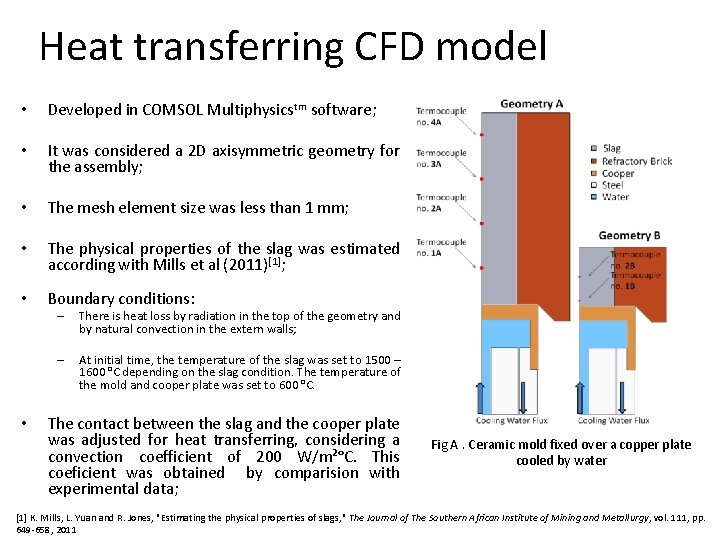
Heat transferring CFD model • Developed in COMSOL Multiphysicstm software; • It was considered a 2 D axisymmetric geometry for the assembly; • The mesh element size was less than 1 mm; • The physical properties of the slag was estimated according with Mills et al (2011)[1]; • Boundary conditions: • – There is heat loss by radiation in the top of the geometry and by natural convection in the extern walls; – At initial time, the temperature of the slag was set to 1500 – 1600 °C depending on the slag condition. The temperature of the mold and cooper plate was set to 600 °C. The contact between the slag and the cooper plate was adjusted for heat transferring, considering a convection coefficient of 200 W/m²°C. This coeficient was obtained by comparision with experimental data; Fig A. Ceramic mold fixed over a copper plate cooled by water [1] K. Mills, L. Yuan and R. Jones, "Estimating the physical properties of slags, " The Journal of The Southern African Institute of Mining and Metallurgy, vol. 111, pp. 649 -658, 2011
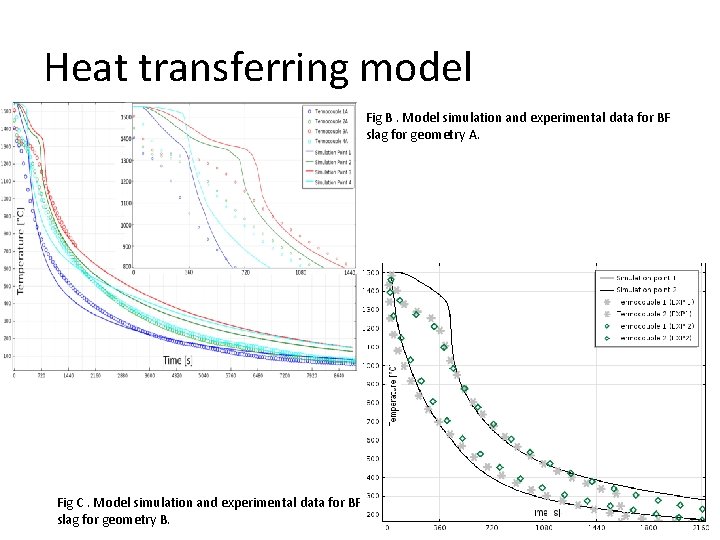
Heat transferring model Fig B. Model simulation and experimental data for BF slag for geometry A. Fig C. Model simulation and experimental data for BF slag for geometry B.
BF Slag
SS Slag
Modified Steel Slag (SS-M 1)
Modified Steel Slag (SS-M 2)