
Modernization in Japan Ch 12 2 Learning targets
- Slides: 14
Modernization in Japan Ch 12 -2
Learning targets • I can……… • 2. Identify historical examples of 18 th and 19 th century imperialism. . • 4. Discuss conflicts that arose as a result of the period of 18 th and 19 th century imperialism. • 5. Describe the main reasons that 18 th and 19 th century imperialism took place. • 7. Describe conflict that occurred between nations practicing imperialism. • 8. Prepare an extended response describing the cause and effect of imperialism during the 18 th and 19 th centuries.
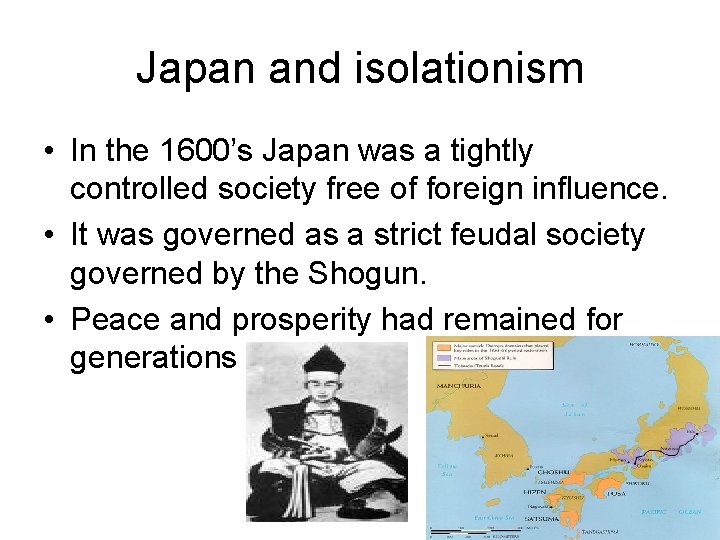
Japan and isolationism • In the 1600’s Japan was a tightly controlled society free of foreign influence. • It was governed as a strict feudal society governed by the Shogun. • Peace and prosperity had remained for generations
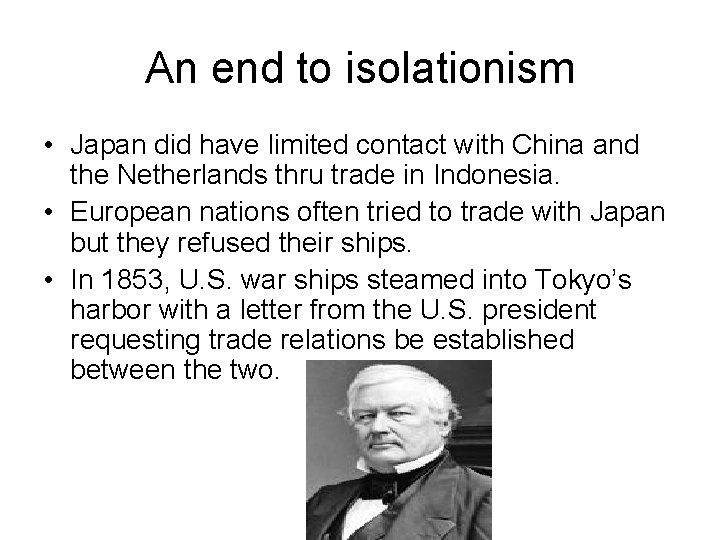
An end to isolationism • Japan did have limited contact with China and the Netherlands thru trade in Indonesia. • European nations often tried to trade with Japan but they refused their ships. • In 1853, U. S. war ships steamed into Tokyo’s harbor with a letter from the U. S. president requesting trade relations be established between the two.
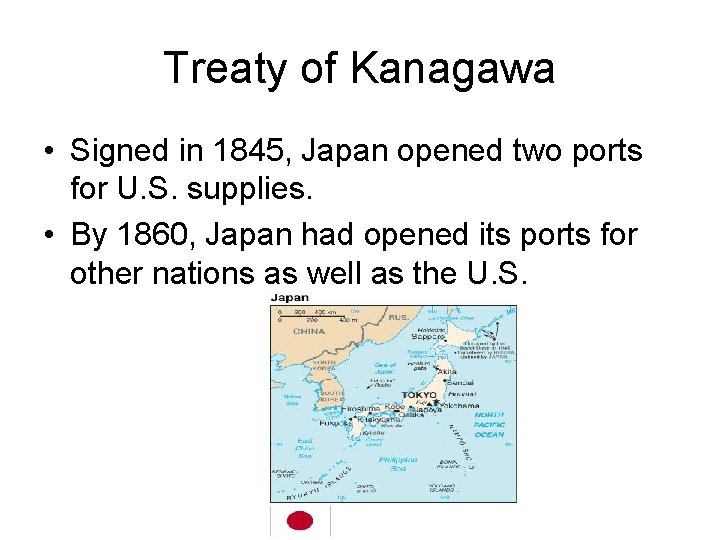
Treaty of Kanagawa • Signed in 1845, Japan opened two ports for U. S. supplies. • By 1860, Japan had opened its ports for other nations as well as the U. S.
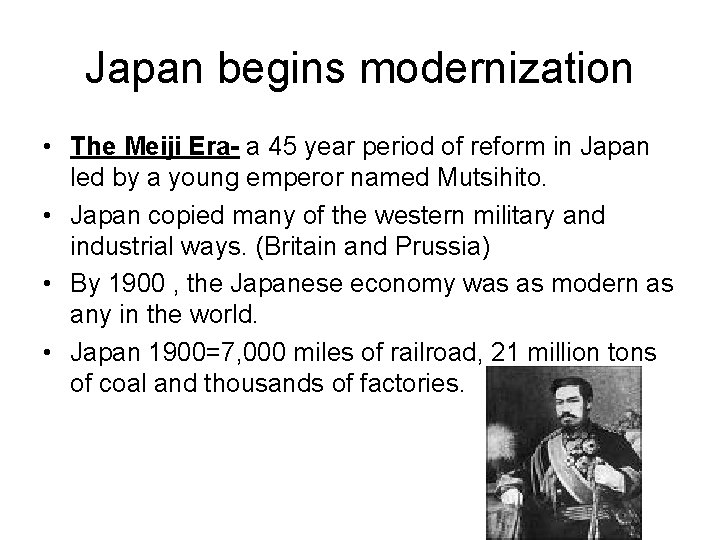
Japan begins modernization • The Meiji Era- a 45 year period of reform in Japan led by a young emperor named Mutsihito. • Japan copied many of the western military and industrial ways. (Britain and Prussia) • By 1900 , the Japanese economy was as modern as any in the world. • Japan 1900=7, 000 miles of railroad, 21 million tons of coal and thousands of factories.
Imperial Japan • By 1890 Japan had developed a modern and effective military. Best in Asia • Japan 1890= several dozen warships, a 500, 000 man army and a central political system. • By 1894 Japan eliminated extraterritorial rights to foreigners. • Japan could stand up to the west!!!!
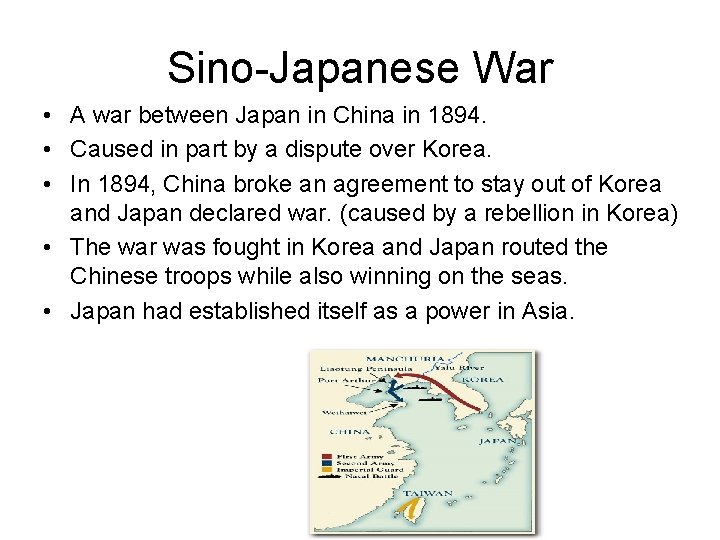
Sino-Japanese War • A war between Japan in China in 1894. • Caused in part by a dispute over Korea. • In 1894, China broke an agreement to stay out of Korea and Japan declared war. (caused by a rebellion in Korea) • The war was fought in Korea and Japan routed the Chinese troops while also winning on the seas. • Japan had established itself as a power in Asia.
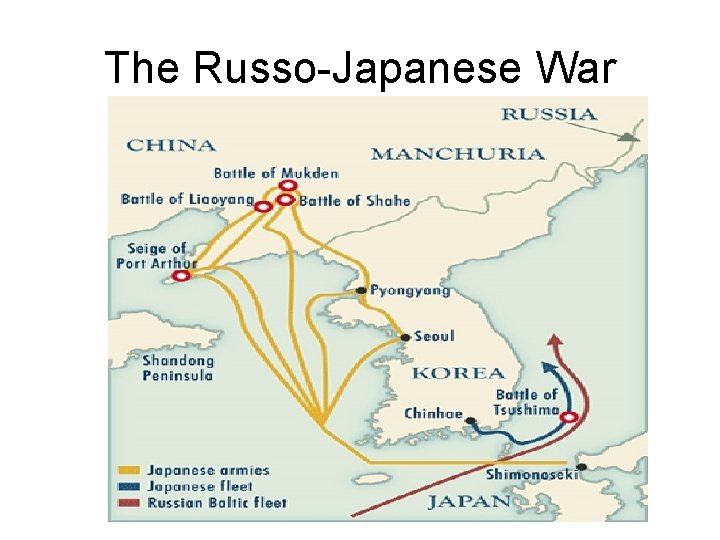
Russo-Japanese War • Russia and Japan were the two powers in Asia. • They feuded over a conflict in Korea and Manchuria. • In 1904, Japan attacked Russian ships. • Japan stunned the world when it beat the Russian ships in both the Pacific and the Baltic. • In 1905, a peace agreement was signed but Japan had established itself as a world power. • Russia was forced out of Korea and Manchuria
The cause of the Russo-Japanese War was 1. China’s role in Manchuria 2. A disagreement over trade 3. A dispute over Hong Kong 4. A dispute over Korea 1 2 3 4 5 6 7 8 9 10 21 22 23 24 25 26 27 28 29 30 11 12 13 14 15 16 17 18 19 20
The Russo-Japanese War
Japanese occupation of Korea • After beating Russia, Japan kept Korea as a protectorate nation. • In 1907, the Korean king was forced to give up control of Korea to Japan and it was annexed. • The Japanese began colonization and harsh policies of assimilation that would remain in Korea thru 1945 (WWII)
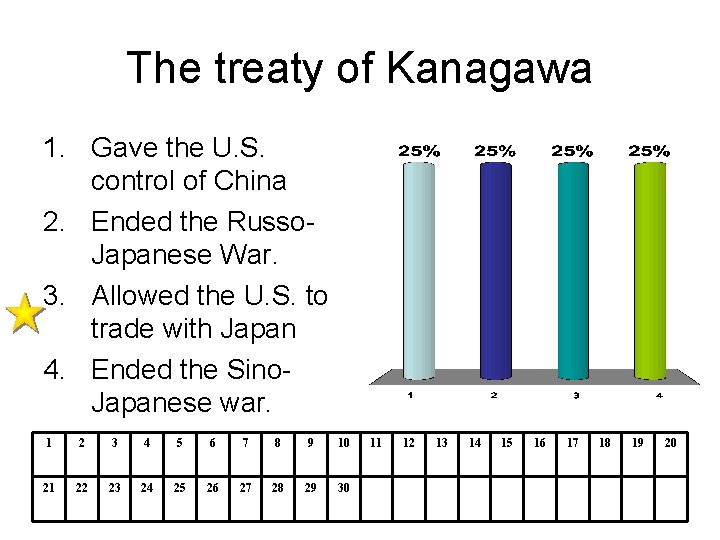
The treaty of Kanagawa 1. Gave the U. S. control of China 2. Ended the Russo. Japanese War. 3. Allowed the U. S. to trade with Japan 4. Ended the Sino. Japanese war. 1 2 3 4 5 6 7 8 9 10 21 22 23 24 25 26 27 28 29 30 11 12 13 14 15 16 17 18 19 20
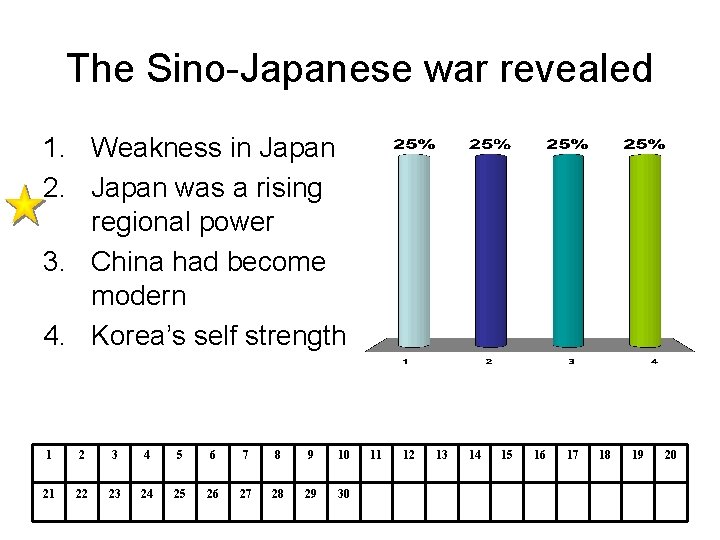
The Sino-Japanese war revealed 1. Weakness in Japan 2. Japan was a rising regional power 3. China had become modern 4. Korea’s self strength 1 2 3 4 5 6 7 8 9 10 21 22 23 24 25 26 27 28 29 30 11 12 13 14 15 16 17 18 19 20