
MODERNISM IN ENGLAND FIRST DECADES OF 20 TH
- Slides: 9
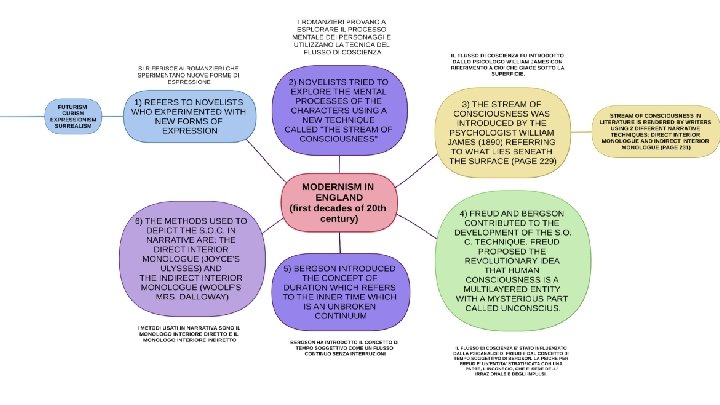
MODERNISM IN ENGLAND (FIRST DECADES OF 20 TH CENTURY) A PERIOD OF: ANXIETY FEAR INSTABILITY UNCERTAINTY
LITERARY BACKGROUND The beginning of the 20 th century was marked by one of the most shocking literary and-artistic revolutions of all time. All the aspects associated with Victorian literature such as - the importance of the third-person omniscient narrator, a well-structured and eventful plot, the presence of many characters, the interest in realism, a general optimism and a strong faith in human progress were swept away (cancelled) by the spread of new theories and ideas that revolutionised the very concept of life and of the world.
Freud, Einstein and the 1 st World War - Einstein's theory of relativity destroyed the faith in objective reality. Freud's psychoanalysis unveiled the world of the unconscious and of the inner self and radically changed the image of both the outer and the inner world. The experience of the First World War (1914 -18) destroyed Victorian optimism and inaugurated an era of anxiety and uncertainty. These trends were reflected in the literary and artistic production of the period, which was characterised by strong technical and stylistic experimentalism and by the attempt to use literature to explore the hidden recesses of the 'modern' human mind.
MODERNISM The literature and the arts of the early 20 th century were marked by the birth of "Modernism', a general term referring to the cosmopolitan literary and artistic movements that violently reacted against late 19 th century values. Modernism included and was influenced by different artistic movements, all of which were united in their attempt to rebel against the past and create new forms and styles in visual arts, literature and music. The main movements were: Futurism , an artistic and literary movement which rebelled against the past and decomposed the subject to create a sense of dynamism in painting; Cubism which fragmented the subject into geometrical and abstract shapes; Expressionism which was characterised by distorted forms and by radical experimentation in the use of colours to convey an idea of anxiety Surrealism which gave importance to the world of the unconscious and used art to represent it.
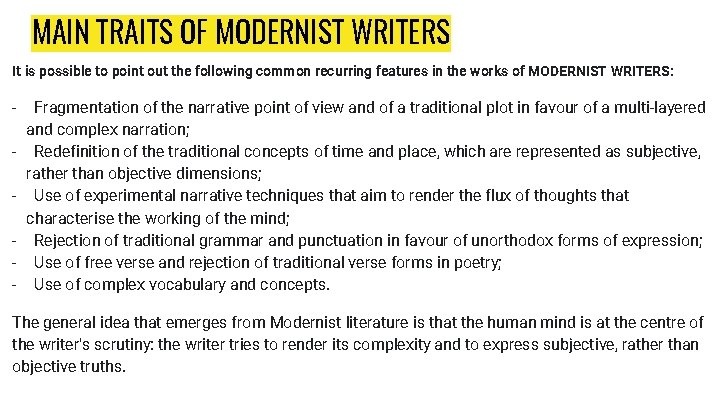
MAIN TRAITS OF MODERNIST WRITERS It is possible to point out the following common recurring features in the works of MODERNIST WRITERS: - Fragmentation of the narrative point of view and of a traditional plot in favour of a multi-layered and complex narration; Redefinition of the traditional concepts of time and place, which are represented as subjective, rather than objective dimensions; Use of experimental narrative techniques that aim to render the flux of thoughts that characterise the working of the mind; Rejection of traditional grammar and punctuation in favour of unorthodox forms of expression; Use of free verse and rejection of traditional verse forms in poetry; Use of complex vocabulary and concepts. The general idea that emerges from Modernist literature is that the human mind is at the centre of the writer's scrutiny: the writer tries to render its complexity and to express subjective, rather than objective truths.
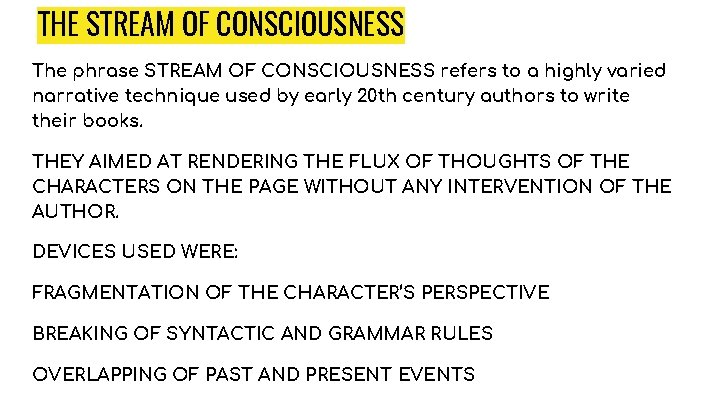
THE STREAM OF CONSCIOUSNESS The phrase STREAM OF CONSCIOUSNESS refers to a highly varied narrative technique used by early 20 th century authors to write their books. THEY AIMED AT RENDERING THE FLUX OF THOUGHTS OF THE CHARACTERS ON THE PAGE WITHOUT ANY INTERVENTION OF THE AUTHOR. DEVICES USED WERE: FRAGMENTATION OF THE CHARACTER’S PERSPECTIVE BREAKING OF SYNTACTIC AND GRAMMAR RULES OVERLAPPING OF PAST AND PRESENT EVENTS
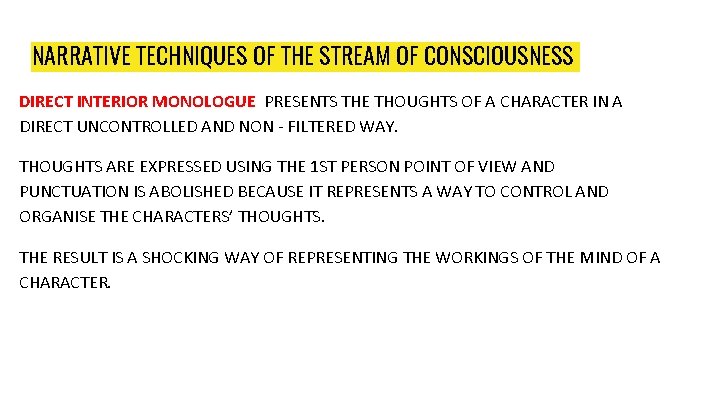
NARRATIVE TECHNIQUES OF THE STREAM OF CONSCIOUSNESS DIRECT INTERIOR MONOLOGUE PRESENTS THE THOUGHTS OF A CHARACTER IN A DIRECT UNCONTROLLED AND NON - FILTERED WAY. THOUGHTS ARE EXPRESSED USING THE 1 ST PERSON POINT OF VIEW AND PUNCTUATION IS ABOLISHED BECAUSE IT REPRESENTS A WAY TO CONTROL AND ORGANISE THE CHARACTERS’ THOUGHTS. THE RESULT IS A SHOCKING WAY OF REPRESENTING THE WORKINGS OF THE MIND OF A CHARACTER.
NARRATIVE TECHNIQUES OF THE STREAM OF CONSCIOUSNESS INDIRECT INTERIOR MONOLOGUE ON THE CONTRARY SHOWS THE WORKINGS OF THE MIND OF A CHARACTER USING THE 3 RD PERSON OMNISCIENT NARRATOR, WHO CONTROLS THE CHARACTER’S FLUX OF THOUGHTS AND USES GRAMMAR RULES AND PUNCTUATION TO ORGANISE THEM IN A LOGICAL WAY. THE NARRATOR USES VERBS LIKE “HE/SHE THINKS OR THOUGHT TO INTRODUCE THE CHARACTERS’ THOUGHTS.