
Modern World History Patterns of Interaction Chapter 1
- Slides: 50
Modern World History: Patterns of Interaction Chapter 1 European Renaissance and Reformation, 1300 -1600 Two movements, the Renaissance and the Reformation, usher in dramatic social and cultural changes in Europe. Next Copyright © by Houghton Mifflin Harcourt Publishing Company
Modern World History: Patterns of Interaction Chapter 1 European Renaissance and Reformation, 1300 -1600 SECTION 11 SECTION Italy: Birthplace of the Renaissance SECTION 22 SECTION The Northern Renaissance SECTION 33 SECTION Luther Leads the Reformation SECTION 4 The Reformation Continues Previous Copyright © by Houghton Mifflin Harcourt Publishing Company Next
Modern World History: Patterns of Interaction Chapter 1 Section-1 Italy: Birthplace of the Renaissance The Italian Renaissance is a rebirth of learning that produces many great works of art and literature. Trade, towns, cities, growth of middle class, wealthy merchants, individual worth, individual thought, democratic thinking, questioning institutions (a little) Previous Copyright © by Houghton Mifflin Harcourt Publishing Company Next
Modern World History: Patterns of Interaction Chapter 1 Section-1 Italy: Birthplace of the Renaissance Italy’s Advantages The Renaissance • Renaissance—an explosion of creativity in art, writing, and thought • Started in northern Italy • Lasted from 1300– 1600 Previous Copyright © by Houghton Mifflin Harcourt Publishing Company Continued… Next
Modern World History: Patterns of Interaction Chapter 1 Italy: Birthplace of the Renaissance Section-1 Italy’s Advantages City-States • Crusades spur trade • 1 st 9 weeks: “it’s all about the spices” • Growth of city-states in northern Italy • In 1300 s bubonic plague killed 60% of population, disrupts economy Previous Copyright © by Houghton Mifflin Harcourt Publishing Company Continued… Next
Modern World History: Patterns of Interaction Chapter 1 Italy’s Advantages {continued} Merchants and the Medici • A wealthy merchant class develops • More emphasis on individual achievement • Banking family, the Medici, controls Florence • In our times: family or merit? Previous Copyright © by Houghton Mifflin Harcourt Publishing Company Next
Modern World History: Patterns of Interaction Chapter 1 Italy’s Advantages {continued} Looking to Greece and Rome • Artists, scholars study ruins of Rome and Latin, Greek manuscripts • Scholars move to Rome after fall of Constantinople in 1453 Previous Copyright © by Houghton Mifflin Harcourt Publishing Company Next
Modern World History: Patterns of Interaction Chapter 1 Classical and Worldly Values Classics Lead to Humanism • Humanism—intellectual movement focused on human achievements • More emphasis on individual achievement • Humanists studied classical texts, history, literature, philosophy Previous Copyright © by Houghton Mifflin Harcourt Publishing Company Continued… Next
Modern World History: Patterns of Interaction Chapter 1 Classical and Worldly Values Worldly Pleasures • Renaissance society was secular—worldly • Wealthy enjoyed fine food, homes, clothes Previous Copyright © by Houghton Mifflin Harcourt Publishing Company Continued… Next
Modern World History: Patterns of Interaction Chapter 1 Classical and Worldly Values{continued} Patrons of the Arts • Patron—a financial supporter of artists • Church leaders spend money on artworks to beautify cities • Wealthy merchants are patrons • Do we have patrons today? Previous Copyright © by Houghton Mifflin Harcourt Publishing Company Continued… Next
Modern World History: Patterns of Interaction Chapter 1 Classical and Worldly Values{continued} The Renaissance Man • Excels in many things: the classics, art, politics, athletics • Baldassare Castiglione’s: • The Courtier (1528) • The book teaches how to become a “universal” person Previous Copyright © by Houghton Mifflin Harcourt Publishing Company Continued… Next
Modern World History: Patterns of Interaction Chapter 1 Classical and Worldly Values{continued} The Renaissance Woman • Upper-class, educated in classics, charming • Expected to inspire art but not create it Previous Copyright © by Houghton Mifflin Harcourt Publishing Company Next
Modern World History: Patterns of Interaction Chapter 1 The Renaissance Revolutionizes Artistic Styles Change • Artists use realistic style copied from classical art, often to portray religious subjects • Painters use perspective—a way to show three dimensions on a canvas Previous Copyright © by Houghton Mifflin Harcourt Publishing Company Continued… Next
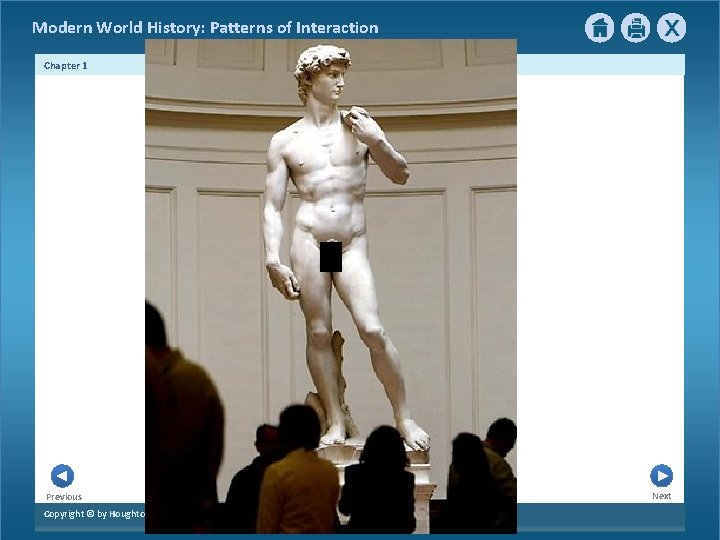
Modern World History: Patterns of Interaction Chapter 1 The Renaissance Revolutionizes Art Realistic Painting and Sculpture • Realistic portraits of prominent citizens • Sculpture shows natural postures and expressions • The biblical David is a favorite subject among sculptors Previous Copyright © by Houghton Mifflin Harcourt Publishing Company Continued… Next
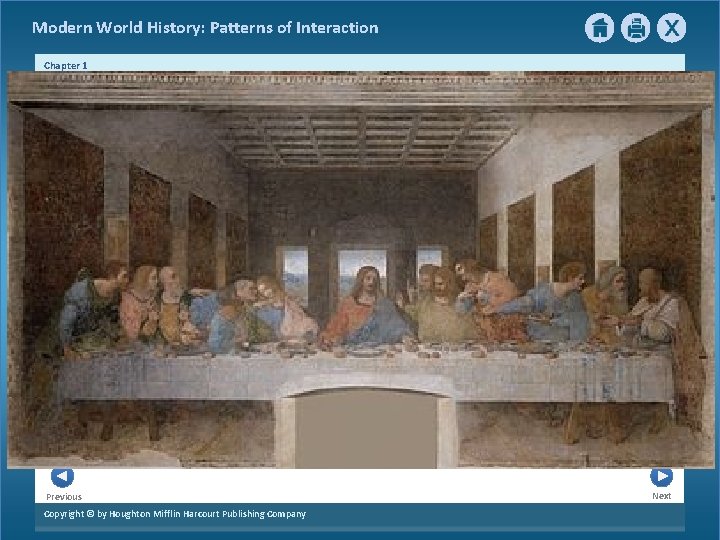
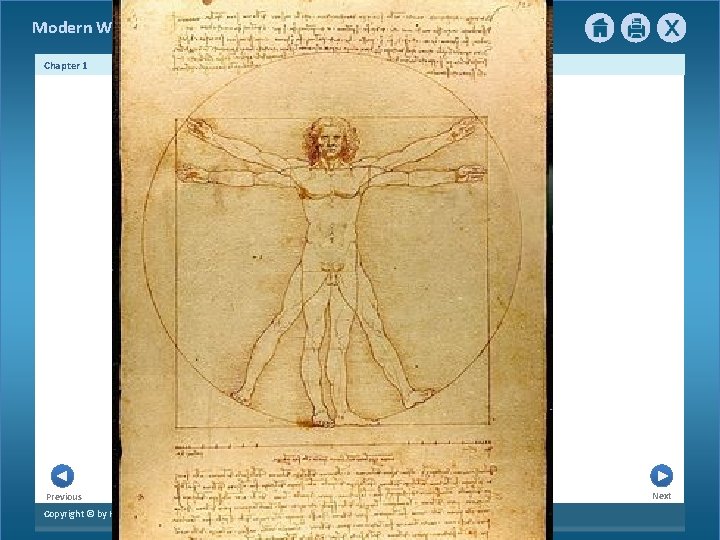
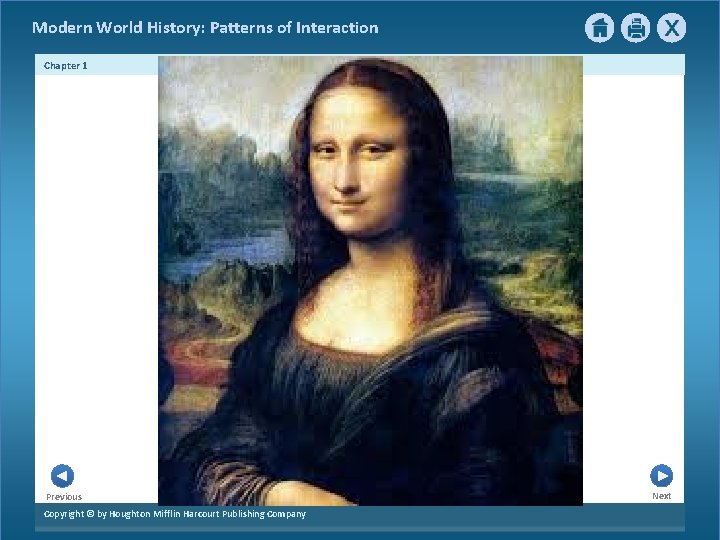
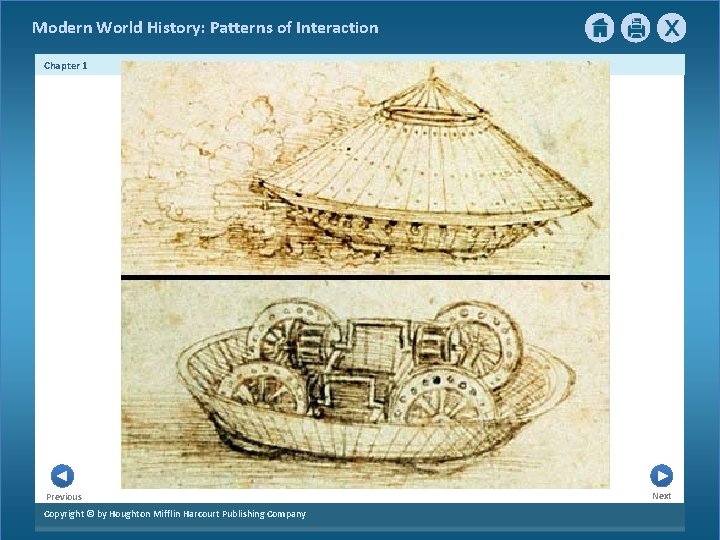
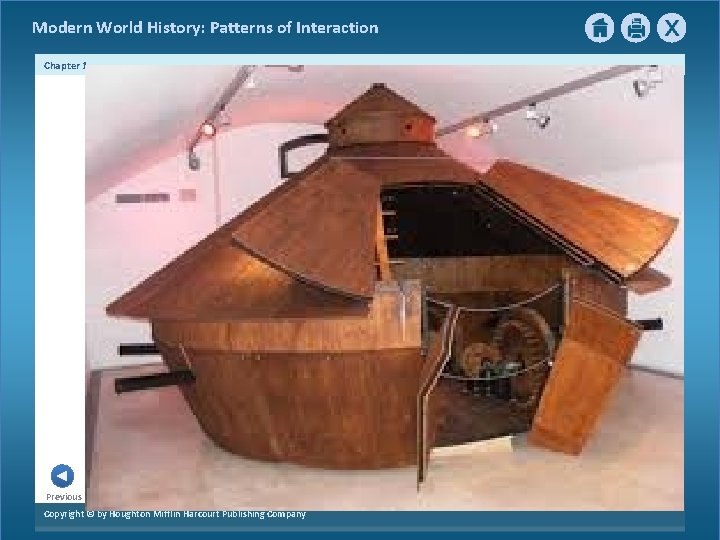
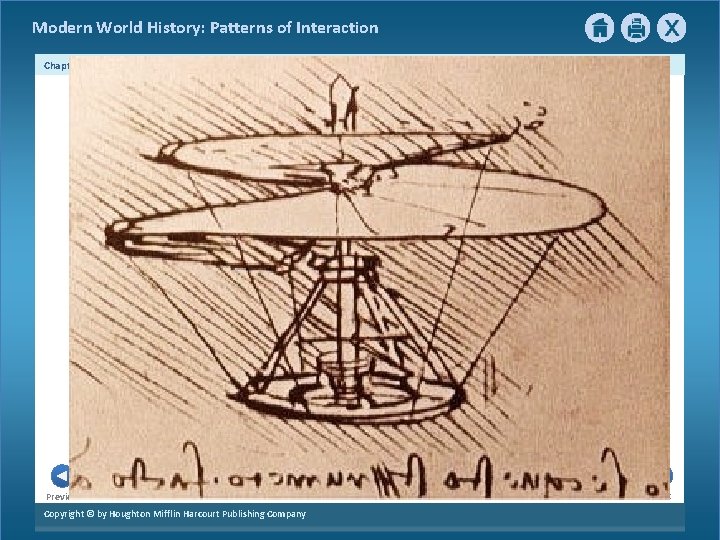
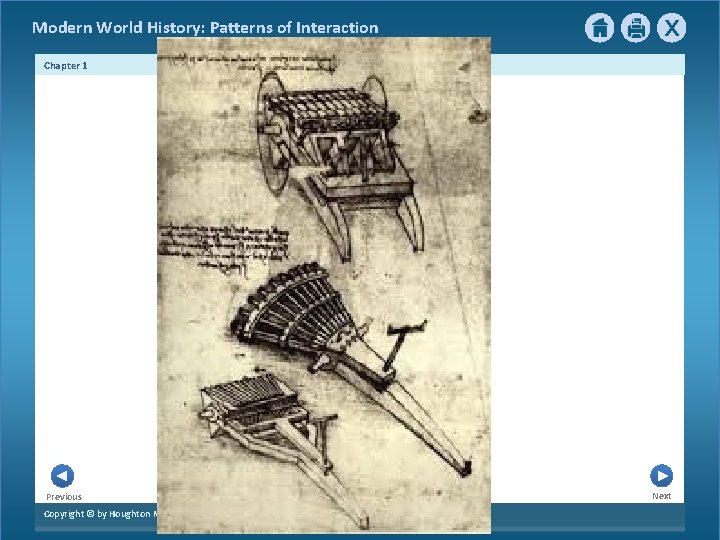
Modern World History: Patterns of Interaction Chapter 1 The Renaissance Revolutionizes Art{continued} Leonardo, Renaissance Man • Leonardo da Vinci—painter, sculptor, inventor, scientist • Paints one of the best-known portraits in the world: the Mona Lisa • Famous religious painting: The Last Supper • Vitruvian Man Previous Copyright © by Houghton Mifflin Harcourt Publishing Company Continued… Next
Modern World History: Patterns of Interaction Chapter 1 Previous Copyright © by Houghton Mifflin Harcourt Publishing Company Next
Modern World History: Patterns of Interaction Chapter 1 Previous Copyright © by Houghton Mifflin Harcourt Publishing Company Next
Modern World History: Patterns of Interaction Chapter 1 Previous Copyright © by Houghton Mifflin Harcourt Publishing Company Next
Modern World History: Patterns of Interaction Chapter 1 Previous Copyright © by Houghton Mifflin Harcourt Publishing Company Next
Modern World History: Patterns of Interaction Chapter 1 Previous Copyright © by Houghton Mifflin Harcourt Publishing Company Next
Modern World History: Patterns of Interaction Chapter 1 Previous Copyright © by Houghton Mifflin Harcourt Publishing Company Next
Modern World History: Patterns of Interaction Chapter 1 Previous Copyright © by Houghton Mifflin Harcourt Publishing Company Next
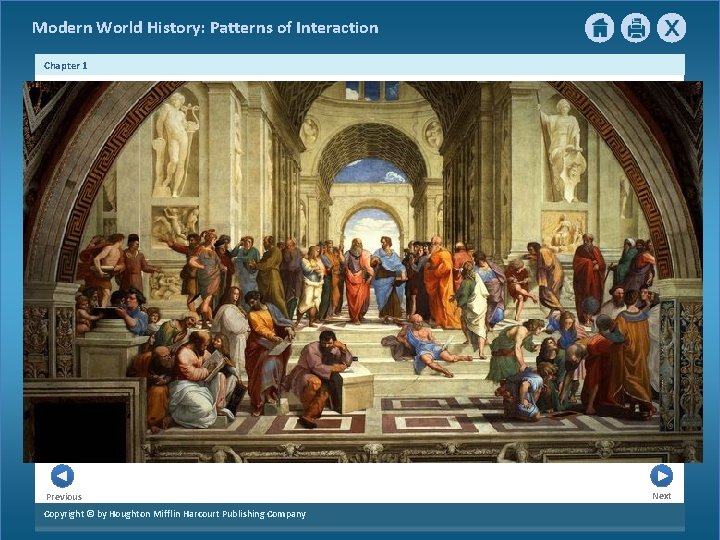
Modern World History: Patterns of Interaction Chapter 1 The Renaissance Revolutionizes Art{continued} Raphael Advances Realism • Raphael Sanzio, famous for his use of perspective • Favorite subject: the Madonna and child • Famous painting: School of Athens Previous Copyright © by Houghton Mifflin Harcourt Publishing Company Continued… Next
Modern World History: Patterns of Interaction Chapter 1 Previous Copyright © by Houghton Mifflin Harcourt Publishing Company Next
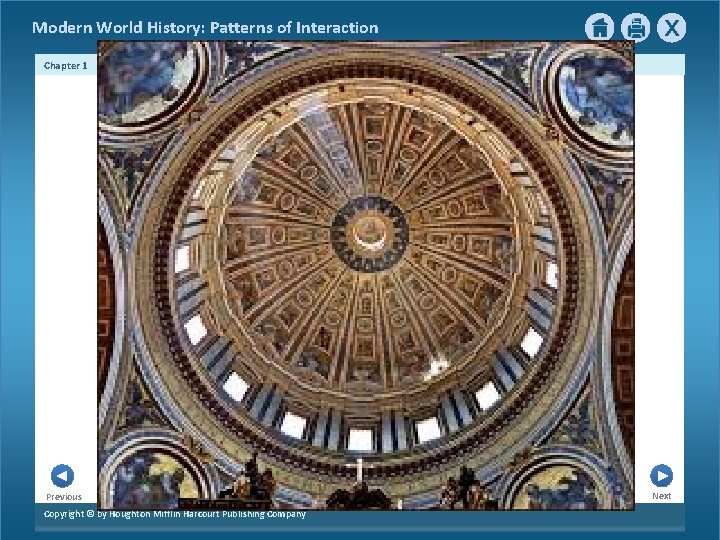
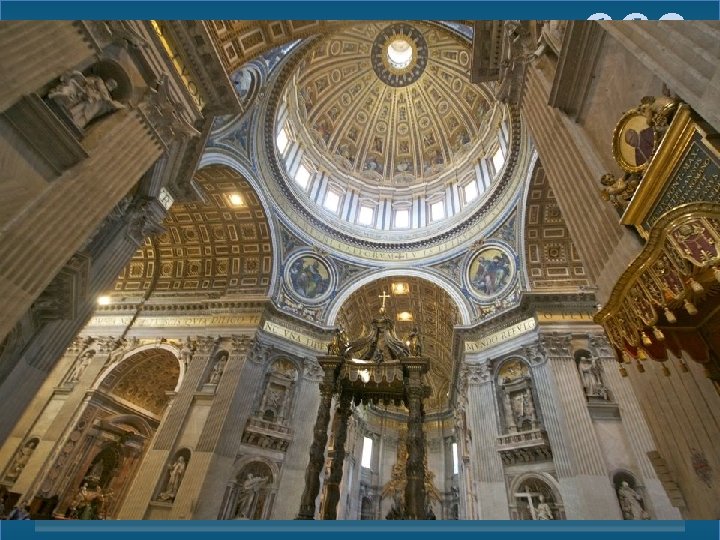
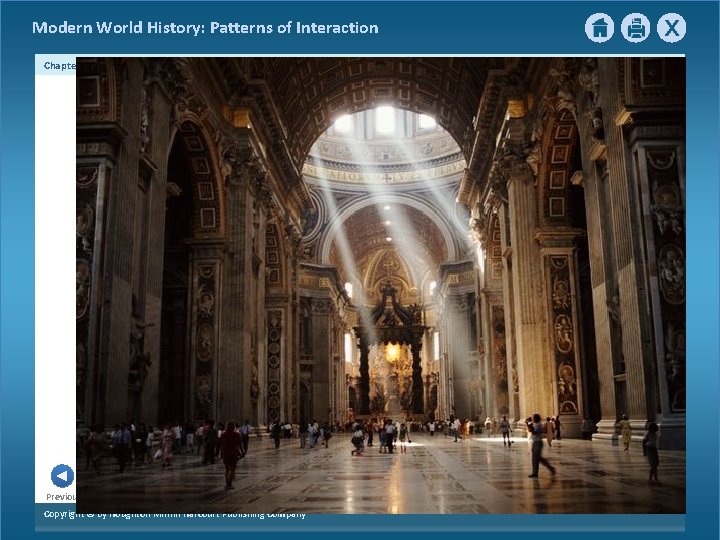
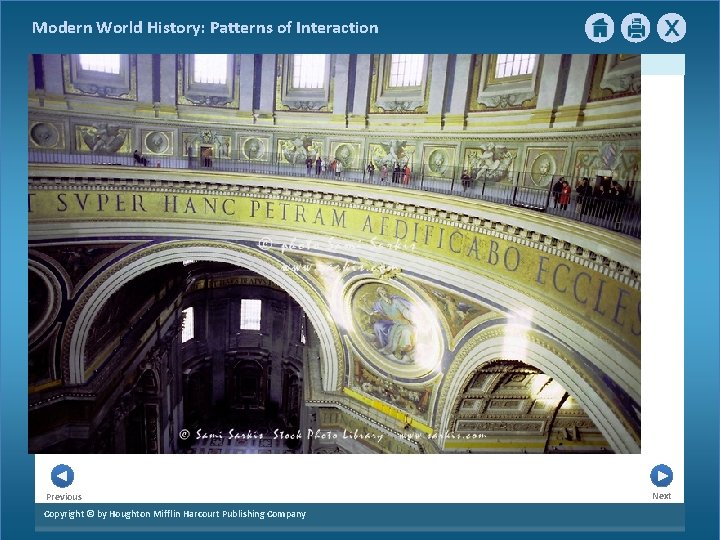
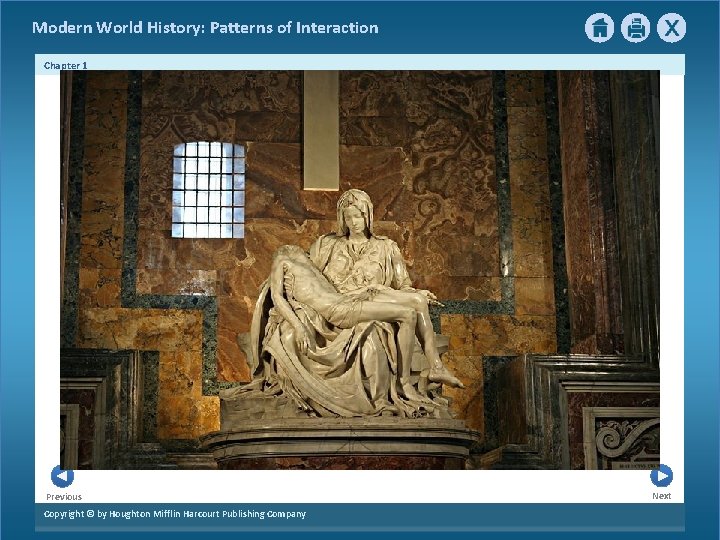
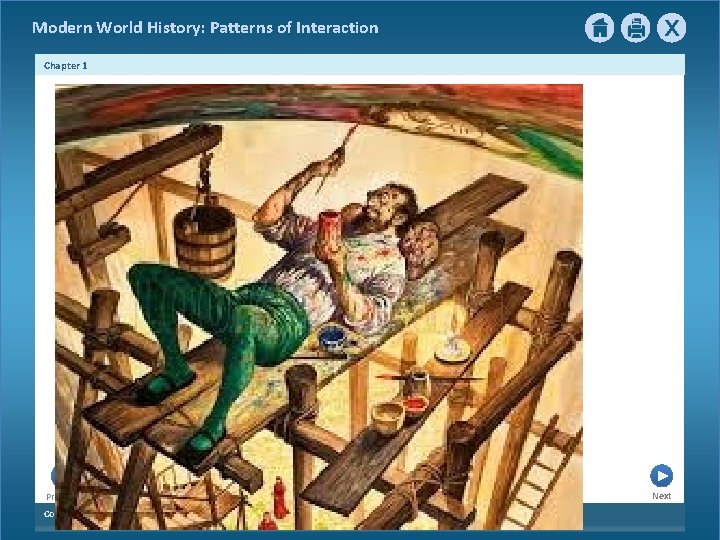
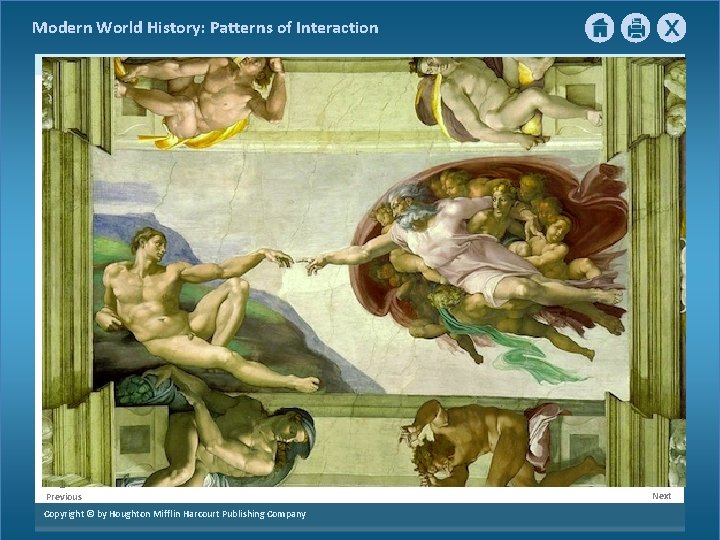
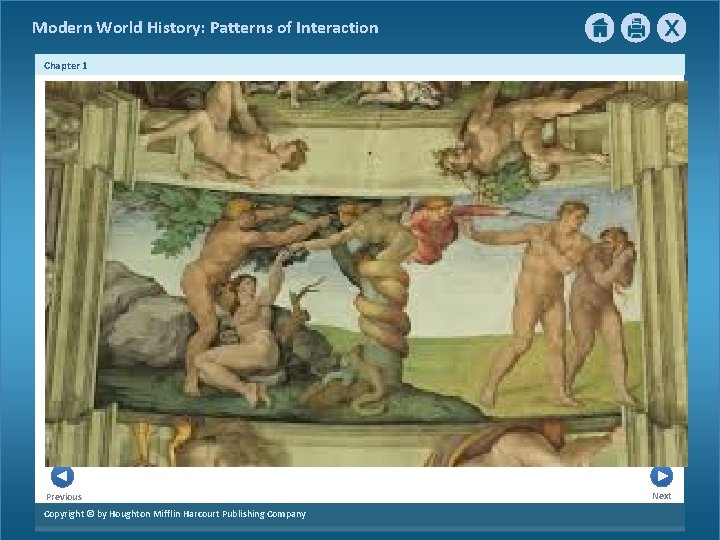
Modern World History: Patterns of Interaction Chapter 1 The Renaissance Revolutionizes Art{continued} Michelangelo Dome of St. Peter’s Basilica Ceiling of the Sistine Chapel Pieta David (statue) Previous Copyright © by Houghton Mifflin Harcourt Publishing Company Next
Modern World History: Patterns of Interaction Chapter 1 Previous Copyright © by Houghton Mifflin Harcourt Publishing Company Next
Modern World History: Patterns of Interaction Chapter 1 Previous Copyright © by Houghton Mifflin Harcourt Publishing Company Next
Modern World History: Patterns of Interaction Chapter 1 Previous Copyright © by Houghton Mifflin Harcourt Publishing Company Next
Modern World History: Patterns of Interaction Chapter 1 Previous Copyright © by Houghton Mifflin Harcourt Publishing Company Next
Modern World History: Patterns of Interaction Chapter 1 Previous Copyright © by Houghton Mifflin Harcourt Publishing Company Next
Modern World History: Patterns of Interaction Chapter 1 Previous Copyright © by Houghton Mifflin Harcourt Publishing Company Next
Modern World History: Patterns of Interaction Chapter 1 Previous Copyright © by Houghton Mifflin Harcourt Publishing Company Next
Modern World History: Patterns of Interaction Chapter 1 Previous Copyright © by Houghton Mifflin Harcourt Publishing Company Next
Modern World History: Patterns of Interaction Chapter 1 Previous Copyright © by Houghton Mifflin Harcourt Publishing Company Next
Modern World History: Patterns of Interaction Chapter 1 Previous Copyright © by Houghton Mifflin Harcourt Publishing Company Next
Modern World History: Patterns of Interaction Chapter 1 http: //Link to the Sistine Chapel tour www. vatican. va/various/cappelle/sistina_vr/index. html Previous Copyright © by Houghton Mifflin Harcourt Publishing Company Next
Modern World History: Patterns of Interaction Chapter 1 Renaissance Writers Change Literature New Trends in Writing • Writers use vernacular—their native language Petrarch • Francesco Petrarch, father of Renaissance humanism Previous Copyright © by Houghton Mifflin Harcourt Publishing Company Continued… Next
Modern World History: Patterns of Interaction Chapter 1 Renaissance Writers Change Literature{continued} Machievelli Advises Rulers • Niccolò Machievelli, author of political guidebook, The Prince • The Prince examines how rulers can gain and Advocated strong leadership, said leaders did not have to keep powerbe moral, ethical, or honest (but he should appear to be good) Advocated strong leadership, said leaders did not have to be moral, ethical, or honest (but he should appear to be good) Advocated strong leadership, said leaders did not have to be moral, ethical, or honest (but he should appear to be good) Previous Copyright © by Houghton Mifflin Harcourt Publishing Company Next
Modern World History: Patterns of Interaction Chapter 1 Section-2 The Northern Renaissance In the 1400 s, the ideas of the Italian Renaissance begin to spread to Northern Europe. Previous Copyright © by Houghton Mifflin Harcourt Publishing Company Next
Modern World History: Patterns of Interaction Chapter 1 The Northern Renaissance Begins Section-2 Renaissance Ideas Spread 1. • Spirit of Renaissance impresses visitors from northern Europe 2. • When Hundred Years’ War ends (1453), cities grow rapidly 3. • Merchants in northern cities prosper and become patrons 4. • England France get strong monarchs who are art patrons 5. • Northern Renaissance artists interested in realism 6. • Humanists interested in social reform based on Judeo. Christian values Previous Copyright © by Houghton Mifflin Harcourt Publishing Company Next
Modern World History: Patterns of Interaction Chapter 1 Section-2 Artistic Ideas Spread Renaissance Styles Migrate North • Artists, writers move to northern Europe fleeing war in Italy (1494) German Painters • Albrecht Dürer’s woodcuts and engravings emphasize realism • Hans Holbein the Younger paints portraits, often of English royalty Previous Copyright © by Houghton Mifflin Harcourt Publishing Company Continued… Next
Modern World History: Patterns of Interaction Chapter 1 Artistic Ideas Spread{continued} Flemish Painters • Flanders is the artistic center of northern Europe • Jan van Eyck, pioneer in oil-based painting, uses layers of paint • Van Eyck’s paintings are realistic and reveal subject’s personality • Pieter Bruegel captures scenes of peasant life with realistic details Previous Copyright © by Houghton Mifflin Harcourt Publishing Company Next
Modern World History: Patterns of Interaction Chapter 1 Northern Writers Try to Reform Society Northern Humanists • Criticize the Catholic Church, start Christian humanism • Want to reform society and promote education, particularly for women Previous Copyright © by Houghton Mifflin Harcourt Publishing Company Continued… Next
Modern World History: Patterns of Interaction Chapter 1 Northern Writers Try to Reform Society Christian Humanists • Desiderius Erasmusof Holland is best -known Christian humanist • His book, The Praise of Folly, pokes fun at merchants and priests • Thomas More of England creates a model society in his book Utopia Previous Copyright © by Houghton Mifflin Harcourt Publishing Company Continued… Next
Modern World History: Patterns of Interaction Chapter 1 Northern Writers Try to Reform Society{continued} Women’s Reforms • Christine de Pizan, one of the first women writers The Book of the City of Ladies • She promotes education, equal treatment for boys and girls Previous Copyright © by Houghton Mifflin Harcourt Publishing Company Next
Modern World History: Patterns of Interaction Chapter 1 Queen Elizabeth I • Renaissance spreads to England in mid-1500 s • Period known as the Elizabethan Age, after Queen Elizabeth I • Elizabeth reigns from 1558 to 1603 The Elizabethan Age Previous Copyright © by Houghton Mifflin Harcourt Publishing Company Next
Modern World History: Patterns of Interaction Chapter 1 The Elizabethan Age William Shakespeare • Shakespeare is often regarded as the greatest playwright • Born in Stratford-upon-Avon in 1564 • London’s Globe Theater Previous Copyright © by Houghton Mifflin Harcourt Publishing Company Next
Modern World History: Patterns of Interaction Chapter 1 Printing Spreads Renaissance Ideas Chinese Invention • Around 1045 Gutenberg Improves the Printing Process • Around 1440 Johann Gutenberg of Germany develops printing press • Printing press allows for quick, cheap book production • First book printed with movable type, Gutenberg Bible (1455) http: //www. history. com/topics/middle-ages/videos/mankind-the-story-of-all-of-us-the-printingpress http: //www. history. com/topics/middle-ages/videos/the-book-that-changed-the. Next Previous world? m=528 e 394 da 93 ae&s=undefined&f=1&free=false Copyright © by Houghton Mifflin Harcourt Publishing Company
Modern World History: Patterns of Interaction Chapter 1 Legacy of the Renaissance Changes in the Arts • Art influenced by classical Greece and Rome • Realistic portrayals of individuals and nature • Art is both secular and religious • Writers use vernacular • Art praises individual achievement Previous Copyright © by Houghton Mifflin Harcourt Publishing Company Continued… Next
Modern World History: Patterns of Interaction Chapter 1 The Legacy of the Renaissance Changes in Society • • • Printing makes information widely available Illiterate people benefit by having books read to them Published accounts of maps and charts lead to more discoveries Published legal proceedings make rights clearer to people Political structures and religious practices are questioned Expansion of the middle class, towns, cities, trade Previous Copyright © by Houghton Mifflin Harcourt Publishing Company Next