
Modern Trends in Electronic System Design Introduction Dr

- Slides: 31
Modern Trends in Electronic System Design (Introduction) Dr. Wajiha Shah Professor Lecture – 01
Outline n n n n Introduction System design Discrete devices Integrated circuits Amplifiers Filters Signal generators A/D data converter Microprocessor & Microcontroller Computer-aided design (CAD) Sensors and Actuators Combinational Logic design Advance trends in electronics System Design
Introduction n Electronics is the branch of science and technology which makes use of the controlled motion of electrons through different media and vacuum. n Most electronic devices today use semiconductor components to perform electron control. n The study of semiconductor devices and related technology is considered a branch of physics, whereas the design and construction of electronic circuits to solve practical problems come under electronics engineering n Two types of electronics circuits n n Analog circuits Digital circuits
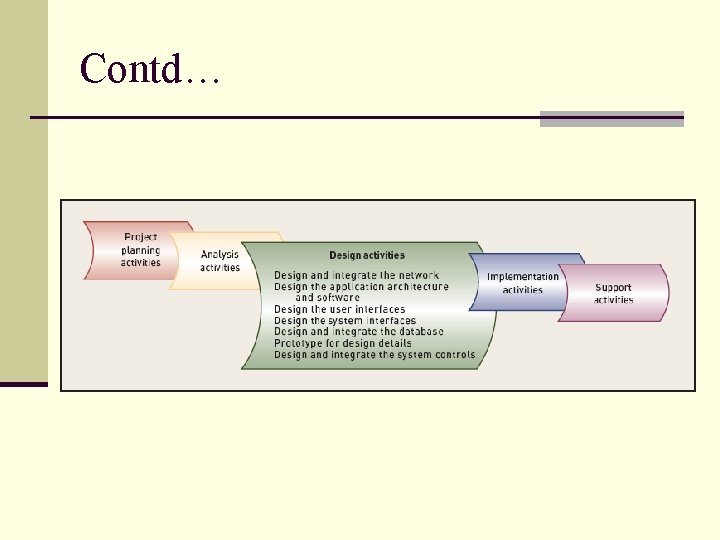
System Design n Design is process of describing, organizing, and structuring system components at architectural design level and detailed design level n Focused on preparing for construction n Like developing plan n Three questions n n n What components require systems design? What are inputs to and outputs of design process? How is systems design done?
Contd…
Quantitative Concepts n Circuit quantities and component values have extreme ranges in electronic circuits. n It is not uncommon to have values such as 1, 200, 000 Hz and 0. 0000047 F in the same circuit. n For this reason, metric prefixes and engineering notation are used to simplify communications and computations.
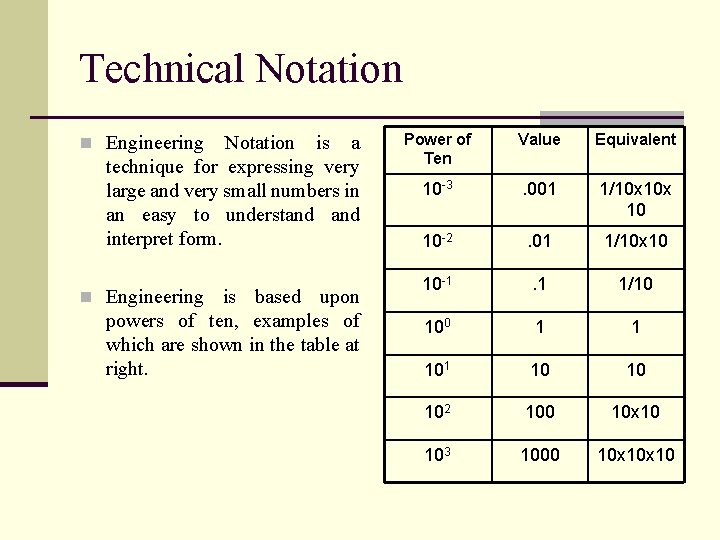
Technical Notation n Engineering Notation is a technique for expressing very large and very small numbers in an easy to understand interpret form. n Engineering is based upon powers of ten, examples of which are shown in the table at right. Power of Ten Value Equivalent 10 -3 . 001 1/10 x 10 10 -2 . 01 1/10 x 10 10 -1 . 1 1/10 100 1 1 10 10 102 100 10 x 10 103 1000 10 x 10
Powers of Ten and Metric Expressions Powers of Ten Prefix Symbol Magnitude 10 -15 femto f One-quadrillionth 10 -12 pico p One-trillionth 10 -9 nano n One-billionth 10 -6 micro µ One-millionth 10 -3 milli m One-thousandth 10 -2 centi c One-hundredth 100 none 103 kilo k thousand 106 mega M million 109 giga G billion 1012 tera T trillion
Design of Electronic System using Discrete Devices n Typical electronic components which are used to design a electronic system include: n Resistors n Capacitors n Inductors n Diode n Transistors
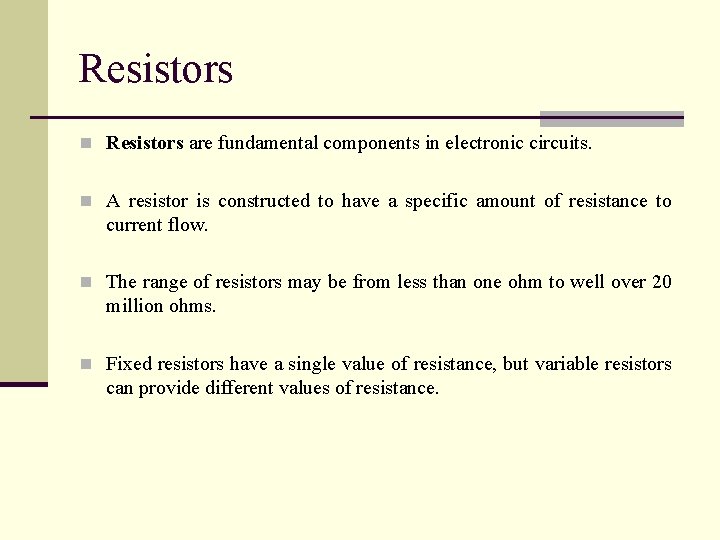
Resistors n Resistors are fundamental components in electronic circuits. n A resistor is constructed to have a specific amount of resistance to current flow. n The range of resistors may be from less than one ohm to well over 20 million ohms. n Fixed resistors have a single value of resistance, but variable resistors can provide different values of resistance.
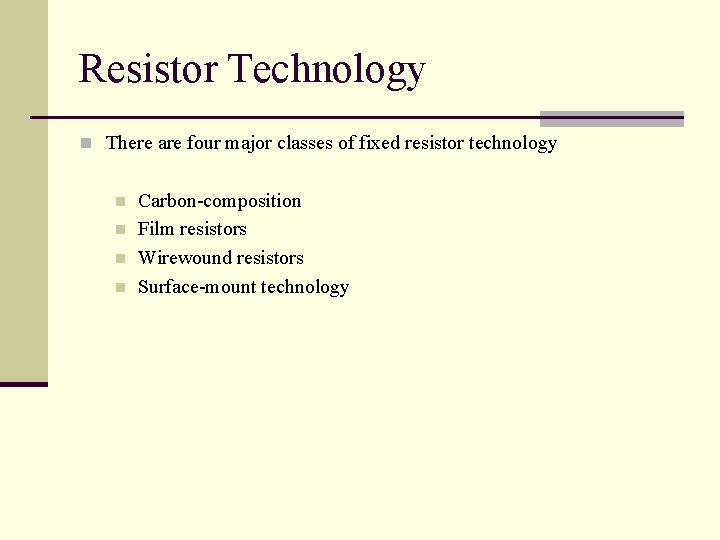
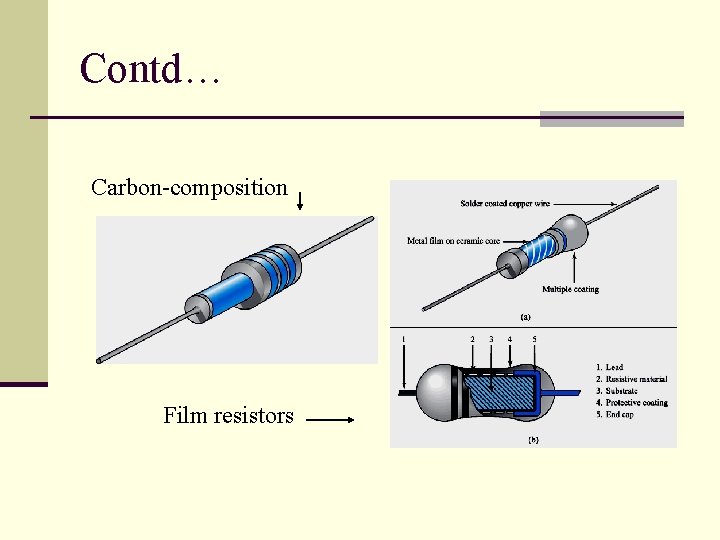
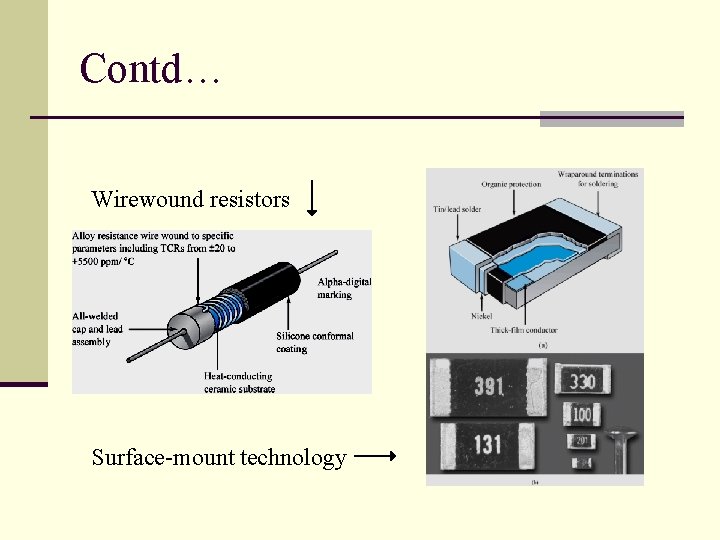
Resistor Technology n There are four major classes of fixed resistor technology n n Carbon-composition Film resistors Wirewound resistors Surface-mount technology
Contd… Carbon-composition Film resistors
Contd… Wirewound resistors Surface-mount technology
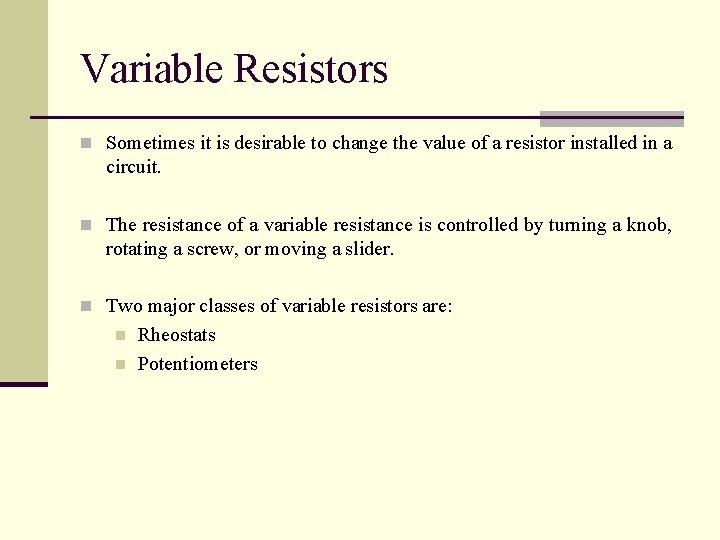
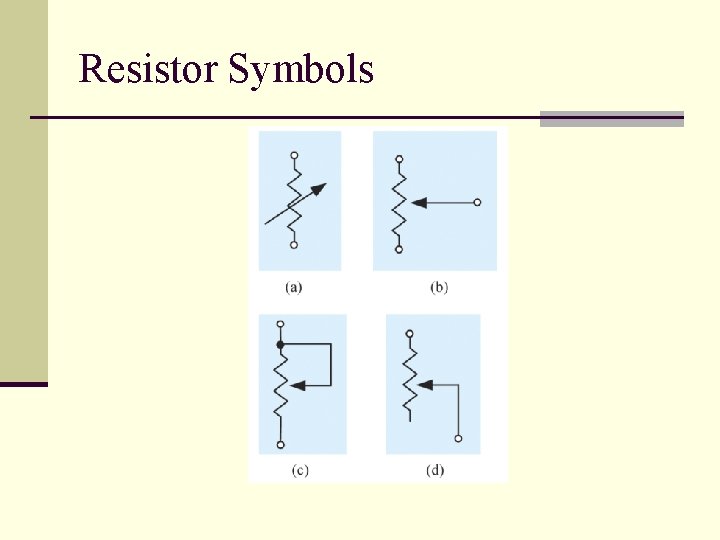
Variable Resistors n Sometimes it is desirable to change the value of a resistor installed in a circuit. n The resistance of a variable resistance is controlled by turning a knob, rotating a screw, or moving a slider. n Two major classes of variable resistors are: n n Rheostats Potentiometers
Resistor Symbols
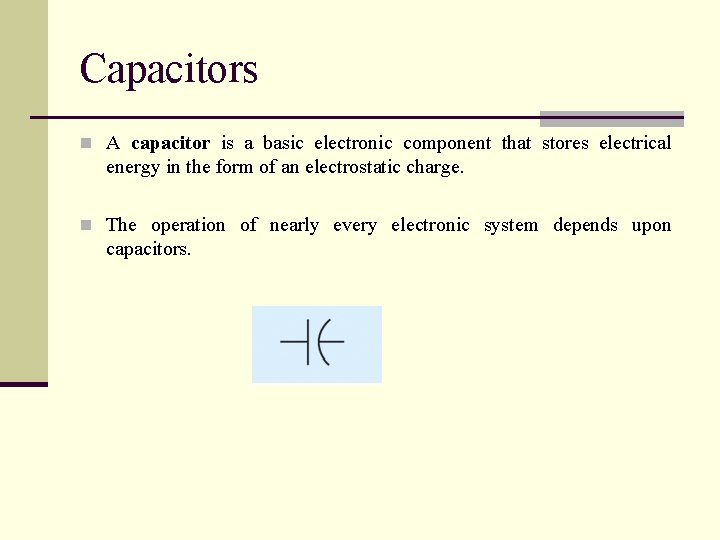
Capacitors n A capacitor is a basic electronic component that stores electrical energy in the form of an electrostatic charge. n The operation of nearly every electronic system depends upon capacitors.
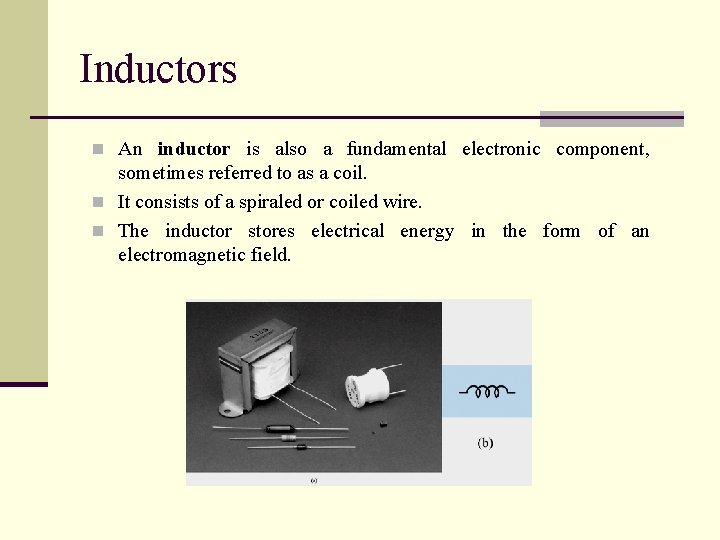
Inductors n An inductor is also a fundamental electronic component, sometimes referred to as a coil. n It consists of a spiraled or coiled wire. n The inductor stores electrical energy in the form of an electromagnetic field.
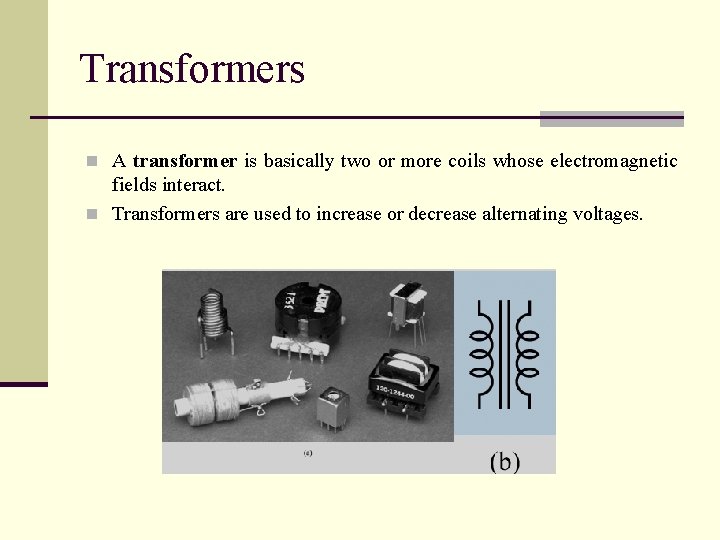
Transformers n A transformer is basically two or more coils whose electromagnetic fields interact. n Transformers are used to increase or decrease alternating voltages.
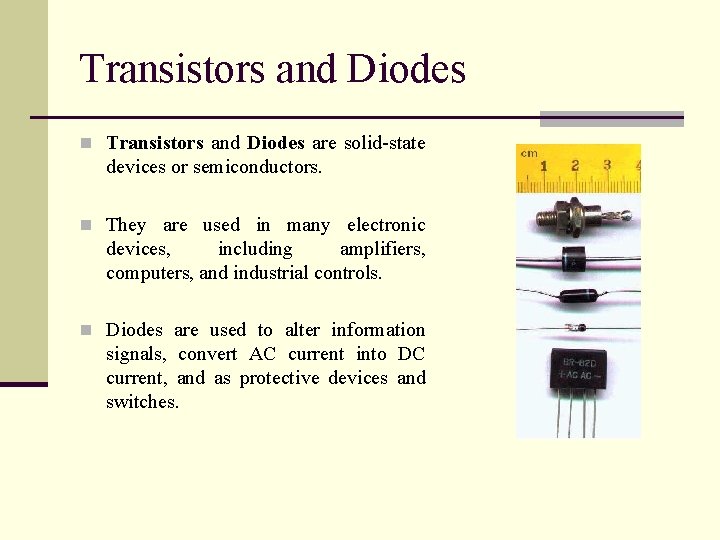
Transistors and Diodes n Transistors and Diodes are solid-state devices or semiconductors. n They are used in many electronic devices, including amplifiers, computers, and industrial controls. n Diodes are used to alter information signals, convert AC current into DC current, and as protective devices and switches.
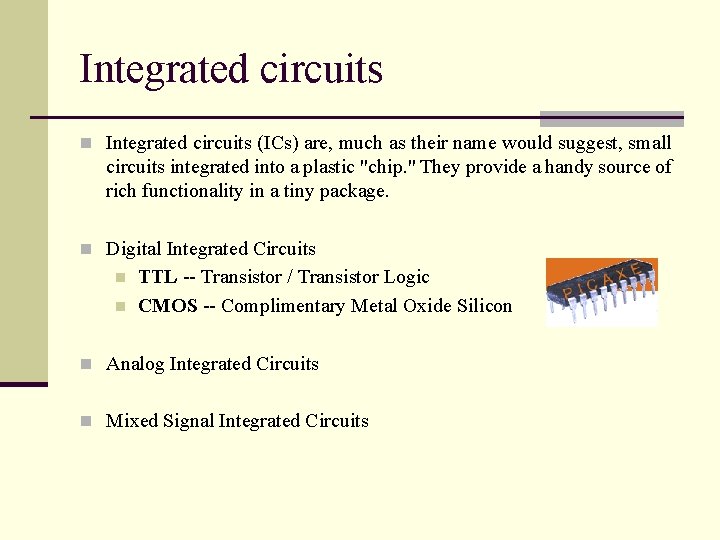
Integrated circuits n Integrated circuits (ICs) are, much as their name would suggest, small circuits integrated into a plastic "chip. " They provide a handy source of rich functionality in a tiny package. n Digital Integrated Circuits n n TTL -- Transistor / Transistor Logic CMOS -- Complimentary Metal Oxide Silicon n Analog Integrated Circuits n Mixed Signal Integrated Circuits
Amplifiers n An amplifier or simply amp, is any device that changes, usually increases, the amplitude of a signal. n Linear amplifier n Non linear amplifier n A linear amplifier is an electronic circuit whose output is proportional to its input, but capable of delivering more power into a load. n A non linear amplifier is an electronic circuit in which a change in input does not produce a proportional change in.
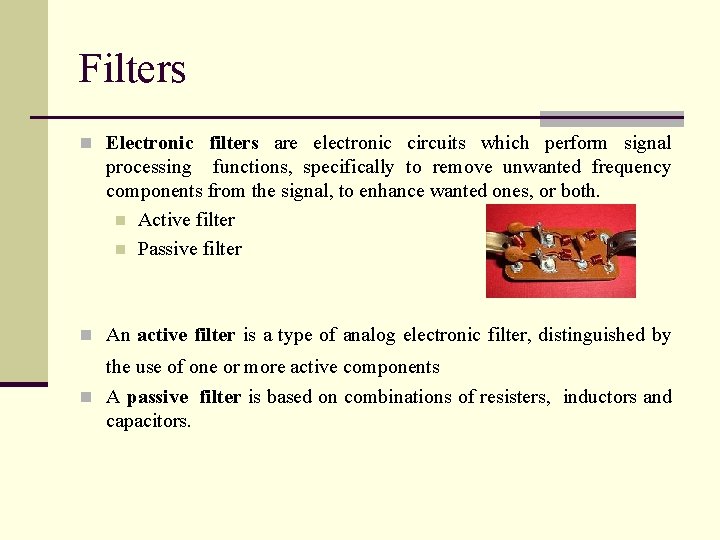
Filters n Electronic filters are electronic circuits which perform signal processing functions, specifically to remove unwanted frequency components from the signal, to enhance wanted ones, or both. n Active filter n Passive filter n An active filter is a type of analog electronic filter, distinguished by the use of one or more active components n A passive filter is based on combinations of resisters, inductors and capacitors.
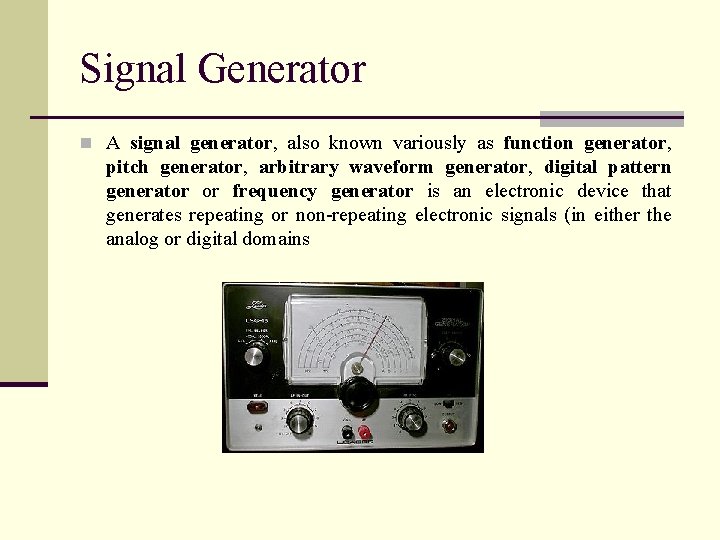
Signal Generator n A signal generator, also known variously as function generator, pitch generator, arbitrary waveform generator, digital pattern generator or frequency generator is an electronic device that generates repeating or non-repeating electronic signals (in either the analog or digital domains
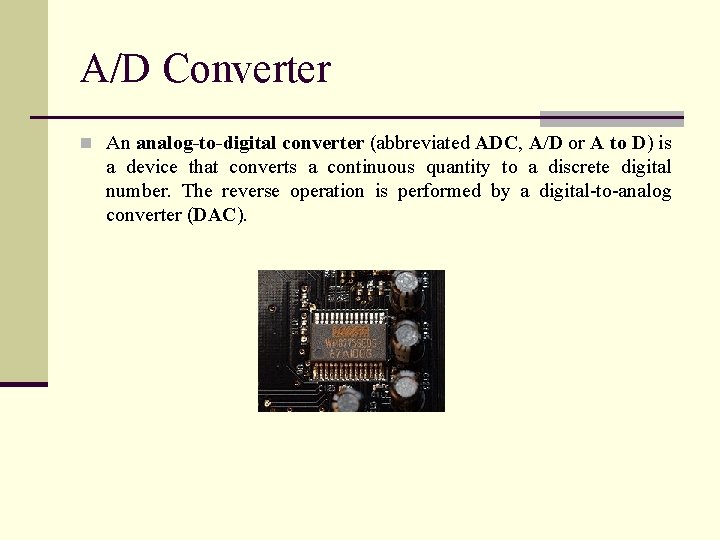
A/D Converter n An analog-to-digital converter (abbreviated ADC, A/D or A to D) is a device that converts a continuous quantity to a discrete digital number. The reverse operation is performed by a digital-to-analog converter (DAC).
Sensors and Actuators n A sensor is any device, such as a thermometer, that detects a physical condition in the world. n Actuators are devices, such as valves and switches, that perform actions such as turning things on or off or making adjustments in an operational system.
Combinational Logic Design Combinational logic design process n Create truth table from specification n Generate K-maps and obtain logic equations n Draw logic diagrams n Simulate circuit for design verification n Circuit optimization for the area or/and performance n Re-simulate and verify optimized design
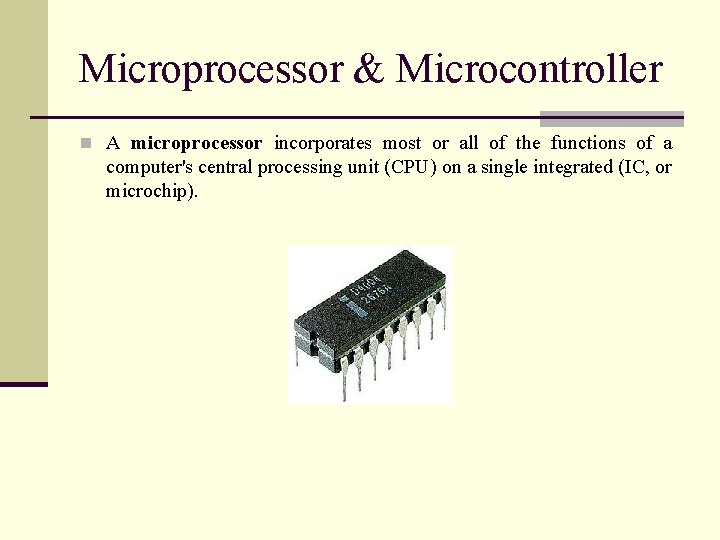
Microprocessor & Microcontroller n A microprocessor incorporates most or all of the functions of a computer's central processing unit (CPU) on a single integrated (IC, or microchip).
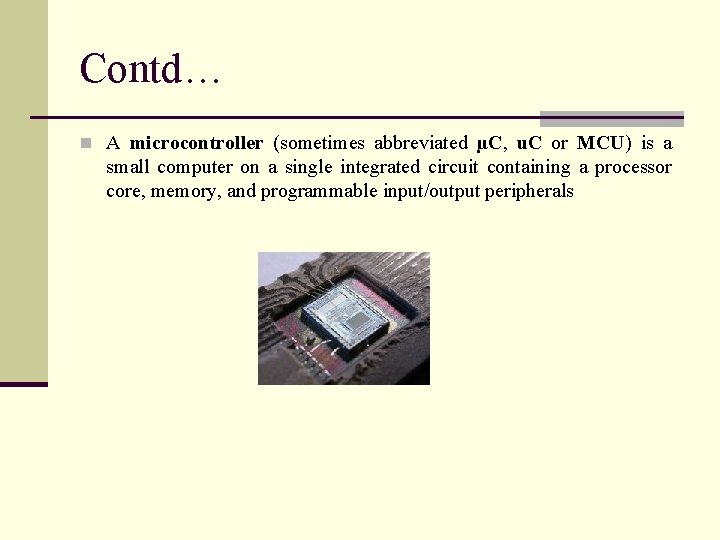
Contd… n A microcontroller (sometimes abbreviated µC, u. C or MCU) is a small computer on a single integrated circuit containing a processor core, memory, and programmable input/output peripherals
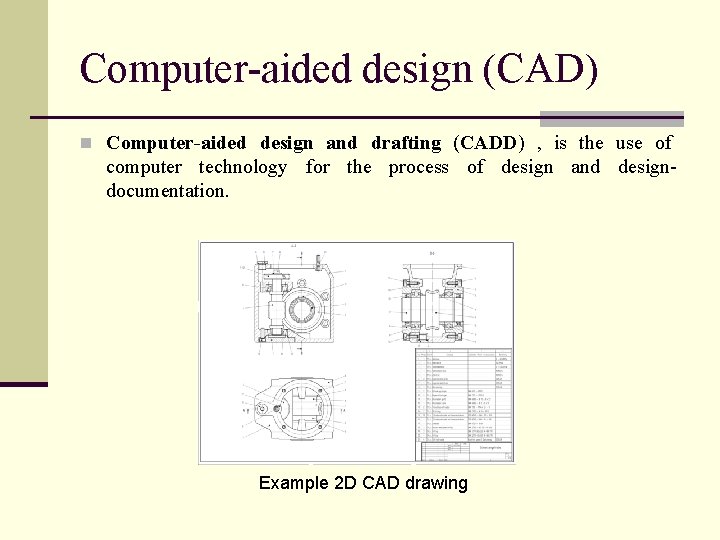
Computer-aided design (CAD) n Computer-aided design and drafting (CADD) , is the use of computer technology for the process of design and designdocumentation. Example 2 D CAD drawing
Advance trends in electronics System Design n Optoelectronic devices n Chemically Self-assembled Nanoelectronic Computing Networks n Carbon nanotubes n Nanotube-based Nano devices n Multiplier and Harmonic generator
Thanks