
Modern Theories of Intelligence Charles Spearman Intelligence At
- Slides: 10
Modern Theories of Intelligence
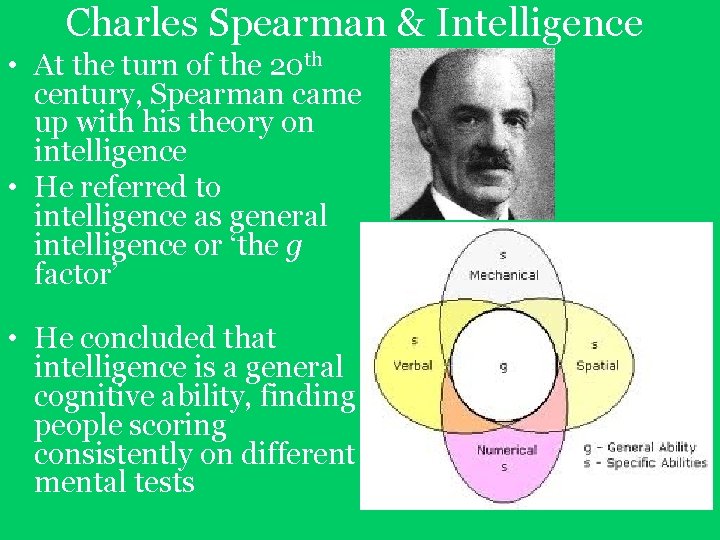
Charles Spearman & Intelligence • At the turn of the 20 th century, Spearman came up with his theory on intelligence • He referred to intelligence as general intelligence or ‘the g factor’ • He concluded that intelligence is a general cognitive ability, finding people scoring consistently on different mental tests
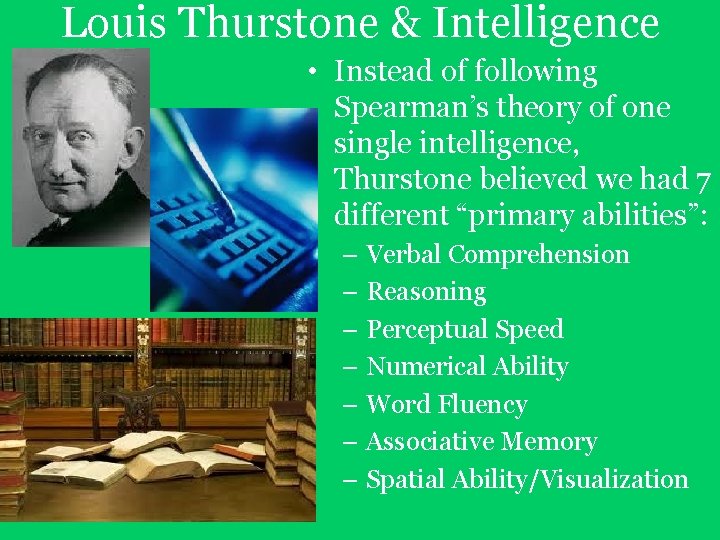
Louis Thurstone & Intelligence • Instead of following Spearman’s theory of one single intelligence, Thurstone believed we had 7 different “primary abilities”: – Verbal Comprehension – Reasoning – Perceptual Speed – Numerical Ability – Word Fluency – Associative Memory – Spatial Ability/Visualization
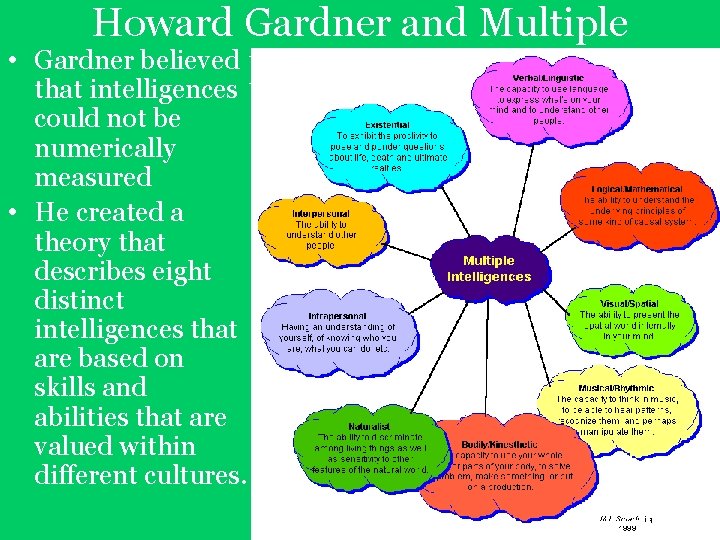
• Howard Gardner and Multiple Gardner believed Intelligences that intelligences could not be numerically measured • He created a theory that describes eight distinct intelligences that are based on skills and abilities that are valued within different cultures.
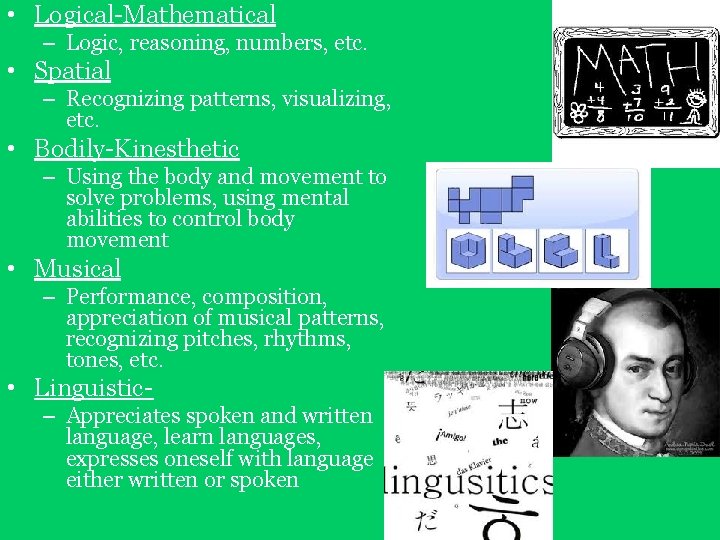
• Logical-Mathematical – Logic, reasoning, numbers, etc. • Spatial – Recognizing patterns, visualizing, etc. • Bodily-Kinesthetic – Using the body and movement to solve problems, using mental abilities to control body movement • Musical – Performance, composition, appreciation of musical patterns, recognizing pitches, rhythms, tones, etc. • Linguistic– Appreciates spoken and written language, learn languages, expresses oneself with language either written or spoken
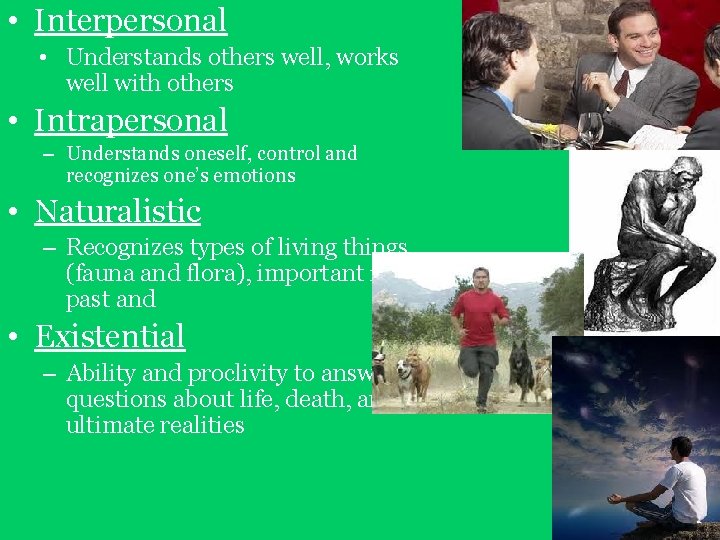
• Interpersonal • Understands others well, works well with others • Intrapersonal – Understands oneself, control and recognizes one’s emotions • Naturalistic – Recognizes types of living things (fauna and flora), important in past and • Existential – Ability and proclivity to answer questions about life, death, and ultimate realities
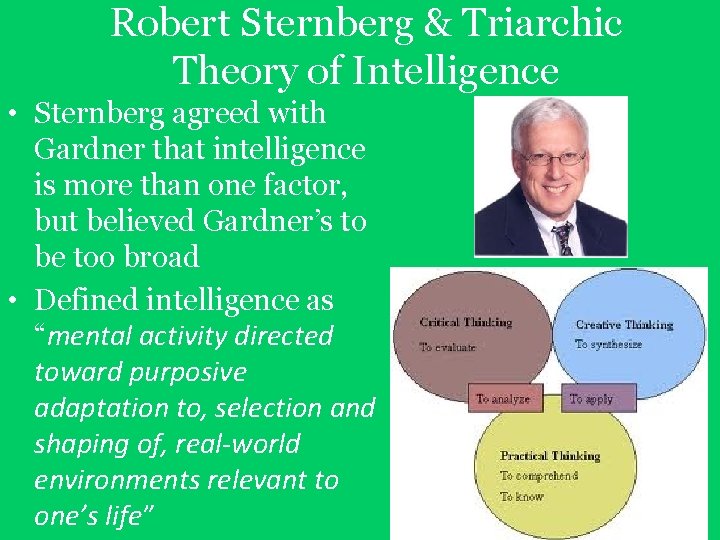
Robert Sternberg & Triarchic Theory of Intelligence • Sternberg agreed with Gardner that intelligence is more than one factor, but believed Gardner’s to be too broad • Defined intelligence as “mental activity directed toward purposive adaptation to, selection and shaping of, real-world environments relevant to one’s life”
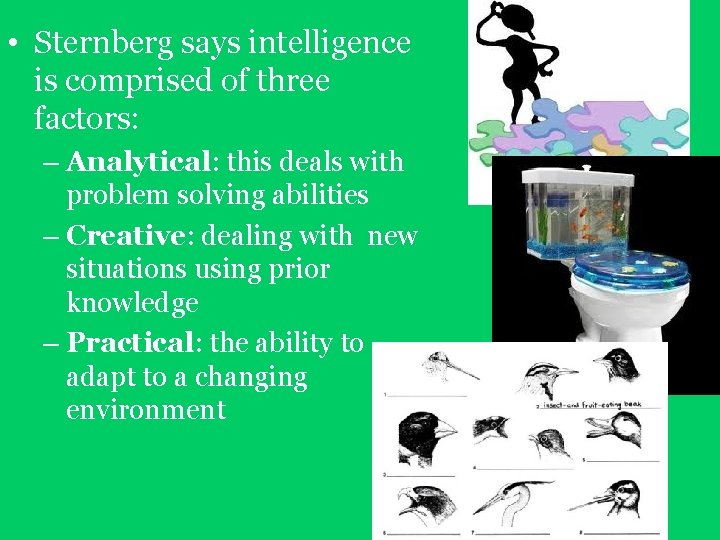
• Sternberg says intelligence is comprised of three factors: – Analytical: this deals with problem solving abilities – Creative: dealing with new situations using prior knowledge – Practical: the ability to adapt to a changing environment
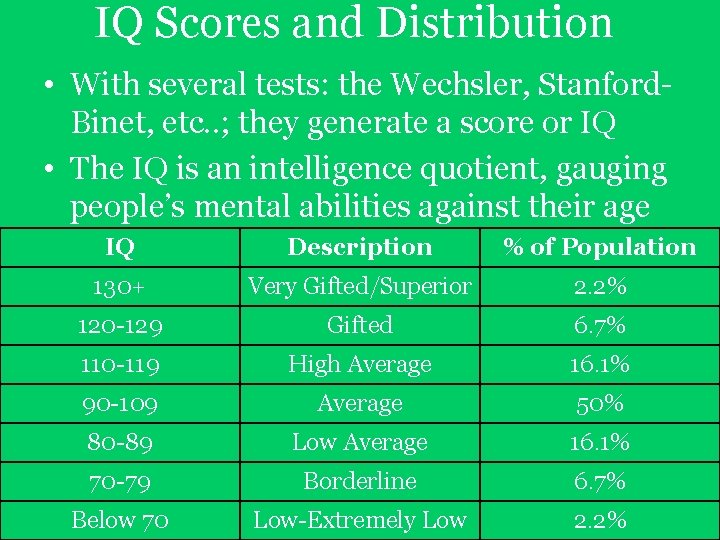
IQ Scores and Distribution • With several tests: the Wechsler, Stanford. Binet, etc. . ; they generate a score or IQ • The IQ is an intelligence quotient, gauging people’s mental abilities against their age IQ Description % of Population 130+ Very Gifted/Superior 2. 2% 120 -129 Gifted 6. 7% 110 -119 High Average 16. 1% 90 -109 Average 50% 80 -89 Low Average 16. 1% 70 -79 Borderline 6. 7% Below 70 Low-Extremely Low 2. 2%
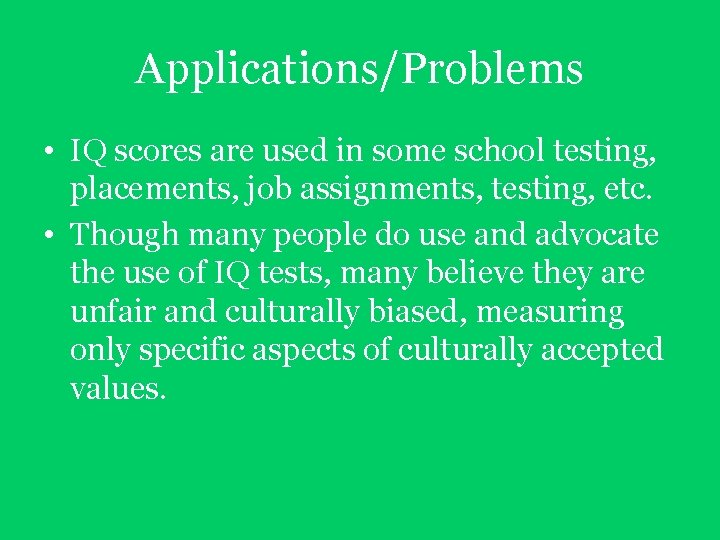
Applications/Problems • IQ scores are used in some school testing, placements, job assignments, testing, etc. • Though many people do use and advocate the use of IQ tests, many believe they are unfair and culturally biased, measuring only specific aspects of culturally accepted values.