
Modern Systems Analysis and Design Third Edition Jeffrey
- Slides: 24
Modern Systems Analysis and Design Third Edition Jeffrey A. Hoffer Joey F. George Joseph S. Valacich Chapter 11 Selecting the Best Alternative Design Strategy 11. 1 Copyright 2002 Prentice-Hall, Inc.
Learning Objectives üDescribe different sources of software üLearn to assemble the various pieces of an alternative design strategy üLearn how to generate at least three alternative design strategies üDiscuss selecting the best design strategy using both qualitative and quantitative methods 11. 2
Learning Objectives üLearn how to use the results of the analysis phase to update a Baseline Project Plan (BPP) üDiscuss design strategies and how they are applied to the Internet 11. 3
Selecting the Best Alternative Design Strategy Two basic steps 1. Generate a comprehensive set of alternative design strategies 2. Select the one design strategy that is most likely to result in the desired information system Process n n n 11. 4 Divide requirements into different sets of capabilities Enumerate different potential implementation environments that could be used to deliver the different sets of capabilities Propose different ways to source or acquire the various sets of capabilities for the different implementation environments
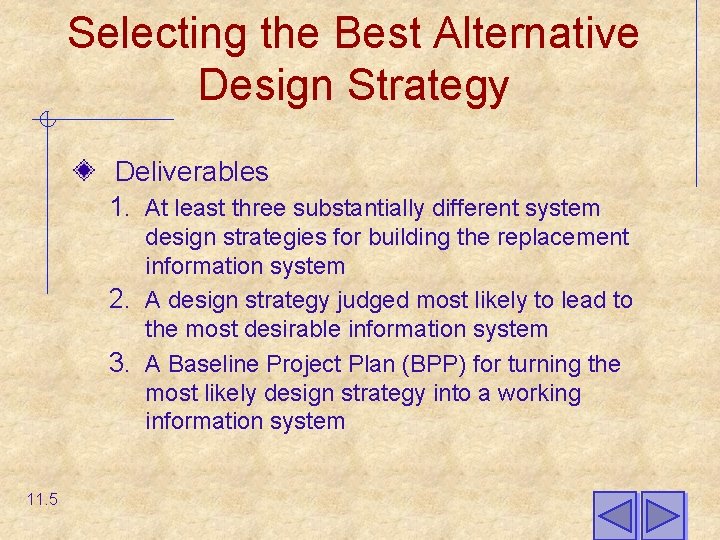
Selecting the Best Alternative Design Strategy Deliverables 1. At least three substantially different system design strategies for building the replacement information system 2. A design strategy judged most likely to lead to the most desirable information system 3. A Baseline Project Plan (BPP) for turning the most likely design strategy into a working information system 11. 5
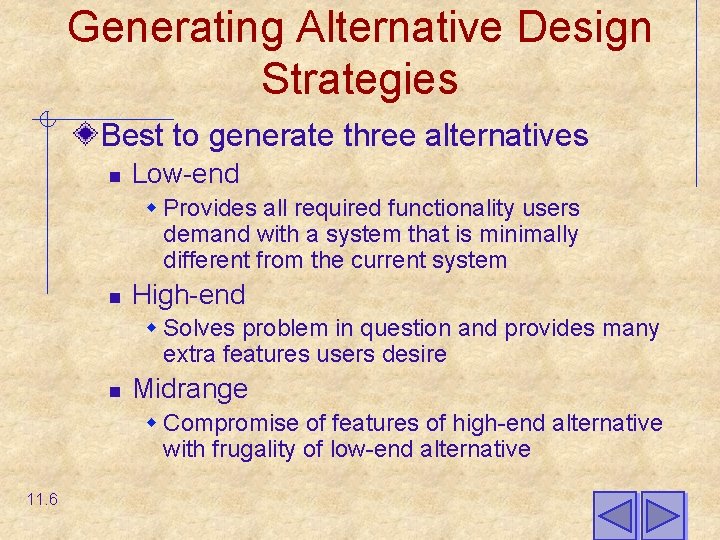
Generating Alternative Design Strategies Best to generate three alternatives n Low-end w Provides all required functionality users demand with a system that is minimally different from the current system n High-end w Solves problem in question and provides many extra features users desire n Midrange w Compromise of features of high-end alternative with frugality of low-end alternative 11. 6
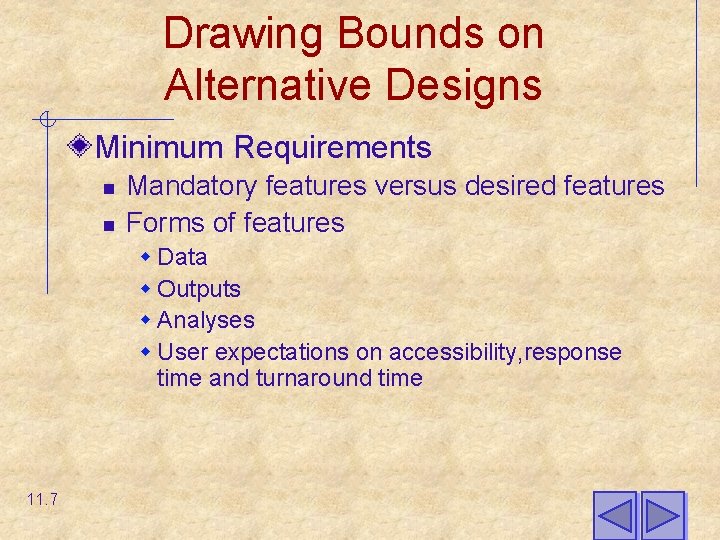
Drawing Bounds on Alternative Designs Minimum Requirements n n Mandatory features versus desired features Forms of features w Data w Outputs w Analyses w User expectations on accessibility, response time and turnaround time 11. 7
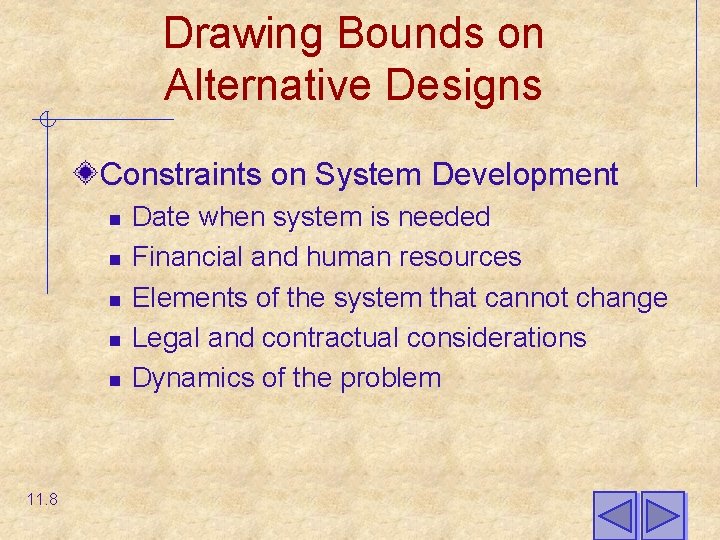
Drawing Bounds on Alternative Designs Constraints on System Development n n n 11. 8 Date when system is needed Financial and human resources Elements of the system that cannot change Legal and contractual considerations Dynamics of the problem
Issues to Consider in Generating Alternatives Outsourcing n n 11. 9 The practice of turning over responsibility of some to all of an organization’s information systems applications and operations to an outside firm Can provide a cost effective solution
Issues to Consider in Generating Alternatives Sources of Software n n n 11. 10 Hardware manufacturers Packaged software producers Custom software producers Enterprise solution software Application Service Providers In-house development
11. 11
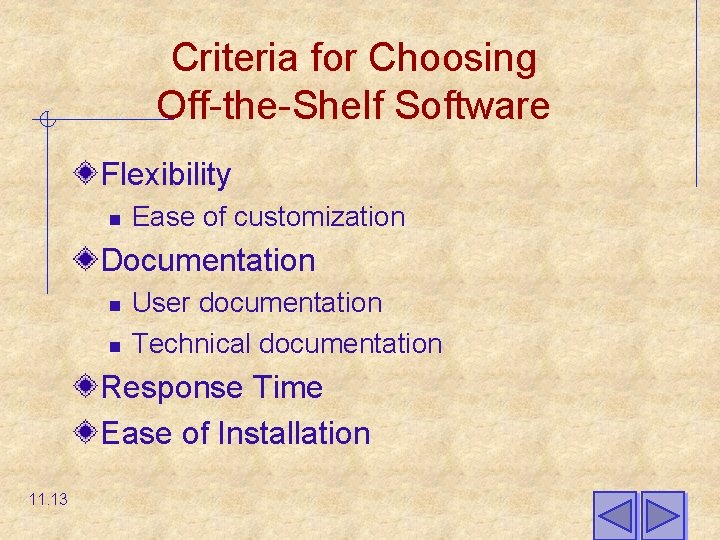
Criteria for Choosing Off-the-Shelf Software Cost n In-House versus purchased Functionality n Mandatory, essential and desired features Vendor Support n n n Installation Training Technical Support Viability of Vendor 11. 12
Criteria for Choosing Off-the-Shelf Software Flexibility n Ease of customization Documentation n n User documentation Technical documentation Response Time Ease of Installation 11. 13
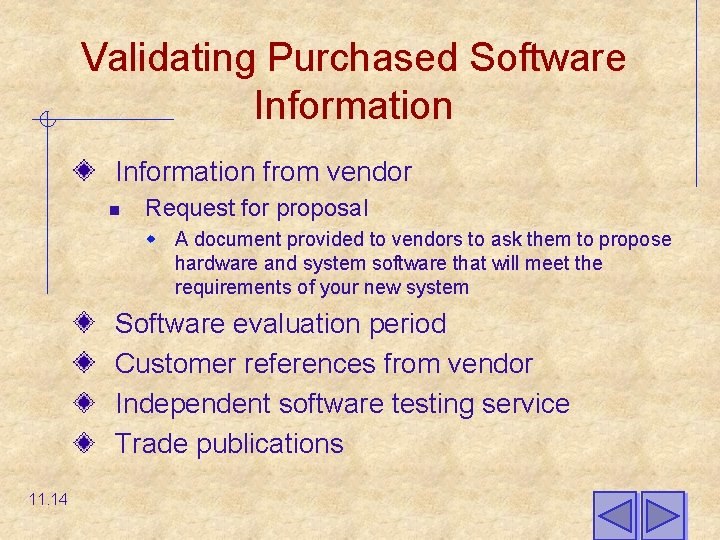
Validating Purchased Software Information from vendor n Request for proposal w A document provided to vendors to ask them to propose hardware and system software that will meet the requirements of your new system Software evaluation period Customer references from vendor Independent software testing service Trade publications 11. 14
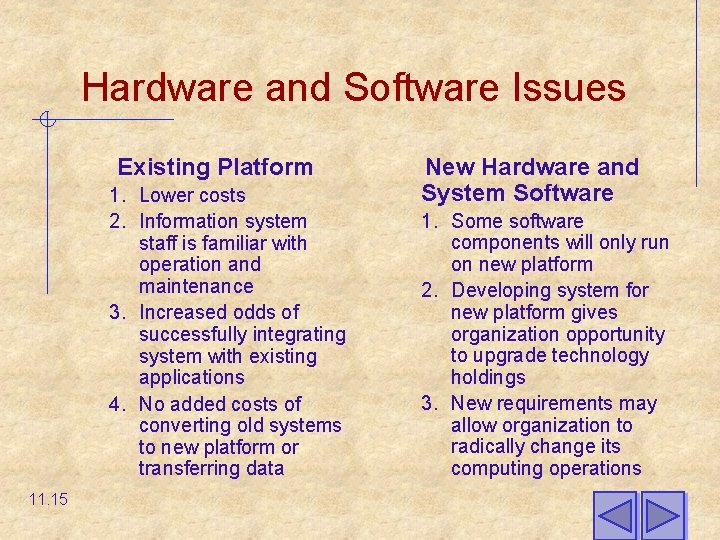
Hardware and Software Issues Existing Platform 1. Lower costs 2. Information system staff is familiar with operation and maintenance 3. Increased odds of successfully integrating system with existing applications 4. No added costs of converting old systems to new platform or transferring data 11. 15 New Hardware and System Software 1. Some software components will only run on new platform 2. Developing system for new platform gives organization opportunity to upgrade technology holdings 3. New requirements may allow organization to radically change its computing operations
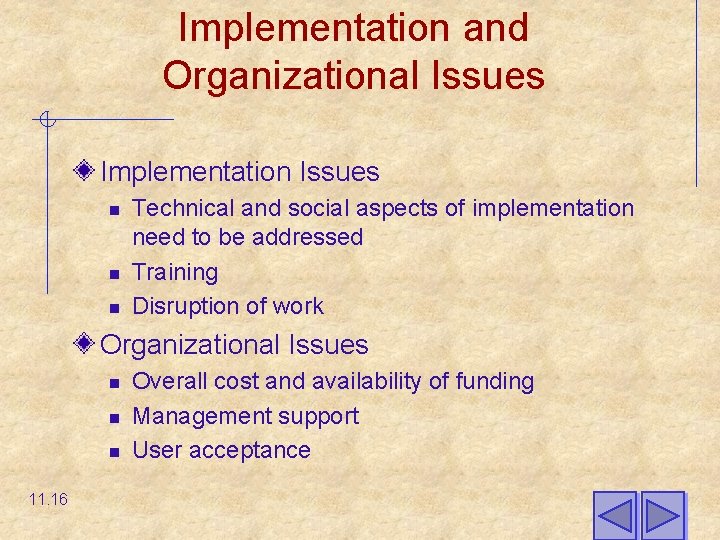
Implementation and Organizational Issues Implementation Issues n n n Technical and social aspects of implementation need to be addressed Training Disruption of work Organizational Issues n n n 11. 16 Overall cost and availability of funding Management support User acceptance
Hoosier Burger’s New Inventory Control System Replacement for existing system Figure 11 -2 ranks system requirements and constraints Figure 11 -3 shows steps of current system When proposing alternatives, the requirements and constraints must be considered 11. 17
Hoosier Burger’s New Inventory Control System Figure 11 -4 lists 3 alternatives n n n 11. 18 Alternative A is a low-end proposal Alternative C is a high-end proposal Alternative B is a midrange proposal
Hoosier Burger’s New Inventory Control System Selecting the most likely alternative n n n Weighted approach can be used to compare three alternatives Figure 11 -5 shows a weighted approach for Hoosier Burger Left hand side of table contains decision criteria w Constants and requirements w Weights are arrived at by discussion with analysis team, users and managers n 11. 19 Each requirement and constraint is ranked w 1 indicates that the alternative does not match the request well or that it violates the constraint w 5 indicates that the alternative meets or exceeds requirements or clearly abides by the constraint
Hoosier Burger’s New Inventory Control System Selecting the most likely alternative n 11. 20 According to the weights used, alternative C appears to be the best choice
Updating the Baseline Project Plan (BPP) The Baseline Project Plan (BPP) was developed during project initiation and planning Baseline Project Plan (BPP) can be used as an outline of a status report at analysis phase Schedule will be updated to reflect actual activities and durations An oral presentation of project status is typically made at this phase 11. 21
Internet Development: Selecting the Best Alternative Design Strategy Pine Valley Furniture Web. Store n 11. 22 Requirements and constraints were compiled by consultant and team (see Table 11 -8)
Internet Development: Selecting the Best Alternative Design Strategy n Proposed system is a scalable, three-tier approach w Scalable n The ability to seamlessly upgrade the system through either hardware upgrades, software upgrades or both w Three-tier n n n 11. 23 Web Server n Provides connection to the internet and presentation of HTML page Applications Server n Middle layer of software and hardware that lies between Web server and corporate network Corporate network n Existing organizational computing infrastructure
Summary Sources of Software Identifying requirements and constraints Generating alternative design strategies Selecting the best design strategy Updating a Baseline Project Plan (BPP) Selecting the best design strategy for Internet applications 11. 24