
Modern Software Design Methods for Concurrent and RealTime
- Slides: 31
Modern Software Design Methods for Concurrent and Real-Time Systems By Hassan Gomaa Presented by James Roberts 2 -12 -2007
Introduction u u Real-Time systems are becoming more prevalent Concurrent processing is a part of real-time systems
Concurrent Processing Concepts Concurrent Tasks u Mutual Exclusion u Synchronization of Tasks u Message Communication u
Concurrent Tasks u u u A concurrent task (process) is the execution of a sequential component of a concurrent program. It is having multiple asynchronous tasks running at different speeds. Concurrent tasks need to coordinate
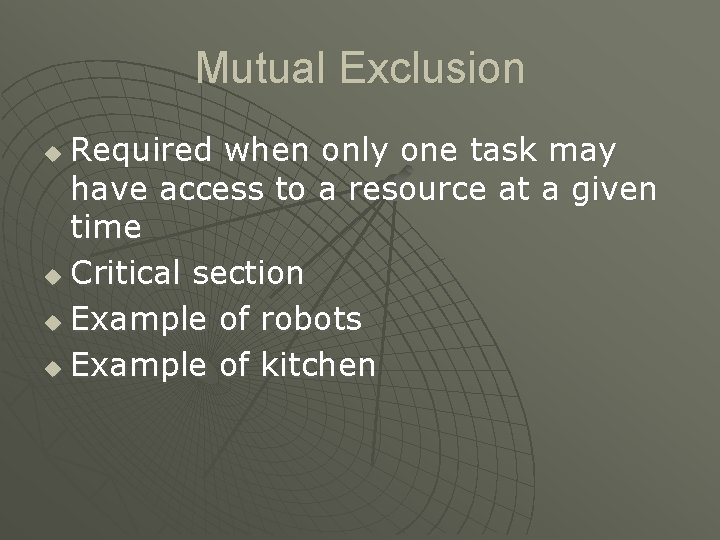
Mutual Exclusion Required when only one task may have access to a resource at a given time u Critical section u Example of robots u Example of kitchen u
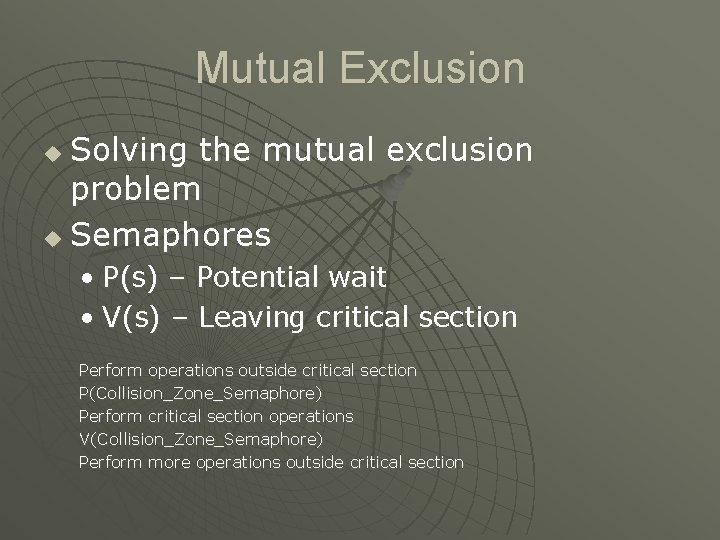
Mutual Exclusion Solving the mutual exclusion problem u Semaphores u • P(s) – Potential wait • V(s) – Leaving critical section Perform operations outside critical section P(Collision_Zone_Semaphore) Perform critical section operations V(Collision_Zone_Semaphore) Perform more operations outside critical section
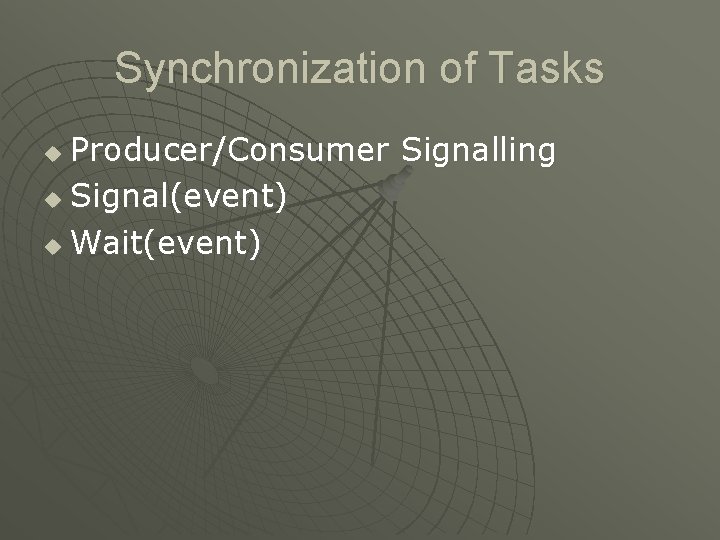
Synchronization of Tasks Producer/Consumer Signalling u Signal(event) u Wait(event) u
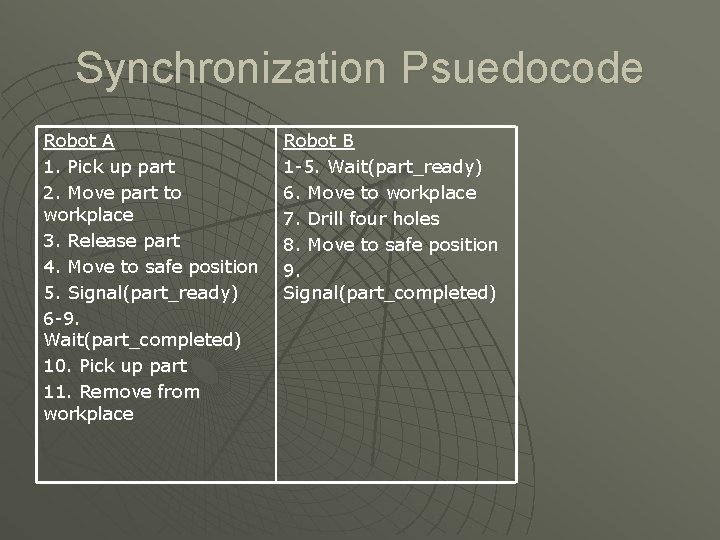
Synchronization Psuedocode Robot A 1. Pick up part 2. Move part to workplace 3. Release part 4. Move to safe position 5. Signal(part_ready) 6 -9. Wait(part_completed) 10. Pick up part 11. Remove from workplace Robot B 1 -5. Wait(part_ready) 6. Move to workplace 7. Drill four holes 8. Move to safe position 9. Signal(part_completed)
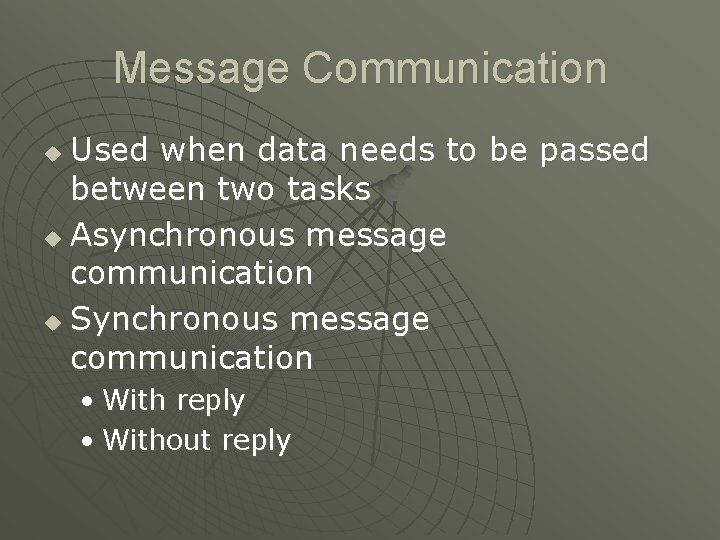
Message Communication Used when data needs to be passed between two tasks u Asynchronous message communication u Synchronous message communication u • With reply • Without reply
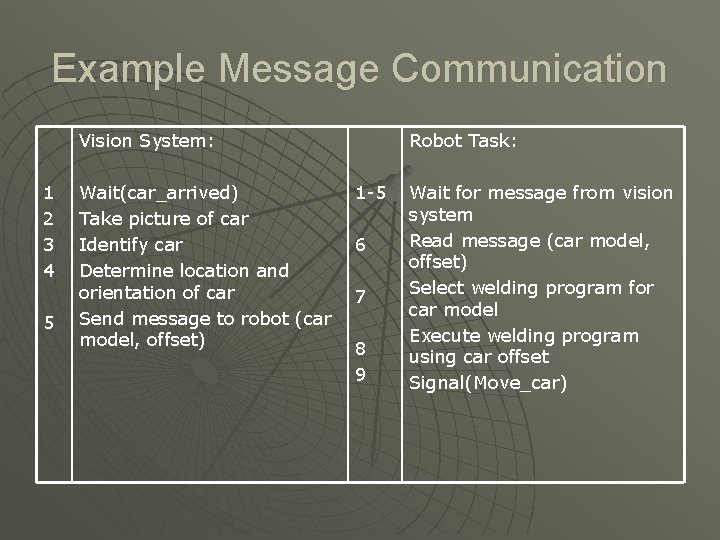
Example Message Communication Vision System: 1 2 3 4 5 Wait(car_arrived) Take picture of car Identify car Determine location and orientation of car Send message to robot (car model, offset) Robot Task: 1 -5 6 7 8 9 Wait for message from vision system Read message (car model, offset) Select welding program for car model Execute welding program using car offset Signal(Move_car)
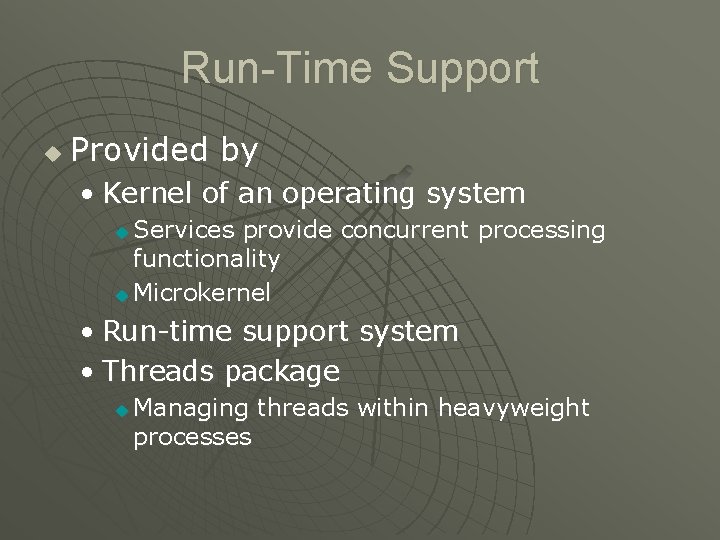
Run-Time Support u Provided by • Kernel of an operating system Services provide concurrent processing functionality u Microkernel u • Run-time support system • Threads package u Managing threads within heavyweight processes
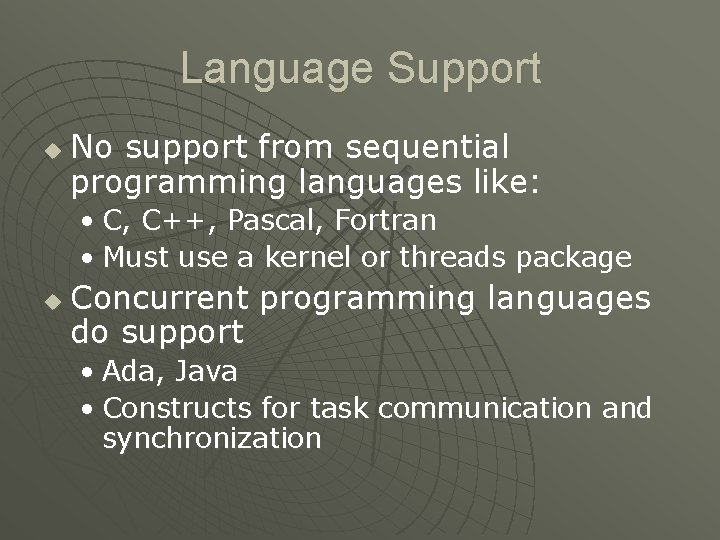
Language Support u No support from sequential programming languages like: • C, C++, Pascal, Fortran • Must use a kernel or threads package u Concurrent programming languages do support • Ada, Java • Constructs for task communication and synchronization
Real-Time Operating Systems u Requirements • Support multitasking • Support priority preemption scheduling • Provide synchronization and communication • Provide memory-locking • Provide a mechanism for priority inheritance • Have a predictable behavior
Design Methods u Several design methods have been developed. • MASCOT • RTSAD (Real-Time Structured Analysis and Design • DARTS (Design Approach for Real-Time Systems) • JSD (Jackson System Development) • CODARTS (Concurrent Design Approach for Real-Time Systems) • Octopus • ROOM (Real-Time Object-Oriented Modeling)
A Modern Design Method COMET (Concurrent Object Modeling and Architectural Design Method) u Integrates object-oriented and concurrent processing concepts u Uses the UML (Unified Modeling Language) notation u Describes decision made on how to use the UML notation u
The COMET Method Used to develop concurrent applications u Highly iterative software life-cycle u • Requirements modeling • Analysis modeling • Design modeling
Requirements Modeling The UML use case model is developed u Actors can be u • Human users • External systems • I/O Devices • Timers
Analysis Modeling Static Modeling u Object Structuring u Dynamic Modeling u
Static Modeling u System context • The interface between the system and the external environment u UML does not support system context diagram • Use a static model or • Collaboration model
Object Structuring u u Categorize objects in order to group similar objects. UML stereotypes are used Stereotype – A subclass of an existing modeling element Can be • • <<entity>> class <<interface>> class <<control>> class <<application logic>> class
Dynamic Modeling State-dependent dynamic analysis u State chart is used u Collaboration diagram is used u These two diagrams are used in conjuction u
Design Modeling Transition From Analysis to Design u Software Architecture Design u Concurrent Collaboration Diagrams u Architectural Design u Task Structuring u Detailed Software Design u
Transition from Analysis to Design u u Collaboration diagram is developed for each use case Consolidated collaboration diagram • A synthesis of all the collaboration diagrams developed to support the use cases • Can be quite large • May call for subsystem collaboration diagrams to be developed u Analogous to robustness analysis
Software Architecture Design Broken down into subsystems u Interfaces between subsystems are defined u The goal – To have objects with strong coupling in the same subsystem, weak coupling in differing systems. u Subsystem – A composite object u
Concurrent Collaboration Diagrams u Active objects are identified • Have own threads of control • Thick black lines u Passive objects are identified • Activated by other objects • Thin black lines
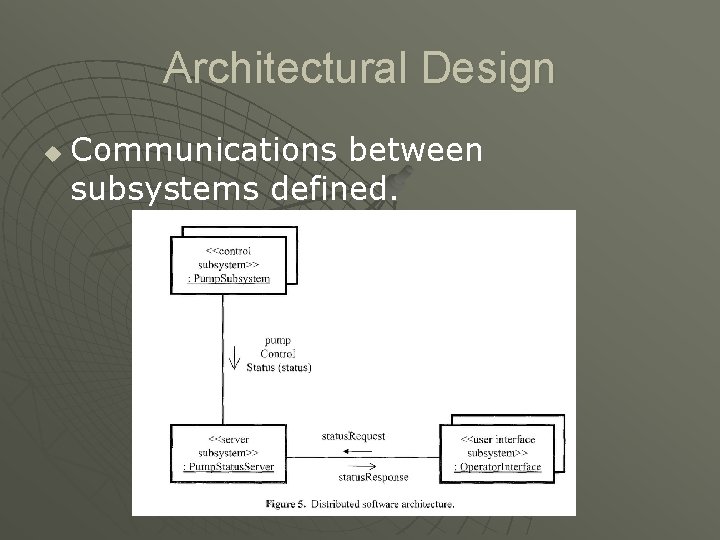
Architectural Design u Communications between subsystems defined.
Task Structuring u u u Each subsystem is structured into concurrent tasks Task interfaces defined Stereotypes are used • <<I/O device interface>> <<Asynchronous I/O device interface>> u <<Periodic I/O device interface>> u <<Passive I/O device interface>> u <<Resource monitor>> u • <<External input device>> • Etc…
Detailed Software Design Composite task internals designed u Detailed task synchronization issues u Connector classes designed u Task’s internal event sequencing logic is defined u
Performance Analysis Performance analysis in real-time systems is very important u Use realtime scheduling theory u Event sequence analysis u
Conclusions Real-Time Software Design is not very different from normal software design u There a few different issues to watch out for and design for u This method is particularly nice since it uses the UML which most already have an idea of how to use u
Questions? ? ?