
Modern Political Theory Syllabus UNIT I Nature of
Modern Political Theory
Syllabus UNIT I : Nature of Political Theory – Significance of Political Theory – State of Political Theory Today – Decline – or Resurgence. UNIT –II: Approaches to the Study of Politics: Traditional Approaches – Contemporary Approaches – Behavioral Approach; Post – Behavioral Revolution – Models of Political Analysis System Analysis; Structural – Functional Analysis – Communications Theory; Decision Making Analysis; Marxian Analysis. UNIT III : Political Elite – Plato’s Ideas – Mosca on Elite Theory – Theory of Circulation of Elite – Concept of Sub Elite – Michel Roberts and Elite Theory. UNIT IV : Political Alienation – Nature and Necessary Implication Alienation and Polity – Maxian Theory – Sociological Theory – Existential Theory. UNIT : V Post Modernism –Feminism – Multiculturalism Globalization The Future of Political Theory.
Concept of Political Theory Political theory is a set of specified relationships encompassing political matters that focus and organize inquiry to describe, explain, and predict political events and behaviours. Political theory is considered as the basis and branch of political science which attempts to arrive at generalizations, inferences, or conclusions to be drawn from the data gathered by other specialists, not only in political science, but throughout the whole range of human knowledge and experience.
From ancient Greece to the present, the history of political theory has dealt with fundamental and perennial ideas of Political Science. Political theory reflects upon political phenomenon, processes and institutions and on actual political behaviour by subjecting it to philosophical or ethical criterion. The most dominant political theories realise all three goals such as describe, explain, and predict. The theories are the results of thoughts and research of many scholars and exponents of political science. Thinkers on the subject formulate definitions of various political concepts and establish theories
David Held described that "Political theory is a network of concepts and generalizations about political life involving ideas, assumptions and statements about the nature, purpose and key features of government, state and society, and about the political capabilities of human beings.
Significance Political philosophy, also known as political theory, is the study of topics such as politics, liberty, justice, property, rights, law, and the enforcement of laws by authority: what they are, if they are needed, what makes a government legitimate, what rights and freedoms it should protect, what form it should take, As mentioned earlier, the fundamental question facing human beings has been ‘how to live together’. Politics is an activity engaged with the management of the collective affairs of society.
The significance of theory lies in evolving various doctrines and approaches regarding the nature and purpose of the state, the bases of political authority, vision of an ideal state, best form of government, relations between the state and the individual and basic issues such as rights, liberty, equality, property, justice etc.
Contemporary states face a number of problems such as poverty, over population, corruption, racial and ethnic tensions, environment pollution etc. , conflicts among individuals, groups as well as nations. The task of political theory is to study and analyse more profoundly than others, the immediate and potential problems of political life of the society and to supply the practical politician with an alternative course of action, the consequences of which have been fully thought of.
Decline of Political Theory David Easton writes, “Political theory today is interested primarily in the history of ideas”. This was the exact character of political theory. Also it was inextricably associated with notions of value and general principles. Easton could not accept this position of political theory. He thought that value, principles and history cannot be the sole determiners of political theory. According to David Easton the ever increasing role of historicism is a major cause of the decline of political theory. In his words: “Political theory has been devoted to a form of historical researches that has robbed it of its earlier, constructive role”.
Domination of Moral Theory For several centuries political science in general and political theory in particular was dominated by the moral premises of Western civilisation. The exponents of these moral premises have constantly and vigorously preached that they are right and no objection or criticism can be levelled against them. This notion also crippled all sorts of research work. Students of political theory took no interest to verify the various aspects of political theory with the help of new facts and data. It was very much difficult for them to challenge the prevailing notion about political theory.
Ideological Reductionism: The decline of political theory can be traced to “ideological reductionism”. Before entering into the depth of the matter ideology and reductionism ought to be clarified. “An ideology is a more or less coherent set of ideas that provides a basis for organised political action”. Simply stated, ideology is a set of coherent ideas. Generally, ideology is related to politics. Reductionism is the practice of analysing and describing a complex phenomenon in terms of its simple or fundamental constituents especially when it is said to provide a sufficient explanation.
Contemporary Conditions: Contemporary conditions of various parts of the globe have contributed to the decline of political theory. Some of these conditions are stated below: Bureaucracy and ideology completely dominated the political as well as ideological affairs of the state, The academic world hardly got any opportunity to think and express freely. Political scientists, researchers and other academicians were not in a position to pursue their academic works without any outside restrictions.
Absence of Man of Vision: Plato, Aristotle, Hobbes, Locke, Rousseau, Hegel, Marx etc. traversed the lanes of political science, political theory, philosophy, and political philosophy with a clear vision in their mind and far flung outlook. We may not agree with what they propounded but they said something worthwhile. But when the tradition and vision created by them came to an end the political scientists lacked the vision and zeal which their predecessors possessed and this lack of vision was to some extent responsible for the declining condition of political theory. Plato, Aristotle, Marx etc. followed this general principle. Plato conceived of an ideal state, Aristotle thought of a polity which will be free from the causes of schisms. Marx imagined of a communist society. All these visions provided raw materials for building up a structure of political theory.
Resurgence of Political Theory is not Dead: The political theory during the last several decades has declined. But the declining condition does not indicate that political theory is dead. The subject was restricted within the activities of these organisations and institutions. Political theory revolved around these traditional conceptions. This traditional outlook considerably dwarfed the content and scope of political theory: Particularly in the field of policy making political theory had no spectacular role to play. But the real scope of political theory is much broader than the one envisaged by traditional thinkers.
Commencement of Resurgence: The post Second World War period—specifically the 1950 s— witnessed new directions in the development of political theory and it is observed that the War served as a dividing line between the old and the new concepts of political theory. A large number of scholars from Europe migrated to America and many of them began serious research work on political theory and their interest did not lie in the study of political theory in traditional way. They arrived at the conclusion that the traditional method of analysing political phenomena and theory was not adequate for new reforms or rejuvenation of political theory. New methods are to be devised. This tendency finally laid the foundation of a new way of studying political theory.
Behaviouralism: Behaviouralism constitutes a very important aspect of the resurgence of political theory that took place at the beginning of the fifties of the last century. A brief definition of behaviouralism runs as follows. It is a belief that social theories can be constructed on the basis of observable facts and behaviour, quantifiable data and facts. it does not deal with all sorts of behaviour of the individuals but only with that behaviour which displays political character.
Approaches of political theory: The study of political science and in the process of search for political truth certain procedure must be followed. These procedures are defined as approaches, methods, techniques and strategies. Approaches to study political science are grouped as traditional and modern approaches Traditional approaches: Traditional approaches are value based. These approaches put emphasis on values more that facts. Advocates of this approaches believe that the study of political science cannot and should not be purely scientific. They stated that in social science such as facts values are closely related with each other. In politics, emphasis should not be on the facts but on the moral quality of political event.
Characteristics of Traditional approaches: Traditional approaches are largely normative and stresses on the values of politics. Emphasis is on the study of different political structures. Traditional approaches made very little attempt to relate theory and research. These approaches believe that since facts and values are closely interlinked, studies in Political Science can never be scientific.
Types of traditional approaches: Philosophical Approach This approach is considered as the oldest approach in the arena of Political Science. The development of this approach can be traced back to the times of the Greek philosophers like Plato and Aristotle. Leo Strauss was one of the main supporter of the philosophical approach. He considered that “the philosophy is the quest for wisdom and political philosophy is the attempt truly to know about the nature of political things and the right or good political order. The aim of this approach is to evolve the standard of right and wrong, for the purpose of critical evaluation of existing institutions, laws and polices
This approach is based on theoretical principle that the values cannot be separated from the study of politics. Therefore, its main concern is to judge what is good or bad in any political society. It is mainly an ethical and normative study of politics and, thus, idealistic. It addresses the problems of the nature and functions of the state, citizenship, rights and duties etc.
Historical Approach: Theorists who developed this political approach focused on the historical factors like the age, place and the situation in which it is evolved are taken into consideration. This approach is related to history and it emphasizes on the study of history of every political reality to analyse any situation. Political thinkers such as Machiavelli, Sabine and Dunning considered that politics and history are closely related and the study of politics always should have a historical standpoint.
This approach strongly maintains the belief that the thinking or the dogma of every political thinker is formed by the surrounding environment. Furthermore, history provide details of the past as well as it also links it with the present events. History gives the chronological order of every political event and thereby helps in future estimation of events also. Therefore, without studying the past political events, institutions and political environment it would be erroneous to analyse the present political events.
Institutional Approach: This is traditional and significant approach in studying Political Science. This approach primarily deals with the formal features of government and politics accentuates the study of the political institutions and structures. Therefore, the institutional approach is concerned with the study of the formal structures like legislature, executive, judiciary, political parties, and interest groups. The supporters of this approach includes both ancient and modern political philosophers. Among the ancient thinkers, Aristotle had significant role in shaping this approach while the modern thinkers include James Bryce, Bentley, Walter Bagehot, Harold Laski contributed to develop this approach.
Legal Approach: This approach concerns that the state is the fundamental organization for the formation and enforcement of laws. Therefore, this approach is concerned with the legal process, legal bodies or institutions, justice and independence of judiciary. The supporters of this approach are Cicero, Jean Bodin, Thomas Hobbes, Jeremy Bentham, John Austin, Dicey and Sir Henry Maine. These approaches were principled also as their concern went beyond how and why political events happen to what ought to happen. In the later period, the modern approaches have made an attempt to make the study of Political Science more scientific and, therefore, emphasize pragmatism.
Behaviouralism is an approach in political science that emerged in the 1930 s in the United States. It represented a sharp break from previous approaches in emphasizing an objective, quantified approach to explain and predict political behaviour. It is associated with the rise of the behavioural sciences, modeled after the natural sciences. Behaviouralism claims it can explain political behaviour from an unbiased, neutral point of view. Behaviouralists seek to examine the behaviour, actions, and acts of individuals – rather than the characteristics of institutions such as legislatures, executives, and judiciaries – and groups in different social settings and explain this behavior as it relates to the political system.
Meaning of the term David Easton was the first to differentiate behaviouralism from behaviourism in the 1950 s (behaviourism is the term mostly associated with psychology). In the early 1940 s, behaviourism itself was referred to as a behavioural science and later referred to as behaviourism. However, Easton sought to differentiate between the two disciplines:
Post Behavioural revolution Post behaviouralism is the next step or reform movement of behavioural revolution. Like behaviouralism, it was again propounded by David Easton in his presidential address to the American Political Science Association in 1969. It has two slogans ‘action’ and ‘relevance’. It calls on the behavioural political scientists to study urgent and emergent problems, attend to crises and challenges of the contemporary society, and commit themselves to find out proper solutions. During behav iouralheydays, they were neglecting, in the name of developing a ‘pure science of polities’, their responsibility towards society.
Easton has discussed three main sources for the incoming of post-behavioural revolution: (a) Dissatisfaction with the efforts to make Political Science a natural science; (b) Utmost desire to find out solutions to the crises and problems of society; and (c) A movement by a group of political scientists and an intellectual tendency. Post behaviouralism accepted the main tenets of behaviouralism but wanted to take Political Science towards new directions – making it more responsible and more utilitarian. unlike behaviouralism, it is not related to any particular ideology or group. It included leftists, rightists, conservatives, classicists, methodologists, etc. However, it is a bit exagger ation to call it a ‘revolution’.
System Analysis System analysis is part of the behaviouralist movement in political science and as a reaction to traditional approach. David Easton was the first to think to analyzing politics from the point of view of system analysis in his work Political System (1953). In simple terms, Easton's behavioral approach to politics, proposed that a political system could be seen as a delimited (i. e. all political systems have precise boundaries) and fluid (changing) system of steps in decision making.
Step 1. changes in the social or physical environment surrounding a political system produce "demands" and "supports" for action or the status quo directed as "inputs" towards the political system, through political behavior. Step 2, these demands and supporting groups stimulate competition in a political system, leading to decisions or "outputs" directed at some aspect of the surrounding social or physical environment. Step 3, after a decision or output is made (e. g. , a specific policy), it interacts with its environment, and if it produces change in the environment, there are "outcomes. "
Step 4, when a new policy interacts with its environment, outcomes may generate new demands or supports and groups in support or against the policy ("feedback") or a new policy on some related matter. Step 5, feedback, leads back to Step 1, forming a never ending cycle. If the system functions as described, then we have a "stable political system". If the system breaks down, then we have a "dysfunctional political system".
Structural Functional Analysis Structural functionalism, in sociology and other social sciences, a school of thought according to which each of the institutions, relationships, roles, and norms that together constitute a society serves a purpose, and each is indispensable for the continued existence of the others and of society as a whole. Each structural element has a definite function or purpose. In structural functionalism, social change is regarded as an adaptive response to some tension within the social system. When some part of an integrated social system changes, a tension between this and other parts of the system is created, which will be resolved by the adaptive change of the other parts.
The origin of contemporary references to social structure can be traced to the French social scientist Émile Durkheim, who argued that parts of society are interdependent and that this interdependency imposes structure on the behaviour of institutions and their members. To Durkheim, the interrelations between the parts of society contributed to social unity—an integrated system with life characteristics of its own, exterior to individuals yet driving their behaviour.
Communication Theory Communication theory is a field of information theory that studies the technical process of information. Communication theory was proposed by S. F. Scudder in the year 1980. It states that all living beings existing on the planet communicate although the way of communication is different. Thus the universal law of communication theory says that all living beings whether they are plants, animals, human beings communicate through sound, speech, visible changes, body movements, gestures or in the best possible way to make the others aware of their thoughts, feelings, problems, happiness or any other information.
Elements of communication Source: "information source", which "produces a message or sequence of messages to be communicated to the receiving terminal. " Sender: the "transmitter", which "operates on the message in some way to produce a signal suitable for transmission over the channel. " In Aristotle, this element is the "speaker" (orator). Channel: the channel is "merely the medium used to transmit the signal from transmitter to receiver. " Receiver: the receiver "performs the inverse operation of that done by the transmitter, reconstructing the message from the signal. " Destination: For Shannon, the destination is "the person (or thing) for whom the message is intended" Message: The message is an information, communication, or statement that is sent in a verbal, written, recorded, or visual form to the recipient. Feedback
Decision Making Stages of Decision Making Types of Decisions Decision Making Process Theories of Decision Making Organisation of Decision Making
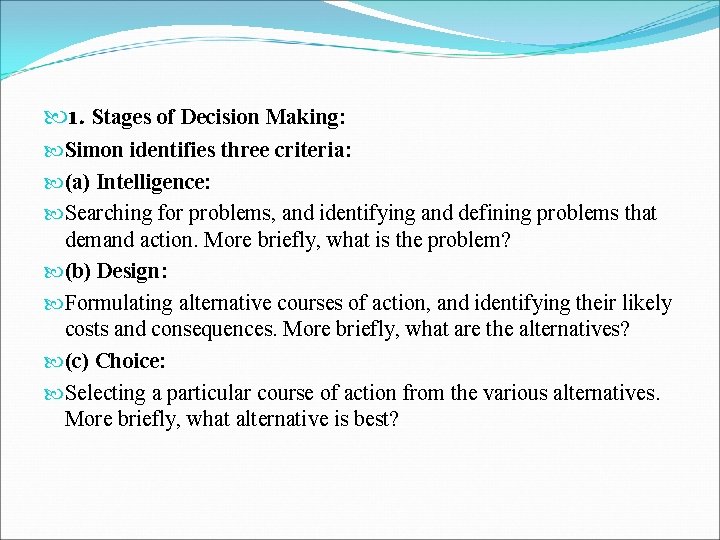
1. Stages of Decision Making: Simon identifies three criteria: (a) Intelligence: Searching for problems, and identifying and defining problems that demand action. More briefly, what is the problem? (b) Design: Formulating alternative courses of action, and identifying their likely costs and consequences. More briefly, what are the alternatives? (c) Choice: Selecting a particular course of action from the various alternatives. More briefly, what alternative is best?
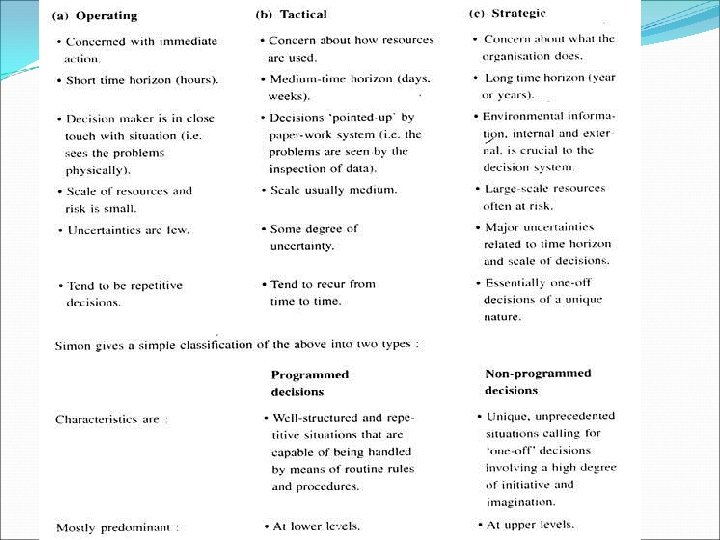
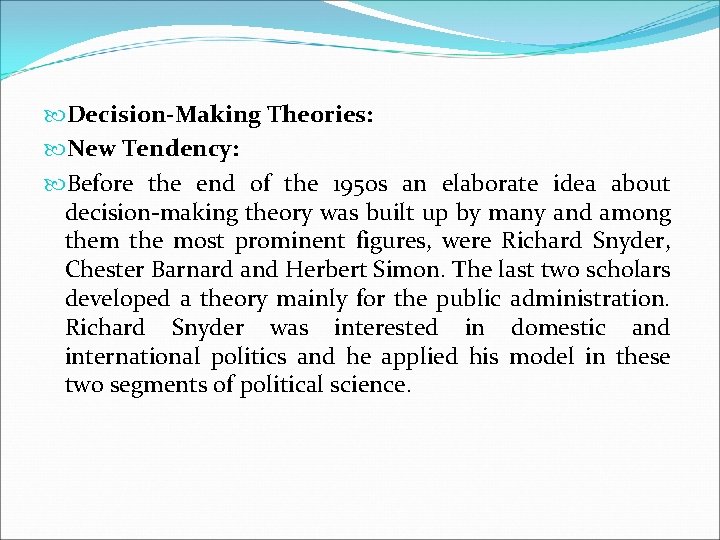
Decision-Making Theories: New Tendency: Before the end of the 1950 s an elaborate idea about decision making theory was built up by many and among them the most prominent figures, were Richard Snyder, Chester Barnard and Herbert Simon. The last two scholars developed a theory mainly for the public administration. Richard Snyder was interested in domestic and international politics and he applied his model in these two segments of political science.
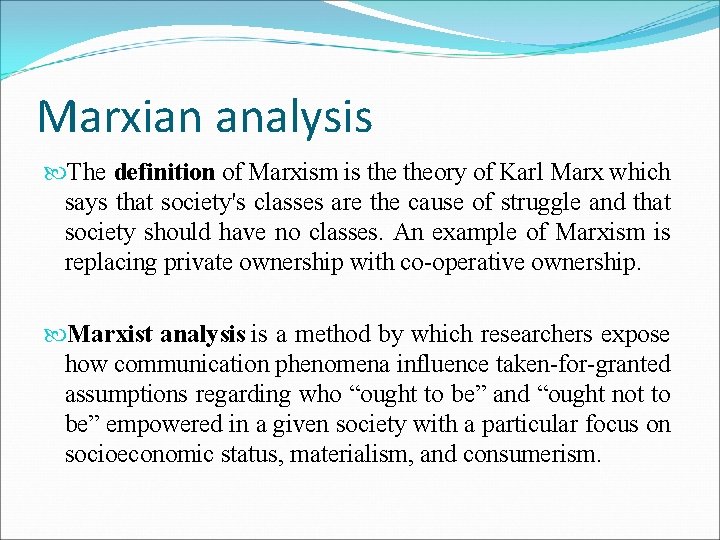
Marxian analysis The definition of Marxism is theory of Karl Marx which says that society's classes are the cause of struggle and that society should have no classes. An example of Marxism is replacing private ownership with co operative ownership. Marxist analysis is a method by which researchers expose how communication phenomena influence taken for granted assumptions regarding who “ought to be” and “ought not to be” empowered in a given society with a particular focus on socioeconomic status, materialism, and consumerism.
Political Elite Who are the elite? Elite are the most influential and prestigious stratum in a society. The ‘elite’ are those persons who are recognized as outstanding leaders in a given field. Thus, there are political, religious, scientific, busi ness, and artistic elite. Pareto, Mosca, Wright Mills, Lasswell, Mannheim, Bottomore, etc. , have given different definitions. the term does not apply to any one person but refers to a plurality, a collec tivity of persons, however small it may be.
If we were to operationalise this term, we could say, political elite include those: (a) Who are elected/nominated to central and state legislatures, (b) Who occupy important positions in national or state level political par ties, (c) Individuals who do not hold any formal positions either in the government or in political parties but are still considered as persons of great political prestige and power because they control power exercisers (e. g. , Gandhi, Jaya Prakash Narayan).
Elite Theory Elite theory, in political science, theoretical perspective according to which (1) a community’s affairs are best handled by a small subset of its members and (2) in modern societies such an arrangement is in fact inevitable. in Plato’s “guardian” class of rulers. The Greek precursr to the English aristocracy (aristokratia) referred to rule by “the best men” (the aristoi).
Mosca on Elite Theory Mosca emphasized the sociological and personal characteristics of elites. He said elites are an organized minority and that the masses are an unorganized majority. The ruling class is composed of the ruling elite and the sub elites. He divides the world into two group: Political class Non Political class
Theory of Circulation of the Elite The circulation of elite is a theory of regime change described by Italian social scientist Vilfredo Pareto (1848– 1923). Changes of regime, revolutions, and so on occur not when rulers are overthrown from below, but when one elite replaces another. The role of ordinary people in such transformation is not that of initiators or principal actors, but as followers and supporters of one elite or another.
It is a basic axiom for Pareto that people are unequal physically, as well as intellectually and morally. In society as a whole, and in any of its particular strata and groupings, some people are more gifted than others. Those who are most capable in any particular grouping are the elite. It denotes simply "a class of the people who have the highest indices in their branch of activity. " Pareto argues that "It will help if we further divide that [elite] class into two classes: a governing elite, and a non governing elite, comprising the rest. " His main discussion focuses on the governing elite.
It would seem that Pareto believed that only in perfectly open societies, those with perfect social mobility, would elite position correlate fully with superior capacity. Only under such conditions would exist the governing elite. The actual social fact is that obstacles such as inherited wealth, family connections, and the like prevent the free circulation of individuals through the ranks of society, so that those wearing an elite label and those possessing highest capacity tend to diverge to greater or lesser degrees.
- Slides: 47