
Modern Physics Reinventing Gravity Einsteins Theory of Special

- Slides: 23
Modern Physics
Reinventing Gravity § Einstein’s Theory of Special Relativity § Theorizes the space time fabric. § Describes why matter interacts. § The larger the mass the larger the curve in the space time fabric. § Objects that are far away have less interaction
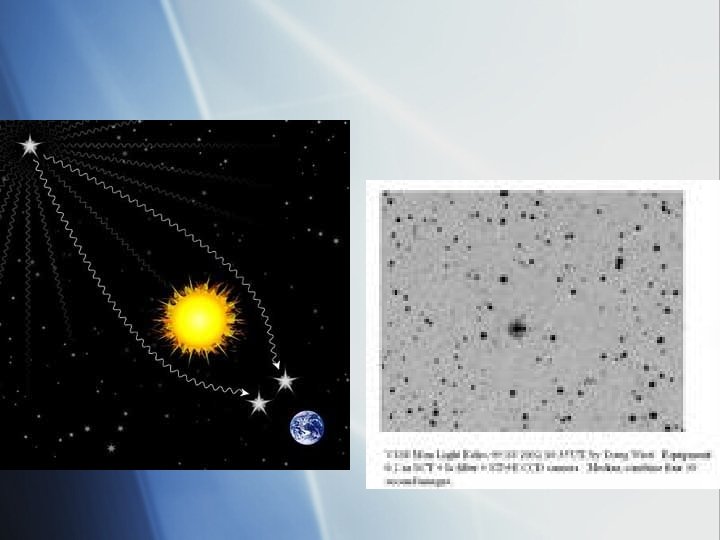
Duality of Light § As seen earlier evidence showed that light can be refracted by gravity. § During an eclipse scientists were able to photograph EM radiation from stars behind the sun. § The gravity of the sun bent the light.
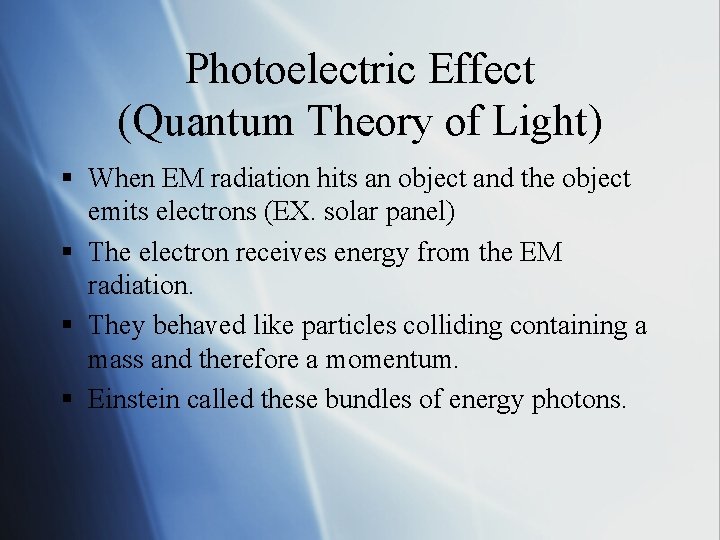
Photoelectric Effect (Quantum Theory of Light) § When EM radiation hits an object and the object emits electrons (EX. solar panel) § The electron receives energy from the EM radiation. § They behaved like particles colliding containing a mass and therefore a momentum. § Einstein called these bundles of energy photons.
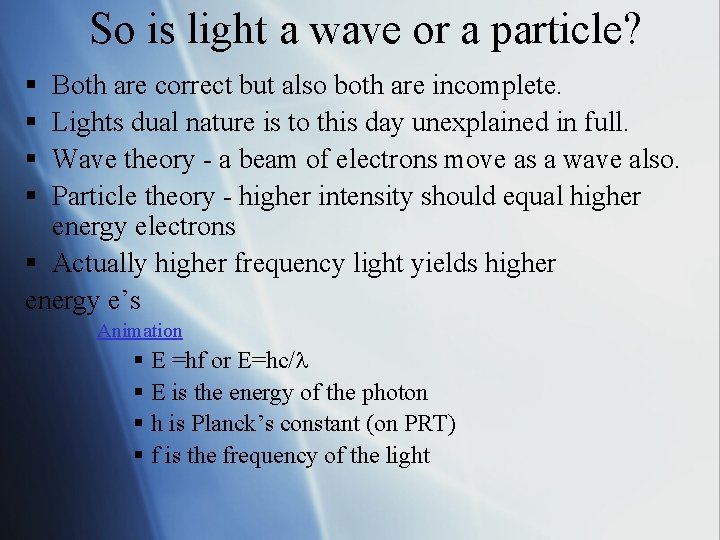
So is light a wave or a particle? § § Both are correct but also both are incomplete. Lights dual nature is to this day unexplained in full. Wave theory - a beam of electrons move as a wave also. Particle theory - higher intensity should equal higher energy electrons § Actually higher frequency light yields higher energy e’s Animation § E =hf or E=hc/ § E is the energy of the photon § h is Planck’s constant (on PRT) § f is the frequency of the light
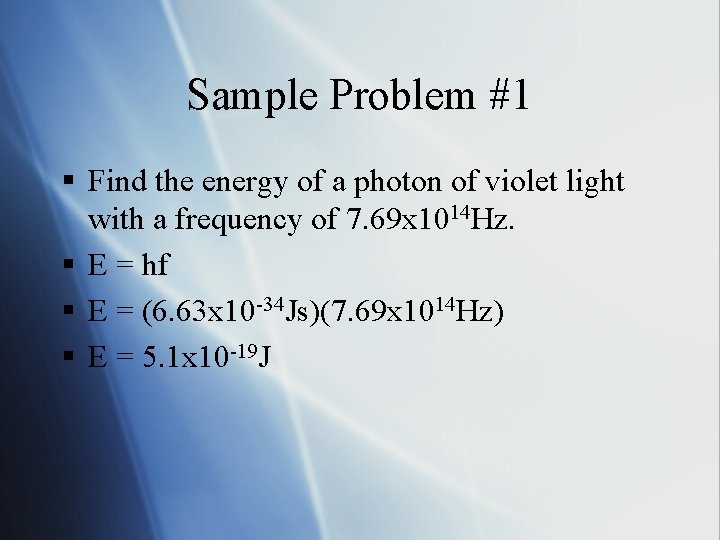
Sample Problem #1 § Find the energy of a photon of violet light with a frequency of 7. 69 x 1014 Hz. § E = hf § E = (6. 63 x 10 -34 Js)(7. 69 x 1014 Hz) § E = 5. 1 x 10 -19 J
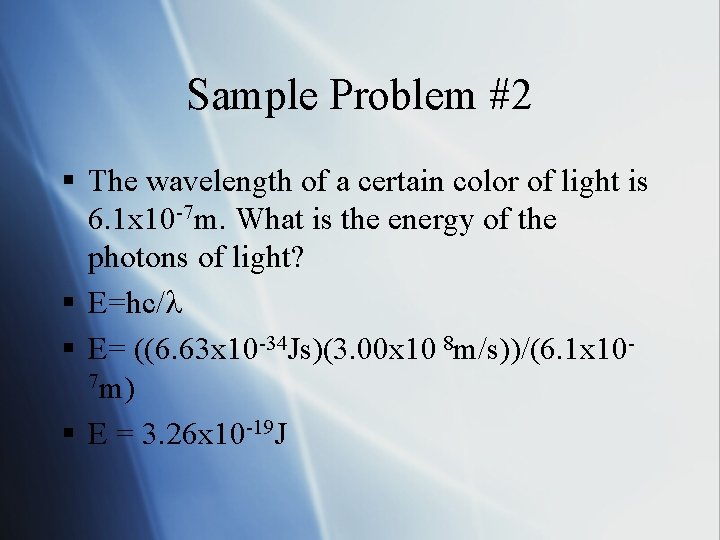
Sample Problem #2 § The wavelength of a certain color of light is 6. 1 x 10 -7 m. What is the energy of the photons of light? § E=hc/ § E= ((6. 63 x 10 -34 Js)(3. 00 x 10 8 m/s))/(6. 1 x 10⁷ m) § E = 3. 26 x 10 -19 J
Physics and the Atom § What happens when light hits an object but does not impart enough energy to cause the object to emit electrons? § The Bohr model answers this § Electrons with the least amount of energy are in the ground state. § If an electron absorbs energy it can transition to a higher energy level called an excited state.
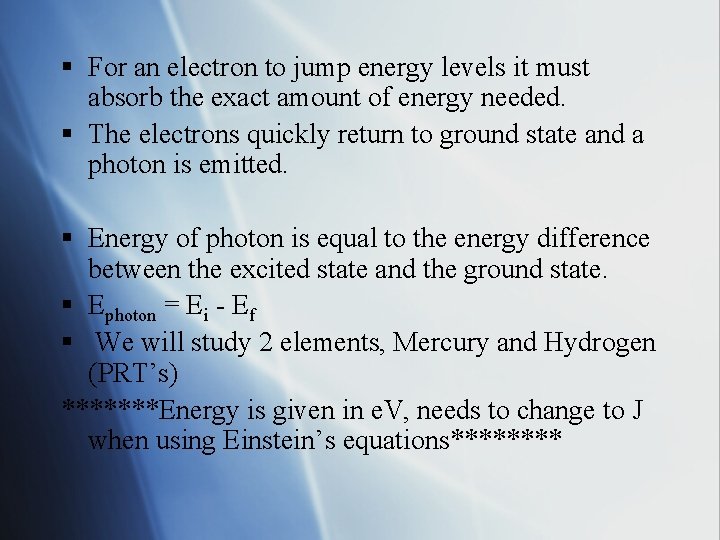
§ For an electron to jump energy levels it must absorb the exact amount of energy needed. § The electrons quickly return to ground state and a photon is emitted. § Energy of photon is equal to the energy difference between the excited state and the ground state. § Ephoton = Ei - Ef § We will study 2 elements, Mercury and Hydrogen (PRT’s) *******Energy is given in e. V, needs to change to J when using Einstein’s equations****
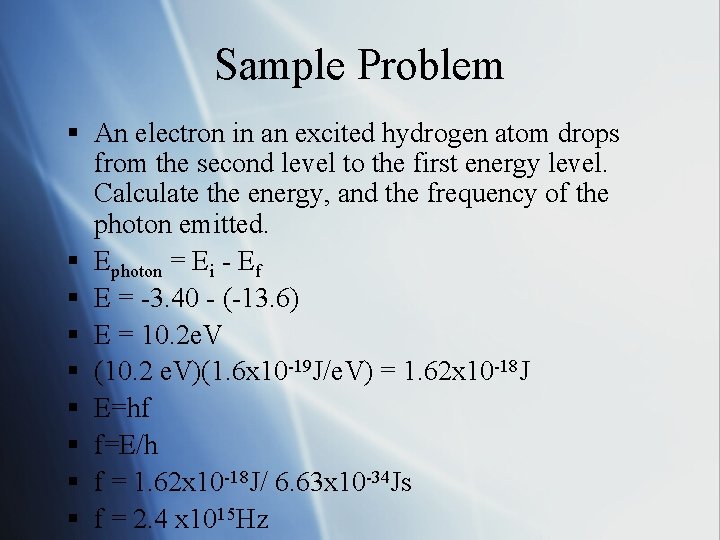
Sample Problem § An electron in an excited hydrogen atom drops from the second level to the first energy level. Calculate the energy, and the frequency of the photon emitted. § Ephoton = Ei - Ef § E = -3. 40 - (-13. 6) § E = 10. 2 e. V § (10. 2 e. V)(1. 6 x 10 -19 J/e. V) = 1. 62 x 10 -18 J § E=hf § f=E/h § f = 1. 62 x 10 -18 J/ 6. 63 x 10 -34 Js § f = 2. 4 x 10¹⁵ Hz
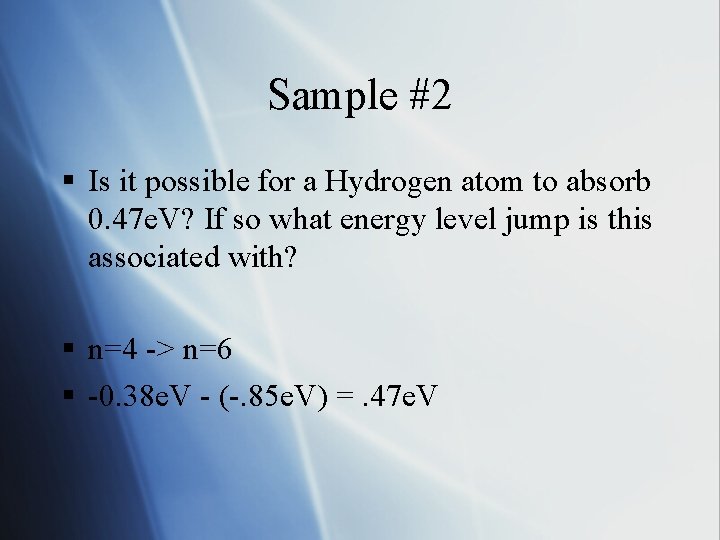
Sample #2 § Is it possible for a Hydrogen atom to absorb 0. 47 e. V? If so what energy level jump is this associated with? § n=4 -> n=6 § -0. 38 e. V - (-. 85 e. V) =. 47 e. V
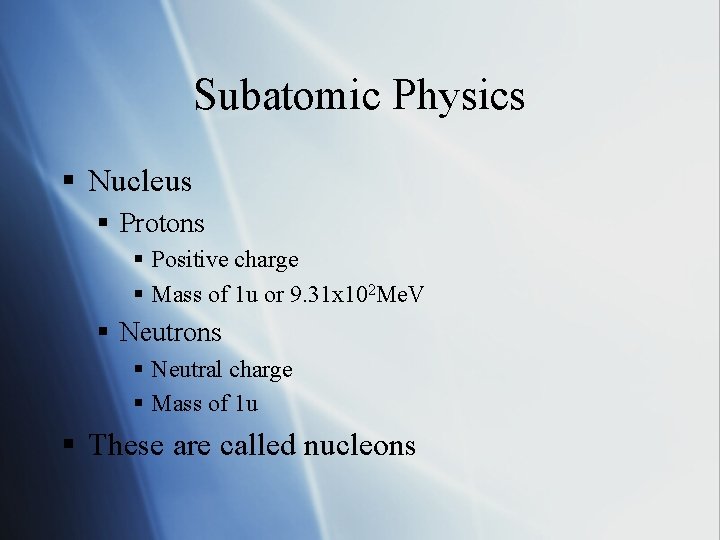
Subatomic Physics § Nucleus § Protons § Positive charge § Mass of 1 u or 9. 31 x 102 Me. V § Neutrons § Neutral charge § Mass of 1 u § These are called nucleons
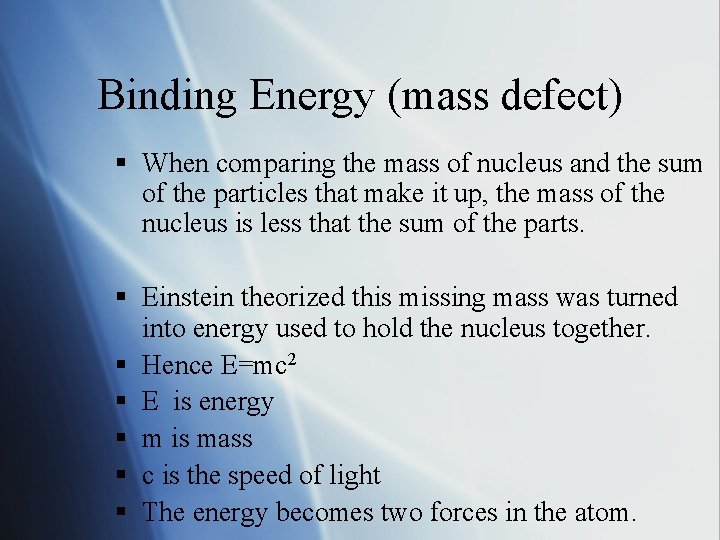
Binding Energy (mass defect) § When comparing the mass of nucleus and the sum of the particles that make it up, the mass of the nucleus is less that the sum of the parts. § Einstein theorized this missing mass was turned into energy used to hold the nucleus together. § Hence E=mc 2 § E is energy § m is mass § c is the speed of light § The energy becomes two forces in the atom.
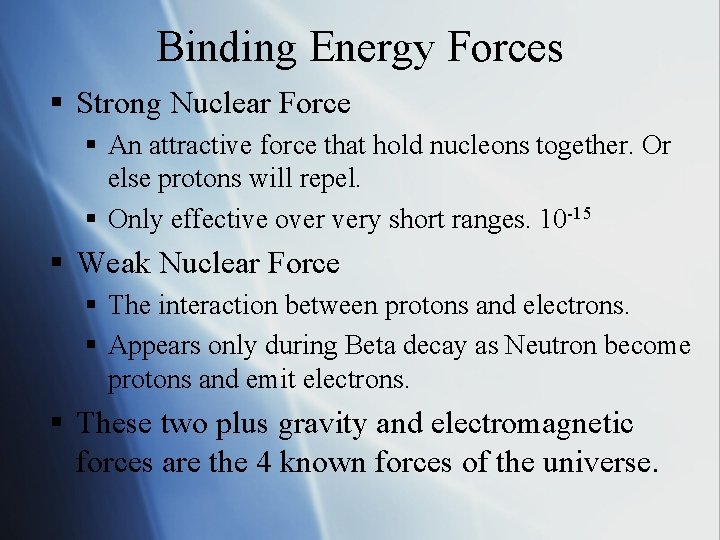
Binding Energy Forces § Strong Nuclear Force § An attractive force that hold nucleons together. Or else protons will repel. § Only effective over very short ranges. 10 -15 § Weak Nuclear Force § The interaction between protons and electrons. § Appears only during Beta decay as Neutron become protons and emit electrons. § These two plus gravity and electromagnetic forces are the 4 known forces of the universe.
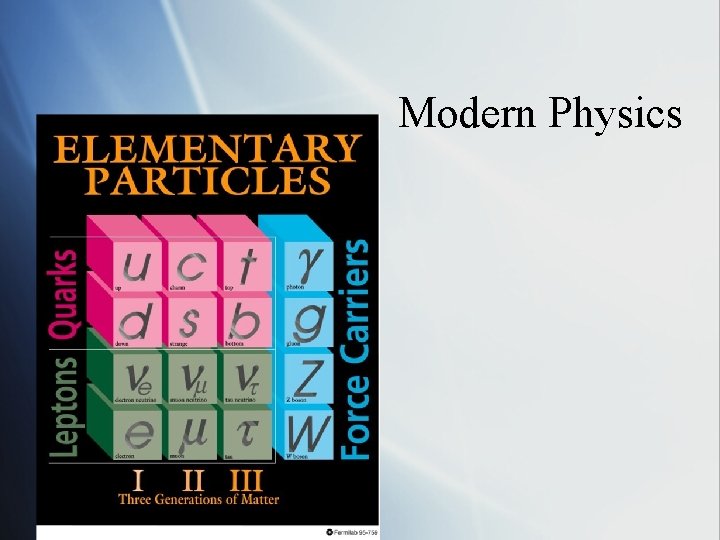
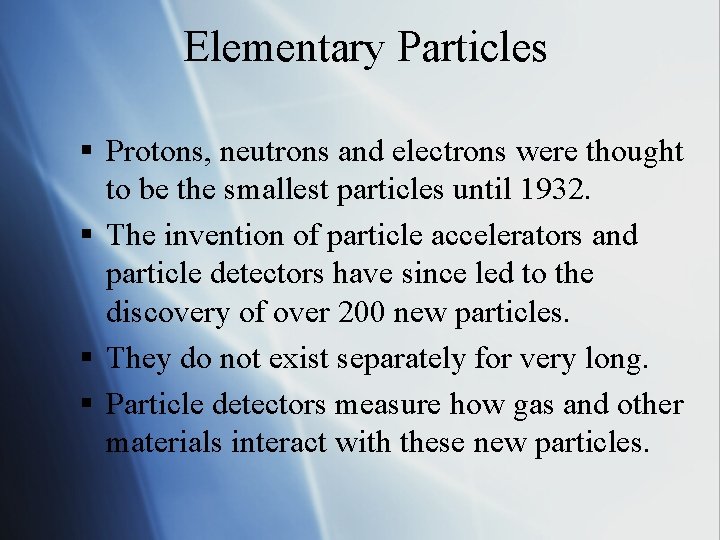
Elementary Particles § Protons, neutrons and electrons were thought to be the smallest particles until 1932. § The invention of particle accelerators and particle detectors have since led to the discovery of over 200 new particles. § They do not exist separately for very long. § Particle detectors measure how gas and other materials interact with these new particles.
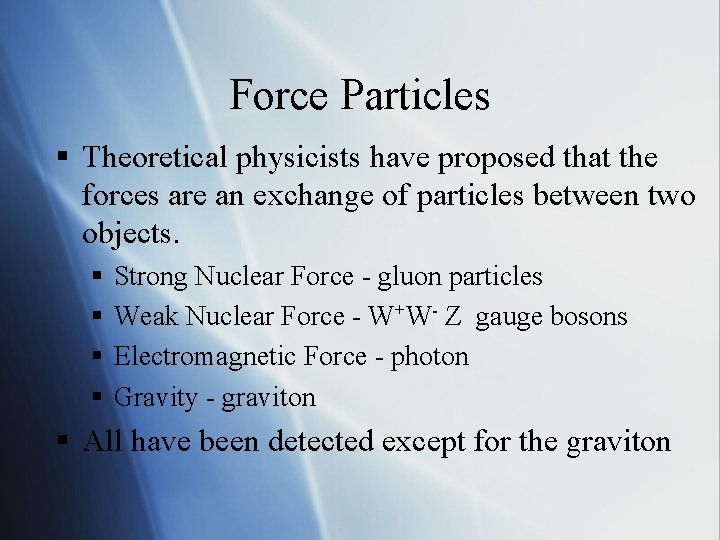
Force Particles § Theoretical physicists have proposed that the forces are an exchange of particles between two objects. § § Strong Nuclear Force - gluon particles Weak Nuclear Force - W+W- Z gauge bosons Electromagnetic Force - photon Gravity - graviton § All have been detected except for the graviton
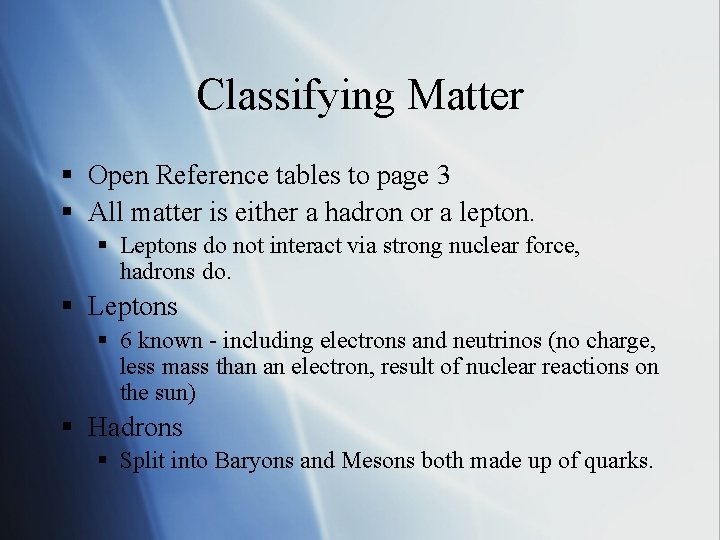
Classifying Matter § Open Reference tables to page 3 § All matter is either a hadron or a lepton. § Leptons do not interact via strong nuclear force, hadrons do. § Leptons § 6 known - including electrons and neutrinos (no charge, less mass than an electron, result of nuclear reactions on the sun) § Hadrons § Split into Baryons and Mesons both made up of quarks.
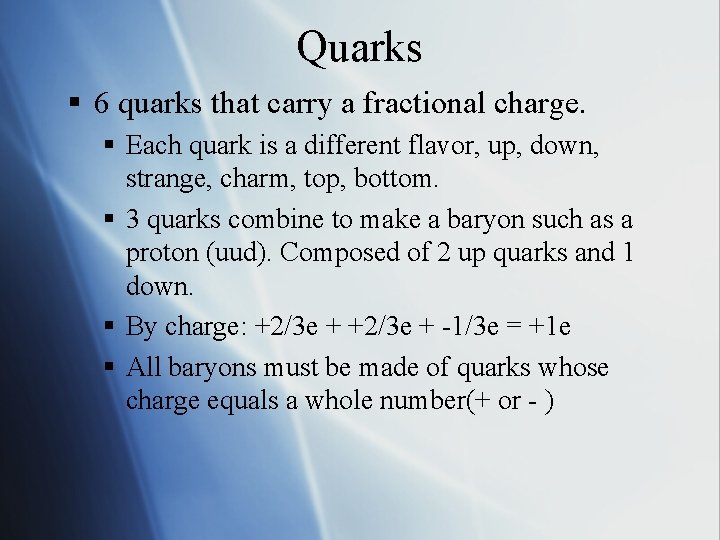
Quarks § 6 quarks that carry a fractional charge. § Each quark is a different flavor, up, down, strange, charm, top, bottom. § 3 quarks combine to make a baryon such as a proton (uud). Composed of 2 up quarks and 1 down. § By charge: +2/3 e + -1/3 e = +1 e § All baryons must be made of quarks whose charge equals a whole number(+ or - )
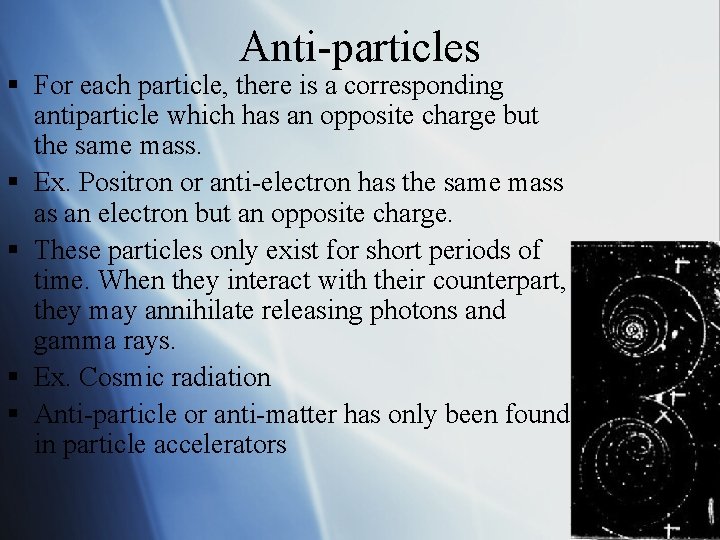
Anti-particles § For each particle, there is a corresponding antiparticle which has an opposite charge but the same mass. § Ex. Positron or anti-electron has the same mass as an electron but an opposite charge. § These particles only exist for short periods of time. When they interact with their counterpart, they may annihilate releasing photons and gamma rays. § Ex. Cosmic radiation § Anti-particle or anti-matter has only been found in particle accelerators
Mesons § § Composed of a quark and an anti-quark. Less massive than baryons. Always have a charge that is a whole number. Exist for 10 -8 - 10 -9 s.
Grand Unified Theory (GUT) § The physics on a large scale does not match the physics on a quantum scale. § Theories such as string theory are trying to tie the two together in order to create a single theory that describes the entire universe. § Problem: string theory requires a minimum of 6 dimensions of which we only know 4. Hypothetically up to 11 dimensions.