
Modern machining methods are established to fabricate difficulttomachine
Modern machining methods are established to fabricate difficult-to-machine materials such as high-strength thermal-resistant alloys; various kinds of carbides, fiberreinforced composite materials, Stellites, and ceramics. Conventional machining of such materials produces high cutting forces that, in some particular cases, may not be sustained by the workpiece. WEEK 9 Laser Beam Machining (LBM)
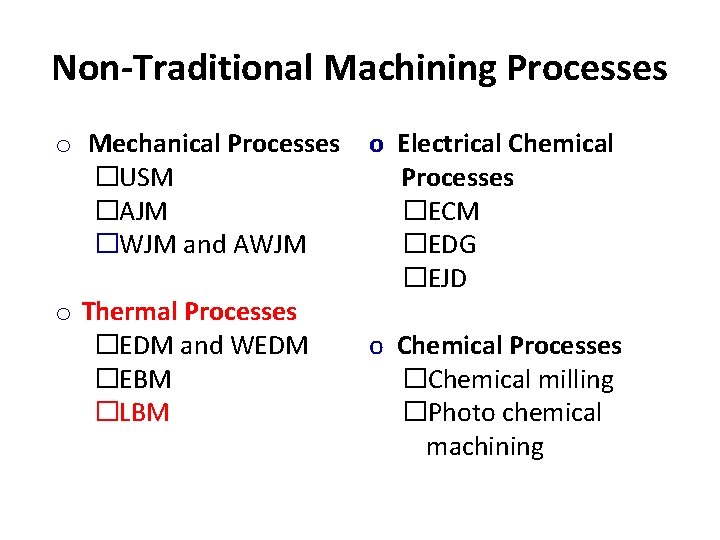
Non-Traditional Machining Processes o Mechanical Processes �USM �AJM �WJM and AWJM o Thermal Processes �EDM and WEDM �EBM �LBM o Electrical Chemical Processes �ECM �EDG �EJD o Chemical Processes �Chemical milling �Photo chemical machining
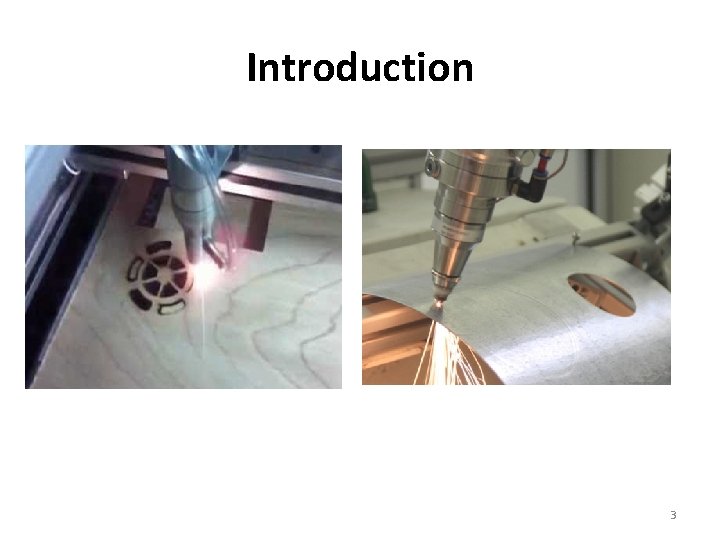
Introduction 3
Introduction 1. Laser beam machining (LBM) offers a good solution that is indeed more associated with material properties such as thermal conductivity and specific heat as well as melting and boiling temperatures. 2. Laser Beam Machining or more broadly laser material processing deals with machining and material processing like heat treatment, alloying, welding, cladding, sheet metal bending etc. 3. Laser beam is mostly converted into thermal energy upon interaction with most of the materials. 4. Nowadays, laser is also finding application in regenerative machining or rapid prototyping as in processes like stereo-lithography, selective laser sintering etc. 4
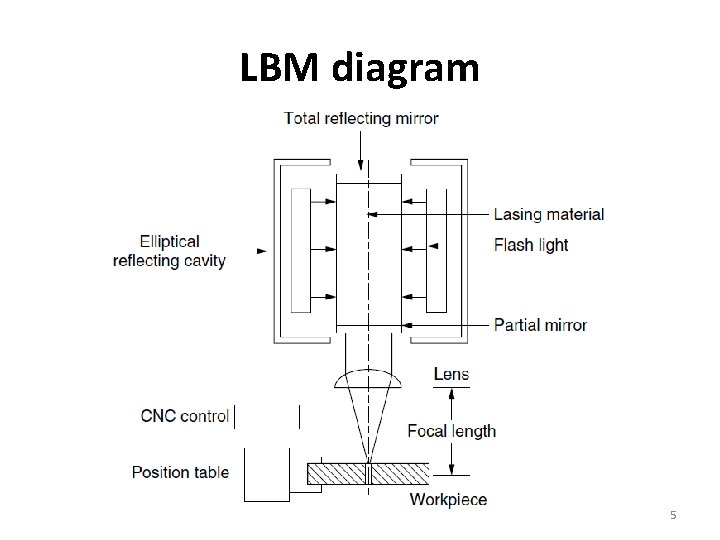
LBM diagram 5
What is LBM? • Laser machining is localized, non-contact machining and is almost reaction-force free. Photon energy is absorbed by target material in the form of thermal energy or photochemical energy. Material is removed by melting and blown away (long pulsed and continuous-wave lasers), or by direct vaporization/ablation (ultra-short pulsed lasers). • A laser machine consists of : 1. Laser 2. Mirrors or a fiber for beam guidance 3. Focusing optics 4. Positioning system 6
What is LBM? • The laser beam is focused onto the work-piece and can be moved relatively to it. The laser machining process is controlled by switching the laser on and off, changing the laser pulse energy and other laser parameters, and by positioning either the work-piece or the laser focus. • Any material that can properly absorb the laser irradiation can be laser machined. The spectrum of laser machinable materials includes hard and brittle materials as well as soft materials. The very high intensities of ultra-short pulsed lasers enable absorption even in transparent materials. 7
LBM Working principles 1. Laser beam can very easily be focused using optical lenses as their wavelength ranges from half micron to around 70 microns. Focussed laser beam as indicated earlier can have power density in excess of 1 MW/mm 2. 2. Although several types of laser exist, all lasers produce (emit) intense, coherent, highly collimated beam of single wavelength light. In material processing applications, this narrow beam is focused by an optical lens to produce a small, intense spot of light on the work piece surface. 3. As laser interacts with the material, the energy of the photon is absorbed by the work material leading to rapid substantial rise in local temperature. This in turn results in melting and vaporisation of the work material and finally material removal. 8
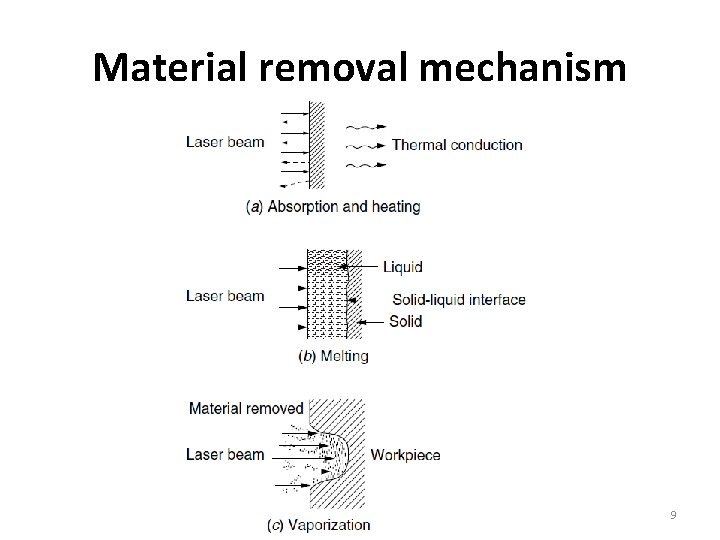
Material removal mechanism 9
What is laser? • Laser is the abbreviation of • Light • Amplification by • Stimulated • Emission of • Radiation • A highly collimated, monochromatic, and coherent light beam is generated and focused to a small spot. High power densities are then obtained. • The main components of a laser are the laser active, light amplifying medium and an optical resonator which usually consists of two mirrors. 10
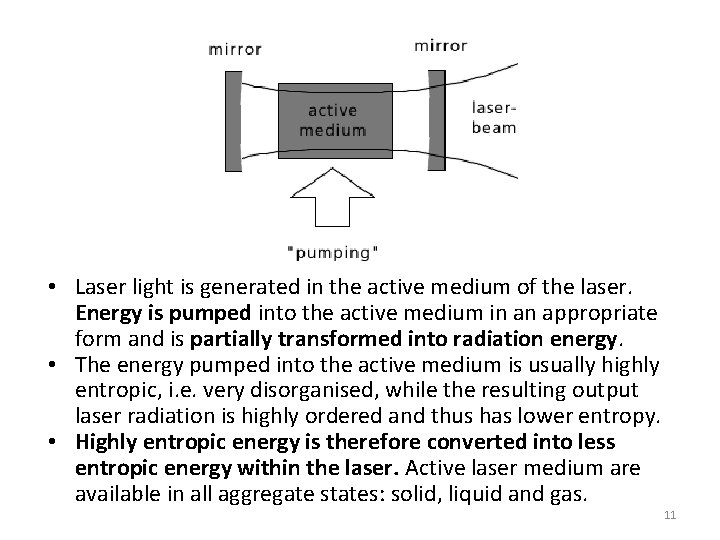
• Laser light is generated in the active medium of the laser. Energy is pumped into the active medium in an appropriate form and is partially transformed into radiation energy. • The energy pumped into the active medium is usually highly entropic, i. e. very disorganised, while the resulting output laser radiation is highly ordered and thus has lower entropy. • Highly entropic energy is therefore converted into less entropic energy within the laser. Active laser medium are available in all aggregate states: solid, liquid and gas. 11
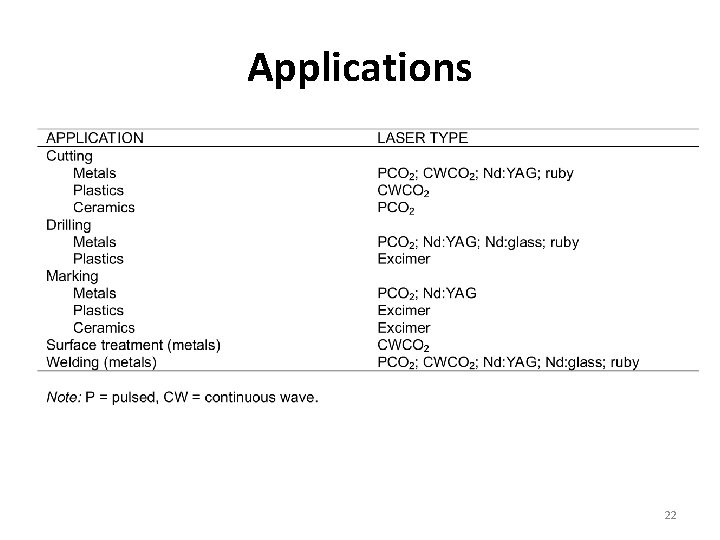
Types of laser 1. CO 2 (pulse of continuous wave) 2. Nd: YAG (neodymium: yttrium-aluminiumgarnet) 3. Nd: glass, ruby 4. Diode 5. Excimer 12
Laser concept • The electrons are charged particles, they carry some energy. The energy related with the orbit in which the electrons revolve. • Generally the electrons are present in the outer most orbit of the atom take part in the process of energy absorption or emission. • Ground state, the state with lowest energy is the most stable state for the electrons. After absorbing the energy electron jump to the higher energy state and staying there for some seconds jump to the ground state and release the absorbed energy. 13
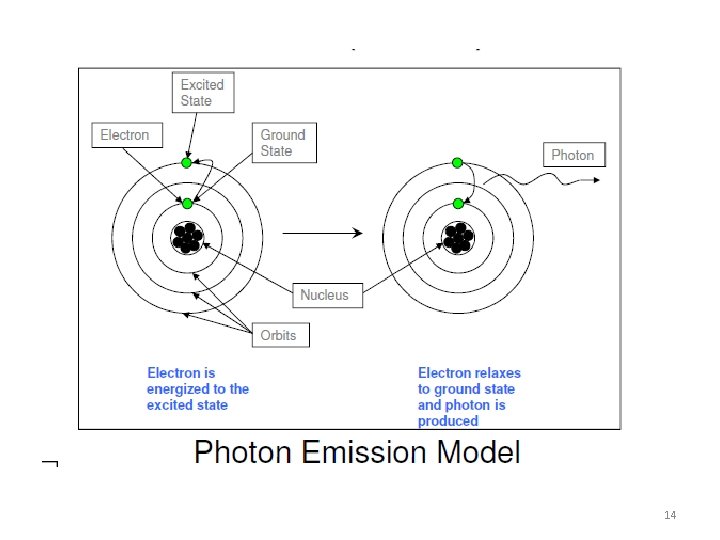
14
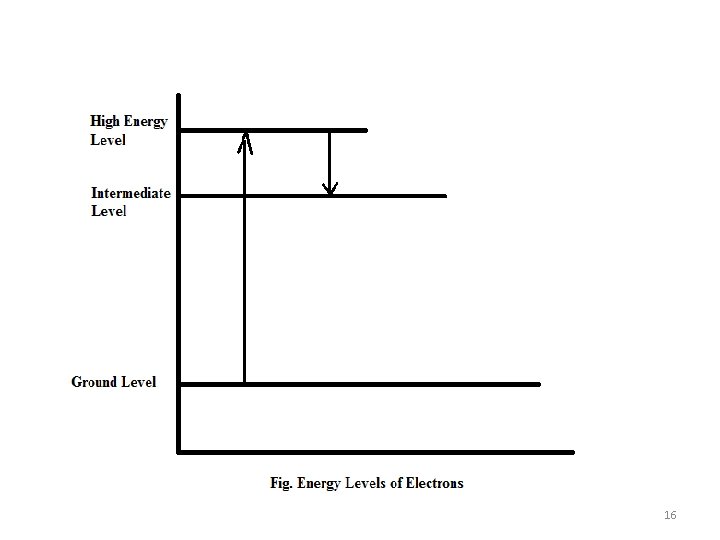
Laser concept This jump may be in two stages: - • Electron from higher state may not come directly to the ground state but may halt for some micro seconds on some intermediate state before finally coming to the ground state. • The period for which electron stays in a higher energy state is known as the lifetime of that energy state. • Lasing action: The emission of photon is not done by only one atom at upper energy level but on the influence of external light, a sort of chain reactions occurs and one after other atoms start emitting photons. Thus whole avalanche dumps down together. This is called lasing action. 15
16
Laser concept • Not all the materials are suitable for producing laser beam. • One of the most common laser materials and also one capable of delivering high power is the chromium on a ruby crystal. • Crystal ruby is aluminum oxide. • Generally the ruby rod 1 cm diameter and 10 cm long with ends polished fully is used. • Important physical parameter in LBM are the reflectivity and thermal conductivity of the workpiece surface and its specific heat latent heats of melting and evaporation; the lower these quantities, the more efficient is the process.
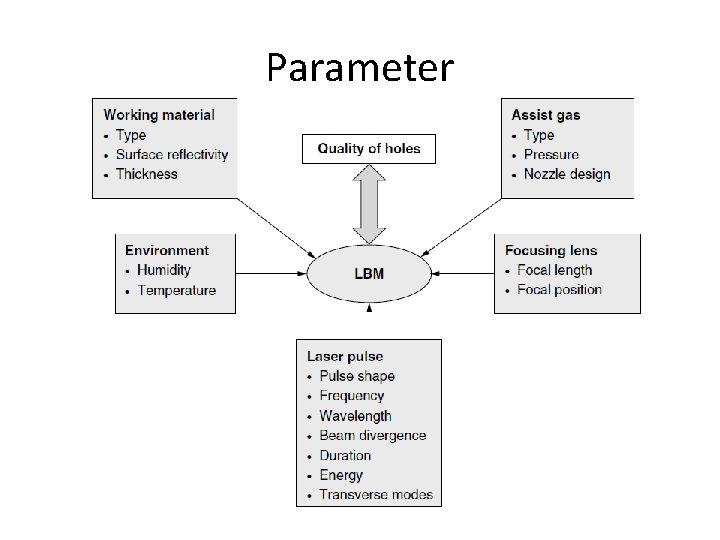
Parameter
Design considerations 1. Sharp corners should be avoided because they can be difficult to produce 2. Deep cuts will produce tapered walls. 3. Dull and unpolished surfaces are preferable. 4. There may be adverse effects on the properties of the machined materials caused by high local temperatures and the heat affected zone.
LBM Advantages 1. It is also faster than conventional tool-making techniques. 2. Laser cutting has higher accuracy rates over other methods using heat generation, as well as water jet cutting. 3. There is quicker turnaround for parts regardless of the complexity, because changes of the design of parts can be easily accommodated. Laser cutting also reduces wastage. 4. Tool wear and breakage are not encountered. 5. Holes can be located accurately by using an optical laser system for alignment. 6. Very small holes with a large aspect ratio can be produced. 7. A wide variety of hard and difficult-to-machine materials can be tackled. 8. Machining is extremely rapid and the setup times are economical. 9. Holes can be drilled at difficult entrance angles (10° to the surface). 20
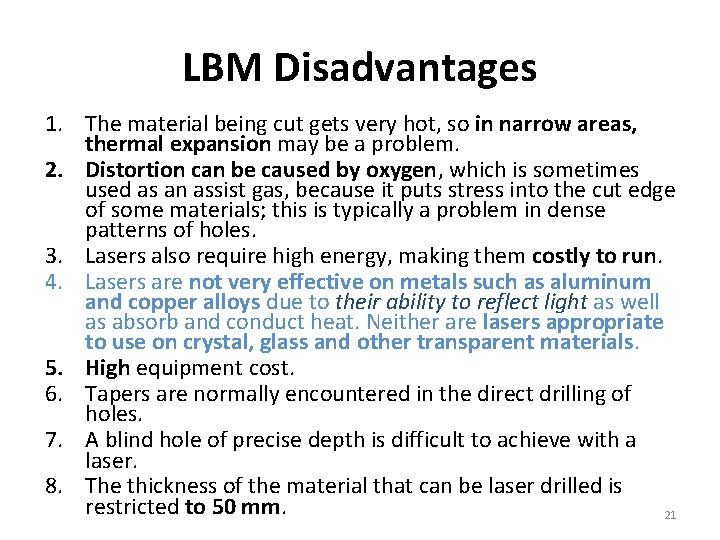
LBM Disadvantages 1. The material being cut gets very hot, so in narrow areas, thermal expansion may be a problem. 2. Distortion can be caused by oxygen, which is sometimes used as an assist gas, because it puts stress into the cut edge of some materials; this is typically a problem in dense patterns of holes. 3. Lasers also require high energy, making them costly to run. 4. Lasers are not very effective on metals such as aluminum and copper alloys due to their ability to reflect light as well as absorb and conduct heat. Neither are lasers appropriate to use on crystal, glass and other transparent materials. 5. High equipment cost. 6. Tapers are normally encountered in the direct drilling of holes. 7. A blind hole of precise depth is difficult to achieve with a laser. 8. The thickness of the material that can be laser drilled is restricted to 50 mm. 21
Applications 22
Lecture highlights • • • What is LBM? What is LASER? . Diagram. Working principles. LBM parameter; working material. Advantages, disadvantages. 23
- Slides: 23