
Modern imaging techniques in biology The physical background
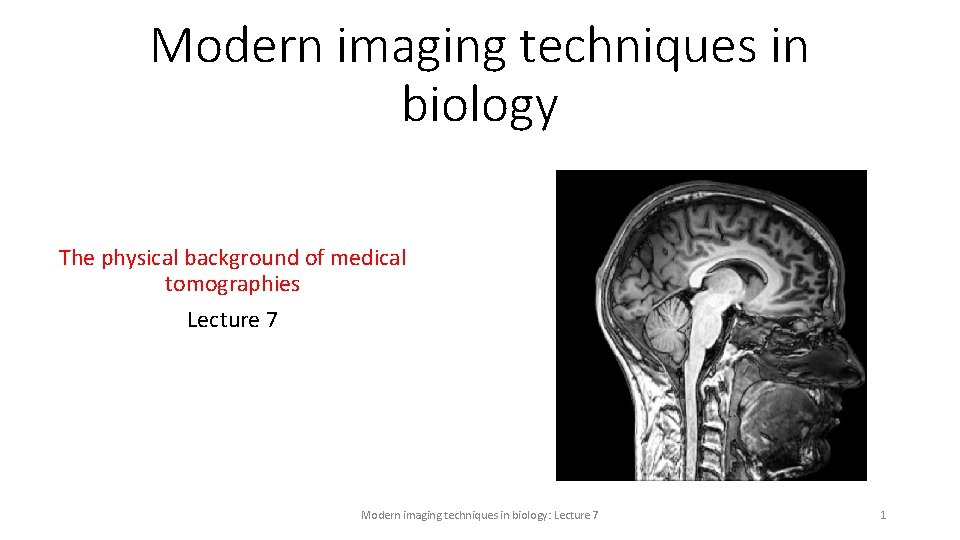
Modern imaging techniques in biology The physical background of medical tomographies Lecture 7 Modern imaging techniques in biology: Lecture 7 1
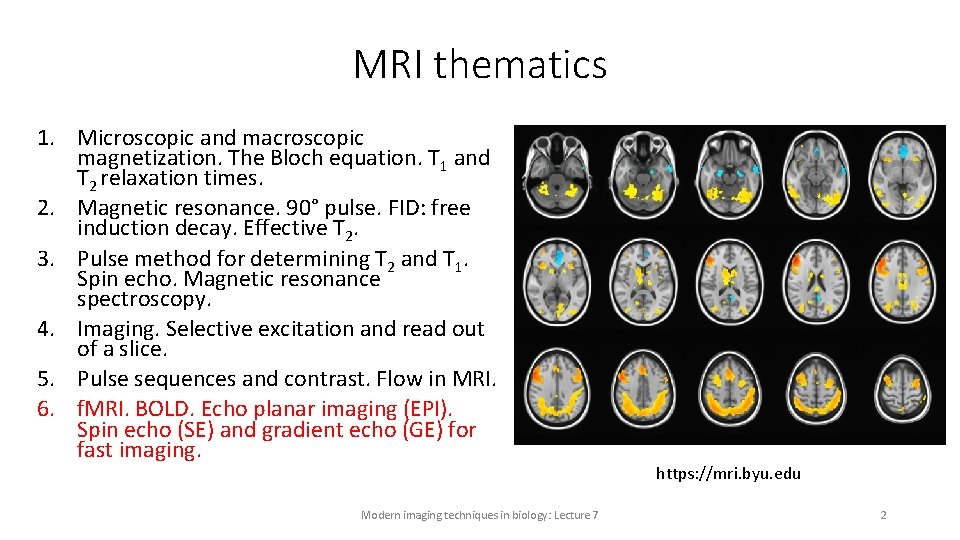
MRI thematics 1. Microscopic and macroscopic magnetization. The Bloch equation. T 1 and T 2 relaxation times. 2. Magnetic resonance. 90° pulse. FID: free induction decay. Effective T 2. 3. Pulse method for determining T 2 and T 1. Spin echo. Magnetic resonance spectroscopy. 4. Imaging. Selective excitation and read out of a slice. 5. Pulse sequences and contrast. Flow in MRI. 6. f. MRI. BOLD. Echo planar imaging (EPI). Spin echo (SE) and gradient echo (GE) for fast imaging. Modern imaging techniques in biology: Lecture 7 https: //mri. byu. edu 2

f. MRI pros and cons Advantages: • non-invasive • fair spatial and temporal resolution • can image the whole brain almost simultaneously Disadvantages: • measures indirect signal (not the electric signal of neurons known to be directly correlated with information processing, i. e. , brain function) • measures the integral signal of many neurons Modern imaging techniques in biology: Lecture 7 3
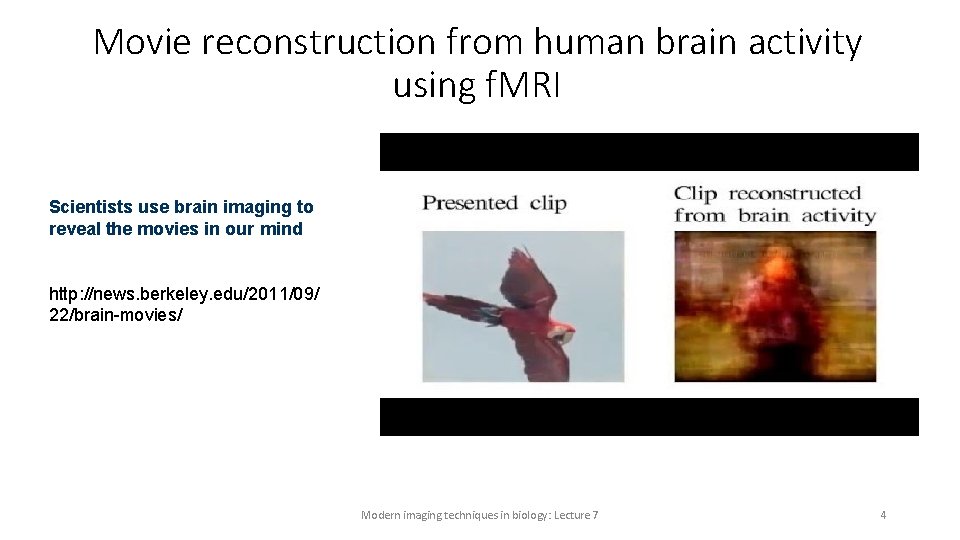
Movie reconstruction from human brain activity using f. MRI Scientists use brain imaging to reveal the movies in our mind http: //news. berkeley. edu/2011/09/ 22/brain-movies/ Modern imaging techniques in biology: Lecture 7 4
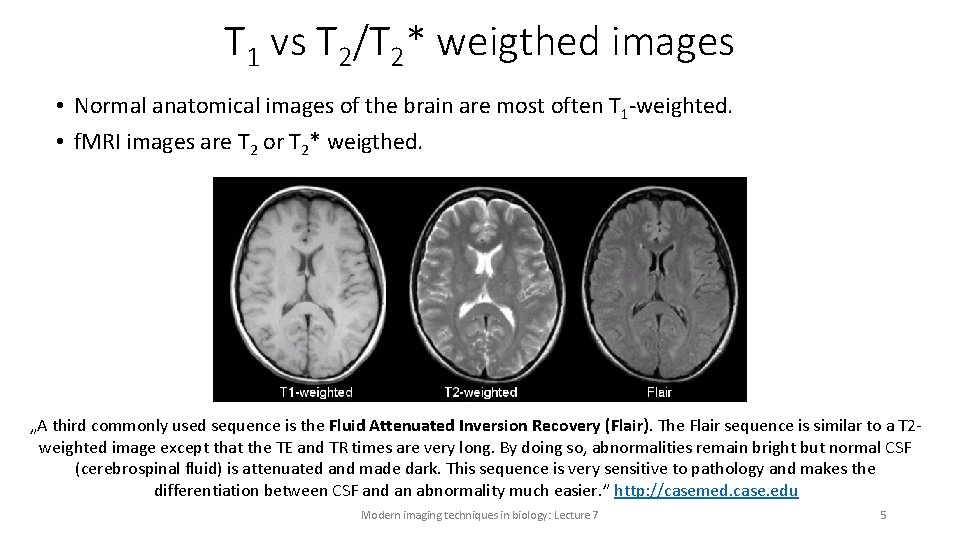
T 1 vs T 2/T 2* weigthed images • Normal anatomical images of the brain are most often T 1 -weighted. • f. MRI images are T 2 or T 2* weigthed. „A third commonly used sequence is the Fluid Attenuated Inversion Recovery (Flair). The Flair sequence is similar to a T 2 weighted image except that the TE and TR times are very long. By doing so, abnormalities remain bright but normal CSF (cerebrospinal fluid) is attenuated and made dark. This sequence is very sensitive to pathology and makes the differentiation between CSF and an abnormality much easier. ” http: //casemed. case. edu Modern imaging techniques in biology: Lecture 7 5
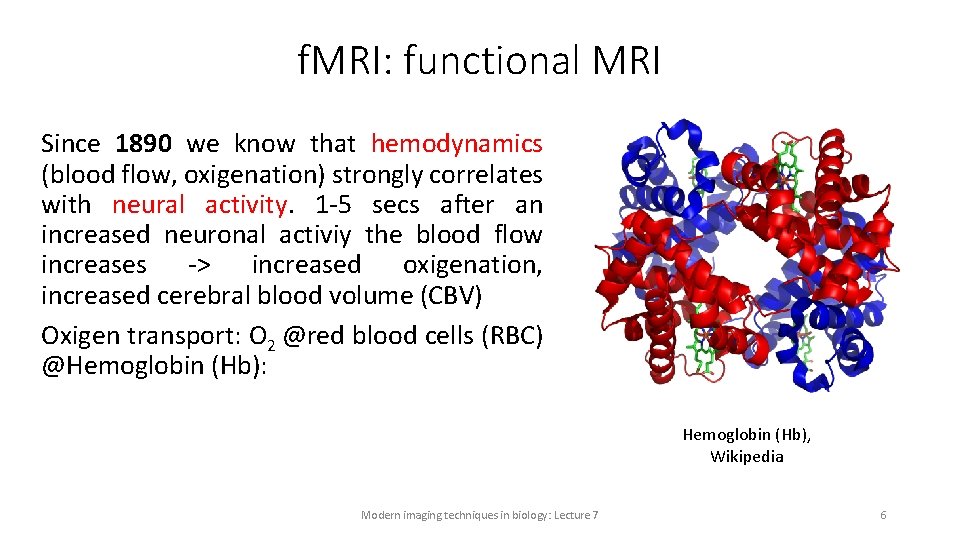
f. MRI: functional MRI Since 1890 we know that hemodynamics (blood flow, oxigenation) strongly correlates with neural activity. 1 -5 secs after an increased neuronal activiy the blood flow increases -> increased oxigenation, increased cerebral blood volume (CBV) Oxigen transport: O 2 @red blood cells (RBC) @Hemoglobin (Hb): Hemoglobin (Hb), Wikipedia Modern imaging techniques in biology: Lecture 7 6
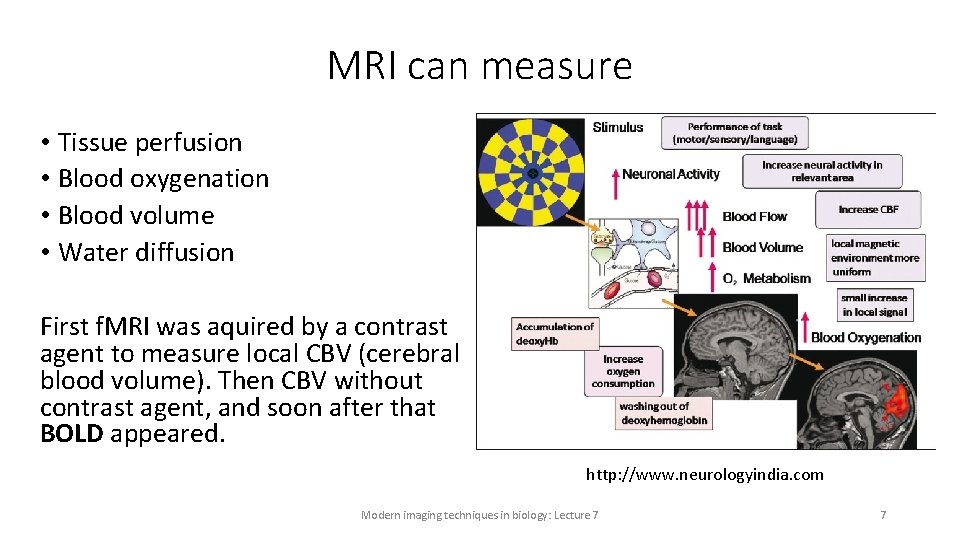
MRI can measure • Tissue perfusion • Blood oxygenation • Blood volume • Water diffusion First f. MRI was aquired by a contrast agent to measure local CBV (cerebral blood volume). Then CBV without contrast agent, and soon after that BOLD appeared. http: //www. neurologyindia. com Modern imaging techniques in biology: Lecture 7 7

BOLD-contrast: Blood oxigenation level dependent contrast BOLD since 1990: hemodynamic response. Fe in the Heme group is in high spin state and thus paramagnetic in deoxy hemoglobin deoxy-Hb. 4 unpaired electrons. http: //mriquestions. com/bold-contrast. html Modern imaging techniques in biology: Lecture 7 Heme group: iron (Fe) ion held in a heterocyclic ring, known as a porphyrin 8

Origin of BOLD contrast „The presence of paramagnetic deoxyhemoglobin within red blood cells creates local magnetic field distortions (susceptibility gradients) in and around blood vessels. These local field disturbances cause nearby stationary and slowly moving spins to have different resonance frequencies and phase shifts. The resultant intravoxel dephasing is a classic T 2*shortening effect most prominent near larger veins and accentuated by use of GRE sequences with echo times (TEs) close to T 2*. The effect scales linearly with field strength (Bo) and is the dominant mechanism for BOLD contrast at 1. 5 T. ” http: //mriquestions. com/bold-contrast. html Paramagnetic deoxyhemoglobin (D) confined to red blood cells causes a local field distortion in and around the vessel. Modern imaging techniques in biology: Lecture 7 9
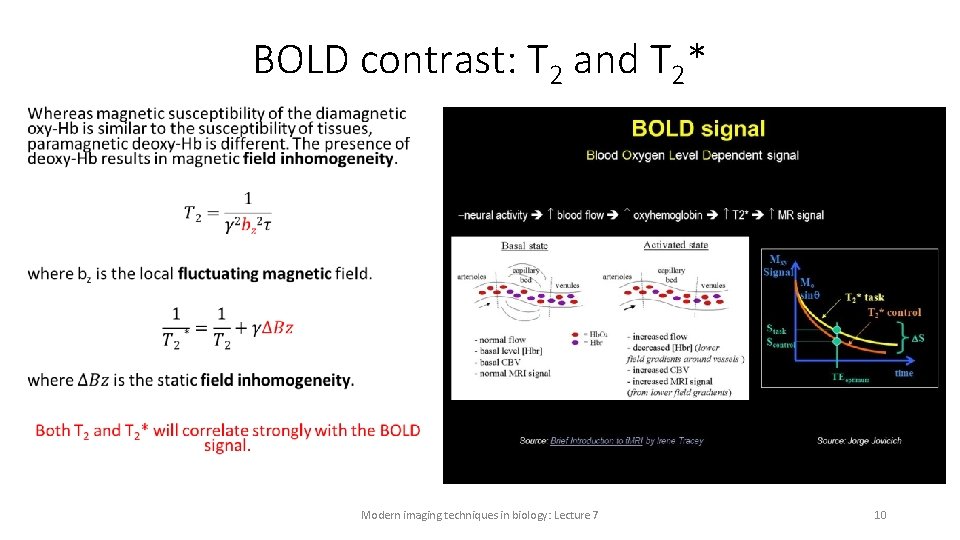
BOLD contrast: T 2 and T 2* • Modern imaging techniques in biology: Lecture 7 10
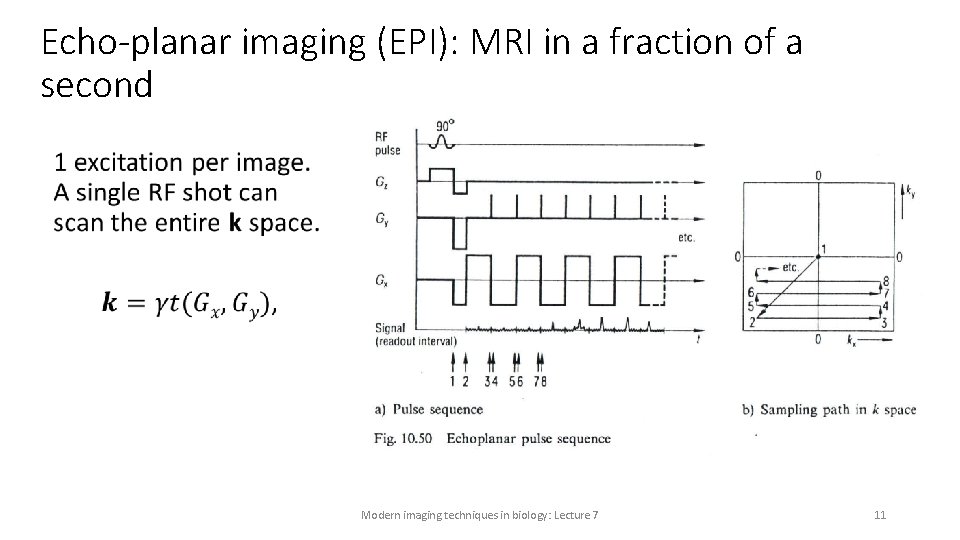
Echo-planar imaging (EPI): MRI in a fraction of a second • Modern imaging techniques in biology: Lecture 7 11
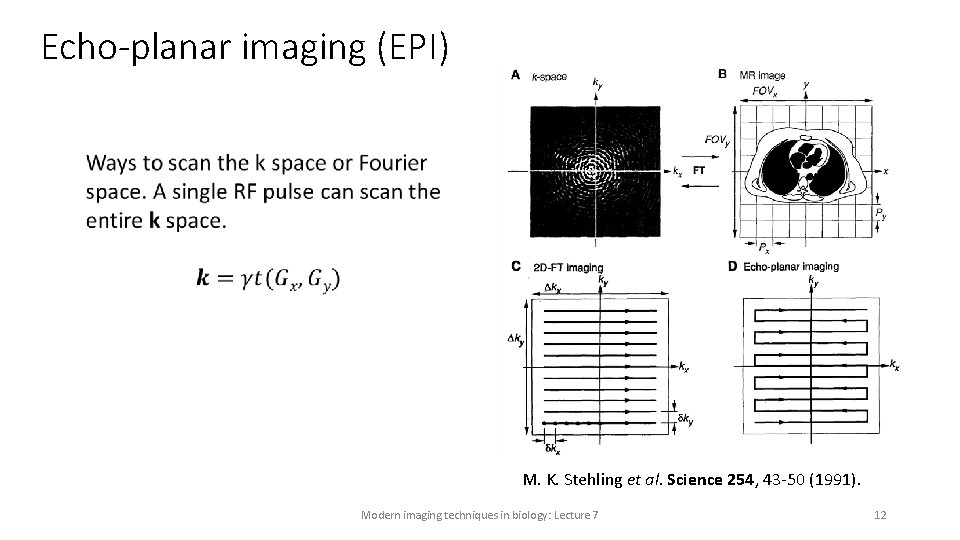
Echo-planar imaging (EPI) M. K. Stehling et al. Science 254, 43 -50 (1991). Modern imaging techniques in biology: Lecture 7 12
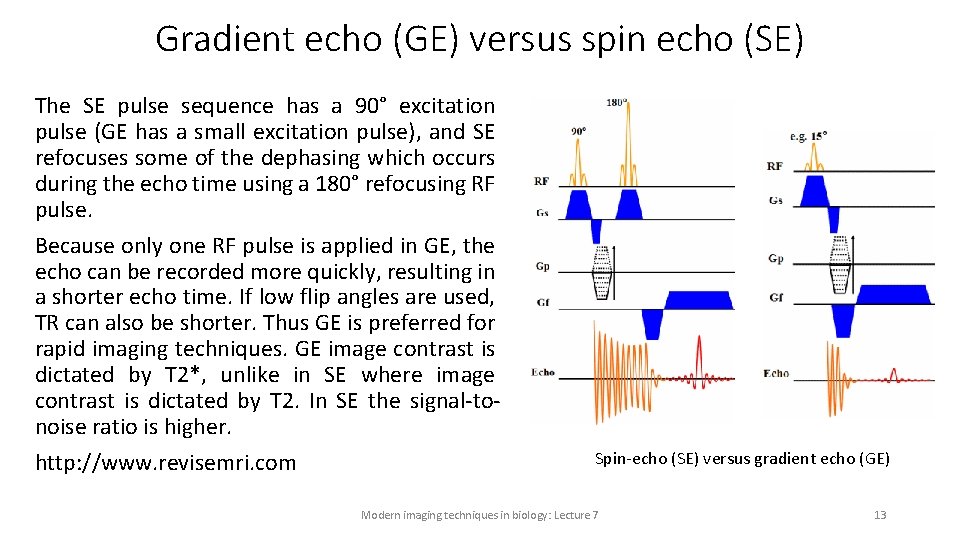
Gradient echo (GE) versus spin echo (SE) The SE pulse sequence has a 90° excitation pulse (GE has a small excitation pulse), and SE refocuses some of the dephasing which occurs during the echo time using a 180° refocusing RF pulse. Because only one RF pulse is applied in GE, the echo can be recorded more quickly, resulting in a shorter echo time. If low flip angles are used, TR can also be shorter. Thus GE is preferred for rapid imaging techniques. GE image contrast is dictated by T 2*, unlike in SE where image contrast is dictated by T 2. In SE the signal-tonoise ratio is higher. http: //www. revisemri. com Spin-echo (SE) versus gradient echo (GE) Modern imaging techniques in biology: Lecture 7 13
- Slides: 13