
Modern demographic transition phase 2 sustained mortality decline




- Slides: 40
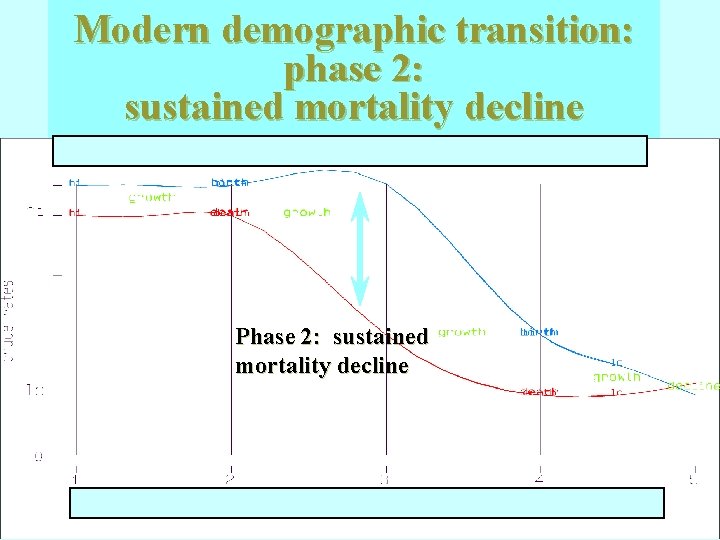
Modern demographic transition: phase 2: sustained mortality decline growth rate Phase 2: sustained mortality decline
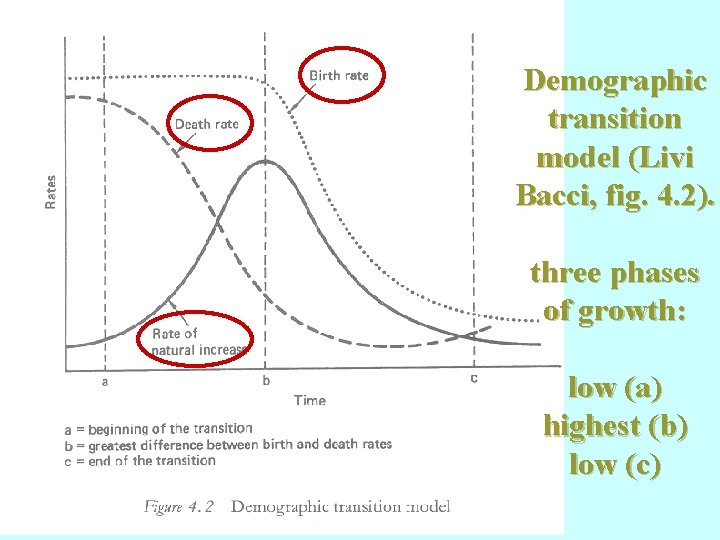
Demographic transition model (Livi Bacci, fig. 4. 2). three phases of growth: low (a) highest (b) low (c)
Demographic transition duration, 70 to 185 years: pop increase 1. 6 – 7 times
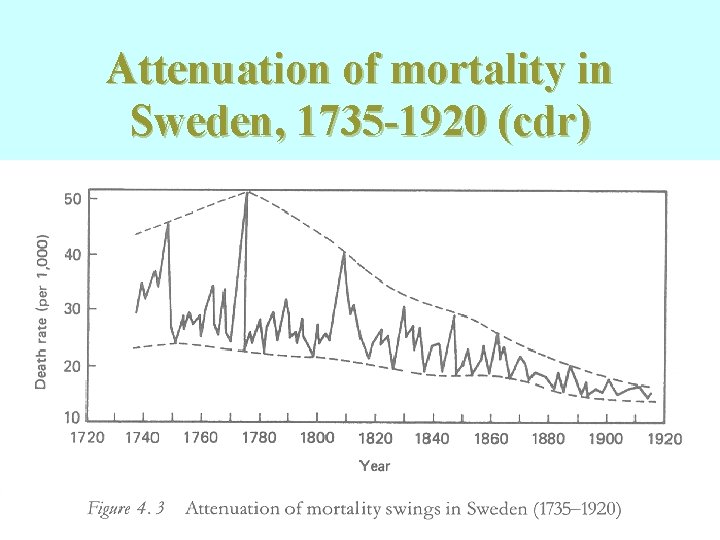
Attenuation of mortality in Sweden, 1735 -1920 (cdr)
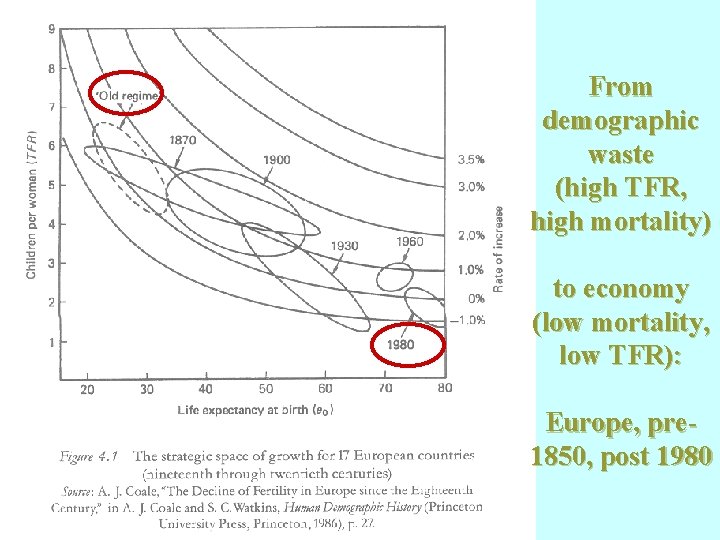
From demographic waste (high TFR, high mortality) to economy (low mortality, low TFR): Europe, pre 1850, post 1980
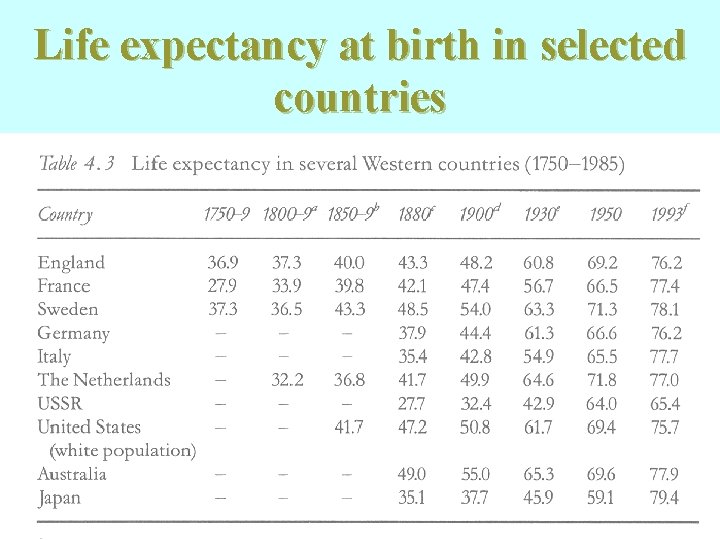
Life expectancy at birth in selected countries
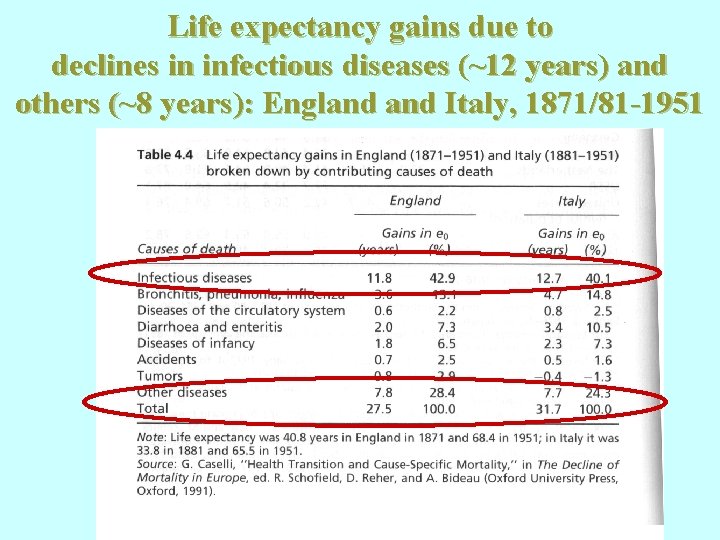
Life expectancy gains due to declines in infectious diseases (~12 years) and others (~8 years): England Italy, 1871/81 -1951
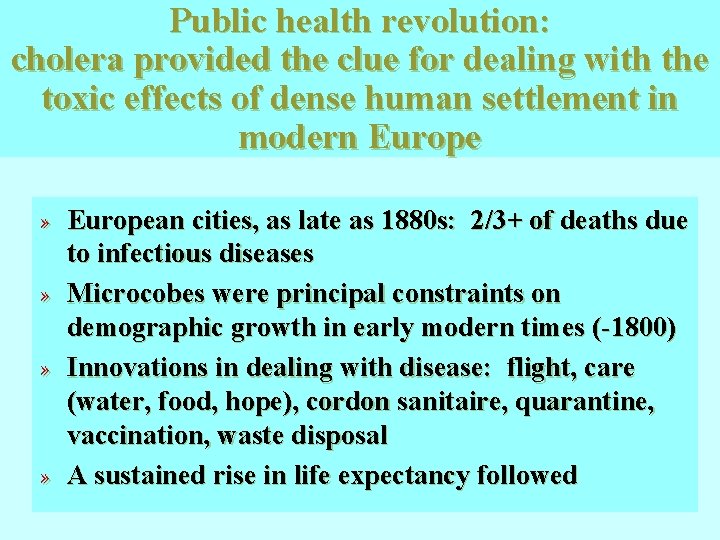
Public health revolution: cholera provided the clue for dealing with the toxic effects of dense human settlement in modern Europe » European cities, as late as 1880 s: 2/3+ of deaths due » » » to infectious diseases Microcobes were principal constraints on demographic growth in early modern times (-1800) Innovations in dealing with disease: flight, care (water, food, hope), cordon sanitaire, quarantine, vaccination, waste disposal A sustained rise in life expectancy followed
Rapid evolution of microbes » “…microbes display an amazing biologic and chemical flexibility; and since in them, generations succeed each other with great speed (at least two every hour, under suitable circumstances) the phenomena of infection constitute an accelerated evolution extraordinarily favorable for the observation of adaptive changes. ” --Zinsser, Rats, Lice and History (1935)
Mutual adaptation between microbes and humans » “…where two organisms have developed a host- parasite relationship, the survival of the parasite species is best served, not by the destruction of the host, but by the development of a balanced condition in which sufficient substance of the host is consumed to allow the parasite’s growth and multiplication, but not sufficient to kill the host. ” --Mac. Farlane Burnet, Natural History of Infectious Diseases (1953)
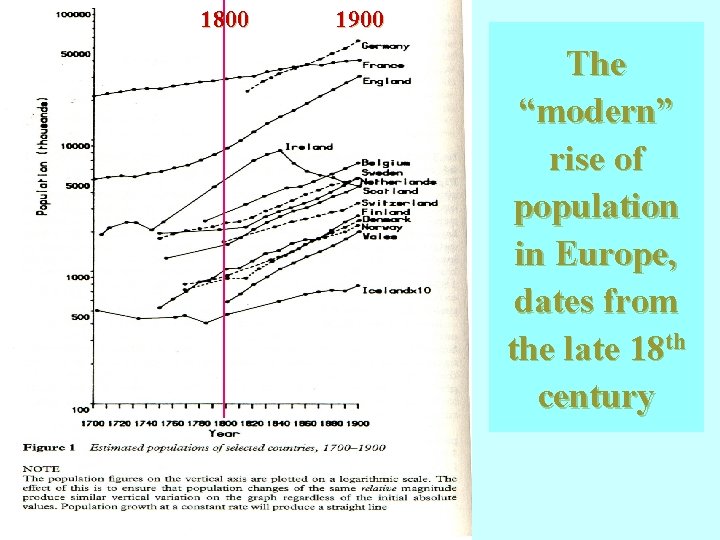
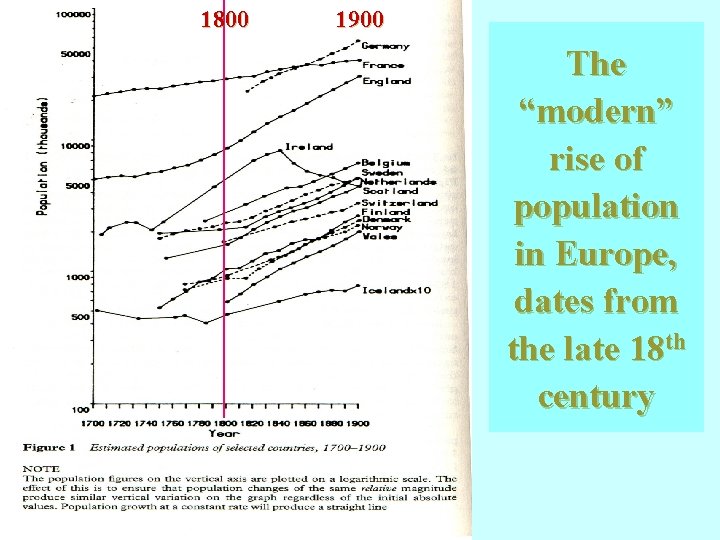
1800 1900 The “modern” rise of population in Europe, dates from the late 18 th century
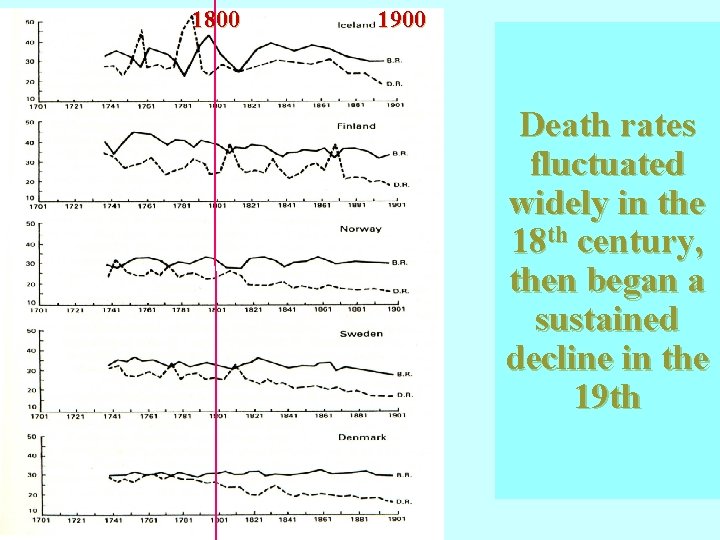
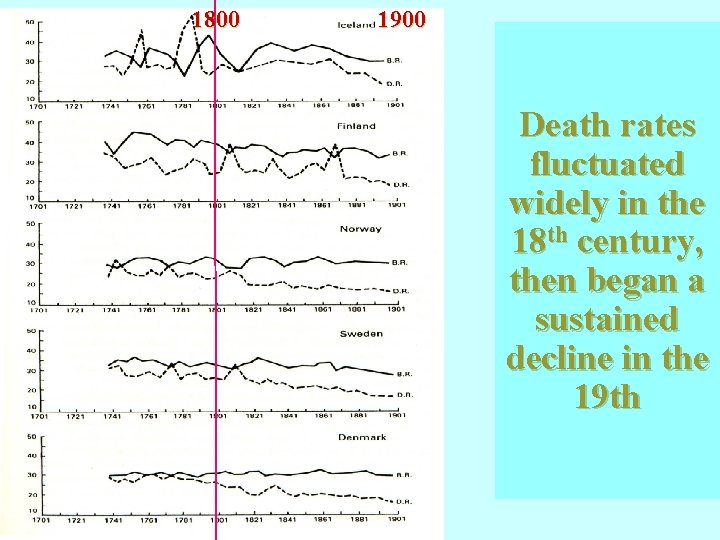
1800 1900 Death rates fluctuated widely in the 18 th century, then began a sustained decline in the 19 th
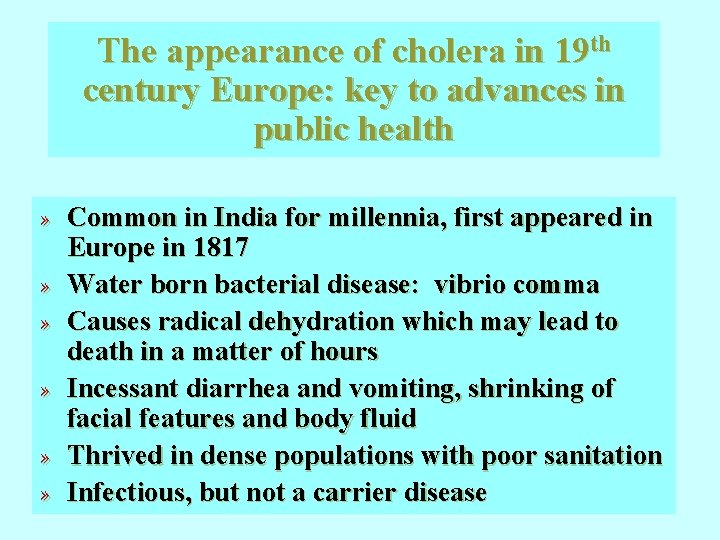
The appearance of cholera in 19 th century Europe: key to advances in public health » Common in India for millennia, first appeared in » » » Europe in 1817 Water born bacterial disease: vibrio comma Causes radical dehydration which may lead to death in a matter of hours Incessant diarrhea and vomiting, shrinking of facial features and body fluid Thrived in dense populations with poor sanitation Infectious, but not a carrier disease
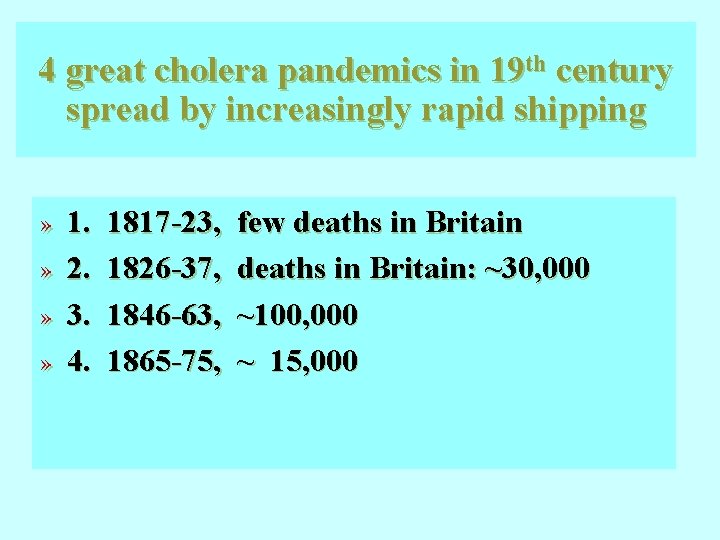
4 great cholera pandemics in 19 th century spread by increasingly rapid shipping » » 1. 2. 3. 4. 1817 -23, 1826 -37, 1846 -63, 1865 -75, few deaths in Britain: ~30, 000 ~100, 000 ~ 15, 000
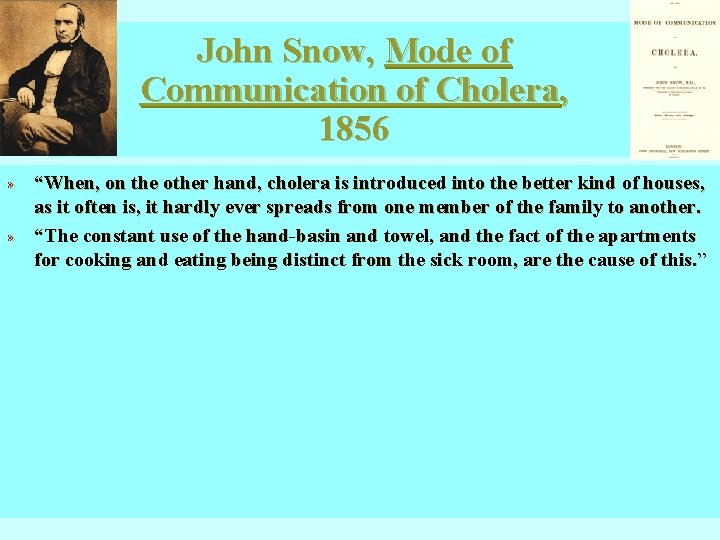
John Snow, Mode of Communication of Cholera, 1856 » “…we had a knowledge of cholera, before it had been twenty years in Europe, more correct than that of most of the older epidemics; a knowledge which, indeed, promises to throw much light on the mode of propagation of many diseases which have been present here for centuries. ”
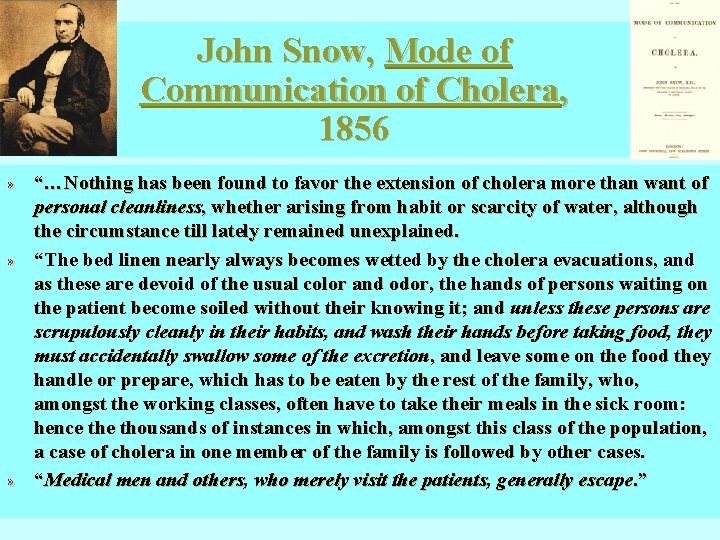
John Snow, Mode of Communication of Cholera, 1856 » “…Nothing has been found to favor the extension of cholera more than want of personal cleanliness, whether arising from habit or scarcity of water, although the circumstance till lately remained unexplained. » “The bed linen nearly always becomes wetted by the cholera evacuations, and as these are devoid of the usual color and odor, the hands of persons waiting on the patient become soiled without their knowing it; and unless these persons are scrupulously cleanly in their habits, and wash their hands before taking food, they must accidentally swallow some of the excretion, and leave some on the food they handle or prepare, which has to be eaten by the rest of the family, who, amongst the working classes, often have to take their meals in the sick room: hence thousands of instances in which, amongst this class of the population, a case of cholera in one member of the family is followed by other cases. » “Medical men and others, who merely visit the patients, generally escape. ”
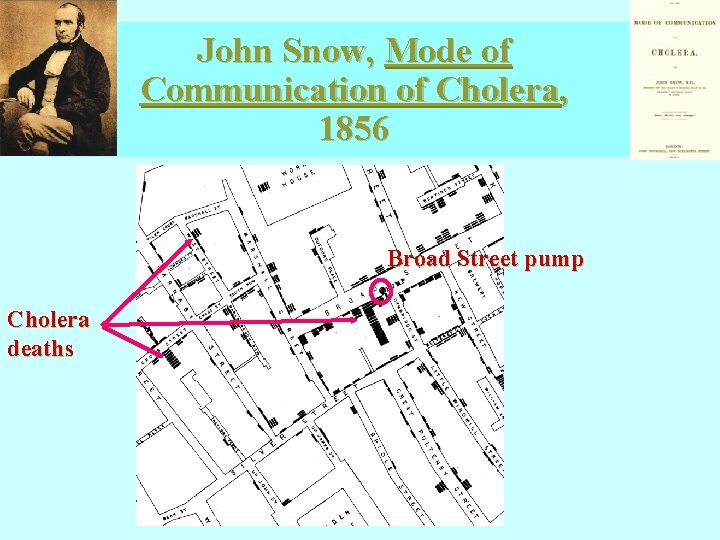
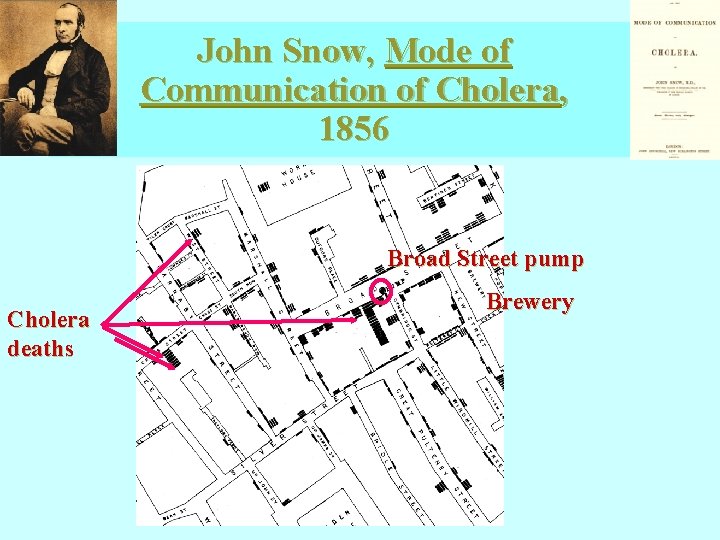
John Snow, Mode of Communication of Cholera, 1856 » “The most terrible outbreak of cholera which ever occurred in this kingdom, is probably that which took place in Broad Street, Golden Square, and the adjoining streets, a few weeks ago. Within two hundred and fifty yards of the spot where Cambridge Street joins Broad Street, there were upwards of five hundred fatal attacks of cholera in ten days. ”
John Snow, Mode of Communication of Cholera, 1856 Broad Street pump Cholera deaths
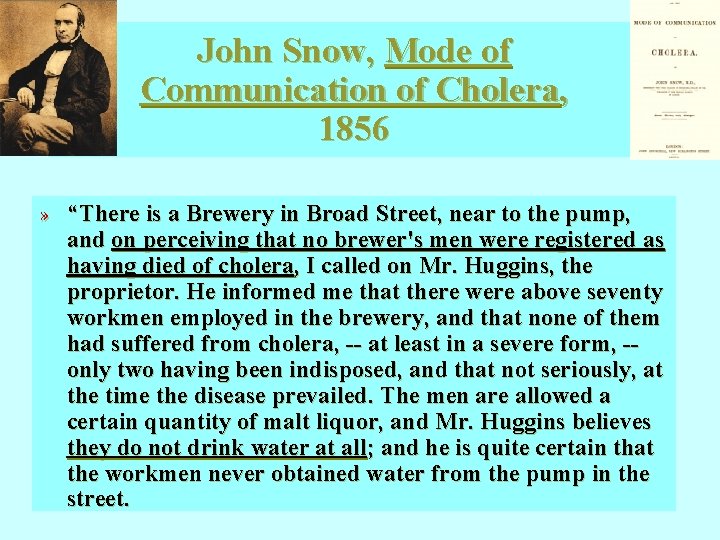
John Snow, Mode of Communication of Cholera, 1856 » “There is a Brewery in Broad Street, near to the pump, and on perceiving that no brewer's men were registered as having died of cholera, I called on Mr. Huggins, the proprietor. He informed me that there were above seventy workmen employed in the brewery, and that none of them had suffered from cholera, -- at least in a severe form, -only two having been indisposed, and that not seriously, at the time the disease prevailed. The men are allowed a certain quantity of malt liquor, and Mr. Huggins believes they do not drink water at all; and he is quite certain that the workmen never obtained water from the pump in the street.
John Snow, Mode of Communication of Cholera, 1856 Broad Street pump Cholera deaths Brewery
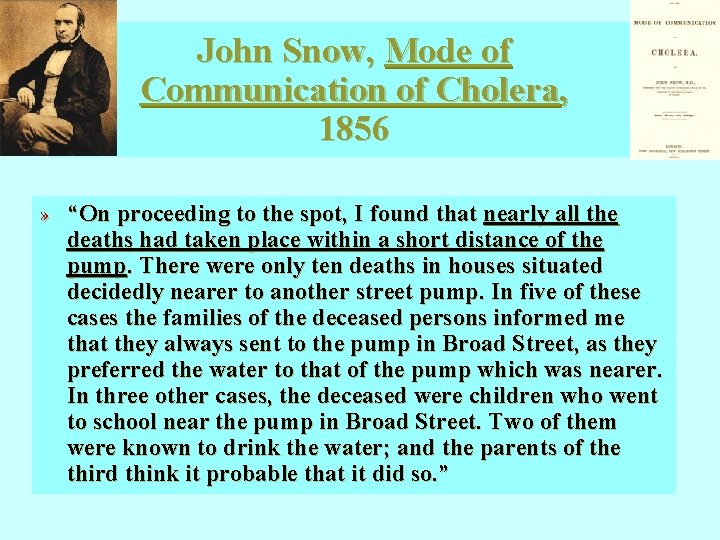
John Snow, Mode of Communication of Cholera, 1856 » “On proceeding to the spot, I found that nearly all the deaths had taken place within a short distance of the pump. There were only ten deaths in houses situated decidedly nearer to another street pump. In five of these cases the families of the deceased persons informed me that they always sent to the pump in Broad Street, as they preferred the water to that of the pump which was nearer. In three other cases, the deceased were children who went to school near the pump in Broad Street. Two of them were known to drink the water; and the parents of the third think it probable that it did so. ”
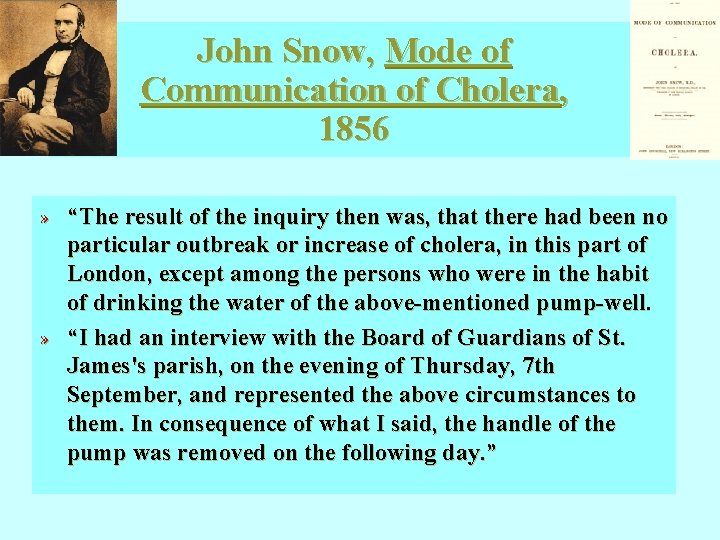
John Snow, Mode of Communication of Cholera, 1856 » “The result of the inquiry then was, that there had been no particular outbreak or increase of cholera, in this part of London, except among the persons who were in the habit of drinking the water of the above-mentioned pump-well. » “I had an interview with the Board of Guardians of St. James's parish, on the evening of Thursday, 7 th September, and represented the above circumstances to them. In consequence of what I said, the handle of the pump was removed on the following day. ”
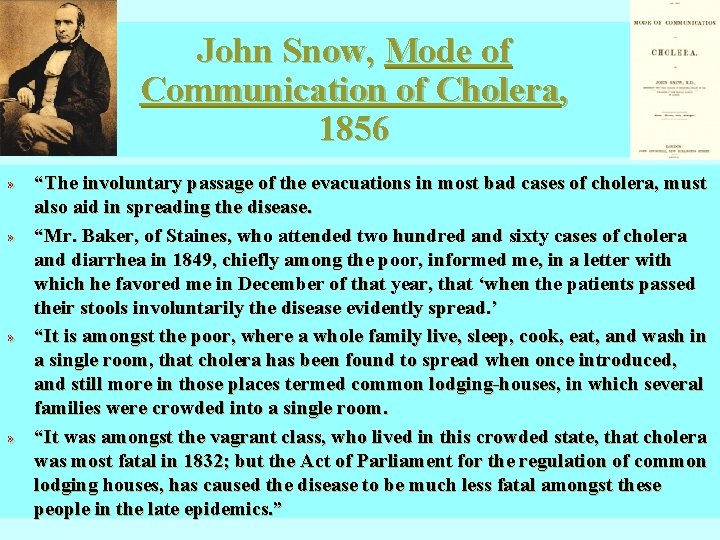
John Snow, Mode of Communication of Cholera, 1856 » “The involuntary passage of the evacuations in most bad cases of cholera, must » » » also aid in spreading the disease. “Mr. Baker, of Staines, who attended two hundred and sixty cases of cholera and diarrhea in 1849, chiefly among the poor, informed me, in a letter with which he favored me in December of that year, that ‘when the patients passed their stools involuntarily the disease evidently spread. ’ “It is amongst the poor, where a whole family live, sleep, cook, eat, and wash in a single room, that cholera has been found to spread when once introduced, and still more in those places termed common lodging-houses, in which several families were crowded into a single room. “It was amongst the vagrant class, who lived in this crowded state, that cholera was most fatal in 1832; but the Act of Parliament for the regulation of common lodging houses, has caused the disease to be much less fatal amongst these people in the late epidemics. ”
John Snow, Mode of Communication of Cholera, 1856 » “When, on the other hand, cholera is introduced into the better kind of houses, as it often is, it hardly ever spreads from one member of the family to another. » “The constant use of the hand-basin and towel, and the fact of the apartments for cooking and eating being distinct from the sick room, are the cause of this. ” this.
MEASURES REQUIRED FOR THE PREVENTION OF CHOLERA AND OTHER DISEASES WHICH ARE COMMUNICATED IN THE SAME WAY—Snow, 1856 » “ 1 st. The strictest cleanliness… » “ 2 nd. The soiled bed linen and body linen of the patient should be immersed in water as soon as they are removed… » “ 3 rd. Care should be taken that the water employed for drinking and preparing food…is not contaminated with the contents of cesspools, house-drains, or sewers… » “ 7 th. The communicability of cholera ought not to be disguised from the people, under the idea that the knowledge of it would cause a panic, or occasion the sick to be deserted. ”
MEASURES REQUIRED FOR THE PREVENTION OF CHOLERA AND OTHER DISEASES WHICH ARE COMMUNICATED IN THE SAME WAY—Snow, 1856 » 1 st. The strictest cleanliness should be observed by those about the sick. There should be a handbasin, water, and towel, in every room where there is a cholera patient, and care should be taken that they are frequently used by the nurse and other attendants, more particularly before touching any food.
MEASURES REQUIRED FOR THE PREVENTION OF CHOLERA AND OTHER DISEASES WHICH ARE COMMUNICATED IN THE SAME WAY—Snow, 1856 » 2 nd. The soiled bed linen and body linen of the patient should be immersed in water as soon as they are removed, until such time as they can be washed, lest the evacuations should become dry, and be wafted about as a fine dust. Articles of bedding and clothing which cannot be washed, should be exposed for some time to a temperature of 212 degrees or upwards.
MEASURES REQUIRED FOR THE PREVENTION OF CHOLERA AND OTHER DISEASES WHICH ARE COMMUNICATED IN THE SAME WAY—Snow, 1856 » 3 rd. Care should be taken that the water employed for drinking and preparing food (whether it come from a pump-well, or be conveyed in pipes) is not contaminated with the contents of cesspools, house-drains, or sewers; or, in the event that water free from suspicion cannot be obtained, is should be well boiled, and, if possible, also filtered.
MEASURES REQUIRED FOR THE PREVENTION OF CHOLERA AND OTHER DISEASES WHICH ARE COMMUNICATED IN THE SAME WAY—Snow, 1856 » 4 th. When cholera prevails very much in the neighborhood, all the provisions which are brought into the house should be well washed with clean water, and exposed to a temperature of 212 degrees Fahrenheit; or at least they should undergo one of these processes, and be purified either by water or by fire. By being careful to wash the hands, and taking due precautions with regard to food, I consider that a person may spend his time amongst cholera patients without exposing himself to any danger.
MEASURES REQUIRED FOR THE PREVENTION OF CHOLERA AND OTHER DISEASES WHICH ARE COMMUNICATED IN THE SAME WAY—Snow, 1856 » 6 th. As it would be impossible to clean out coal- pits, and establish privies and lavatories in them, or even to provide the means of eating a meal with anything like common decency, the time of working should be divided into periods of four hours instead of eight, so that the pit-men might go home to their meals, and be prevented from taking food into the mines.
MEASURES REQUIRED FOR THE PREVENTION OF CHOLERA AND OTHER DISEASES WHICH ARE COMMUNICATED IN THE SAME WAY—Snow, 1856 » 7 th. The communicability of cholera ought not to be disguised from the people, under the idea that the knowledge of it would cause a panic, or occasion the sick to be deserted. British people would not desert their friends or relatives in illness, though they should incur danger by attending to them; but the truth is, that to look on cholera as a "catching" disease, which one may avoid by a few simple precautions, is a much less discouraging doctrine than that which supposes it to depend on some mysterious state of the atmosphere in which we are all of us immersed and obliged to breathe.
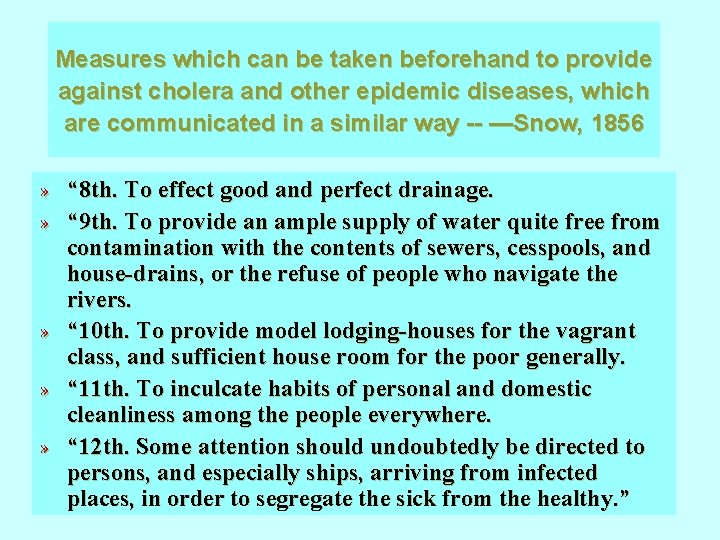
Measures which can be taken beforehand to provide against cholera and other epidemic diseases, which are communicated in a similar way -- —Snow, 1856 » “ 8 th. To effect good and perfect drainage. » “ 9 th. To provide an ample supply of water quite free from » » » contamination with the contents of sewers, cesspools, and house-drains, or the refuse of people who navigate the rivers. “ 10 th. To provide model lodging-houses for the vagrant class, and sufficient house room for the poor generally. “ 11 th. To inculcate habits of personal and domestic cleanliness among the people everywhere. “ 12 th. Some attention should undoubtedly be directed to persons, and especially ships, arriving from infected places, in order to segregate the sick from the healthy. ”
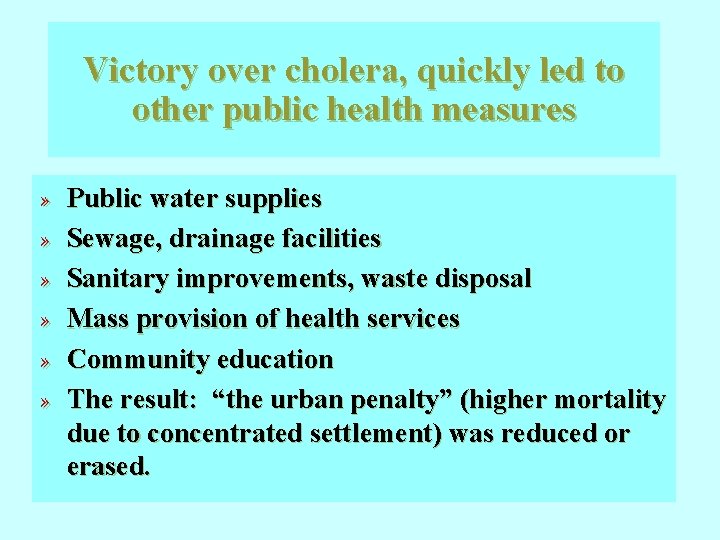
Victory over cholera, quickly led to other public health measures » » » Public water supplies Sewage, drainage facilities Sanitary improvements, waste disposal Mass provision of health services Community education The result: “the urban penalty” (higher mortality due to concentrated settlement) was reduced or erased.
1800 1900 The “modern” rise of population in Europe, dates from the late 18 th century
1800 1900 Death rates fluctuated widely in the 18 th century, then began a sustained decline in the 19 th
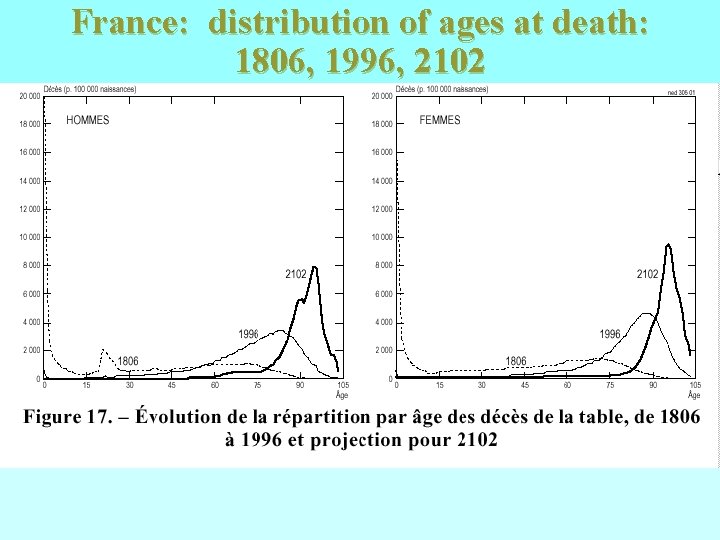
France: distribution of ages at death: 1806, 1996, 2102
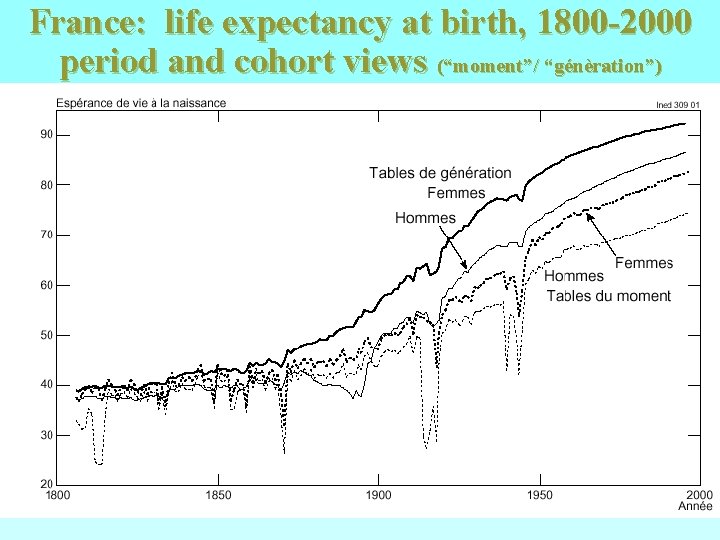
France: life expectancy at birth, 1800 -2000 period and cohort views (“moment”/ “génèration”)
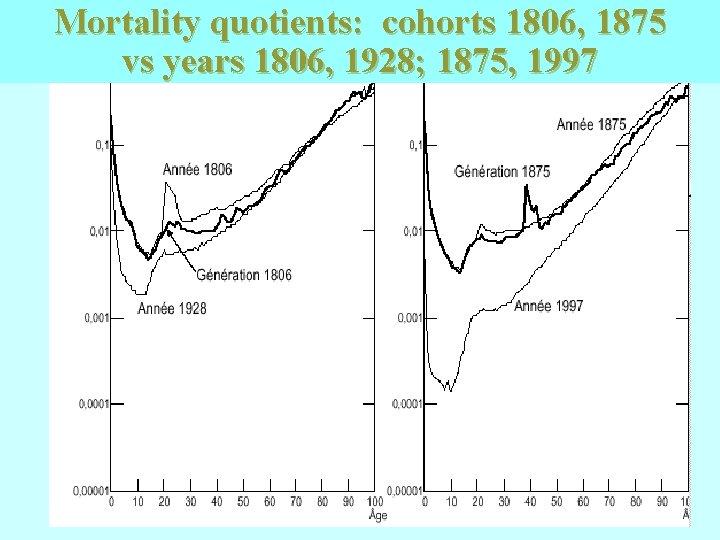
Mortality quotients: cohorts 1806, 1875 vs years 1806, 1928; 1875, 1997
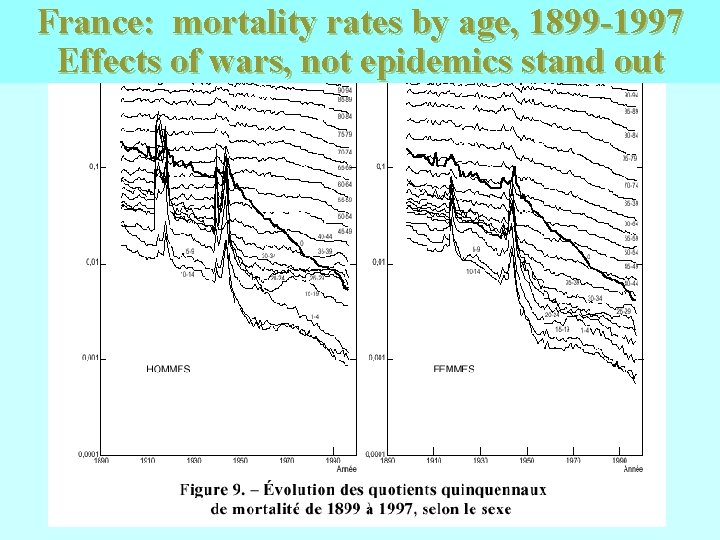
France: mortality rates by age, 1899 -1997 Effects of wars, not epidemics stand out
End