
Modern Cryptography www dziembowski netStudentiBISS 09 Lecture 9
Modern Cryptography www. dziembowski. net/Studenti/BISS 09 Lecture 9 Chosen-Ciphertext Security Stefan Dziembowski University of Rome La Sapienza Bi. SS 2009 Bertinoro International Spring School 2 -6 March 2009
Plan 1. CCA-security – the motivation and the definition 2. CCA-security in the private-key settings 3. CCA-security in the public-key settings 1. 2. a scheme that is efficient and simple, a scheme that is even more efficient and a bit less simple.
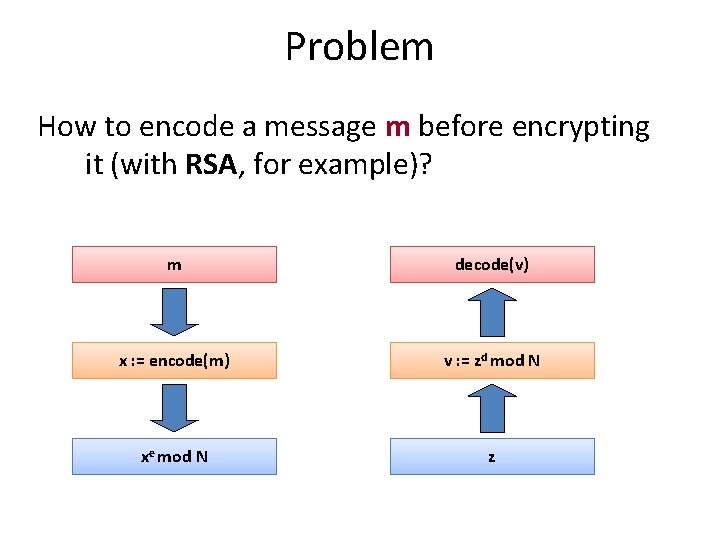
Problem How to encode a message m before encrypting it (with RSA, for example)? m decode(v) x : = encode(m) v : = zd mod N xe mod N z
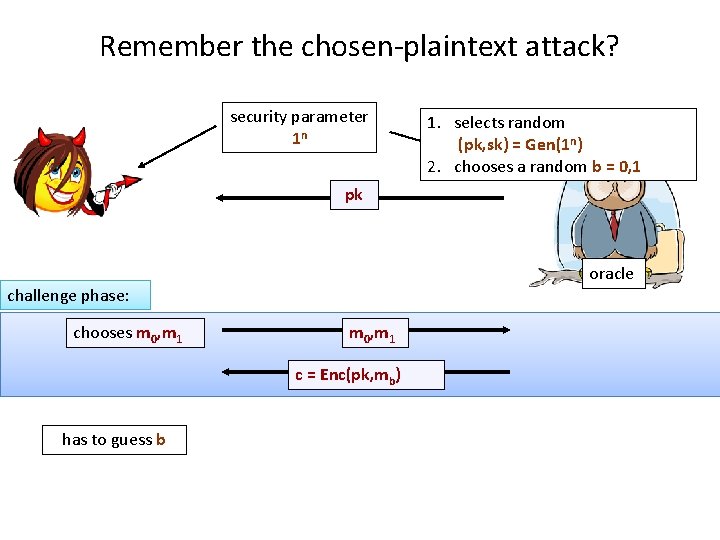
Remember the chosen-plaintext attack? security parameter 1 n 1. selects random (pk, sk) = Gen(1 n) 2. chooses a random b = 0, 1 pk oracle challenge phase: chooses m 0, m 1 c = Enc(pk, mb) has to guess b
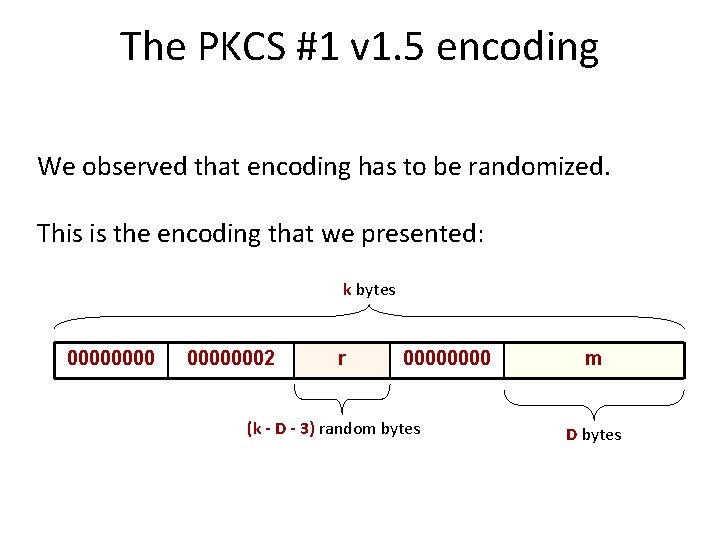
The PKCS #1 v 1. 5 encoding We observed that encoding has to be randomized. This is the encoding that we presented: k bytes 00000002 r 0000 (k - D - 3) random bytes m D bytes
This lecture The PKCS #1 v 1. 5 encoding looks ad-hoc. . . Today we present a more “scientific” encoding. For this, we are going to use a stronger security definition.
Chosen Ciphertext Attack (CCA) The adversary may also choose a ciphertext and learn the corresponding plaintext. Does it make sense? – Aren’t we too paranoid? – How to formalize it?
![Aren’t we too paranoid? No! Bleichenbacher [1998] showed a “practical” chosen ciphertext attack on](http://slidetodoc.com/presentation_image_h2/9ae9e6207565893d9400a334f22f1f84/image-8.jpg "Aren’t we too paranoid? No! Bleichenbacher [1998] showed a “practical” chosen ciphertext attack on")
Aren’t we too paranoid? No! Bleichenbacher [1998] showed a “practical” chosen ciphertext attack on encoding proposed for the PKCS #1 v. 2 standard. [see also: Bleichenbacher, D. , Kaliski B. , Staddon J. , "Recent results on PKCS #1: RSA encryption standard", RSA Laboratories' bulletin #7, ftp: //ftp. rsasecurity. com/pub/pdfs/bulletn 7. pdf ] Why is Blaichenbacher’s attack practical? Because it assumes that the adversary can get only one bit of information about the plaintext. . .
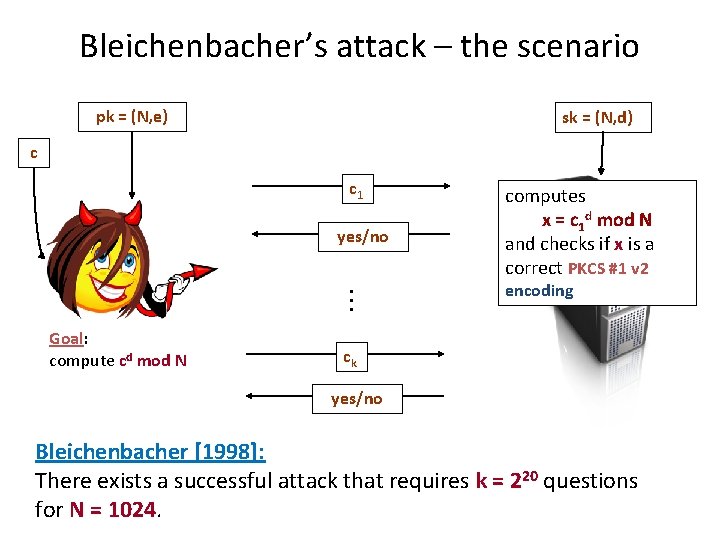
Bleichenbacher’s attack – the scenario pk = (N, e) sk = (N, d) c c 1 yes/no. . . Goal: compute cd mod N computes x = c 1 d mod N and checks if x is a correct PKCS #1 v 2 encoding ck yes/no Bleichenbacher [1998]: There exists a successful attack that requires k = 220 questions for N = 1024.
So, chosen ciphertext attacks are practical! In Bleichenbacher’s attack the adversary could obtain just one bit of information. Conservative approach: assume that he can get the entire plaintext.
Idea 1. Provide a security definition that “covers” this type of an attack. 2. Propose a scheme that is “provably secure” according to this definition. This will lead to an encoding that is less ad-hoc than PKCS #1 v 1. 5
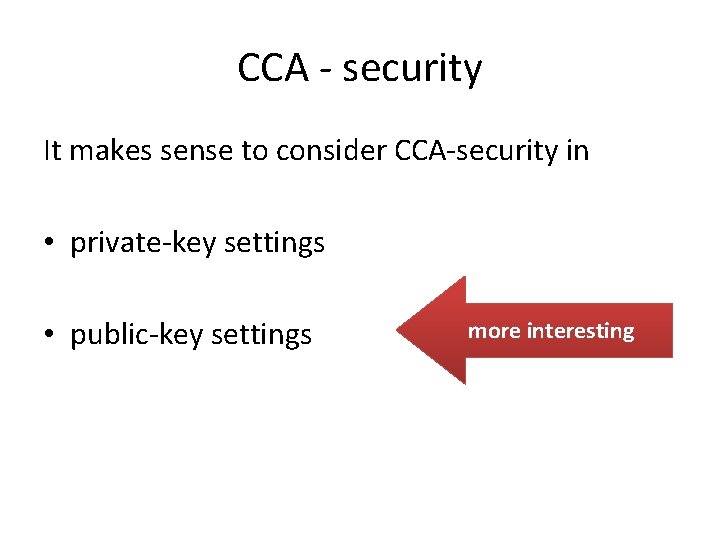
CCA - security It makes sense to consider CCA-security in • private-key settings • public-key settings more interesting
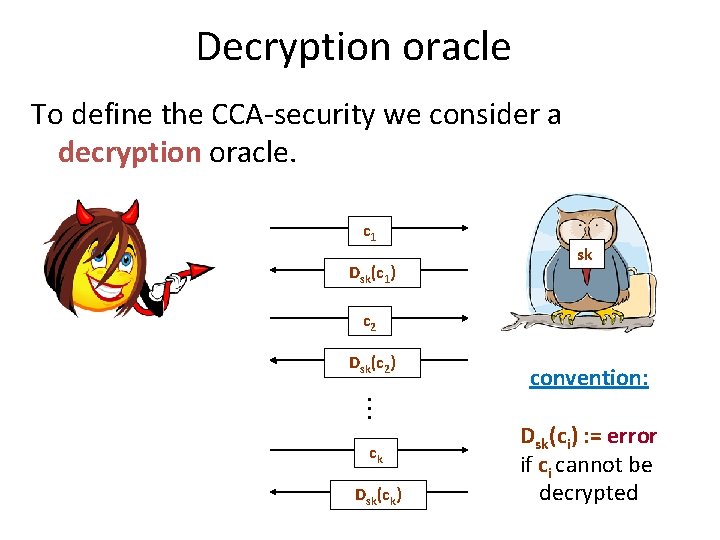
Decryption oracle To define the CCA-security we consider a decryption oracle. c 1 Dsk(c 1) sk c 2 Dsk(c 2) convention: . . . ck Dsk(ck) Dsk(ci) : = error if ci cannot be decrypted
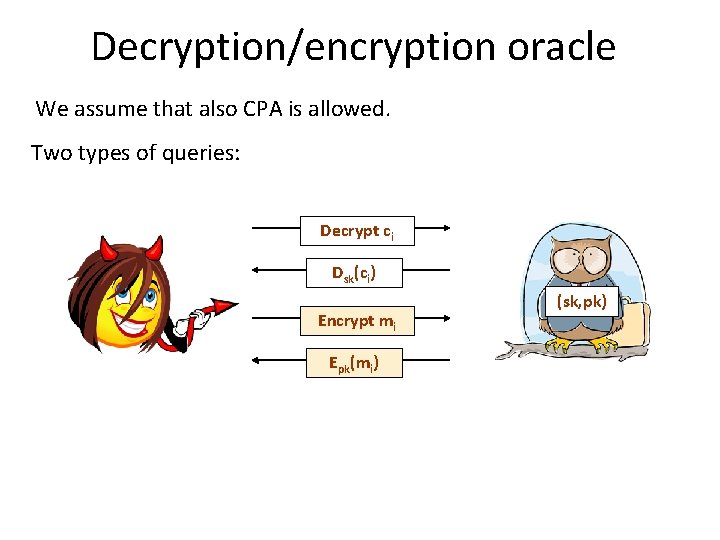
Decryption/encryption oracle We assume that also CPA is allowed. Two types of queries: Decrypt ci Dsk(ci) Encrypt mi Epk(mi) (sk, pk)
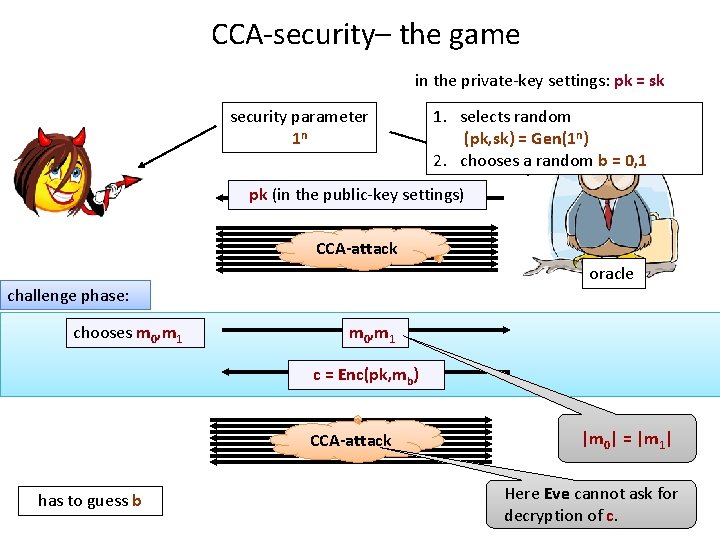
CCA-security– the game in the private-key settings: pk = sk security parameter 1 n 1. selects random (pk, sk) = Gen(1 n) 2. chooses a random b = 0, 1 pk (in the public-key settings) CCA-attack oracle challenge phase: chooses m 0, m 1 c = Enc(pk, mb) CCA-attack has to guess b |m 0| = |m 1| Here Eve cannot ask for decryption of c.
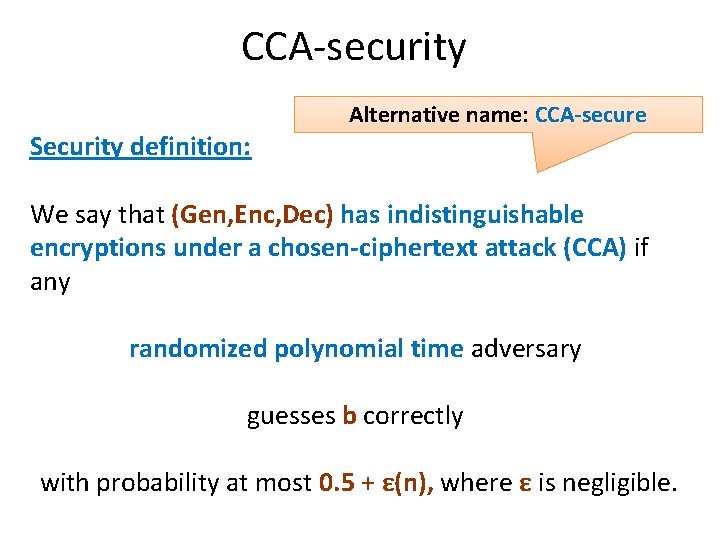
CCA-security Alternative name: CCA-secure Security definition: We say that (Gen, Enc, Dec) has indistinguishable encryptions under a chosen-ciphertext attack (CCA) if any randomized polynomial time adversary guesses b correctly with probability at most 0. 5 + ε(n), where ε is negligible.
CCA in practice (1/2) Some actions of the receiver may depend on the decrypted message. For example, the receiver may communicate an error if the message “looks strange”. (like in the Bleichenbacher’s attack)
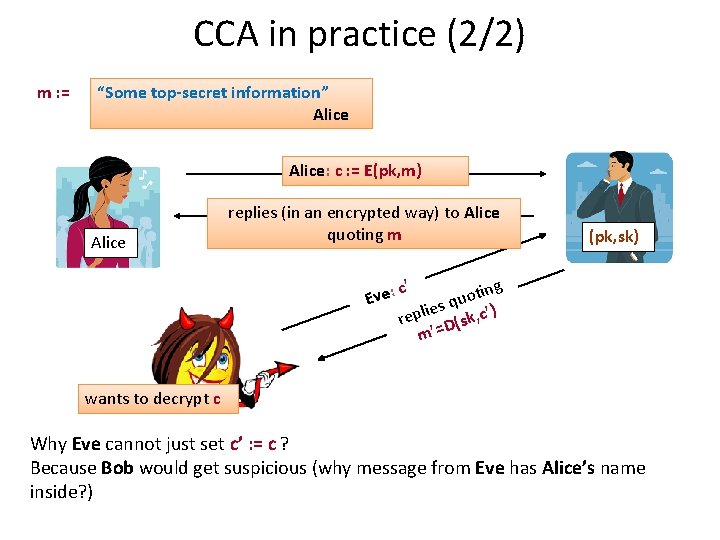
CCA in practice (2/2) m : = “Some top-secret information” Alice: c : = E(pk, m) Alice replies (in an encrypted way) to Alice quoting m (pk, sk) c’ : ting e o v u E ies q k, c’) l p e r D(s = ’ m wants to decrypt c Why Eve cannot just set c’ : = c ? Because Bob would get suspicious (why message from Eve has Alice’s name inside? )
Plan 1. CCA-security – the motivation and the definition 2. CCA-security in the private-key settings 3. CCA-security in the public-key settings 1. 2. a scheme that is efficient and simple, a scheme that is even more efficient and a bit less simple.
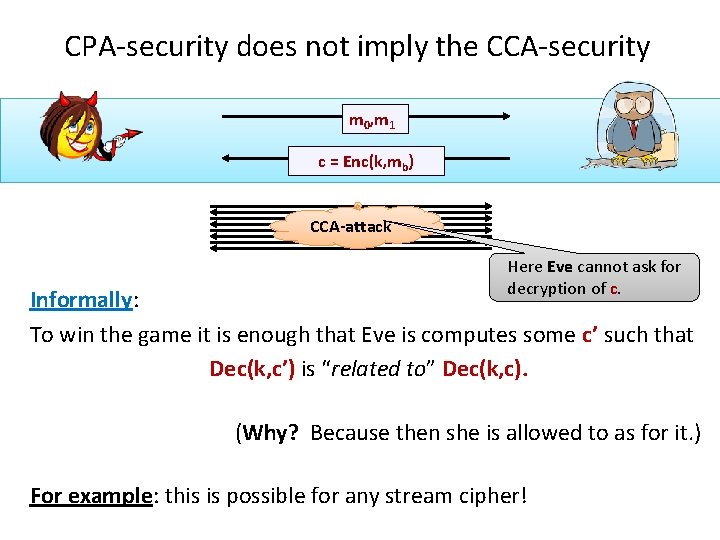
CPA-security does not imply the CCA-security m 0, m 1 c = Enc(k, mb) CCA-attack Here Eve cannot ask for decryption of c. Informally: To win the game it is enough that Eve is computes some c’ such that Dec(k, c’) is “related to” Dec(k, c). (Why? Because then she is allowed to as for it. ) For example: this is possible for any stream cipher!
What to do? CCA-security in the private-key settings can be achieved by adding authentication. How to combine authentication with encryption? We already considered this problem some time ago.
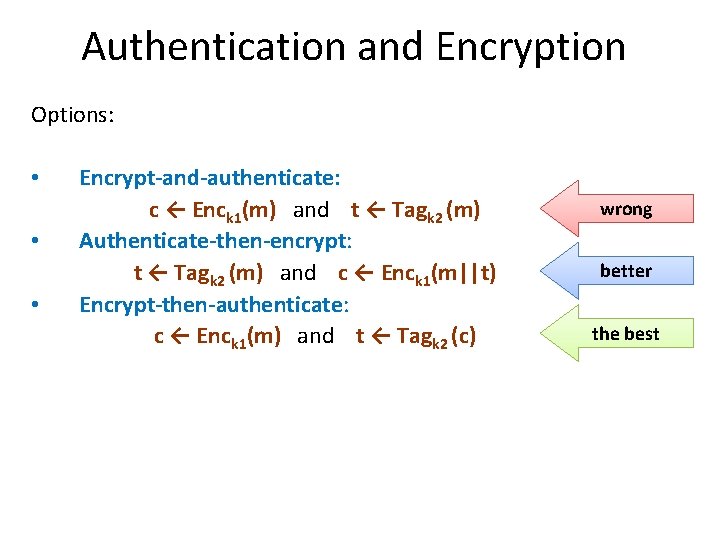
Authentication and Encryption Options: • • • Encrypt-and-authenticate: c ← Enck 1(m) and t ← Tagk 2 (m) Authenticate-then-encrypt: t ← Tagk 2 (m) and c ← Enck 1(m||t) Encrypt-then-authenticate: c ← Enck 1(m) and t ← Tagk 2 (c) wrong better the best
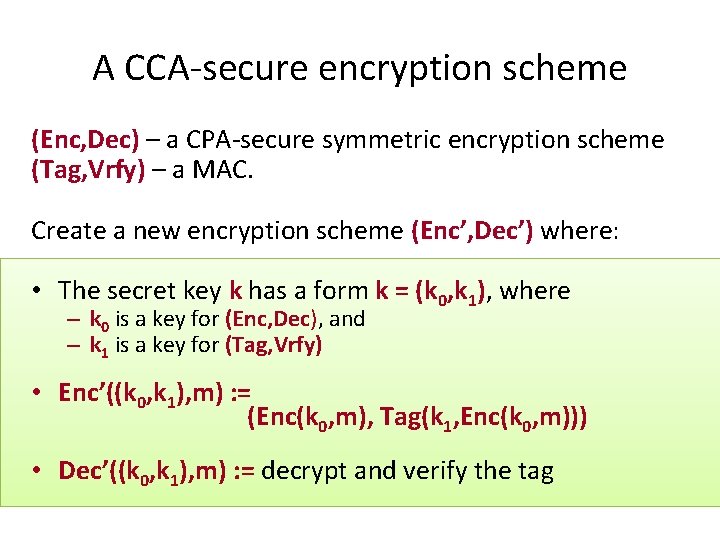
A CCA-secure encryption scheme (Enc, Dec) – a CPA-secure symmetric encryption scheme (Tag, Vrfy) – a MAC. Create a new encryption scheme (Enc’, Dec’) where: • The secret key k has a form k = (k 0, k 1), where – k 0 is a key for (Enc, Dec), and – k 1 is a key for (Tag, Vrfy) • Enc’((k 0, k 1), m) : = (Enc(k 0, m), Tag(k 1, Enc(k 0, m))) • Dec’((k 0, k 1), m) : = decrypt and verify the tag
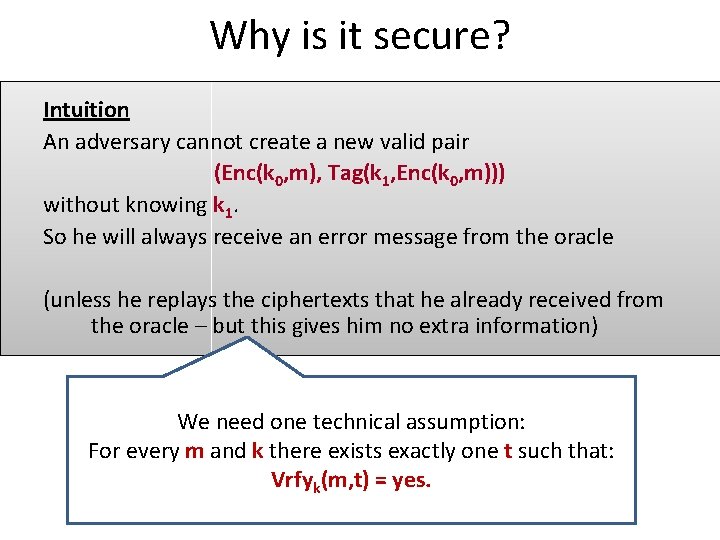
Why is it secure? Intuition An adversary cannot create a new valid pair (Enc(k 0, m), Tag(k 1, Enc(k 0, m))) without knowing k 1. So he will always receive an error message from the oracle (unless he replays the ciphertexts that he already received from the oracle – but this gives him no extra information) We need one technical assumption: For every m and k there exists exactly one t such that: Vrfyk(m, t) = yes.
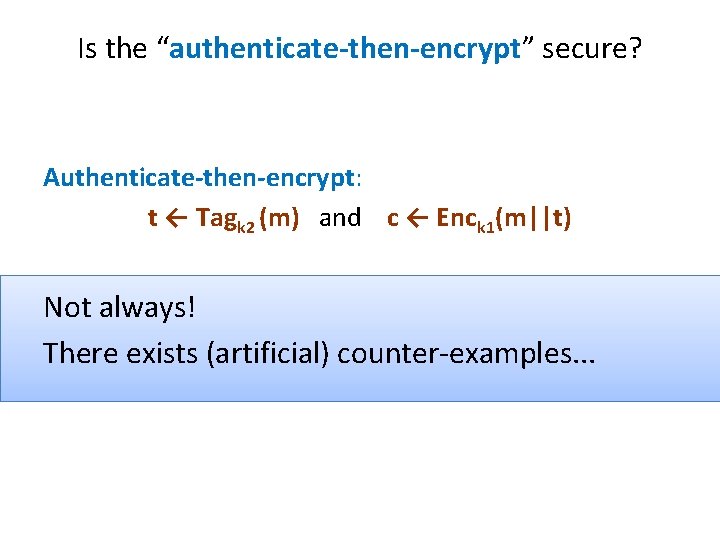
Is the “authenticate-then-encrypt” secure? Authenticate-then-encrypt: t ← Tagk 2 (m) and c ← Enck 1(m||t) Not always! There exists (artificial) counter-examples. . .
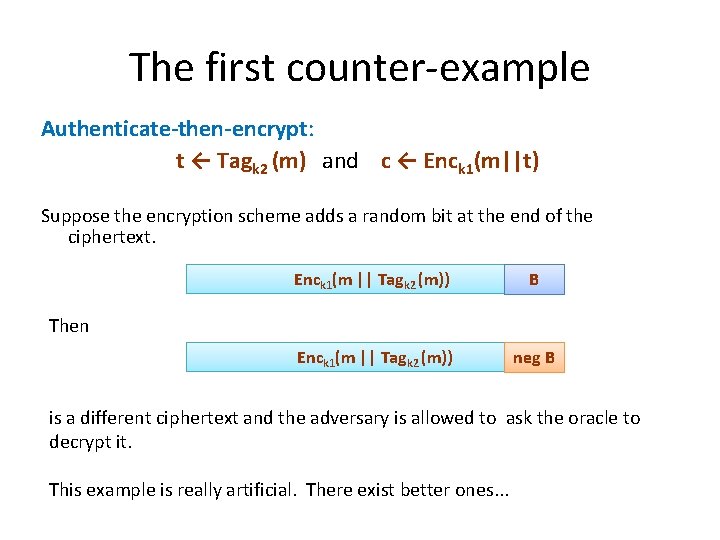
The first counter-example Authenticate-then-encrypt: t ← Tagk 2 (m) and c ← Enck 1(m||t) Suppose the encryption scheme adds a random bit at the end of the ciphertext. Enck 1(m || Tagk 2 (m)) B Enck 1(m || Tagk 2 (m)) neg B Then is a different ciphertext and the adversary is allowed to ask the oracle to decrypt it. This example is really artificial. There exist better ones. . .
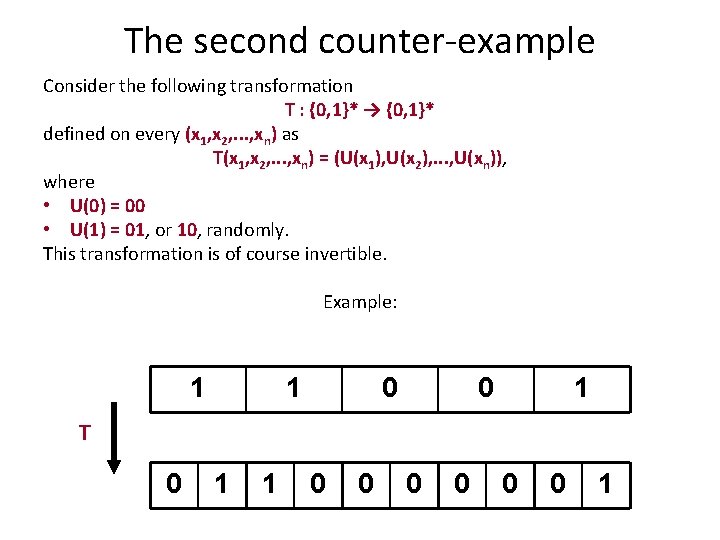
The second counter-example Consider the following transformation T : {0, 1}* → {0, 1}* defined on every (x 1, x 2, . . . , xn) as T(x 1, x 2, . . . , xn) = (U(x 1), U(x 2), . . . , U(xn)), where • U(0) = 00 • U(1) = 01, or 10, randomly. This transformation is of course invertible. Example: 1 1 0 0 1 T 0 1 1 0 0 0 1
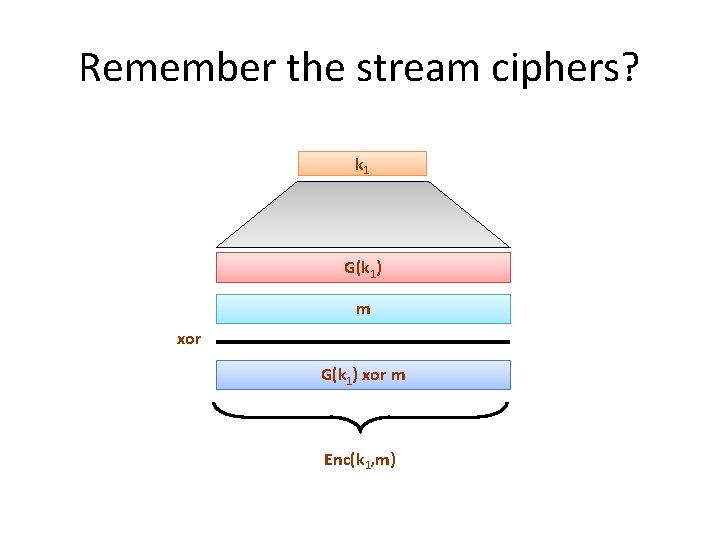
Remember the stream ciphers? k 1 G(k 1) m xor G(k 1) xor m Enc(k 1, m)
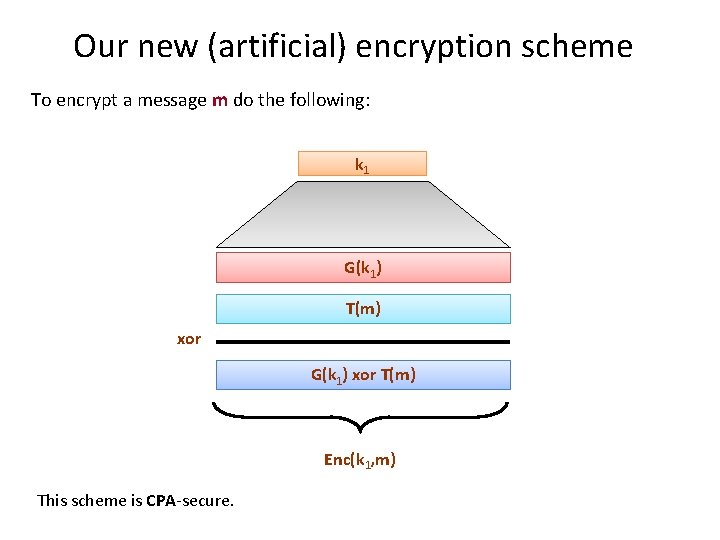
Our new (artificial) encryption scheme To encrypt a message m do the following: k 1 G(k 1) T(m) xor G(k 1) xor T(m) Enc(k 1, m) This scheme is CPA-secure.
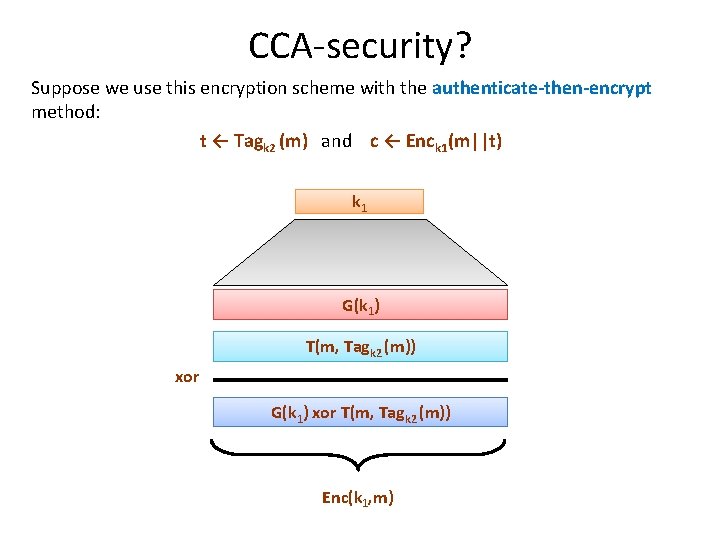
CCA-security? Suppose we use this encryption scheme with the authenticate-then-encrypt method: t ← Tagk 2 (m) and c ← Enck 1(m||t) k 1 G(k 1) T(m, Tagk 2 (m)) xor G(k 1) xor T(m, Tagk 2 (m)) Enc(k 1, m)
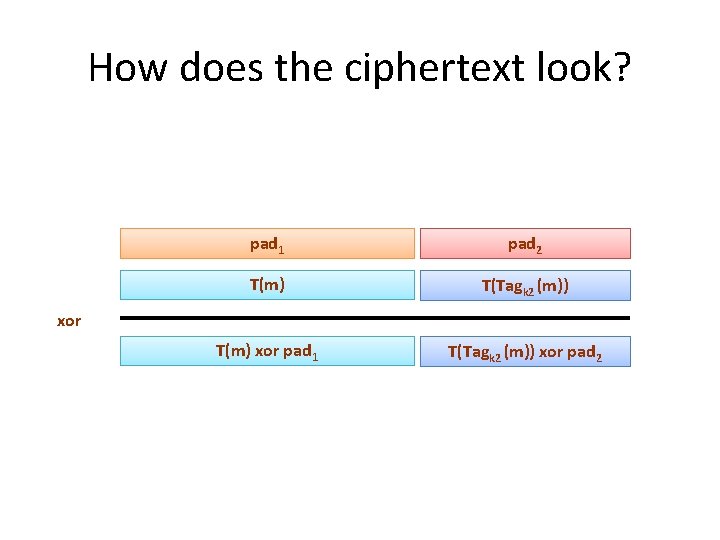
How does the ciphertext look? pad 1 pad 2 T(m) T(Tagk 2 (m)) T(m) xor pad 1 T(Tagk 2 (m)) xor pad 2 xor
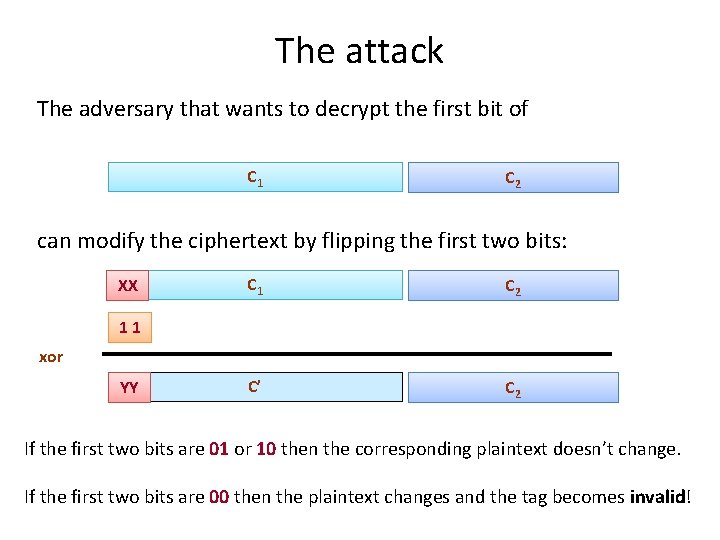
The attack The adversary that wants to decrypt the first bit of C 1 C 2 can modify the ciphertext by flipping the first two bits: XX C 1 C 2 C’ C 2 11 xor YY If the first two bits are 01 or 10 then the corresponding plaintext doesn’t change. If the first two bits are 00 then the plaintext changes and the tag becomes invalid!
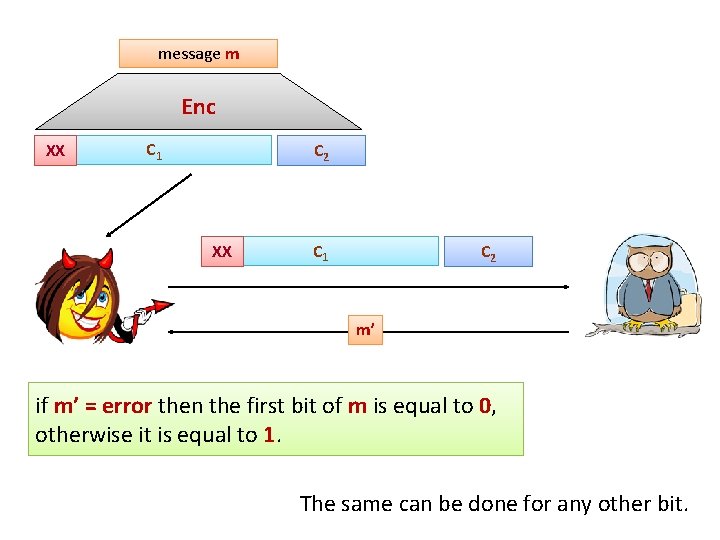
message m Enc XX C 1 C 2 m’ if m’ = error then the first bit of m is equal to 0, otherwise it is equal to 1. The same can be done for any other bit.
These examples are artificial It is likely that for many “normal” schemes this combination is secure. However, these examples show that the authenticate-then-encrypt method cannot be proven secure. . . (from the standard assumptions)
Plan 1. CCA-security – the motivation and the definition 2. CCA-security in the private-key settings? 3. CCA-security in the public-key settings 1. 2. a scheme that is efficient and simple, a scheme that is even more efficient and a bit less simple.
How does it look in the public-key settings There are many constructions of a CCA-secure public-key encryption scheme. Probably the most famous is the one of Cramer and Shoup: [Ronald Cramer and Victor Shoup: "A practical public key cryptosystem provably secure against adaptive chosen ciphertext attack. " 1998]. It is based on hardness of discrete logarithm and is quite efficient. Still, many practitioners prefer more efficient schemes (with a weaker security proof).
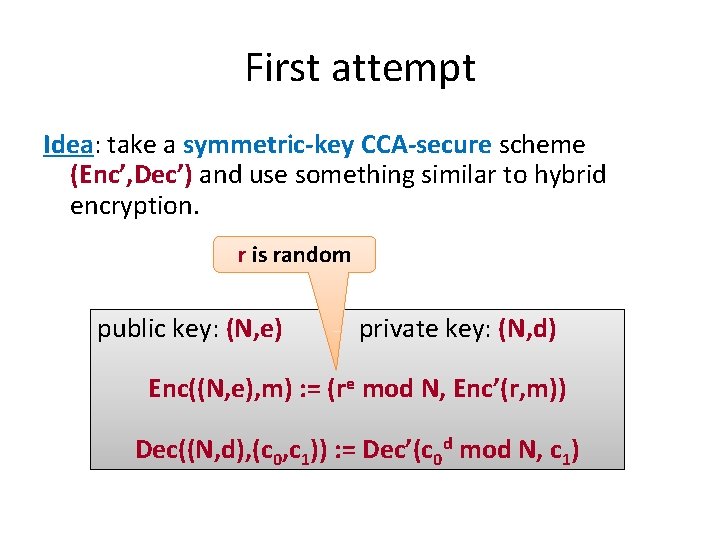
First attempt Idea: take a symmetric-key CCA-secure scheme (Enc’, Dec’) and use something similar to hybrid encryption. r is random public key: (N, e) private key: (N, d) Enc((N, e), m) : = (re mod N, Enc’(r, m)) Dec((N, d), (c 0, c 1)) : = Dec’(c 0 d mod N, c 1)
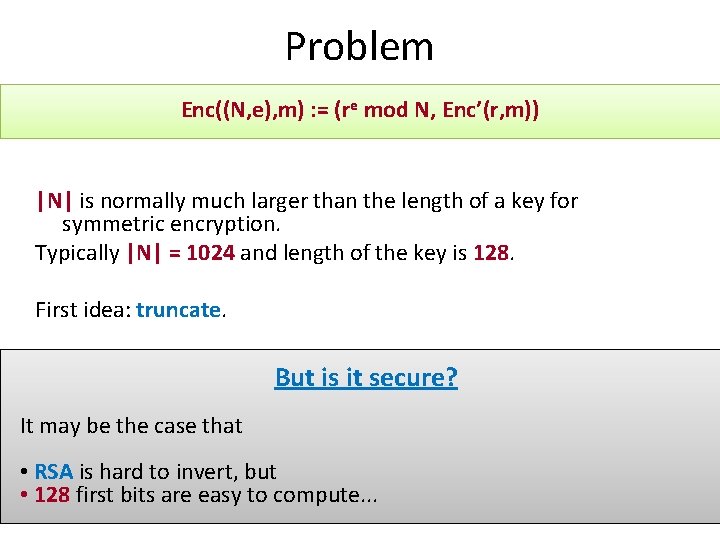
Problem Enc((N, e), m) : = (re mod N, Enc’(r, m)) |N| is normally much larger than the length of a key for symmetric encryption. Typically |N| = 1024 and length of the key is 128. First idea: truncate. But is it secure? It may be the case that • RSA is hard to invert, but • 128 first bits are easy to compute. . .
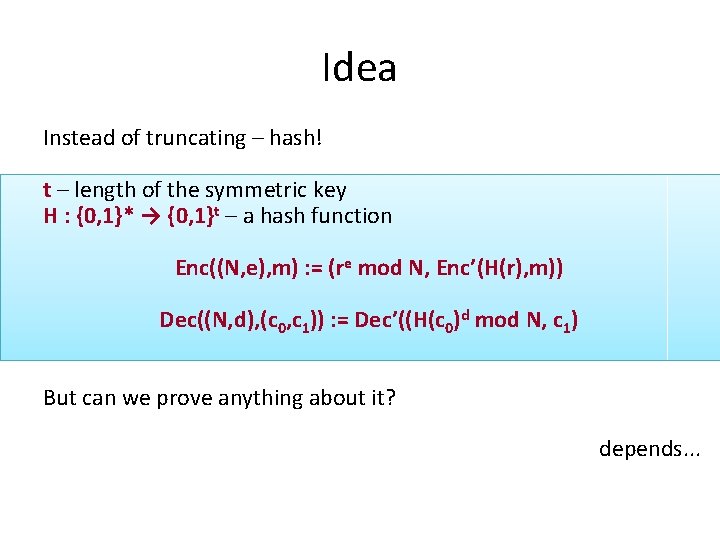
Idea Instead of truncating – hash! t – length of the symmetric key H : {0, 1}* → {0, 1}t – a hash function Enc((N, e), m) : = (re mod N, Enc’(H(r), m)) Dec((N, d), (c 0, c 1)) : = Dec’((H(c 0)d mod N, c 1) But can we prove anything about it? depends. . .
Which properties should H have? If we just assume that H is collision-resistant we cannot prove anything. . . We have to assume that H “outputs random values on different inputs”. This can be formalized by modeling H as random oracle. Remember the Random Oracle Model?
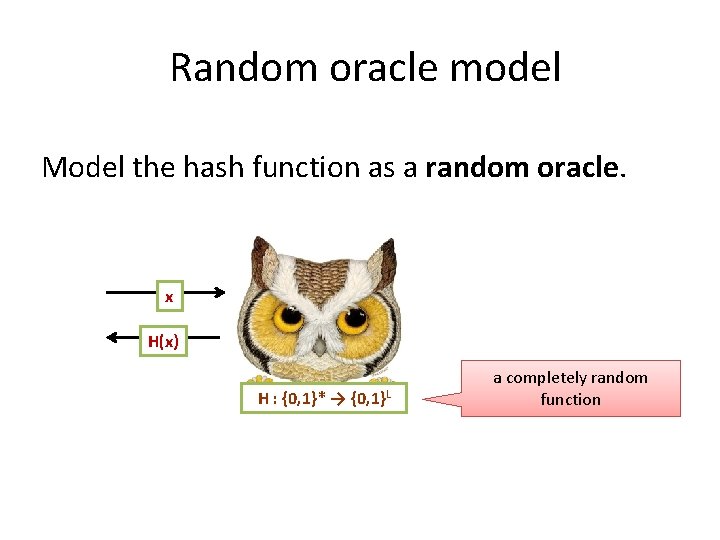
Random oracle model Model the hash function as a random oracle. x H(x) H : {0, 1}* → {0, 1}L a completely random function
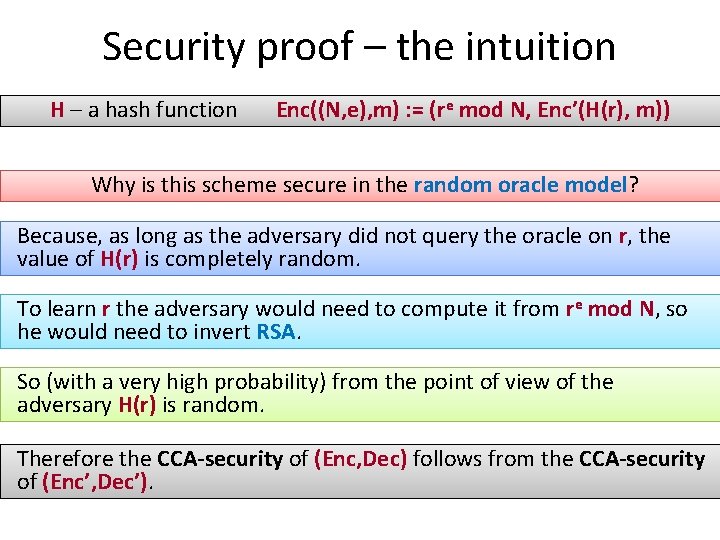
Security proof – the intuition H – a hash function Enc((N, e), m) : = (re mod N, Enc’(H(r), m)) Why is this scheme secure in the random oracle model? Because, as long as the adversary did not query the oracle on r, the value of H(r) is completely random. To learn r the adversary would need to compute it from re mod N, so he would need to invert RSA. So (with a very high probability) from the point of view of the adversary H(r) is random. Therefore the CCA-security of (Enc, Dec) follows from the CCA-security of (Enc’, Dec’).
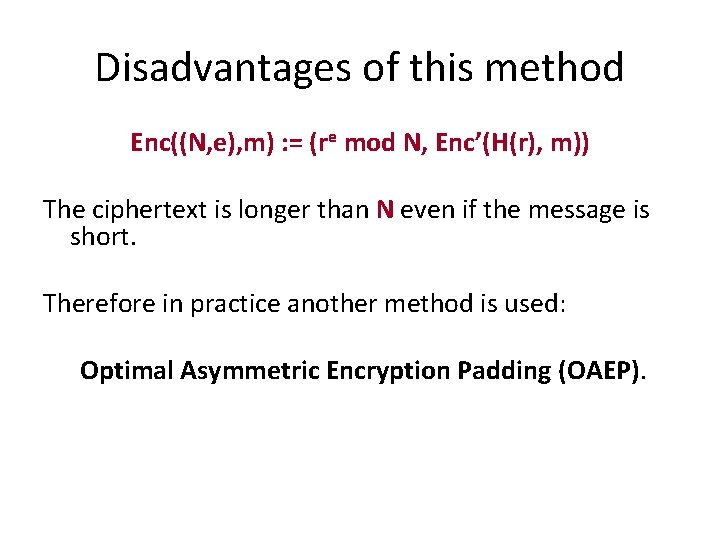
Disadvantages of this method Enc((N, e), m) : = (re mod N, Enc’(H(r), m)) The ciphertext is longer than N even if the message is short. Therefore in practice another method is used: Optimal Asymmetric Encryption Padding (OAEP).
Plan 1. CCA-security – the motivation and the definition 2. CCA-security in the private-key settings? 3. CCA-security in the public-key settings 1. 2. a scheme that is efficient and simple, a scheme that is even more efficient and a bit less simple.
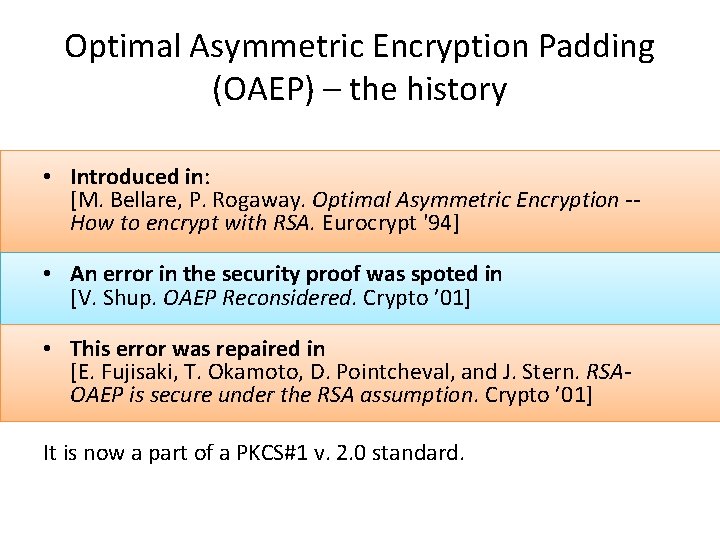
Optimal Asymmetric Encryption Padding (OAEP) – the history • Introduced in: [M. Bellare, P. Rogaway. Optimal Asymmetric Encryption -How to encrypt with RSA. Eurocrypt '94] • An error in the security proof was spoted in [V. Shup. OAEP Reconsidered. Crypto ’ 01] • This error was repaired in [E. Fujisaki, T. Okamoto, D. Pointcheval, and J. Stern. RSAOAEP is secure under the RSA assumption. Crypto ’ 01] It is now a part of a PKCS#1 v. 2. 0 standard.
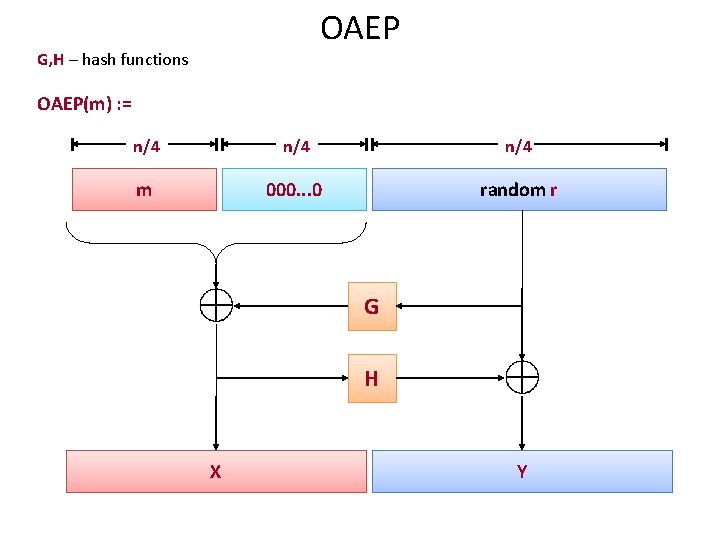
OAEP G, H – hash functions OAEP(m) : = n/4 n/4 m 000. . . 0 random r G H X Y
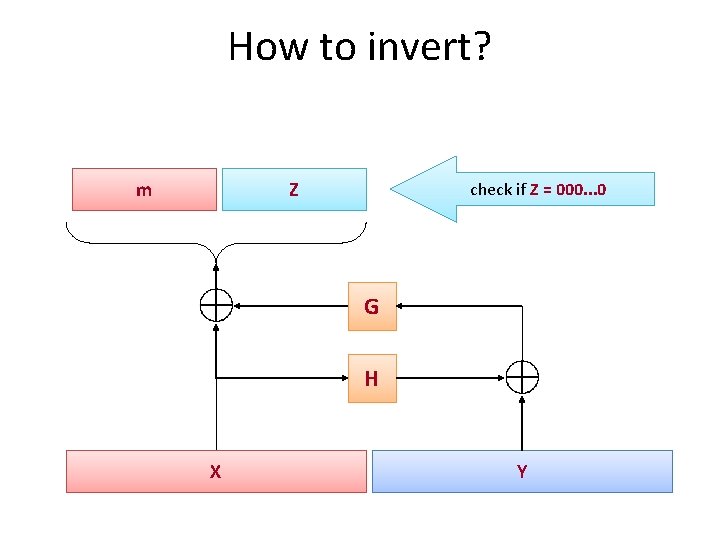
How to invert? m Z check if Z = 000. . . 0 G H X Y
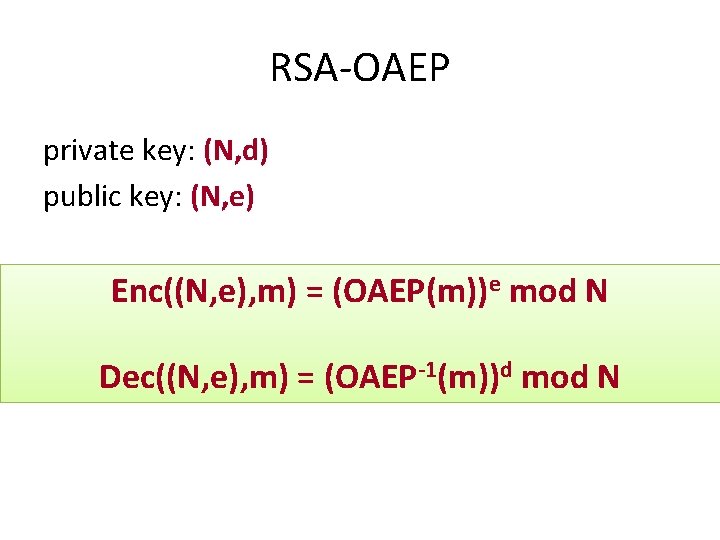
RSA-OAEP private key: (N, d) public key: (N, e) Enc((N, e), m) = (OAEP(m))e mod N Dec((N, e), m) = (OAEP-1(m))d mod N
Security of RSA-OAEP can be proven if • one models H and G as random oracles • the RSA assumption holds. We do not present the proof here. We just mention some nice properties of this encoding.
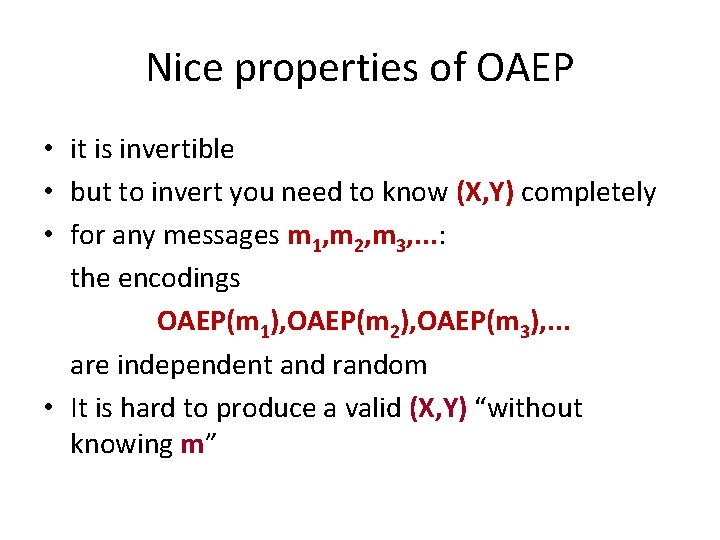
Nice properties of OAEP • it is invertible • but to invert you need to know (X, Y) completely • for any messages m 1, m 2, m 3, . . . : the encodings OAEP(m 1), OAEP(m 2), OAEP(m 3), . . . are independent and random • It is hard to produce a valid (X, Y) “without knowing m”
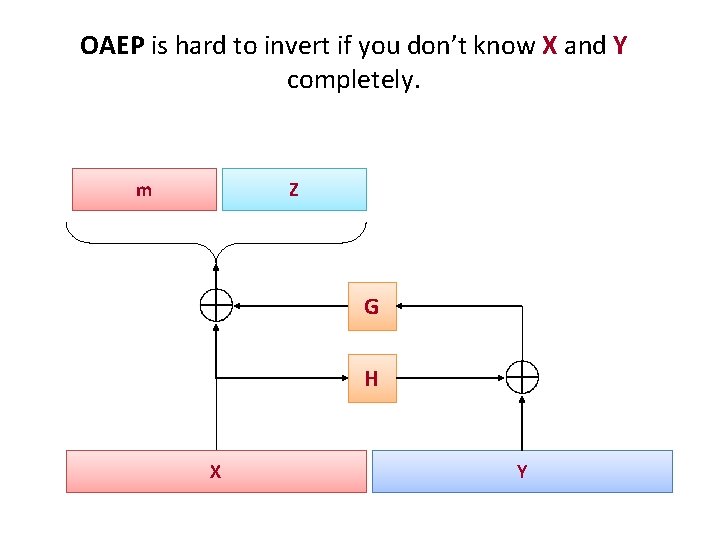
OAEP is hard to invert if you don’t know X and Y completely. m Z G H X Y
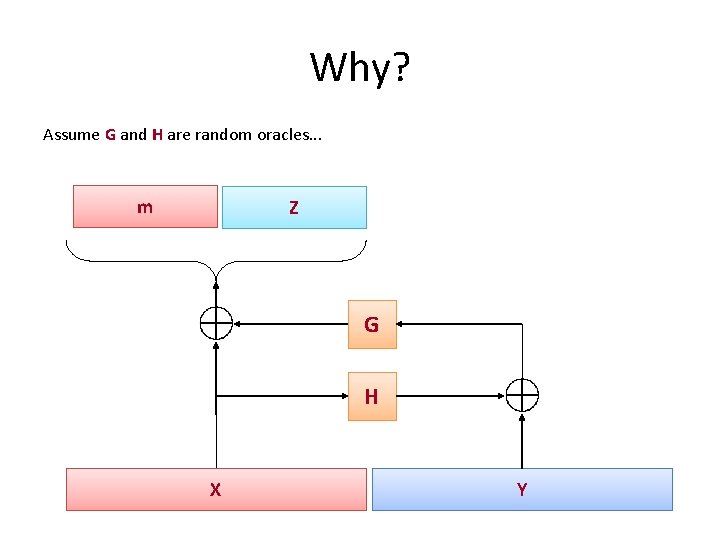
Why? Assume G and H are random oracles. . . m Z G H X Y
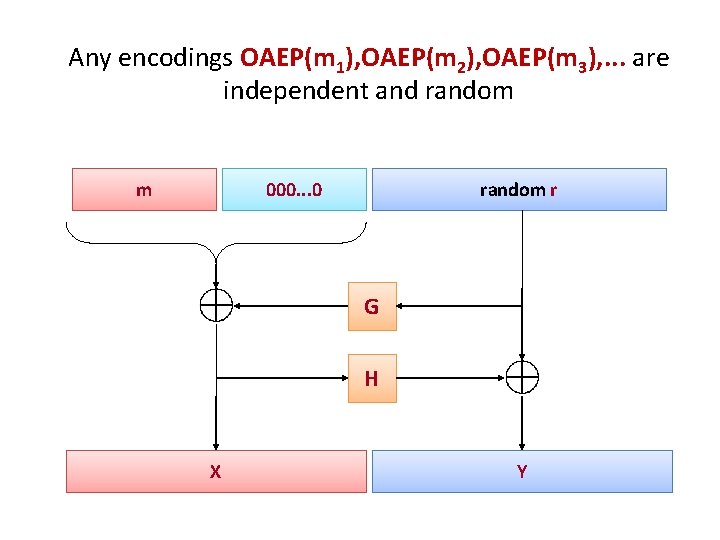
Any encodings OAEP(m 1), OAEP(m 2), OAEP(m 3), . . . are independent and random m 000. . . 0 random r G H X Y
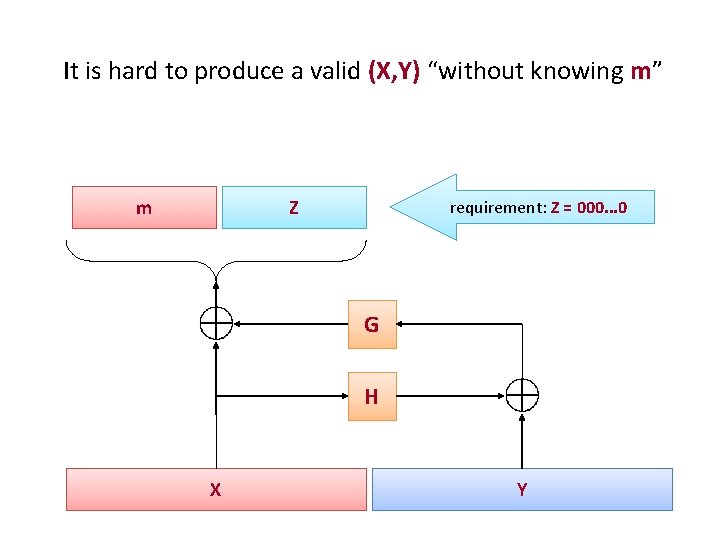
It is hard to produce a valid (X, Y) “without knowing m” m Z requirement: Z = 000. . . 0 G H X Y
This last property is useful for CCAsecurity Why? Informally: Eve can produce valid ciphertexts only of those messages that she knows. . .
Security – the conclusion If it is hard to produce a valid (X, Y) “without knowing m”, then CCA should not help the adversary. Because he will only receive the error messages from the oracle. (that was just an intuition – in reality the proof is complicated)
© 2009 by Stefan Dziembowski. Permission to make digital or hard copies of part or all of this material is currently granted without fee provided that copies are made only for personal or classroom use, are not distributed for profit or commercial advantage, and that new copies bear this notice and the full citation.
- Slides: 57