
Modern cosmology 3 The Growth of Structure Growth
- Slides: 14
Modern cosmology 3: The Growth of Structure Growth of structure in an expanding universe l The Jeans length l Dark matter l Large scale structure simulations l effect l of cosmological parameters Large scale structure data galaxy surveys cosmic microwave background PHY 306 1
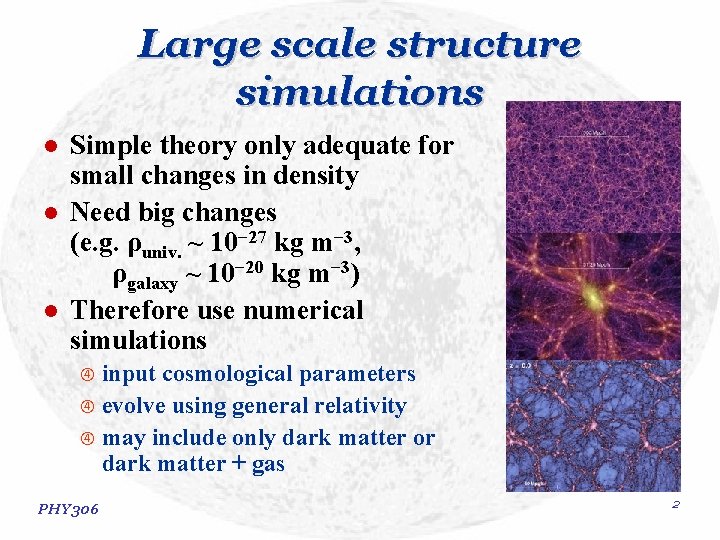
Large scale structure simulations l l l Simple theory only adequate for small changes in density Need big changes (e. g. ρuniv. ~ 10− 27 kg m− 3, ρgalaxy ~ 10− 20 kg m− 3) Therefore use numerical simulations input cosmological parameters evolve using general relativity may include only dark matter or dark matter + gas PHY 306 2
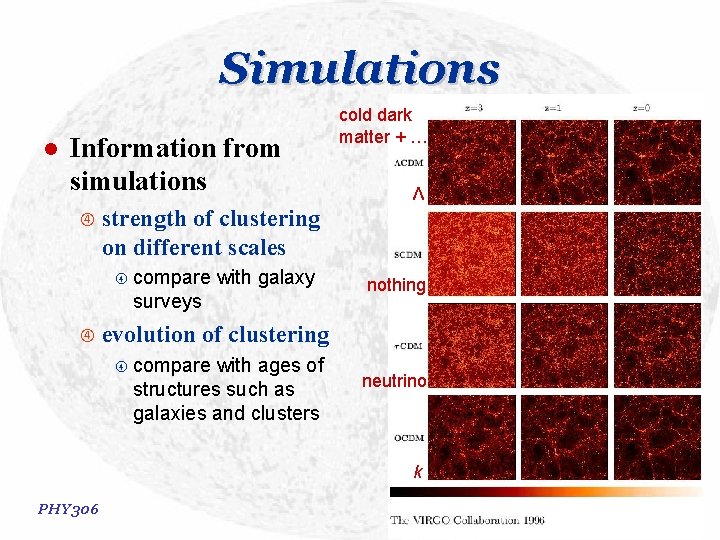
Simulations l Information from simulations Λ strength of clustering on different scales compare with galaxy surveys cold dark matter + … nothing evolution of clustering compare with ages of structures such as galaxies and clusters neutrino k PHY 306 3
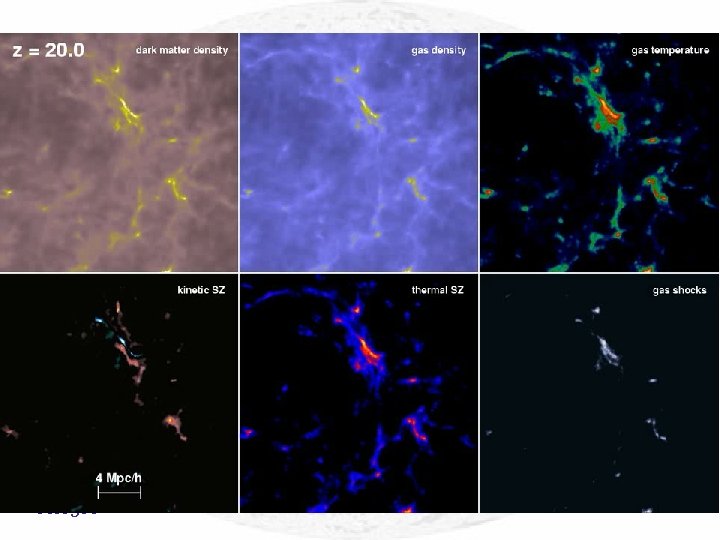
Simulations PHY 306 4
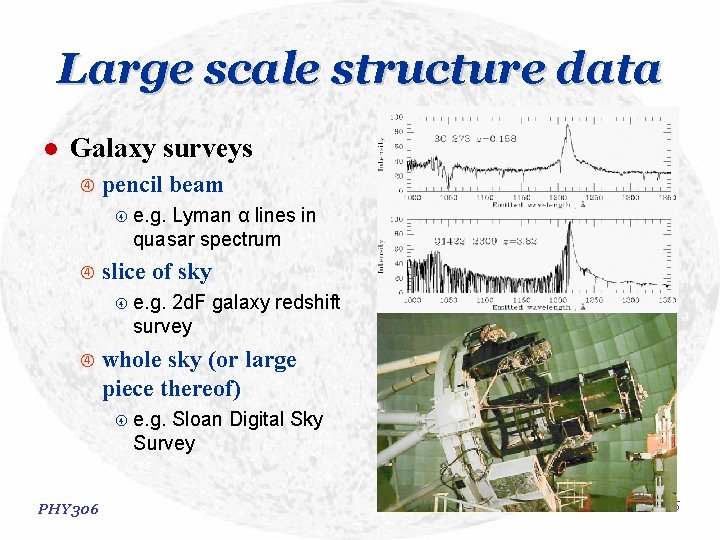
Large scale structure data l Galaxy surveys pencil beam e. g. Lyman α lines in quasar spectrum slice of sky e. g. 2 d. F galaxy redshift survey whole sky (or large piece thereof) e. g. Sloan Digital Sky Survey PHY 306 5
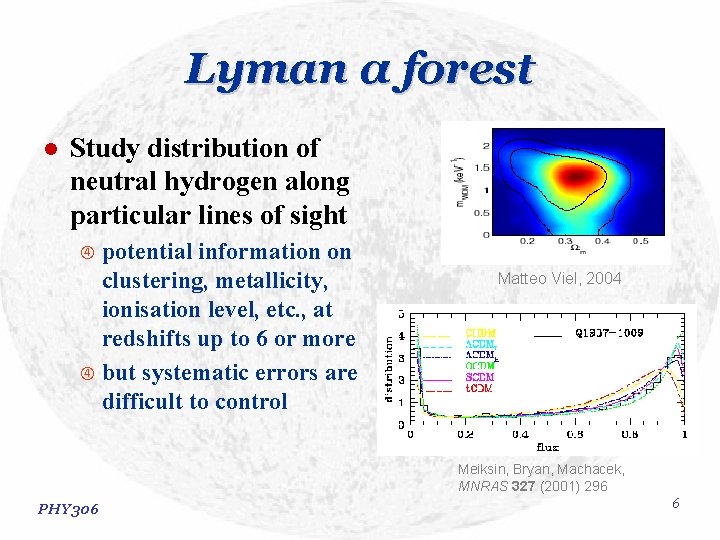
Lyman α forest l Study distribution of neutral hydrogen along particular lines of sight potential information on clustering, metallicity, ionisation level, etc. , at redshifts up to 6 or more but systematic errors are difficult to control Matteo Viel, 2004 Meiksin, Bryan, Machacek, MNRAS 327 (2001) 296 PHY 306 6
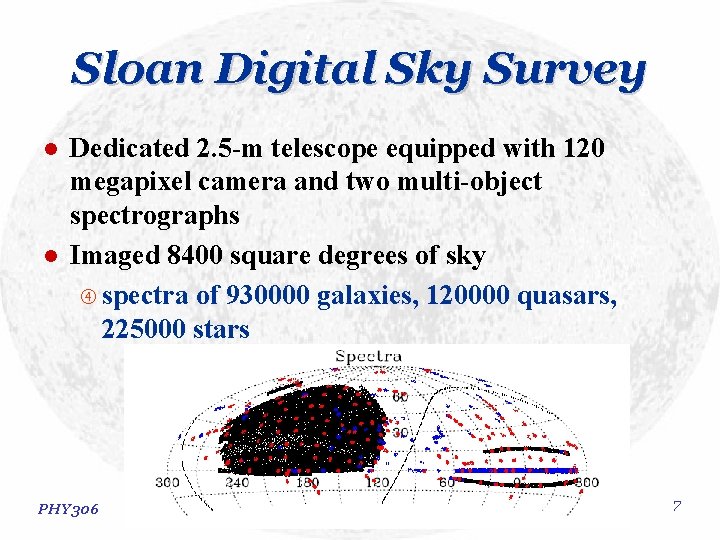
Sloan Digital Sky Survey l l Dedicated 2. 5 -m telescope equipped with 120 megapixel camera and two multi-object spectrographs Imaged 8400 square degrees of sky spectra of 930000 galaxies, 120000 quasars, 225000 stars PHY 306 7
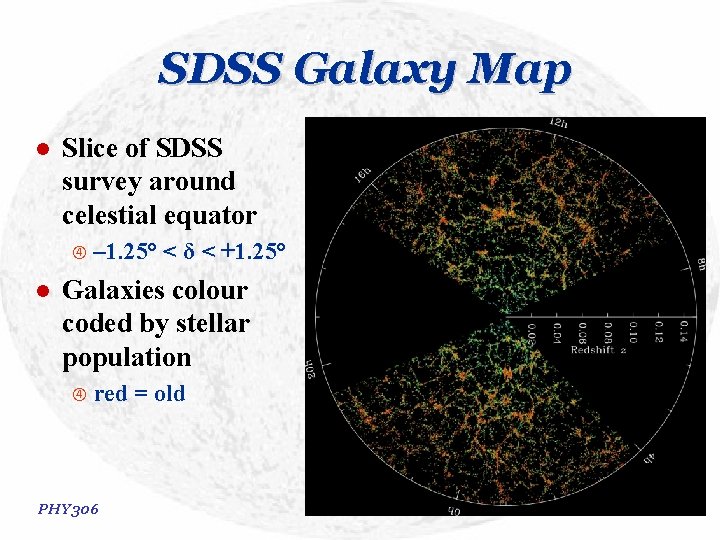
SDSS Galaxy Map l Slice of SDSS survey around celestial equator l – 1. 25° < δ < +1. 25° Galaxies colour coded by stellar population red = old PHY 306 8
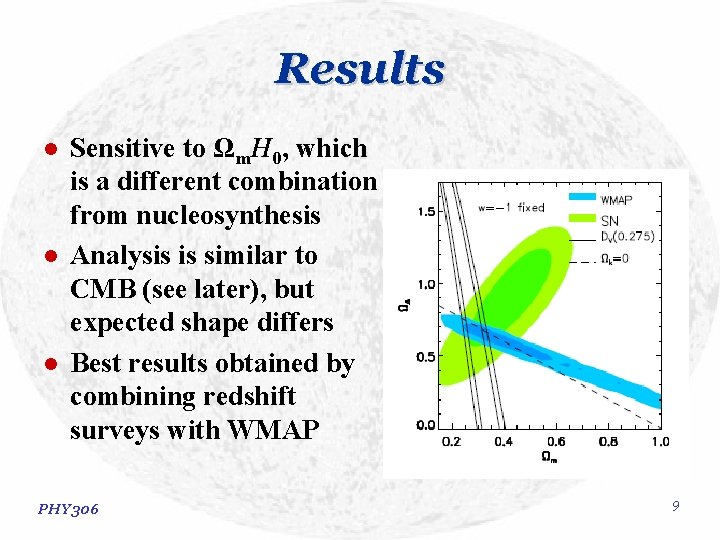
Results l l l Sensitive to Ωm. H 0, which is a different combination from nucleosynthesis Analysis is similar to CMB (see later), but expected shape differs Best results obtained by combining redshift surveys with WMAP PHY 306 9
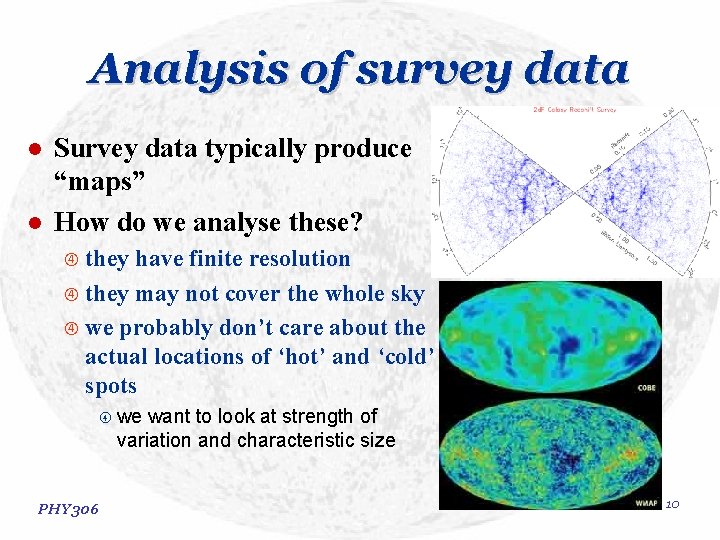
Analysis of survey data l l Survey data typically produce “maps” How do we analyse these? they have finite resolution they may not cover the whole sky we probably don’t care about the actual locations of ‘hot’ and ‘cold’ spots we want to look at strength of variation and characteristic size PHY 306 10
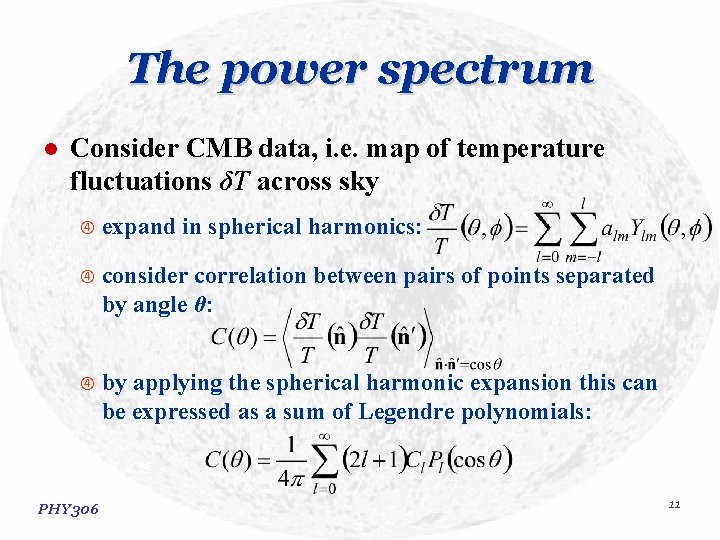
The power spectrum l Consider CMB data, i. e. map of temperature fluctuations δT across sky expand in spherical harmonics: consider correlation between pairs of points separated by angle θ: by applying the spherical harmonic expansion this can be expressed as a sum of Legendre polynomials: PHY 306 11
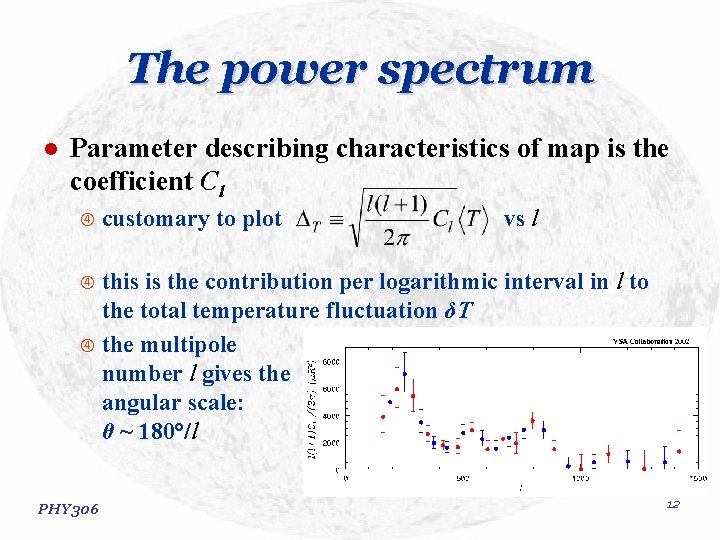
The power spectrum l Parameter describing characteristics of map is the coefficient Cl customary to plot vs l this is the contribution per logarithmic interval in l to the total temperature fluctuation δT the multipole number l gives the angular scale: θ ~ 180°/l PHY 306 12
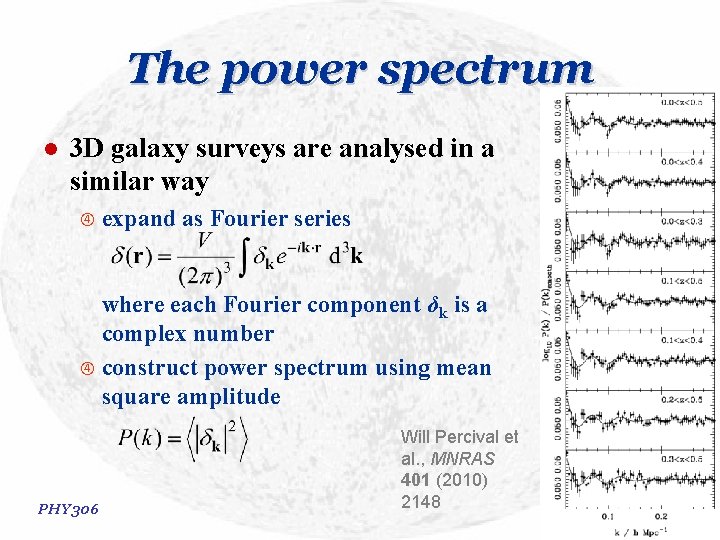
The power spectrum l 3 D galaxy surveys are analysed in a similar way expand as Fourier series where each Fourier component δk is a complex number construct power spectrum using mean square amplitude PHY 306 Will Percival et al. , MNRAS 401 (2010) 2148 13
Conclusion l Large scale structure is very sensitive to cosmological parameters cold vs hot dark matter, Λ, etc. 2 D or 3 D maps can be analysed by expanding as spherical harmonics or Fourier series l Most significant contributors: galaxy surveys (especially SDSS) and CMB l PHY 306 14