
Modern Control Systems Chapter 1 Introduction to Control





- Slides: 38
Modern Control Systems
Chapter 1: Introduction to Control Systems Objectives In this chapter we describe a general process for designing a control system. A control system consisting of interconnected components is designed to achieve a desired purpose. To understand the purpose of a control system, it is useful to examine examples of control systems through the course of history. These early systems incorporated many of the same ideas of feedback that are in use today. Modern control engineering practice includes the use of control design strategies for improving manufacturing processes, the efficiency of energy use, advanced automobile control, including rapid transit, among others. We also discuss the notion of a design gap. The gap exists between the complex physical system under investigation and the model used in the control system synthesis. The iterative nature of design allows us to handle the design gap effectively while accomplishing necessary tradeoffs in complexity, performance, and cost in order to meet the design specifications.
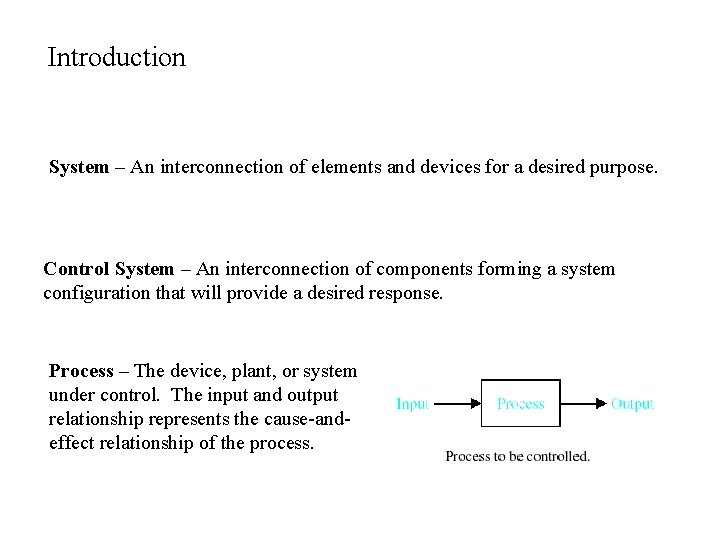
Introduction System – An interconnection of elements and devices for a desired purpose. Control System – An interconnection of components forming a system configuration that will provide a desired response. Process – The device, plant, or system under control. The input and output relationship represents the cause-andeffect relationship of the process.
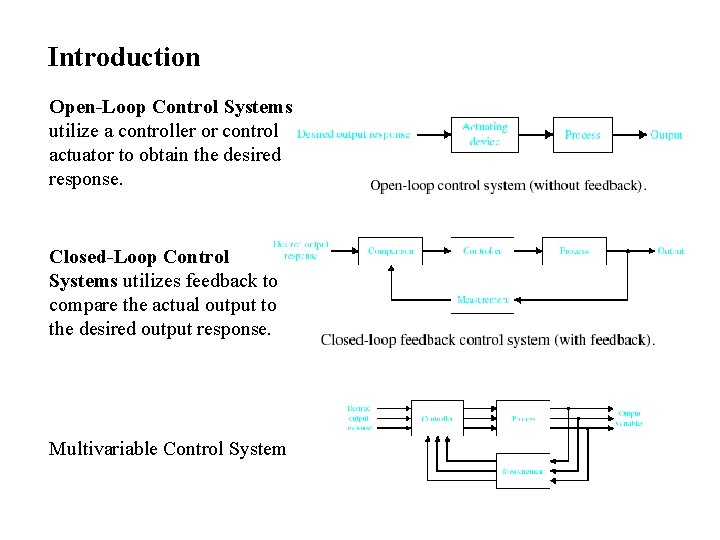
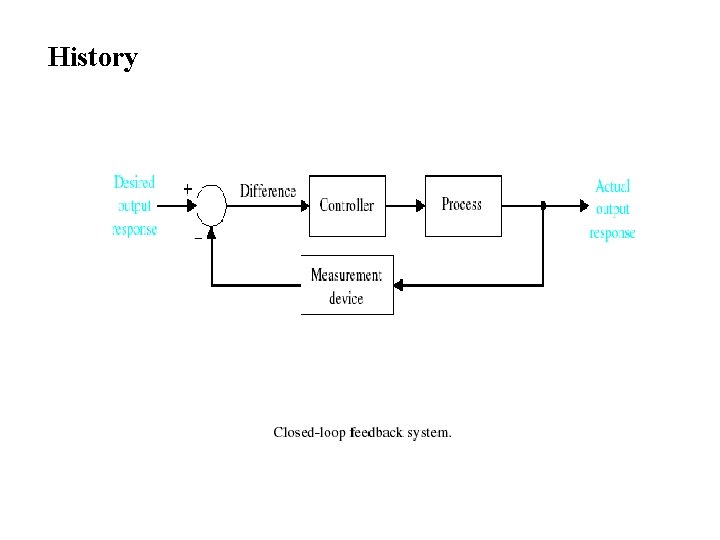
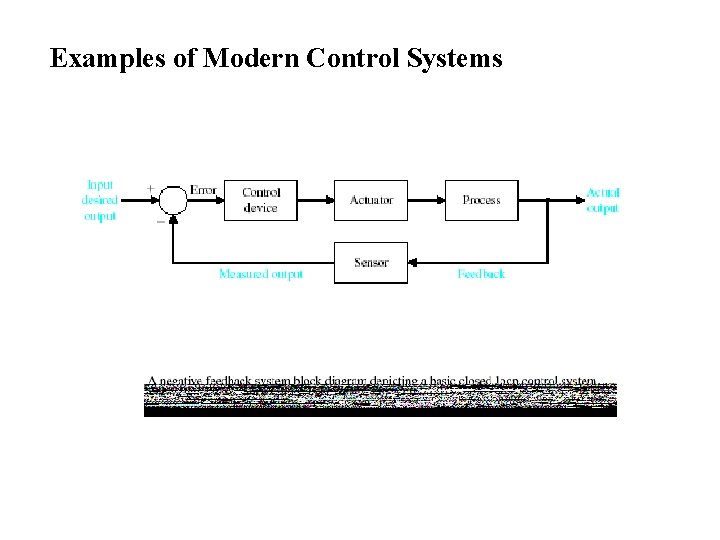
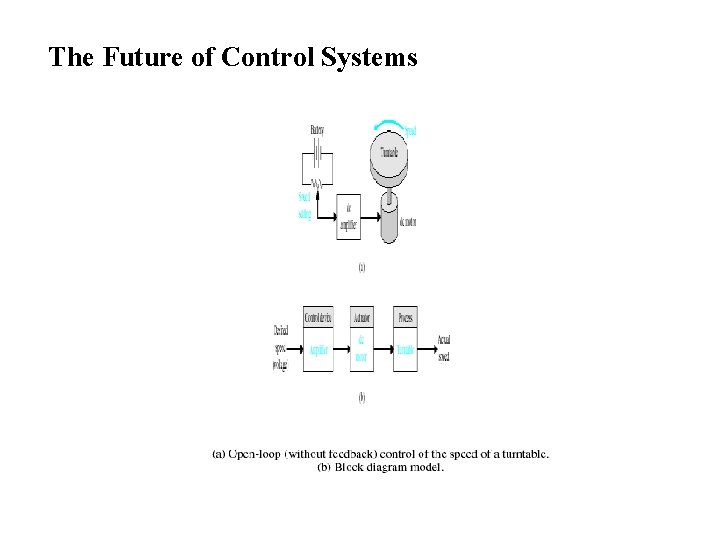
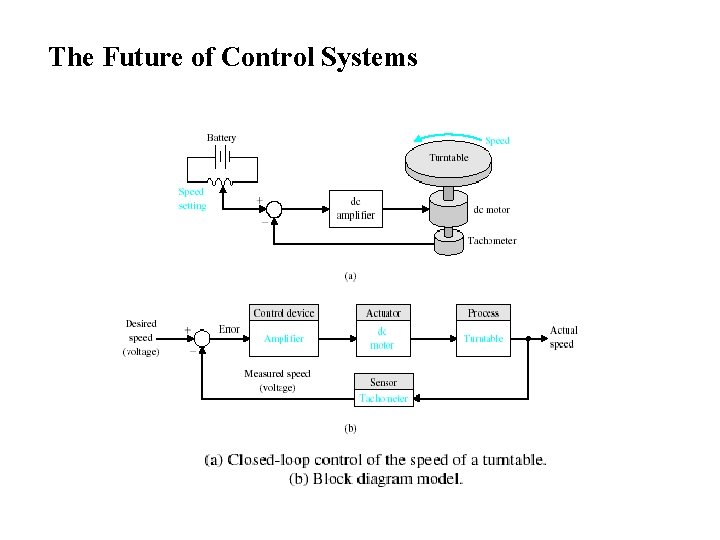
Introduction Open-Loop Control Systems utilize a controller or control actuator to obtain the desired response. Closed-Loop Control Systems utilizes feedback to compare the actual output to the desired output response. Multivariable Control System
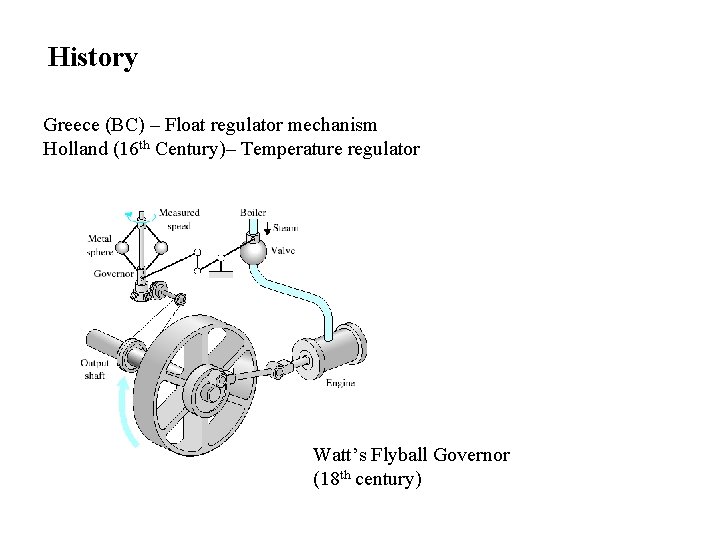
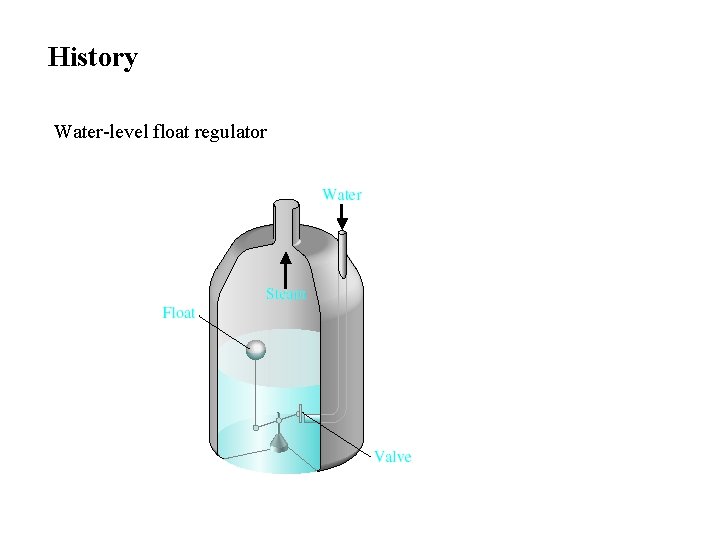
History Greece (BC) – Float regulator mechanism Holland (16 th Century)– Temperature regulator Watt’s Flyball Governor (18 th century)
History Water-level float regulator
History
History 18 th Century James Watt’s centrifugal governor for the speed control of a steam engine. 1920 s Minorsky worked on automatic controllers for steering ships. 1930 s Nyquist developed a method for analyzing the stability of controlled systems 1940 s Frequency response methods made it possible to design linear closed-loop control systems 1950 s Root-locus method due to Evans was fully developed 1960 s State space methods, optimal control, adaptive control and 1980 s Learning controls are begun to investigated and developed. Present and on-going research fields. Recent application of modern control theory includes such non-engineering systems such as biological, biomedical, economic and socio-economic systems ? ? ? ? ? ? ? ? ?
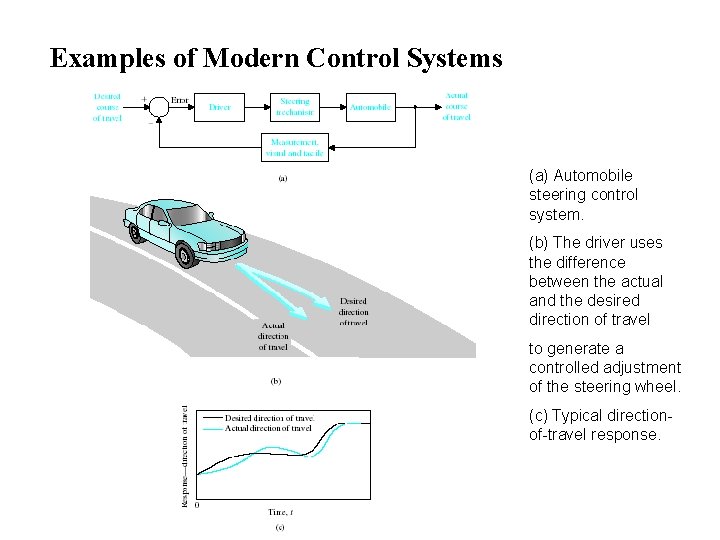
Examples of Modern Control Systems (a) Automobile steering control system. (b) The driver uses the difference between the actual and the desired direction of travel to generate a controlled adjustment of the steering wheel. (c) Typical directionof-travel response.
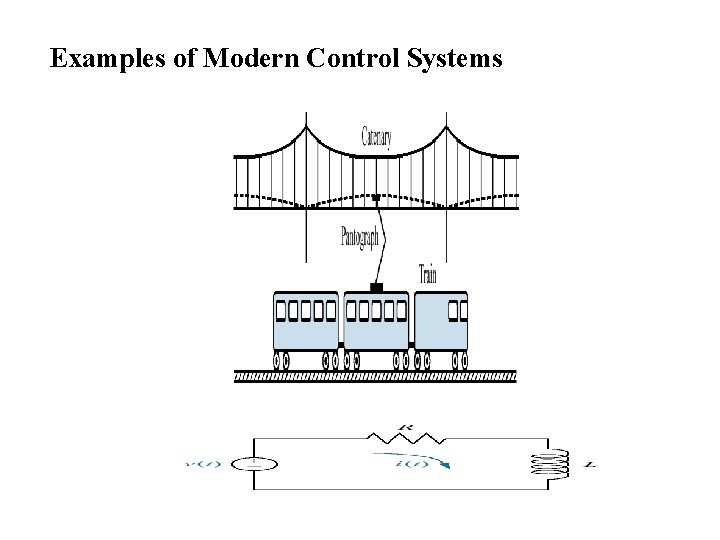
Examples of Modern Control Systems
Examples of Modern Control Systems
Examples of Modern Control Systems
Examples of Modern Control Systems
Examples of Modern Control Systems
Examples of Modern Control Systems
Examples of Modern Control Systems
Examples of Modern Control Systems
The Future of Control Systems
The Future of Control Systems
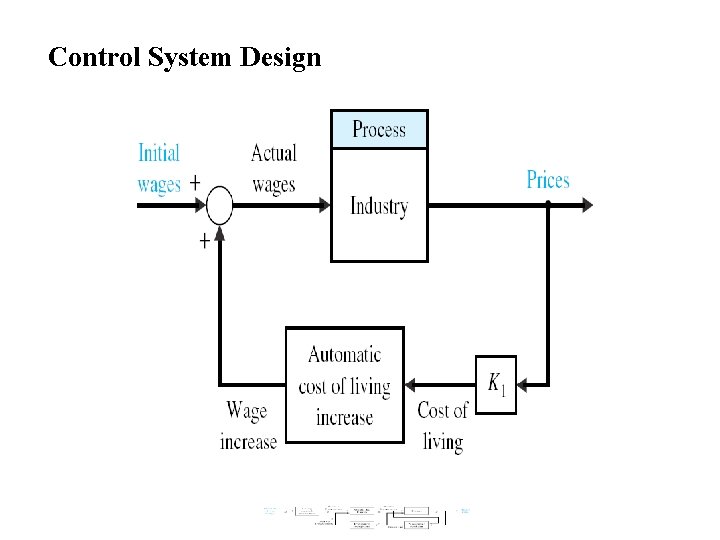
Control System Design
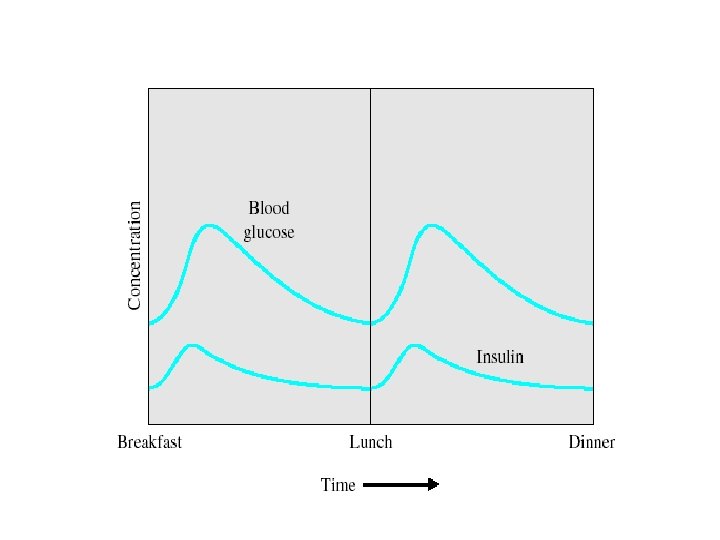
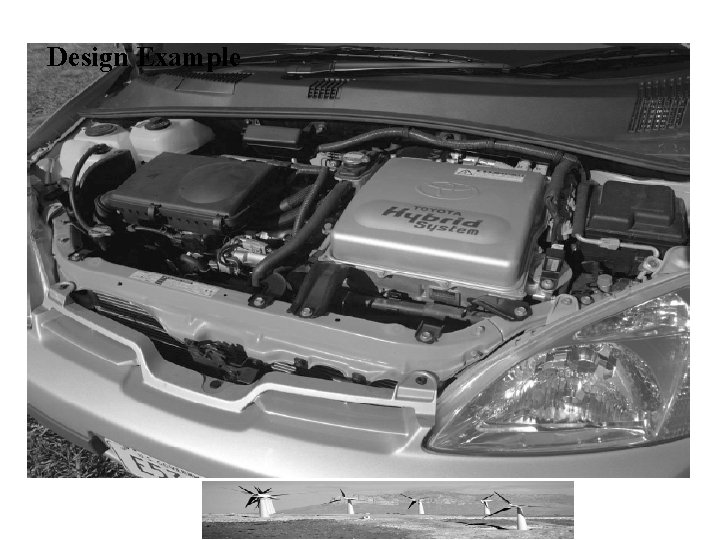
Design Example
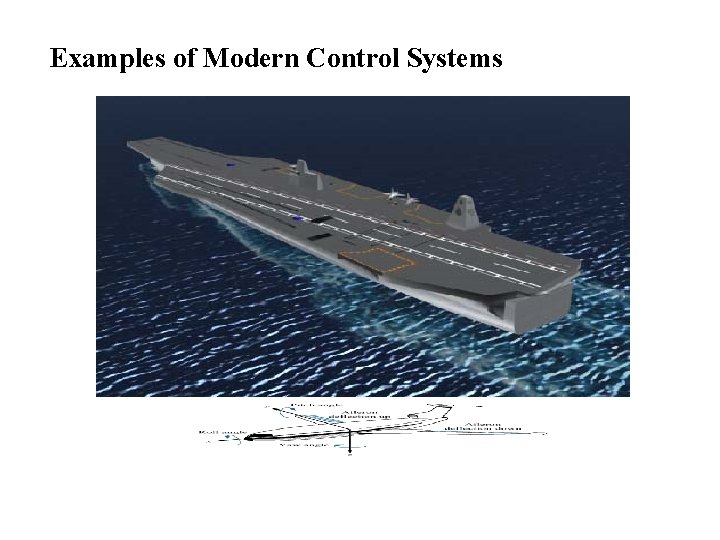
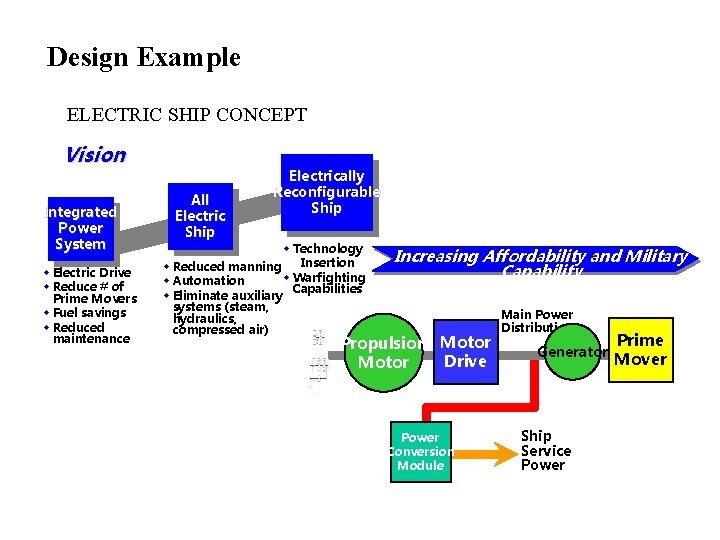
Design Example ELECTRIC SHIP CONCEPT Vision Integrated Power System w Electric Drive w Reduce # of Prime Movers w Fuel savings w Reduced maintenance All Electric Ship Electrically Reconfigurable Ship w Technology Insertion w Reduced manning w Warfighting w Automation Capabilities w Eliminate auxiliary systems (steam, hydraulics, compressed air) Increasing Affordability and Military Capability Propulsion Motor Drive Motor Power Conversion Module Main Power Distribution Generator Ship Service Power Prime Mover
Design Example CVN(X) FUTURE AIRCRAFT CARRIER
Design Example EMALS
Design Example
Design Example
Design Example
Design Example
Design Example
Design Example
Sequential Design Example
Sequential Design Example