
Modern Atomic Theory and the Periodic Table Outline
Modern Atomic Theory and the Periodic Table
Outline A Brief History Electromagnetic Radiation and the Electromagnetic Spectrum The Bohr Atom Energy Levels of Electrons Atomic Structure of the First 18 Elements Electron Structures and the Periodic Table

A Brief History
Electromagnetic Radiation
Electromagnetic Radiation travels at the speed of light: 3 X 10⁸ m/s carries energy does not have mass exhibits behavior of both waves and particles has electrical and magnetic components Sound waves are NOT electromagnetic radiation and travel much slower: 344 m/s in dry air.
Examples of Electromagnetic Radiation light, all the colors of the rainbow radio and TV waves microwaves X-rays radiant heat
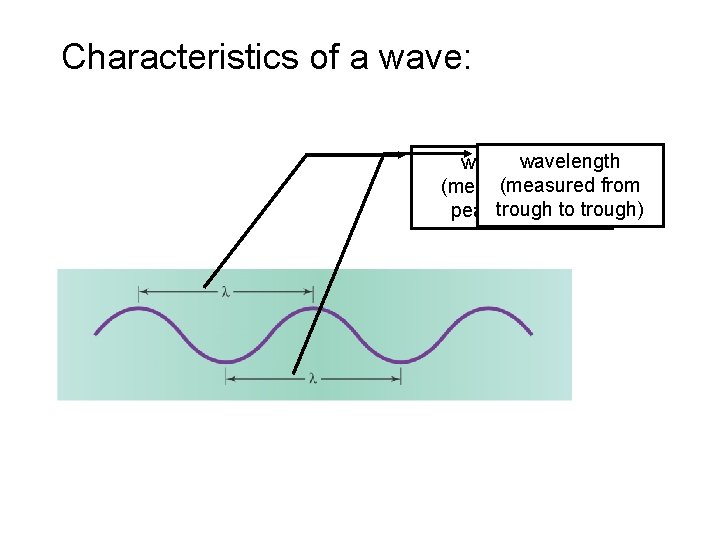
Characteristics of a wave: wavelength (measured from to trough) peak trough to peak)
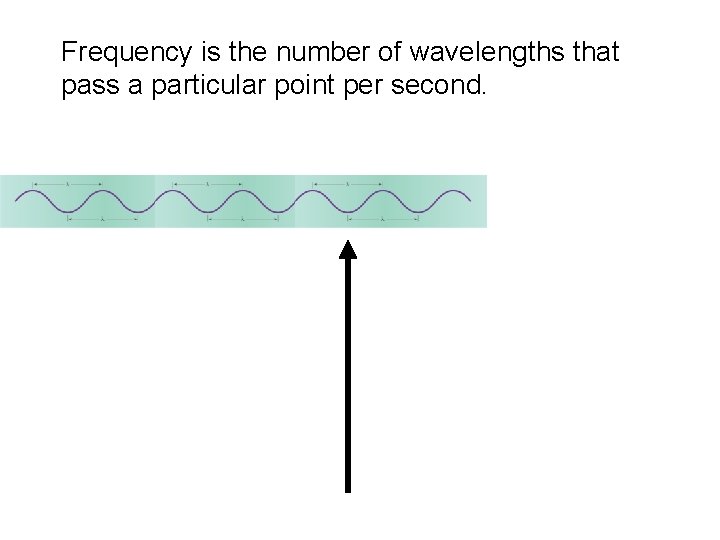
Frequency is the number of wavelengths that pass a particular point per second.
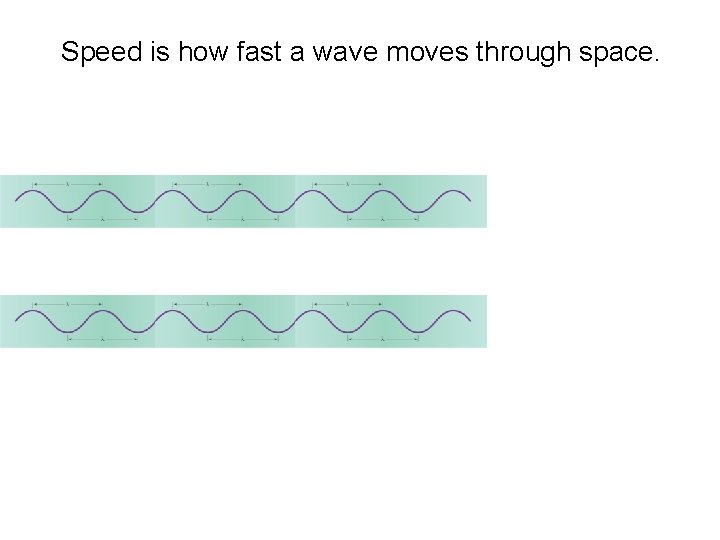
Speed is how fast a wave moves through space.
EMR also exhibits the properties of a particle. EMR particles are called photons. Both the wave model and the particle model are used to explain the properties of EMR.
The Electromagnetic Spectrum
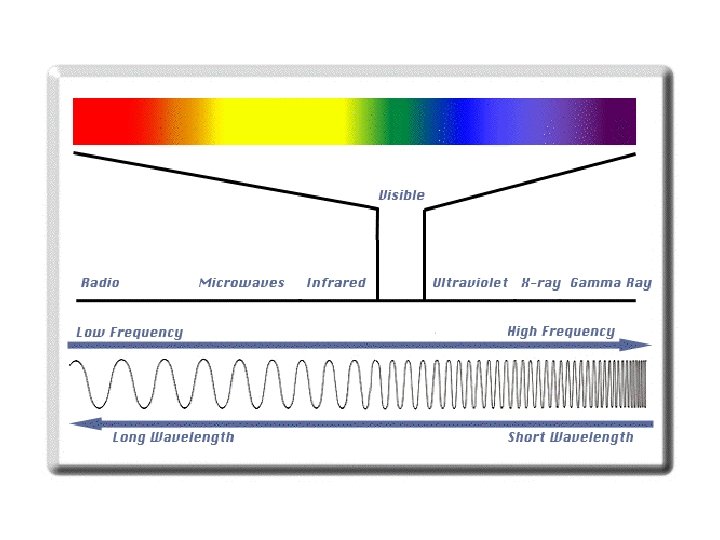
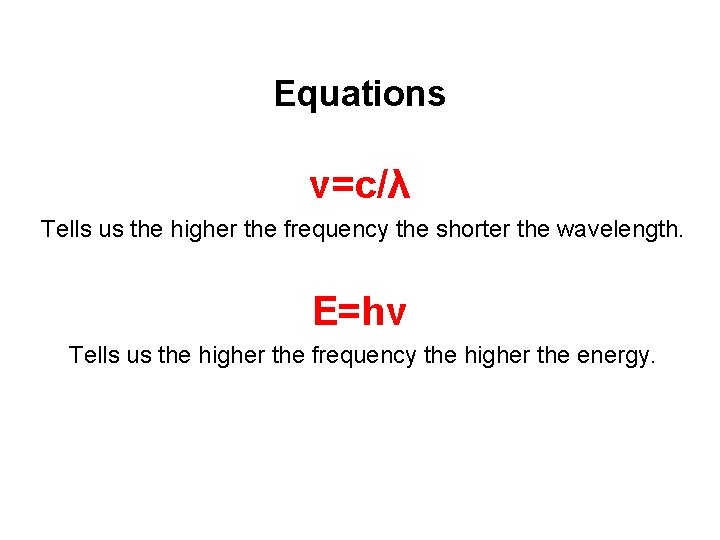
Equations ν=c/λ Tells us the higher the frequency the shorter the wavelength. E=hv Tells us the higher the frequency the higher the energy.
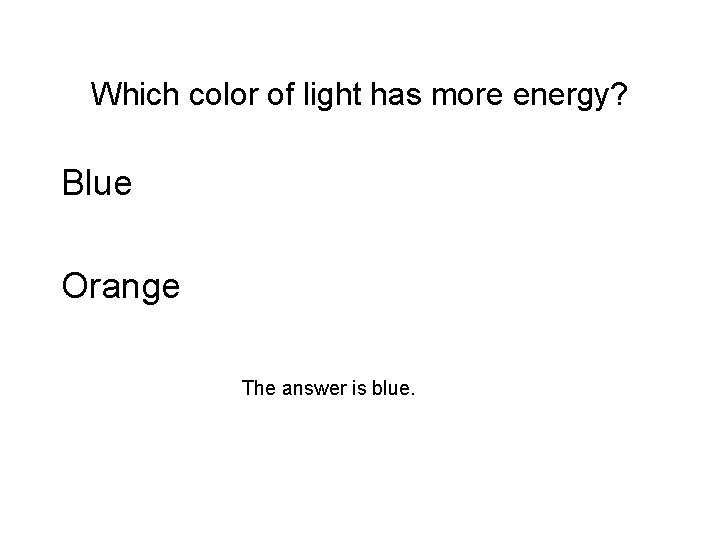
Which color of light has more energy? Blue Orange The answer is blue.
The Bohr Atom
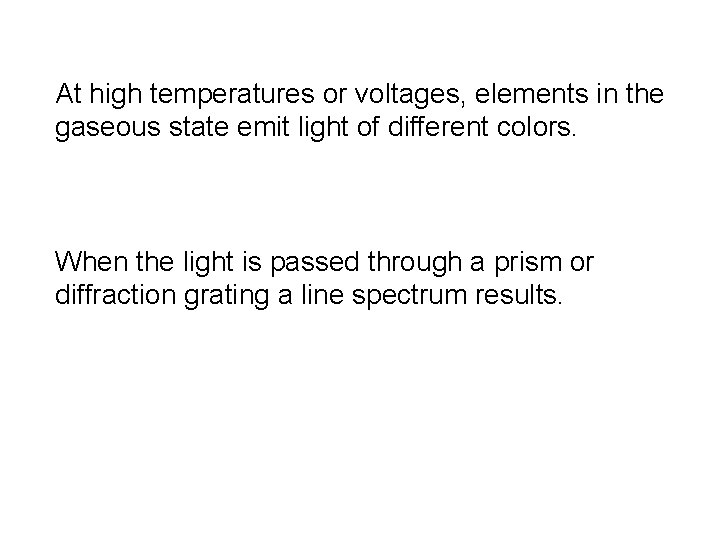
At high temperatures or voltages, elements in the gaseous state emit light of different colors. When the light is passed through a prism or diffraction grating a line spectrum results.
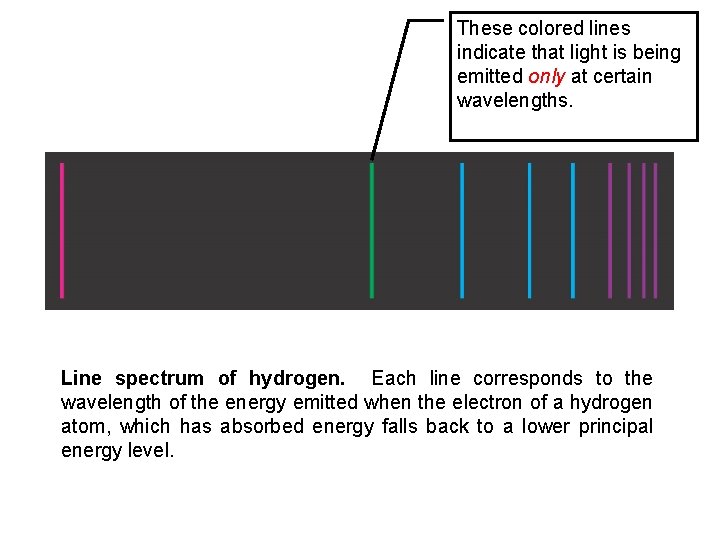
These colored lines indicate that light is being emitted only at certain wavelengths. Line spectrum of hydrogen. Each line corresponds to the wavelength of the energy emitted when the electron of a hydrogen atom, which has absorbed energy falls back to a lower principal energy level.
Niels Bohr, a Danish physicist, in 1912 -1913 carried out research on the hydrogen atom.
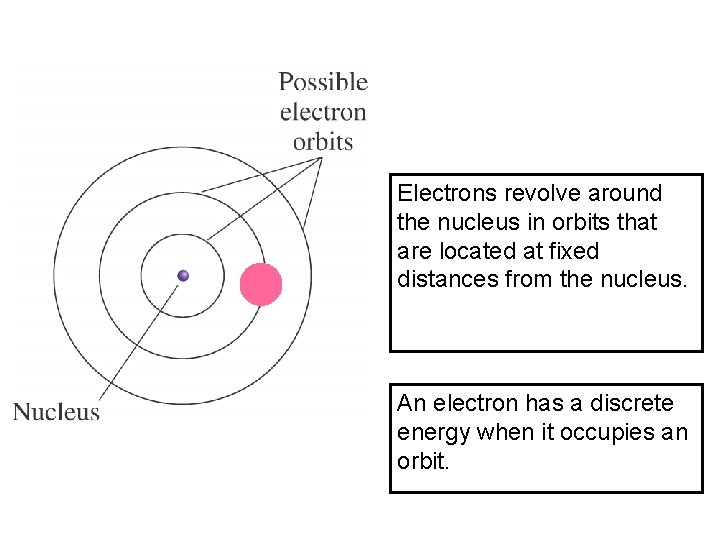
Electrons revolve around the nucleus in orbits that are located at fixed distances from the nucleus. An electron has a discrete energy when it occupies an orbit.
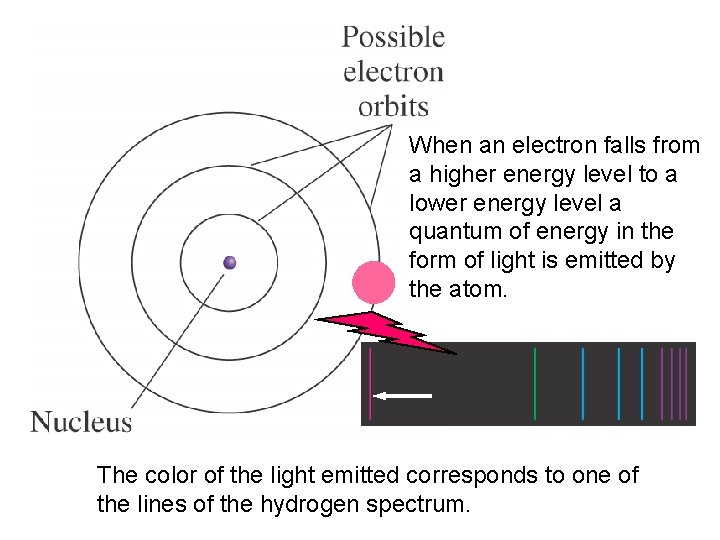
When an electron falls from a higher energy level to a lower energy level a quantum of energy in the form of light is emitted by the atom. The color of the light emitted corresponds to one of the lines of the hydrogen spectrum.
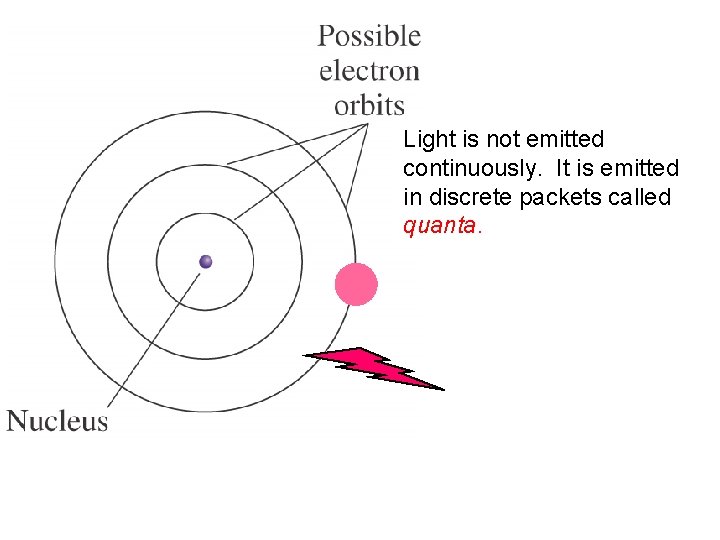
Light is not emitted continuously. It is emitted in discrete packets called quanta.
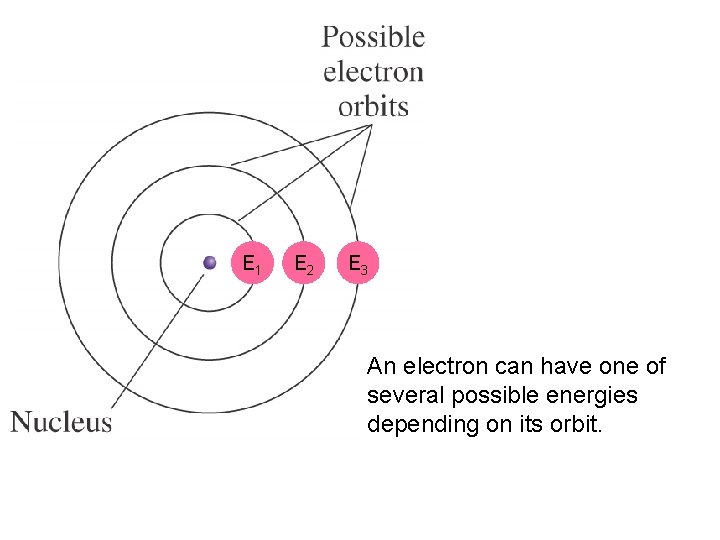
E 1 E 2 E 3 An electron can have one of several possible energies depending on its orbit.
Bohr’s calculations succeeded very well in correlating the experimentally observed spectral lines with electron energy levels for the hydrogen atom. Bohr’s methods did not succeed for heavier atoms. More theoretical work on atomic structure was needed.
In 1924 Louis De Broglie suggested that all objects have wave properties. – De Broglie showed that the wavelength of ordinary sized objects, such as a baseball, are too small to be observed. – For objects the size of an electron the wavelength can be detected.
In 1926 Erwin Schröedinger created a mathematical model that showed electrons as waves. – Schröedinger’s work led to a new branch of physics called wave or quantum mechanics. – Using Schröedinger’s wave mechanics, the probability of finding an electron in a certain region around the atom can be determined. – The actual location of an electron within an atom cannot be determined.
Based on wave mechanics it is clear that electrons are not revolving around the nucleus in orbits. Instead of being located in orbits, the electrons are located in orbitals. An orbital is a region around the nucleus where there is a high probability of finding an electron.
Energy Levels of Electrons
The wave-mechanical model of the atom predicts discrete principal energy levels within the atom
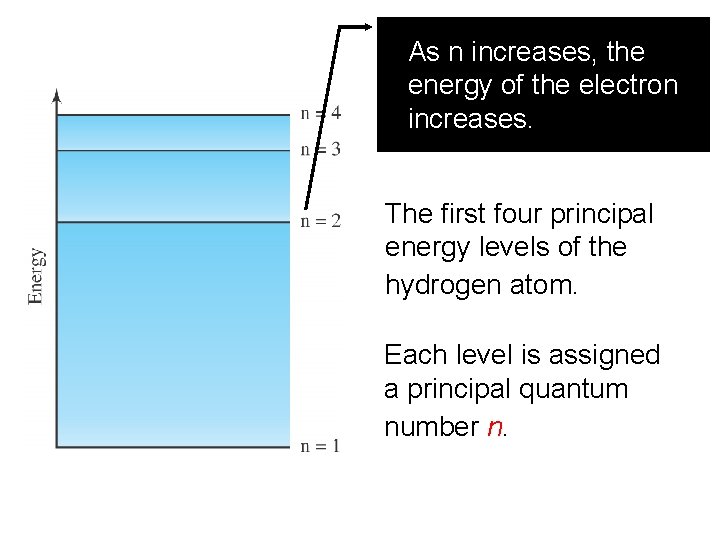
As n increases, the energy of the electron increases. The first four principal energy levels of the hydrogen atom. Each level is assigned a principal quantum number n.
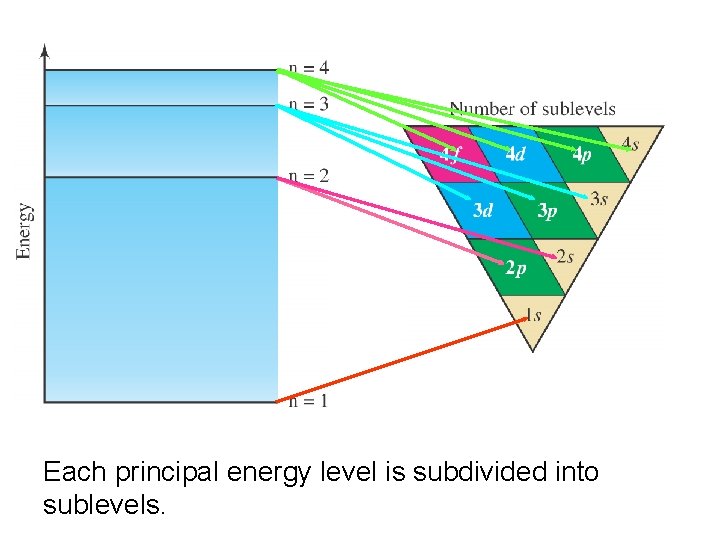
Each principal energy level is subdivided into sublevels.
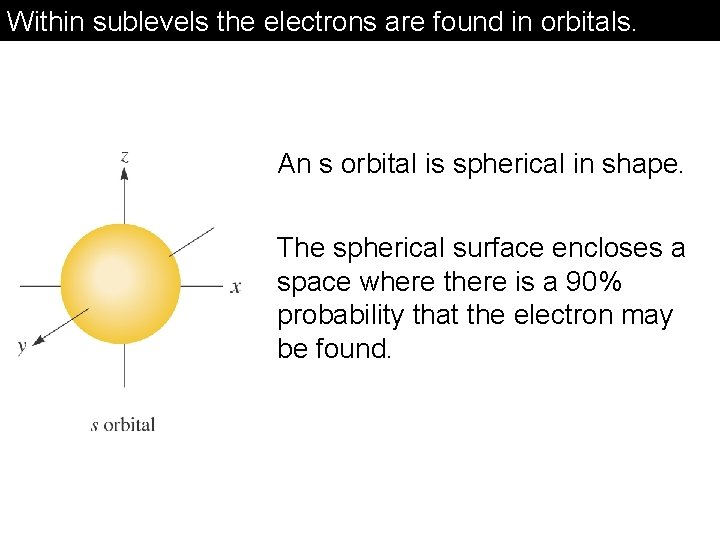
Within sublevels the electrons are found in orbitals. An s orbital is spherical in shape. The spherical surface encloses a space where there is a 90% probability that the electron may be found.
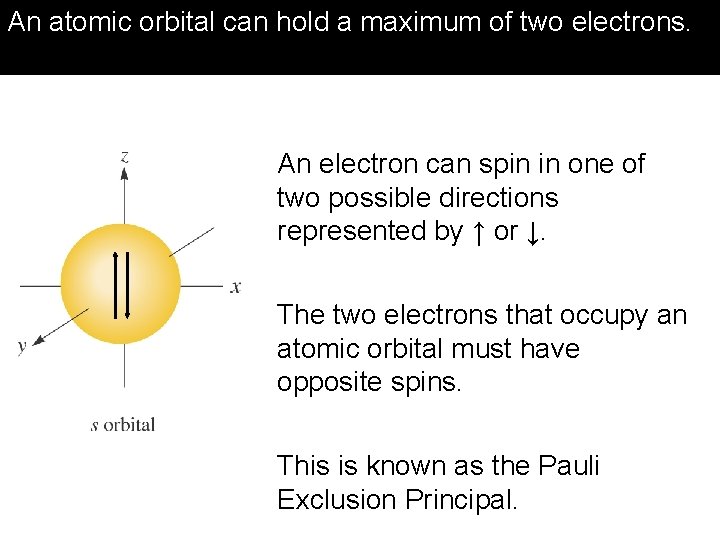
An atomic orbital can hold a maximum of two electrons. An electron can spin in one of two possible directions represented by ↑ or ↓. The two electrons that occupy an atomic orbital must have opposite spins. This is known as the Pauli Exclusion Principal.
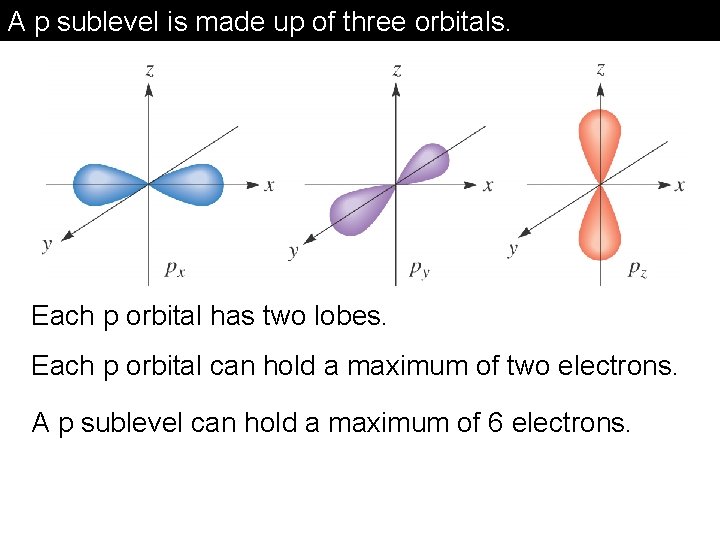
A p sublevel is made up of three orbitals. Each p orbital has two lobes. Each p orbital can hold a maximum of two electrons. A p sublevel can hold a maximum of 6 electrons.
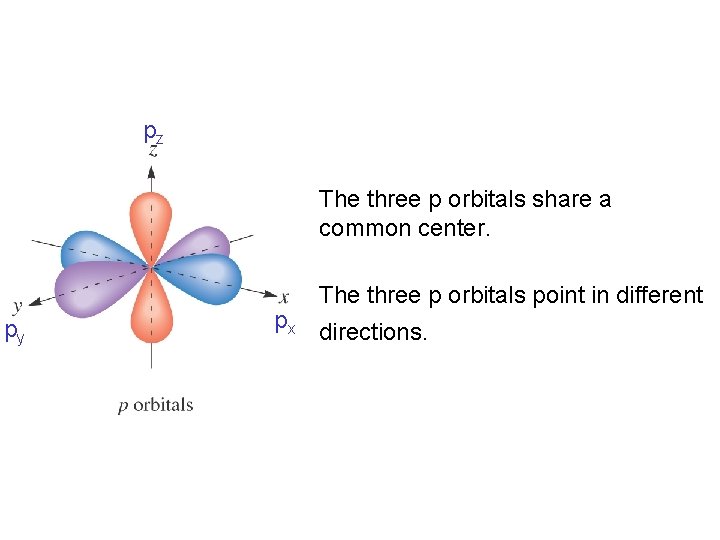
pz The three p orbitals share a common center. The three p orbitals point in different py px directions.
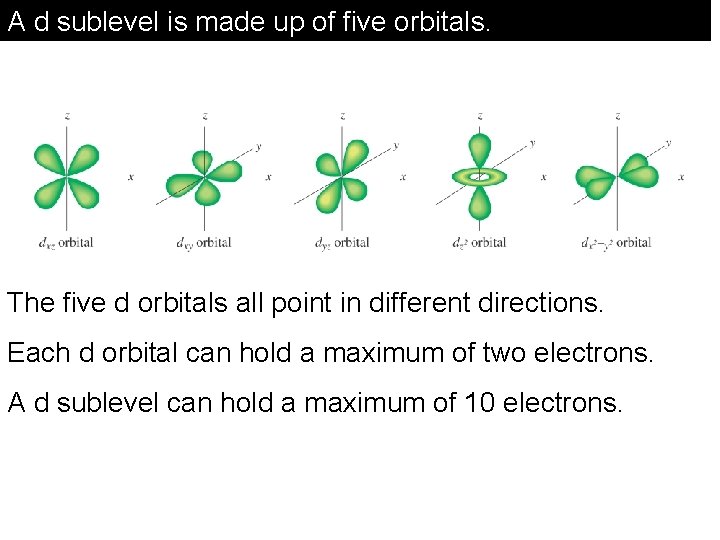
A d sublevel is made up of five orbitals. The five d orbitals all point in different directions. Each d orbital can hold a maximum of two electrons. A d sublevel can hold a maximum of 10 electrons.
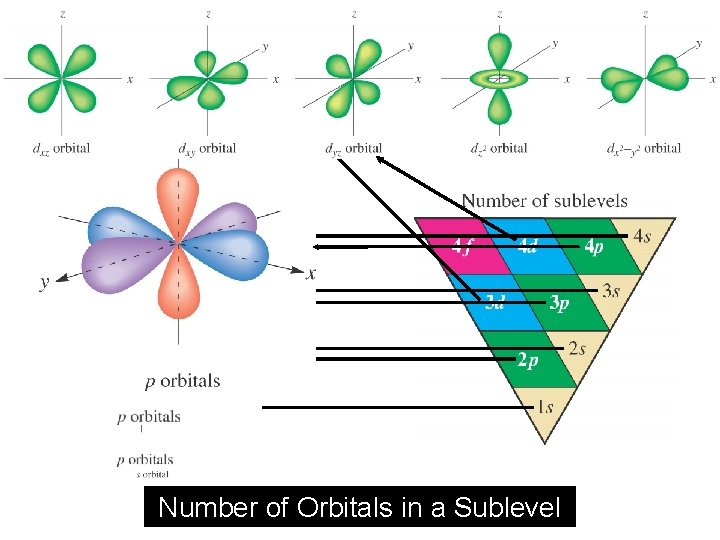
Number of Orbitals in a Sublevel
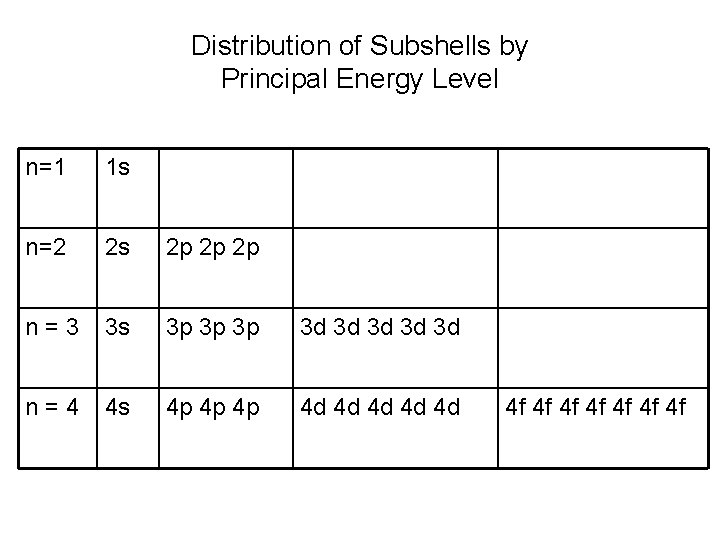
Distribution of Subshells by Principal Energy Level n=1 1 s n=2 2 s 2 p 2 p 2 p n=3 3 s 3 p 3 p 3 p 3 d 3 d 3 d n=4 4 s 4 p 4 p 4 p 4 d 4 d 4 d 4 f 4 f
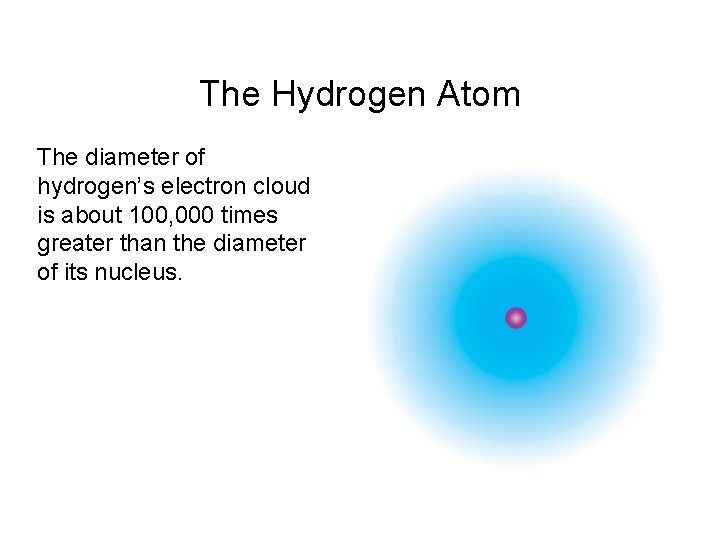
The Hydrogen Atom The In thediameter The diameter ground of of state hydrogen’s cloud hydrogen’s electron single electron nucleus is -13 is about times lies about in 10 the 100, 000 1 scm. orbital. greater than the The diameter of its nucleus. Hydrogen hydrogen’s can electron absorb cloud energy is aboutand 10 -8 the cm. electron will move to excited states.
Atomic Structure of the First 18 Elements
To determine the electronic structures of atoms, the following guidelines are used.
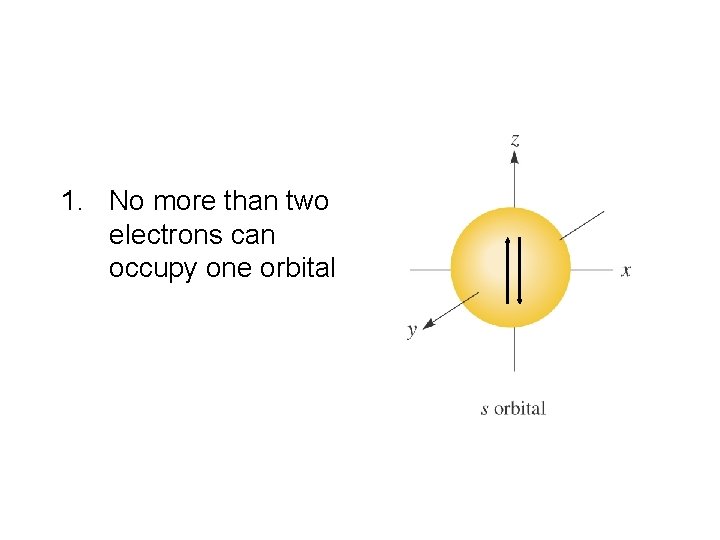
1. No more than two electrons can occupy one orbital
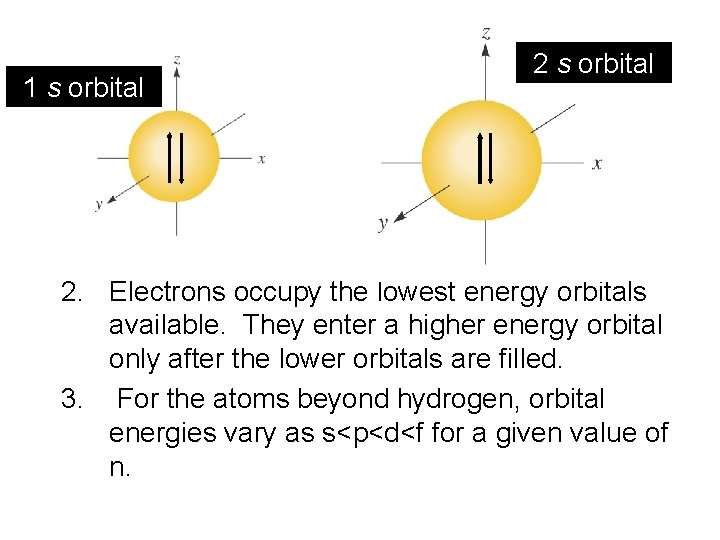
1 s orbital 2. Electrons occupy the lowest energy orbitals available. They enter a higher energy orbital only after the lower orbitals are filled. 3. For the atoms beyond hydrogen, orbital energies vary as s<p<d<f for a given value of n.
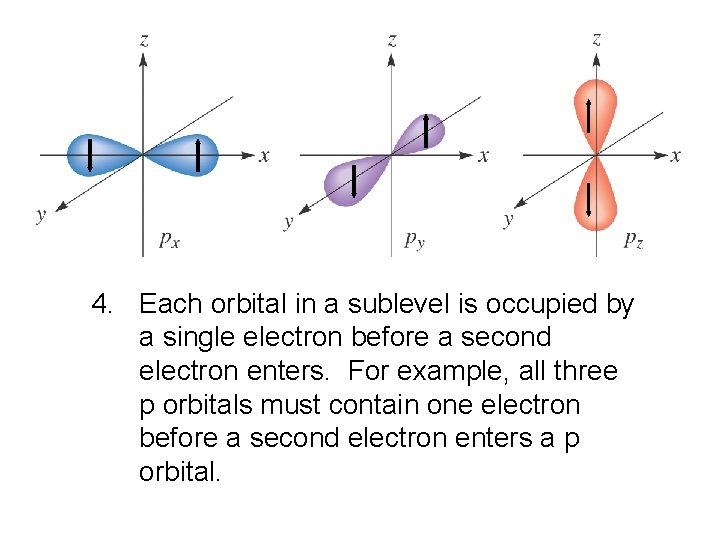
4. Each orbital in a sublevel is occupied by a single electron before a second electron enters. For example, all three p orbitals must contain one electron before a second electron enters a p orbital.
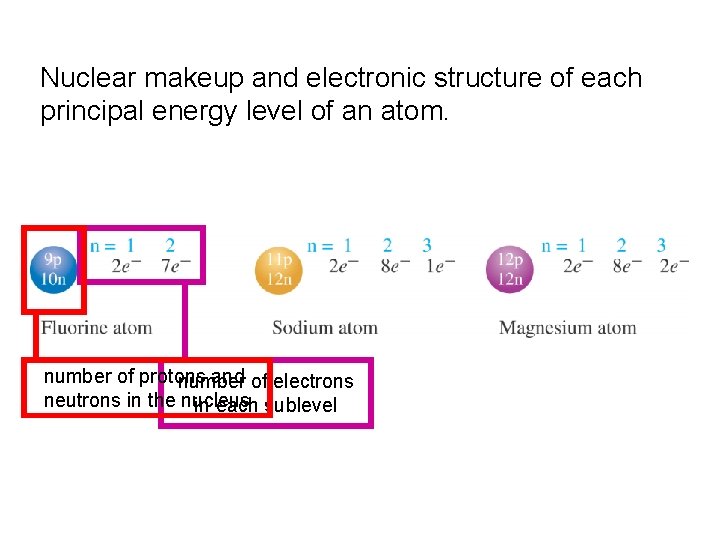
Nuclear makeup and electronic structure of each principal energy level of an atom. number of protons and of electrons number neutrons in the nucleus in each sublevel
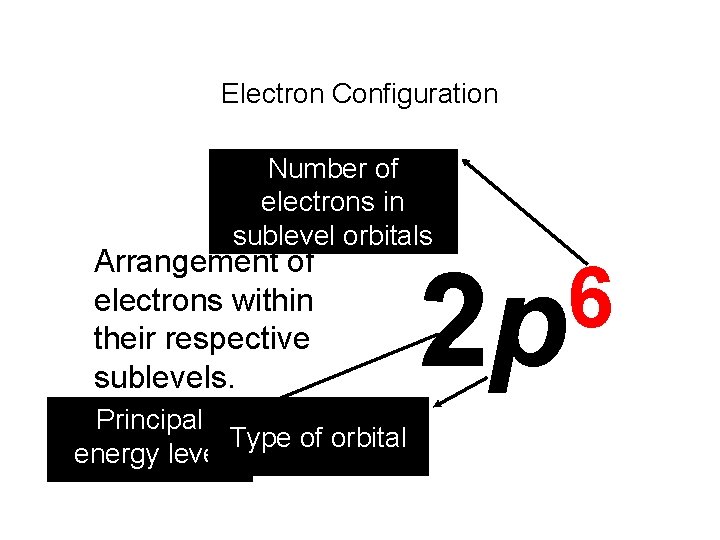
Electron Configuration Number of electrons in sublevel orbitals Arrangement of electrons within their respective sublevels. Principal Type of orbital energy level 6 2 p
Orbital Filling
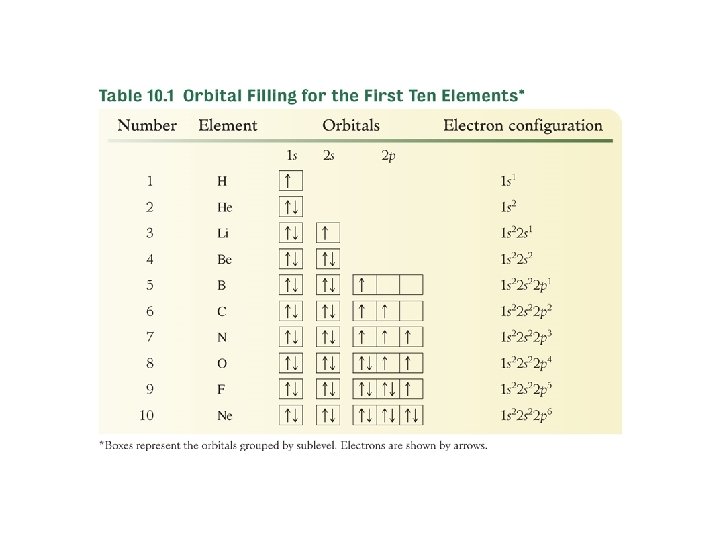
In the following diagrams boxes represent orbitals. Electrons are indicated by arrows: ↑ or ↓. Each arrow direction represents one of the two possible electron spin states.

Filling the 1 s Sublevel
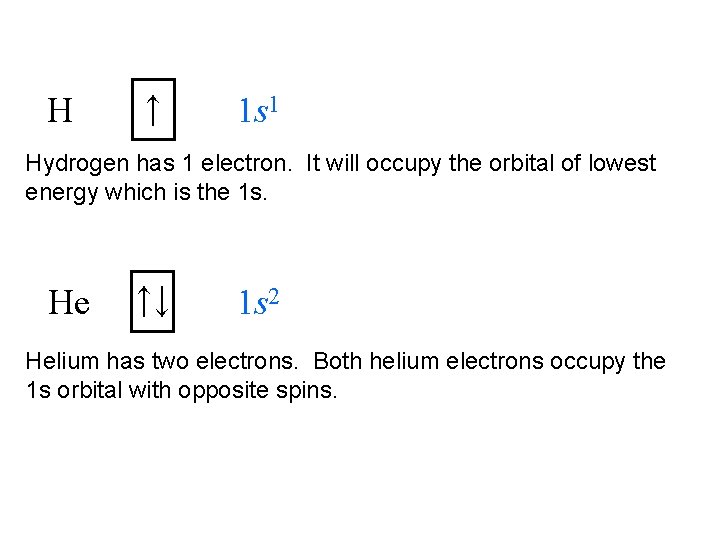
H ↑ 1 s 1 Hydrogen has 1 electron. It will occupy the orbital of lowest energy which is the 1 s. He ↑↓ 1 s 2 Helium has two electrons. Both helium electrons occupy the 1 s orbital with opposite spins.

Filling the 2 s Sublevel
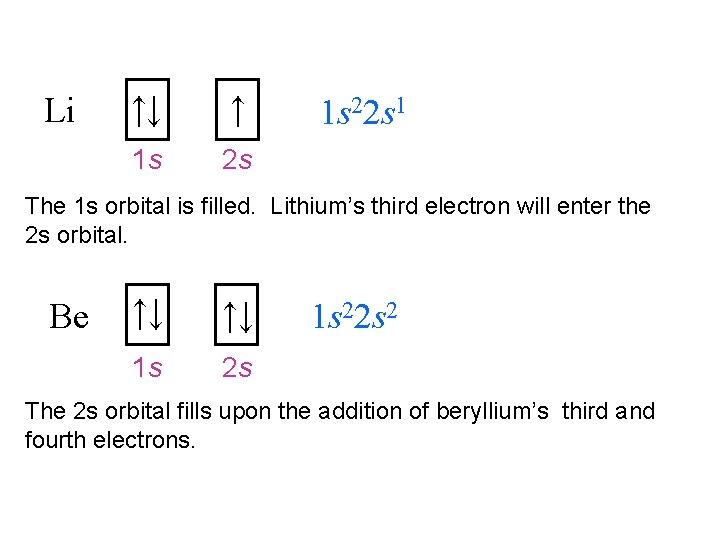
Li ↑↓ ↑ 1 s 2 s 1 s 22 s 1 The 1 s orbital is filled. Lithium’s third electron will enter the 2 s orbital. Be ↑↓ ↑↓ 1 s 2 s 1 s 22 s 2 The 2 s orbital fills upon the addition of beryllium’s third and fourth electrons.

Filling the 2 p Sublevel
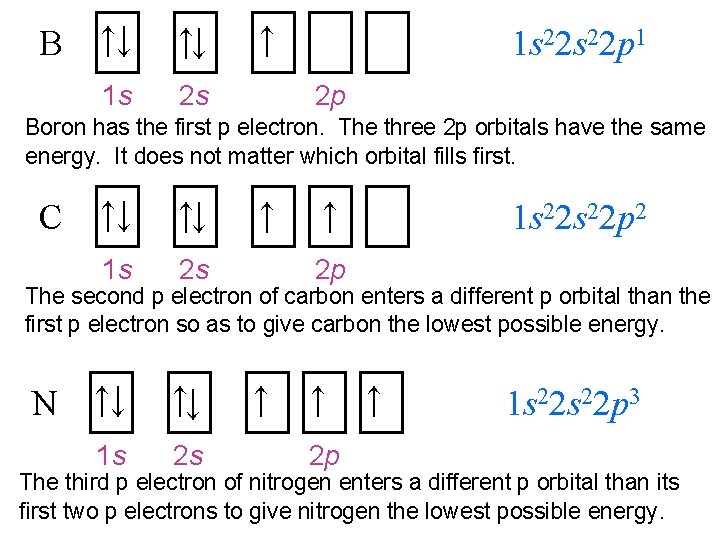
B ↑↓ ↑↓ 1 s 2 s ↑ 1 s 22 p 1 2 p Boron has the first p electron. The three 2 p orbitals have the same energy. It does not matter which orbital fills first. ↑↓ ↑↓ 1 s 2 s N ↑↓ ↑↓ 1 s 2 s C ↑ ↑ 1 s 22 p 2 2 p The second p electron of carbon enters a different p orbital than the first p electron so as to give carbon the lowest possible energy. ↑ ↑ 2 p ↑ 1 s 22 p 3 The third p electron of nitrogen enters a different p orbital than its first two p electrons to give nitrogen the lowest possible energy.
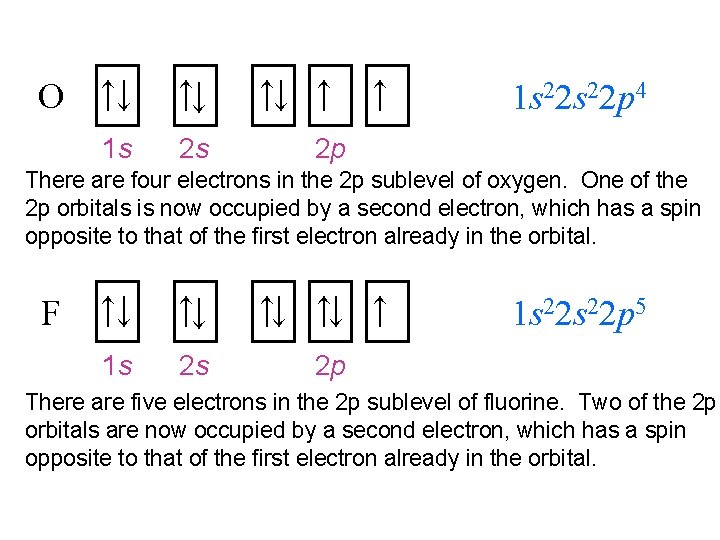
O ↑↓ ↑↓ 1 s 2 s ↑↓ ↑ ↑ 1 s 22 p 4 2 p There are four electrons in the 2 p sublevel of oxygen. One of the 2 p orbitals is now occupied by a second electron, which has a spin opposite to that of the first electron already in the orbital. F ↑↓ ↑↓ ↑ 1 s 2 s 2 p 1 s 22 p 5 There are five electrons in the 2 p sublevel of fluorine. Two of the 2 p orbitals are now occupied by a second electron, which has a spin opposite to that of the first electron already in the orbital.
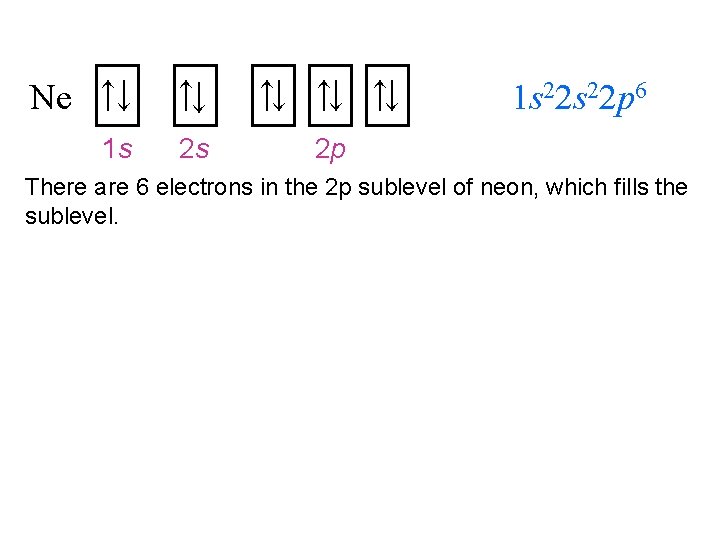
Ne ↑↓ ↑↓ ↑↓ 1 s 2 s 2 p 1 s 22 p 6 There are 6 electrons in the 2 p sublevel of neon, which fills the sublevel.

Filling the 3 s Sublevel
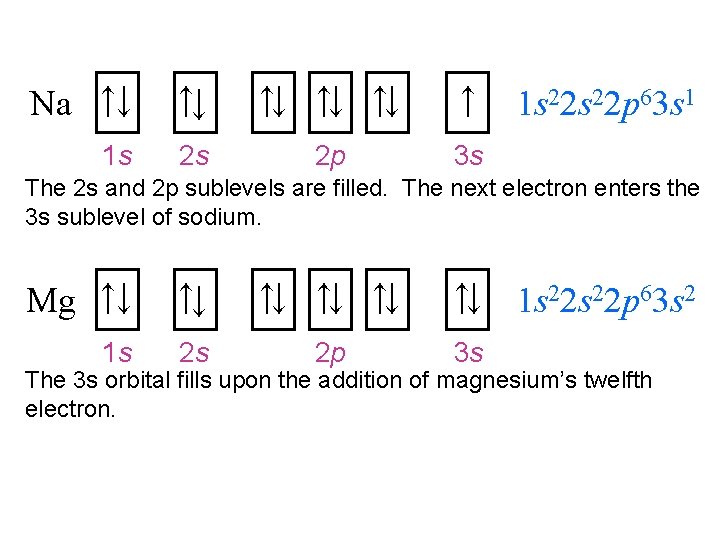
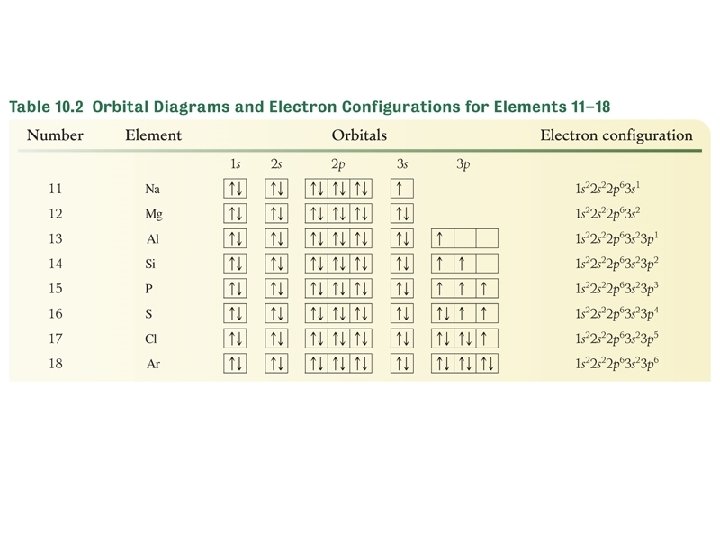
Na ↑↓ ↑↓ ↑↓ ↑ 1 s 2 s 2 p 3 s 1 s 22 p 63 s 1 The 2 s and 2 p sublevels are filled. The next electron enters the 3 s sublevel of sodium. Mg ↑↓ ↑↓ ↑↓ 1 s 2 s 2 p ↑↓ 1 s 22 p 63 s 2 3 s The 3 s orbital fills upon the addition of magnesium’s twelfth electron.
Electron Structures and the Periodic Table
In 1869 Dimitri Mendeleev of Russia and Lothar Meyer of Germany independently published periodic arrangements of the elements based on increasing atomic masses. Mendeleev’s arrangement is the precursor to the modern periodic table.
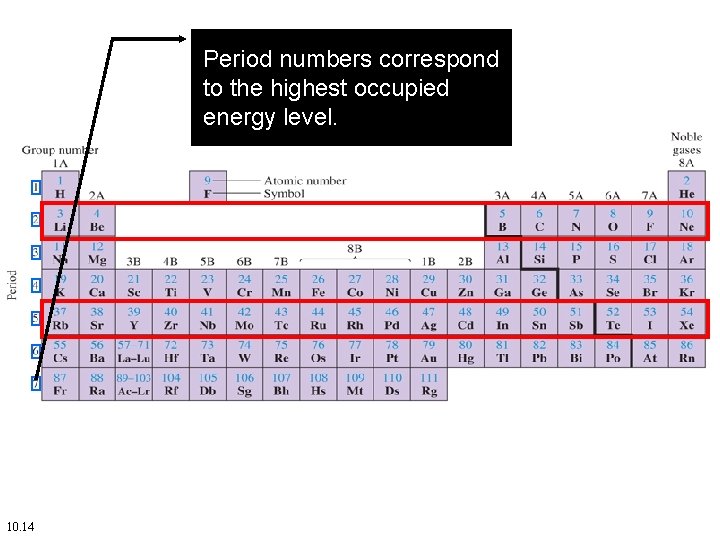
Period numbers correspond Horizontal rows are to the highest occupied called periods energy level. 10. 14
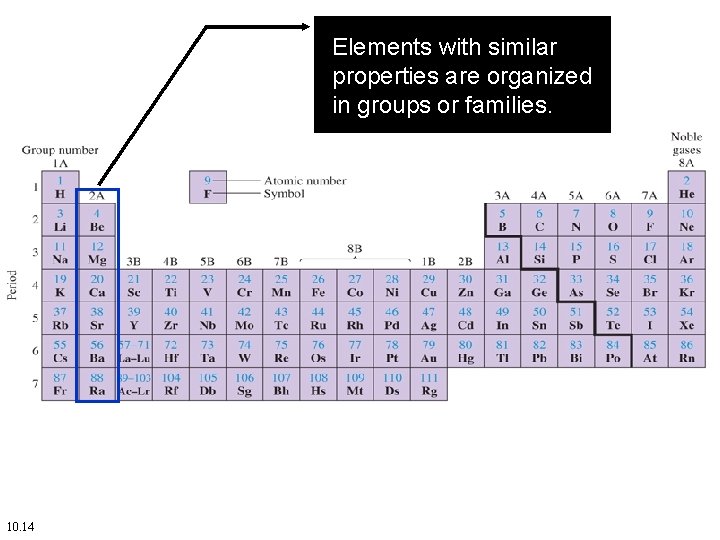
Elements with similar properties are organized in groups or families. 10. 14
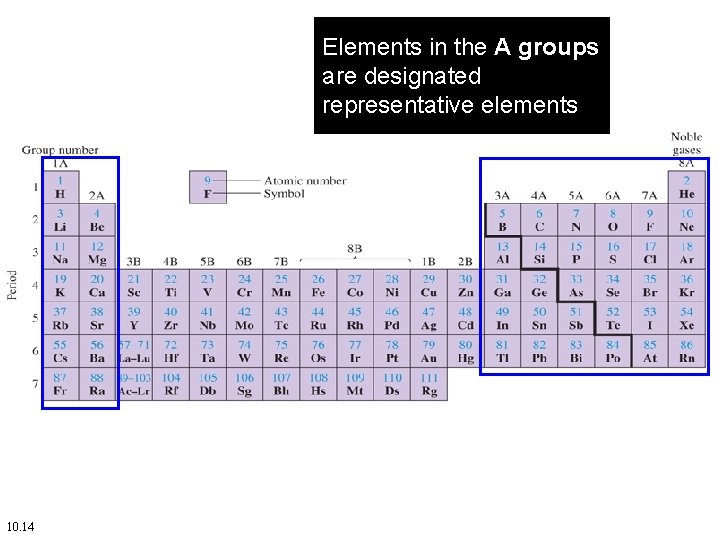
Elements in the A groups are designated representative elements 10. 14
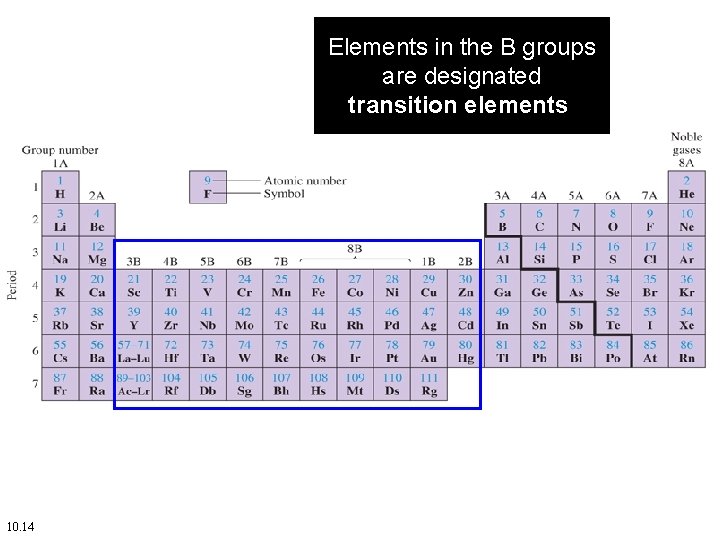
Elements in the B groups are designated transition elements 10. 14
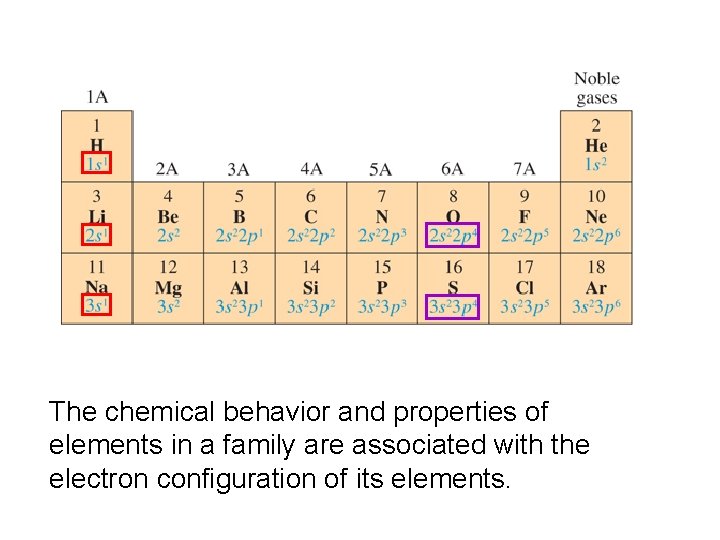
The. For chemical A familybehavior elements and theproperties valence electron of elements configuration in a family is the aresame associated in eachwith column. the electron configuration of its elements.
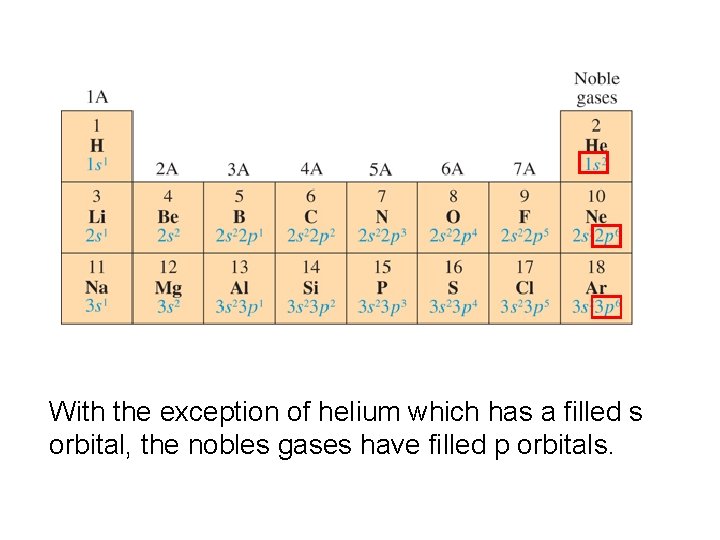
With the exception of helium which has a filled s orbital, the nobles gases have filled p orbitals.
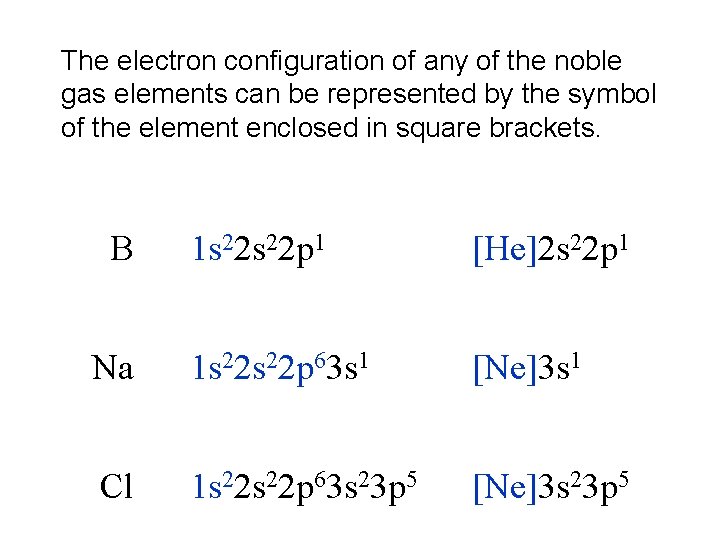
The electron configuration of any of the noble gas elements can be represented by the symbol of the element enclosed in square brackets. B 1 s 22 p 1 [He]2 s 22 p 1 Na 1 s 22 p 63 s 1 [Ne]3 s 1 Cl 1 s 22 p 63 s 23 p 5 [Ne]3 s 23 p 5
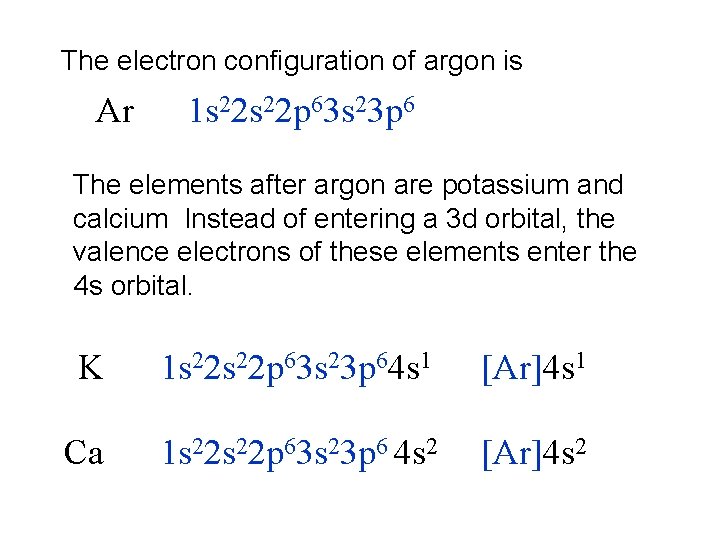
The electron configuration of argon is Ar 1 s 22 p 63 s 23 p 6 The elements after argon are potassium and calcium Instead of entering a 3 d orbital, the valence electrons of these elements enter the 4 s orbital. K 1 s 22 p 63 s 23 p 64 s 1 [Ar]4 s 1 Ca 1 s 22 p 63 s 23 p 6 4 s 2 [Ar]4 s 2
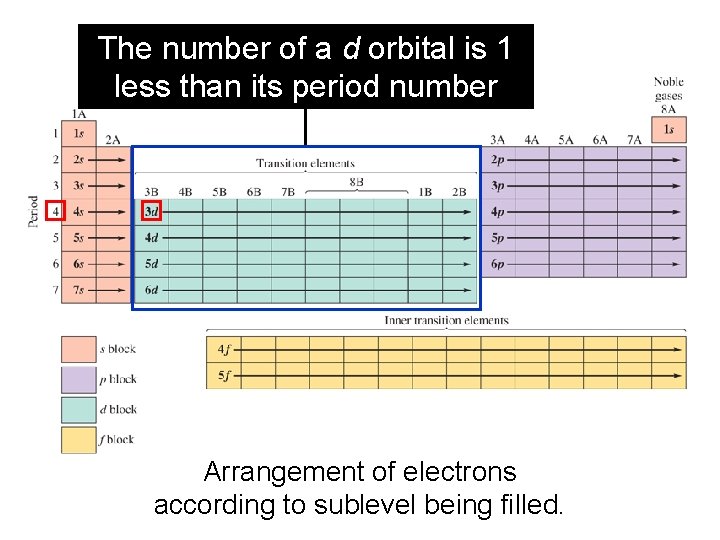
The number of a d orbital is 1 d orbital filling less than its period number Arrangement of electrons according to sublevel being filled.
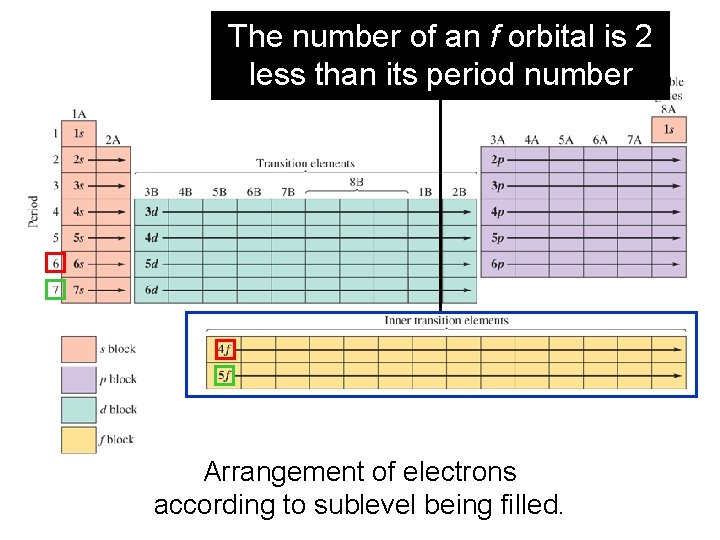
The number of an f orbital is 2 less than its period f orbital fillingnumber Arrangement of electrons according to sublevel being filled.
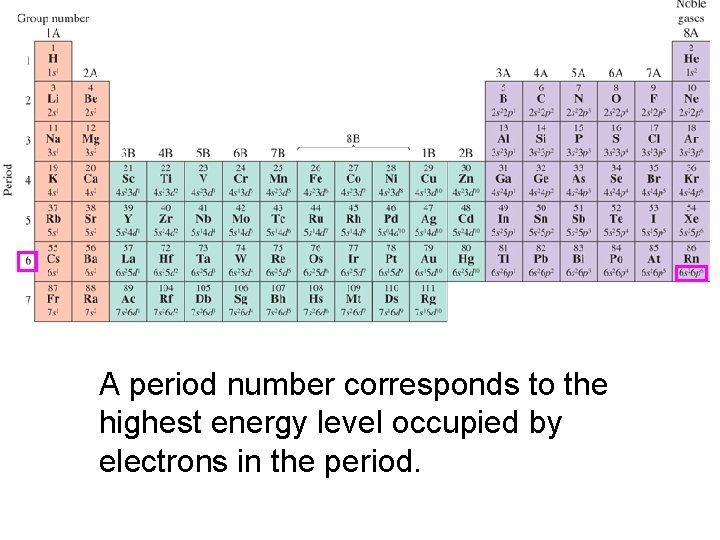
A period number corresponds to the highest energy level occupied by electrons in the period.
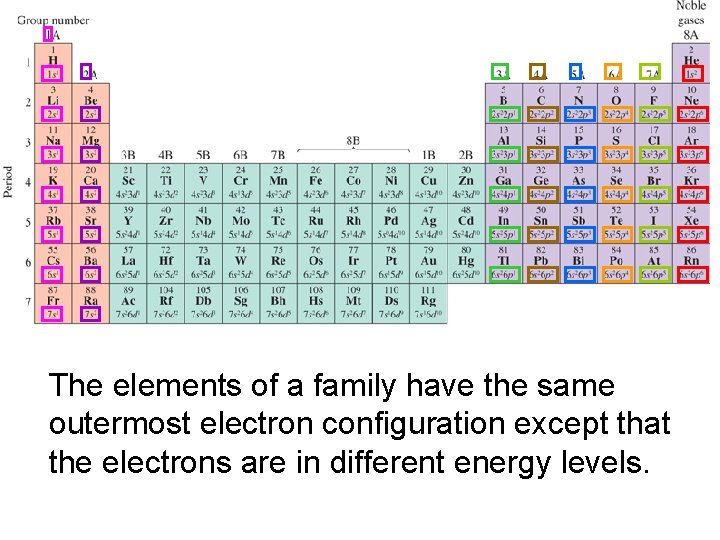
The group elements numbers of a family for have the representative the same elements outermostare electron equal configuration to the total number except that of outermost the electrons are in in different the atoms energy of the levels. group.
- Slides: 74