
Modern Applications of Learning Theory 212022 1 Application

- Slides: 48
Modern Applications of Learning Theory 2/1/2022 1
Application: Language Acquisition Skinner (1957) • Proposed that children acquire language through imitation and shaping. Examples: • baby hears words and tries to imitate • Parents and others provide plenty of reinforcement, smiles, attention, etc. • Even Random babbling which sounds like words is reinforced by parents • Can inadvertantly reinforce poor pronunciations because it is “cute” 2/1/2022 2
Application: The Development of Anxiety Disorders • Category of psychological disorders characterized by intense feelings of apprehension and anxiety which impedes daily functioning. • 8 to 15% of adult populations western cultures are affected by it. • Can be explained by differences in learning • However, Identical twins are more likely to suffer from then non-identical twins 2/1/2022 3
Application: Explaining the Existence of Superstitious Behaviors • • Any positive consequence can cause humans to repeat a behavior, even if the consequence was not really the result of the behavior. In other words, responses were reinforced by coincidence! Skinner called this process: “Non-contingent reinforcement” Can explain rituals and superstitions 2/1/2022 4
Application: Explaining Gender Behaviors Key Questions: • Do boys and girls really act differently? • Are differences in gender behaviors innate or learned? Gender Behaviors are Innate: • Androgens tend to influence gender specific behaviors • Existence of certain genes appear to be correlated with specific behaviors Gender Behaviors are Learned: • No universal definition of Male or Female behavior – differs widely across cultures. • Reinforcement • Deaux (1985) estimated that only 5% of individual differences among children can be attributed to biology. 2/1/2022 5
Application: Explaining the Development of Aggressive Behaviors Instrumental Aggression • • • Suggests that aggression is reinforced by experiences in which it is effective in accomplishing a goal Fairly widely accepted Some empirical support Aggression/Frustration Hypothesis • • Dollard and Miller (1950) Frustration is the sole cause of Aggression Frustration is the blocking of a goal oriented response Frustration can result in legitimate or non-legitimate ways of expressing frustration Aggression can be displaced in order to reduce frustration Suggests that one learns which behavors decrease frustration Empirical support is lacking 2/1/2022 6
Application: Community Behavior Analysis Use of Learning theory to address social problems which have not responded to traditional programs. Examples: 1. Sherman (1992) – Minneapolis Police Department created to deal with repeat offenders of domestic violence. • Punishment was immediate, severe, and inevitable punishment to domestic violence offenders: One night in Jail versus telling offender to leave the scene or attend joint counseling. • 90% did not re-offend 2. Fox (1987) - described use of token economies in mines which used positive reinforcement to reward lack of accidents. • Reduced accidents by 75% over ten years. 2/1/2022 7
Therapies and Techniques which use the Principles of Learning Theory 1) Behavioral Therapy 2) Behavioral Modification 2/1/2022 8
Therapies within the Learning Perspective • The principles of learning theory are used to devise methods of teaching patients to overcome maladaptive habits. • Learning theorists would contend that most if not all normal and abnormal behaviors (neurotic and sometimes psychotic symptoms) have been learned • Therefore, they can be unlearned • Or substituted for more adaptive patterns of behavior • Today, most therapists also use Cognitive Therapies along with behavioral therapies. • This combination has been found to be more effective than just using one method and or the other. 2/1/2022 9
Behavioral Therapies • Utilize Principles of Classical Conditioning • Examples: – Systematic Desensitization – Flooding 2/1/2022 10
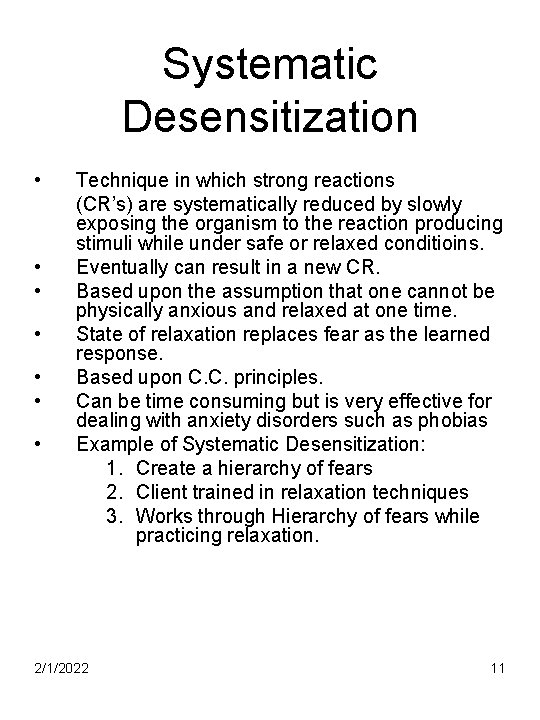
Systematic Desensitization • • Technique in which strong reactions (CR’s) are systematically reduced by slowly exposing the organism to the reaction producing stimuli while under safe or relaxed conditioins. Eventually can result in a new CR. Based upon the assumption that one cannot be physically anxious and relaxed at one time. State of relaxation replaces fear as the learned response. Based upon C. C. principles. Can be time consuming but is very effective for dealing with anxiety disorders such as phobias Example of Systematic Desensitization: 1. Create a hierarchy of fears 2. Client trained in relaxation techniques 3. Works through Hierarchy of fears while practicing relaxation. 2/1/2022 11
Flooding • technique in which an organism is exposed to a fear producing stimuli all once (while avoiding any real danger) until anxiety decreases. • Hoped that patient will learn a new response. • Can effectively and quickly erase a response, but is criticized for being harsh. • Requires permission from clients • Also called Implosion therapy. 2/1/2022 12
Aversive Therapy • Using a strong aversive stimulus to reduce an unwanted or dysfunctional behavior. • Creates a new CS and CR • For instance: – Lacing Alcohol with a chemical which causes vomiting. – putting poor tasting chemicals on one’s fingernails to reduce nail biting. (called Taste Aversion 2/1/2022 13
Techniques used in Behavioral Modification • • Utilize Principles of Operant Conditioning Examples: • • 2/1/2022 Shaping Token Economies 14
Shaping • Conditioning a new behavior through progressive reinforcement of behaviors which are similar to the desired response. • In other words, a term which describes the process of guiding the acquisition of a new response by reinforcing “successive approximations” until the desired behavior appears. • Requires precise timing and consistency when administering the reinforcer. • Frequently used in animal training. Example: Teaching a rat to press the lever on a skinner box 2/1/2022 15
Token Economy • A form of behavior modification based upon operant conditioning • Most commonly used in institutional settings • involves giving conditioned reinforcers (tokens) for completing specific behaviors. • Tokens can then be used to “purchase” reinforcers from a store. 2/1/2022 16
Modern Applications of Learning Theory 2/1/2022 17
Application: Language Acquisition Skinner (1957) • Proposed that children acquire language through imitation and shaping. Examples: • baby hears words and tries to imitate • Parents and others provide plenty of reinforcement, smiles, attention, etc. • Even Random babbling which sounds like words is reinforced by parents • Can inadvertantly reinforce poor pronunciations because it is “cute” 2/1/2022 18
Application: The Development of Anxiety Disorders • Category of psychological disorders characterized by intense feelings of apprehension and anxiety which impedes daily functioning. • 8 to 15% of adult populations western cultures are affected by it. • Can be explained by differences in learning • However, Identical twins are more likely to suffer from then non-identical twins 2/1/2022 19
Application: Explaining the Existence of Superstitious Behaviors • • Any positive consequence can cause humans to repeat a behavior, even if the consequence was not really the result of the behavior. In other words, responses were reinforced by coincidence! Skinner called this process: “Non-contingent reinforcement” Can explain rituals and superstitions 2/1/2022 20
Application: Explaining Gender Behaviors Key Questions: • Do boys and girls really act differently? • Are differences in gender behaviors innate or learned? Gender Behaviors are Innate: • Androgens tend to influence gender specific behaviors • Existence of certain genes appear to be correlated with specific behaviors Gender Behaviors are Learned: • No universal definition of Male or Female behavior – differs widely across cultures. • Reinforcement • Deaux (1985) estimated that only 5% of individual differences among children can be attributed to biology. 2/1/2022 21
Application: Explaining the Development of Aggressive Behaviors Instrumental Aggression • • • Suggests that aggression is reinforced by experiences in which it is effective in accomplishing a goal Fairly widely accepted Some empirical support Aggression/Frustration Hypothesis • • Dollard and Miller (1950) Frustration is the sole cause of Aggression Frustration is the blocking of a goal oriented response Frustration can result in legitimate or non-legitimate ways of expressing frustration Aggression can be displaced in order to reduce frustration Suggests that one learns which behavors decrease frustration Empirical support is lacking 2/1/2022 22
Application: Community Behavior Analysis Use of Learning theory to address social problems which have not responded to traditional programs. Examples: 1. Sherman (1992) – Minneapolis Police Department created to deal with repeat offenders of domestic violence. • Punishment was immediate, severe, and inevitable punishment to domestic violence offenders: One night in Jail versus telling offender to leave the scene or attend joint counseling. • 90% did not re-offend 2. Fox (1987) - described use of token economies in mines which used positive reinforcement to reward lack of accidents. • Reduced accidents by 75% over ten years. 2/1/2022 23
Techniques used for Behavioral Change and Behavioral Therapy 2/1/2022 24
Behavioral Therapy • The type of therapy used within the Learning Perspective • Psychologists who use this therapy are sometimes called Behavioral Therapists. • In this therapy, the principles of learning theory are used to devise methods of teaching patients to overcome maladaptive habits. • It is based on the belief that most if not all neurotic and sometimes psychotic symptoms have been learned in the first place, and that the substitution of more adaptive patterns of behavior will of itself improve the emotional state of mentally disordered patients. • Behavioral Therapy has tended to place much emphasis on rewards and punishment • Today, most behavior therapists are now also using Cognitive Therapy methods as well. This combination is more effective than just using one method and not the other. 2/1/2022 25
2/1/2022 26
Techniques in Behavioral Modification 2/1/2022 27
Evaluation of the Learning Perspective 2/1/2022 28
Assessing the Learning Perspective: • Key Studies which the Theory was built upon • Ethical Considerations • Cultural Issues • Importance and Strengths • Criticisms and Weaknesses 2/1/2022 29
Key Studies 1. 2. 3. 4. 5. 6. 7. 8. Pavlov (1927) Classicallly Conditioning the salivation response Thorndike (1911) Acquisition of new behaviors in cats Gustafson (1974) Watson and Raynor (1920) Little Albert and Generalization of Phobic responses Skinner (1948) Superstition in the Pigeon Nicol (1999) Effects of observational learning in Chickens Bandura (1961) Transmission of Aggression through imitation of aggressive models Mead (1935) 2/1/2022 30
Ethical Considerations • Treatment of Animals • Little Albert Study 2/1/2022 31
Cultural Issues • American Influence may make the perspective most relevant to American Culture. 1. Based in part upon the American paradigm of Pragmatism, 2. Most influential theorists were American. • Mead (1935) – This famous crosscultural study supports the idea that learning can have powerful effects. 2/1/2022 32
Learning Perspective: Importance and Strengths • Based upon Empirical Evidence gained under controlled conditions • Behavioral Modification and Behavioral Therapy can be very effective – especially for relatively minor behavioral problems 2/1/2022 33
Learning Perspective: Weaknesses and Criticisms • Internal Factors: Avoids unconscious motives or internal dispositions. • Animal Research - Too much reliance on it. Can it really be generalized to humans? • Reductionism – can complex behaviors really be explained in terms of one or two factors? • Doesn’t account for biological or cognitive influences • Behavioral therapy has not proven very effective for severe behavioral problems 2/1/2022 34
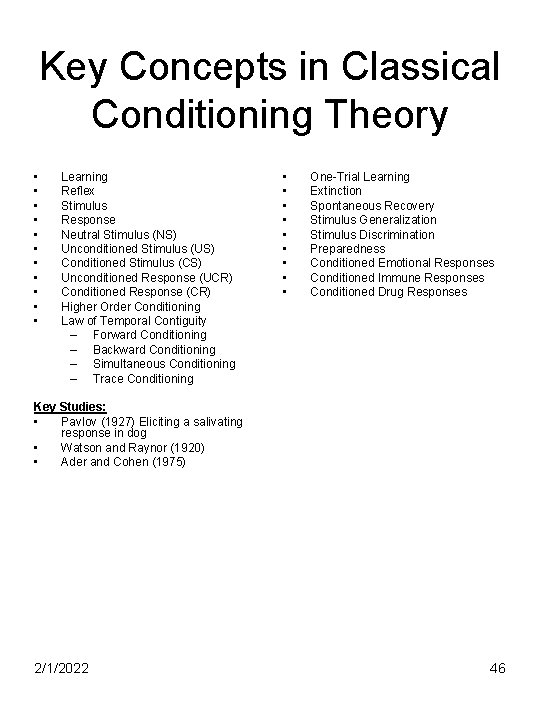
Key Concepts in Classical Conditioning Theory • • • Learning Reflex Stimulus Response Neutral Stimulus (NS) Unconditioned Stimulus (US) Conditioned Stimulus (CS) Unconditioned Response (UCR) Conditioned Response (CR) Higher Order Conditioning Law of Temporal Contiguity – Forward Conditioning – Backward Conditioning – Simultaneous Conditioning – Trace Conditioning • • • One-Trial Learning Extinction Spontaneous Recovery Stimulus Generalization Stimulus Discrimination Preparedness Conditioned Emotional Responses Conditioned Immune Responses Conditioned Drug Responses Key Studies: • Pavlov (1927) Eliciting a salivating response in dog • Watson and Raynor (1920) • Ader and Cohen (1975) 2/1/2022 35
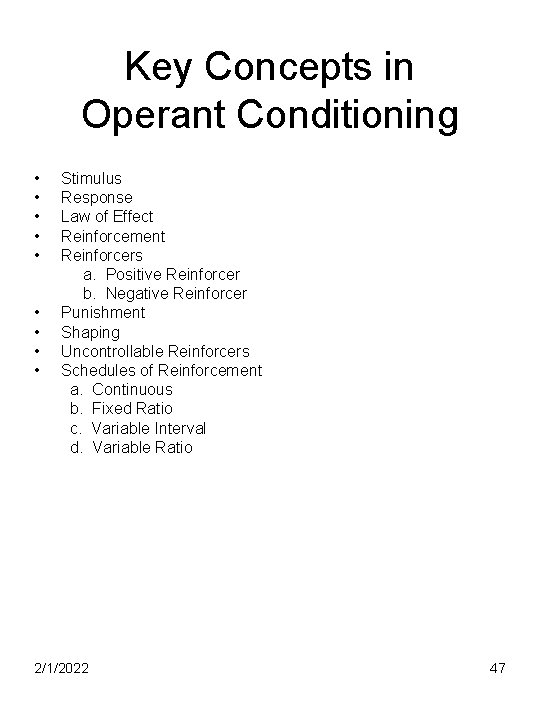
Key Concepts in Operant Conditioning • • • Stimulus Response Law of Effect Reinforcement Reinforcers a. Positive Reinforcer b. Negative Reinforcer Punishment Shaping Uncontrollable Reinforcers Schedules of Reinforcement a. Continuous b. Fixed Ratio c. Variable Interval d. Variable Ratio 2/1/2022 36
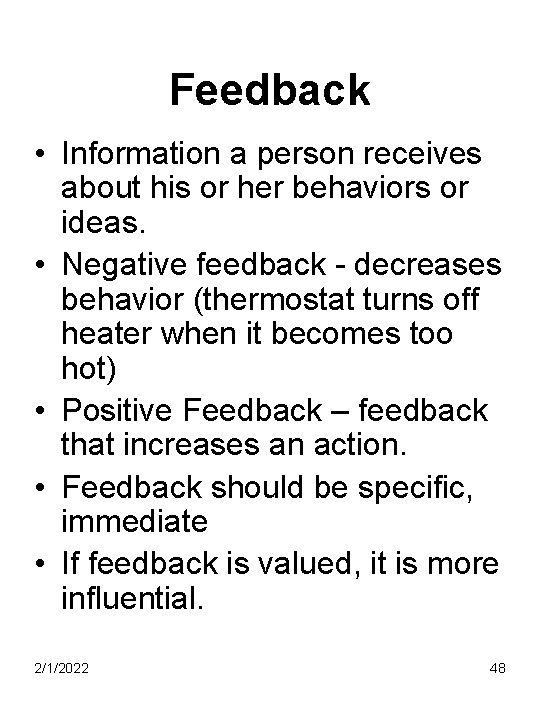
Feedback • Information a person receives about his or her behaviors or ideas. • Negative feedback - decreases behavior (thermostat turns off heater when it becomes too hot) • Positive Feedback – feedback that increases an action. • Feedback should be specific, immediate • If feedback is valued, it is more influential. 2/1/2022 37
Techniques in Behavioral Modification • Aversive Therapy – using a strong negative reinforcer to reduce an unwanted or dysfunctional behavior. Based on C. C. principles. For instance: – Lacing Alcohol with a chemical which causes vomiting. Or – putting poor tasting chemicals on one’s fingernails to reduce nail biting. (called Taste Aversion) • Shaping - Learning through progressive reinforcement. • Token Economy - a form of behavior modification based upon operant conditioning; most commonly used in institutional settings, it involves giving conditioned reinforcers (tokens) for completing specific behaviors. Tokens can then be used to “purchase” reinforcers from a store. 2/1/2022 38
Evaluation of the Learning Perspective 2/1/2022 39
Assessing the Learning Perspective: • Key Studies which the Theory was built upon • Ethical Considerations • Cultural Issues • Importance and Strengths • Criticisms and Weaknesses 2/1/2022 40
Key Studies 1. 2. 3. 4. 5. 6. 7. 8. Pavlov (1927) Classicallly Conditioning the salivation response Thorndike (1911) Acquisition of new behaviors in cats Gustafson (1974) Watson and Raynor (1920) Little Albert and Generalization of Phobic responses Skinner (1948) Superstition in the Pigeon Nicol (1999) Effects of observational learning in Chickens Bandura (1961) Transmission of Aggression through imitation of aggressive models Mead (1935) 2/1/2022 41
Ethical Considerations • Treatment of Animals • Little Albert Study 2/1/2022 42
Cultural Issues • American Influence may make the perspective most relevant to American Culture. 1. Based in part upon the American paradigm of Pragmatism, 2. Most influential theorists were American. • Mead (1935) – This famous crosscultural study supports the idea that learning can have powerful effects. 2/1/2022 43
Learning Perspective: Importance and Strengths • Based upon Empirical Evidence gained under controlled conditions • Behavioral Modification and Behavioral Therapy can be very effective – especially for relatively minor behavioral problems 2/1/2022 44
Learning Perspective: Weaknesses and Criticisms • Internal Factors: Avoids unconscious motives or internal dispositions. • Animal Research - Too much reliance on it. Can it really be generalized to humans? • Reductionism – can complex behaviors really be explained in terms of one or two factors? • Doesn’t account for biological, cognitive influences or internal drives • Behavioral therapy has not proven very effective for severe behavioral problems 2/1/2022 45
Key Concepts in Classical Conditioning Theory • • • Learning Reflex Stimulus Response Neutral Stimulus (NS) Unconditioned Stimulus (US) Conditioned Stimulus (CS) Unconditioned Response (UCR) Conditioned Response (CR) Higher Order Conditioning Law of Temporal Contiguity – Forward Conditioning – Backward Conditioning – Simultaneous Conditioning – Trace Conditioning • • • One-Trial Learning Extinction Spontaneous Recovery Stimulus Generalization Stimulus Discrimination Preparedness Conditioned Emotional Responses Conditioned Immune Responses Conditioned Drug Responses Key Studies: • Pavlov (1927) Eliciting a salivating response in dog • Watson and Raynor (1920) • Ader and Cohen (1975) 2/1/2022 46
Key Concepts in Operant Conditioning • • • Stimulus Response Law of Effect Reinforcement Reinforcers a. Positive Reinforcer b. Negative Reinforcer Punishment Shaping Uncontrollable Reinforcers Schedules of Reinforcement a. Continuous b. Fixed Ratio c. Variable Interval d. Variable Ratio 2/1/2022 47
Feedback • Information a person receives about his or her behaviors or ideas. • Negative feedback - decreases behavior (thermostat turns off heater when it becomes too hot) • Positive Feedback – feedback that increases an action. • Feedback should be specific, immediate • If feedback is valued, it is more influential. 2/1/2022 48