
Modern and Contemporary Art What is it Modern
- Slides: 55
Modern and Contemporary Art - What is it? Modern and Contemporary Art generally refers to art from 1900 onwards. Modern art generally refers to art from the 20 th century. Modern art movements include Cubism, Futurism, Dada, Surrealism, Abstract Expressionism and Pop Art, among others. Post-modern or Contemporary art generally refers to art from the 1970 s onwards.
Art History - What do you think? What does art history mean to you? What areas interest you the most, and why? Do you think the current art history curriculum is relevant to students today? What are your opinions about Modern and Contemporary Art?
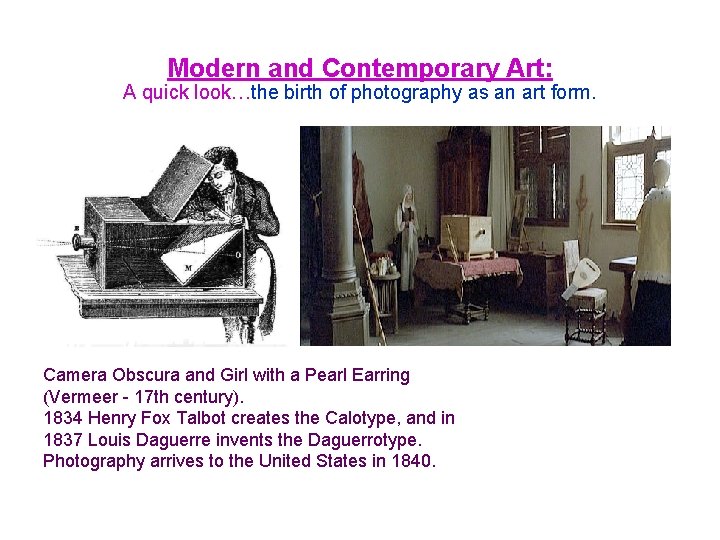
Modern and Contemporary Art: A quick look…the birth of photography as an art form. Camera Obscura and Girl with a Pearl Earring (Vermeer - 17 th century). 1834 Henry Fox Talbot creates the Calotype, and in 1837 Louis Daguerre invents the Daguerrotype. Photography arrives to the United States in 1840.
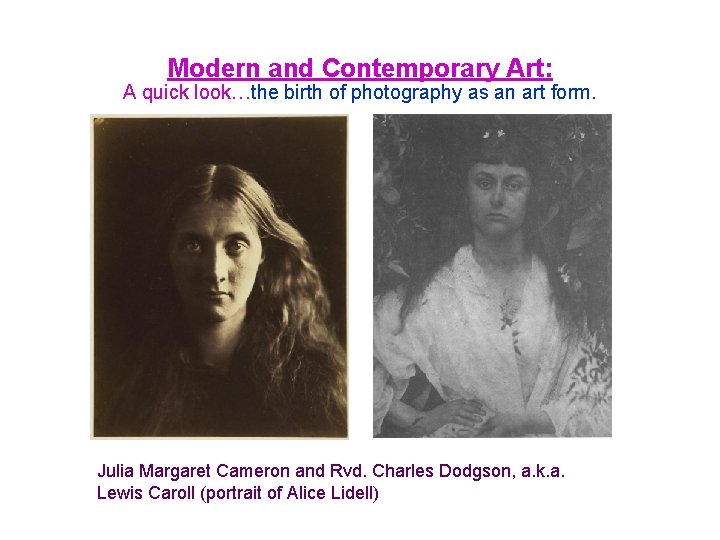
Modern and Contemporary Art: A quick look…the birth of photography as an art form. Julia Margaret Cameron and Rvd. Charles Dodgson, a. k. a. Lewis Caroll (portrait of Alice Lidell)
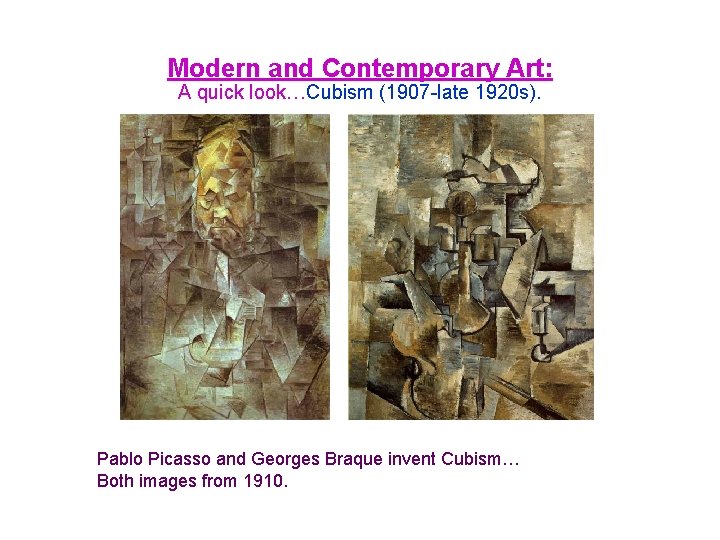
Modern and Contemporary Art: A quick look…Cubism (1907 -late 1920 s). Pablo Picasso and Georges Braque invent Cubism… Both images from 1910.
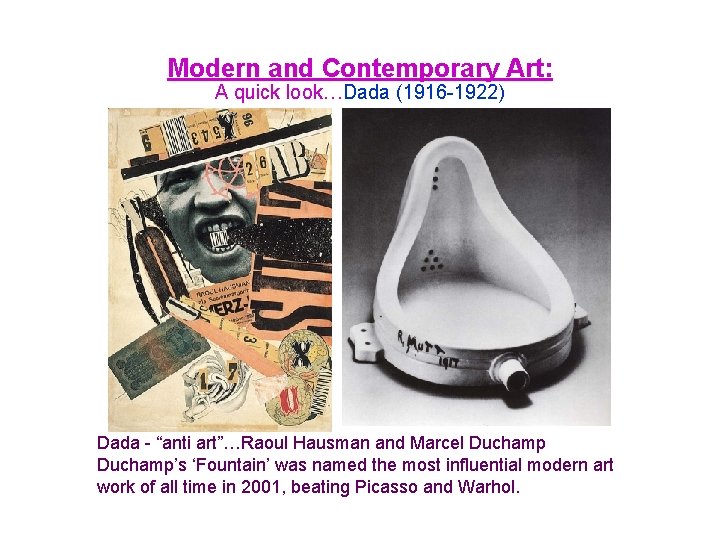
Modern and Contemporary Art: A quick look…Dada (1916 -1922) Dada - “anti art”…Raoul Hausman and Marcel Duchamp’s ‘Fountain’ was named the most influential modern art work of all time in 2001, beating Picasso and Warhol.
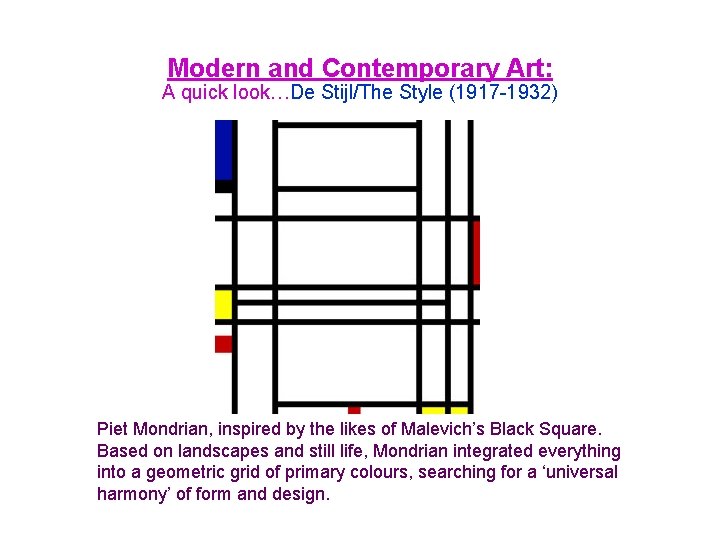
Modern and Contemporary Art: A quick look…De Stijl/The Style (1917 -1932) Piet Mondrian, inspired by the likes of Malevich’s Black Square. Based on landscapes and still life, Mondrian integrated everything into a geometric grid of primary colours, searching for a ‘universal harmony’ of form and design.
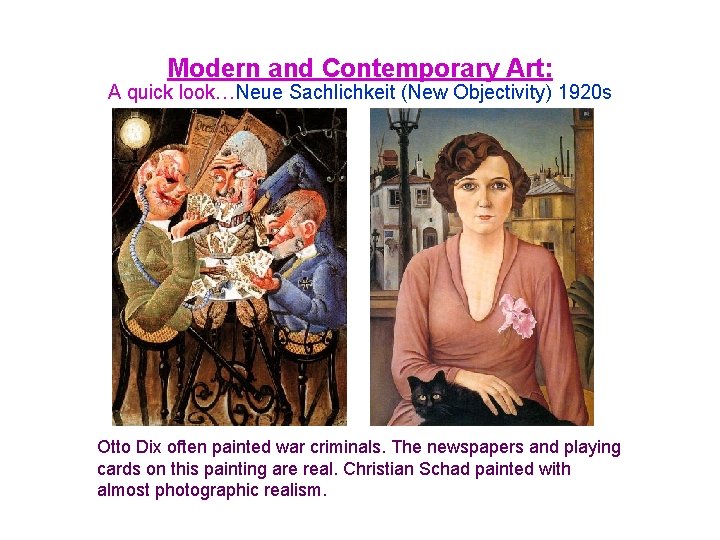
Modern and Contemporary Art: A quick look…Neue Sachlichkeit (New Objectivity) 1920 s Otto Dix often painted war criminals. The newspapers and playing cards on this painting are real. Christian Schad painted with almost photographic realism.
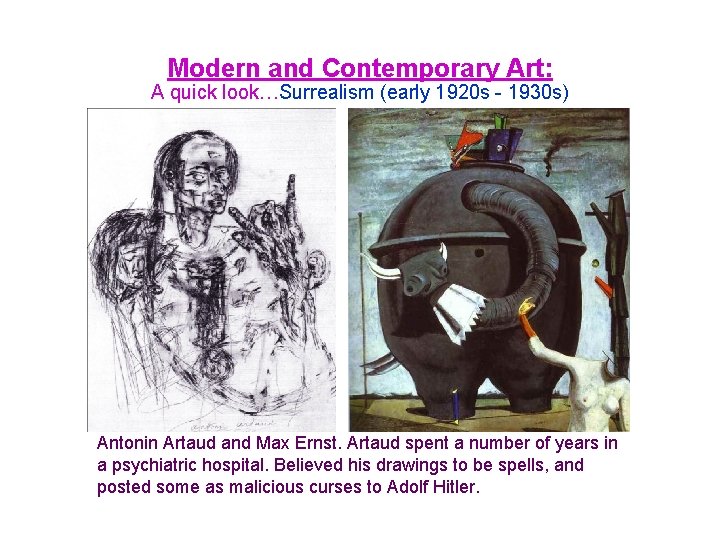
Modern and Contemporary Art: A quick look…Surrealism (early 1920 s - 1930 s) Antonin Artaud and Max Ernst. Artaud spent a number of years in a psychiatric hospital. Believed his drawings to be spells, and posted some as malicious curses to Adolf Hitler.
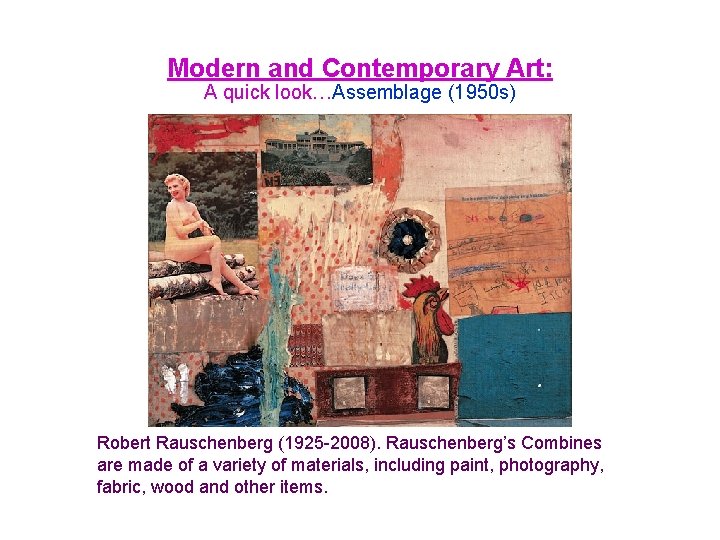
Modern and Contemporary Art: A quick look…Assemblage (1950 s) Robert Rauschenberg (1925 -2008). Rauschenberg’s Combines are made of a variety of materials, including paint, photography, fabric, wood and other items.
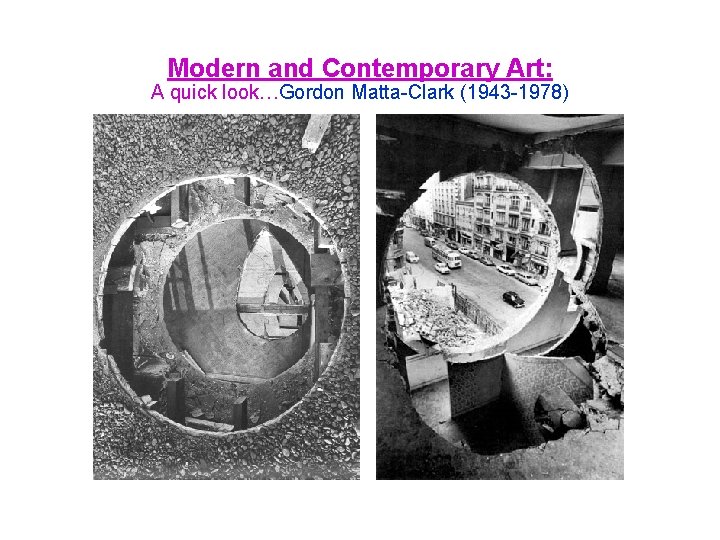
Modern and Contemporary Art: A quick look…Gordon Matta-Clark (1943 -1978)
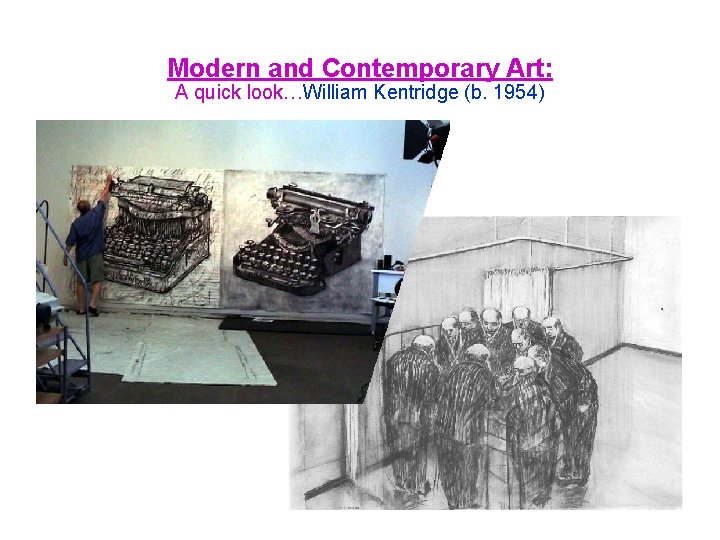
Modern and Contemporary Art: A quick look…William Kentridge (b. 1954)
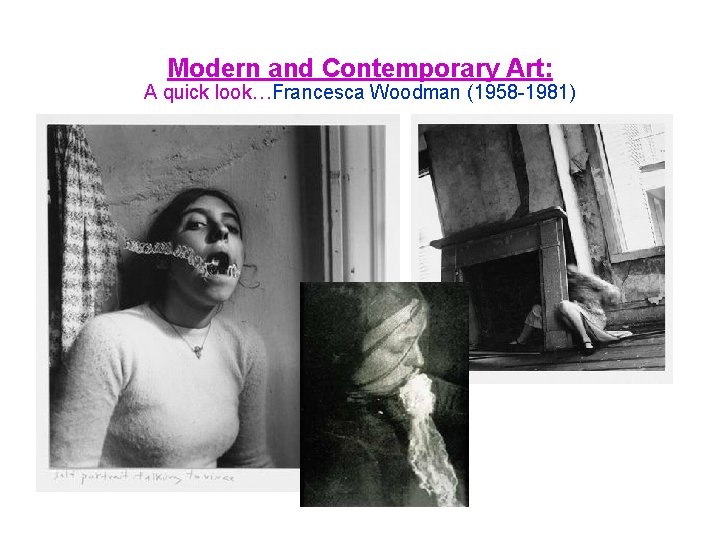
Modern and Contemporary Art: A quick look…Francesca Woodman (1958 -1981)
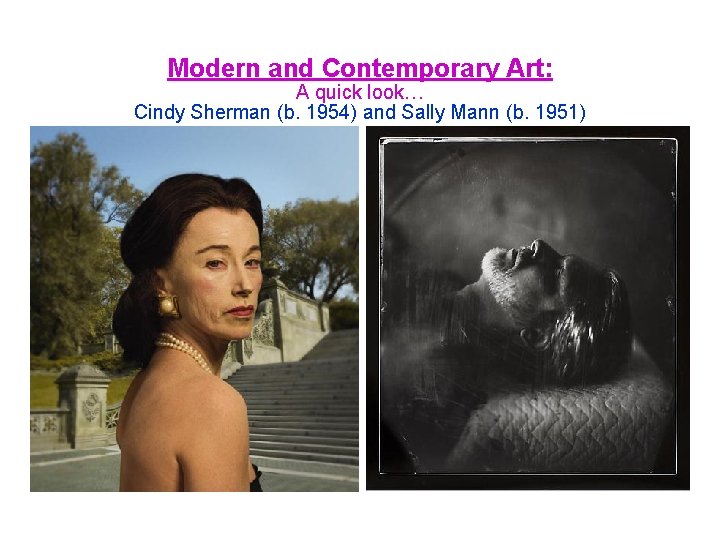
Modern and Contemporary Art: A quick look… Cindy Sherman (b. 1954) and Sally Mann (b. 1951)
Modern and Contemporary Art… What about your personal response? What images did you like/dislike, and why? You must be able to explain your reasons! So how can having an opinion help in the exam? Well, for one thing - you get marks for it! Remembering details and facts is always easier if you have a personal response to something. So forming an opinion can help you to actually learn the information!
Interpreting Art… • There are 3 categories of statements that one can make about art: • Context: refers to the circumstances surrounding the production and reception of an art work. (eg. Whether the artist is male/female, religious/secular…this kind of background info can affect our understanding of the work. ) • Form: the work itself and its constituent elements. (eg. A work’s colour, light, shape, size, technique, texture etc. ) • Content: refers to what a work says and the effects it produces in an observer.
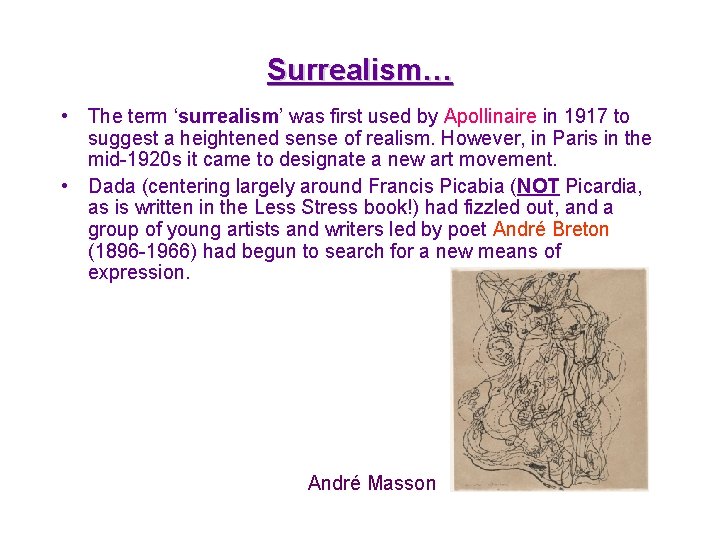
Surrealism… • The term ‘surrealism’ was first used by Apollinaire in 1917 to suggest a heightened sense of realism. However, in Paris in the mid-1920 s it came to designate a new art movement. • Dada (centering largely around Francis Picabia (NOT Picardia, as is written in the Less Stress book!) had fizzled out, and a group of young artists and writers led by poet André Breton (1896 -1966) had begun to search for a new means of expression. André Masson
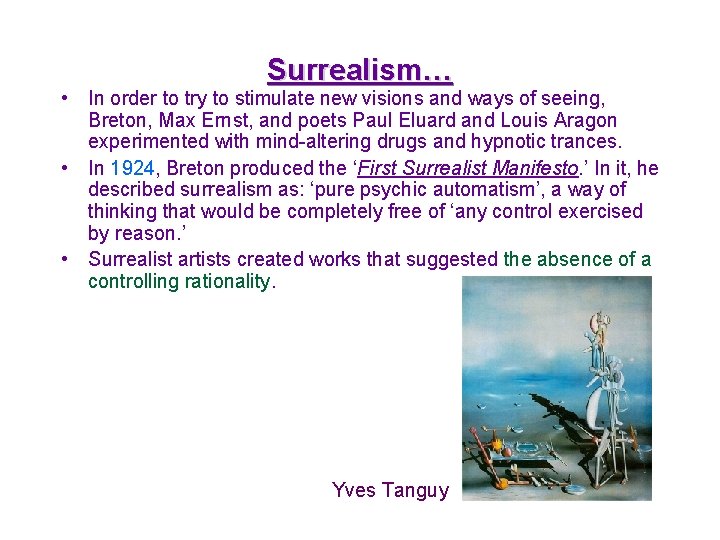
Surrealism… • In order to try to stimulate new visions and ways of seeing, Breton, Max Ernst, and poets Paul Eluard and Louis Aragon experimented with mind-altering drugs and hypnotic trances. • In 1924, Breton produced the ‘First Surrealist Manifesto. ’ In it, he described surrealism as: ‘pure psychic automatism’, a way of thinking that would be completely free of ‘any control exercised by reason. ’ • Surrealist artists created works that suggested the absence of a controlling rationality. Yves Tanguy
Surrealism… • The surrealists were also highly influenced by the creativity of children and the mentally disturbed. (Genius has been linked to insanity. ) • They were also profoundly interested in the subconscious mind, and particularly the writings of Austrian psychoanalyst Sigmund Freud (1856 -1939). • Surrealist art went beyond painting, and moved into the fields of Photography (Dalí, Man Ray), and Film (Artaud). • Surrealism flourished in Europe between World Wars 1 and 2 (however, Francesca Woodman’s art from the 1970 s and ‘ 80 s has been described as surrealist in style). • Surrealist artists wanted to combine the world of dreams and fantasy with the everyday, rational world. They were fascinated by the subconscious mind, and the secrets that it could harbour.
Surrealism… • Surreal: having a strange dreamlike, irrational quality or atmosphere. • The Surrealists’ art sought to release the creative potential of the unconscious mind, eg. by using the irrational juxtaposition of images. • Surrealist artists were highly influenced by the work of Sigmund Freud, the Father of Psychoanalysis. Freud’s theories on the unconscious were hugely influential and controversial at the time. • The Surrealists were hugely influenced by Freud because his theories about the unconscious mind were ground-breaking.
Surrealism… • Freud was the first to emphasise the significance of unconscious processes in both normal and neurotic behaviour. • He was the founder of psychoanalysis as a therapeutic practice (no more archaic methods of treating mental disorders, such as the medieval method of drilling into the head!). • Some of Freud’s theories highlighted the possibility of how unconscious issues, desires and fears could affect a person’s behaviour. • Freud believed dreams to be a way in which the mind could work through issues that were not yet consciously realised.
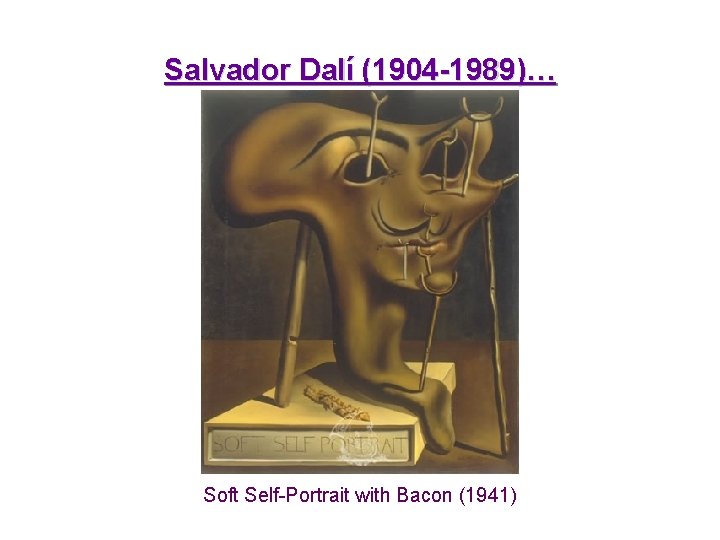
Salvador Dalí (1904 -1989)… Soft Self-Portrait with Bacon (1941)
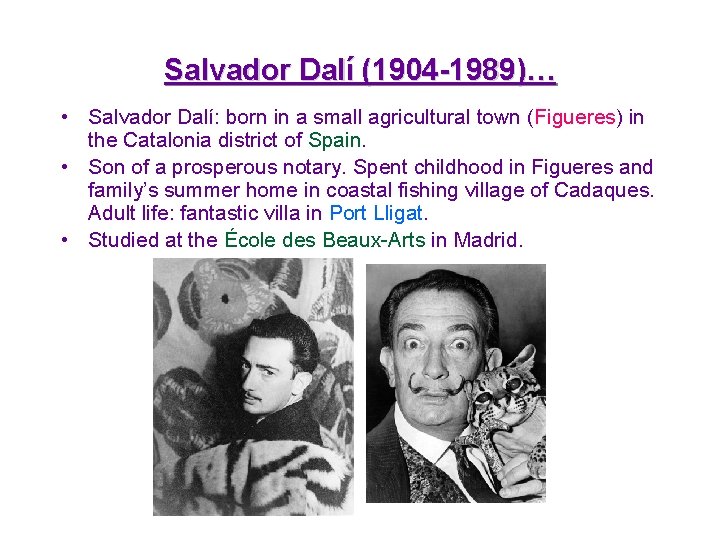
Salvador Dalí (1904 -1989)… • Salvador Dalí: born in a small agricultural town (Figueres) in the Catalonia district of Spain. • Son of a prosperous notary. Spent childhood in Figueres and family’s summer home in coastal fishing village of Cadaques. Adult life: fantastic villa in Port Lligat. • Studied at the École des Beaux-Arts in Madrid.
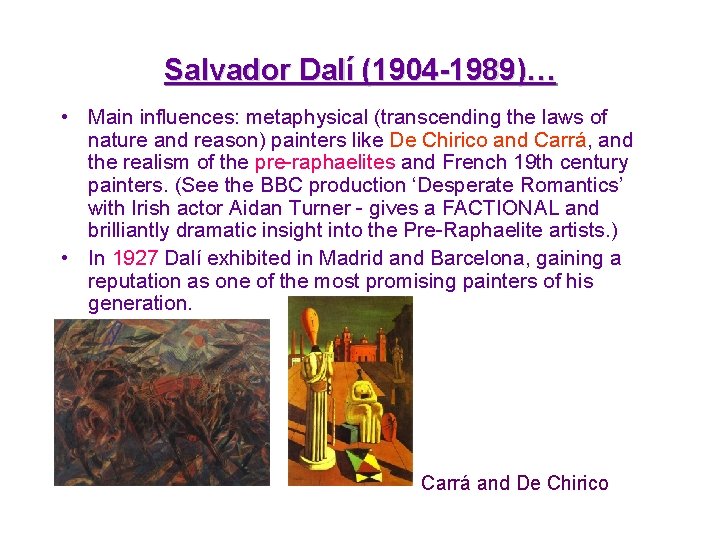
Salvador Dalí (1904 -1989)… • Main influences: metaphysical (transcending the laws of nature and reason) painters like De Chirico and Carrá, and the realism of the pre-raphaelites and French 19 th century painters. (See the BBC production ‘Desperate Romantics’ with Irish actor Aidan Turner - gives a FACTIONAL and brilliantly dramatic insight into the Pre-Raphaelite artists. ) • In 1927 Dalí exhibited in Madrid and Barcelona, gaining a reputation as one of the most promising painters of his generation. Carrá and De Chirico
Salvador Dalí (1904 -1989)… • In 1928 visited Paris, where he met Picasso and surrealists Joan Miró, André Breton, Max Ernst, Yves Tanguy, André Masson. • Dalí joined the group in 1929, and rapidly became one of the leading figures of the movement. • Met Gala Eluard when she visited him in Cadaques with her husband , French poet Paul Eluard. • Gala became Dalí’s lover, muse, business manager and the source of inspiration for many of his greatest works. • Married in a civil ceremony in 1934.
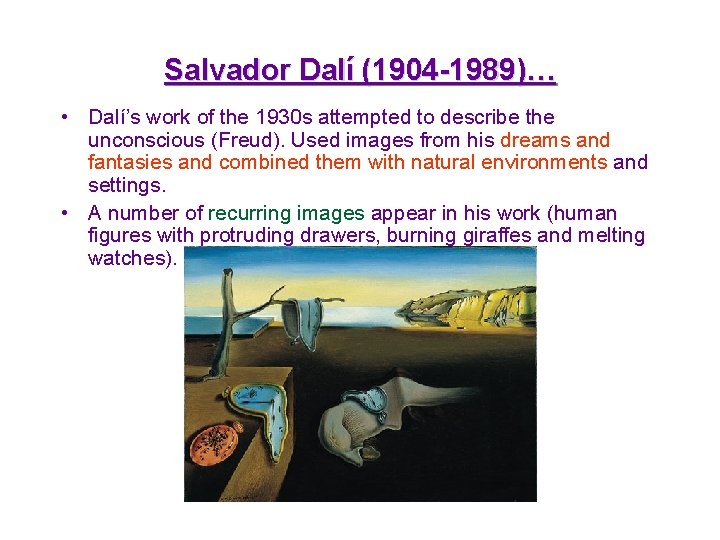
Salvador Dalí (1904 -1989)… • Dalí’s work of the 1930 s attempted to describe the unconscious (Freud). Used images from his dreams and fantasies and combined them with natural environments and settings. • A number of recurring images appear in his work (human figures with protruding drawers, burning giraffes and melting watches).
Salvador Dalí (1904 -1989)… • Named his technique ‘critical paranoia’ (a delusional state in which one could create artwork, while at the same time maintaining a certain level of reason and control). • Thrown out of the surrealist movement by Breton in 1937 for 2 reasons: (a) his work had become too traditional, and (b) his work had become quite political, supporting General Franco’s (selfproclaimed leader of Spain; established a dictatorship in Spain in 1939 until his death in ‘ 75) regime.
Salvador Dalí (1904 -1989)… • In 1940, Dalí left for the U. S. From 1948 he split his time between New York, Paris and Spain. 1955: finally settled in Spain where he became a worldfamous recluse. • Was a multi-disciplinary artist: as well as painting and printing, was also a sculptor, photographer, jewellery designer, and set designer, even working on films with Louis Bunuel and Alfred Hitchcock.
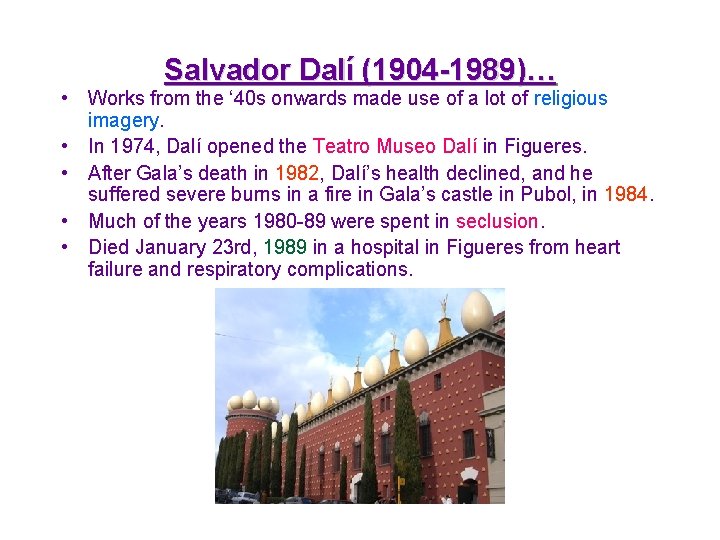
Salvador Dalí (1904 -1989)… • Works from the ‘ 40 s onwards made use of a lot of religious imagery. • In 1974, Dalí opened the Teatro Museo Dalí in Figueres. • After Gala’s death in 1982, Dalí’s health declined, and he suffered severe burns in a fire in Gala’s castle in Pubol, in 1984. • Much of the years 1980 -89 were spent in seclusion. • Died January 23 rd, 1989 in a hospital in Figueres from heart failure and respiratory complications.
Salvador Dalí: in more detail… • Now we will take a look at some of Dalí’s paintings in more detail… • Influences: Francisco de Goya and Hieronymus Bosch, as well as Giorgio de. Chirco and Carlo Carrá. • Dalí reverted to academic realistic methods of painting, giving his extraordinary images a finish that was as smooth and polished as porcelain. • This technique allowed any irrational or illogical composition to look disarmingly realistic. • Many of Dalí’s images were of everyday objects, shown in a manner that distorted them - painting objects such as clocks in a soft, melting or liquid state or, as he said himself, like Camembert cheese.
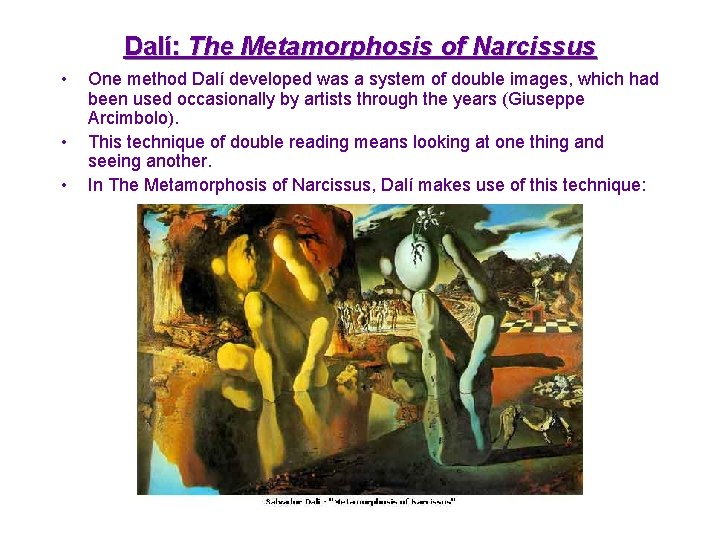
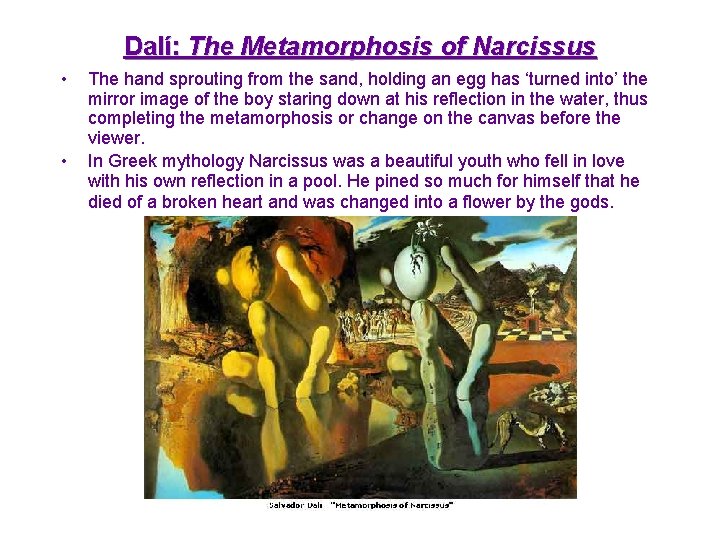
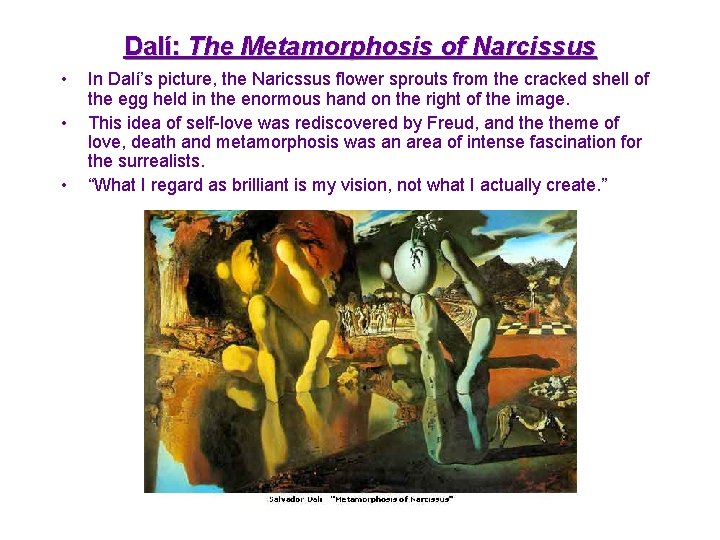
Dalí: The Metamorphosis of Narcissus • • • One method Dalí developed was a system of double images, which had been used occasionally by artists through the years (Giuseppe Arcimbolo). This technique of double reading means looking at one thing and seeing another. In The Metamorphosis of Narcissus, Dalí makes use of this technique:
Dalí: The Metamorphosis of Narcissus • • The hand sprouting from the sand, holding an egg has ‘turned into’ the mirror image of the boy staring down at his reflection in the water, thus completing the metamorphosis or change on the canvas before the viewer. In Greek mythology Narcissus was a beautiful youth who fell in love with his own reflection in a pool. He pined so much for himself that he died of a broken heart and was changed into a flower by the gods.
Dalí: The Metamorphosis of Narcissus • • • In Dalí’s picture, the Naricssus flower sprouts from the cracked shell of the egg held in the enormous hand on the right of the image. This idea of self-love was rediscovered by Freud, and theme of love, death and metamorphosis was an area of intense fascination for the surrealists. “What I regard as brilliant is my vision, not what I actually create. ”
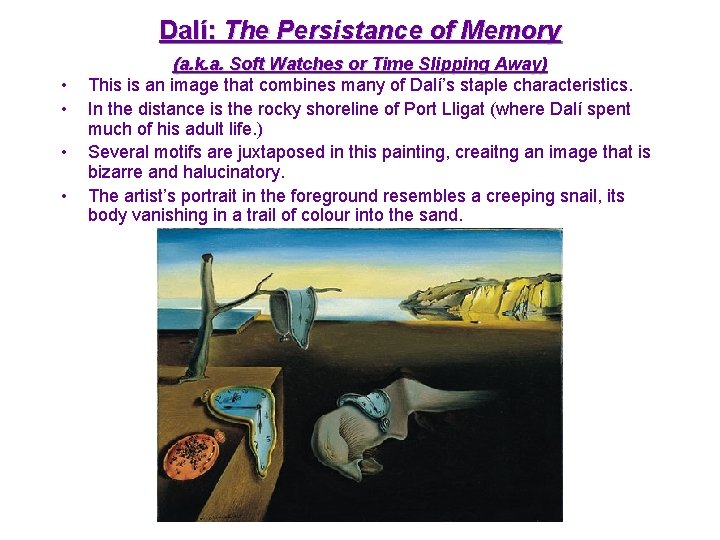
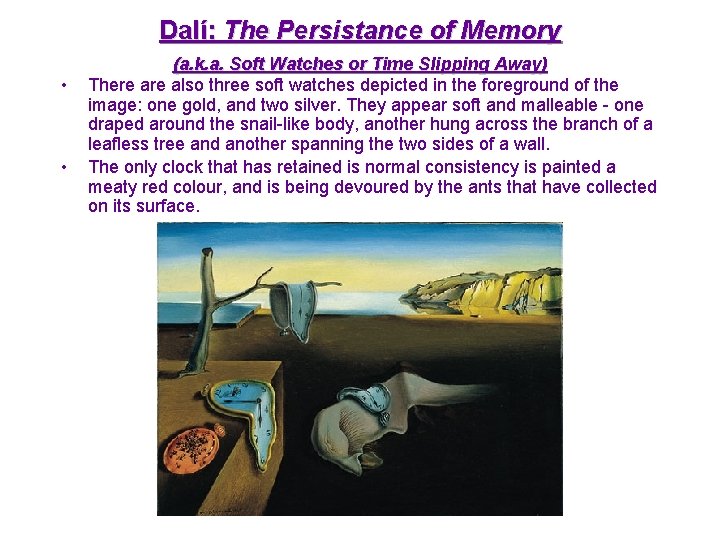
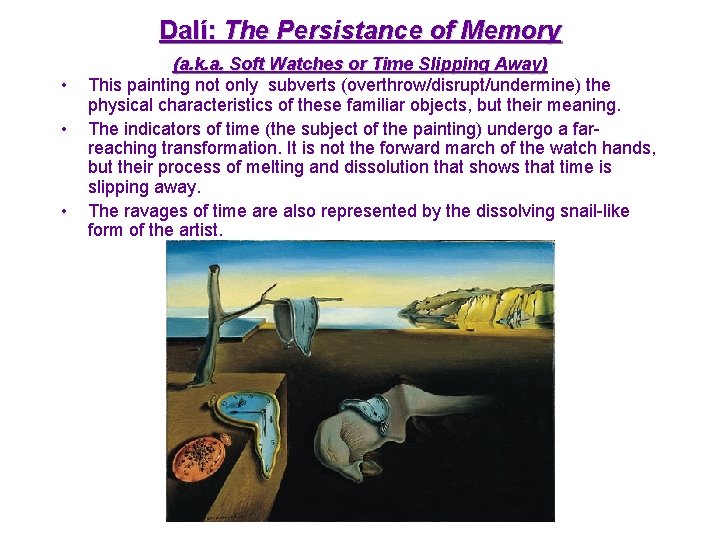
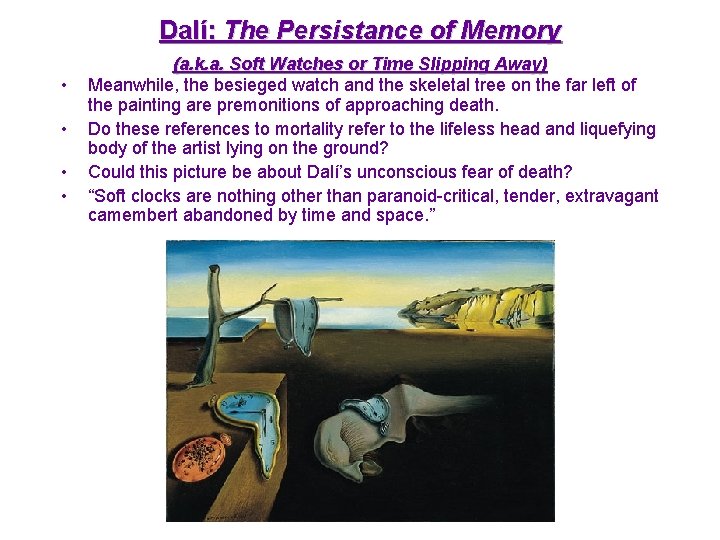
Dalí: The Persistance of Memory • • (a. k. a. Soft Watches or Time Slipping Away) This is an image that combines many of Dalí’s staple characteristics. In the distance is the rocky shoreline of Port Lligat (where Dalí spent much of his adult life. ) Several motifs are juxtaposed in this painting, creaitng an image that is bizarre and halucinatory. The artist’s portrait in the foreground resembles a creeping snail, its body vanishing in a trail of colour into the sand.
Dalí: The Persistance of Memory • • (a. k. a. Soft Watches or Time Slipping Away) There also three soft watches depicted in the foreground of the image: one gold, and two silver. They appear soft and malleable - one draped around the snail-like body, another hung across the branch of a leafless tree and another spanning the two sides of a wall. The only clock that has retained is normal consistency is painted a meaty red colour, and is being devoured by the ants that have collected on its surface.
Dalí: The Persistance of Memory • • • (a. k. a. Soft Watches or Time Slipping Away) This painting not only subverts (overthrow/disrupt/undermine) the physical characteristics of these familiar objects, but their meaning. The indicators of time (the subject of the painting) undergo a farreaching transformation. It is not the forward march of the watch hands, but their process of melting and dissolution that shows that time is slipping away. The ravages of time are also represented by the dissolving snail-like form of the artist.
Dalí: The Persistance of Memory • • (a. k. a. Soft Watches or Time Slipping Away) Meanwhile, the besieged watch and the skeletal tree on the far left of the painting are premonitions of approaching death. Do these references to mortality refer to the lifeless head and liquefying body of the artist lying on the ground? Could this picture be about Dalí’s unconscious fear of death? “Soft clocks are nothing other than paranoid-critical, tender, extravagant camembert abandoned by time and space. ”
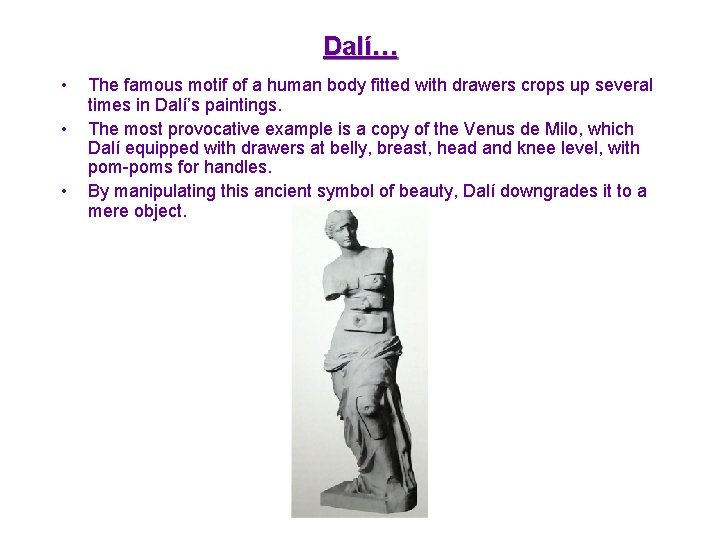
Dalí… • • • The famous motif of a human body fitted with drawers crops up several times in Dalí’s paintings. The most provocative example is a copy of the Venus de Milo, which Dalí equipped with drawers at belly, breast, head and knee level, with pom-poms for handles. By manipulating this ancient symbol of beauty, Dalí downgrades it to a mere object.
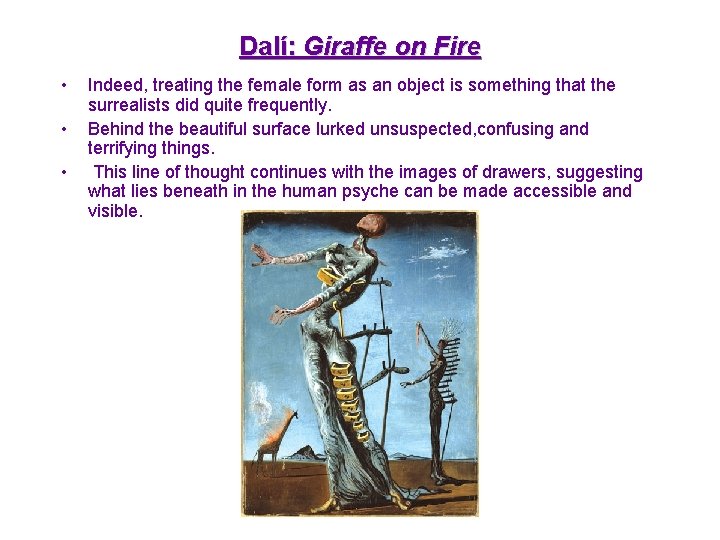
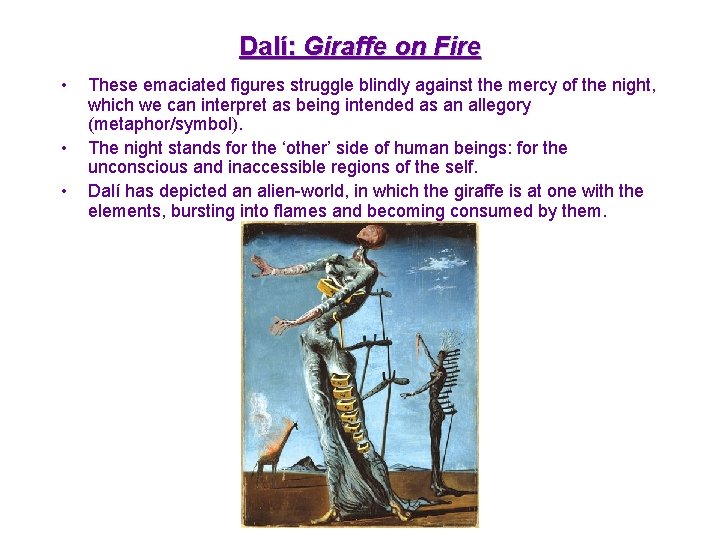
Dalí: Giraffe on Fire • • • Indeed, treating the female form as an object is something that the surrealists did quite frequently. Behind the beautiful surface lurked unsuspected, confusing and terrifying things. This line of thought continues with the images of drawers, suggesting what lies beneath in the human psyche can be made accessible and visible.
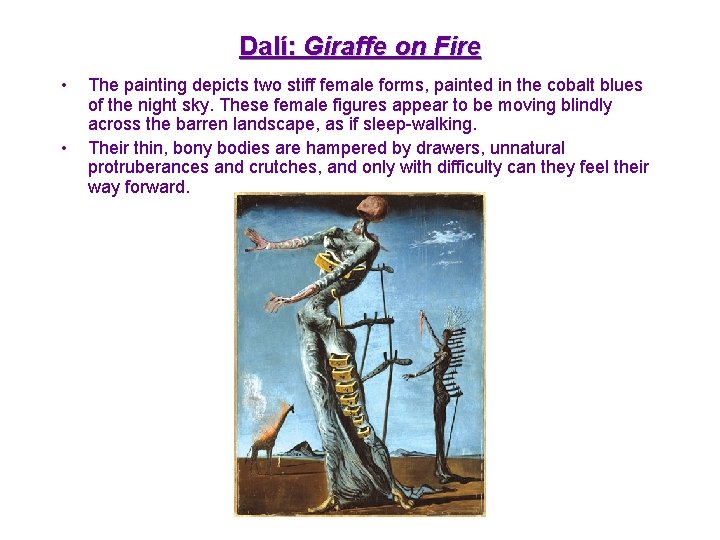
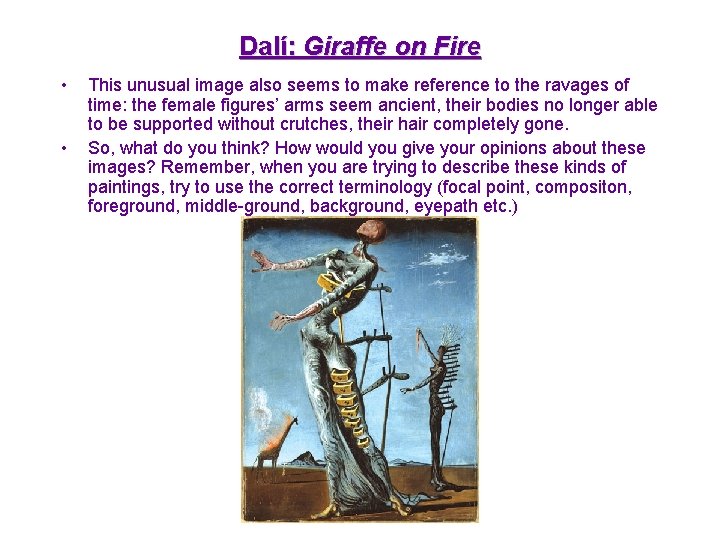
Dalí: Giraffe on Fire • • The painting depicts two stiff female forms, painted in the cobalt blues of the night sky. These female figures appear to be moving blindly across the barren landscape, as if sleep-walking. Their thin, bony bodies are hampered by drawers, unnatural protruberances and crutches, and only with difficulty can they feel their way forward.
Dalí: Giraffe on Fire • • • These emaciated figures struggle blindly against the mercy of the night, which we can interpret as being intended as an allegory (metaphor/symbol). The night stands for the ‘other’ side of human beings: for the unconscious and inaccessible regions of the self. Dalí has depicted an alien-world, in which the giraffe is at one with the elements, bursting into flames and becoming consumed by them.
Dalí: Giraffe on Fire • • This unusual image also seems to make reference to the ravages of time: the female figures’ arms seem ancient, their bodies no longer able to be supported without crutches, their hair completely gone. So, what do you think? How would you give your opinions about these images? Remember, when you are trying to describe these kinds of paintings, try to use the correct terminology (focal point, compositon, foreground, middle-ground, background, eyepath etc. )
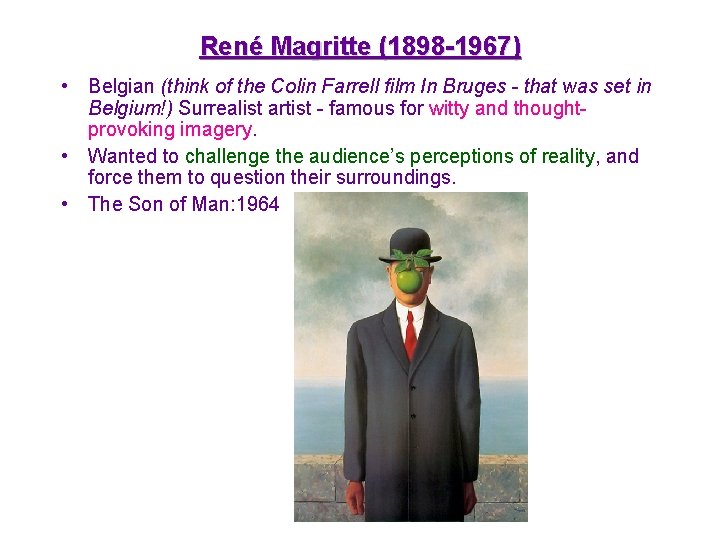
René Magritte (1898 -1967) • Belgian (think of the Colin Farrell film In Bruges - that was set in Belgium!) Surrealist artist - famous for witty and thoughtprovoking imagery. • Wanted to challenge the audience’s perceptions of reality, and force them to question their surroundings. • The Son of Man: 1964
René Magritte (1898 -1967) • Born in Lessines, and was the eldest son of a tailor and textile merchant. • Very little is known about Magritte’s early life, but he is widely known as being one of the most influential surrealist artists. • In 1912, Magritte’s mother committed suicide. Magritte was 13 at the time. • Magritte’s early paintings were Impressionistic in style. • Studied at the Académie Royale des Beaux-Arts in Brussels. • Was also influenced by the Cubists and the Futurists. • Held his first exhibition of surrealist works in Brussels in 1927. • The exhibit was criticised. Depressed by the failure, Magritte relocated to Paris, where he met André Breton and joined the surrealist movement. • Returned to Brussels in 1930, and remained there throughout World War 2 (1939 -45).
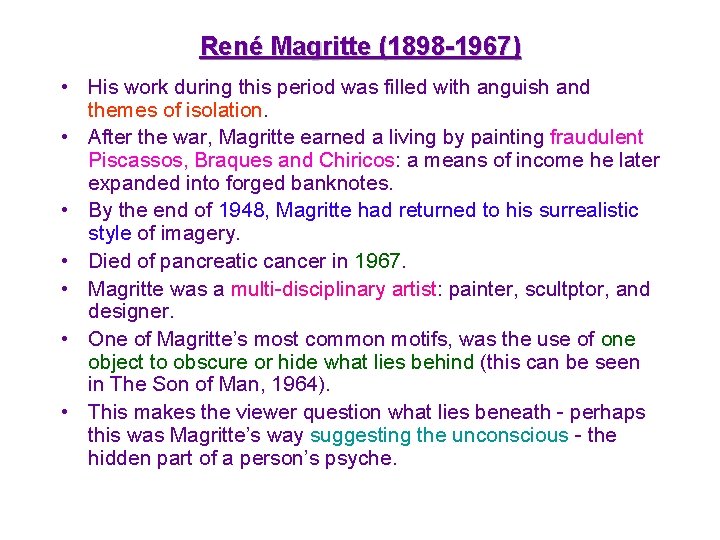
René Magritte (1898 -1967) • His work during this period was filled with anguish and themes of isolation. • After the war, Magritte earned a living by painting fraudulent Piscassos, Braques and Chiricos: a means of income he later expanded into forged banknotes. • By the end of 1948, Magritte had returned to his surrealistic style of imagery. • Died of pancreatic cancer in 1967. • Magritte was a multi-disciplinary artist: painter, scultptor, and designer. • One of Magritte’s most common motifs, was the use of one object to obscure or hide what lies behind (this can be seen in The Son of Man, 1964). • This makes the viewer question what lies beneath - perhaps this was Magritte’s way suggesting the unconscious - the hidden part of a person’s psyche.
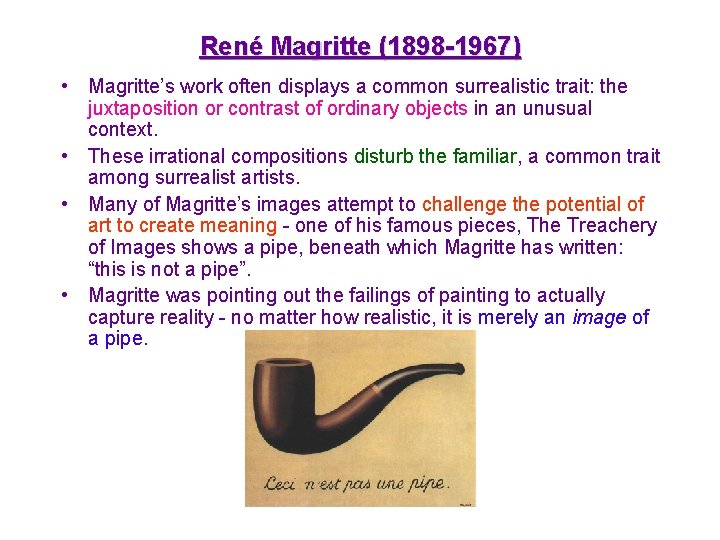
René Magritte (1898 -1967) • Magritte’s work often displays a common surrealistic trait: the juxtaposition or contrast of ordinary objects in an unusual context. • These irrational compositions disturb the familiar, a common trait among surrealist artists. • Many of Magritte’s images attempt to challenge the potential of art to create meaning - one of his famous pieces, The Treachery of Images shows a pipe, beneath which Magritte has written: “this is not a pipe”. • Magritte was pointing out the failings of painting to actually capture reality - no matter how realistic, it is merely an image of a pipe.
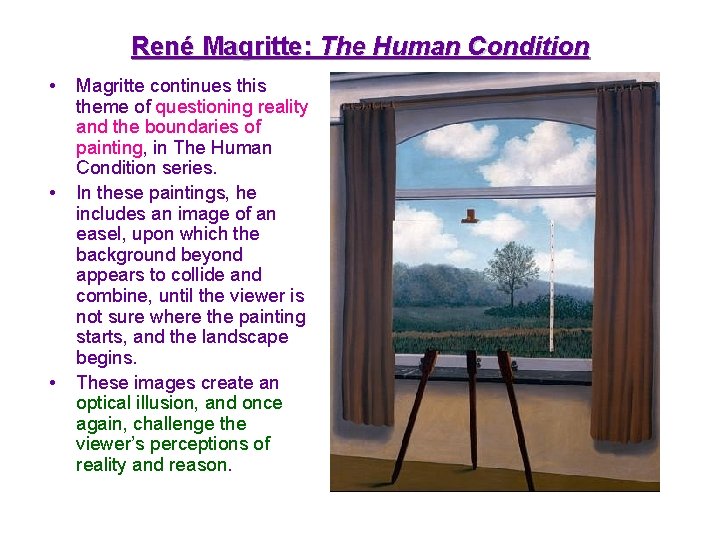
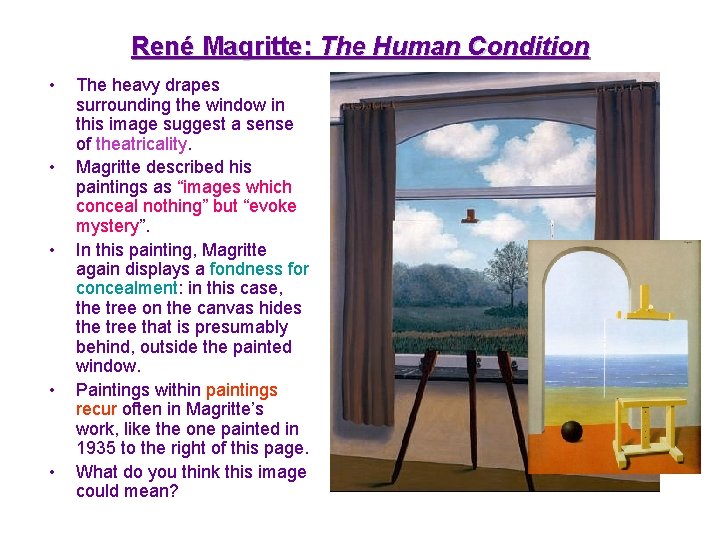
René Magritte: The Human Condition • • • Magritte continues this theme of questioning reality and the boundaries of painting, in The Human Condition series. In these paintings, he includes an image of an easel, upon which the background beyond appears to collide and combine, until the viewer is not sure where the painting starts, and the landscape begins. These images create an optical illusion, and once again, challenge the viewer’s perceptions of reality and reason.
René Magritte: The Human Condition • • • The heavy drapes surrounding the window in this image suggest a sense of theatricality. Magritte described his paintings as “images which conceal nothing” but “evoke mystery”. In this painting, Magritte again displays a fondness for concealment: in this case, the tree on the canvas hides the tree that is presumably behind, outside the painted window. Paintings within paintings recur often in Magritte’s work, like the one painted in 1935 to the right of this page. What do you think this image could mean?
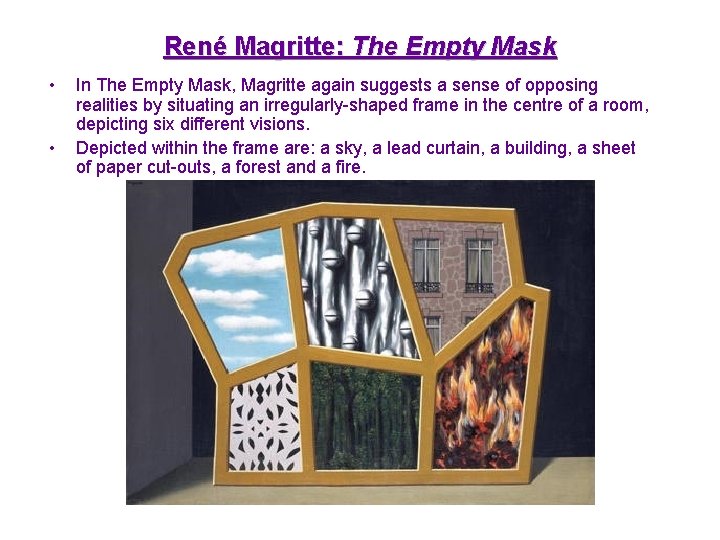
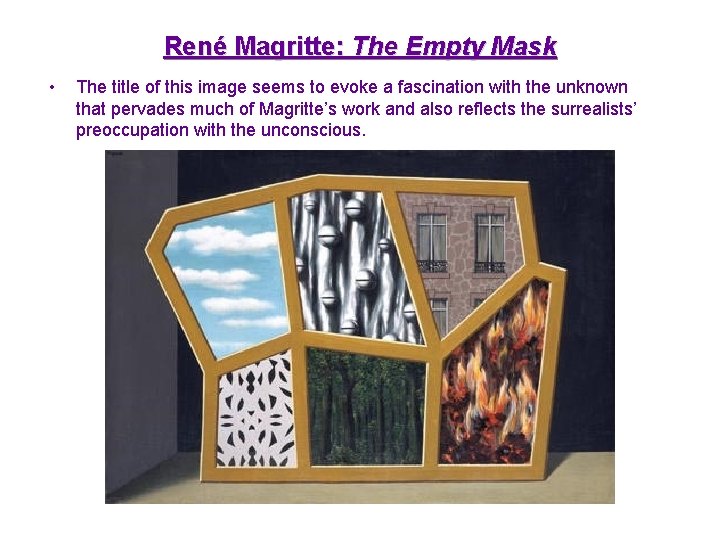
René Magritte: The Empty Mask • • In The Empty Mask, Magritte again suggests a sense of opposing realities by situating an irregularly-shaped frame in the centre of a room, depicting six different visions. Depicted within the frame are: a sky, a lead curtain, a building, a sheet of paper cut-outs, a forest and a fire.
René Magritte: The Empty Mask • The title of this image seems to evoke a fascination with the unknown that pervades much of Magritte’s work and also reflects the surrealists’ preoccupation with the unconscious.
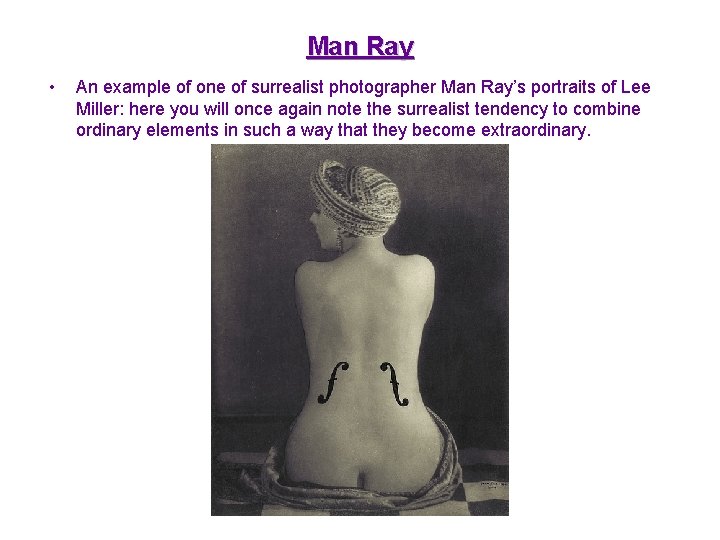
Man Ray • An example of one of surrealist photographer Man Ray’s portraits of Lee Miller: here you will once again note the surrealist tendency to combine ordinary elements in such a way that they become extraordinary.
Surrealism: A Summary • André Breton publishes the First Surrealist Manifesto in 1924. • Surrealist artists include Salvador Dalí, René Magritte and Max Ernst. • Flourished between World Wars 1 and 2. • Surrealist artists fascinated by Freud’s theories on the unconscious and dreams. • Themes in surrealist art include subverting the familiar, questioning reality and juxtaposing everyday objects. • Many surrealist artists were multi-disciplinary, spanning the disciplines of painting, film, sculpture and photography. • Surrealist artists wanted to go beyond the boundaries of traditional art, and find new ways of expression (experimentation with drugs and starvation to induce hallucinogenic states of consciousness). • Were fascinated by the artwork of the mentally ill and of children - believed they were closer to the unconscious (women were also thought to be naturally closer to the realm of the unconscious than men).
Surrealism: A Summary • • Salvador Dalí: Spanish surrealist artist (1904 -1989). Very provocative artist both artistically and socially. Ended his life as a recluse. Created images that were highly detailed and overtly surrealist in nature. • Used the common surrealist method of taking everyday objects and putting them in unusual situations as a way of disturbing the familiar and creating dream-like, irrational visions. • Common motifs include burning giraffes, melting watches and human figures with drawers protruding from them. • Common themes are involved with the subject of time, life and death, the unconscious and dreams.
Surrealism: A Summary • René Magritte: Belgian surrealist artist (1898 -1967). • Made a dubious living by painting fraudulent Braques and Picassos, as well as forged banknotes. • Early work influenced by Cubists and Futurists. • Created images that were quite subtle but thoughprovoking - they do this by forcing the viewer to take a second look and examine them. • Common motifs include paintings within paintings, disguising or masking sections of the canvas with unusually-placed items and contrast, for example a day-time sky combined with a vision of a house in darkness. • Common themes are involved with subjects of the unconscious, questioning reality and the unknown.
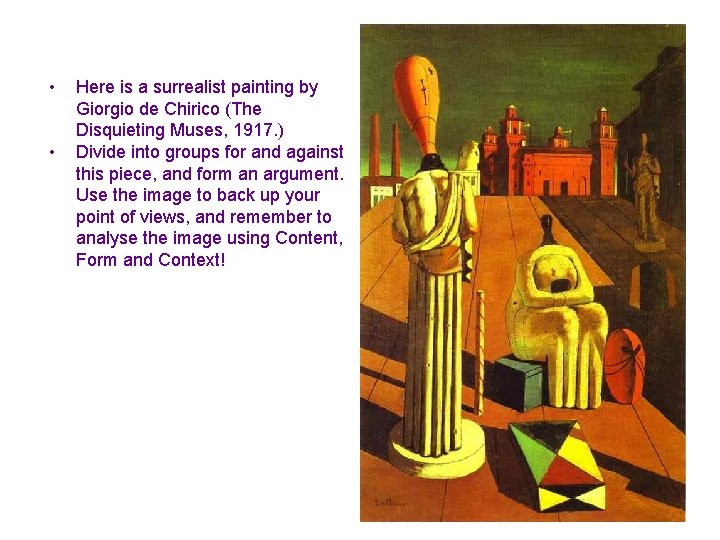
• • Here is a surrealist painting by Giorgio de Chirico (The Disquieting Muses, 1917. ) Divide into groups for and against this piece, and form an argument. Use the image to back up your point of views, and remember to analyse the image using Content, Form and Context!