
Modern a g d p nInduced Activation Transmutation
- Slides: 17
Modern a, g, d, p, n-Induced Activation Transmutation Systems EURATOM/CCFE Fusion Association J-Ch. Sublet and L. Packer (CCFE) Culham Centre for Fusion Research, Abingdon, United Kingdom J Kopecky (JUKO) Juko research, Kalmanstraat 4, 1817 HX Alkmarr, The Netherlands D. Rochman, A. J. Koning (NRG) Nuclear research and Consultancy Group, Petten, The Netherlands CCFE is the fusion research arm of the United Kingdom Atomic Energy Authority
Outline • History - introduction • European Activation System • Activation – transmutation modeling • Nuclear data • Verification and Validation - V&V • Next steps and Conclusions
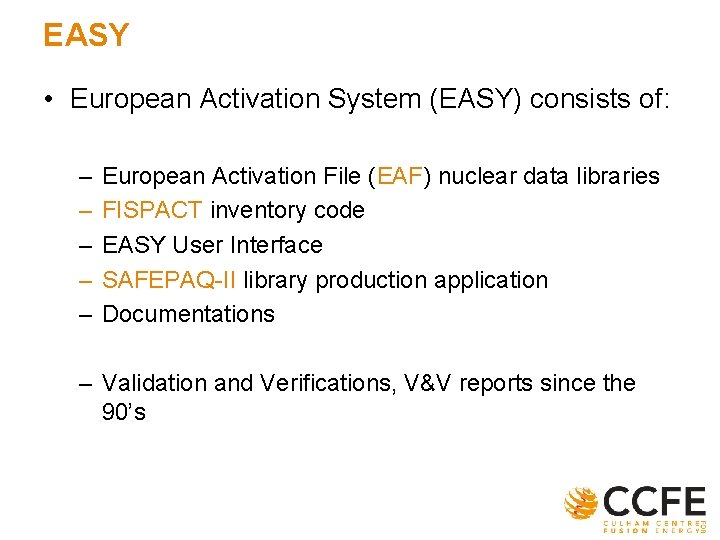
EASY • European Activation System (EASY) consists of: – – – European Activation File (EAF) nuclear data libraries FISPACT inventory code EASY User Interface SAFEPAQ-II library production application Documentations – Validation and Verifications, V&V reports since the 90’s
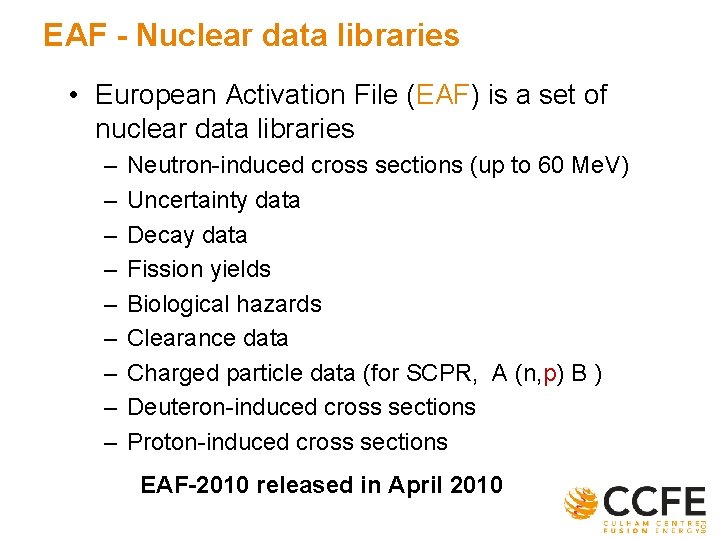
EAF - Nuclear data libraries • European Activation File (EAF) is a set of nuclear data libraries – – – – – Neutron-induced cross sections (up to 60 Me. V) Uncertainty data Decay data Fission yields Biological hazards Clearance data Charged particle data (for SCPR, A (n, p) B ) Deuteron-induced cross sections Proton-induced cross sections EAF-2010 released in April 2010
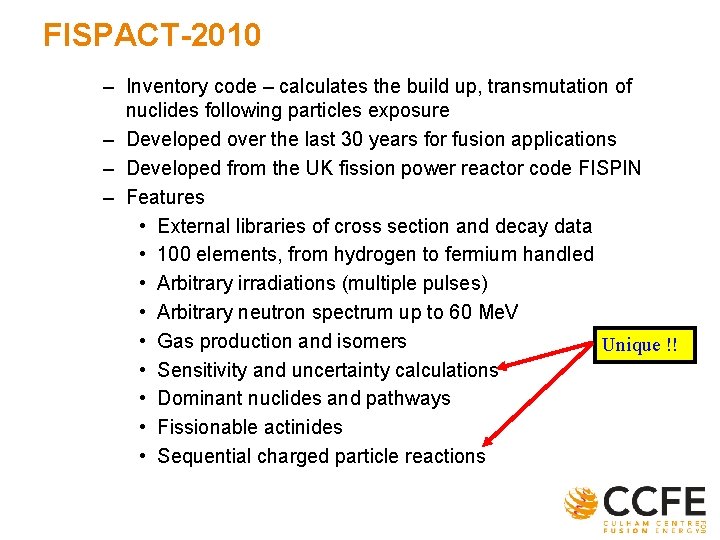
FISPACT-2010 – Inventory code – calculates the build up, transmutation of nuclides following particles exposure – Developed over the last 30 years for fusion applications – Developed from the UK fission power reactor code FISPIN – Features • External libraries of cross section and decay data • 100 elements, from hydrogen to fermium handled • Arbitrary irradiations (multiple pulses) • Arbitrary neutron spectrum up to 60 Me. V • Gas production and isomers Unique !! • Sensitivity and uncertainty calculations • Dominant nuclides and pathways • Fissionable actinides • Sequential charged particle reactions
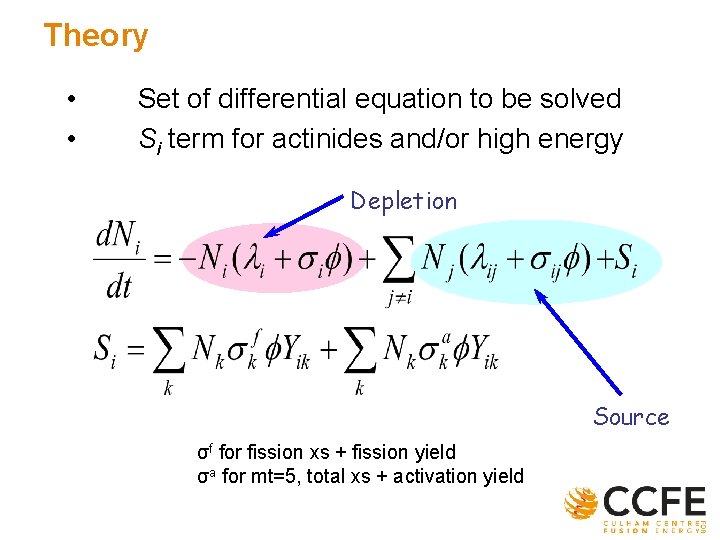
Theory • • Set of differential equation to be solved Si term for actinides and/or high energy Depletion Source σf for fission xs + fission yield σa for mt=5, total xs + activation yield
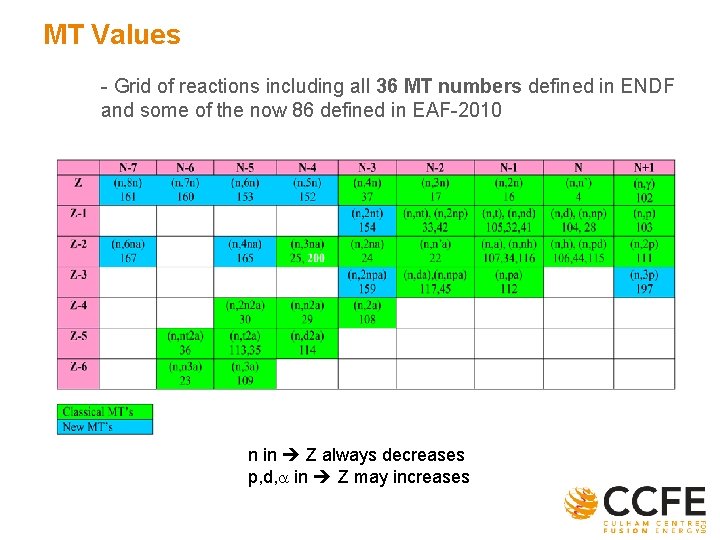
MT Values - Grid of reactions including all 36 MT numbers defined in ENDF and some of the now 86 defined in EAF-2010 n in Z always decreases p, d, a in Z may increases
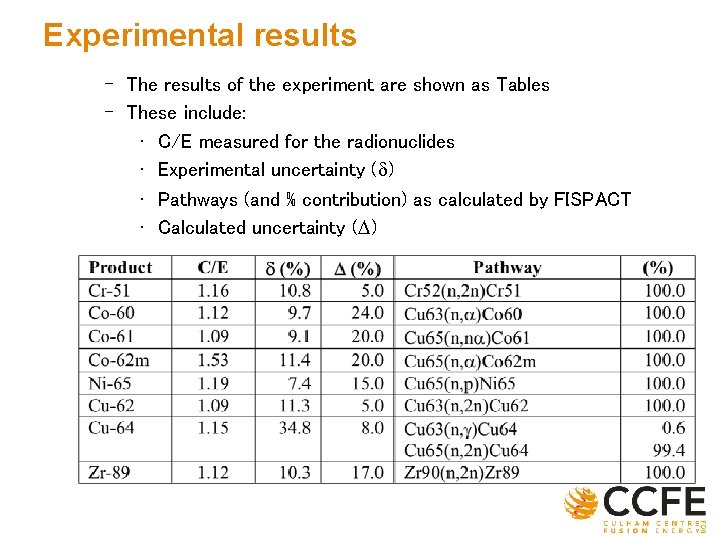
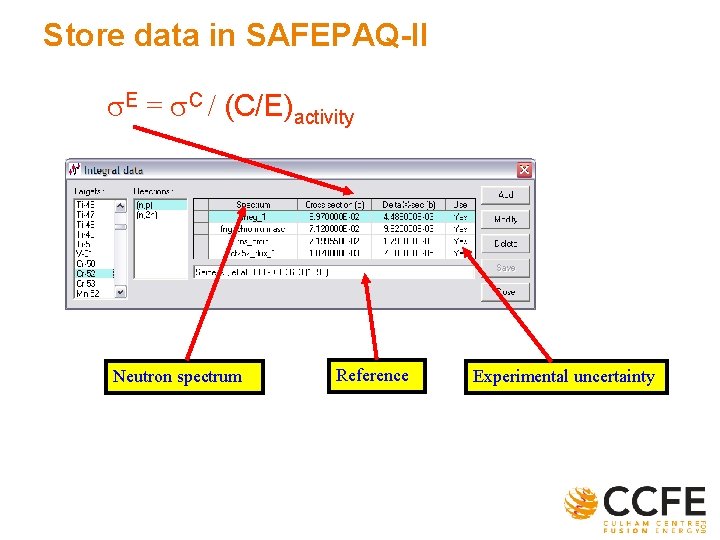
Experimental results – The results of the experiment are shown as Tables – These include: • C/E measured for the radionuclides • Experimental uncertainty (d) • Pathways (and % contribution) as calculated by FISPACT • Calculated uncertainty (D)
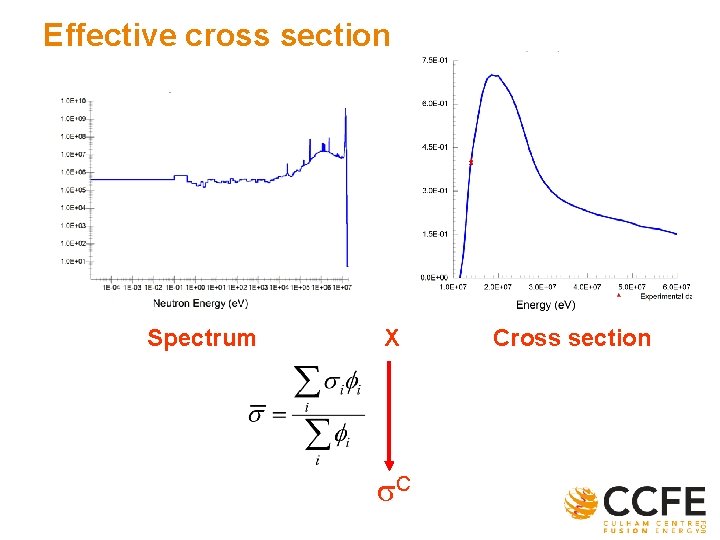
Effective cross section Spectrum X s. C Cross section
Store data in SAFEPAQ-II s. E = s. C / (C/E)activity Neutron spectrum Reference Experimental uncertainty
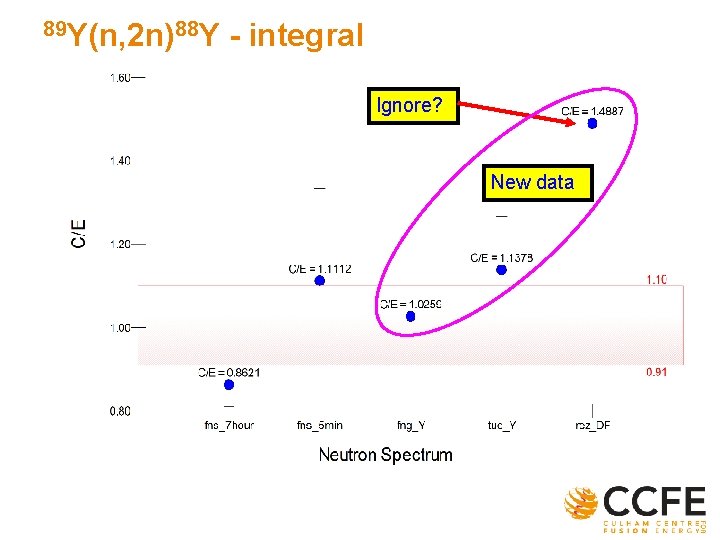
89 Y(n, 2 n)88 Y - integral Ignore? New data
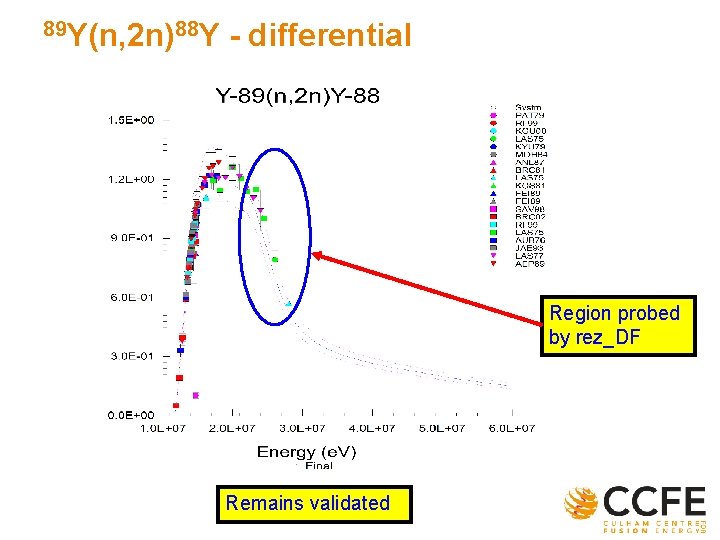
89 Y(n, 2 n)88 Y - differential Region probed by rez_DF Remains validated
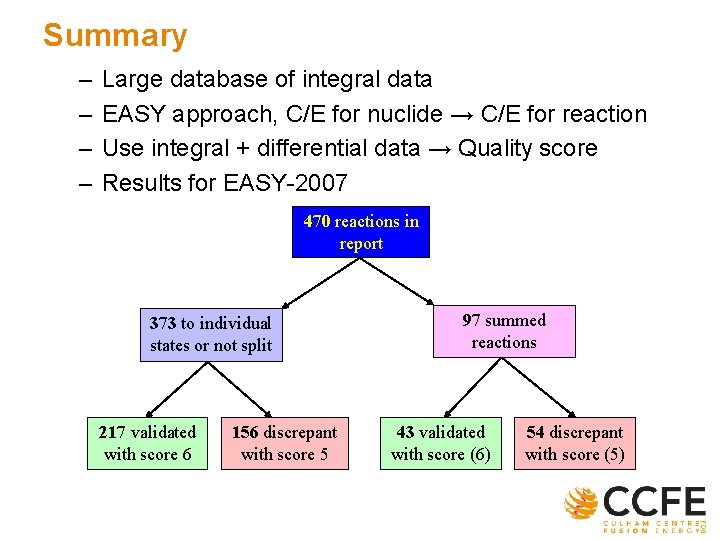
Summary – – Large database of integral data EASY approach, C/E for nuclide → C/E for reaction Use integral + differential data → Quality score Results for EASY-2007 470 reactions in report 373 to individual states or not split 217 validated with score 6 156 discrepant with score 5 97 summed reactions 43 validated with score (6) 54 discrepant with score (5)
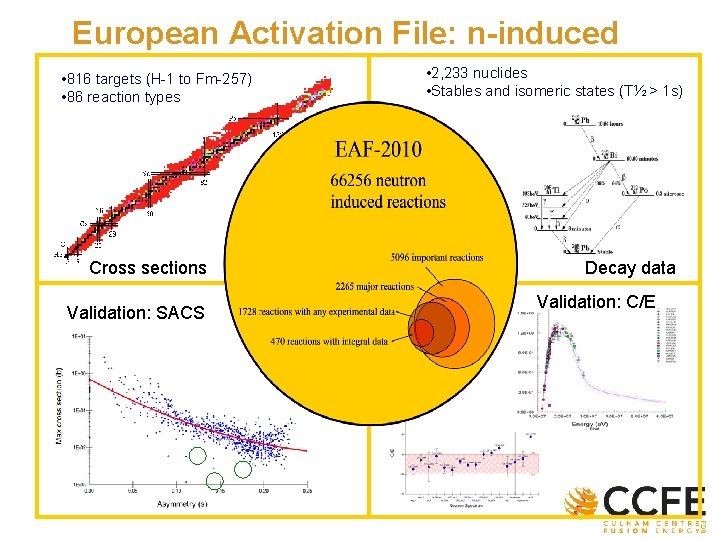
European Activation File: n-induced • 816 targets (H-1 to Fm-257) • 86 reaction types Cross sections Validation: SACS • 2, 233 nuclides • Stables and isomeric states (T½ > 1 s) Decay data Validation: C/E
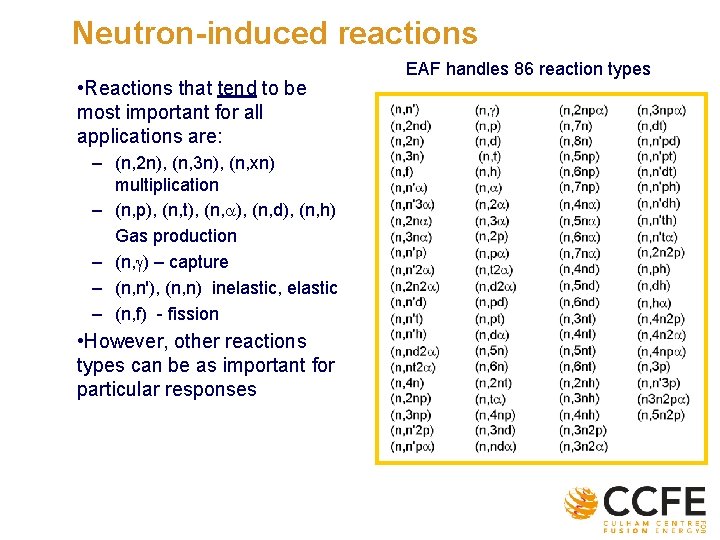
Neutron-induced reactions • Reactions that tend to be most important for all applications are: – (n, 2 n), (n, 3 n), (n, xn) multiplication – (n, p), (n, t), (n, a), (n, d), (n, h) Gas production – (n, g) – capture – (n, n'), (n, n) inelastic, elastic – (n, f) - fission • However, other reactions types can be as important for particular responses EAF handles 86 reaction types
New features • The FISPACT code is been re-written in modern Fortran 95 language and structure – already at phase 3 • Better, more user friendly multi-platforms, pre and post processing GUI tools are developed • The a, g, d, p, n-induced data libraries energy ranges are extended to 200 Me. V • Alpha and gamma induced reactions added • Universal 616 energy groups structure • Temperatures dependant n-cross section libraries • Probability table derived self-shielding factors in the resonance resolved and unresolved energy range
Conclusions • The now a day performance of computer cluster and the development of modern computing techniques allow building a new generation of truly multi purpose activation transmutation systems to be used in: 1. 2. 3. 4. 5. 6. 7. Fusion studies Reactor physics, fuel and waste management Accelerators shielding, operational dose GEN IV energy production systems Medical application Ores exploration …. .