
Models of Yukawa interaction in the two Higgs
![b→sγ Aoki, Kanemura, Tsumura, K. Y ar. Xiv: 0902. 4665 [hep-ph] NLO calculation Ciuchini](https://slidetodoc.com/presentation_image_h2/6e3ea8d33701eaf72b52477c70c39bf7/image-8.jpg "b→sγ Aoki, Kanemura, Tsumura, K. Y ar. Xiv: 0902. 4665 [hep-ph] NLO calculation Ciuchini")
![Significance (S/root(B)) Aoki, Kanemura, Tsumura, K. Y ar. Xiv: 0902. 4665 [hep-ph] gg→τ+τ- pp→bbτ+τ-](https://slidetodoc.com/presentation_image_h2/6e3ea8d33701eaf72b52477c70c39bf7/image-13.jpg "Significance (S/root(B)) Aoki, Kanemura, Tsumura, K. Y ar. Xiv: 0902. 4665 [hep-ph] gg→τ+τ- pp→bbτ+τ-")
![Signal background analysis for ττμμ events dσ/d. Mμμ [pb/Ge. V] m. Z dσ/d. Mμμ](https://slidetodoc.com/presentation_image_h2/6e3ea8d33701eaf72b52477c70c39bf7/image-17.jpg "Signal background analysis for ττμμ events dσ/d. Mμμ [pb/Ge. V] m. Z dσ/d. Mμμ")
![Signal background analysis for ττ ττ events dσ/d. Mμμ [pb/Ge. V] The ττ invariant](https://slidetodoc.com/presentation_image_h2/6e3ea8d33701eaf72b52477c70c39bf7/image-18.jpg "Signal background analysis for ττ ττ events dσ/d. Mμμ [pb/Ge. V] The ττ invariant")
- Slides: 23
Models of Yukawa interaction in the two Higgs doublet model, and their collider phenomenology Kei Yagyu Univ. Toyama Collaborators Mayumi Aoki, Shinya Kanemura, Koji Tsumura ar. Xiv: 0902. 4665 [hep-ph] April 20 TILC 09 @Tsukuba, Japan
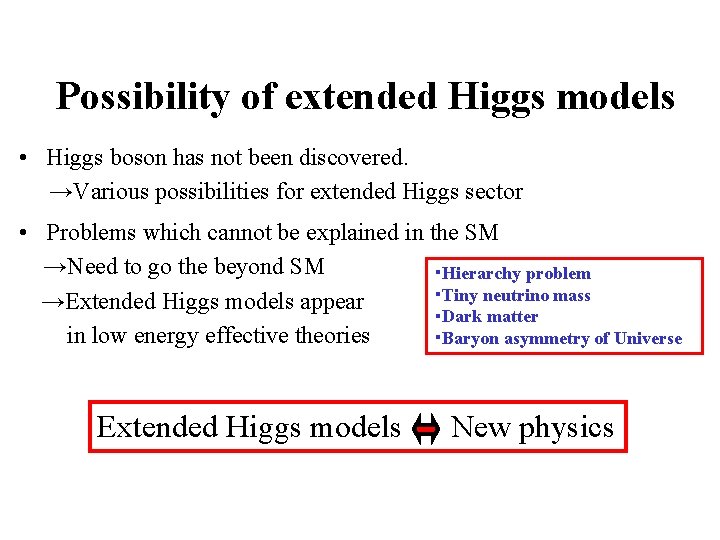
Possibility of extended Higgs models • Higgs boson has not been discovered. →Various possibilities for extended Higgs sector • Problems which cannot be explained in the SM →Need to go the beyond SM ・Hierarchy problem ・Tiny neutrino mass →Extended Higgs models appear ・Dark matter in low energy effective theories ・Baryon asymmetry of Universe Extended Higgs models New physics
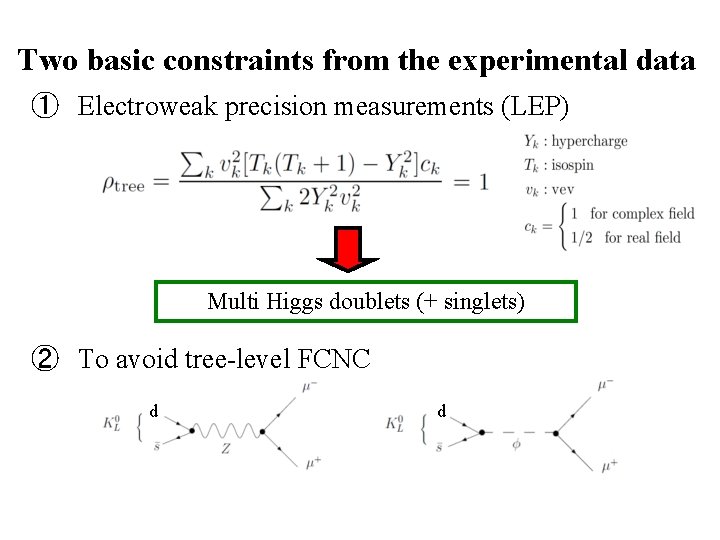
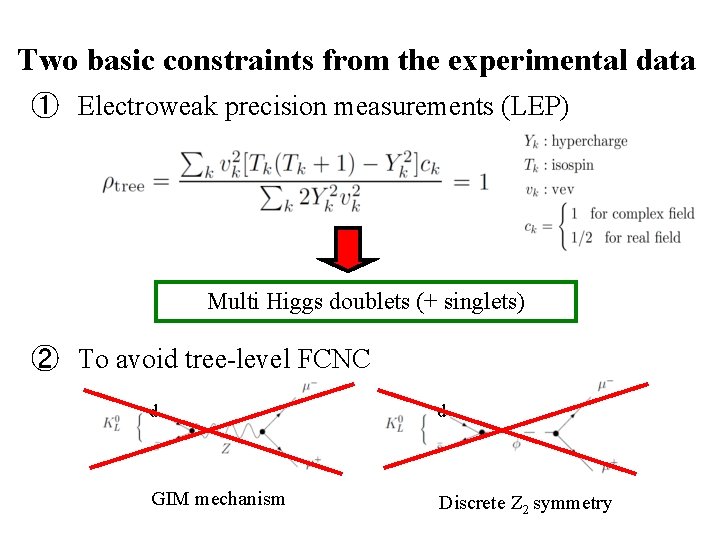
Two basic constraints from the experimental data ① Electroweak precision measurements (LEP) Multi Higgs doublets (+ singlets) ② To avoid tree-level FCNC d d
Two basic constraints from the experimental data ① Electroweak precision measurements (LEP) Multi Higgs doublets (+ singlets) ② To avoid tree-level FCNC d d GIM mechanism Discrete Z 2 symmetry
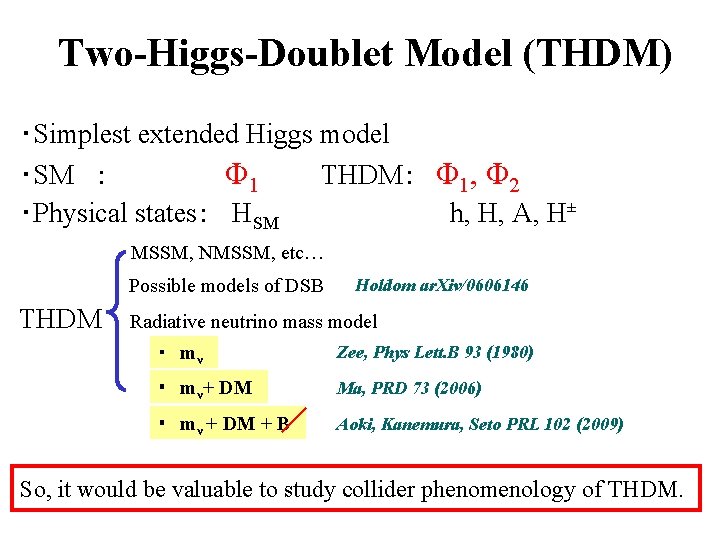
Two-Higgs-Doublet Model (THDM) ・Simplest extended Higgs model ・SM : Φ 1 THDM: Φ 1, Φ 2 ・Physical states: HSM h, H, A, H± MSSM, NMSSM, etc… Possible models of DSB THDM Holdom ar. Xiv/0606146 Radiative neutrino mass model ・ mν Zee, Phys Lett. B 93 (1980) ・ mν+ DM Ma, PRD 73 (2006) ・ mν + DM + B Aoki, Kanemura, Seto PRL 102 (2009) So, it would be valuable to study collider phenomenology of THDM.
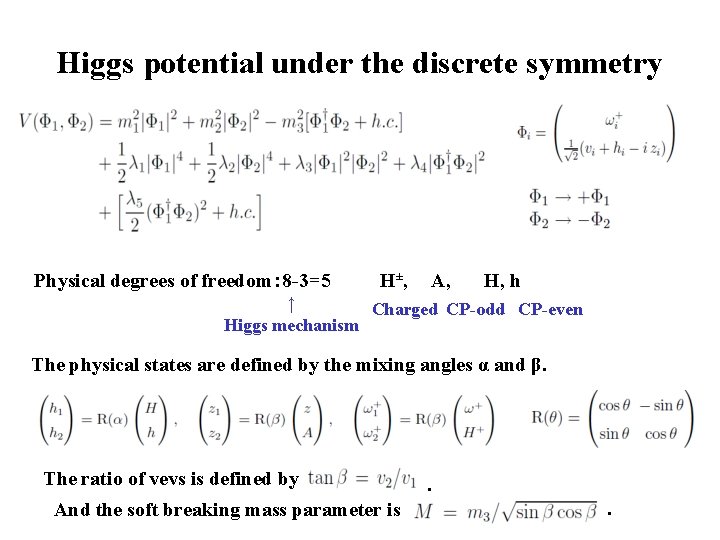
Higgs potential under the discrete symmetry Physical degrees of freedom: 8 -3=5 H±, A, H, h ↑ Charged CP-odd CP-even Higgs mechanism The physical states are defined by the mixing angles α and β. The ratio of vevs is defined by And the soft breaking mass parameter is . .
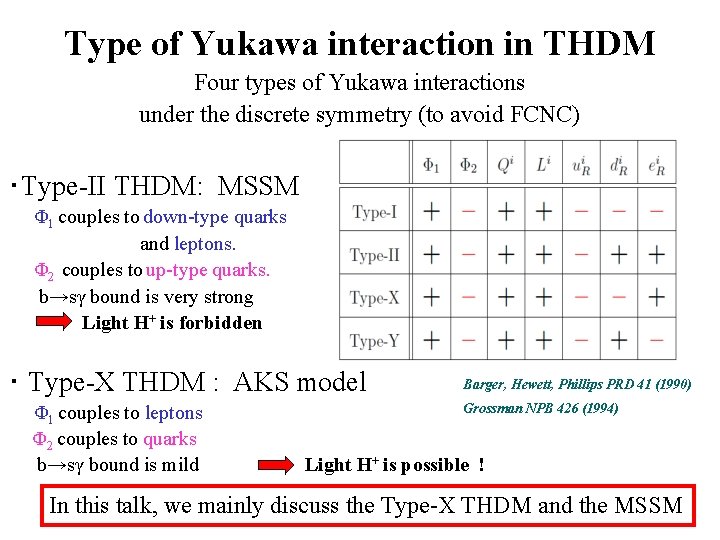
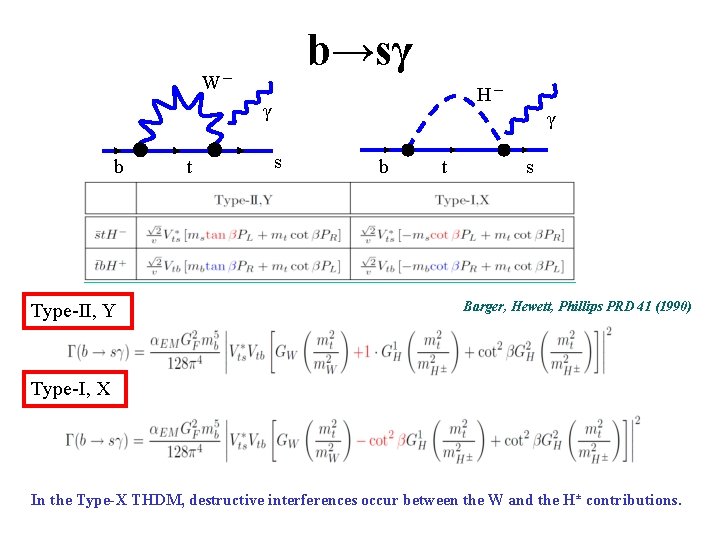
Type of Yukawa interaction in THDM Four types of Yukawa interactions under the discrete symmetry (to avoid FCNC) ・Type-II THDM: MSSM Φ 1 couples to down-type quarks and leptons. Φ 2 couples to up-type quarks. b→sγ bound is very strong Light H+ is forbidden ・ Type-X THDM : AKS model Φ 1 couples to leptons Φ 2 couples to quarks b→sγ bound is mild Barger, Hewett, Phillips PRD 41 (1990) Grossman NPB 426 (1994) Light H+ is possible ! In this talk, we mainly discuss the Type-X THDM and the MSSM
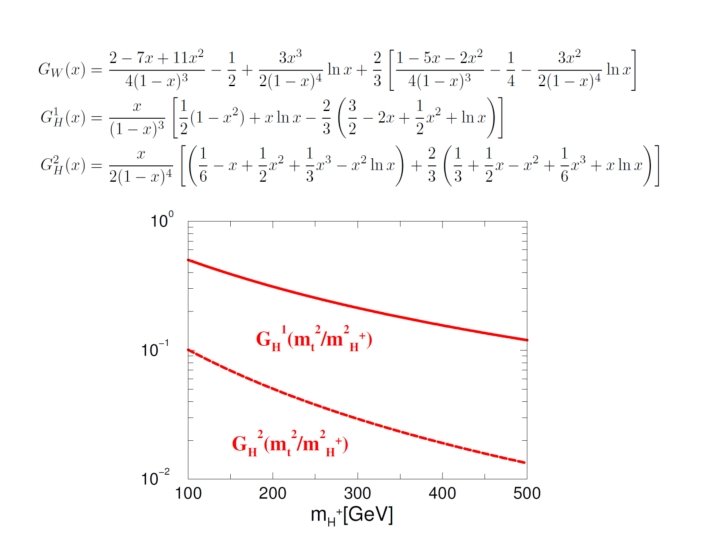
b→sγ Aoki, Kanemura, Tsumura, K. Y ar. Xiv: 0902. 4665 [hep-ph] NLO calculation Ciuchini et al. Nucl. Phys. B 527, 21 (1998). NLO NNLO calculation : 1σ : 2σ Misiak, Steinhauser, Nucl. Phys. B 764, 62 (2007). Misiak et al. , PRL. 98, 022002 (2007). m. H+> 295 Ge. V [95% C. L. ] (Type-II, Y) No bound (Type-I,-X) Light charged Higgs are possible in the Type-X and MSSM
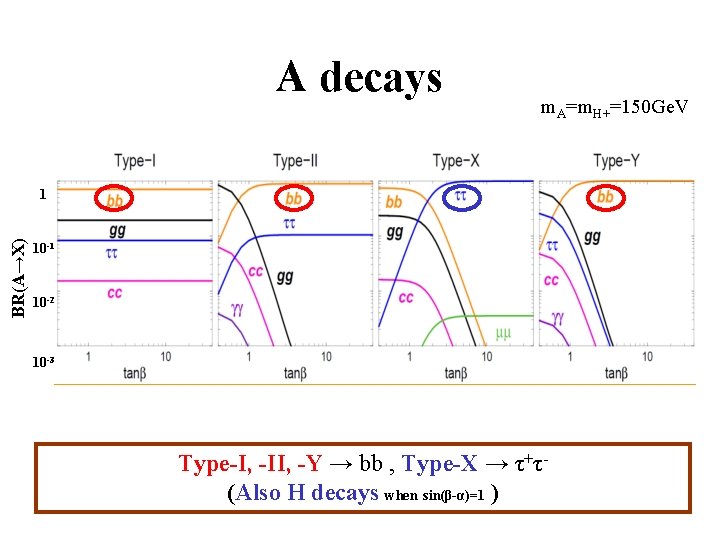
A decays m. A=m. H+=150 Ge. V BR(A→X) 1 10 -2 10 -3 Type-I, -II, -Y → bb , Type-X → τ+τ(Also H decays when sin(β-α)=1 )
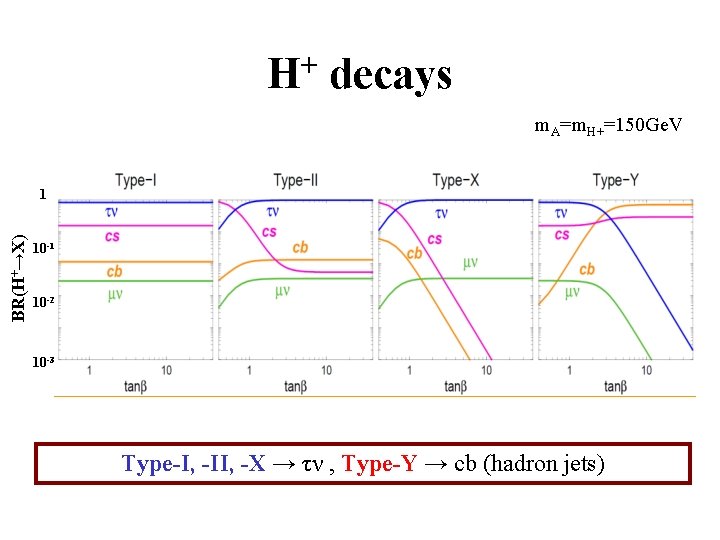
+ H decays m. A=m. H+=150 Ge. V BR(H+→X) 1 10 -2 10 -3 Type-I, -II, -X → τν , Type-Y → cb (hadron jets)
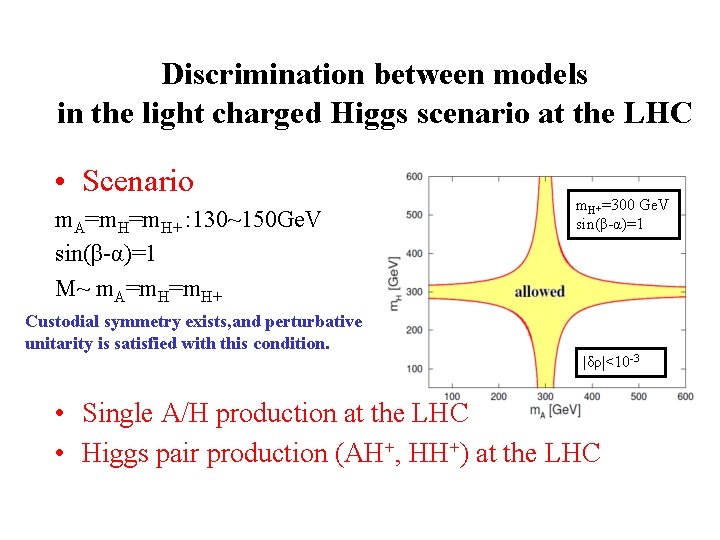
Discrimination between models in the light charged Higgs scenario at the LHC • Scenario m. A=m. H+ : 130~150 Ge. V sin(β-α)=1 M~ m. A=m. H+=300 Ge. V sin(β-α)=1 Custodial symmetry exists, and perturbative unitarity is satisfied with this condition. |δρ|<10 -3 • Single A/H production at the LHC • Higgs pair production (AH+, HH+) at the LHC
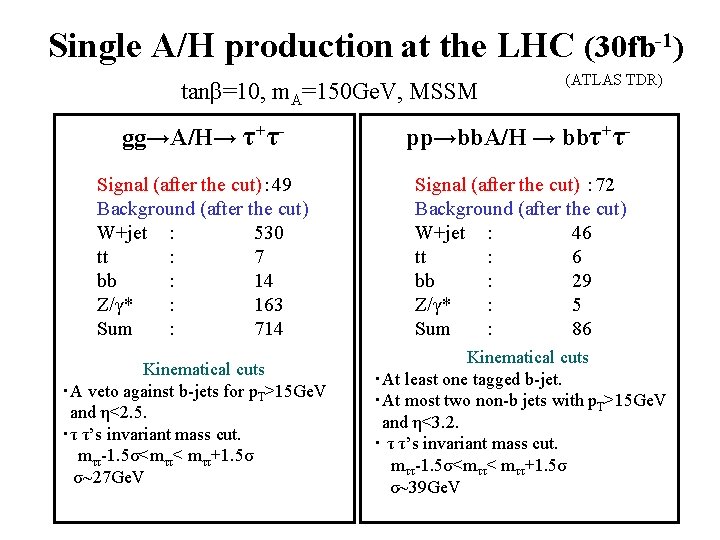
Single A/H production at the LHC (30 fb-1) tanβ=10, m. A=150 Ge. V, MSSM (ATLAS TDR) gg→A/H→ τ+τ- pp→bb. A/H → bbτ+τ- Signal (after the cut): 49 Background (after the cut) W+jet : 530 tt : 7 bb : 14 Z/γ* : 163 Sum : 714 Signal (after the cut) : 72 Background (after the cut) W+jet : 46 tt : 6 bb : 29 Z/γ* : 5 Sum : 86 Kinematical cuts ・A veto against b-jets for p. T>15 Ge. V and η<2. 5. ・τ τ’s invariant mass cut. mττ-1. 5σ<mττ< mττ+1. 5σ σ~27 Ge. V Kinematical cuts ・At least one tagged b-jet. ・At most two non-b jets with p. T>15 Ge. V and η<3. 2. ・ τ τ’s invariant mass cut. mττ-1. 5σ<mττ< mττ+1. 5σ σ~39 Ge. V
Significance (S/root(B)) Aoki, Kanemura, Tsumura, K. Y ar. Xiv: 0902. 4665 [hep-ph] gg→τ+τ- pp→bbτ+τ- Low tanβ Type-X MSSM Mid tanβ High tanβ Direct Associate
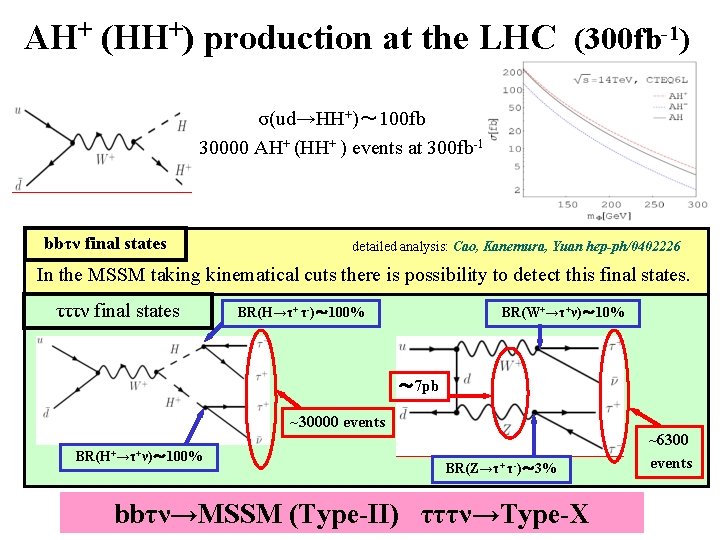
AH+ (HH+) production at the LHC (300 fb-1) σ(ud→HH+)~ 100 fb 30000 AH+ (HH+ ) events at 300 fb-1 bbτν final states detailed analysis: Cao, Kanemura, Yuan hep-ph/0402226 In the MSSM taking kinematical cuts there is possibility to detect this final states. τττν final states BR(H→τ+ τ-)~ 100% BR(W+→τ+ν)~ 10% ~ 7 pb ~30000 events BR(H+→τ+ν)~ 100% BR(Z→τ+ τ-)~ 3% bbτν→MSSM (Type-II) τττν→Type-X ~6300 events
Physics of the Type-X THDM at the ILC
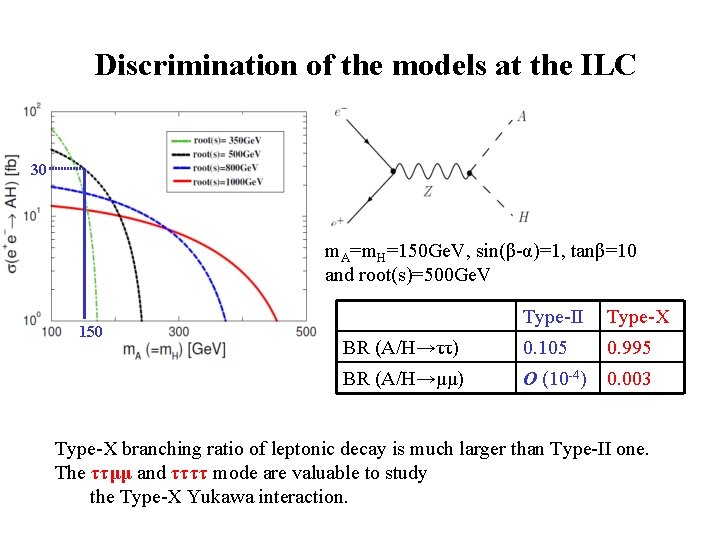
Discrimination of the models at the ILC 30 m. A=m. H=150 Ge. V, sin(β-α)=1, tanβ=10 and root(s)=500 Ge. V 150 Type-II Type-X BR (A/H→ττ) 0. 105 0. 995 BR (A/H→μμ) O (10 -4) 0. 003 Type-X branching ratio of leptonic decay is much larger than Type-II one. The ττμμ and ττττ mode are valuable to study the Type-X Yukawa interaction.
Signal background analysis for ττμμ events dσ/d. Mμμ [pb/Ge. V] m. Z dσ/d. Mμμ [pb/Ge. V] The μμ invariant mass distribution A/H Signal ! Mμμ[Ge. V] For L=500 fb-1 After invariant mass cuts S~96 B~9 Taking kinematical cuts we can obtain S/Sqrt(S+B) ~ 9
Signal background analysis for ττ ττ events dσ/d. Mμμ [pb/Ge. V] The ττ invariant mass distribution m. Z A/H Signal ! Mττ[Ge. V] For L=500 fb-1 After cuts S~7350 B~41 Taking kinematical cuts we can obtain S/Sqrt(S+B) ~ 85 !! But we assumed that tau tagging efficiency is 100% → Realistic simulation study is necessary.
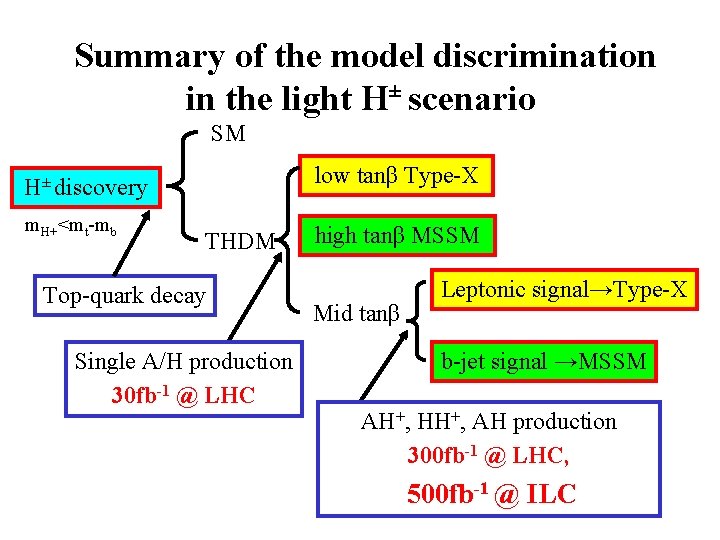
Summary of the model discrimination in the light H± scenario SM low tanβ Type-X H± discovery m. H+<mt-mb THDM Top-quark decay Single A/H production 30 fb-1 @ LHC high tanβ MSSM Mid tanβ Leptonic signal→Type-X b-jet signal →MSSM AH+, HH+, AH production 300 fb-1 @ LHC, 500 fb-1 @ ILC
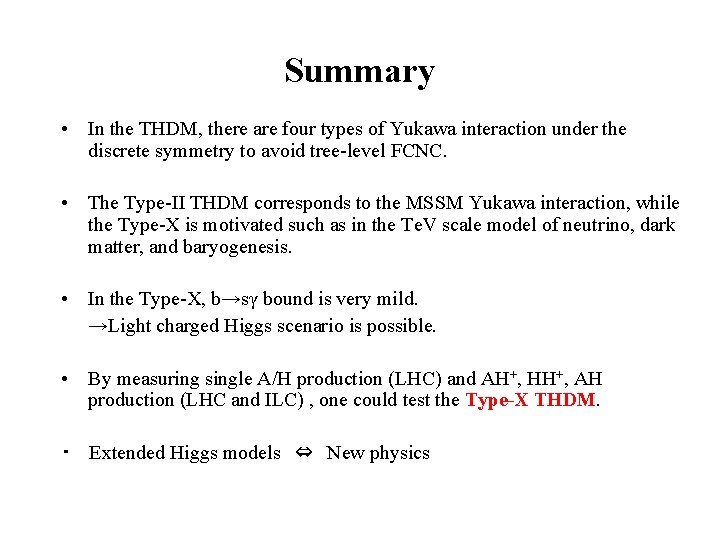
Summary • In the THDM, there are four types of Yukawa interaction under the discrete symmetry to avoid tree-level FCNC. • The Type-II THDM corresponds to the MSSM Yukawa interaction, while the Type-X is motivated such as in the Te. V scale model of neutrino, dark matter, and baryogenesis. • In the Type-X, b→sγ bound is very mild. →Light charged Higgs scenario is possible. • By measuring single A/H production (LHC) and AH+, HH+, AH production (LHC and ILC) , one could test the Type-X THDM. ・ Extended Higgs models ⇔ New physics
b→sγ W- H- γ b Type-II, Y t γ s b t s Barger, Hewett, Phillips PRD 41 (1990) Type-I, X In the Type-X THDM, destructive interferences occur between the W and the H± contributions.
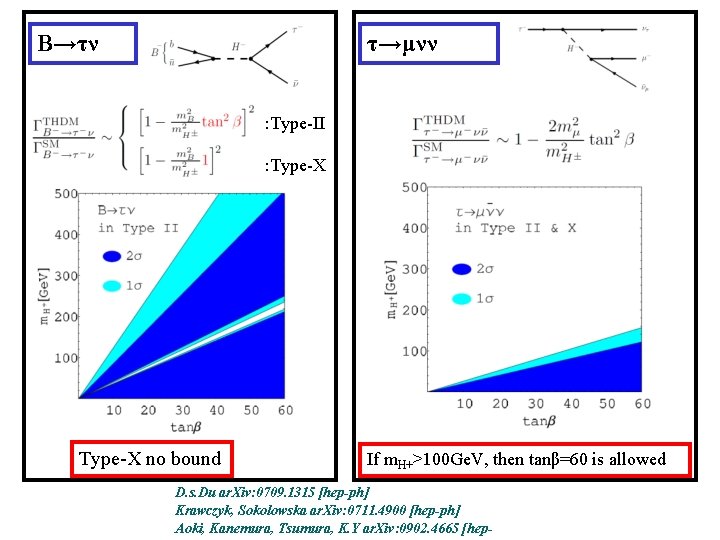
τ→μνν B→τν : Type-II : Type-X no bound If m. H+>100 Ge. V, then tanβ=60 is allowed D. s. Du ar. Xiv: 0709. 1315 [hep-ph] Krawczyk, Sokolowska ar. Xiv: 0711. 4900 [hep-ph] Aoki, Kanemura, Tsumura, K. Y ar. Xiv: 0902. 4665 [hep-