
Models of Voting Behaviour Social Structures Party Identification
Models of Voting Behaviour Social Structures Party Identification Rational Choice Voting Context Dominant Ideology
This model suggests that parties must compete for votes on the basis of policies, past records and credibility of their leaders. Voters are treated as consumers who are shopping around for the best deal offered by the various parties and then voting accordingly.
The Dominant Ideology Model Powerful institutions (known as “the Establishment”) significantly influence voter behaviour. These are: the mass media, business interests & the government itself. The party which most serves the Establishment receives support which subliminally affects voters.
An explanation for voting behaviour that suggests most people vote according to their class background and interest. For this model to work, parties have to be seen by many voters as representing specific classes.
Voters weigh up the likely impact of their vote, depending on the electoral circumstances – this explains tactical voting and different voting behaviour in local, european, by-elections and general elections. Options for voters include not voting and also protest voting – most commonly witnessed in european and by-elections.
Refers to the attachment by voters to a particular party. It is considered to be a psychological attachment rather than one caused by rational choice (which is based on voters’ assessment of their best interests)
The Voting Context Model This suggests that voters hold a view about the PURPOSE of an election. This could include: • Removing the govt (1997 tactical voting) • Warning the govt to change (’ 01 - spending) • Raising the profile of issues (eg immigration) • Condemning the political system (protest votes)
General Election Turnout This has fallen from 84% in 1950 to a low of 59% in 2001. By 2010 the figure had recovered slightly to 65%. This happened without a change in electoral system or public interest in politics – 71% of those surveyed expressed at least “some interest” in politics in 2005, the same figure as 1974.
Falling Turnout Trend What might be the reasons? Why does it matter?
DI Model Example (I) The poll tax introduced by the Tory Govt of 1980 s lead to significant underregistration of, primarily, Labour voters into the 1990 s (estimated to be worth 8 seats to the Tories in the 1992 election). Suggestion is that one of reasons for Establishment’s support for the poll tax was to reduce Labour vote.
Example (II) 1992 election: 70% of press favoured Tories (27% labour) 1997 election: 58% favoured Labour – The Sun notably switched to Labour between 1992 & 97 Tories narrowly won ‘ 92 election; lost ‘ 97 election.
Example (III) In opposition Tories regularly suggested pro-Labour bias in BBC political/news coverage. Argument was that most journalists are naturally more commonly aligned to leftwing causes. http: //www. dailymail. co. uk/news/article-2190412/Iain-Duncan. Smith-BBC-Economics-Editor-Stephanie-Flanders-accusedshowing-pro-Labour-bias. html
Judging a Party’s Competence Prospective model – votes go to the party most likely to improve their personal standard of living in the future. Retrospective model – votes go to the party that has shown the most competence in dealing with the issues in the past.
Activity Suggest a set of policies which would be a rational choice for: Pensioners Parents High Income Earners Under 25 s
Activity In same pairs, suggest in how rational choice ought to drive voting behaviour: Benefits Spending? Environment? Immigration? Housing Policy? Crime and punishment (law & order)?
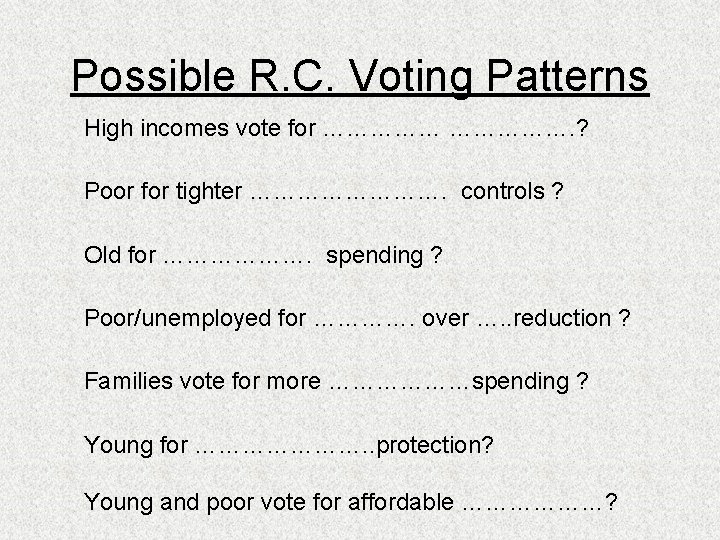
Possible R. C. Voting Patterns High incomes vote for ……………. ? Poor for tighter …………. controls ? Old for ………………. spending ? Poor/unemployed for …………. over …. . reduction ? Families vote for more ………………spending ? Young for …………………. . protection? Young and poor vote for affordable ………………?
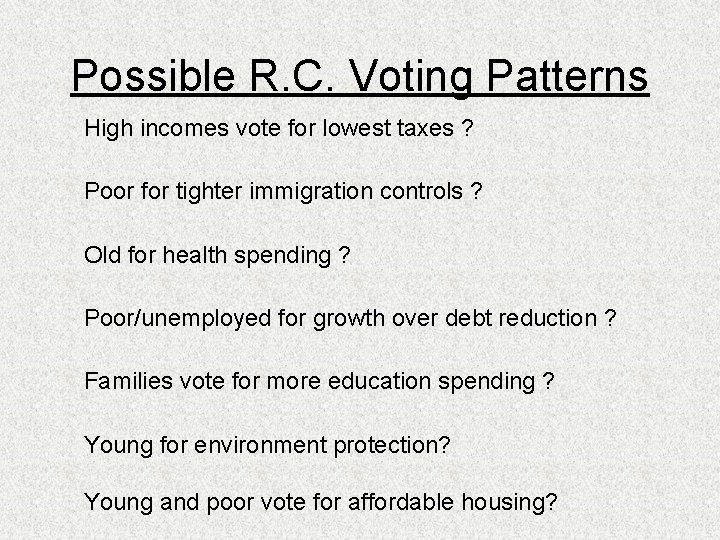
Possible R. C. Voting Patterns High incomes vote for lowest taxes ? Poor for tighter immigration controls ? Old for health spending ? Poor/unemployed for growth over debt reduction ? Families vote for more education spending ? Young for environment protection? Young and poor vote for affordable housing?
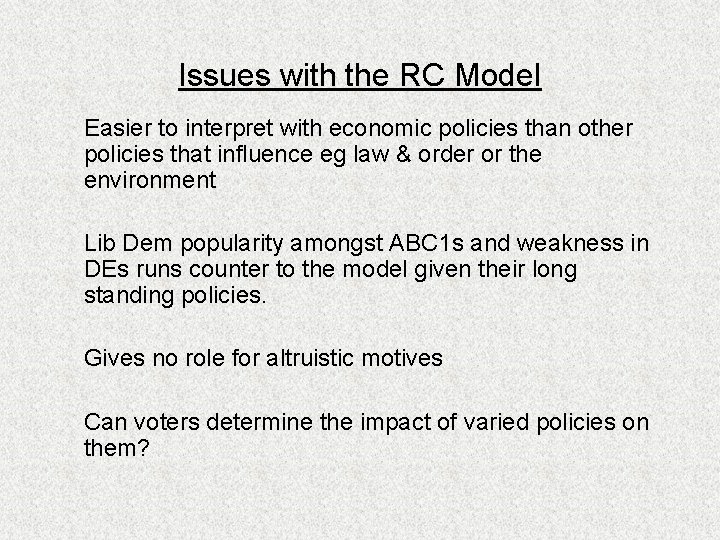
Issues with the RC Model Easier to interpret with economic policies than other policies that influence eg law & order or the environment Lib Dem popularity amongst ABC 1 s and weakness in DEs runs counter to the model given their long standing policies. Gives no role for altruistic motives Can voters determine the impact of varied policies on them?
- Slides: 18