
Models of networks synthetic networks or generative models

- Slides: 20
Models of networks (synthetic networks or generative models) Prof. Ralucca Gera, Applied Mathematics Dept. Naval Postgraduate School Monterey, California rgera@nps. edu Excellence Through Knowledge
Learning Outcomes • Identify network models and explain their structures; • Contrast networks and synthetic models; • Understand how to design new network models (based on the existing ones and on the collected data) • Distinguish methodologies used in analyzing networks.
The three papers for each of the models Synthetic models are used as reference/null models to compare against and build new complex networks • “On Random Graphs I” by Paul Erdős and Alfed Renyi in Publicationes Mathematicae (1958) Times cited: ∼ 3, 517 (as of January 1, 2015) • “Collective dynamics of ‘small-world’ networks” by Duncan Watts and Steve Strogatz in Nature, (1998) Times cited: ∼ 24, 535 (as of January 1, 2015) • “Emergence of scaling in random networks” by László Barabási and Réka Albert in Science, (1999) Times cited: ∼ 21, 418 (as of January 1, 2015) 3
Why care? • Epidemiology: – A virus propagates much faster in scale-free networks. – Vaccination of random nodes in scale free does not work, but targeted vaccination is very effective • Create synthetic networks to be used as null models: – What effect does the degree distribution alone have on the behavior of the system? (answered by comparing to the configuration model) • Create networks of different sizes – Networks of particular sizes and structures can be quickly and cheaply generated, instead of collecting and cleaning the data that takes time
Barabási-Albert Scale free model (1999) 5
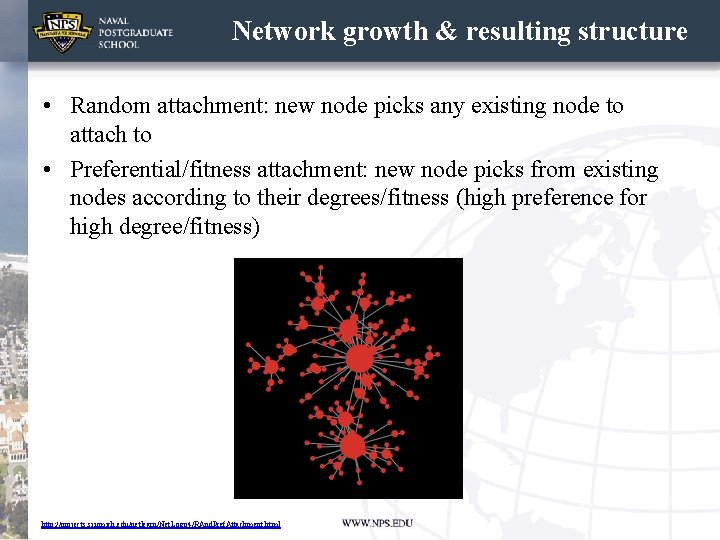
Network growth & resulting structure • Random attachment: new node picks any existing node to attach to • Preferential/fitness attachment: new node picks from existing nodes according to their degrees/fitness (high preference for high degree/fitness) http: //projects. si. umich. edu/netlearn/Net. Logo 4/RAnd. Pref. Attachment. html
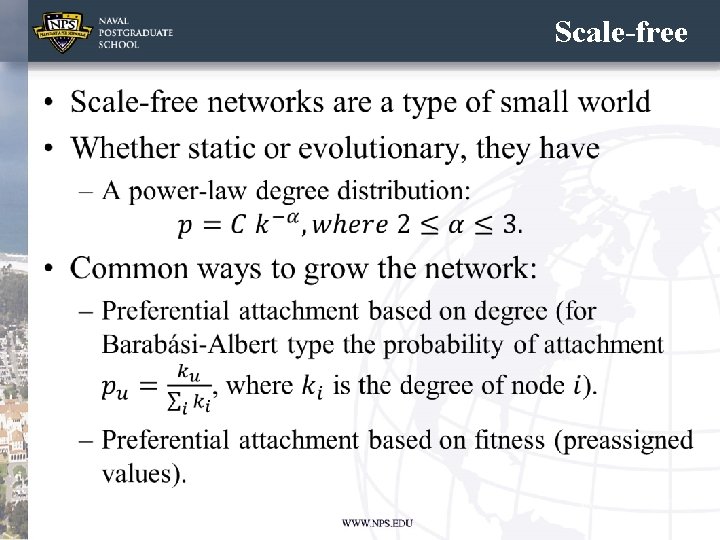
Scale-free •
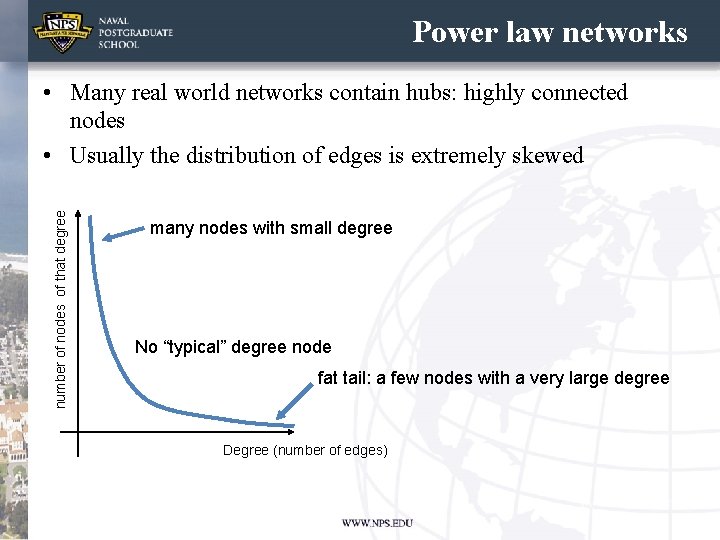
Power law networks number of nodes of that degree • Many real world networks contain hubs: highly connected nodes • Usually the distribution of edges is extremely skewed many nodes with small degree No “typical” degree node fat tail: a few nodes with a very large degree Degree (number of edges)
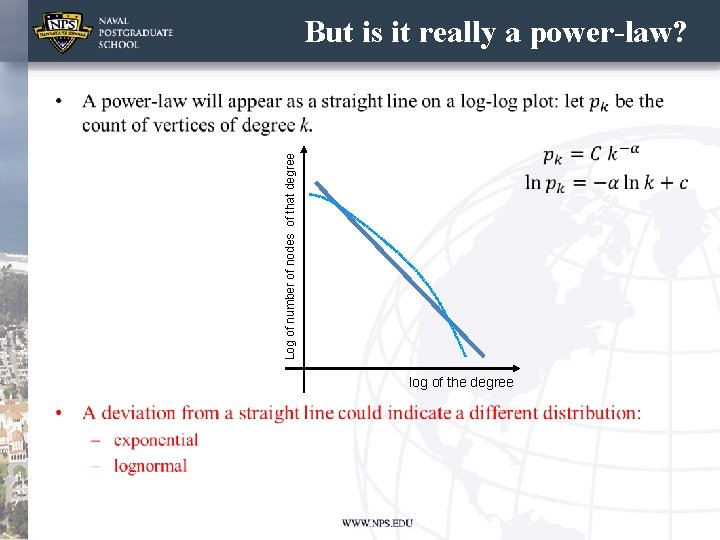
But is it really a power-law? Log of number of nodes of that degree • log of the degree
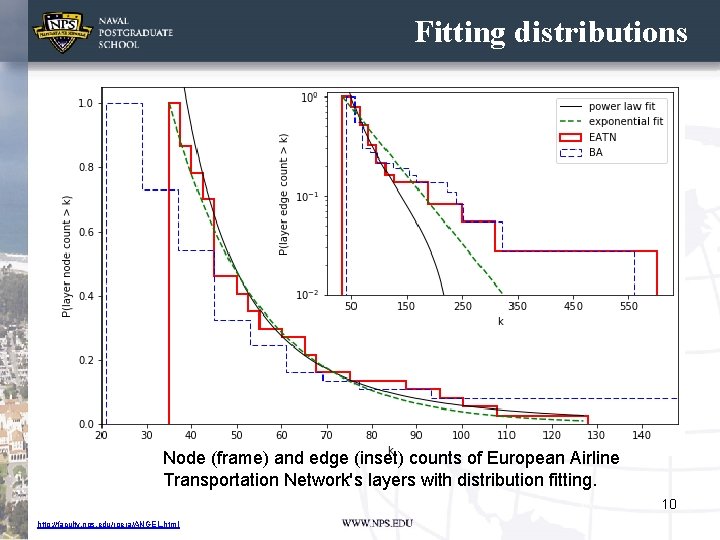
Fitting distributions Node (frame) and edge (inset) counts of European Airline Transportation Network's layers with distribution fitting. 10 http: //faculty. nps. edu/rgera/ANGEL. html
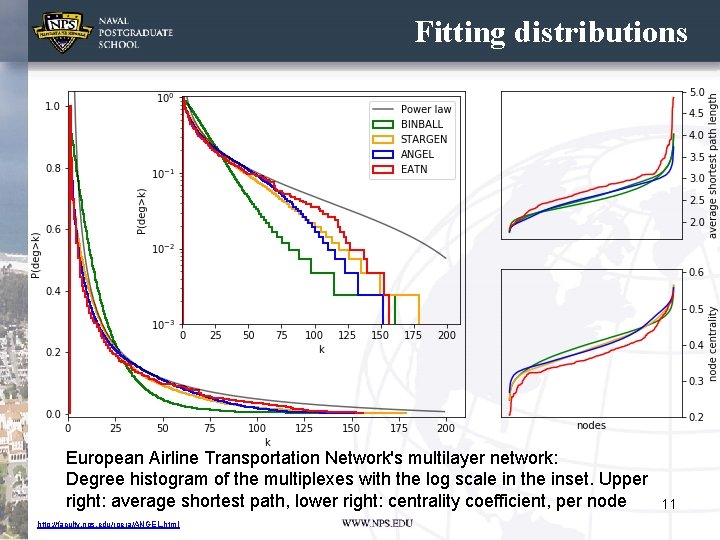
Fitting distributions European Airline Transportation Network's multilayer network: Degree histogram of the multiplexes with the log scale in the inset. Upper right: average shortest path, lower right: centrality coefficient, per node http: //faculty. nps. edu/rgera/ANGEL. html 11
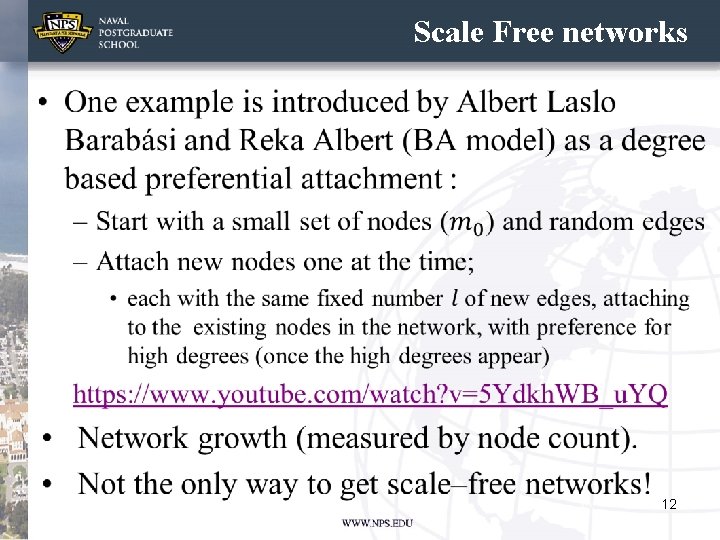
Scale Free networks • 12
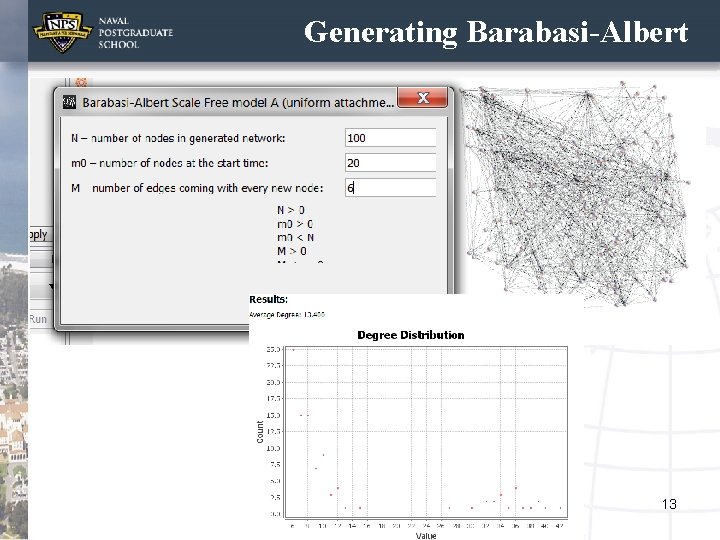
Generating Barabasi-Albert 13
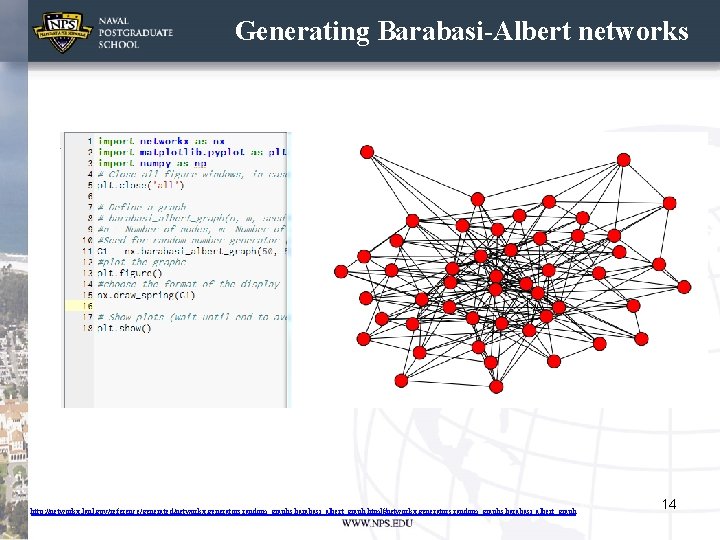
Generating Barabasi-Albert networks http: //networkx. lanl. gov/reference/generated/networkx. generators. random_graphs. barabasi_albert_graph. html#networkx. generators. random_graphs. barabasi_albert_graph 14
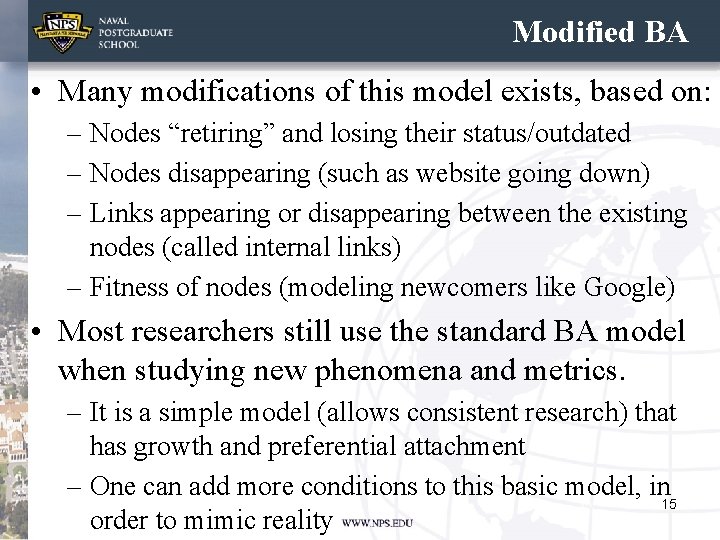
Modified BA • Many modifications of this model exists, based on: – Nodes “retiring” and losing their status/outdated – Nodes disappearing (such as website going down) – Links appearing or disappearing between the existing nodes (called internal links) – Fitness of nodes (modeling newcomers like Google) • Most researchers still use the standard BA model when studying new phenomena and metrics. – It is a simple model (allows consistent research) that has growth and preferential attachment – One can add more conditions to this basic model, in 15 order to mimic reality
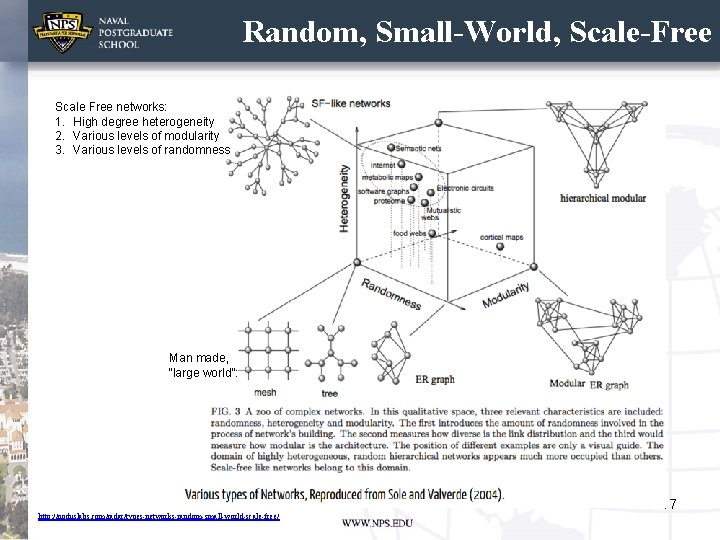
A zoo of complex networks 16
Random, Small-World, Scale-Free Scale Free networks: 1. High degree heterogeneity 2. Various levels of modularity 3. Various levels of randomness Man made, “large world”: 17 http: //noduslabs. com/radar/types-networks-random-small-world-scale-free/
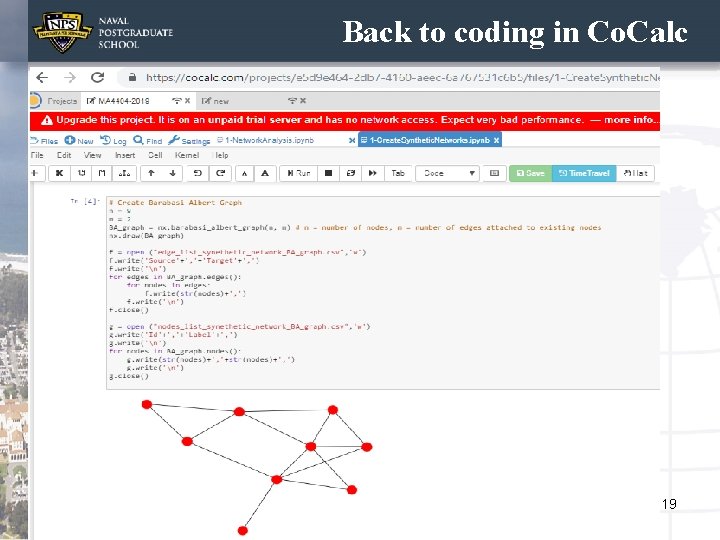
Let’s practice in Co. Calc 18
Back to coding in Co. Calc 19
Main References • Newman “The structure and function of complex networks” (2003) • Estrada “The structure of complex Networks” (2012) • Barabasi “Network Science” (online: http: //barabasi. com/networksciencebook/) • References to the classes that exist in python: http: //networkx. lanl. gov/reference/generators. html 20