
MODELS OF MEMORY DEFINITION OF MEMORY The retention
- Slides: 31
MODELS OF MEMORY DEFINITION OF MEMORY: “The retention of learning or experience”
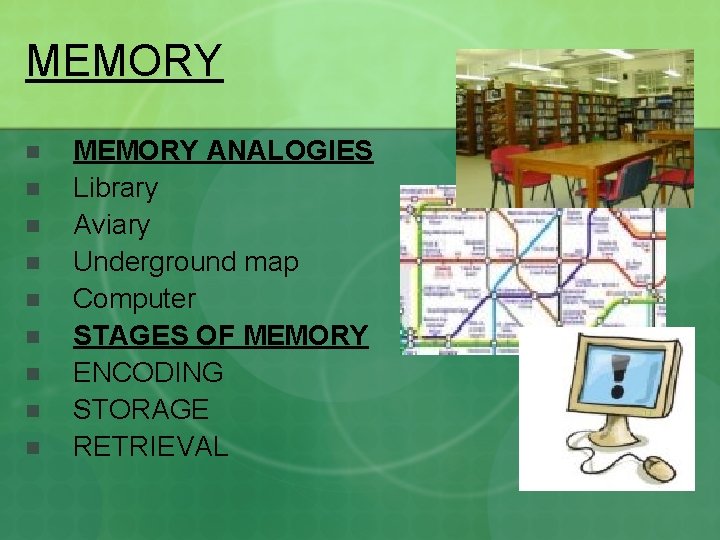
MEMORY n n n n n MEMORY ANALOGIES Library Aviary Underground map Computer STAGES OF MEMORY ENCODING STORAGE RETRIEVAL
MEMORY n n n n THE SHORT TERM MEMORY DEFINITION: “Memory for events in the present or immediate past” CAPACITY OF THE STM The Digit Span Test (Jacobs 1887) Magic number 7 (Miller 1956) Note: Vogel and Cowan (2001) have concluded its more likely to be 4 items Chunking ( a useful application of psychological theory) rehearsal
THE SHORT TERM MEMORY ENCODING IN THE STM n Predominantly acoustic (sound) n Evidence = errors made with similar sounding letters when presented visually for 0. 75 seconds (Conrad 1964) n Note: research has shown we use other forms of coding also e. g. visual n DURATION OF THE STM n Approx. 15 – 30 seconds without rehearsal n
THE SHORT TERM MEMORY n A STUDY INTO THE DURATION OF THE STM (Peterson & Peterson 1959) n See worksheet
THE LONG TERM MEMORY DEFINITION: “Memory for events that have happened in the past” n CAPACITY OF THE LTM n Unknown n Unlimited n
THE LONG TERM MEMORY n n n ENCODING IN THE LTM Predominantly semantic Evidence: (Baddeley 1966) semantically similar words presented to the LTM are most susceptible to being muddled up But also acoustic, visual, olfactory, gustatory DURATION OF THE LTM Potentially a lifetime but there are many individual differences
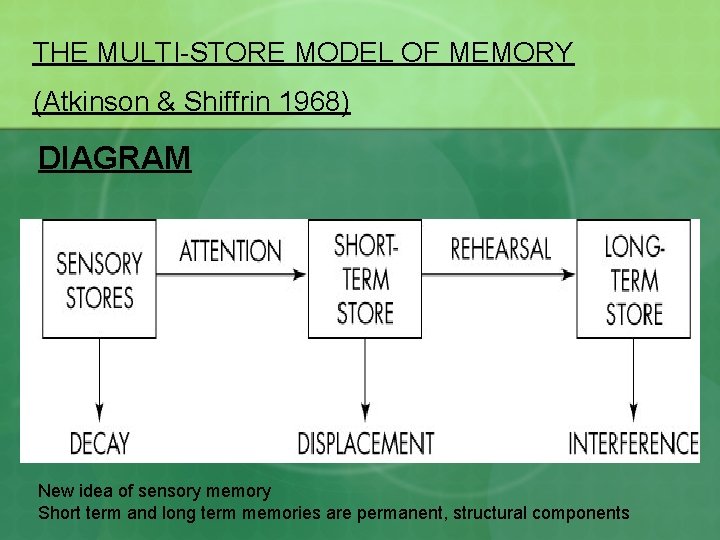
THE MULTI-STORE MODEL OF MEMORY (Atkinson & Shiffrin 1968) DIAGRAM New idea of sensory memory Short term and long term memories are permanent, structural components
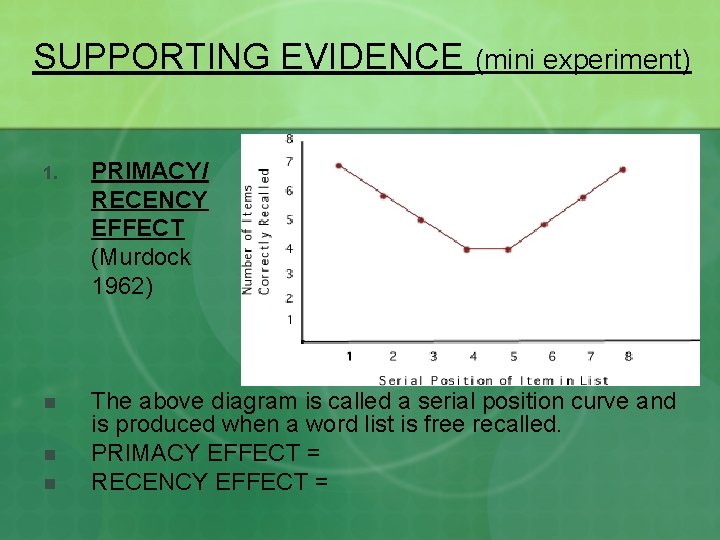
SUPPORTING EVIDENCE (mini experiment) 1. PRIMACY/ RECENCY EFFECT (Murdock 1962) n The above diagram is called a serial position curve and is produced when a word list is free recalled. PRIMACY EFFECT = RECENCY EFFECT = n n
2. DIFFERENT TYPES OF CODING IN STM & LTM Baddeley (1966) studied STM n P’s presented with acoustically similar words n P’s then presented with semantically similar words n Results = immediate recall of acoustically similar words was poor because the grammatical and phonemic parts of language are quickly forgotten n
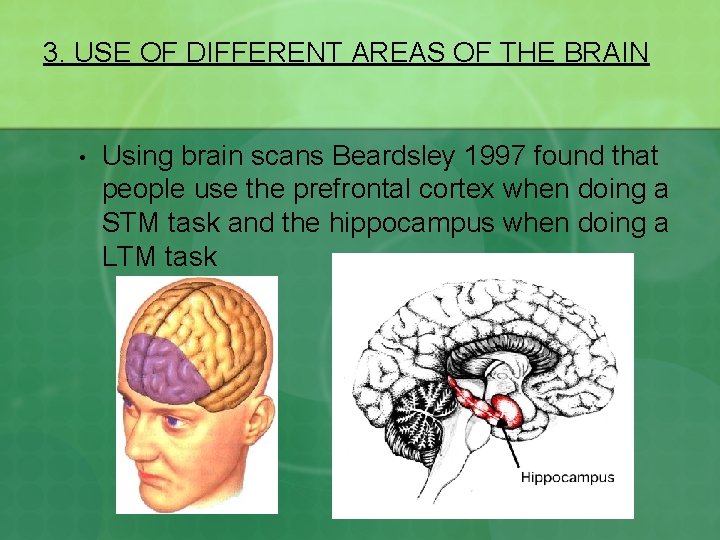
3. USE OF DIFFERENT AREAS OF THE BRAIN • Using brain scans Beardsley 1997 found that people use the prefrontal cortex when doing a STM task and the hippocampus when doing a LTM task
4. STUDIES OF PEOPLE WITH MEMORY LOSS See video and worksheet
EVALUATING THE MULTI-STORE MEMORY POSITIVES § Has evidence to support it § Looks at structure AND process § Enables us to make predictions
EVALUATING THE MULTI-STORE MEMORY NEGATIVES n Oversimplified n Unitary stores n Proposal of one short term store is wrong (see next model) n Proposal of one long term store is wrong
EVALUATING THE MULTI-STORE MEMORY n n n n Cohen & Squire (1980) distinguished between: declarative memories (memories for ‘knowing that’) and procedural memories (memories for ‘knowing how’) – people with different conditions can lose one or the other, e. g. HM his STM was damaged but he could still learn skills (learned to play tennis) Clive Wearing – musical ability still intact Sub-divisions of declarative = semantic episodic (Tulving 1972) Evidence for this in brain scans using radioactive gold to measure blood flow Model finds it difficult to explain flashbulb memories (these can be autobiographical or historical) Examples are:
EVALUATING THE MULTI-STORE MEMORY n n n n Rehearsal – now accepted that is not to only way into LTM Levels of processing model (LOP) – depth of processing is more important 3 levels i) visual ii) phonetic iii) semantic Integrated STM and LTM not separate STM relies on LTM’s to chunk for instance e. g. AQABBCITVIBM Supporting evidence comes from artificial, unecologically valid laboratory experiments
The Working Memory n See work sheet
Evaluating the Working Memory Model POSITIVES § Can explain partial memory difficulties § e. g. case sudy of someone with normal LTM but phonological loop difficulties § Has plenty of research evidence, e. g. dual task experiments § Emphasizes the active nature of short term memories
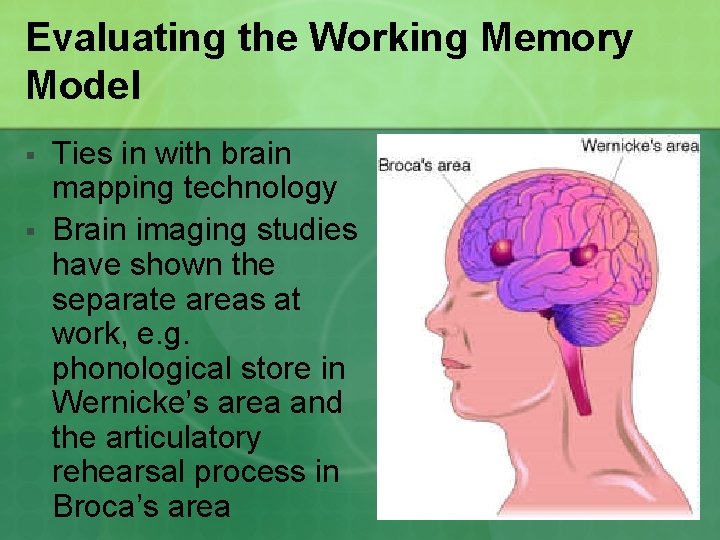
Evaluating the Working Memory Model § § Ties in with brain mapping technology Brain imaging studies have shown the separate areas at work, e. g. phonological store in Wernicke’s area and the articulatory rehearsal process in Broca’s area
Evaluating the Working Memory Model NEGATIVES § Little is known about the CE (vague concept) – its probably also subdivided § Using case studies of brain damaged people is problematic § Lab studies also have their drawbacks ? ? ? ? ACTIVITY “Alice is ……
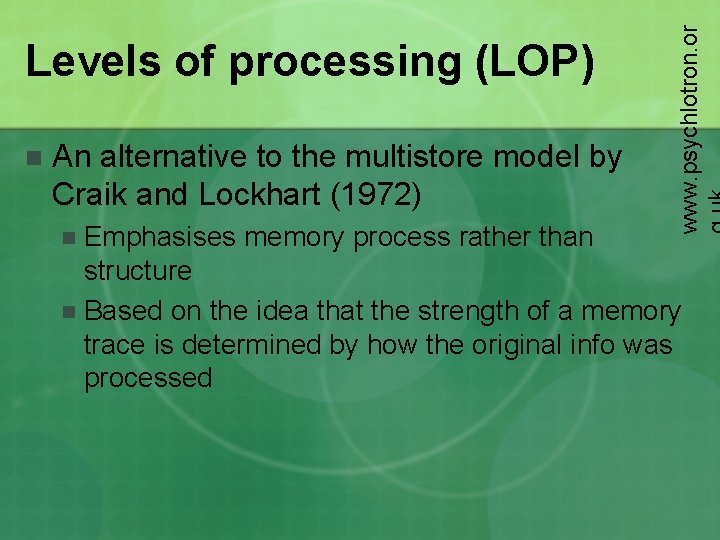
n An alternative to the multistore model by Craik and Lockhart (1972) www. psychlotron. or Levels of processing (LOP) Emphasises memory process rather than structure n Based on the idea that the strength of a memory trace is determined by how the original info was processed n
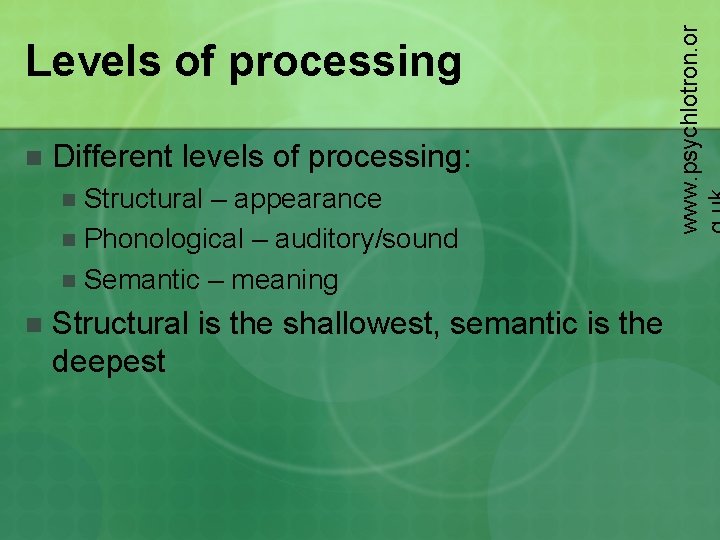
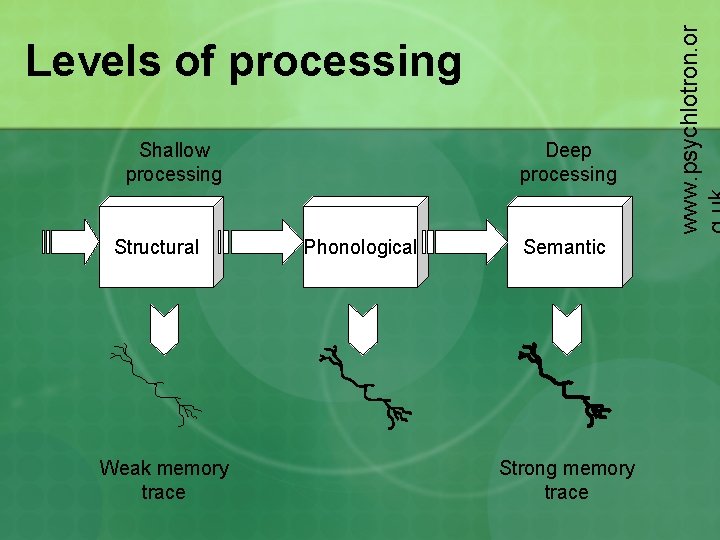
n Different levels of processing: Structural – appearance n Phonological – auditory/sound n Semantic – meaning n n Structural is the shallowest, semantic is the deepest www. psychlotron. or Levels of processing
Shallow processing Structural Weak memory trace Deep processing Phonological Semantic Strong memory trace www. psychlotron. or Levels of processing
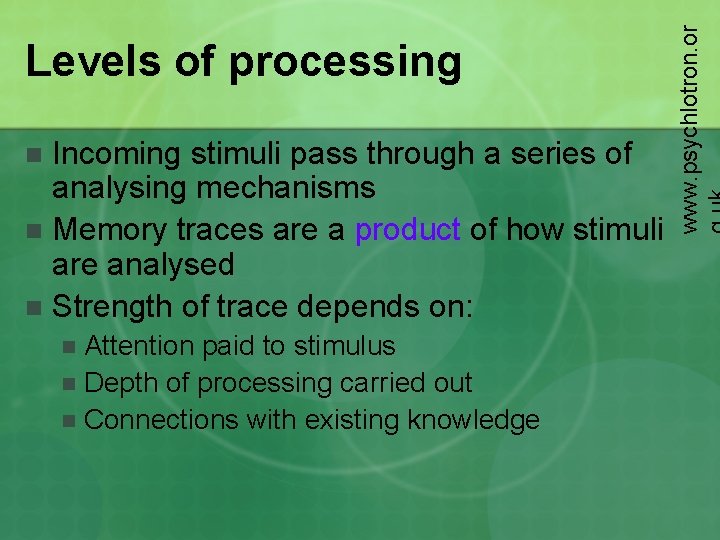
Incoming stimuli pass through a series of analysing mechanisms n Memory traces are a product of how stimuli are analysed n Strength of trace depends on: n Attention paid to stimulus n Depth of processing carried out n Connections with existing knowledge n www. psychlotron. or Levels of processing
The basic prediction of the LOP approach is that the amount of info P’s will recall/recognise will depend on how deeply the experimental stimuli were processed n Complete experiment into LOP n www. psychlotron. or Levels of processing
n Elias & Perfetti (1973) n www. psychlotron. or Supporting evidence P’s had greater recognition of words they had thought of similes for (semantic) than word they had thought of rhymes for (phono)
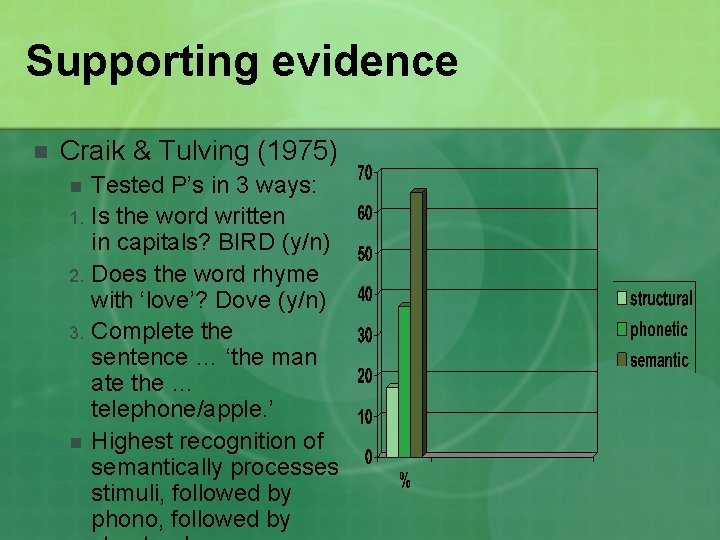
Supporting evidence n Craik & Tulving (1975) Tested P’s in 3 ways: 1. Is the word written in capitals? BIRD (y/n) 2. Does the word rhyme with ‘love’? Dove (y/n) 3. Complete the sentence … ‘the man ate the … telephone/apple. ’ n Highest recognition of semantically processes stimuli, followed by phono, followed by n
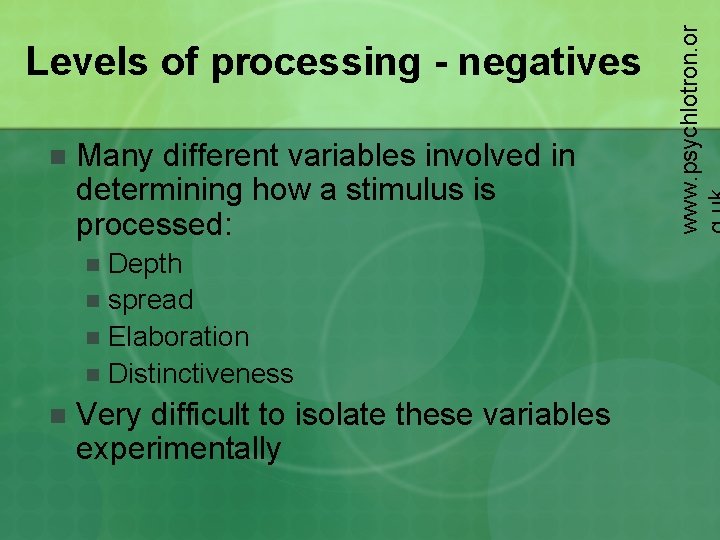
www. psychlotron. or Levels of processing - positives n n Influential model that focused researchers on processes that they had tended to neglect The idea that the nature of a memory trace depends on encoding processes is well supported by empirical evidence Theory can be applied to everyday life, e. g. exam revision You will recall more if you use… n Depth – make sure you understand & make connections between the topics & ideas n Spread – use several different techniques on the material n Elaboration – mental effort is required to store material effectively n Distinctiveness – make the material your own
n Many different variables involved in determining how a stimulus is processed: Depth n spread n Elaboration n Distinctiveness n n Very difficult to isolate these variables experimentally www. psychlotron. or Levels of processing - negatives
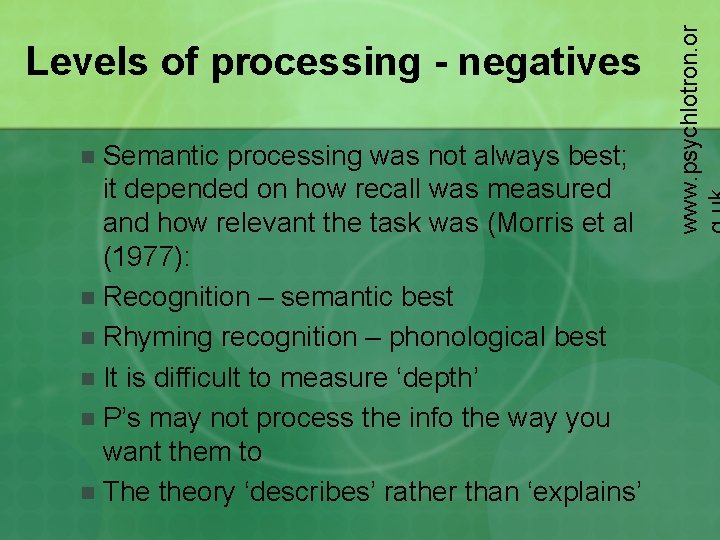
Semantic processing was not always best; it depended on how recall was measured and how relevant the task was (Morris et al (1977): n Recognition – semantic best n Rhyming recognition – phonological best n It is difficult to measure ‘depth’ n P’s may not process the info the way you want them to n The theory ‘describes’ rather than ‘explains’ n www. psychlotron. or Levels of processing - negatives
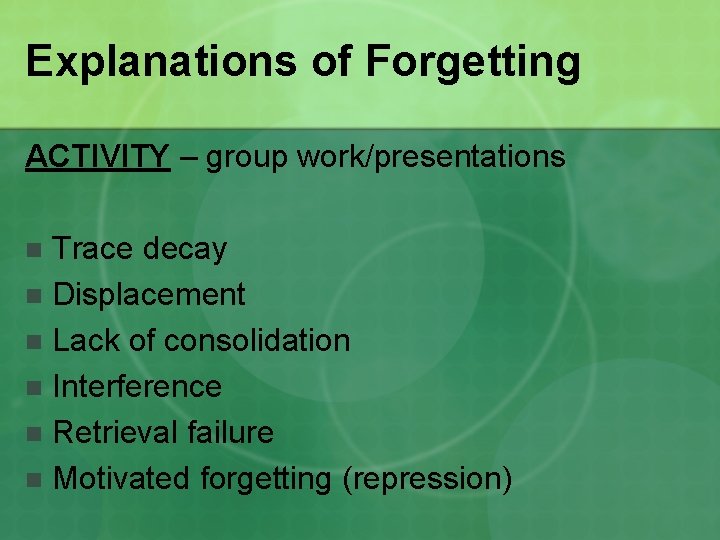
Explanations of Forgetting ACTIVITY – group work/presentations Trace decay n Displacement n Lack of consolidation n Interference n Retrieval failure n Motivated forgetting (repression) n