
Models of Learning and Motivation Hugh Davis Learning
- Slides: 25
Models of Learning and Motivation Hugh Davis Learning Societies Lab ECS The University of Southampton, UK www. ecs. soton. ac. uk/~hcd Event
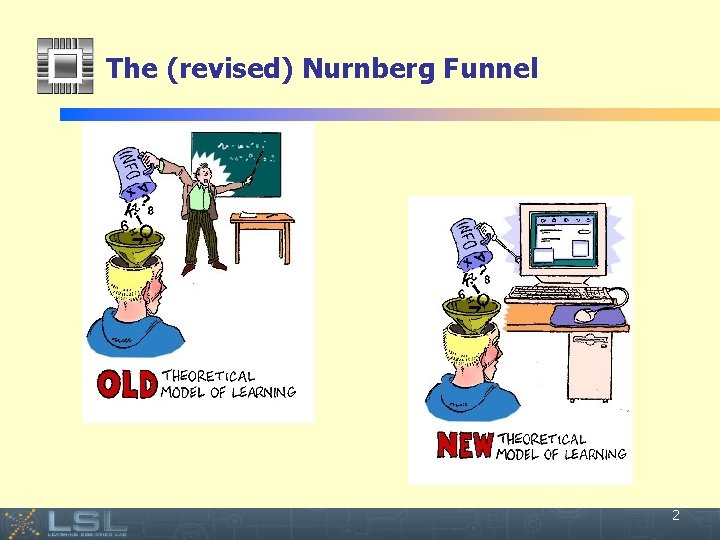
The (revised) Nurnberg Funnel Event 2
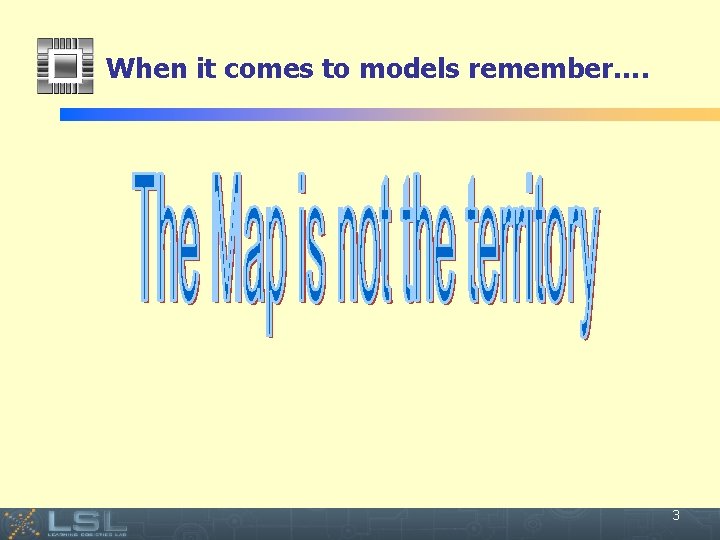
When it comes to models remember…. Event 3
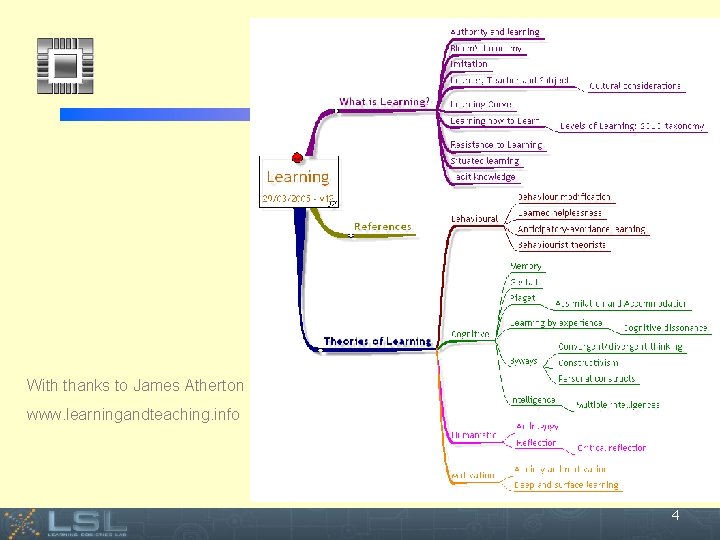
With thanks to James Atherton www. learningandteaching. info Event 4
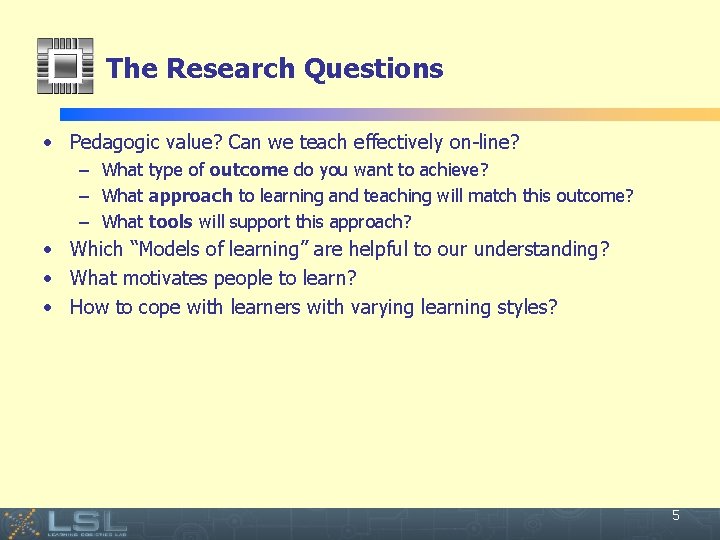
The Research Questions • Pedagogic value? Can we teach effectively on-line? – What type of outcome do you want to achieve? – What approach to learning and teaching will match this outcome? – What tools will support this approach? • Which “Models of learning” are helpful to our understanding? • What motivates people to learn? • How to cope with learners with varying learning styles? Event 5
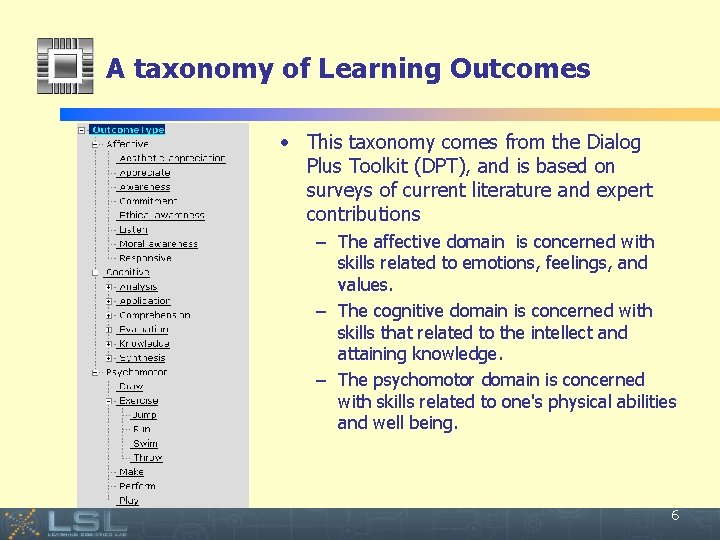
A taxonomy of Learning Outcomes • This taxonomy comes from the Dialog Plus Toolkit (DPT), and is based on surveys of current literature and expert contributions – The affective domain is concerned with skills related to emotions, feelings, and values. – The cognitive domain is concerned with skills that related to the intellect and attaining knowledge. – The psychomotor domain is concerned with skills related to one's physical abilities and well being. Event 6
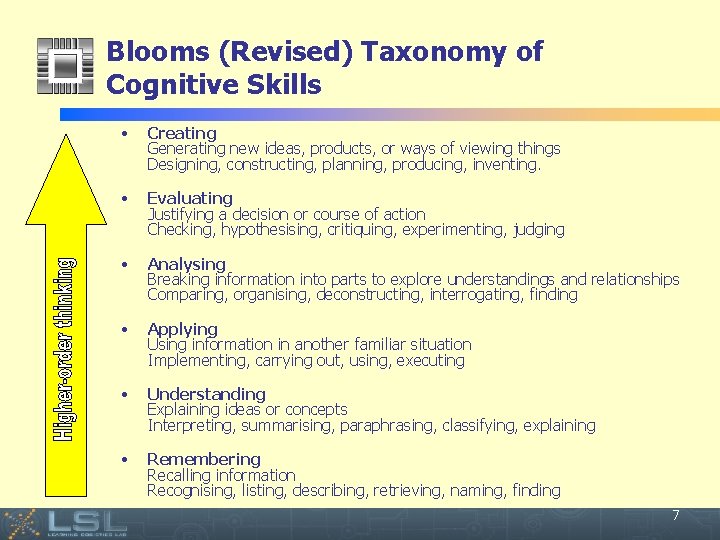
Blooms (Revised) Taxonomy of Cognitive Skills • Creating Generating new ideas, products, or ways of viewing things Designing, constructing, planning, producing, inventing. • Evaluating Justifying a decision or course of action Checking, hypothesising, critiquing, experimenting, judging • Analysing Breaking information into parts to explore understandings and relationships Comparing, organising, deconstructing, interrogating, finding • Applying Using information in another familiar situation Implementing, carrying out, using, executing • Understanding Explaining ideas or concepts Interpreting, summarising, paraphrasing, classifying, explaining • Remembering Recalling information Recognising, listing, describing, retrieving, naming, finding Event 7
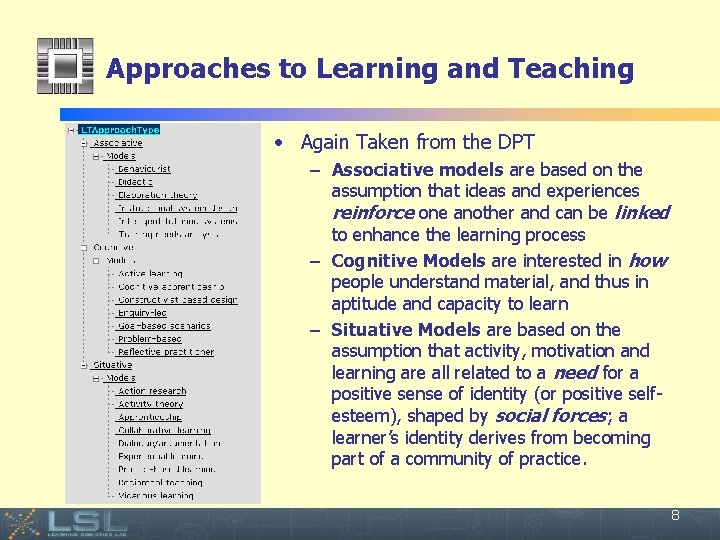
Approaches to Learning and Teaching • Again Taken from the DPT – Associative models are based on the assumption that ideas and experiences reinforce one another and can be linked to enhance the learning process – Cognitive Models are interested in how people understand material, and thus in aptitude and capacity to learn – Situative Models are based on the assumption that activity, motivation and learning are all related to a need for a positive sense of identity (or positive selfesteem), shaped by social forces; a learner’s identity derives from becoming part of a community of practice. Event 8
(Some) Important Approaches to Learning • • • Behaviourism Instructional Systems Design (Lester is covering this) Constructivism Problem Based Learning Apprenticeship Vicarious Learning Event 9
Behaviourism: Classical conditioning (or Behaviorism – most texts are US) : • is the process of reflex learning—investigated by Pavlov—through which an unconditioned stimulus (e. g. food) which produces an unconditioned response (salivation) is presented together with a conditioned stimulus (a bell), such that the salivation is eventually produced on the presentation of the conditioned stimulus alone, thus becoming a conditioned response. • This is a disciplined account of our common-sense experience of learning by association Event 10
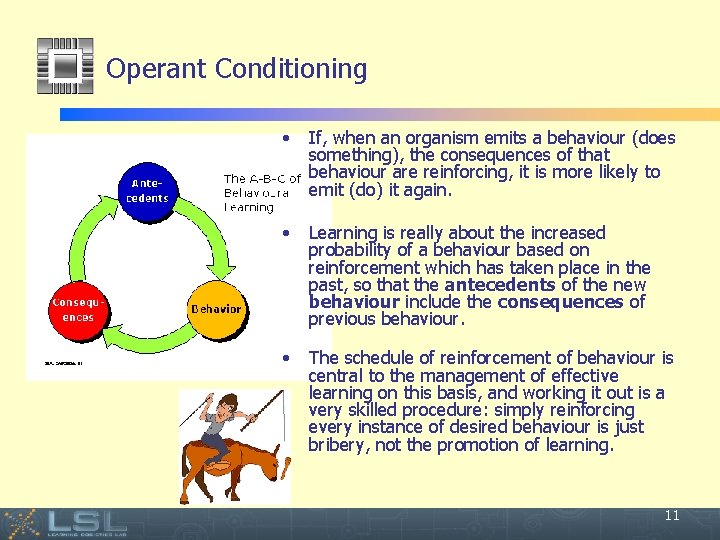
Operant Conditioning • If, when an organism emits a behaviour (does something), the consequences of that behaviour are reinforcing, it is more likely to emit (do) it again. • Learning is really about the increased probability of a behaviour based on reinforcement which has taken place in the past, so that the antecedents of the new behaviour include the consequences of previous behaviour. • The schedule of reinforcement of behaviour is central to the management of effective learning on this basis, and working it out is a very skilled procedure: simply reinforcing every instance of desired behaviour is just bribery, not the promotion of learning. Event 11
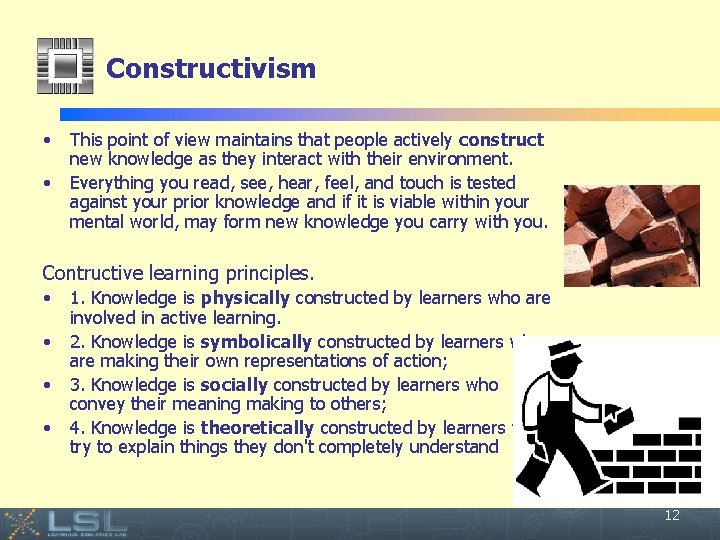
Constructivism • • This point of view maintains that people actively construct new knowledge as they interact with their environment. Everything you read, see, hear, feel, and touch is tested against your prior knowledge and if it is viable within your mental world, may form new knowledge you carry with you. Contructive learning principles. • • 1. Knowledge is physically constructed by learners who are involved in active learning. 2. Knowledge is symbolically constructed by learners who are making their own representations of action; 3. Knowledge is socially constructed by learners who convey their meaning making to others; 4. Knowledge is theoretically constructed by learners who try to explain things they don't completely understand Event 12
Problem Based Learning (PBL) • There all sorts of variations on this…. . • General Characteristics – learning is driven by messy, open-ended problems – students work in small collaborative groups – 'teachers' are not required, the process uses 'facilitators' of learning. Accordingly, students are encouraged to take responsibility for their group and organise and direct the learning process with support from a tutor or instructor • can be used in a "weak" or a "strong" form: – if you go for the strong form, it requires a whole different approach to curriculum and course design, crossing disciplinary boundaries, and tolerating a degree of uncertainty about outcomes. – The weak form, on the other hand, can be incorporated within existing structures with rather less disruption. Event 13
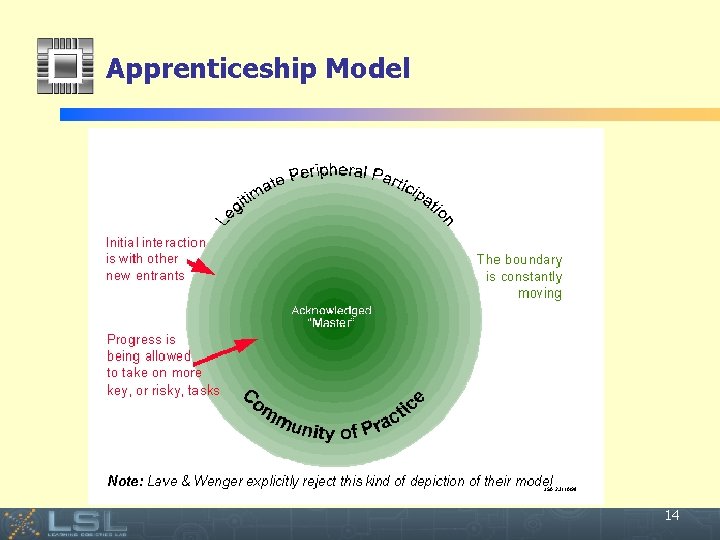
Apprenticeship Model Event 14
Vicarious Learning • Learning that occurs as a function of observing, retaining and replicating behavior observed in others. • The Modeling Effect occurs when a person almost directly duplicates a behavior they have seen someone else perform and which the observer has not previously suppressed. • The Eliciting Effect occurs when the observer performs a behavior to the model's, but still somewhat different. • The Disinhibitory Effect occurs when a person who has previously refrained from a behavior goes ahead and performs that behavior after seeing a model perform the behavior without receiving any negative consequences. • The Inhibitory Effect occurs when a person refrains from a behavior after seeing a model punished for engaging in that behavior. Event 15
Motivation Intrinsic (doing something for its own sake) Extrinsic (doing something for some other reason) • Expressive Interest for its own sake: satisfaction derived directly from understanding/ skill • Achievement Desire to succeed: “I'm not going to let this beat me”: mastery represents something important • Social In order to gain social acceptance, either within the class/course etc. (“Pleasing teacher” or being one of the in-crowd, or outside • Instrumental In order to gain a tangible reward or avoid negative consequences Event 16
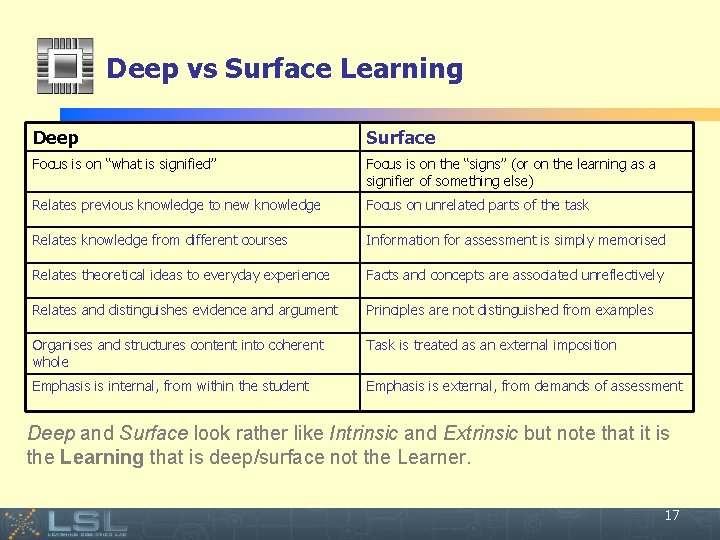
Deep vs Surface Learning Deep Surface Focus is on “what is signified” Focus is on the “signs” (or on the learning as a signifier of something else) Relates previous knowledge to new knowledge Focus on unrelated parts of the task Relates knowledge from different courses Information for assessment is simply memorised Relates theoretical ideas to everyday experience Facts and concepts are associated unreflectively Relates and distinguishes evidence and argument Principles are not distinguished from examples Organises and structures content into coherent whole Task is treated as an external imposition Emphasis is internal, from within the student Emphasis is external, from demands of assessment Deep and Surface look rather like Intrinsic and Extrinsic but note that it is the Learning that is deep/surface not the Learner. Event 17
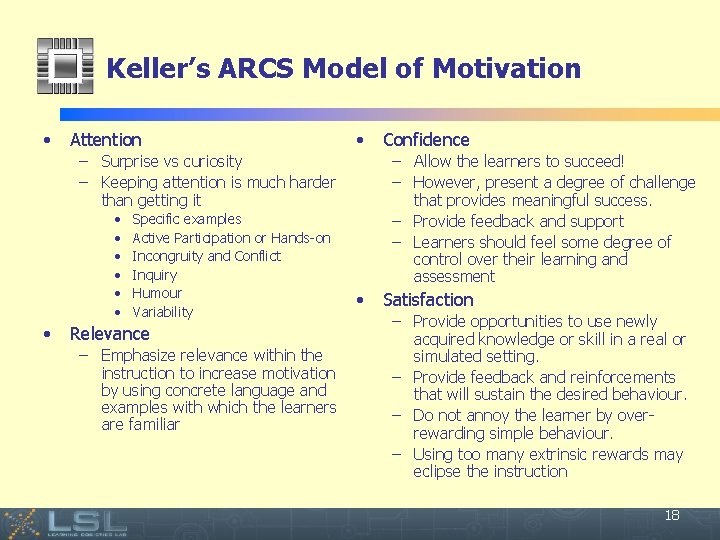
Keller’s ARCS Model of Motivation • • Attention – Surprise vs curiosity – Keeping attention is much harder than getting it • • Specific examples Active Participation or Hands-on Incongruity and Conflict Inquiry Humour Variability Relevance – Emphasize relevance within the instruction to increase motivation by using concrete language and examples with which the learners are familiar Event Confidence – Allow the learners to succeed! – However, present a degree of challenge that provides meaningful success. – Provide feedback and support – Learners should feel some degree of control over their learning and assessment • Satisfaction – Provide opportunities to use newly acquired knowledge or skill in a real or simulated setting. – Provide feedback and reinforcements that will sustain the desired behaviour. – Do not annoy the learner by overrewarding simple behaviour. – Using too many extrinsic rewards may eclipse the instruction 18
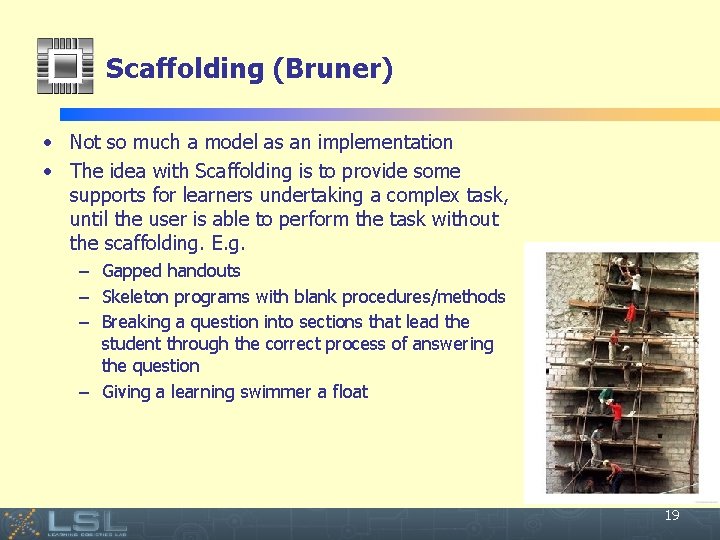
Scaffolding (Bruner) • Not so much a model as an implementation • The idea with Scaffolding is to provide some supports for learners undertaking a complex task, until the user is able to perform the task without the scaffolding. E. g. – Gapped handouts – Skeleton programs with blank procedures/methods – Breaking a question into sections that lead the student through the correct process of answering the question – Giving a learning swimmer a float Event 19
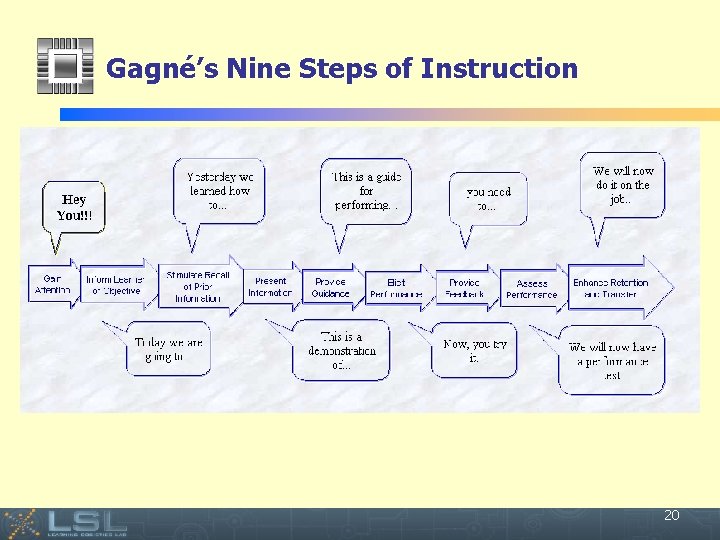
Gagné’s Nine Steps of Instruction Event 20
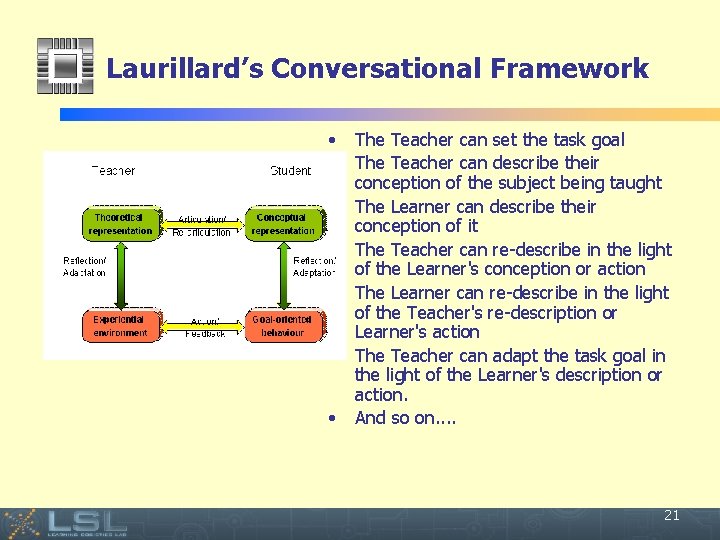
Laurillard’s Conversational Framework • • Event The Teacher can set the task goal The Teacher can describe their conception of the subject being taught The Learner can describe their conception of it The Teacher can re-describe in the light of the Learner's conception or action The Learner can re-describe in the light of the Teacher's re-description or Learner's action The Teacher can adapt the task goal in the light of the Learner's description or action. And so on. . 21
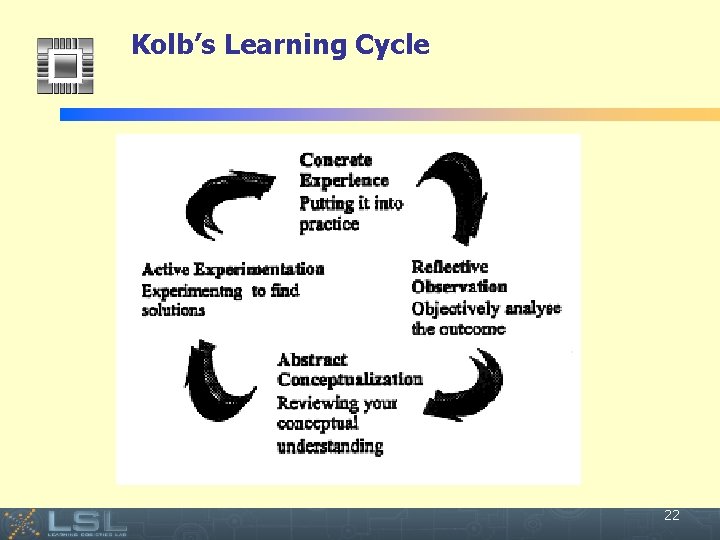
Kolb’s Learning Cycle Event 22
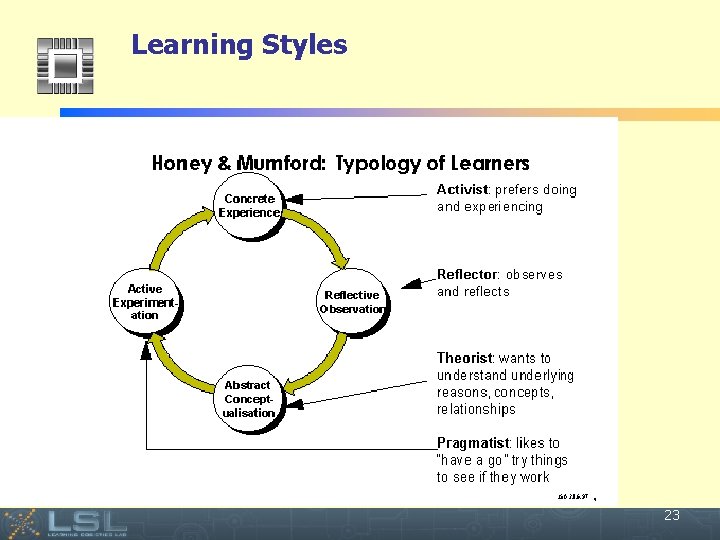
Learning Styles Event 23
Other Learning Styles • VAK (Kolb) – Vision, Auditory, and Kinesthetic • Serialists vs Holists (Pask) – Serialists • • Build up their knowledge sequentially May lose sight of the broader picture Are impatient with "jumping around" May be more comfortable with inherently "linear" subjects – Holists • • • Pick up bits and pieces within a broad framework May leave gaps, or repeat themselves May make mistakes about the connections between things May over-generalise May be more comfortable with "topic" based learning Event 24
Some questions to answer in groups after the lecture: 1. For each of the following Scenarios, – – – What type of learning outcome is required? What approach to learning and teaching do you think might be appropriate? If delivering this course on-line or by blended learning, what tools might support your approach? How? Scenario 1. You need to teach a group of undergraduate students to program using arrays. Scenario 2. You need to teach a group of trainee apprentice instructors (they will be teaching brick-laying, plumbing, car mechanics etc, ) that excess negative behaviour re-enforcement (heavy sarcasm, ritual humiliation, physical violence etc) will not necessarily have the effect on their students that they suppose. Scenario 3. You need to teach a group of students of learning technology to design an effective learning activity. Scenario 4. You need to teach a group of primary school children to swim. 2. How can teachers take onto account the different learning styles of their students – – When classroom teaching? When teaching on-line? 3. VLE’s force lecturers to adapt a particular instructional approach. Discuss. Event 25