
Models of Emotions Approaches to conceptualising emotion 1
- Slides: 20
Models of Emotions Approaches to conceptualising emotion 1
Aims of the lecture: n Overarching: try to define the term ‘emotion’ n To acquaint you with the principal current emotion theories and research. n To highlight the similarities and differences of terminology in the area (emotion, mood, affect etc. ) n Continue on the culture vs. Body debate 2
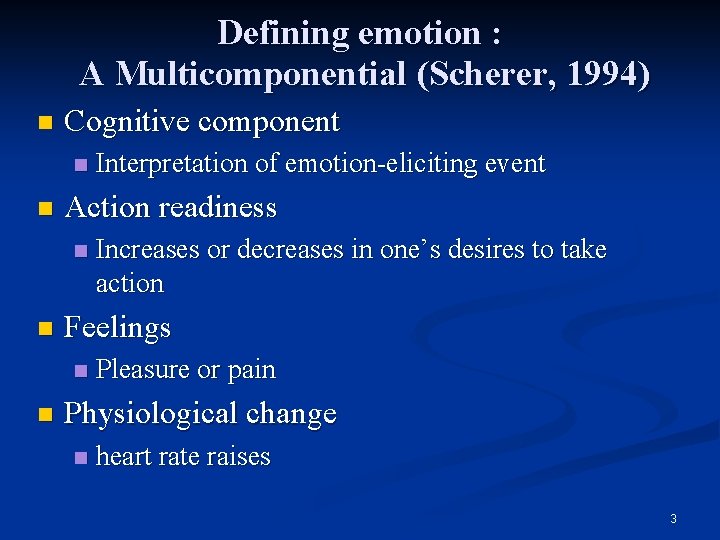
Defining emotion : A Multicomponential (Scherer, 1994) n Cognitive component n n Action readiness n n Increases or decreases in one’s desires to take action Feelings n n Interpretation of emotion-eliciting event Pleasure or pain Physiological change n heart rate raises 3
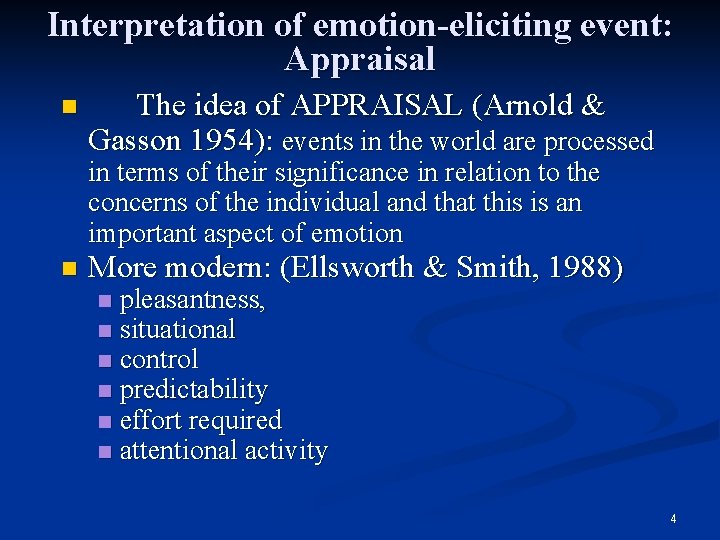
Interpretation of emotion-eliciting event: Appraisal n The idea of APPRAISAL (Arnold & Gasson 1954): events in the world are processed in terms of their significance in relation to the concerns of the individual and that this is an important aspect of emotion n More modern: (Ellsworth & Smith, 1988) pleasantness, situational n control n predictability n effort required n attentional activity n n 4
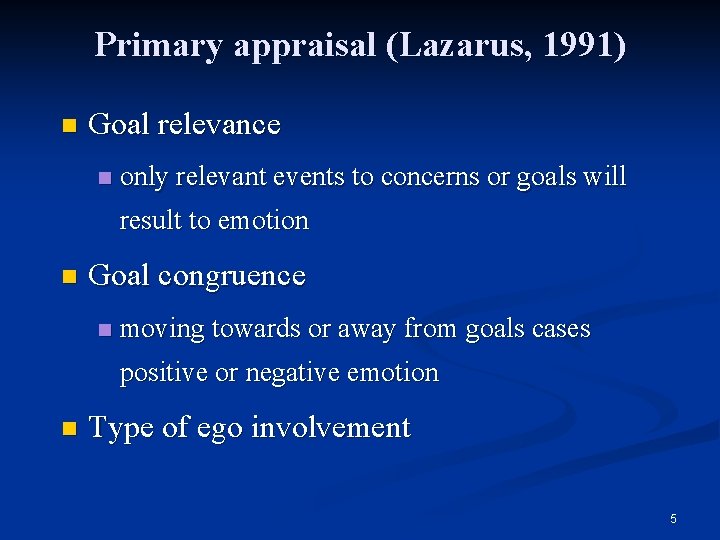
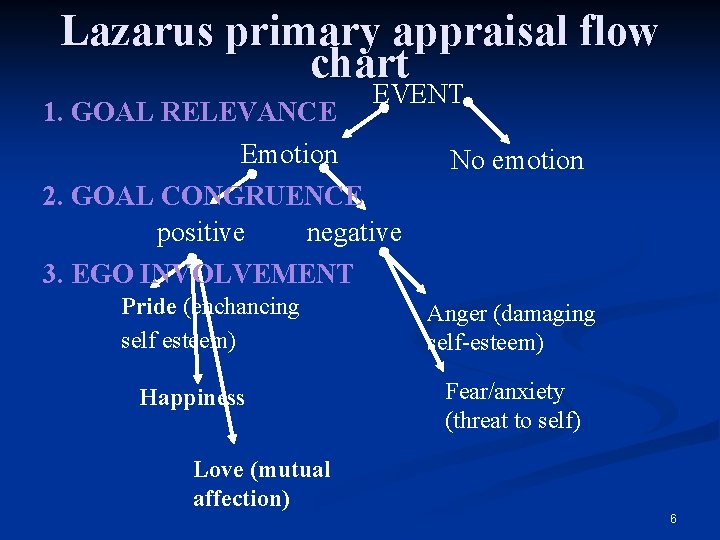
Primary appraisal (Lazarus, 1991) n Goal relevance n only relevant events to concerns or goals will result to emotion n Goal congruence n moving towards or away from goals cases positive or negative emotion n Type of ego involvement 5
Lazarus primary appraisal flow chart 1. GOAL RELEVANCE EVENT Emotion 2. GOAL CONGRUENCE positive negative 3. EGO INVOLVEMENT Pride (enchancing self esteem) Happiness No emotion Anger (damaging self-esteem) Fear/anxiety (threat to self) Love (mutual affection) 6
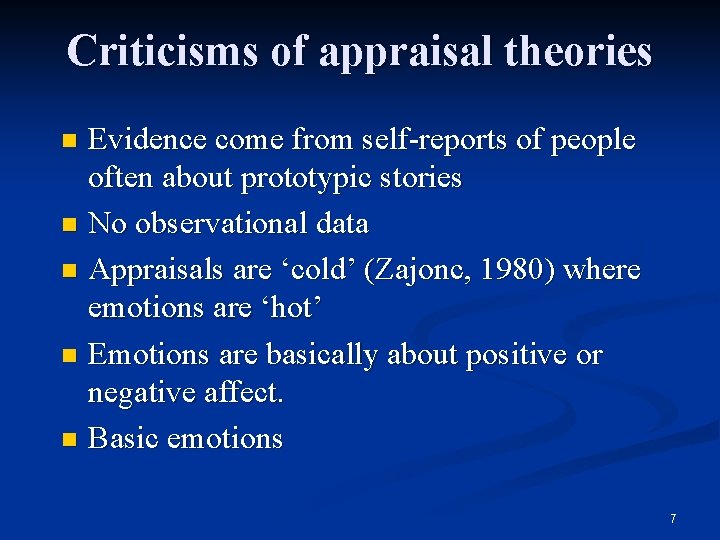
Criticisms of appraisal theories Evidence come from self-reports of people often about prototypic stories n No observational data n Appraisals are ‘cold’ (Zajonc, 1980) where emotions are ‘hot’ n Emotions are basically about positive or negative affect. n Basic emotions n 7
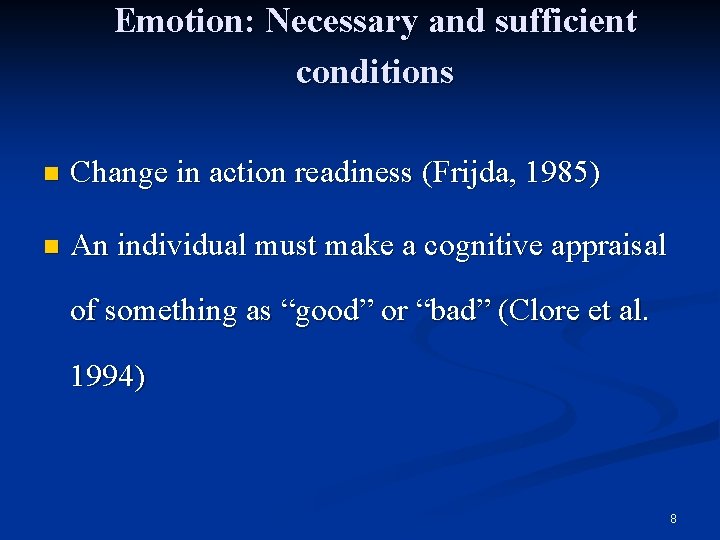
Emotion: Necessary and sufficient conditions n Change in action readiness (Frijda, 1985) n An individual must make a cognitive appraisal of something as “good” or “bad” (Clore et al. 1994) 8
Affect “internal mental states that are primarily based on affect” (p. 325, Ortony, Clore and Foss, 1987) n Affect n n n “the irreducible aspect of emotion that gives feelings their emotional, non cognitive character” (p 383, Frijda, 1993) For many the most basic feature of emotion. Batson et al. (1992) argued that affect is phylogenetically and ontogenetically more primate than either emotion or mood. 9
Mood Emotions are specific, internal states, where moods are none-specific. n People in good mood are: n more helpful and more cooperative (Carnevale & Isen, 1986; Isen, Clark, & Schwartz, 1976) n more likely to start a conversation, n more persuasive in producing counter attitudinal messages and n more easily persuaded in some circumstances n speak faster and n report more life satisfaction. n 10
Models of mood mediating information processing Resource allocation model (Ellis & Ashbrook, 1988) The associative network model (Bower, 1981; Isen, 1984) Feelings as information (Scwartz, 1990; Schwartz & Clore, 1988) The affect infusion model (Forgas, 1995) 11
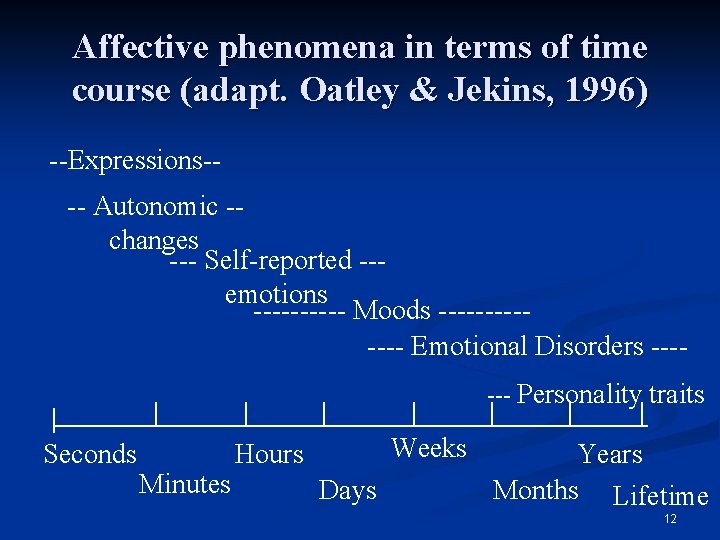
Affective phenomena in terms of time course (adapt. Oatley & Jekins, 1996) --Expressions--- Autonomic -changes --- Self-reported --emotions ----- Moods ------- Emotional Disorders ---- Seconds Minutes Weeks Hours Days --- Personality traits -- Years Months Lifetime 12
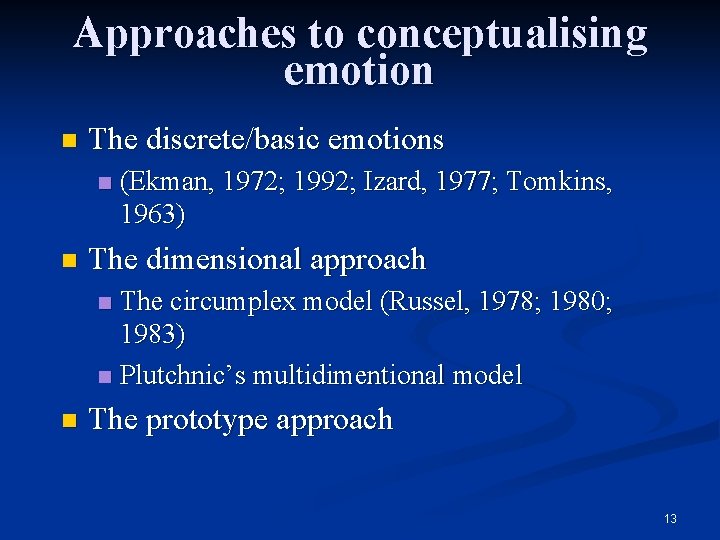
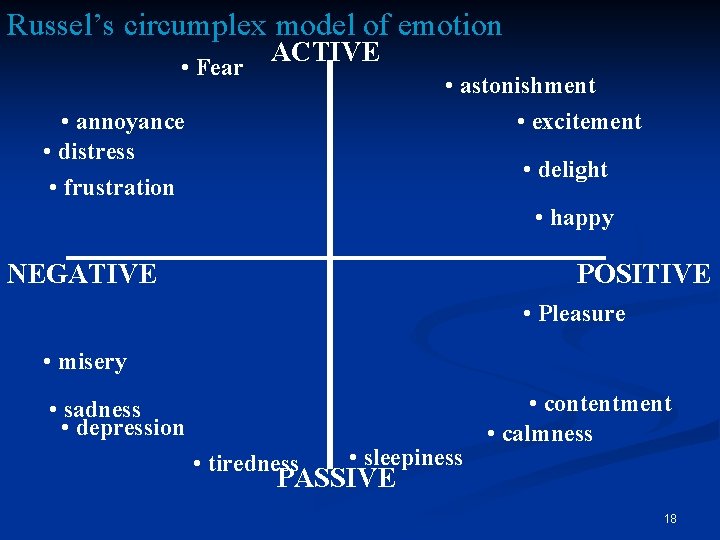
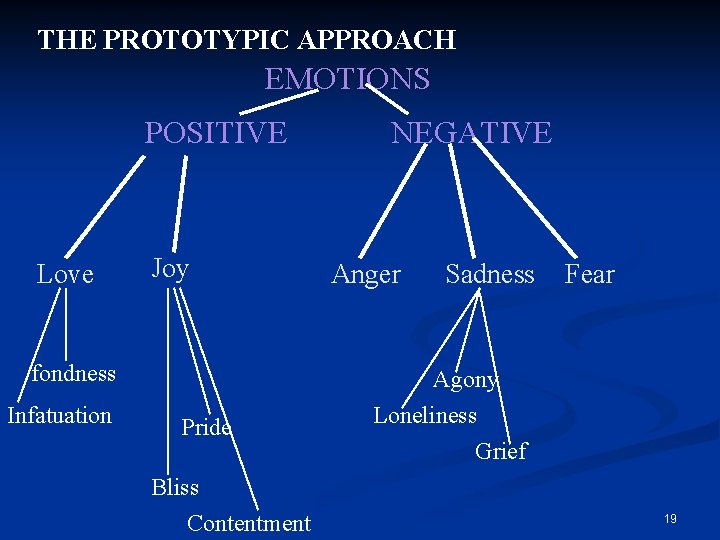
Approaches to conceptualising emotion n The discrete/basic emotions n n (Ekman, 1972; 1992; Izard, 1977; Tomkins, 1963) The dimensional approach The circumplex model (Russel, 1978; 1980; 1983) n Plutchnic’s multidimentional model n n The prototype approach 13
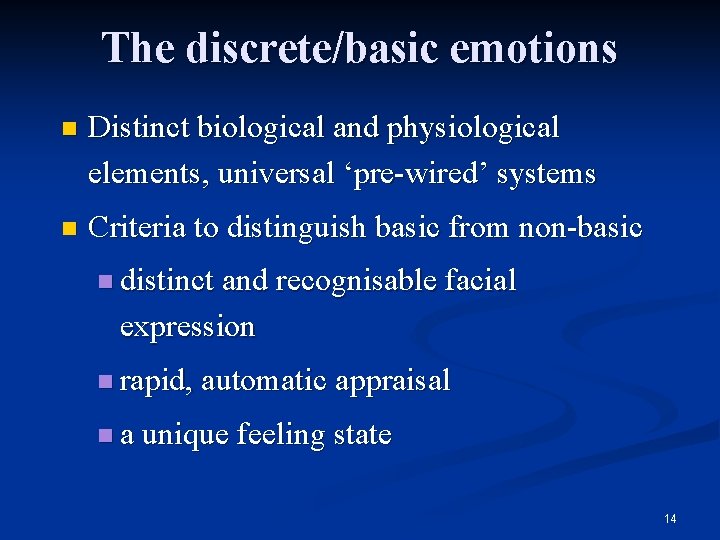
The discrete/basic emotions n Distinct biological and physiological elements, universal ‘pre-wired’ systems n Criteria to distinguish basic from non-basic n distinct and recognisable facial expression n rapid, automatic appraisal n a unique feeling state 14
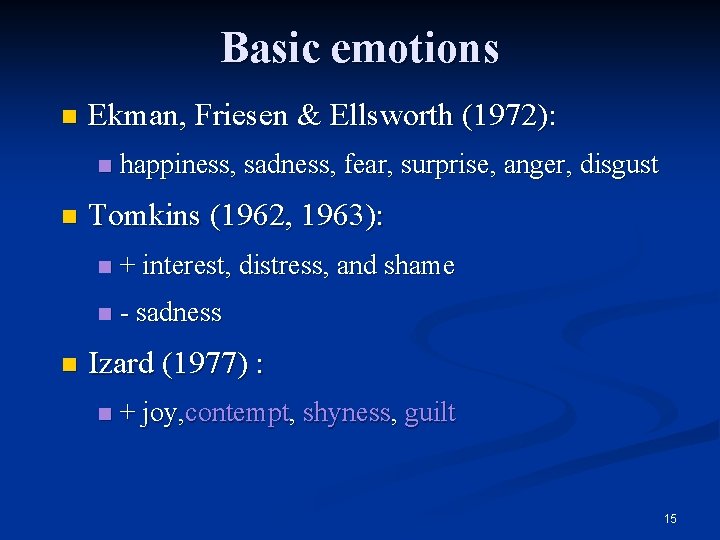
Basic emotions n Ekman, Friesen & Ellsworth (1972): n n n happiness, sadness, fear, surprise, anger, disgust Tomkins (1962, 1963): n + interest, distress, and shame n - sadness Izard (1977) : n + joy, contempt, shyness, guilt 15
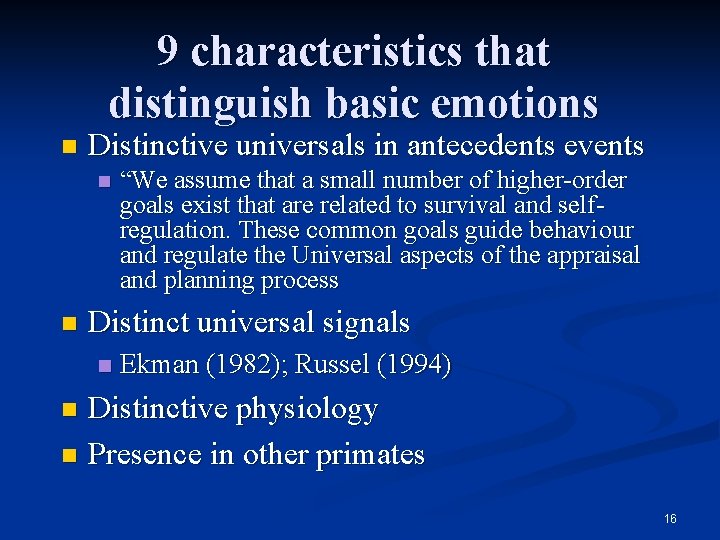
9 characteristics that distinguish basic emotions n Distinctive universals in antecedents events n n “We assume that a small number of higher-order goals exist that are related to survival and selfregulation. These common goals guide behaviour and regulate the Universal aspects of the appraisal and planning process Distinct universal signals n Ekman (1982); Russel (1994) Distinctive physiology n Presence in other primates n 16
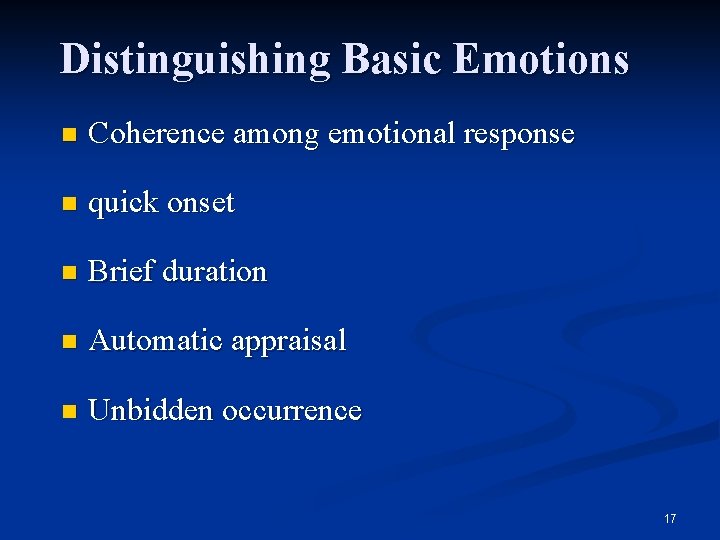
Distinguishing Basic Emotions n Coherence among emotional response n quick onset n Brief duration n Automatic appraisal n Unbidden occurrence 17
Russel’s circumplex model of emotion • Fear ACTIVE • astonishment • excitement • annoyance • distress • frustration • delight • happy NEGATIVE POSITIVE • Pleasure • misery • sadness • depression • tiredness • sleepiness • contentment • calmness PASSIVE 18
THE PROTOTYPIC APPROACH EMOTIONS POSITIVE Love Joy fondness Infatuation Pride Bliss Contentment NEGATIVE Anger Sadness Fear Agony Loneliness Grief 19
References n Batson, Shaw & Oleson (1992) Differentiating affect, mood, and emotion: Towards functionally based conceptual distinctions. In M. S. Clark (Ed. ) Review of Personality and social Psychology: Emotion. Sage n Clore, Schwartz & Conway (1994) Affective causes and consequences of social information processing. I Wyer & Srull (eds. ) Handbook of social cognition. Hillsdale: Erlbaum n Frijda, (1985) n Ortony, Clore and Foss, (1987) The referencial structure of the affective lexicon. Cognitive Science, 11, 361 -384 n Shaver, P. , Schwartz, J. , Kirson, D. , and O'Connor, C. (1987). Emotion knowledge: Further exploration of a prototype approach. Journal of Personality and Social Psychology, 52, 1061 -1086. n Fischer, Shaver & Carnochan (1990). How emotions develop and how they organise development. Cognition and Emotion, 4, 81 -127 20