
Models of Earth EQ How do maps and

- Slides: 7
Models of Earth EQ: How do maps and globes represent the Earth? G 1 -2
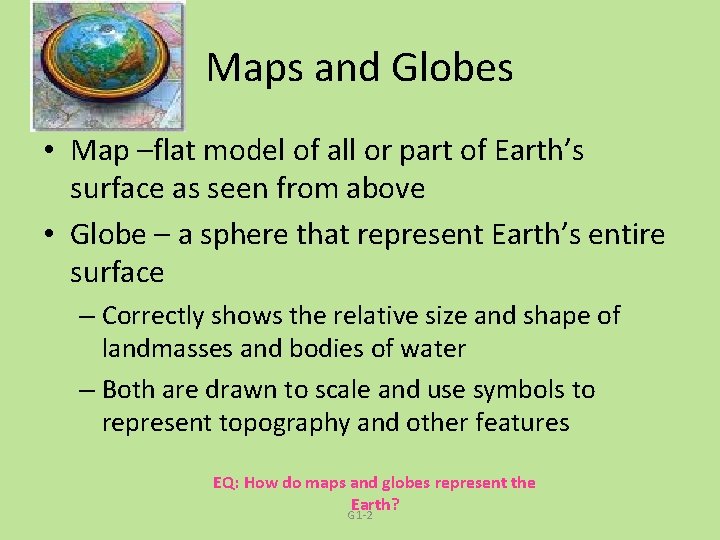
Maps and Globes • Map –flat model of all or part of Earth’s surface as seen from above • Globe – a sphere that represent Earth’s entire surface – Correctly shows the relative size and shape of landmasses and bodies of water – Both are drawn to scale and use symbols to represent topography and other features EQ: How do maps and globes represent the Earth? G 1 -2
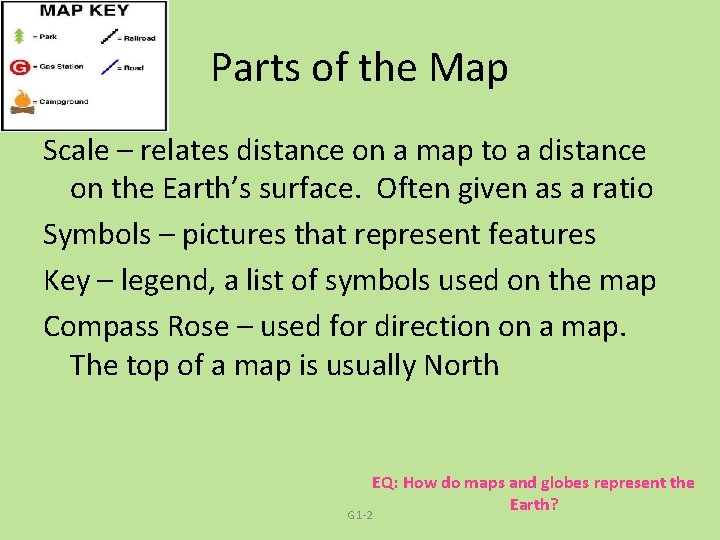
Parts of the Map Scale – relates distance on a map to a distance on the Earth’s surface. Often given as a ratio Symbols – pictures that represent features Key – legend, a list of symbols used on the map Compass Rose – used for direction on a map. The top of a map is usually North EQ: How do maps and globes represent the Earth? G 1 -2
Earth’s Reference System Equator – imaginary line divides the Earth into Northern and Southern hemispheres. Hemispheres= ½ of the sphere that is planet Earth. Prime Meridian – imaginary line that makes a half circle from the North Pole and the South Pole. It divides the earth into the Western and Eastern hemispheres EQ: How maps and globes Degree – 1/360 of thedoway around a full circle. represent the Earth? G 1 -2
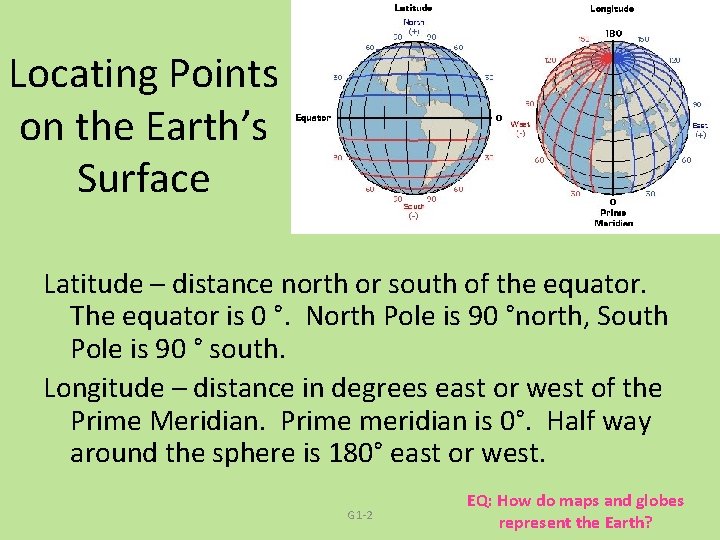
Locating Points on the Earth’s Surface Latitude – distance north or south of the equator. The equator is 0 °. North Pole is 90 °north, South Pole is 90 ° south. Longitude – distance in degrees east or west of the Prime Meridian. Prime meridian is 0°. Half way around the sphere is 180° east or west. G 1 -2 EQ: How do maps and globes represent the Earth?
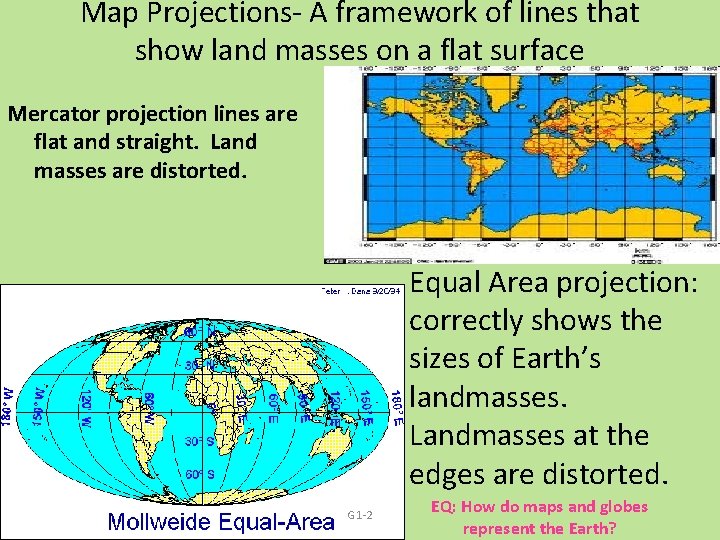
Map Projections- A framework of lines that show land masses on a flat surface Mercator projection lines are flat and straight. Land masses are distorted. Equal Area projection: correctly shows the sizes of Earth’s landmasses. Landmasses at the edges are distorted. G 1 -2 EQ: How do maps and globes represent the Earth?
Class work and Homework EQ: How do maps and globes represent the Earth? Fill In What did I learn Confused Say Inquiry, “A Borderline Case”, page G 25, , G 168 -169. G 1 -2