
MODELS FOR SUCCESS AN INTEGRATED APPROACH FOR JUVENILE

- Slides: 17
MODELS FOR SUCCESS: AN INTEGRATED APPROACH FOR JUVENILE DRUG COURT Reclaiming Futures/Juvenile Drug Court Evaluation Southwest Institute for Research on Women University of Arizona Problem Solving Courts Conference 2013 May 14,
Evaluation Team • University of Arizona’s Southwest Institute for Research on Women (SIROW) • Carnevale Associates, LLC • Chestnut Health Systems
Brief History Juvenile Drug Court and Reclaiming Futures Initiative
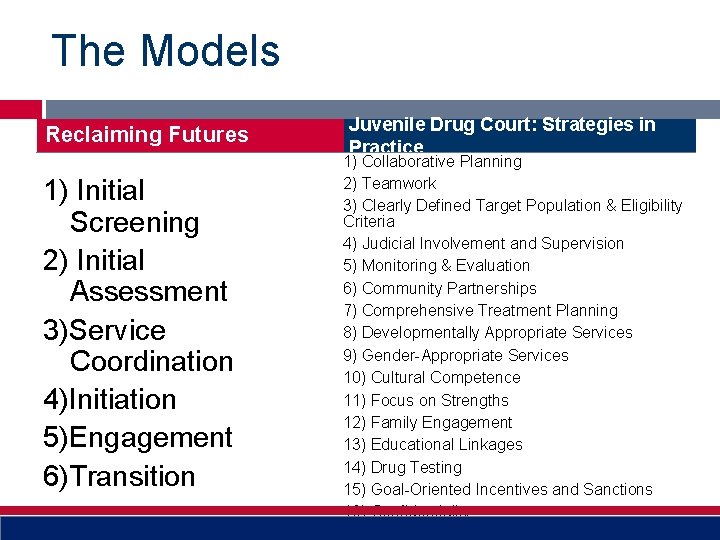
The Models Reclaiming Futures 1) Initial Screening 2) Initial Assessment 3)Service Coordination 4)Initiation 5)Engagement 6)Transition Juvenile Drug Court: Strategies in Practice 1) Collaborative Planning 2) Teamwork 3) Clearly Defined Target Population & Eligibility Criteria 4) Judicial Involvement and Supervision 5) Monitoring & Evaluation 6) Community Partnerships 7) Comprehensive Treatment Planning 8) Developmentally Appropriate Services 9) Gender-Appropriate Services 10) Cultural Competence 11) Focus on Strengths 12) Family Engagement 13) Educational Linkages 14) Drug Testing 15) Goal-Oriented Incentives and Sanctions 16) Confidentiality
Evaluation Overview • Multi-Site, four-year evaluation of the Juvenile Drug Court and Reclaiming Futures Initiative • Charged with evaluating the outcomes and cost-effectiveness of the integration of the Juvenile Drug Court: Strategies in Practice and the Reclaiming Futures Models.
OBJECTIVE 1: ASSESS THE OPERATIONS OF JUVENILE DRUG COURT/RECLAIMING FUTURES MODELS USING ESTABLISHED INDICES FOR PERFORMANCE, EFFICIENCIES AND COST EFFECTIVENESS • Critical factors to combining the models • System level effects that occurred by combining the models • Adaptations and modifications in integrating the models
OBJECTIVE 2: IMPROVE THE EMPIRICAL KNOWLEDGE BASE ABOUT JUVENILE DRUG COURTS AND THE RECLAIMING FUTURES MODEL. • Services provided • Service recipients • Who is missing
OBJECTIVE 3: ANALYZE THE EFFICACY OF COMBINED EFFORTS OF JUVENILE DRUG COURTS AND THE RECLAIMING FUTURES MODEL. • Approaches to keeping target population involved • Interventions that support matching clients to services • System-level approaches, training, & resources associated with changes in services • Level and appropriateness of services related to client and program performance
OBJECTIVE 4: CONDUCT CASE STUDIES USING ADMINISTRATIVE, COLLABORATION, AND QUALITY INDICES AND THE SIXTEEN KEY ELEMENTS OF JUVENILE DRUG COURTS • Individual Case Studies • System/Organizational Case Studies
OBJECTIVE 5: EVALUATE THE POTENTIAL FOR REPLICATION OF THESE MODELS • Cost-effectiveness of different approaches
Group Activity: Brainstorming Challenges, Strategies, and Discussing Successes
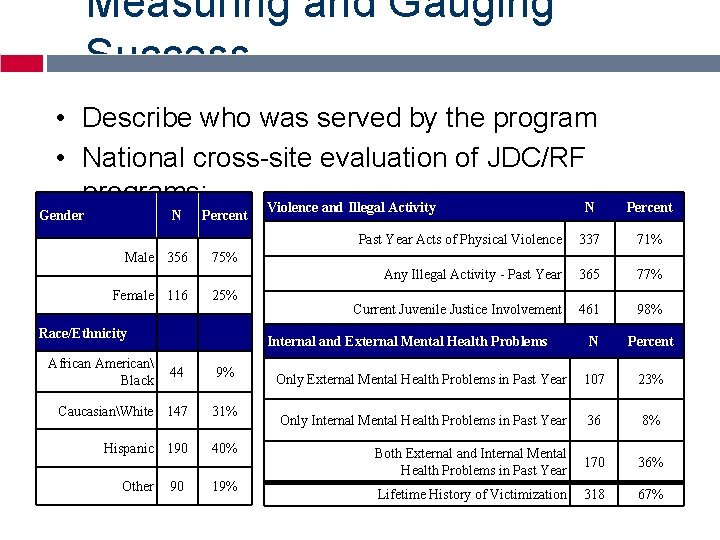
Measuring and Gauging Success • Describe who was served by the program • National cross-site evaluation of JDC/RF programs: Violence and Illegal Activity N Gender N Male 356 Female 116 Percent 25% 337 71% Any Illegal Activity - Past Year 365 77% Current Juvenile Justice Involvement 461 98% N Percent Only External Mental Health Problems in Past Year 107 23% Only Internal Mental Health Problems in Past Year 36 8% Both External and Internal Mental Health Problems in Past Year 170 36% Lifetime History of Victimization 318 67% Internal and External Mental Health Problems 44 9% CaucasianWhite 147 31% Hispanic 190 40% Other Past Year Acts of Physical Violence 75% Race/Ethnicity African American Black 90 Percent 19%
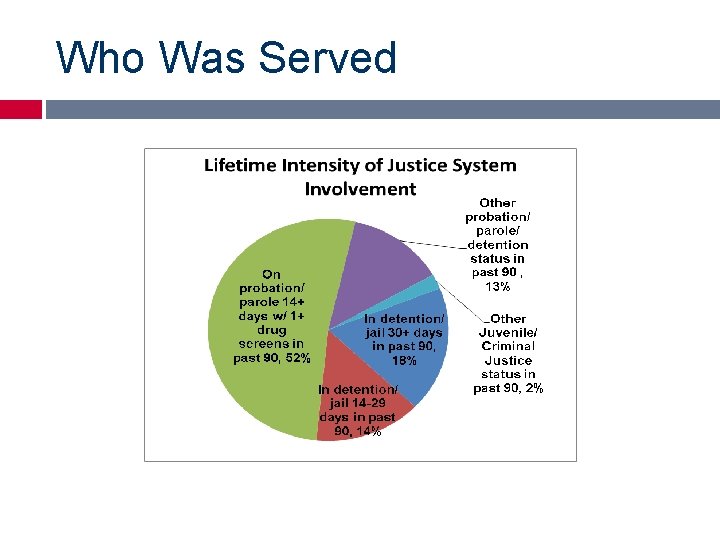
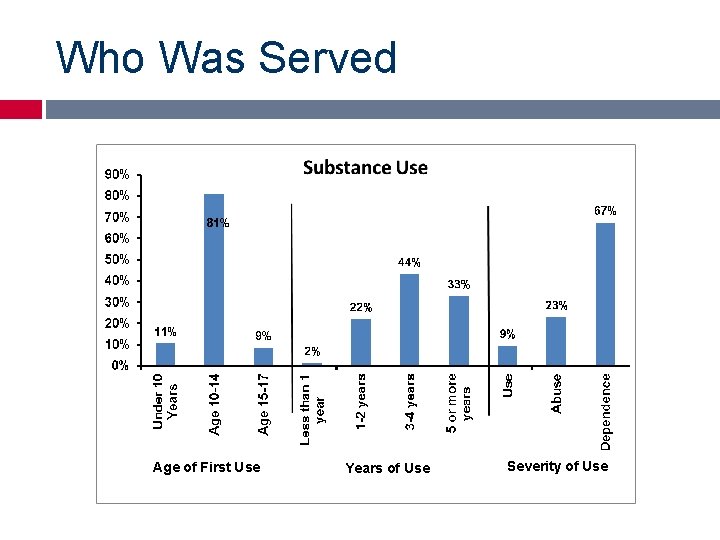
Who Was Served
Who Was Served Age of First Use Years of Use Severity of Use
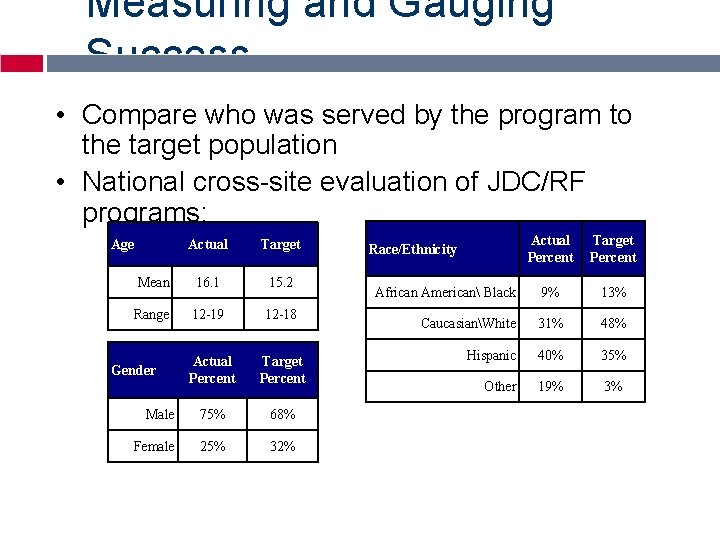
Measuring and Gauging Success • Compare who was served by the program to the target population • National cross-site evaluation of JDC/RF programs: Age Actual Target Mean 16. 1 15. 2 Range 12 -19 12 -18 Actual Percent Target Percent Male 75% 68% Female 25% 32% Gender Actual Percent Target Percent African American Black 9% 13% CaucasianWhite 31% 48% Hispanic 40% 35% Other 19% 3% Race/Ethnicity
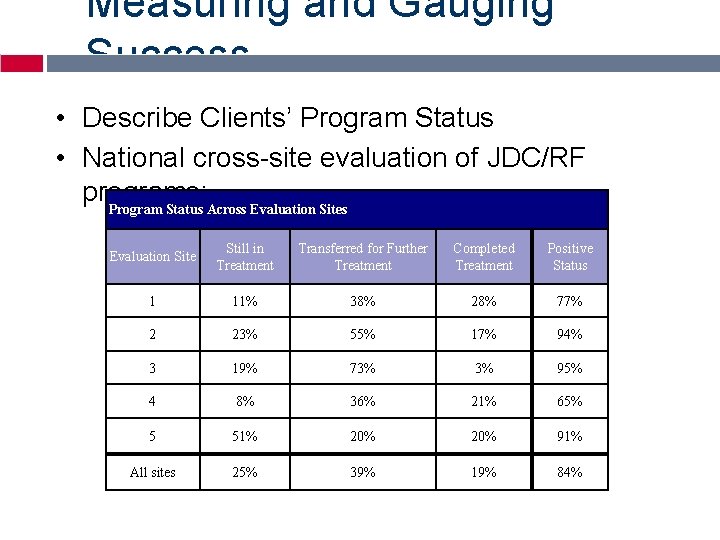
Measuring and Gauging Success • Describe Clients’ Program Status • National cross-site evaluation of JDC/RF programs: Program Status Across Evaluation Site Still in Treatment Transferred for Further Treatment Completed Treatment Positive Status 1 11% 38% 28% 77% 2 23% 55% 17% 94% 3 19% 73% 3% 95% 4 8% 36% 21% 65% 5 51% 20% 91% All sites 25% 39% 19% 84%
Questions? Questions: For questions about this presentation or the National Cross-Site Evaluation, contact Monica Davis, Evaluation Coordinator at 520 -295 -9339 x 211 or midavis@email. arizona. edu Disclaimer: The development of this report is funded by the Office of Juvenile Justice and Delinquency Prevention (OJJDP) through an interagency agreement with the Library of Congress – contract number LCFRD 11 C 0007. The views expressed here are the authors and do not necessarily represent the official policies of OJJDP or the Library of Congress; nor does mention of trade names, commercial practices, or organizations imply endorsement by the U. S. Government. Acknowledgements: SIROW wishes to acknowledge the contributions of the evaluation sites and the evaluation partners, Chestnut Health Systems (CHS) and Carnevale Associates, LLC (CALLC) to this National Cross-Site Evaluation. In addition, SIROW is appreciative of support from the Library of Congress - Federal Research Division, OJJDP, the National Council of Juvenile and Family Court Judges, and the Reclaiming Futures National Program Office. Individual Site Program Funding: Federal funding for these JDC/RF sites is provided by OJJDP and SAMHSA. Suggested Citation: University of Arizona - Southwest Institute for Research on Women (2013). National Cross-Site Evaluation of Juvenile Drug Courts and Reclaiming Futures. Models for Success: An Integrated Approach for Juvenile Drug Court – May, 2013. Accepted for presentation at the Arizona Problem Solving Courts Conference. May 14, 2013. Prescott, AZ. Submitted.