
Models and experimental results from LQ HQ and
- Slides: 29
Models and experimental results from LQ, HQ (… and more) and QXF Giorgio Ambrosio Fermilab With contributions by: Helene Felice, Shlomo Caspi, Tiina Salmi, Maxim Martchevsky (LBNL) Guram Chlachidize, Linda Imbasciati (FNAL) Massimo Sorbi, Lidia Rossi, Vittorio Marinozzi (Univ. of Milan) Paolo Ferracin, Ezio Todesco, Marta Baiko, Hugo Bajas (CERN) Giulio Manfreda (Univ. of Udine) WAMSDO CERN January 16, 2013 WAMSDO, January 16, 2013 - CERN Models and experimental results – G. Ambrosio 1
Outline • What is the maximum acceptable temperature at the hot spot in Nb 3 Sn accelerator magnets? • What feedback from magnet test to QP codes? • Where does the QXF stand? WAMSDO, January 16, 2013 - CERN Models and experimental results – G. Ambrosio 2
MAXIMUM ACCEPTABLE TEMPERATURE AT HOT SPOT? In Nb 3 Sn accelerator magnets WAMSDO, January 16, 2013 - CERN Models and experimental results – G. Ambrosio 3
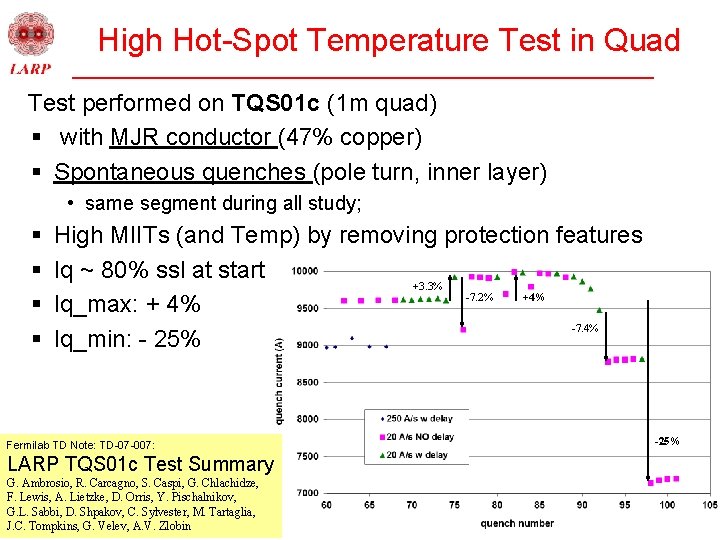
High Hot-Spot Temperature Test in Quad Test performed on TQS 01 c (1 m quad) § with MJR conductor (47% copper) § Spontaneous quenches (pole turn, inner layer) • same segment during all study; § § High MIITs (and Temp) by removing protection features Iq ~ 80% ssl at start +3. 3% -7. 2% +4% Iq_max: + 4% -7. 4% Iq_min: - 25% -25% Fermilab TD Note: TD-07 -007: LARP TQS 01 c Test Summary G. Ambrosio, R. Carcagno, S. Caspi, G. Chlachidze, F. Lewis, A. Lietzke, D. Orris, Y. Pischalnikov, G. L. Sabbi, D. Shpakov, C. Sylvester, M. Tartaglia, 16, 2013 - CERN J. C. WAMSDO, Tompkins, January G. Velev, A. V. Zlobin Models and experimental results – G. Ambrosio 4
IEEE TRANSACTIONS ON APPLIED SUPERCONDUCTIVITY, VOL. 18, NO. 2, JUNE 2008 179 Test and Analysis of Technology Quadrupole Shell (TQS) Magnet Models for LARP S. Caspi, G. Ambrosio, A. N. Andreev, E. Barzi, R. Bossert, D. R. Dietderich, P. Ferracin, A. Ghosh, A. R. Hafalia, V. V. Kashikhin, A. F. Lietzke, I. Novitski, G. L. Sabbi, and A. V. Zlobin Fig. 9. Epoxy de-lamination and slight inward cable displacements on one side of coil-15’s inner-pole island after high-MIITs study. WAMSDO, January 16, 2013 - CERN Models and experimental results – G. Ambrosio 5
Hot Spot Temperature Computation Hot spot temperature computed with Quench. Pro: • MIITs vs. Temperature including epoxy and insulation in enthalpy computation • Adiabatic approximation • Assuming peak field on cable (at quench current) § Constant in Quench. Pro • RRR: 130 -170 (range of RRR in quenching coil) § RRR of quenching segment not available WAMSDO, January 16, 2013 - CERN Models and experimental results – G. Ambrosio 6
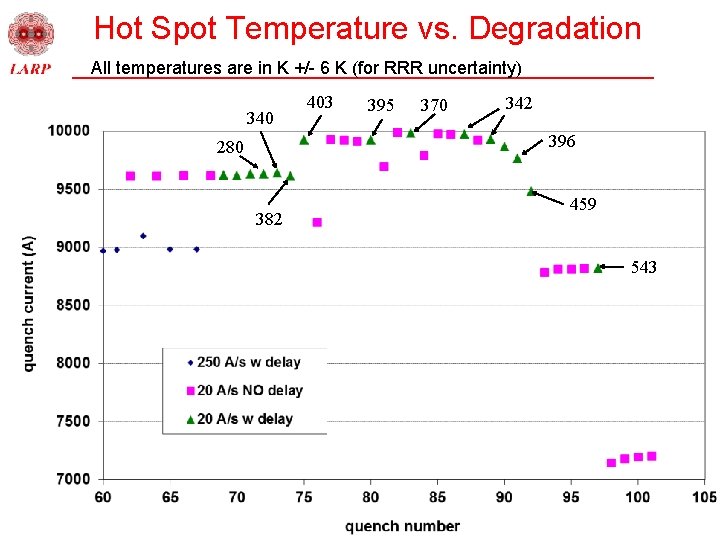
Hot Spot Temperature vs. Degradation All temperatures are in K +/- 6 K (for RRR uncertainty) 340 403 395 370 342 396 280 459 382 543 WAMSDO, January 16, 2013 - CERN Models and experimental results – G. Ambrosio 7
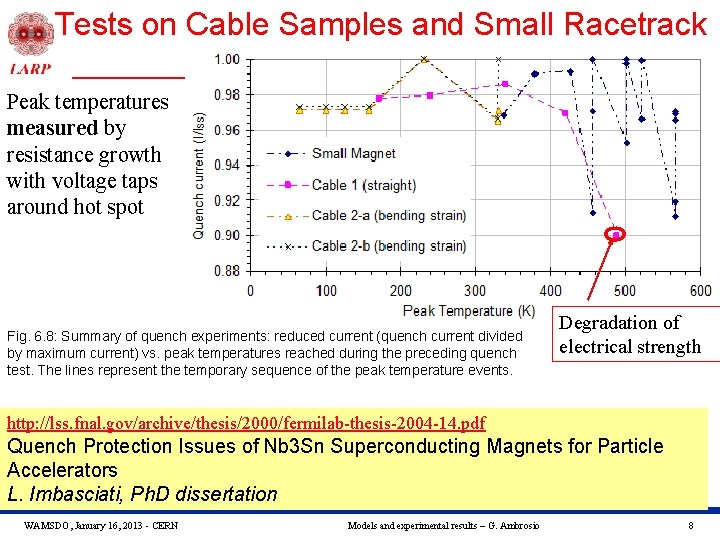
Tests on Cable Samples and Small Racetrack Peak temperatures measured by resistance growth with voltage taps around hot spot Fig. 6. 8: Summary of quench experiments: reduced current (quench current divided by maximum current) vs. peak temperatures reached during the preceding quench test. The lines represent the temporary sequence of the peak temperature events. Degradation of electrical strength http: //lss. fnal. gov/archive/thesis/2000/fermilab-thesis-2004 -14. pdf Quench Protection Issues of Nb 3 Sn Superconducting Magnets for Particle Accelerators L. Imbasciati, Ph. D dissertation WAMSDO, January 16, 2013 - CERN Models and experimental results – G. Ambrosio 8
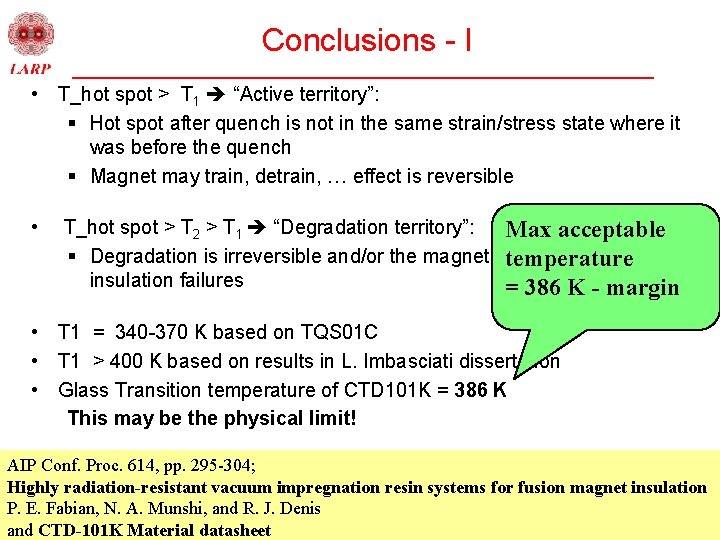
Conclusions - I • T_hot spot > T 1 “Active territory”: § Hot spot after quench is not in the same strain/stress state where it was before the quench § Magnet may train, detrain, … effect is reversible • T_hot spot > T 2 > T 1 “Degradation territory”: Max acceptable § Degradation is irreversible and/or the magnet may experience temperature insulation failures = 386 K - margin • T 1 = 340 -370 K based on TQS 01 C • T 1 > 400 K based on results in L. Imbasciati dissertation • Glass Transition temperature of CTD 101 K = 386 K This may be the physical limit! AIP Conf. Proc. 614, pp. 295 -304; Highly radiation-resistant vacuum impregnation resin systems for fusion magnet insulation P. E. Fabian, N. A. Munshi, and R. J. Denis 9 WAMSDO, January 16, 2013 - CERN Models and experimental results – G. Ambrosio and CTD-101 K Material datasheet
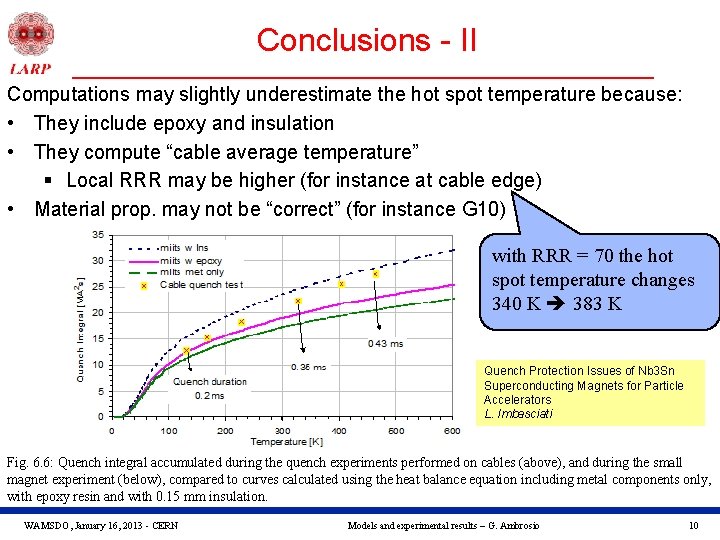
Conclusions - II Computations may slightly underestimate the hot spot temperature because: • They include epoxy and insulation • They compute “cable average temperature” § Local RRR may be higher (for instance at cable edge) • Material prop. may not be “correct” (for instance G 10) with RRR = 70 the hot spot temperature changes 340 K 383 K Quench Protection Issues of Nb 3 Sn Superconducting Magnets for Particle Accelerators L. Imbasciati Fig. 6. 6: Quench integral accumulated during the quench experiments performed on cables (above), and during the small magnet experiment (below), compared to curves calculated using the heat balance equation including metal components only, with epoxy resin and with 0. 15 mm insulation. WAMSDO, January 16, 2013 - CERN Models and experimental results – G. Ambrosio 10
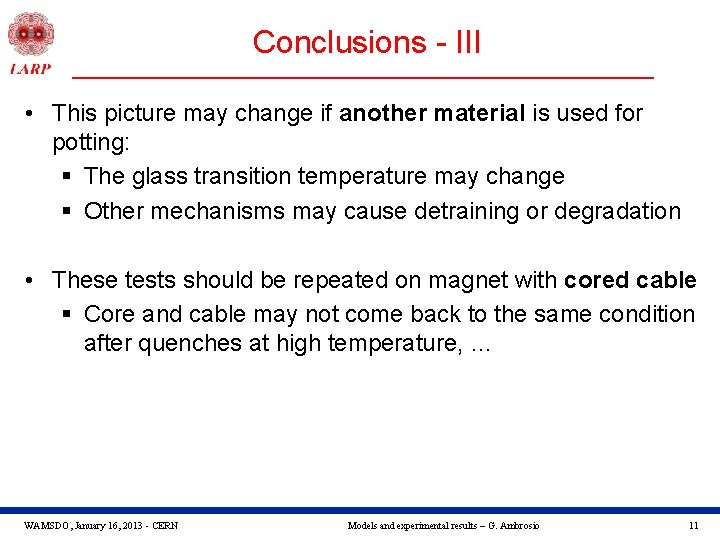
Conclusions - III • This picture may change if another material is used for potting: § The glass transition temperature may change § Other mechanisms may cause detraining or degradation • These tests should be repeated on magnet with cored cable § Core and cable may not come back to the same condition after quenches at high temperature, … WAMSDO, January 16, 2013 - CERN Models and experimental results – G. Ambrosio 11
FEEDBACK FROM LQ TEST WAMSDO, January 16, 2013 - CERN Models and experimental results – G. Ambrosio 12
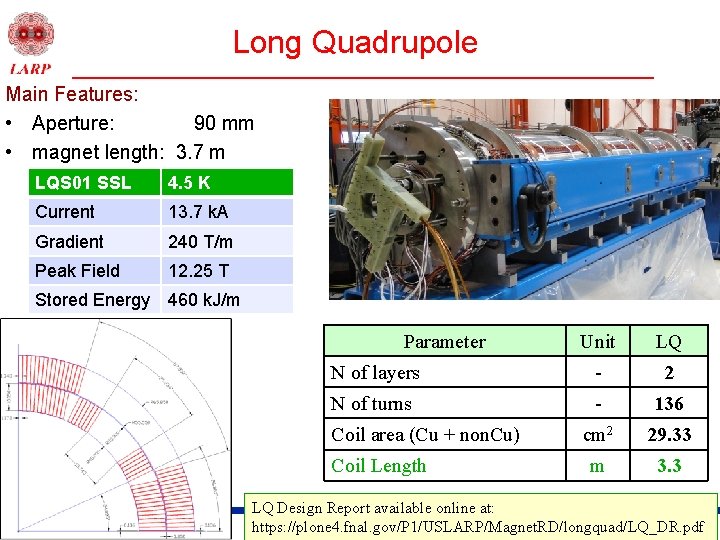
Long Quadrupole Main Features: • Aperture: 90 mm • magnet length: 3. 7 m LQS 01 SSL 4. 5 K Current 13. 7 k. A Gradient 240 T/m Peak Field 12. 25 T Stored Energy 460 k. J/m Parameter Unit LQ N of layers - 2 N of turns - 136 cm 2 29. 33 m 3. 3 Coil area (Cu + non. Cu) Coil Length WAMSDO, January 16, 2013 - CERN LQ Design Report available online at: 13 Models and experimental results – G. Ambrosio https: //plone 4. fnal. gov/P 1/USLARP/Magnet. RD/longquad/LQ_DR. pdf
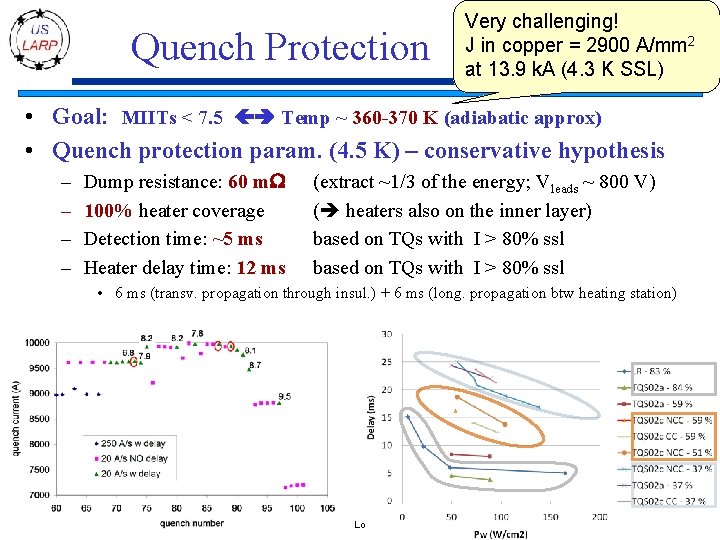
Quench Protection Very challenging! J in copper = 2900 A/mm 2 at 13. 9 k. A (4. 3 K SSL) • Goal: MIITs < 7. 5 Temp ~ 360 -370 K (adiabatic approx) • Quench protection param. (4. 5 K) – conservative hypothesis – – Dump resistance: 60 m. W 100% heater coverage Detection time: ~5 ms Heater delay time: 12 ms (extract ~1/3 of the energy; Vleads ~ 800 V) ( heaters also on the inner layer) based on TQs with I > 80% ssl • 6 ms (transv. propagation through insul. ) + 6 ms (long. propagation btw heating station) LARP Collab. Mtg 10 – Port Jefferson, Apr. 23 -25, 2008 Long Quadrupole Overview – G. Ambrosio 14
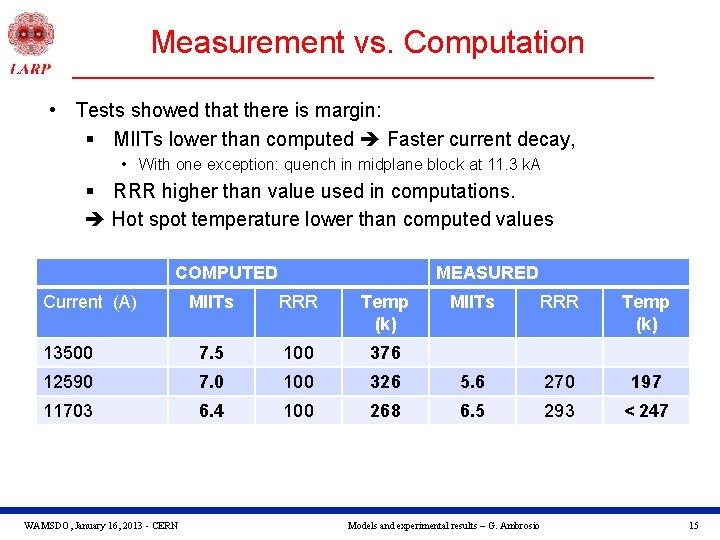
Measurement vs. Computation • Tests showed that there is margin: § MIITs lower than computed Faster current decay, • With one exception: quench in midplane block at 11. 3 k. A § RRR higher than value used in computations. Hot spot temperature lower than computed values COMPUTED Current (A) MEASURED MIITs RRR Temp (k) 13500 7. 5 100 376 12590 7. 0 100 11703 6. 4 100 WAMSDO, January 16, 2013 - CERN MIITs RRR Temp (k) 326 5. 6 270 197 268 6. 5 293 < 247 Models and experimental results – G. Ambrosio 15
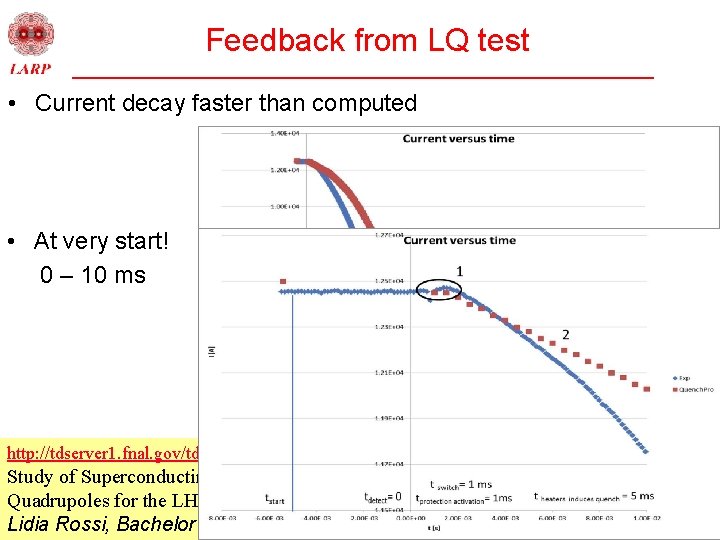
Feedback from LQ test • Current decay faster than computed • At very start! 0 – 10 ms http: //tdserver 1. fnal. gov/tdlibry/TD-Notes/2012%20 Tech%20 Notes/TD-12 -018. pdf Study of Superconducting-to-Resistive Transition for the US-LARP Large High Field Quadrupoles for the LHC Upgrade 16 WAMSDO, January 16, Bachelor 2013 - CERN Models and experimental results – G. Ambrosio Lidia Rossi, dissertation
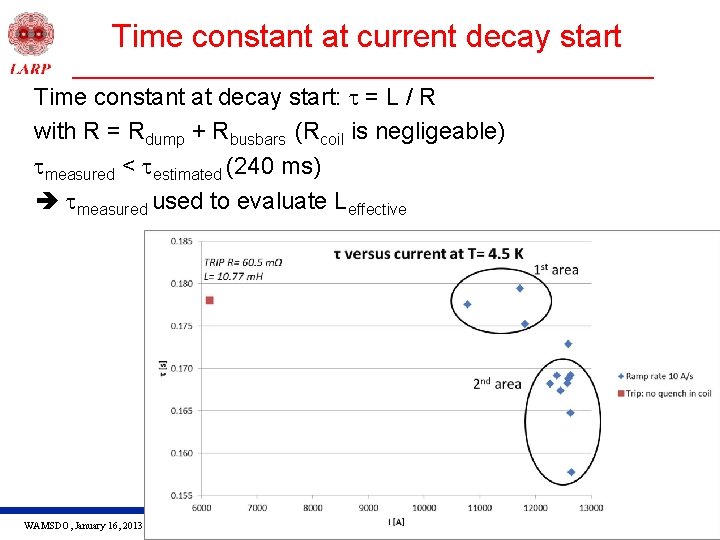
Time constant at current decay start Time constant at decay start: t = L / R with R = Rdump + Rbusbars (Rcoil is negligeable) tmeasured < testimated (240 ms) tmeasured used to evaluate Leffective WAMSDO, January 16, 2013 - CERN Models and experimental results – G. Ambrosio 17
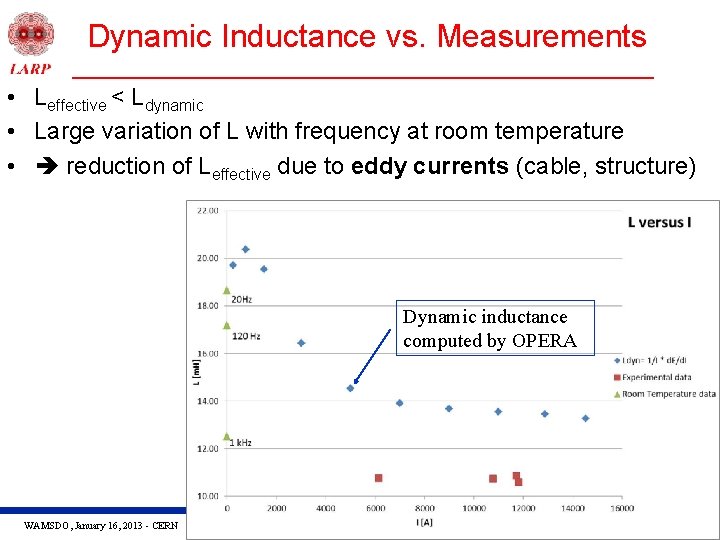
Dynamic Inductance vs. Measurements • Leffective < Ldynamic • Large variation of L with frequency at room temperature • reduction of Leffective due to eddy currents (cable, structure) Dynamic inductance computed by OPERA WAMSDO, January 16, 2013 - CERN Models and experimental results – G. Ambrosio 18
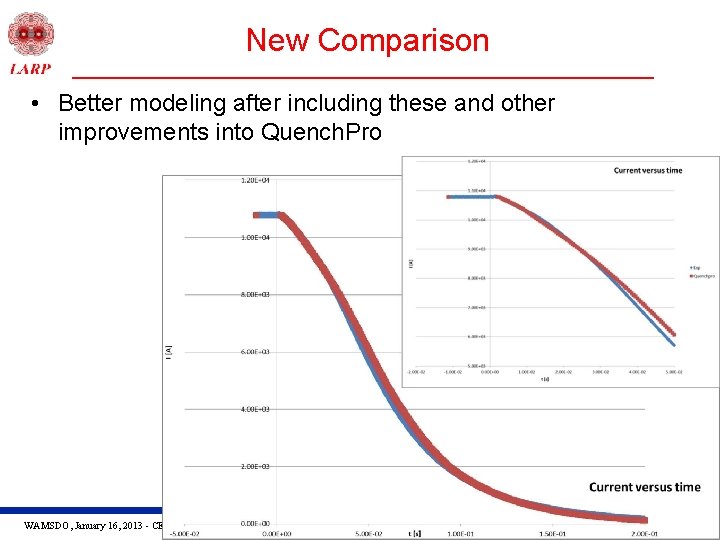
New Comparison • Better modeling after including these and other improvements into Quench. Pro WAMSDO, January 16, 2013 - CERN Models and experimental results – G. Ambrosio 19
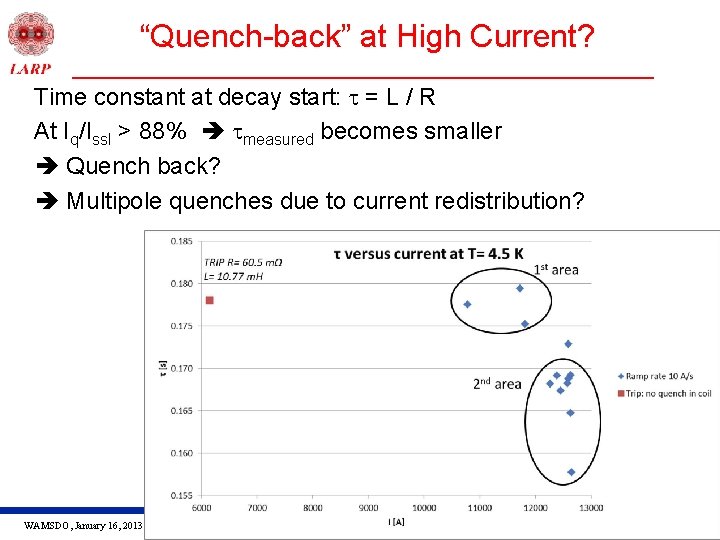
“Quench-back” at High Current? Time constant at decay start: t = L / R At Iq/Issl > 88% tmeasured becomes smaller Quench back? Multipole quenches due to current redistribution? WAMSDO, January 16, 2013 - CERN Models and experimental results – G. Ambrosio 20
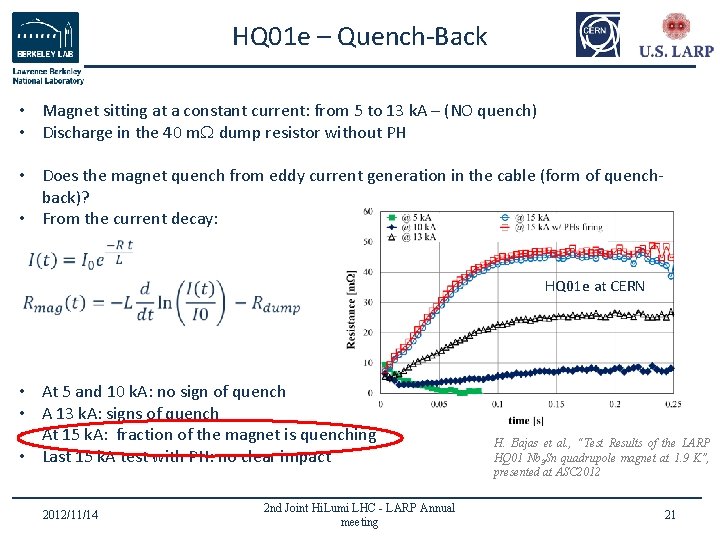
HQ 01 e – Quench-Back • Magnet sitting at a constant current: from 5 to 13 k. A – (NO quench) • Discharge in the 40 m. W dump resistor without PH • Does the magnet quench from eddy current generation in the cable (form of quenchback)? • From the current decay: HQ 01 e at CERN • • At 5 and 10 k. A: no sign of quench A 13 k. A: signs of quench At 15 k. A: fraction of the magnet is quenching Last 15 k. A test with PH: no clear impact 2012/11/14 2 nd Joint Hi. Lumi LHC - LARP Annual meeting H. Bajas et al. , “Test Results of the LARP HQ 01 Nb 3 Sn quadrupole magnet at 1. 9 K”, presented at ASC 2012 21
Conclusions • These features may help the protection, but should be well understood: § Above what Iq/Issl do they have a significant effect? § Effect of cored cable? • Note: maybe a “dump resistor” may help to trigger them even if the energy extracted is no so significant… • Generally speaking: do validation of QP codes with real data! WAMSDO, January 16, 2013 - CERN Models and experimental results – G. Ambrosio 22
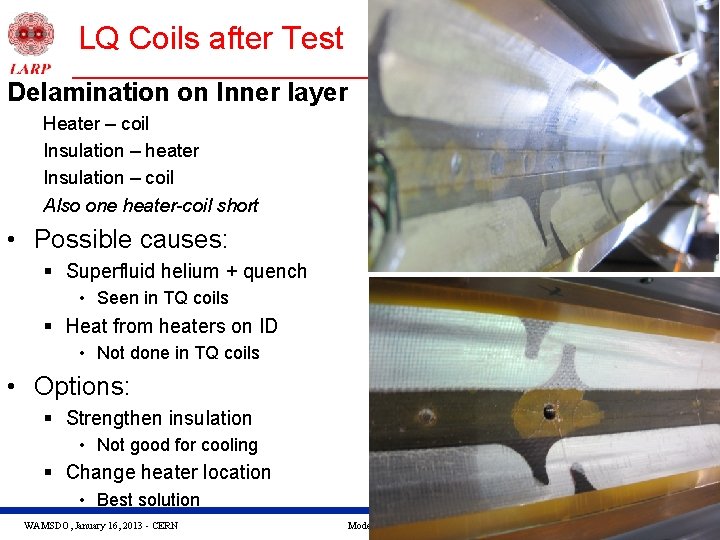
LQ Coils after Test Delamination on Inner layer Heater – coil Insulation – heater Insulation – coil Also one heater-coil short • Possible causes: § Superfluid helium + quench • Seen in TQ coils § Heat from heaters on ID • Not done in TQ coils • Options: § Strengthen insulation • Not good for cooling § Change heater location • Best solution WAMSDO, January 16, 2013 - CERN Models and experimental results – G. Ambrosio 23 23
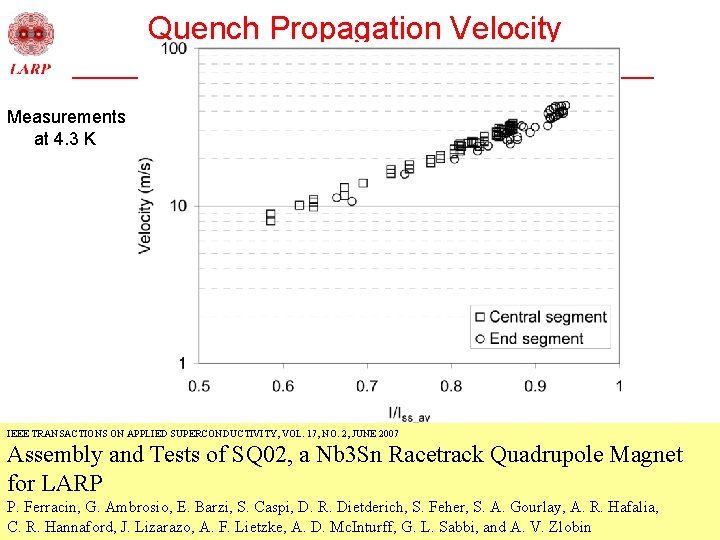
Quench Propagation Velocity Measurements at 4. 3 K IEEE TRANSACTIONS ON APPLIED SUPERCONDUCTIVITY, VOL. 17, NO. 2, JUNE 2007 Assembly and Tests of SQ 02, a Nb 3 Sn Racetrack Quadrupole Magnet for LARP P. Ferracin, G. Ambrosio, E. Barzi, S. Caspi, D. R. Dietderich, S. Feher, S. A. Gourlay, A. R. Hafalia, January 16, J. 2013 - CERN Models and experimental results –and G. Ambrosio C. WAMSDO, R. Hannaford, Lizarazo, A. F. Lietzke, A. D. Mc. Inturff, G. L. Sabbi, A. V. Zlobin 24
QXF PROTECTION (preliminary results) By Massimo Sorbi, Giulio Manfreda, Vittorio Marinozzi WAMSDO, January 16, 2013 - CERN Models and experimental results – G. Ambrosio 25
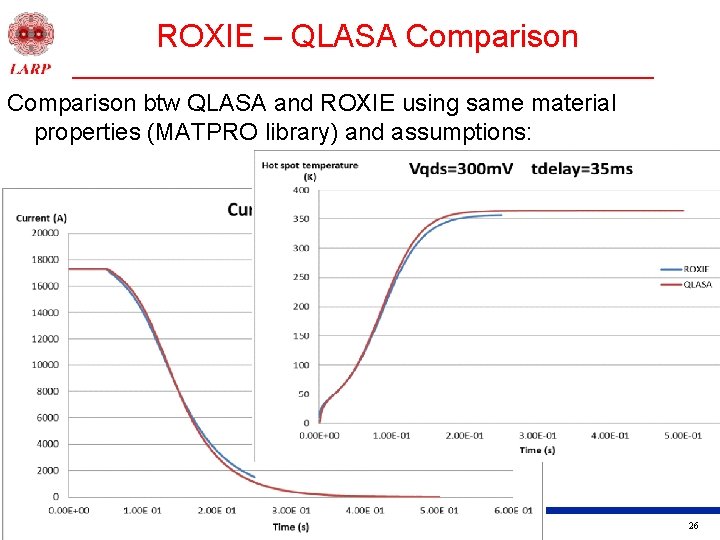
ROXIE – QLASA Comparison btw QLASA and ROXIE using same material properties (MATPRO library) and assumptions: Magnet length: 8. 5 m Total stored Energy: 15. 2 MJ for Qlasa – 12. 2 MJ for Roxie, with the inductance variation Rdump = 58 mohm Vmax = 1000 V (+/- 500 V) Heaters on Inner and Outer layers WAMSDO, January 16, 2013 - CERN Models and experimental results – G. Ambrosio 26
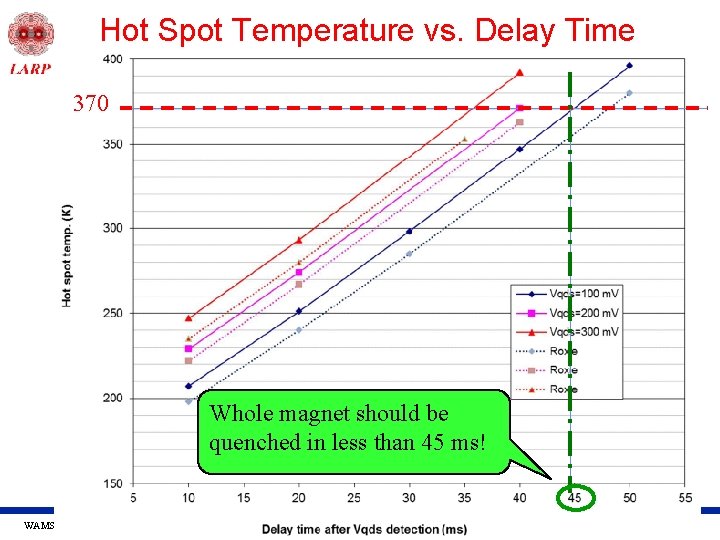
Hot Spot Temperature vs. Delay Time 370 Whole magnet should be quenched in less than 45 ms! WAMSDO, January 16, 2013 - CERN Models and experimental results – G. Ambrosio 27
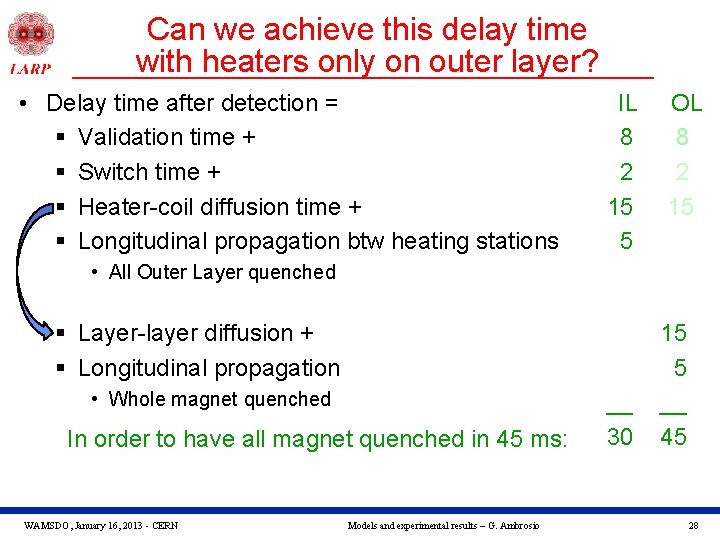
Can we achieve this delay time with heaters only on outer layer? • Delay time after detection = § Validation time + § Switch time + § Heater-coil diffusion time + § Longitudinal propagation btw heating stations IL 8 2 15 5 OL 8 2 15 • All Outer Layer quenched § Layer-layer diffusion + § Longitudinal propagation • Whole magnet quenched In order to have all magnet quenched in 45 ms: WAMSDO, January 16, 2013 - CERN Models and experimental results – G. Ambrosio __ 30 15 5 __ 45 28
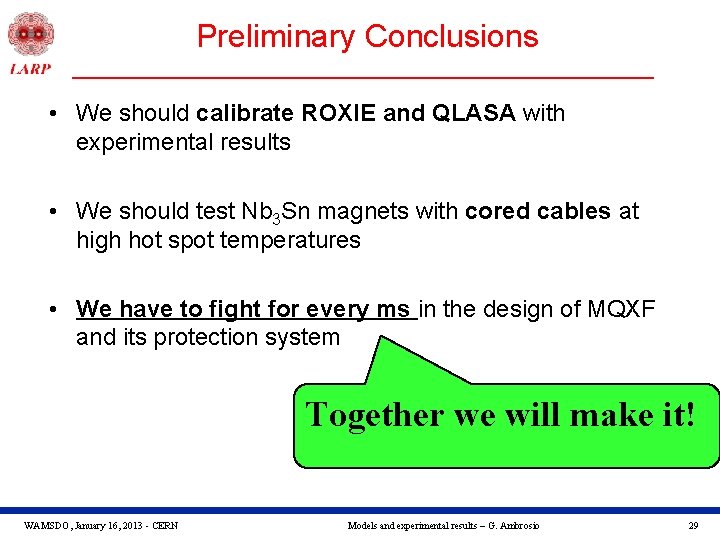
Preliminary Conclusions • We should calibrate ROXIE and QLASA with experimental results • We should test Nb 3 Sn magnets with cored cables at high hot spot temperatures • We have to fight for every ms in the design of MQXF and its protection system Together we will make it! WAMSDO, January 16, 2013 - CERN Models and experimental results – G. Ambrosio 29